
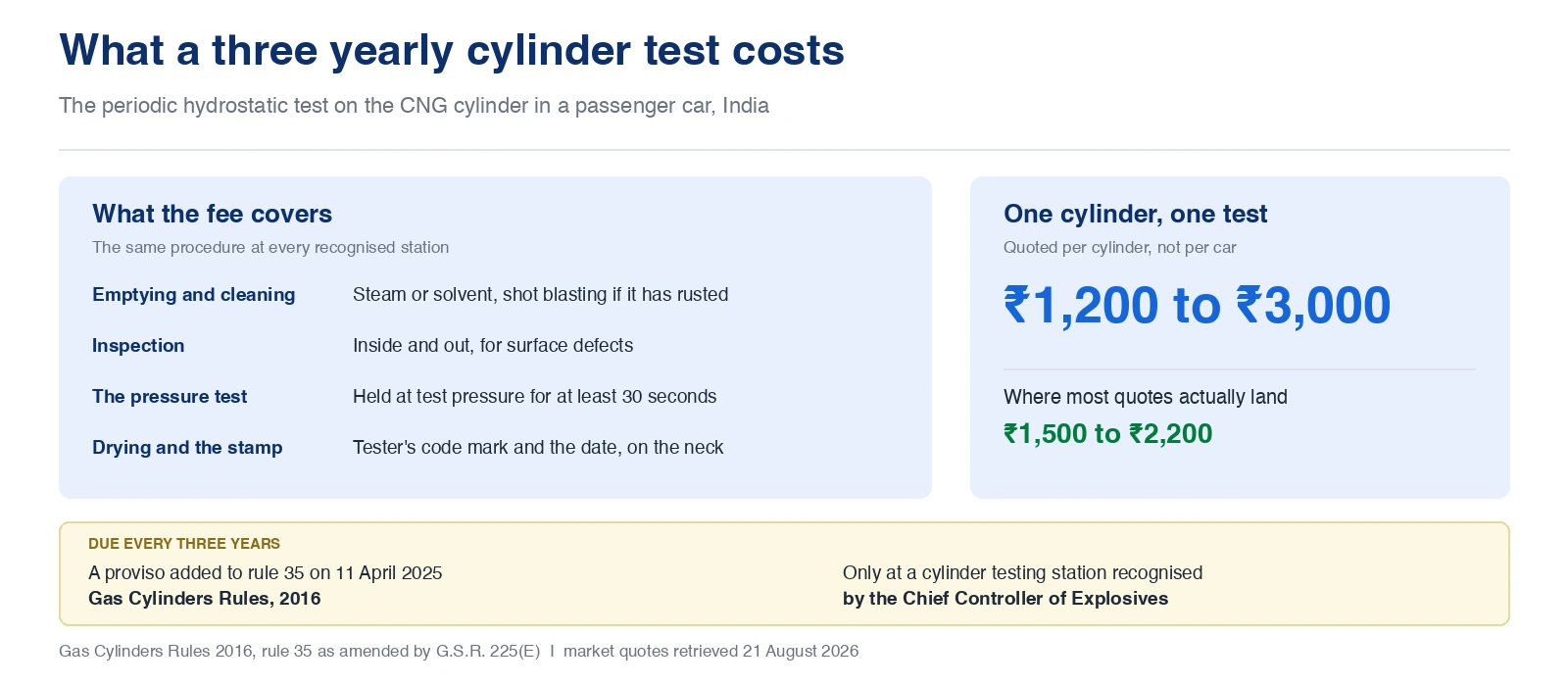
The CNG cylinder testing price in India is ₹1,200 to ₹3,000 for the single cylinder in a passenger car, and most quotes land between about ₹1,500 and ₹2,200. The test falls due every three years, and only a cylinder testing station recognised by the Chief Controller of Explosives is allowed to do it. Set aside a day without your car, because the cylinder has to come out of the boot to be tested and go back in afterwards.
What the CNG cylinder testing price covers
| What you are paying for | Typical national range |
|---|---|
| Testing the one cylinder in a passenger car | ₹1,200 to ₹3,000 |
| Where most quotes actually land | ₹1,500 to ₹2,200 |
| A vehicle carrying more than one cylinder | Quoted per cylinder, so the bill multiplies rather than shifting to a different rate |
| What the fee buys you | Emptying and cleaning the cylinder, an internal and external inspection, the pressure test itself, drying, the neck stamp and the certificate |
| What pushes it to the top of the range | Taking the cylinder out and refitting it, and a rusted interior that needs shot blasting or a furnace burn out before anyone can test it |
Why is the spread that wide for one standardised job? Because the rules fix the test and the interval but not the fee. Every station on the approved list is an independent business setting its own rate, and a stripped down price usually means the cylinder is coming out and going back in on your time rather than theirs.
When your cylinder is due, and how you know
The law here is the Gas Cylinders Rules, 2016, notified as G.S.R. 1081(E) on 22 November 2016. If somebody quotes you the Gas Cylinder Rules, 2004, they’re working from a repealed document: rule 73(1) of the 2016 rules repealed the 2004 rules outright, and the definition of a gas cylinder in the current rules expressly covers a CNG cylinder fitted to a motor vehicle as its fuel tank.
Rule 35(1) creates the duty, and for years it left the interval to a Bureau of Indian Standards code rather than naming one itself. That changed on 11 April 2025, when G.S.R. 225(E) added a proviso saying it outright: “compressed bio gas cylinder, compressed natural gas cylinder and onboard Hydrogen cylinder shall also be subjected to hydrostatic test or hydrostatic stretch test as the case may be and other tests set forth in Schedule IV every three years.” So three years is now written into the rules themselves, in terms, for CNG. The standard the rule otherwise points to, IS 15975, has said the same thing all along: its table of compressed gases gives natural gas a test period of three years, where air, argon and nitrogen get five. Gas is on a tighter clock than most of what gets bottled in this country.
You don’t have to keep the date in your head, because it’s stamped on the cylinder. Rule 6 requires the neck to carry the date of the last hydrostatic test along with the code mark of the testing station that did it, and that code mark is registered with the Chief Controller. Read the most recent date on the neck, add three years, and that’s your deadline. That date is separate from the cylinder’s manufacturing life, which is a different clock with a different consequence, so it’s worth knowing the CNG cylinder expiry rules as well before you spend money on a test.
What actually happens at the station
CNG cylinder hydro testing sounds more dramatic than it is. Your cylinder is emptied and labelled empty, then treated as though it still holds gas under pressure until the station has proved otherwise. It gets cleaned out by steam or solvent, and if the inside has rusted, by shot blasting or a controlled furnace burn out. Then it’s examined inside and out for surface defects, filled with water and taken up to its test pressure, which has to hold for at least thirty seconds. Any drop in pressure, any leak, any visible bulge or deformation and the cylinder has failed.
Pass it and the cylinder is dried out internally and stamped on the neck with the station’s mark and the date, which is what your CNG cylinder testing certificate is recording. Fail it and you don’t get the cylinder back for a second opinion. Rule 36 requires a failed cylinder to be destroyed, flattened or cut up so the pieces can’t be welded back into a cylinder, with the owner informed.
Where to get it done
Only at a station recognised by the Chief Controller of Explosives. PESO publishes the approved CNG cylinder testing stations itself, and that list is the one for you to work from rather than a search result, because recognition is granted for a year at first and extended to a maximum of ten on the strength of ISO accreditation and testing records. Check the list before you book. A station whose permission has lapsed cannot give you a certificate that means anything.
What skipping it costs you
So what happens if you let it lapse? Not a fine, in the first instance. A closed pump. The licence every CNG station operates under carries a standing condition that gas be dispensed “only into those cylinders of motor vehicles, which are approved by the Chief Controller and have passed the periodic statutory tests under these rules conducted by a testing station recognised by the Chief Controller”. Rule 26 says the same thing from the other end: a cylinder whose periodical re-test has fallen due shall not be charged and transported until the re-test has been carried out. An overdue cylinder isn’t illegal to own. It’s just impossible to refuel, which for a CNG car amounts to the same thing.
For all that, it isn’t a big number. Spread across three years it works out at a few hundred rupees a year. If you’re weighing up converting a petrol car to CNG, the test is a recurring line for you to pencil in rather than a reason to reconsider, and if you’re still choosing between models, the boot space and the factory premium across the CNG cars sold in India will decide far more for you than this will. The CNG cylinder testing price is the most predictable number a gas car ever asks you for. It just arrives without a reminder.