
The CNG car maintenance cost for a moderately driven car in India is ₹9,000 to ₹12,000 a year, which is about ₹3,000 to ₹4,000 more than the same car would cost you to service on petrol. So where does the extra go? Your oil comes round sooner, there’s a filter petrol cars don’t carry at all, and your spark plugs wear out faster. No mystery premium in there anywhere.
What the CNG car maintenance cost covers
| Service item | How often on CNG | What it costs |
|---|---|---|
| Engine oil and oil filter | Every 7,500 km, against 10,000 km on petrol | The same job, about a third more often |
| CNG filter | Every 15,000 to 20,000 km, so about once a year at moderate running | ₹400 to ₹900 per service |
| Spark plugs | Earlier than a petrol car asks for them | A heat resistant specialty grade, so more per plug |
| Valve clearance | Adjusted more often than on petrol | Let it slide on a retrofit and you are into valve seat recession and a cylinder head rebuild |
| A full year of scheduled servicing | ₹9,000 to ₹12,000 |
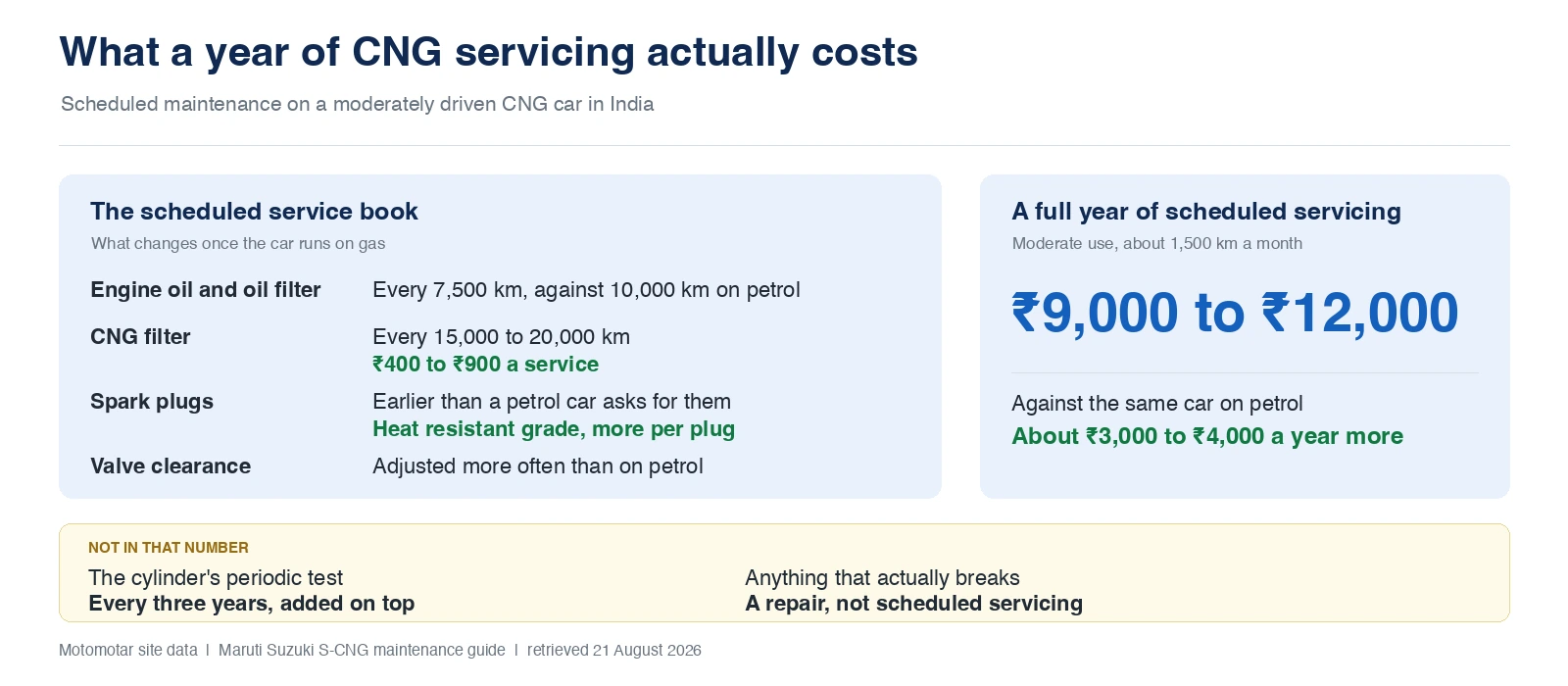
Nothing on that list is exotic, and that’s rather the point. It’s the same service book your petrol car has, run tighter, with one extra filter in it.
A worked year at 1,500 km a month
Cover 1,500 km a month and you finish the year on 18,000 km. At 7,500 km intervals the oil and its filter come round twice inside that distance instead of once. One CNG filter falls due, at ₹400 to ₹900. Your plugs are a heat resistant specialty grade, so whenever they do come round they cost more per plug than the petrol equivalent. Add the valve clearance checks the workshop runs more often on gas, and that’s the year your ₹9,000 to ₹12,000 is buying.
Two things sit outside it. The cylinder’s periodic test runs on a three year clock and gets added on top in the year it falls due. And anything that actually breaks is a repair, not scheduled maintenance.
Why the service book tightens
Why does gas need a tighter schedule at all? Heat, mostly. CNG burns about 80°C hotter than petrol in the combustion chamber, and that heat goes straight at the valve seats. Petrol also arrives as an atomised liquid mist, which gives your intake valves a little evaporative cooling and lubrication on the way in. Gas arrives dry and does neither. Shorter oil intervals, a heat resistant plug and more frequent valve checks are what the service schedule does about it. Maruti’s own S-CNG maintenance guide makes the same point about the plugs: on a CNG kit they wear out faster, so they want cleaning periodically and replacing when they need it.
The CNG filter is the one item petrol owners have no equivalent for. It sits on top of your regular air and oil filter changes rather than replacing either of them.
Problems that push the bill past the schedule
Scheduled servicing is the predictable half of your CNG car service cost. And the other half? That’s whatever goes wrong, so read up on the common CNG car problems before you fix a budget, because a couple of them are genuinely expensive. Stay ahead of the valve clearance. Let those adjustments slide on an aftermarket retrofit and you’re risking valve seat recession, which ends in a cylinder head rebuild rather than a ₹900 filter. On an aftermarket kit that bill is yours in full, because the retrofit voids your manufacturer’s warranty on the engine and the fuel system.
Where maintenance sits in the total picture
Keep it in proportion. Set against what CNG saves you at the pump, this is the small number. At May 2026 prices the running cost works out at roughly ₹3.65 per km on CNG against ₹5.32 on petrol, so a full year of servicing is paid off inside the first 7,500 km you drive.
Maintenance is the smallest of the three numbers a CNG owner deals with, which is why it’s the one people forget to ask about. Thinking about a retrofit rather than a factory car? Settle what a CNG conversion costs first, because that’s the decision that changes your warranty position too. If you’re still picking the car, the factory premium and the boot compromise across the best CNG cars in India will move your budget far more than a filter ever will.