
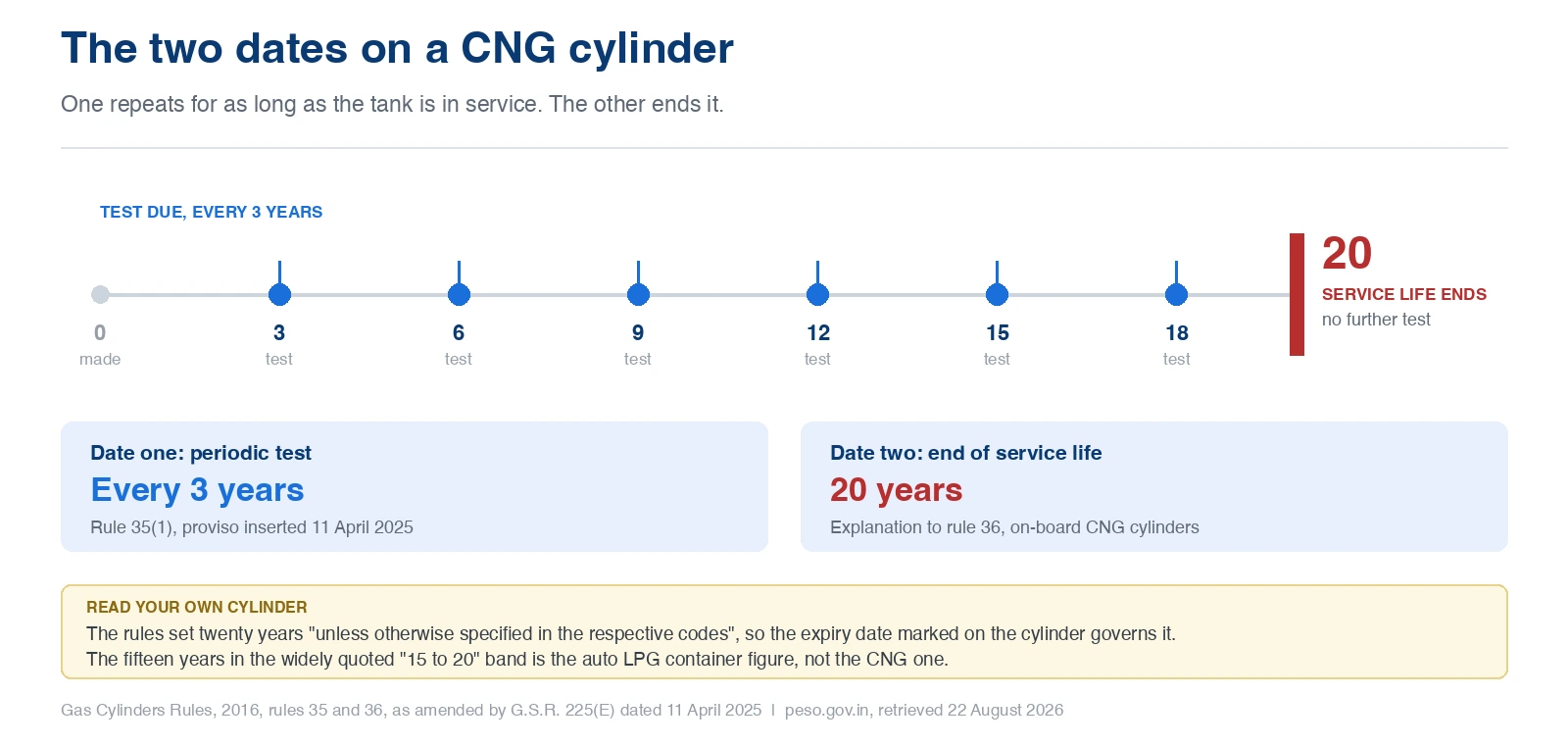
Two separate dates govern the tank in your CNG car, and they get mixed up constantly. The CNG cylinder expiry date is the end of the cylinder’s service life, which Indian rules put at twenty years for an on-board CNG cylinder. Past it the tank can’t be refilled, can’t be tested back into service and has to be scrapped. The other date is the test due date, and that one comes round every three years. Both are stamped into the metal at the neck end, so you can read them yourself.
Date one: the three year test clock
Every CNG cylinder in a car has to pass a hydrostatic test every three years, and since 11 April 2025 that interval sits in the rules themselves. G.S.R. 225(E) inserted a proviso into rule 35(1) of the Gas Cylinders Rules, 2016. A compressed natural gas cylinder, it says, “shall also be subjected to hydrostatic test or hydrostatic stretch test as the case may be and other tests set forth in Schedule IV every three years”. Before that the rule named no interval of its own and left the period to a Bureau of Indian Standards code, IS 15975.
Two stale citations travel with this question. One is the Gas Cylinder Rules, 2004, repealed when the 2016 rules came in. The other is IS 8451:2009, now in a 2018 revision, and never the standard that set the interval anyway. Neither one governs your tank.
Working out your own due date is arithmetic: last test date stamped on the neck, plus three years. Passing resets it and nothing else does. Diarise it, and what cylinder testing costs stops being a surprise.
CNG cylinder life: the rules say twenty years
Ask about cylinder life and you’ll be told “15 to 20 years” almost everywhere. For a CNG car that band is wrong at one end. The Gas Cylinders Rules, 2016 address it in the Explanation to rule 36: “service life of on-board CNG cylinders and other CNG cylinders to be twenty years and auto LPG containers made of low carbon steel to be fifteen years unless otherwise specified in the respective codes”. Twenty is the CNG number. Fifteen belongs to auto LPG containers, and the popular band is those two figures collapsed into one.
Read that last clause before you assume twenty for your own tank. The rules name a figure and then defer to the code the cylinder was built to, which is why the date marked on it is the one that governs yours.
What happens when you get there? Rule 36 makes expiry of the service life a condemning ground in its own right, alongside failing a test: the cylinder shall not be filled with any compressed gas and shall be destroyed, flattened whole or cut up so the pieces can’t be welded back into a cylinder. Passing a test buys no more time, because the test is not what ran out. You replace the tank, or the car stops running on gas.
How to read the CNG cylinder expiry date on your own cylinder
Rule 6 puts both dates there. It requires every cylinder to carry the date of its last hydrostatic test with the code mark of the recognised testing station that did it, and separately requires an expiry date marked on CNG on-board cylinders. Apart from the maker’s markings, which may sit on the base, all of it is stamped on the neck end, with space left alongside the original markings for each new test date.
So take a torch to the boot floor. It isn’t a label in the service book, and the characters are small. The dates belong to the cylinder rather than to how it reached the car, which matters most on a retrofit: your tank carries its own history, and it owes nothing to the year the car was registered.
What an expired date actually means
So what actually happens? A refusal at the pump. Rule 26 says a cylinder whose periodical re-test has fallen due shall not be charged and transported until that re-test has been properly carried out, and the April 2025 amendment adds that CNG shall be dispensed only into vehicle cylinders that have passed the periodic tests conducted by a testing station recognised by the Chief Controller. The same amendment requires a bar code on the cylinder to be scanned before filling, and one that won’t read is not to be filled either.
Past that point the answer isn’t a test, it’s a new cylinder. Worth saying plainly, because you’ll read otherwise: the Gas Cylinders Rules attach no insurance consequence to either date. The enforcement that exists sits at the dispenser, and for a gas car, a station that can’t fill you is enforcement enough.
Deciding as either date comes round
A test due date is a diary entry. The expiry date is a decision. Twenty years puts most cars near the end of their own road, and if you’re in Delhi NCR, where petrol and CNG cars run into a fifteen year age cap, your car’s deadline lands well before the cylinder’s. The one worth checking properly? A retrofit on an older car, where the tank can easily outlive the vehicle.
On a car worth keeping, price the replacement the way you’d price an aftermarket CNG conversion: against the fuel saving it buys over the years that follow, not as a bill on its own. And if it’s the car that’s finished rather than the tank, both clocks start from zero on the factory CNG models sold here today.