
The petrol vs diesel decision in 2026 looks nothing like it did five years back. BS6 Phase 2 emission norms have pushed diesel variants ₹1.5 to ₹3 lakh costlier than their petrol cousins. The 10-year diesel rule in Delhi-NCR is killing residual values in metros. And BS7 norms are queued up for 2027, ready to add another ₹1.8 to ₹2.5 lakh to diesel sticker prices.
So is diesel finished? Not exactly. For a Toyota Fortuner buyer in Hyderabad doing 2,500 km a month, diesel is still the only sensible answer. For a Hyundai i20 buyer in Delhi doing 600 km a month, petrol wins by a mile and there isn’t even a diesel option anymore.
This guide gives you the actual math. We’ve used May 2026 fuel prices, real-world mileage from owner data, and a break-even formula you can apply to any specific car you’re considering. By the end, you’ll know exactly what monthly running figure tips the scale toward diesel for your situation, and whether it’s worth the upfront premium.
Petrol vs Diesel at a Glance (2026)
| Factor | Petrol Car | Diesel Car |
|---|---|---|
| Fuel price (Delhi, May 2026) | ₹94.77 / litre | ₹87.67 / litre |
| Real-world mileage (mid-size SUV) | 13 to 15 km/l | 17 to 20 km/l |
| Running cost per km | ₹6.31 to ₹7.29 | ₹4.38 to ₹5.15 |
| Purchase price | Lower (baseline) | Higher by ₹1.5L to ₹3.0L |
| 5-year maintenance | ₹50,000 to ₹80,000 | ₹60,000 to ₹1,00,000 |
| NCR residual life | 15 years | 10 years |
| Best for | City use, low-to-medium running | High running, highway, big SUVs |
| 2026 verdict | Right for ~80% of private buyers | Right for high-mileage SUV owners |
The headline: diesel saves ₹2.14 per kilometre in fuel cost. Sounds great. But you need to be clocking at least 1,500 to 1,800 km a month, ideally on highways, to amortise the higher purchase price and maintenance over five years. Below that threshold, petrol is the financially smarter call.
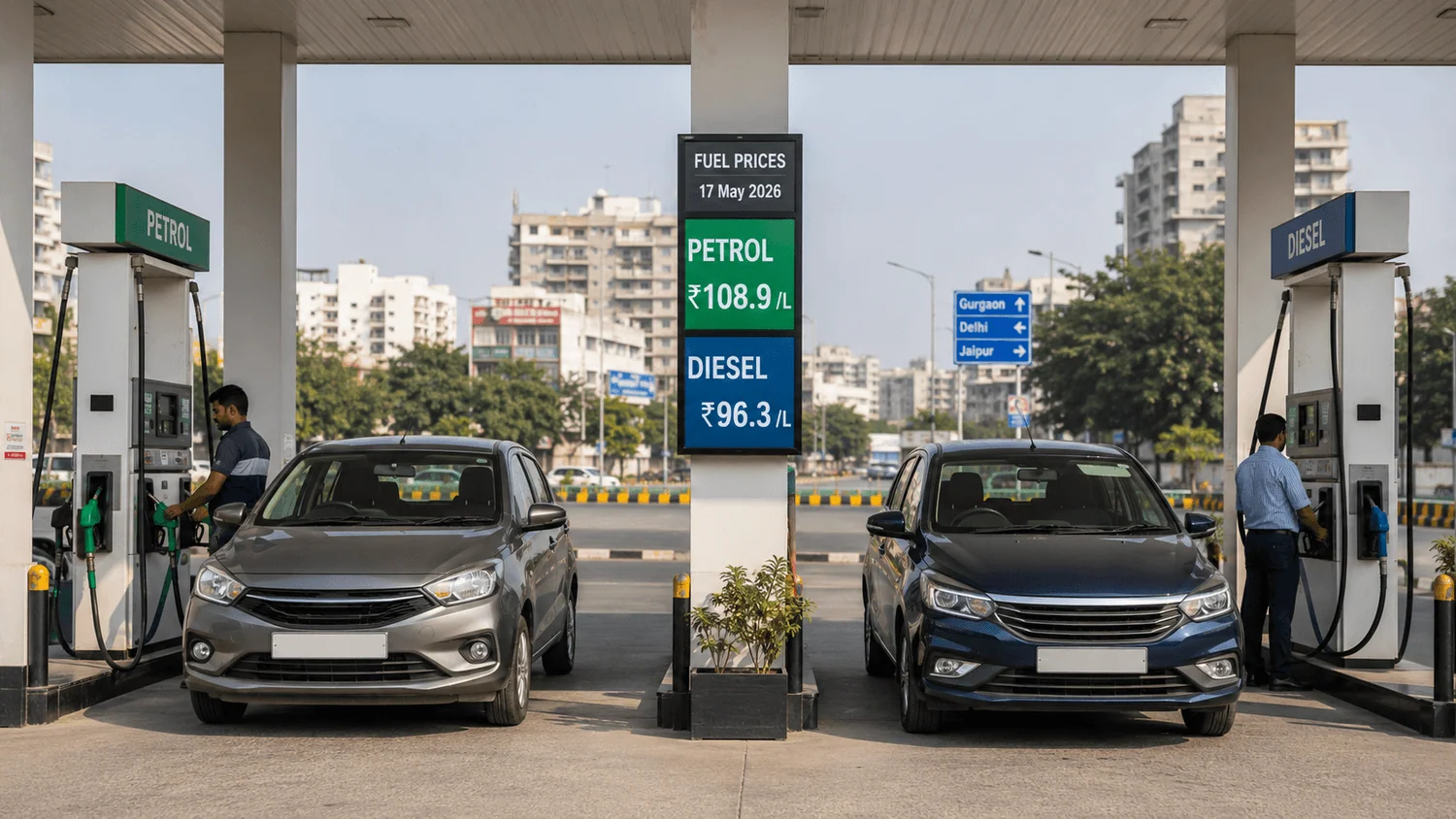
Petrol vs Diesel — 2026 Running Cost per Km
This is where most buyers start, and rightly so. Fuel is the single biggest recurring cost over your ownership period. So before we get into purchase price, maintenance and resale, let’s nail the cost-per-km math with May 2026 prices.
The basic cost-per-km formula
It’s simple: fuel price per litre divided by your real-world mileage gives you the cost per kilometre. Use real-world figures, not ARAI numbers. ARAI claims are typically 20 to 30% higher than what you’ll actually see, because the test cycle has no AC, no traffic and no payload.
For a mid-size SUV (Creta, Seltos, Grand Vitara class), here’s where the math lands using Delhi fuel rates:
| Fuel | Price per Litre (Delhi May 2026) | Real-World Mileage | Cost per Km |
|---|---|---|---|
| Petrol | ₹94.77 | 13 km/l | ₹7.29 |
| Diesel | ₹87.67 | 17 km/l | ₹5.15 |
| Savings with diesel | ₹2.14 / km |
Two and a quarter rupees per km. Doesn’t look dramatic in isolation, does it? Now multiply. Every 10,000 km you drive saves ₹21,400. Drive 50,000 km over four years and you’re looking at ₹1.07 lakh saved on fuel alone. That’s the diesel pitch.
City-by-city fuel price spread
The savings story depends heavily on where you live. State VAT and local cesses make a big difference, and the petrol-diesel gap is wider in some cities than others.
| City | Petrol (₹/L) | Diesel (₹/L) | Price Gap |
|---|---|---|---|
| Delhi | 94.77 | 87.67 | ₹7.10 |
| Mumbai | 103.54 | 90.03 | ₹13.51 |
| Bengaluru | 102.96 | 90.99 | ₹11.97 |
| Chennai | 100.84 | 92.39 | ₹8.45 |
| Hyderabad | ~107.50 | ~93.50 | ~₹14.00 |
| Kolkata | ~106.00 | ~92.80 | ~₹13.20 |
| Pune | ~104.00 | ~90.50 | ~₹13.50 |
Notice what’s happening here? In Mumbai, Hyderabad or Pune, where the petrol-diesel gap pushes ₹13-14 per litre, diesel’s cost edge widens. In Delhi, where the gap is only ₹7.10, the math is tighter. So run the cost-per-km calculation for your specific city, not Delhi, when you’re making the call.
Monthly fuel cost at five usage levels
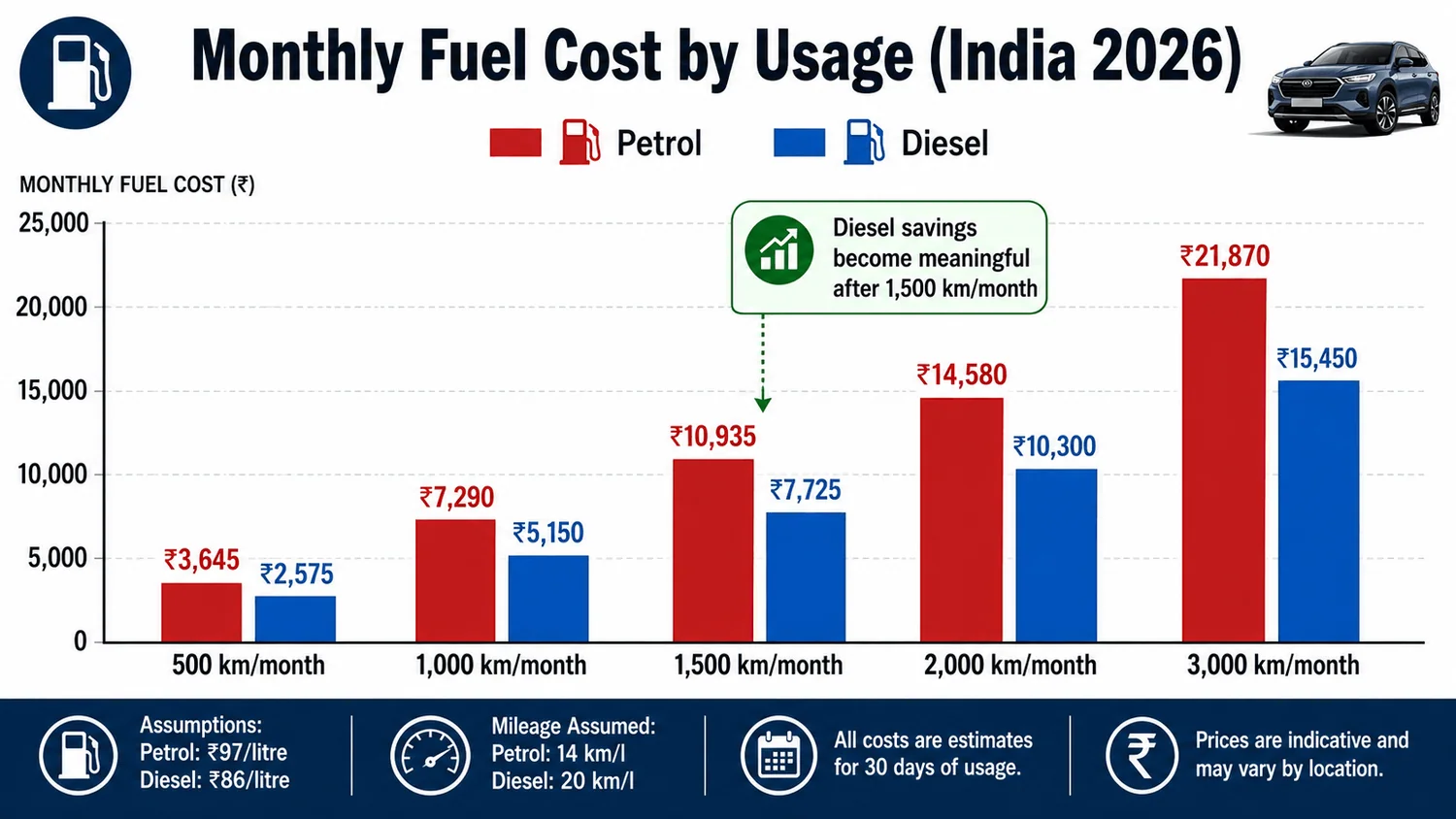
Here’s the table that should anchor your decision. We’ve applied the ₹2.14/km savings figure across five usage tiers covering the full range of Indian private car owners.
| Monthly Running | Petrol Fuel Cost | Diesel Fuel Cost | Monthly Savings | Annual Savings |
|---|---|---|---|---|
| 500 km/month (~17 km/day) | ₹3,645 | ₹2,575 | ₹1,070 | ₹12,840 |
| 1,000 km/month (~33 km/day) | ₹7,290 | ₹5,150 | ₹2,140 | ₹25,680 |
| 1,500 km/month (~50 km/day) | ₹10,935 | ₹7,725 | ₹3,210 | ₹38,520 |
| 2,000 km/month (~67 km/day) | ₹14,580 | ₹10,300 | ₹4,280 | ₹51,360 |
| 3,000 km/month (~100 km/day) | ₹21,870 | ₹15,450 | ₹6,420 | ₹77,040 |
What this tells you, in plain terms:
- At 500 km/month, a typical weekend driver, you save ₹12,840 a year. Sounds nice. But you’ll never recover the ₹1.5-3 lakh diesel premium in any realistic ownership window. The math doesn’t work.
- At 1,000 km/month, the average urban Indian owner, ₹25,680 a year is a moderate case. You’d break even on a ₹1.5 lakh premium around year six. Not great if you change cars every four to five years.
- At 2,000 km/month and above, the picture flips. ₹51,360 a year compounds quickly. A ₹2 lakh premium amortises in roughly four years. Diesel starts making real sense.
Why diesel’s lab claim doesn’t survive Indian traffic
Manufacturers will quote you ARAI-certified mileage figures of 21+ km/l for diesel and 18+ km/l for petrol. These come off chassis dynamometers under controlled conditions. In real Indian city driving, expect a 20 to 30% drop.
A Hyundai Creta diesel-MT is rated 21.8 km/l ARAI. Owners on Team-BHP and Reddit consistently report 16 to 18 km/l in city use and 20+ on the highway. The same Creta in petrol-MT trim claims 17 km/l ARAI but delivers 12 to 14 km/l in city traffic.
Three things eat into your mileage in Indian conditions:
- Stop-go traffic, which is brutal on both fuels but especially on diesel because the engine never reaches optimal operating temperature and the DPF (diesel particulate filter) starts clogging.
- AC load, which can knock 10 to 15% off your fuel efficiency in Indian summers when the compressor is running at full bore.
- Idling, which most Indian drivers underestimate. Ten minutes of AC-on idling at traffic lights every day adds up to litres of wasted fuel monthly.
The 13 km/l petrol and 17 km/l diesel figures in our calculations already factor in this real-world hit. If anything, they’re conservative for highway-heavy drivers and optimistic for full-time city use.
Purchase Price Difference
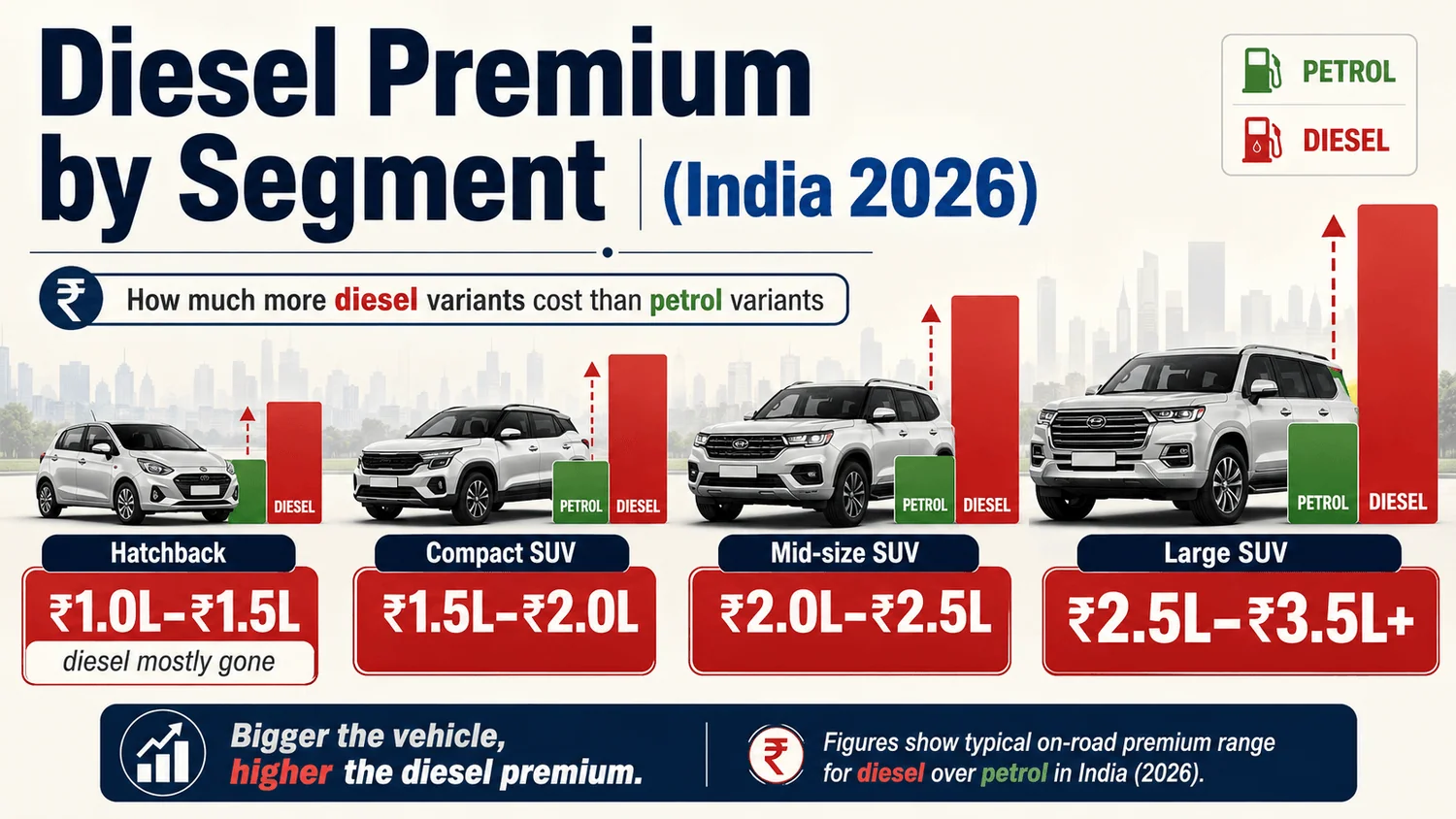
Here’s where diesel takes its biggest hit. The ex-showroom premium for a diesel variant over the petrol equivalent has ballooned in the BS6 Phase 2 era, and BS7 will widen it further.
Why diesel costs so much more upfront
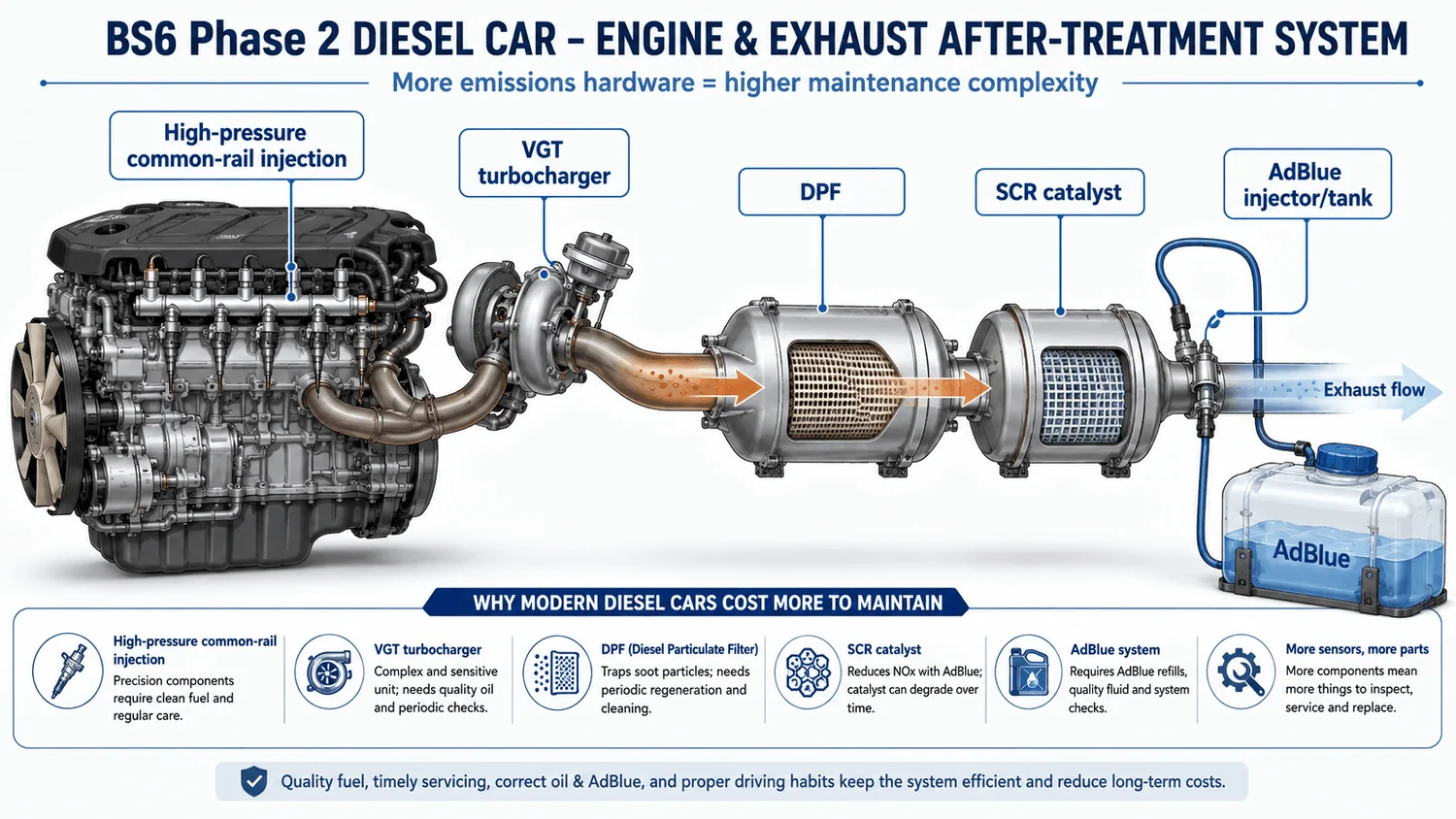
Modern BS6 Phase 2 diesel engines aren’t just a different fuel type, they’re an entirely different beast of mechanical complexity. To meet the stringent emission limits, every diesel car you buy today carries:
- A diesel particulate filter (DPF), a precious-metal-coated ceramic honeycomb that traps and incinerates soot particles. Replacement cost when it fails post-warranty: ₹40,000 to over ₹1 lakh.
- A selective catalytic reduction (SCR) system with an AdBlue tank, on all diesel engines above 1.5L. SCR injects aqueous urea into the exhaust stream to chemically break down NOx.
- A lean NOx trap (LNT) on smaller diesels that don’t have SCR, doing similar NOx mitigation but with limits.
- High-pressure common-rail direct injection with piezoelectric injectors that operate at over 2,000 bar.
- A variable geometry turbocharger (VGT) that adjusts vane angles to manage spool across engine speeds.
None of this exists on a petrol engine. A modern naturally aspirated or mildly turbocharged petrol motor uses spark ignition, a simpler exhaust catalyst, and standard fuel injection. Less hardware. Less complexity. Less cost.
The result: manufacturers pass that hardware cost straight to you on the diesel variant sticker.
Typical petrol-diesel price gap by segment (2026)
| Segment | Typical Premium for Diesel | Notes |
|---|---|---|
| Hatchback | ₹1.0L to ₹1.5L | Diesel availability has collapsed. Effectively only the Tata Altroz left in the mass-market hatch space. Maruti, Hyundai and others have completely killed diesel hatchbacks. |
| Compact SUV | ₹1.5L to ₹2.0L | Diesel still alive in Tata Nexon, Kia Sonet, Mahindra XUV 3XO. Hyundai Venue diesel was phased out. |
| Mid-size SUV | ₹2.0L to ₹2.5L | The heart of the diesel market. Creta, Seltos, Grand Vitara, Tata Sierra, Hyundai Alcazar all offer diesel and find real takers. |
| Large SUV | ₹2.5L to ₹3.5L+ | Diesel rules here. Fortuner, Scorpio-N, XUV700, Mahindra Thar, Tata Safari, Toyota Hyryder all-diesel. Petrol variants exist but don’t sell. |
See the pattern? Diesel is dead in the sub-four-metre value segment. It’s alive but contested in compact SUVs. And it still dominates in large body-on-frame SUVs where torque, payload and highway cruising matter more than urban fuel economy.
Here’s something most buyers miss. The ₹2 lakh extra you spend on the diesel variant isn’t just ₹2 lakh out of pocket. It’s ₹2 lakh that could have:
- Earned you compound interest in a mutual fund (~10-12% annual returns), worth ₹3.5 lakh over five years
- Reduced your car loan principal, saving you EMI interest at 9-10% per year
- Funded a year’s worth of fuel itself if invested in an FD
That opportunity cost has to be factored into your break-even math. We’ll get to that calculation in a moment. For now, the takeaway: the diesel premium is not just an upfront cost. It’s a financial decision that needs to be justified by genuinely high running.
For a fuller breakdown of how on-road price actually adds up beyond the ex-showroom sticker, our ex-showroom vs on-road price guide covers the line items that pile up when you finalise the variant.
Maintenance Cost Comparison
The fuel saving is half the story. The other half is what you’ll spend keeping the car running, especially after the warranty runs out.
Petrol maintenance: simpler, cheaper, predictable
Petrol engines are mechanically conservative. Lower compression ratios, lighter components, fewer points of failure. A typical petrol car ownership timeline looks like this:
- Annual service: ₹5,000 to ₹8,000 depending on brand and city
- Engine oil: 3 to 4 litres per change (standard semi-synthetic grade)
- Fuel filter: Inexpensive, swap during scheduled services
- Emission system: Standard three-way catalytic converter, rarely fails in the first decade
- Post-warranty risks: Low to moderate. Replacing components like the alternator, water pump or timing chain costs ₹8,000 to ₹25,000 depending on brand
The reason petrol service centres are cheaper is structural. Lighter engine internals, smaller oil capacity, no DPF regeneration cycles, no AdBlue refills, no piezo injectors to baby. Mechanics across India have decades of experience with naturally aspirated petrol motors, and OEM parts are abundant.
For a deeper view of brand-by-brand service costs across petrol cars, our car service cost by brand breakdown has the numbers.
Diesel maintenance: where things get expensive
Diesel engines are mechanically tough but operationally fussy. The emission control hardware bolted onto modern BS6 Phase 2 diesels has fundamentally changed the maintenance equation.
Routine costs run higher across the board:
- Annual service: ₹8,000 to ₹12,000, sometimes more on premium SUVs
- Engine oil: 4 to 6 litres of high-grade synthetic, mandated to manage soot loading
- Fuel filter: ₹800 to ₹1,800, harder filtration to protect injectors from micro-contaminants
- DPF regeneration: Forced active regen at service centres if the passive cycle fails, ₹2,000 to ₹5,000 each time
- AdBlue refill: ₹500 to ₹800 for a top-up (consumed at roughly 1 litre per 800-1,000 km)
But the real diesel cost shows up after year five, when the warranty lapses. The post-warranty risk profile on a BS6 Phase 2 diesel is significantly higher than petrol:
- DPF replacement: ₹40,000 to over ₹1 lakh if the filter cracks or becomes irrecoverable
- AdBlue pump failure: Up to ₹45,000 for replacement, an issue documented across Team-BHP threads on Hyundai and Kia diesels
- Piezo injector replacement: ₹15,000 to ₹40,000 per injector if you’ve been using contaminated fuel, and they fail in pairs
- VGT turbocharger overhaul: ₹40,000 to ₹80,000 depending on brand
- High-pressure fuel pump: ₹35,000 to ₹70,000
5-year maintenance comparison (typical compact-to-mid-size SUV)
| Cost Area | Petrol | Diesel | Winner |
|---|---|---|---|
| Routine service (filters, fluids) | ₹5,000 to ₹8,000 / yr | ₹8,000 to ₹12,000 / yr | Petrol |
| Engine oil quantity / cost | 3-4 L (semi-synthetic) | 4-6 L (full synthetic) | Petrol |
| Major repair risk (post-warranty) | Low to moderate | Moderate to high (injectors, DPF, turbo) | Petrol |
| Emission system upkeep | Minimal | High (AdBlue, DPF regen) | Petrol |
| 5-year estimate | ₹50,000 to ₹80,000 | ₹60,000 to ₹1,00,000 | Petrol |
The extra ₹20,000 to ₹30,000 over five years isn’t catastrophic on its own. But the post-warranty risk is. We’ve seen Team-BHP threads where a single DPF failure on an out-of-warranty Hyundai Verna diesel cost the owner ₹90,000, no negotiation possible. That kind of unpredictable downside is what makes diesel maintenance a tougher proposition for low-utilisation owners.
The DPF problem nobody warns you about
This deserves its own callout because it catches so many city diesel buyers off guard.
Modern BS6 Phase 2 diesels need their exhaust to reach roughly 600°C to passively regenerate the DPF, that is, burn off the accumulated soot. This temperature is only sustained during extended highway driving at decent speeds. If you drive your diesel exclusively in city traffic, short trips, with frequent stops, your DPF never gets hot enough to clean itself.
The result: clogged DPF, dashboard warning light, forced active regeneration at a service centre, and if you ignore it for too long, full DPF replacement. The Reddit r/CarsIndia threads are full of city-only diesel owners discovering this the hard way.
Rule of thumb? If you’re not doing at least one 50+ km highway run per fortnight, don’t buy a modern diesel. Period.
For a complete annual maintenance cost view by model across petrol and diesel, our annual car maintenance cost guide has model-specific numbers.
Resale Value: Petrol vs Diesel
Historically, this is where diesel cars used to print money. A four-year-old Toyota Innova diesel routinely held 70% of its original value. Tier-1 buyers in Punjab, Haryana and UP would queue up to take used Fortuners and Scorpios off your hands at strong premiums.
That world still exists, but only in pockets. The 2026 resale reality is far more fragmented.
The 10-year diesel rule and what it does to NCR resale
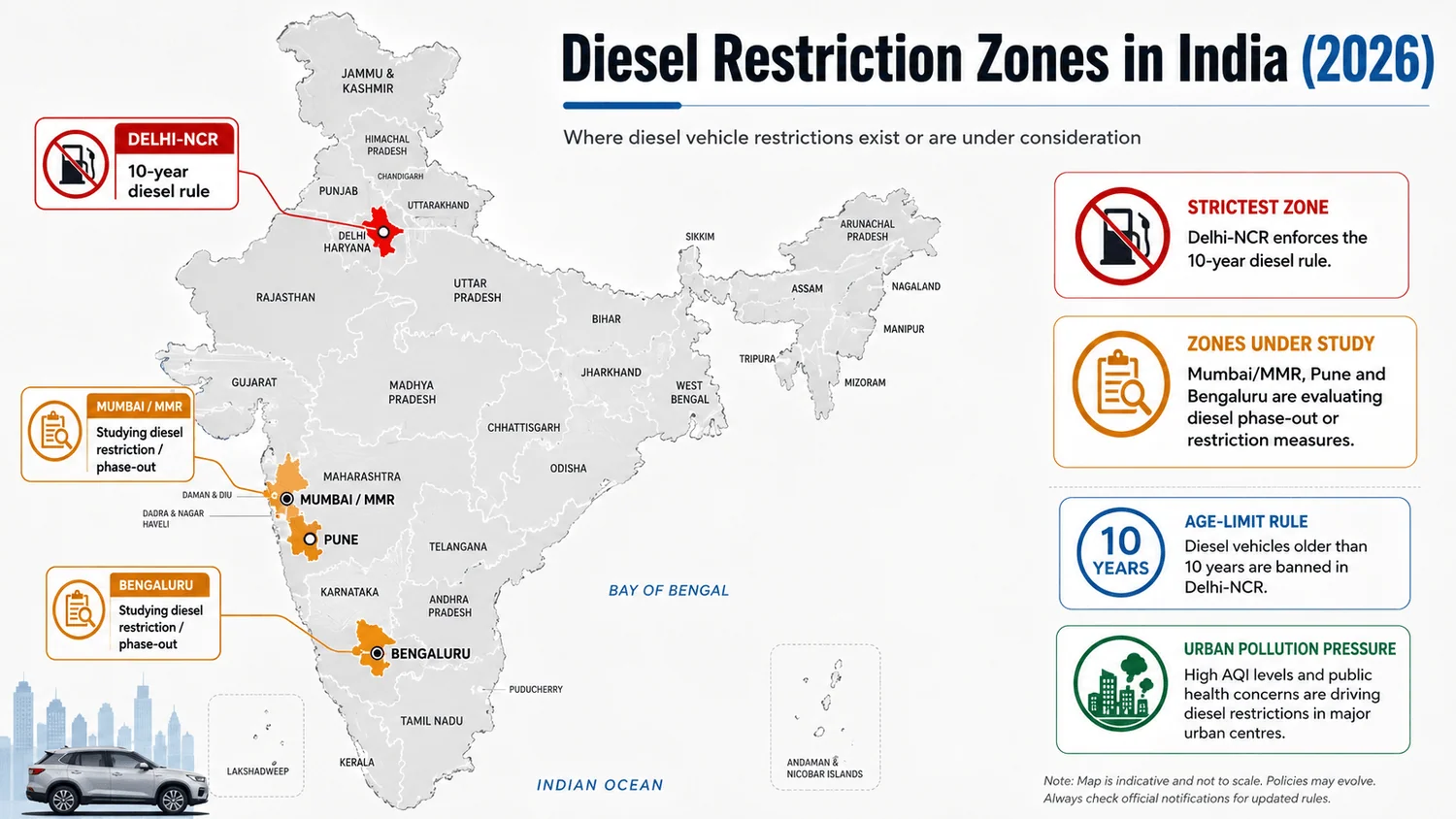
In Delhi-NCR, the National Green Tribunal has mandated that diesel vehicles cannot be operated legally beyond 10 years from registration. Petrol vehicles get 15 years. The Supreme Court, in a December 2025 modification, narrowed the seizure powers to BS-IV and older vehicles, with BS-VI cars protected from age-based scrapping. But the structural rule stays: diesel residual values in NCR collapse around the 6-7 year mark.
What this means in practice:
- A 7-year-old Hyundai Creta diesel registered in Delhi has roughly three years of legal life left in the NCR. Buyers know this. The resale takes a 20 to 30% hit compared to a comparable Creta petrol of the same age.
- To sell that car at a fair value, you’ll need to issue an NOC (No Objection Certificate) and physically transport it to a tier-2 city in an alternate state. The logistics costs and re-registration fees usually get baked into the seller’s loss.
- Pune and Bengaluru have committees actively studying similar rules. Mumbai’s Bombay High Court has ordered a phase-out study. The market knows this and is already pricing in expected restrictions.
The 2026 resale picture by body type
| Vehicle Type | Petrol Resale | Diesel Resale | Practical Insight |
|---|---|---|---|
| Hatchback | High | Low | Petrol dominates. Urban buyers prefer petrol hatchbacks for low maintenance and ease of driving. |
| Sedan | High | Moderate to Low | Metros pay premiums for clean petrol sedans. Diesel sedans are losing market favour fast. |
| Compact SUV | High | Moderate | Strong city demand for petrol. Diesel holds value only if sold before year five, mostly outside metros. |
| Large SUV | Moderate | High | Diesel torque remains critical. Outside Delhi-NCR, large diesel SUVs retain exceptional residual value. |
For sellers, the implication is straightforward: if you’re buying a Fortuner, Scorpio-N or XUV700, diesel resale will be strong, especially if you’re in Punjab, UP, Haryana, Andhra Pradesh, Tamil Nadu, Kerala or Maharashtra outside Mumbai. If you’re buying a compact SUV in NCR, petrol is the safer resale bet. If you’re buying a hatchback or sedan, diesel isn’t even a meaningful option anymore.
For a fuller view on how to protect your resale value across categories, our car resale value tips article covers the levers you can pull at purchase and ownership time.
What the secondary market is telling us
Cars24, Spinny and OLX listing data through 2025-26 consistently shows three patterns:
- Petrol Maruti Swifts, Hyundai i20s and Honda Citys hold 65-75% of original value at 3 years in metros
- Diesel Fortuners, Scorpio-Ns and XUV700s hold 70-80% at 3 years in rural and tier-2 markets
- Diesel compact SUVs in NCR drop to 50-55% at 5 years, the steepest depreciation in the new car space
There’s no single answer here. The right question to ask yourself: what body type am I buying, and where will I sell it three years from now?
Video Explaining When Petrol or Diesel Saves You More Money

When Diesel Makes Financial Sense (Break-Even Calculator)
This is the section the brief was built around, and probably what you came looking for. The math that tells you exactly when diesel pays for itself.
The break-even formula
The basic break-even calculation isolates just two variables: the extra diesel purchase cost and the per-km fuel savings.
Break-even km = Extra diesel purchase cost ÷ Savings per km
To find your monthly threshold over a typical 5-year ownership:
Monthly break-even km = Break-even km ÷ 60
Worked example: mid-size SUV in Delhi
Let’s use the numbers from earlier in the article. Mid-size SUV like a Creta or Seltos in Delhi.
- Petrol cost per km: ₹94.77 ÷ 13 km/l = ₹7.29 / km
- Diesel cost per km: ₹87.67 ÷ 17 km/l = ₹5.15 / km
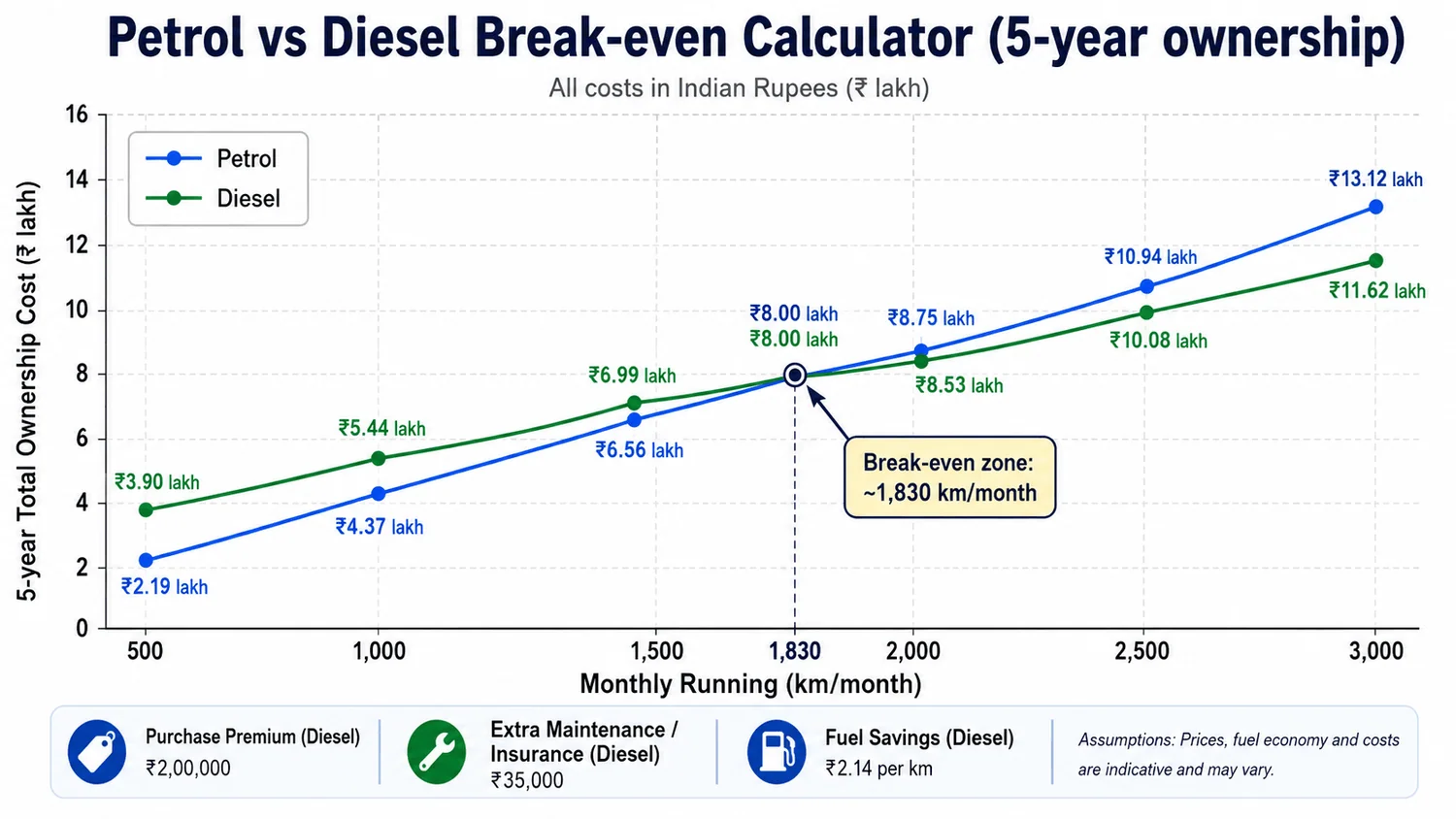
- Savings per km: ₹7.29 – ₹5.15 = ₹2.14 / km
If the diesel variant carries a ₹2,00,000 on-road premium:
- Break-even km = ₹2,00,000 ÷ ₹2.14 = 93,457 km
- Monthly break-even over 5 years = 93,457 ÷ 60 = 1,557 km / month
You need to drive roughly 1,557 km a month. Every month. For five years. Just to recover the upfront diesel premium through fuel savings alone. Is that you?
| Extra Diesel Price | Savings per Km | Break-Even Km | Monthly Km Over 5 Years |
|---|---|---|---|
| ₹1.0 lakh | ₹2.14 | ~46,700 km | ~778 km / month |
| ₹1.5 lakh | ₹2.14 | ~70,000 km | ~1,166 km / month |
| ₹2.0 lakh | ₹2.14 | ~93,400 km | ~1,556 km / month |
| ₹2.5 lakh | ₹2.14 | ~116,800 km | ~1,946 km / month |
| ₹3.0 lakh | ₹2.14 | ~140,200 km | ~2,336 km / month |
So a Fortuner buyer paying ₹3 lakh premium for diesel needs to clock 2,336 km a month over five years. That’s roughly 78 km a day, every day. Doable for a businessman with frequent intercity travel. Unrealistic for a family weekend driver.
The adjusted break-even (factoring maintenance and insurance)
The basic formula has a blind spot. It ignores two real costs that diesel adds:
- Higher annual insurance premium, because the IDV (insured declared value) is higher. Roughly ₹3,000 to ₹5,000 extra per year, or ₹15,000 to ₹25,000 over five years.
- Higher routine maintenance, ₹20,000 to ₹30,000 more than petrol over the same period.
Combined, that’s an additional ₹35,000 to ₹55,000 in lifetime ownership cost that you’re paying just because the car runs on diesel. The adjusted formula:
Adjusted break-even km = (Extra diesel purchase price + Extra maintenance & insurance) ÷ Savings per km
Re-running the mid-size SUV example with ₹2 lakh premium plus ₹35,000 in maintenance and insurance over 5 years:
- Adjusted Extra Cost = ₹2,35,000
- Adjusted Break-even km = ₹2,35,000 ÷ ₹2.14 = 109,813 km
- Adjusted Monthly Break-even (5 years) = 109,813 ÷ 60 = 1,830 km / month
The monthly threshold jumps from 1,557 to 1,830 km. That’s a meaningful difference. Anyone running less than 1,800 km a month consistently is mathematically losing money on a diesel variant in this segment.
The honest verdict on usage
This is the punchline. The break-even math gives you a clean, unambiguous answer:
- Below 1,000 km/month: Diesel never recovers its cost. Buy petrol.
- 1,000 to 1,500 km/month: Marginal case. Diesel only works if you’re keeping the car 7+ years and doing significant highway driving. Otherwise petrol still wins.
- 1,500 to 2,000 km/month: The tipping zone. Diesel makes sense if your premium is under ₹1.5L (compact SUV) and you’re highway-heavy. For mid-size SUVs at ₹2L+ premium, still tight.
- 2,000+ km/month: Diesel clearly wins, especially for larger SUVs with bigger premiums. The high savings compound fast.
If you’re a city-only driver doing under 1,000 km a month, a modern BS6 Phase 2 diesel will not just fail to recover its premium. The DPF clogging risk could land you with a ₹50,000+ repair bill. That’s a real net loss.
Environmental Considerations
If you’re buying a car in 2026, this isn’t a vague “be green” pitch. Environmental factors actively affect your legal use of the car, your resale value and your refuelling access in certain cities. Let’s separate the science from the policy.
What petrol emits
Petrol engines run on spark ignition with lower compression ratios. They burn less efficiently per unit fuel than diesel, which means they release more CO2 per kilometre travelled, roughly 200 g/km on a mid-size petrol car versus 120 g/km on a comparable diesel.
But CO2 is a global pollutant, contributing to climate change rather than to direct human health risks. The local air around you isn’t being damaged in the same way.
What petrol does emit very little of:
- Nitrogen oxides (NOx): Well below BS6 limits. NOx is what causes urban smog and triggers asthma attacks.
- Particulate matter (PM2.5): Almost negligible from a modern petrol car with a three-way catalyst.
What diesel emits
Diesel engines run on compression ignition. Higher thermal efficiency means lower CO2 per km. But the high-pressure combustion physics generate two pollutants in much greater quantities than petrol:
- NOx: Centre for Science and Environment (CSE) on-road testing in India found that one diesel SUV emits NOx equivalent to 25 to 65 small petrol cars. Yes, the math is that lopsided.
- PM2.5: Diesel cars made up 25% of Delhi’s fleet but contributed 78% of vehicular PM2.5 emissions, per CSE data. Older BS-IV diesels emitted 1,000 times more ultrafine particulates than equivalent BS-VI cars.
- Cancer risk: Particulate emissions from diesel cars in Delhi carry roughly four times the cancer risk of petrol, according to the same CSE analysis.
BS6 Phase 2 has dramatically cut these numbers via DPF and SCR technology. A new BS6 Phase 2 diesel today emits far less than a BS-IV diesel from 2017. But the localised pollution profile remains worse than petrol, and DPF systems perform poorly in stop-go city traffic, which is when emissions hurt most.
The regulatory pressure on diesel
The science explains why Indian regulators have been moving aggressively against urban diesel use. Some specific 2026 pressure points:
- Delhi-NCR end-of-life rules: 10 years for diesel, 15 for petrol. Enforcement against BS-III and older has resumed post the December 2025 Supreme Court clarification.
- GRAP Stage III/IV: During winter smog crises, BS-IV diesels are routinely banned from entering Delhi. BS6 diesels are allowed but face restrictions.
- NCR fuel ban from April 2026: Delhi government has notified that diesel vehicles older than 10 years cannot be refuelled at NCR pumps starting 1 April 2026.
- Commercial fleet mandates in NCR: Aggregators and delivery fleets in NCR are being progressively forced to EV or CNG, with diesel phased out.
- Mumbai/MMR study: Bombay HC has ordered a phase-out study via a seven-member committee.
- National panel proposal: Union petroleum ministry committee has proposed banning diesel four-wheelers in cities with population over 1 million by 2027. Under review.
BS7 is coming and it will hurt diesel
BS7 emission norms are expected to roll out by late 2026 or 2027. The headline change for diesel: NOx limits will be brought in line with petrol at 60 mg/km (down from 80 mg/km currently). This will force OEMs to add more SCR catalyst volume, larger AdBlue tanks and more aggressive after-treatment.
Industry projections put the BS7 cost impact on diesel cars at ₹1.8 to ₹2.5 lakh additional retail price. For a Creta diesel that’s already ₹2 lakh more than petrol, BS7 could push the gap to ₹4 lakh+. The break-even math at that point becomes essentially impossible for anyone outside genuine high-mileage commercial use.
Diesel’s national market share has already fallen from above 50% pre-BS6 to 17% in 2025. Industry analysts widely project this will drop below 5% by 2030.
Is Diesel Being Phased Out in India?
Short answer: no, not nationally, not for private use. But the practical answer has layers.
Diesel is not banned in India. It remains a legally available fuel, supplied by every IOC, BPCL and HPCL pump nationwide. There’s no announced timeline for a country-wide diesel ban for private cars.
Diesel availability has collapsed in the small car segment. Hatchbacks under ₹10 lakh have effectively lost diesel as an option, because compliance hardware costs eat the segment’s margins. Maruti, Hyundai, Tata (except Altroz) and Honda have all withdrawn diesel from their entry-level and mid-segment cars.
Diesel is being squeezed in urban India. The 10-year NCR rule is already biting. BS7 norms are queued for 2026-27. GRAP restrictions trigger every winter. And Mumbai, Pune and Bengaluru are studying their own phase-outs. Urban diesel ownership is getting more friction-filled every year.
Diesel still works in large SUVs, highway driving and commercial fleets. Where torque, range and load-bearing matter more than urban regulations, diesel remains the right tool. Fortuner, Scorpio-N, XUV700, Mahindra Thar, Tata Safari, Toyota Hyryder large variants all sell well in diesel for legitimate functional reasons.
For a broader three-way fuel comparison covering CNG alongside petrol and diesel, the three-way fuel comparison guide walks through how each fuel type fits different buyer profiles. And if you’re seriously weighing CNG as an alternative to either, the petrol vs CNG running cost deep-dive runs a similar break-even calculation against CNG.
Our Verdict: Buy Petrol If, Buy Diesel If
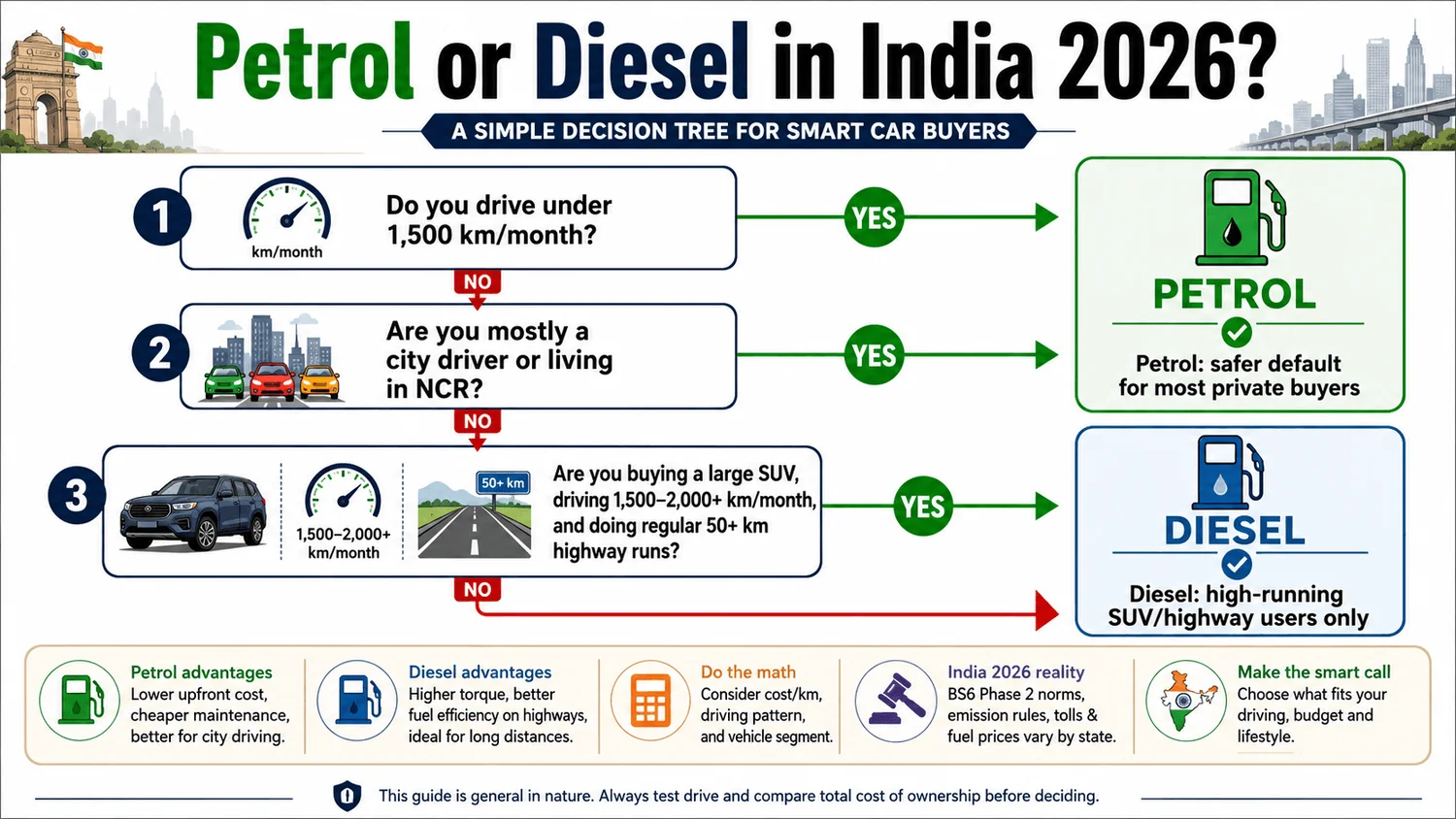
Let’s translate all the math into a decision tree you can actually use.
Buy Petrol If:
- You drive under 1,500 km per month. The break-even math doesn’t work in your favour.
- You’re a predominantly city driver, dealing with stop-go traffic that actively degrades DPF systems.
- You want lower running anxiety and freedom from AdBlue refills, DPF regeneration cycles and post-warranty turbocharger or injector risk.
- You keep cars for 3 to 5 years and want clean resale exits in the secondary market.
- You live in NCR, where the 10-year diesel rule decimates long-term residual value.
- You want smoother, quieter refinement and the vibration-free idling of modern spark-ignition engines.
- You’re shopping in the hatchback or compact sedan segment, where diesel barely exists anymore.
Buy Diesel If:
- You drive consistently over 1,500 to 2,000 km per month, every month, year after year.
- You do frequent highway runs of 50+ km that let the DPF regenerate naturally and the engine deliver its full thermodynamic efficiency.
- You’re buying a large SUV or full-size 7-seater (Fortuner, Scorpio-N, XUV700, Safari, Innova HyCross diesel) where torque and payload matter more than urban refinement.
- You plan to keep the car for 7+ years and have run the break-even numbers in your favour.
- You have access to a reliable diesel service network equipped for BS6 Phase 2 diagnostics.
- You’re outside strict diesel-restriction zones (Punjab, UP, Haryana, Maharashtra outside Mumbai, Andhra, Telangana, Tamil Nadu, Kerala) where rural and tier-2 markets still value diesel highly on resale.
Final Verdict
In 2026, petrol is the safer default for roughly 80% of private car buyers in India. The combination of lower upfront cost, simpler maintenance, broader segment availability and stronger urban resale makes it the rational choice for the typical low-to-medium running urban household.
Diesel still makes sense, but only inside a tighter and tighter window: high-running SUV buyers, highway-heavy users and commercial applications where the torque and range advantages are functional rather than emotional. If you’re seriously considering diesel, run your specific break-even math with your car’s actual premium, your real expected monthly running and your city’s fuel prices. If the formula gives you a monthly threshold above what you’ll honestly drive, walk into the dealership and ask for the petrol variant instead.
The diesel era isn’t ending in India. It’s just narrowing to where it actually belongs.
FAQs
Is diesel still worth it in 2026?
Yes, but selectively. Diesel remains genuinely worthwhile for heavy SUVs (Fortuner, Scorpio-N, XUV700, Safari) and for drivers clocking 1,500+ km per month, mostly on highways. For low-mileage city commuters, the higher upfront cost, severe DPF maintenance risk and weak urban resale entirely erase the fuel savings. Run the break-even calculation for your specific car and usage before deciding.
At what monthly km does diesel save money?
Factoring in the May 2026 ₹2.14/km fuel savings and the ₹1.5L to ₹2.5L purchase premium of BS6 Phase 2 diesels, the adjusted break-even threshold typically sits between 1,500 and 2,000 km per month over a 5-year ownership window. Under 1,000 km a month, diesel mathematically cannot recover its cost. Above 2,000 km a month, it makes solid financial sense in most segments.
Is diesel being phased out in India?
Not nationally and not for private vehicles. But yes, diesel is effectively dead in small hatchbacks and compact sedans because compliance hardware costs eat the segment margins. In Delhi-NCR, the 10-year diesel age limit and winter GRAP restrictions actively discourage diesel ownership. Mumbai, Pune and Bengaluru are studying similar restrictions. Large SUVs and commercial fleets remain unaffected.
Which has better mileage: petrol or diesel?
Diesel engines have higher thermal efficiency and deliver 25 to 35% better real-world mileage than equivalent-displacement petrol engines, particularly under heavy load and highway cruising. A Hyundai Creta petrol delivers 12-14 km/l in city traffic versus 16-18 km/l for the diesel variant. On highways, that gap can widen to 17 km/l petrol versus 20+ km/l diesel.
Is petrol cheaper to maintain than diesel?
Yes. Petrol engines have no DPF, SCR or AdBlue systems, simpler injection mechanics and lower oil capacity. Routine servicing, fluid replacements and post-warranty repairs are roughly 20 to 30% cheaper over a 5-year ownership period compared to diesel. The post-warranty risk is also significantly lower because there are fewer expensive components like turbochargers, piezo injectors and DPF assemblies that can fail catastrophically.
Which has better resale value: petrol or diesel?
In metro cities, especially Delhi-NCR, petrol cars hold significantly higher resale due to the 15-year legal lifespan versus diesel’s restrictive 10-year limit. For hatchbacks, sedans and compact SUVs in metros, petrol is the resale winner. Conversely, in rural markets, tier-2 cities and large body-on-frame SUVs (Fortuner, Scorpio, Safari), diesel still commands strong residual value, especially in Punjab, Haryana, UP and the southern peninsula.
Is diesel good for city driving?
No, not really. Modern BS6 Phase 2 diesels are highly susceptible to DPF clogging if used exclusively in low-speed stop-go city traffic. The exhaust frequently fails to reach the 600°C threshold required for passive soot regeneration. Repeated forced active regeneration at service centres costs ₹2,000 to ₹5,000 each time, and a fully clogged DPF replacement runs ₹40,000 to over ₹1 lakh.
Should I buy diesel if I drive less than 1,000 km a month?
No. At under 1,000 km a month, the annual fuel savings of roughly ₹25,000 are mathematically insufficient to recover the ₹1.5 to ₹3 lakh higher initial purchase price and the ₹20-30,000 of extra maintenance cost over 5 years. A petrol vehicle is the financially sound choice. The savings exist, but they will not recover the premium before you sell the car.
Are diesel cars more expensive to repair?
Yes. The extreme internal operating pressures (over 2,000 bar in common-rail injection), precision piezoelectric injectors, variable geometry turbochargers and complex emission hardware mean that post-warranty major repairs on a diesel are significantly more expensive than on a naturally aspirated petrol engine. A single injector replacement can cost ₹15,000 to ₹40,000. DPF replacement can hit ₹1 lakh.
Which is better for SUVs: petrol or diesel?
For heavy full-size SUVs (Toyota Fortuner, Mahindra Scorpio-N, XUV700, Mahindra Thar, Tata Safari), diesel is fundamentally superior. The massive low-end torque required to move 2,000+ kg of body-on-frame mass, tow trailers and tackle off-road terrain is what diesel engines are built for. For lighter compact crossovers (Brezza, Nexon, Sonet) driven primarily in cities, petrol is the lower-risk choice with better resale.
How does BS7 affect the petrol vs diesel choice?
BS7 norms are expected to roll out in 2026-27 with diesel NOx limits dropping from 80 mg/km to 60 mg/km, matching petrol. This will force diesel OEMs to add expensive after-treatment hardware, projected to raise diesel retail prices by ₹1.8 to ₹2.5 lakh. The break-even math will get significantly harder for diesel after BS7. If you’re buying in 2026, factor this future-proofing concern into your decision, especially if you intend to keep the car past 2030.
Will diesel cars be banned in India by 2027?
There’s no confirmed nationwide ban. A government panel proposed banning diesel four-wheelers in cities with over 1 million population by 2027, but the proposal remains under review and has not been notified into law. Delhi-NCR already has age-based restrictions, and Mumbai and Bengaluru are studying similar phase-outs. A blanket diesel ban is not imminent, but urban restrictions are tightening progressively.
Decision-ready next steps:
- If you’ve decided on petrol, things to check before buying a new car walks through the pre-purchase checklist
- If you’re still weighing fuel types, the three-way fuel comparison covers CNG alongside petrol and diesel
- For a similar break-even analysis against CNG, the petrol vs CNG running cost deep-dive is the companion piece to this article