
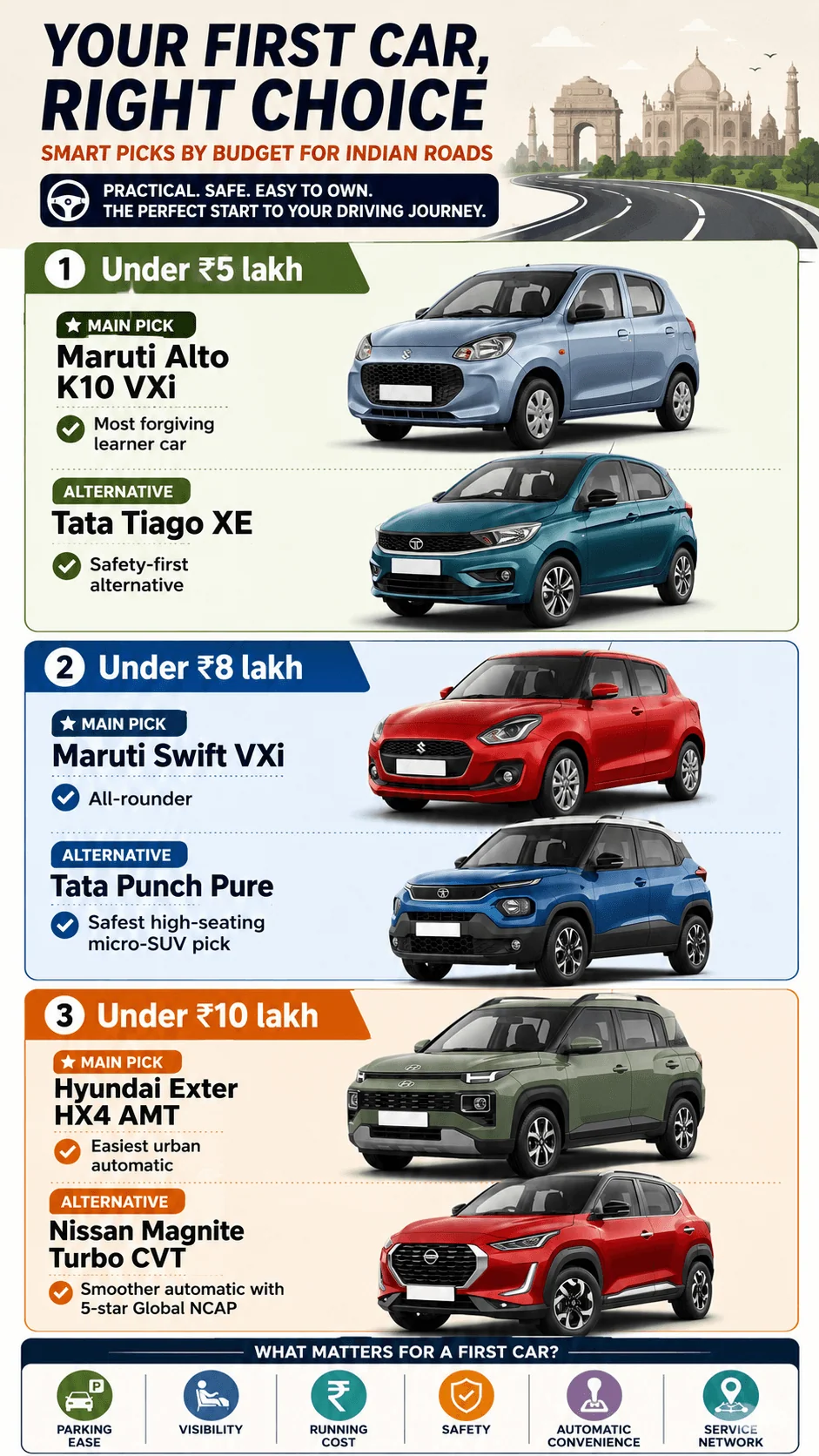
Looking for the best first car to buy in India in 2026? Under ₹5 lakh, the Maruti Alto K10 VXi is the most forgiving learner car you can buy. Stretch to ₹8 lakh and the Maruti Swift VXi becomes the all-rounder pick, with the Tata Punch Pure winning on pure safety. At ₹10 lakh the Hyundai Exter HX4 AMT is the easiest automatic, or the Nissan Magnite Turbo CVT for CVT smoothness with a 5-star NCAP rating. If you would rather skip the clutch, our automatic cars under ₹10 lakh roundup lists the easiest first-time picks.
Here’s what actually matters in a first car, and it has surprisingly little to do with sticker price or feature sheet length. New drivers care about how easily a car parks, how clearly they can see out of it, how much insurance and service cost in year one, real city mileage, and how the body shell holds up if they misjudge a turn into a flyover divider. Five things. Every pick below gets graded on them, not on horsepower.
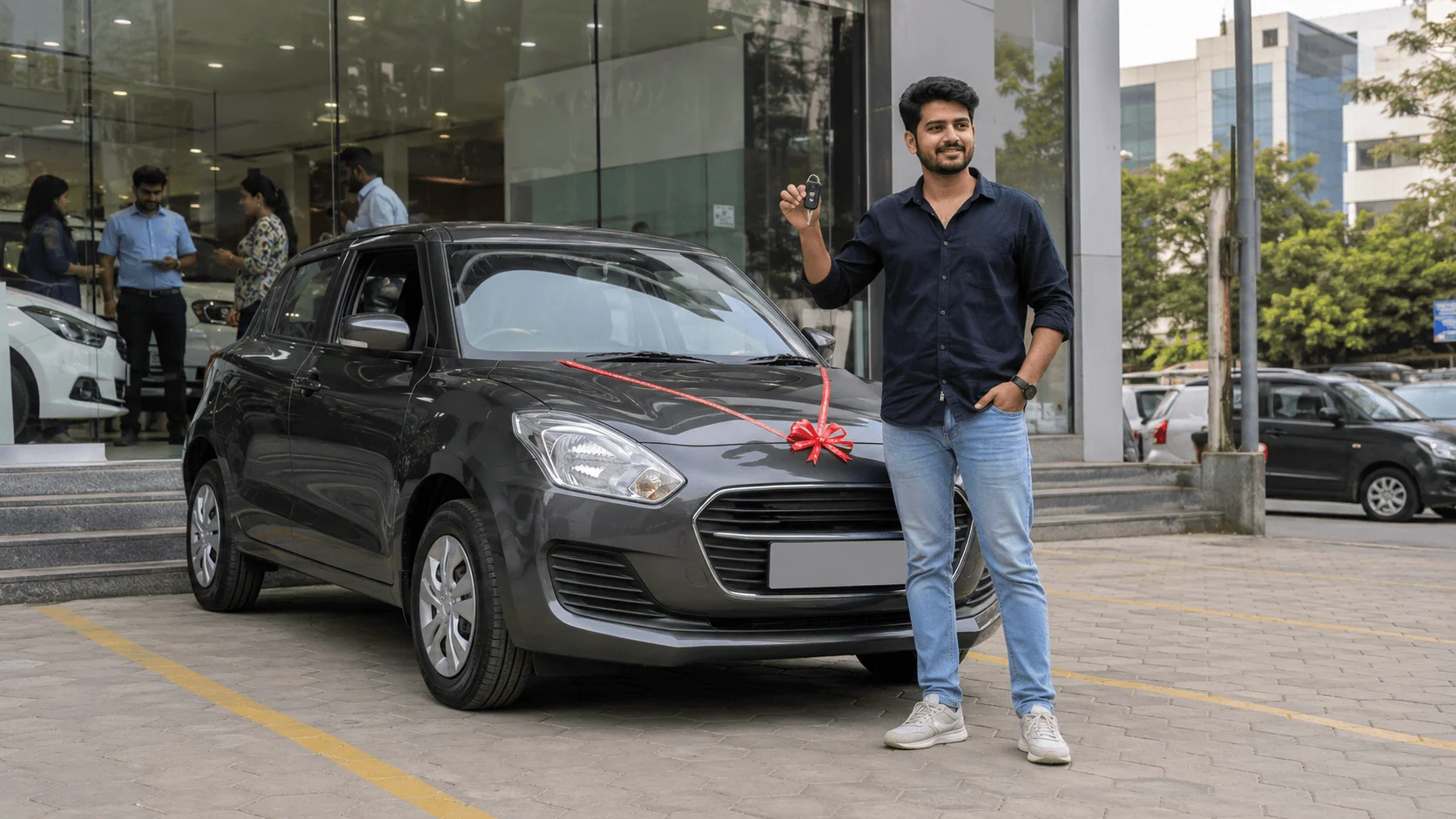
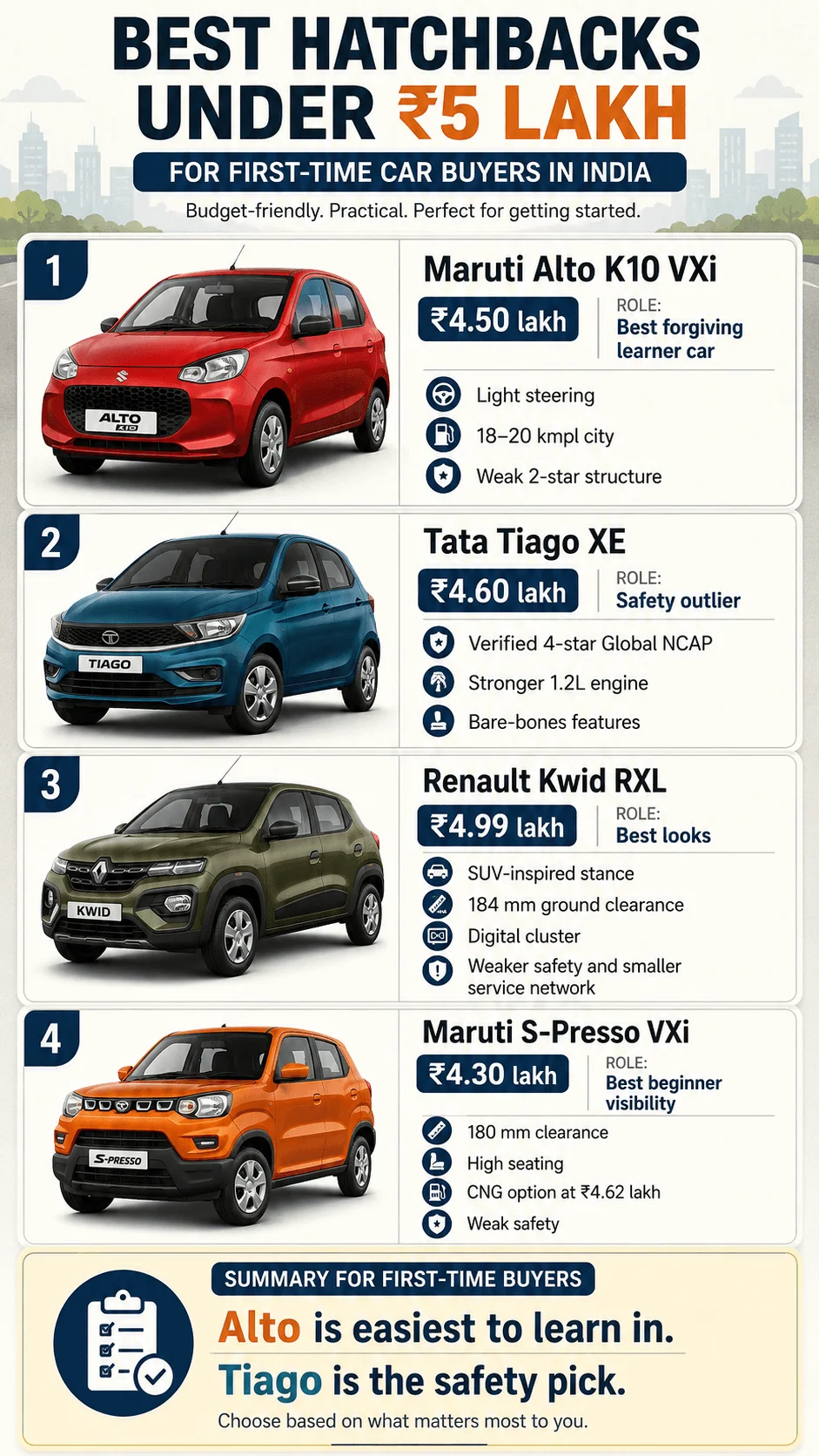
What to Look for in Your First Car
Don’t start with brand loyalty. Start with how you’ll actually live with the car day-to-day, because the things that matter on a test drive aren’t the things that matter on month six.
Easy parking and a tight turning radius. Your first six months behind the wheel will involve a lot of three-point turns, and a car under 3.7m long with a turning radius below 5m makes that exercise far less humbling. The Alto K10, S-Presso and Kwid all clear that bar. Big SUVs don’t.
Light steering and a forgiving clutch. A heavy clutch in Bengaluru’s Silk Board jam isn’t character-building. It’s left-knee surgery. Maruti’s K-series and Hyundai’s 1.2L Kappa engines are calibrated for low-effort city use.
Good outward visibility. Tall-boy hatchbacks like the Wagon R, and flat-bonneted micro-SUVs like the Tata Punch and Hyundai Exter, let you see where the car ends. Watch out for thick C-pillars on the i20 and Baleno, which create blind spots when changing lanes.
Low maintenance cost. Year one will probably include at least one minor scrape. Maruti and Hyundai spare parts are cheap and available in any Tier-2 city. Skoda, Volkswagen and Renault parts cost more and take longer to arrive.
Genuine safety, not just airbag count. Six airbags on a one-star body shell isn’t safety. Stick to cars with a verified 4-star or 5-star Global NCAP or Bharat NCAP rating. The 2026 reality: the Tata Punch holds 5-star BNCAP, the Nissan Magnite re-tested at 5-star Global NCAP, and the new Maruti Swift earned 5-star BNCAP on its latest iteration.
Insurance and running cost. A new driver’s comprehensive policy on a ₹6 lakh hatch runs ₹22,000-28,000 in year one. On a ₹10 lakh sub-compact SUV, it climbs to ₹32,000-38,000. That gap compounds across five years of ownership.
| First-time buyer need | Why it matters |
|---|---|
| Compact dimensions | Forgives bad parking judgement |
| Light steering | Cuts arm fatigue in stop-go traffic |
| Flat bonnet / high seating | Lets you judge the front of the car |
| Cheap spare parts | Makes minor dents affordable |
| 4-star+ NCAP rating | Protects you from rookie mistakes |
| Automatic option | Removes clutch anxiety on inclines |
| Wide service network | Faster turnaround for repairs |
If you want the bigger picture on the whole process, here’s our step-by-step buying guide for first-time buyers in India.
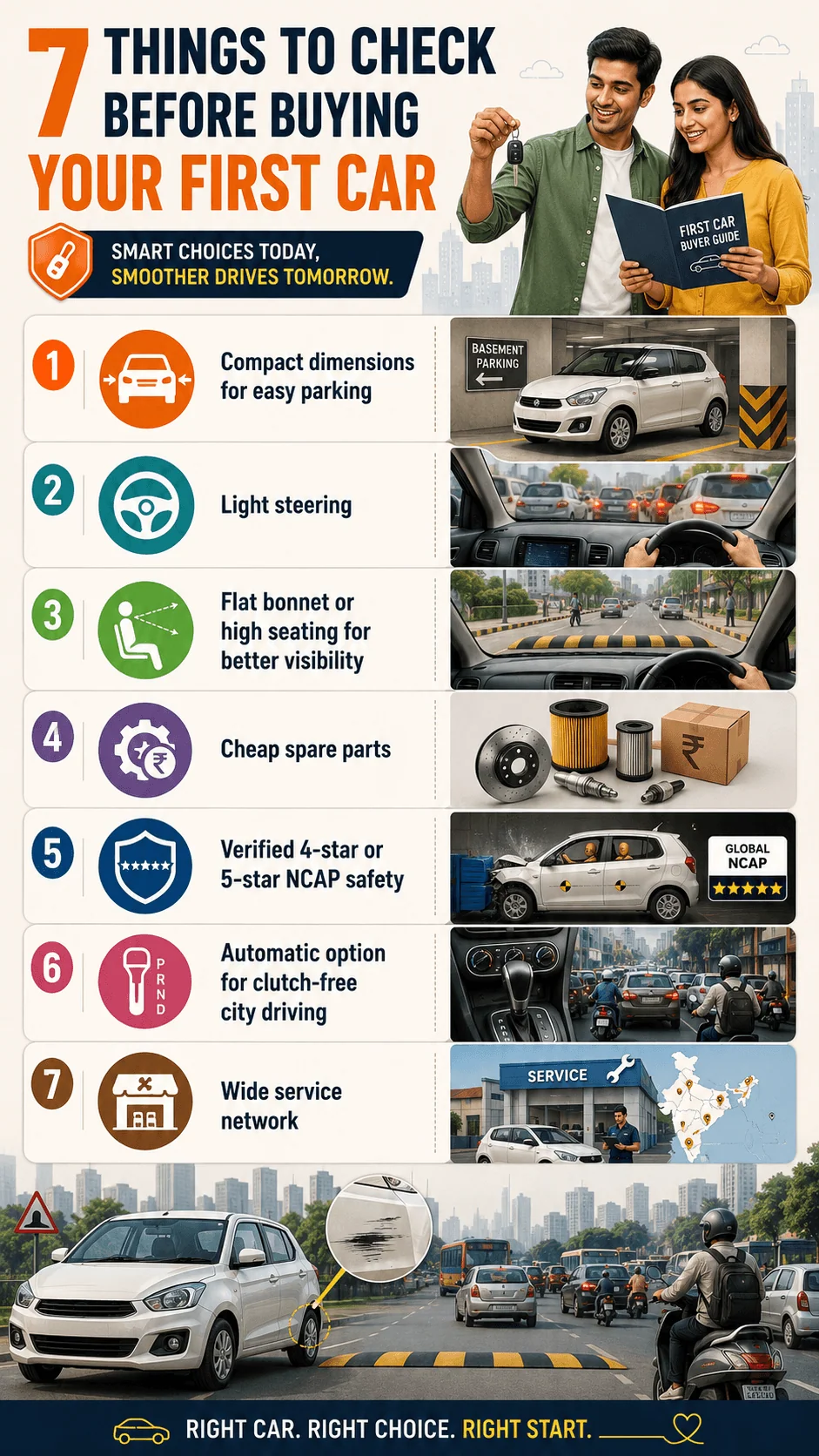
Best First Cars Under 5 Lakhs
Honest disclaimer up front: at this price, you’re buying mechanical reliability, not safety scores. Most models in this bracket score one or two stars on Global NCAP, and the base trims often skip airbags beyond the front pair. If structural safety is non-negotiable for your household, skip ahead to the ₹8 lakh section.
1. Maruti Alto K10 VXi — The Driving School Car
Ex-showroom: ₹4.50 lakh.
The Alto K10 is the hatch most Indian driving schools quietly recommend, and spend ten minutes in one and you’ll understand why every nervous learner from Mumbai to Madurai eventually ends up borrowing one. Featherlight steering. A clutch so soft it’s almost telepathic. A sub-4.6m turning radius. The 1.0L K-series engine returns a forgiving 18-20 kmpl in real urban traffic, and spare parts cost peanuts at any Maruti workshop in the country.
The catch? A 2-star GNCAP score and just two front airbags as standard, plus a tendency to wobble in highway crosswinds past 100 kmph. City tool.
- Best for: Anyone genuinely learning to drive in a congested city.
- Skip if: You commute on highways or insist on six airbags.
2. Tata Tiago XE — The Safety Outlier
Ex-showroom: ₹4.60 lakh.
The Tiago XE is the only model under ₹5 lakh with a verified 4-star Global NCAP rating, and that fact alone changes the conversation. Tata’s structural rigidity is class-leading. The 1.2L Revotron has more grunt than its 1.0L rivals, so highway overtakes feel less stressful.
But the trade-off is brutal de-contenting. No audio system, no rear power windows, and no steering controls of any kind. The XE is essentially a safety capsule with bare-bones comfort, so stretch ₹40,000 to the XM trim if you possibly can. It’s the bracket’s worst dressed but best built.
- Best for: Buyers who won’t compromise on crash safety.
- Skip if: Basic creature comforts matter from day one.
3. Renault Kwid RXL — Best Looks in Budget
Ex-showroom: ₹4.99 lakh.
SUV-inspired stance, 184mm of ground clearance, and a digital instrument cluster that genuinely feels two segments above its price tag are the Kwid’s headline pitches. Light steering and absorbent suspension make potholes a non-event. The 1-star GNCAP score and a sparser service network outside metros, however, keep it behind the Alto on raw engineering credibility.
- Best for: Style-first buyers driving on broken urban roads.
- Skip if: Service availability or crash safety is high on your list.
4. Maruti S-Presso VXi — Best Beginner Visibility
Ex-showroom: ₹4.30 lakh (₹4.62L for CNG).
The S-Presso’s upright seating gives you a commanding road view, which is absolutely gold for a nervous new driver navigating a four-lane Tier-1 intersection for the first time. 180mm of ground clearance shrugs off speed breakers. The CNG version delivers 32 km/kg, so fuel costs feel almost imaginary, particularly if you cover 1,200-1,500 km a month. Same caveats as the Alto though: 1-star structural rating, light at highway speeds.
- Best for: Nervous beginners who want SUV-like seat height.
- Skip if: You drive on highways often.
> Honest take for the under-5L bracket: if safety is even slightly on your radar, the Tiago XE wins. If you want pure ease of learning plus cheap upkeep, the Alto K10 VXi takes it. Either way, skip the absolute base STD trims. They usually don’t even include air conditioning.
Video Guide: Best First Cars in India by Budget

Best First Cars Under 8 Lakhs
Here’s where the math finally tilts in your favour. Verified 5-star crash ratings show up on the shelf for the first time, with six airbags as standard, touchscreens, automatic climate control, and the kind of cabin space that won’t have your back complaining after a 2-hour Friday commute through Outer Ring Road. Stretch the budget. Honestly, do.
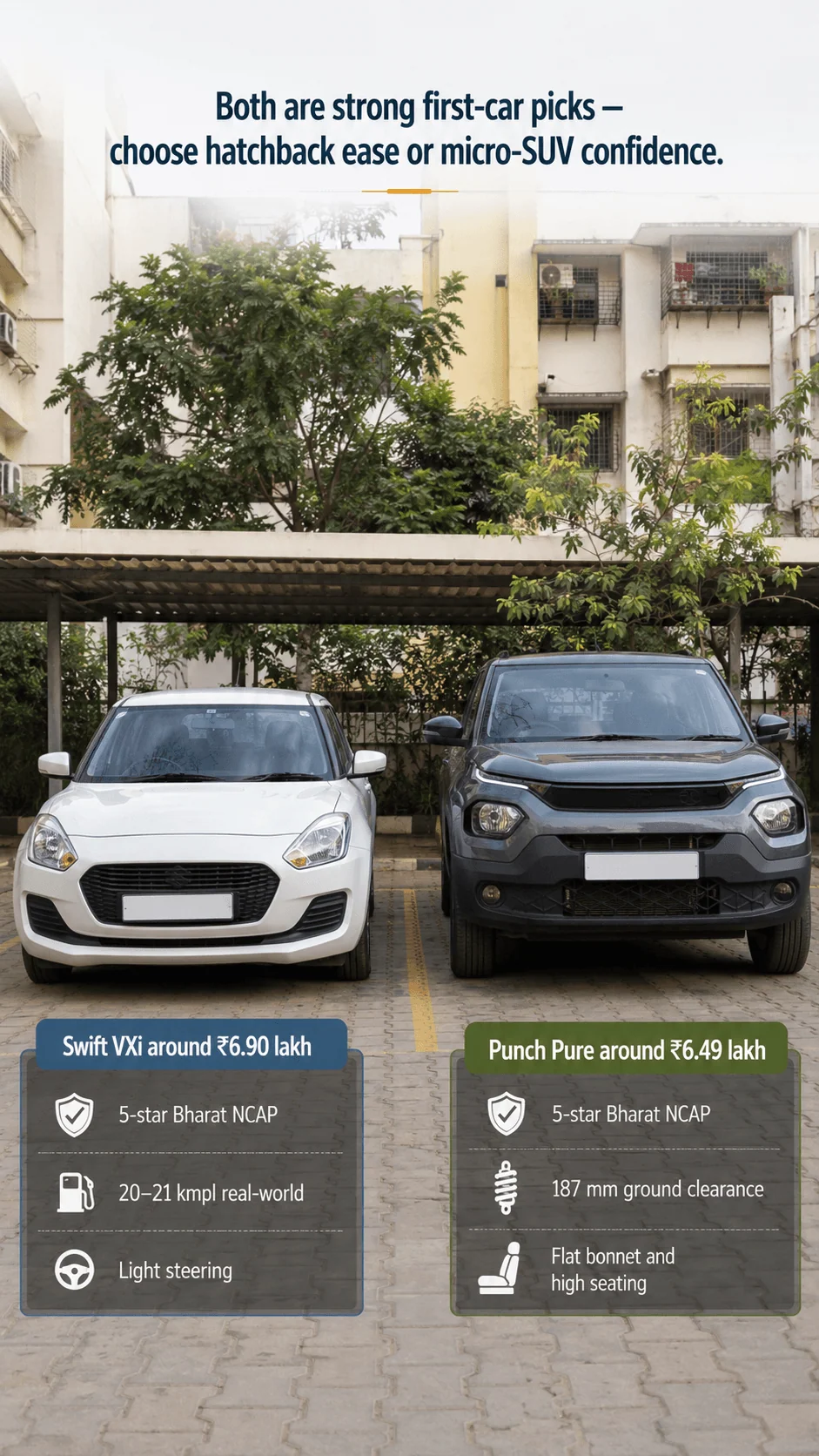
1. Maruti Swift VXi — The All-Rounder
Ex-showroom: ₹6.90 lakh approximately.
This is, hands down, the most balanced starter hatch you can buy in India in 2026. The new Z-series 1.2L three-cylinder engine returns 20-21 kmpl in mixed traffic. segment-best for a petrol hatch. Steering’s light. The gearbox shifts cleanly. The low dashboard gives you a front-corner view that helps enormously when you’re still learning where the car ends.
The bigger story is what changed under the metal. The latest Swift earned a 5-star Bharat NCAP rating in its 2026 testing, with six airbags now standard from VXi trim upwards, which is a near-complete reversal from the older Swift’s modest crash scores that have nagged the model for years. Owner complaints? Mostly small. Some idle vibration from the three-cylinder unit. A snug rear seat. Neither matters when you’re driving it solo through Andheri or Indiranagar.
- Best for: Anyone who wants one car that does everything reasonably well.
- Skip if: You regularly carry three adults in the rear.
2. Tata Punch Pure — The Safest Pick
Ex-showroom: ₹6.49 lakh.
The 2026 Punch facelift holds a 5-star Bharat NCAP rating across every variant and powertrain. yes, including the CNG twin-cylinder version. That’s still rare in this price band. High seating. A flat bonnet you can actually see over. 187mm of ground clearance that forgives most rookie misjudgements on a service-road speedbreaker.
The 1.2L naturally aspirated petrol is honest rather than quick, so highway overtakes need a bit of planning. AMT is available on higher trims if you want the safety story plus a clutchless drive.
- Best for: Safety-first families and buyers who drive on broken roads.
- Skip if: Highway commutes dominate your weekly mileage.
3. Maruti Baleno Sigma — Best Cabin Space
Ex-showroom: ₹5.99 lakh post-GST cut.
The Baleno Sigma at ₹5.99L is, frankly, one of the best value-for-money equations in the entire Indian car market right now and the kind of car that quietly makes you wonder why anyone bothers with the segment above. You get premium-hatch cabin width, a 4-star BNCAP rating, six airbags, and Maruti’s bulletproof service network. Real-world mileage hovers around 16-18 kmpl, which is excellent for a hatchback this size. The Sigma trim skips a touchscreen and steering controls, but the Delta one rung up at ₹6.80L adds both for a fairly reasonable jump.
- Best for: Small families needing space and refinement without crossing ₹7 lakh.
- Skip if: You want sporty handling. the Baleno is tuned for comfort.
4. Hyundai Exter HX3/HX4 — Best Micro-SUV for Beginners
Ex-showroom: ₹6.24-7.50 lakh.
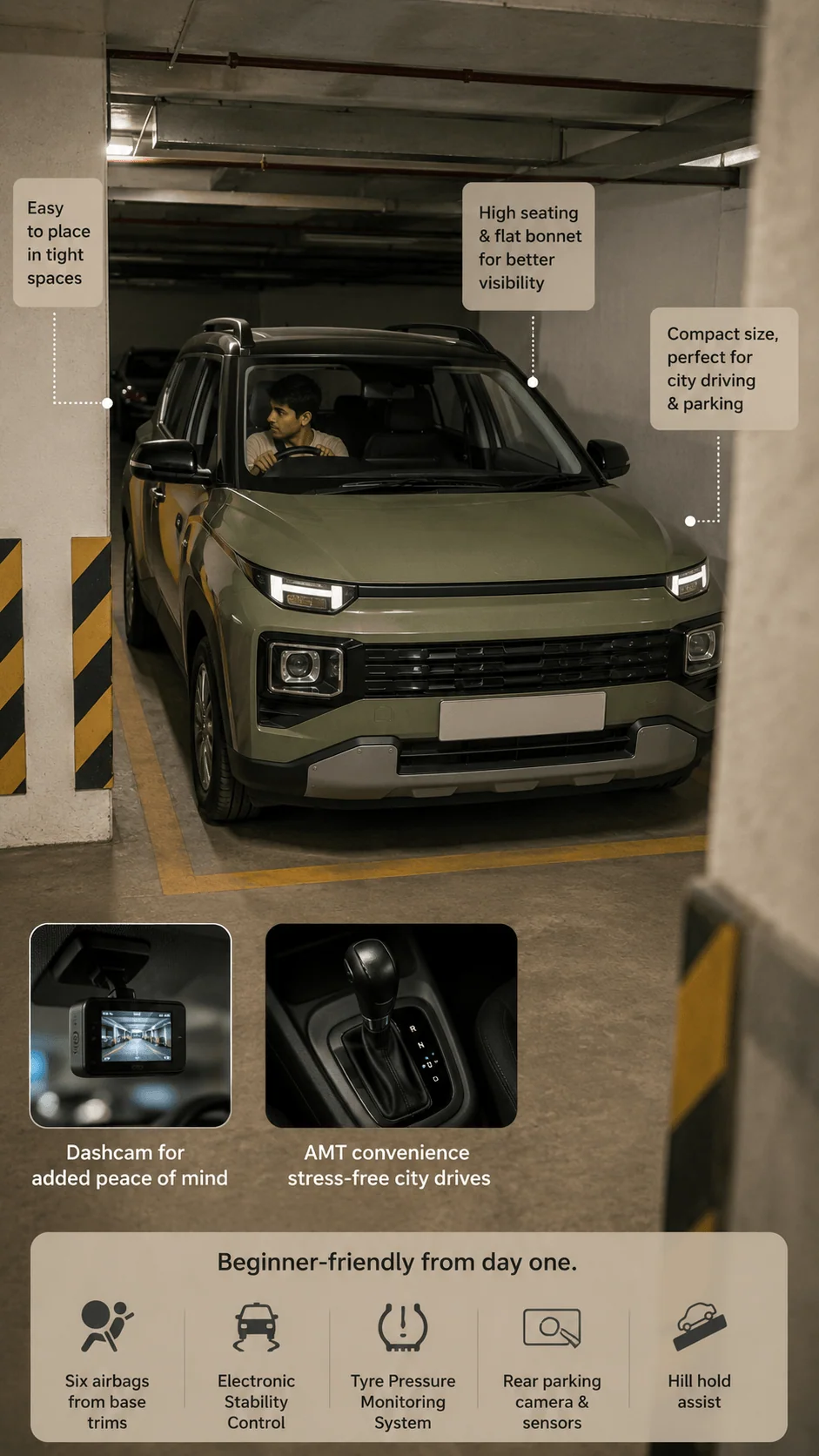
The Exter combines flat-bonnet visibility with a high seating position, which is genuinely beginner-friendly because it lets a new driver judge the four corners of the car without resorting to nervous bumper-poking in basement parking. The 1.2L petrol is refined and quiet. Hyundai has equipped even mid-trims with a factory dashcam, uniquely useful for new drivers dealing with the inevitable insurance dispute after a low-speed shunt. Bharat NCAP testing is still pending. The Exter is expected to clear a 3-star rating based on shared platform results.
- Best for: Buyers who want the SUV stance without losing parking ease.
- Skip if: You want a proven crash rating right now.
5. Tata Tiago XZ+ — Loaded and Safe
Ex-showroom: ₹6.83 lakh.
The Tiago XZ+ is the top trim with automatic climate control, an 8-speaker Harman audio system, and a digital cluster. Combined with the Tiago’s 4-star GNCAP shell, it’s one of the most safety-loaded sub-₹7L cars. The 1.2L Revotron is a bit noisier than the Marutis but offers a heavier, more planted feel at speed.
- Best for: Buyers who want a feature-rich, structurally safe hatchback at a flat budget.
- Skip if: You need the absolute lowest service costs.
| Car | Best variant | Price (ex-showroom) | Safety | Mileage | Why a beginner picks it |
|---|---|---|---|---|---|
| Maruti Swift | VXi | ₹6.90L | 5★ BNCAP | 20-21 kmpl | Best all-round driver confidence |
| Tata Punch | Pure | ₹6.49L | 5★ BNCAP | 18-20 kmpl | Highest seating, top crash safety |
| Maruti Baleno | Sigma | ₹5.99L | 4★ BNCAP | 16-18 kmpl | Premium cabin space, low running cost |
| Hyundai Exter | HX3 | ₹6.24L | Expected 3★+ | 17-19 kmpl | Flat bonnet, factory dashcam |
| Tata Tiago | XZ+ | ₹6.83L | 4★ GNCAP | 14-16 kmpl | Feature-loaded, structurally safe |
Best First Cars Under 10 Lakhs
A ₹10 lakh budget unlocks real automatic transmissions, premium hatchback comfort, and the kind of sub-compact SUV that doesn’t punish you for switching segments. The conversation shifts here. It stops being “what can I afford” and starts being “what kind of life will the car actually fit into”.
1. Hyundai Exter HX4 AMT — Best Beginner Automatic
Ex-showroom: ₹8.06 lakh.
The Exter HX4 AMT is the easiest first car to live with in a congested city. Elevated seating, a flat bonnet, six airbags from the base trim, and an AMT smooth enough for daily metro traffic. The factory dashcam pays for itself the first time you get rear-ended at a signal.
- Best for: Bengaluru, Mumbai and Pune commuters dealing with daily gridlock.
2. Nissan Magnite Turbo CVT — Smoothest Drive
Ex-showroom: ₹9.99 lakh.
The Magnite is the only sub-₹10L car with a true CVT, which means zero shift jerks. Add a 5-star Global NCAP rating under 2025 protocols and a 360-degree camera, and it’s the lowest-anxiety first car here. The trade-off is a sparser service network than Maruti or Hyundai.
- Best for: Buyers who want CVT smoothness on a hatchback-adjacent budget.
3. Maruti Baleno Zeta AMT — Premium Hatchback Auto
Ex-showroom: ₹8.20 lakh.
A 4-star BNCAP shell, six airbags, automatic climate control, and Maruti’s most reliable AMT calibration. It’s the natural step up from a Swift if you want more cabin room.
- Best for: Small families wanting an auto hatchback with Maruti reliability.
4. Tata Punch Adventure AMT — Top Trim Safety
Ex-showroom: ₹8.00-9.50 lakh.
The Punch’s higher AMT trims add a touchscreen, cruise control, electric ORVMs and a digital cluster, while retaining that golden 5-star BNCAP rating across the lineup. If you want the safest urban automatic with SUV-like seating, this is your pick.
If you want pure clutchless ease across this entire price band, an AMT or CVT first car is the call. Drive both before deciding, since calibrations differ noticeably between brands.
| Car | Best beginner variant | Price | Safety | Why pick it |
|---|---|---|---|---|
| Hyundai Exter | HX4 AMT | ₹8.06L | Expected 3★+ | Easiest auto micro-SUV |
| Nissan Magnite | Turbo CVT | ₹9.99L | 5★ GNCAP | Smoothest gearbox, best crash rating |
| Maruti Baleno | Zeta AMT | ₹8.20L | 4★ BNCAP | Premium hatch + Maruti service |
| Tata Punch | Adventure AMT | ~₹8.50L | 5★ BNCAP | Top safety + features |
Automatic vs Manual for Beginners
This is the question that splits first-time buyers more than any other. Here’s the unbiased call.
Choose manual if:
- You drive mostly on mixed roads, not constant traffic.
- Your budget can’t absorb the ₹50,000-70,000 automatic premium.
- You actually want to learn full mechanical control over the drivetrain.
- Your commute includes regular highway stretches.
Choose automatic (AMT or CVT) if:
- Your daily commute is bumper-to-bumper grind (Silk Board, Powai Lake, Outer Ring Road, Delhi peak hours).
- You stall the engine on inclines and dread holding up the queue behind you.
- Multiple family members with varying skill levels will share the vehicle.
- Convenience matters more than the small upfront premium.
The gearbox itself matters too. Quick breakdown:
| Gearbox type | Beginner suitability | Pros | Cons |
|---|---|---|---|
| Manual (MT) | Good for learning | Cheapest, full control, best mileage | Left-leg fatigue in heavy traffic |
| AMT (AGS) | Good budget auto | Cheap auto, fuel-efficient | Distinct “head-nod” between shifts |
| CVT | Excellent | Infinitely smooth, no jerks | Costlier, rubber-band engine sound |
| Torque Converter | Excellent | Smooth, reliable | Heavier, lower mileage |
| DCT | Premium | Fast shifts, sportier feel | Expensive, prone to overheating in jams |
The honest verdict: if you commute daily in a metro, get an AMT or CVT. The premium pays for itself in reduced fatigue and stress. If you live in a Tier-2 city with light traffic, a manual is perfectly fine and saves you money.
Always test-drive both before deciding. The same AMT calibration can feel jerky in one car and smooth in another. Our test drive checklist covers what to look for.
Is an SUV Good for a First-Time Driver?
Micro-SUVs help. Full sub-compact SUVs hurt.
The Tata Punch and Hyundai Exter are essentially elevated hatchbacks. Narrow dimensions, manageable turning radius, flat bonnet, plus higher seating and ground clearance. That combination genuinely builds beginner confidence.
The Tata Nexon, Hyundai Venue, Kia Sonet and Mahindra XUV 3XO are wider, with bigger blind spots and larger turning circles. Try parallel parking one between two Innovas in a Bandra lane and you’ll regret it. Insurance also runs 20-30% higher.
Start with a micro-SUV if you want SUV stance. Move up to a full sub-compact SUV as your second car. For a safety-led shortlist, see our list of the safest cars in India 2026.
First-Time Buyer Recommendation Matrix
If you’d rather skip the budget-by-budget logic, match yourself to one row:
| Buyer profile | Recommended models |
|---|---|
| Nervous new driver, city only | Maruti Alto K10 VXi, Maruti Wagon R VXi, Maruti Swift AMT |
| Heavy city traffic, daily | Hyundai Exter AMT, Tata Punch AMT, Nissan Magnite CVT |
| Safety-first beginner | Tata Punch, Maruti Swift, Nissan Magnite, Tata Tiago |
| Strict budget under ₹5L | Maruti Alto K10, Tata Tiago XE |
| Small family first car | Maruti Baleno, Hyundai i20, Tata Punch |
| Broken roads, semi-urban | Tata Punch, Hyundai Exter, Renault Kwid |
| Lowest maintenance | Maruti Swift, Maruti Baleno, Maruti Wagon R |
| Premium beginner car | Nissan Magnite Turbo CVT, Hyundai i20 Magna |
Common First-Car Mistakes to Avoid
- Buying too big a car. A 4.3m sub-compact SUV bought for “road presence” turns into a parking nightmare the first time you face stilt parking.
- Picking an SUV just for image. If you don’t need ground clearance or boot space, you’re paying extra for fuel and insurance with no real benefit.
- Ignoring home parking. Measure your slot before shortlisting. Several buyers discover their basement ramp can’t fit a 4-meter car only after delivery.
- Skipping safety on the base trim. Avoid variants without ABS, six airbags, or rear parking sensors. The ₹40,000 saved isn’t worth it.
- Forgetting insurance and RTO. Always calculate the on-road price including RTO charges before locking your budget.
- Choosing manual despite hating traffic. A manual through Mumbai monsoons after a 10-hour workday is a particular kind of regret.
- Buying an AMT without test-driving it. Shift jerks vary wildly between cars. Drive one in real traffic, not just on the dealership road.
- Stretching the loan. Your first-car EMI shouldn’t exceed 12% of monthly take-home. Leave room for fuel, insurance and inevitable first-year scratches.
- Skipping the pre-delivery inspection. Run through a proper pre-delivery checklist before signing.
FAQs
What car should I buy as my first car? The Maruti Swift VXi at around ₹6.90 lakh is the most balanced first car in India in 2026. It has a 5-star Bharat NCAP rating, returns 20-21 kmpl in real-world city traffic, and Maruti’s nationwide service network keeps upkeep hassle-free. If your budget caps at ₹5 lakh, the Maruti Alto K10 VXi is the most forgiving learner car.
Should I buy automatic or manual as a first car? If you commute daily in heavy city traffic, go automatic. An AMT or CVT removes clutch fatigue and lets you focus entirely on the road. If your driving includes regular highways or your budget is tight, a manual is fine and saves you ₹50,000-70,000.
Is an SUV good for a first-time driver? Micro-SUVs like the Tata Punch and Hyundai Exter are excellent first cars thanks to their high seating and flat bonnets. Full sub-compact SUVs (Nexon, Venue, Sonet) are wider and harder to park, with 20-30% higher insurance costs. Start with a micro-SUV if you want SUV stance without the parking penalty.
Which is the safest first car in India 2026? The Tata Punch and Maruti Swift both carry 5-star Bharat NCAP ratings, with the Nissan Magnite achieving 5-star Global NCAP under the 2025 protocols. All three offer six airbags and ESC as standard, making them the safest first-car picks.
Which is the best first car under ₹5 lakh? The Maruti Alto K10 VXi for ease of driving and lowest running cost. If structural safety matters more, the Tata Tiago XE is the only sub-₹5L car with a verified 4-star Global NCAP rating.
Which is the best first car under ₹8 lakh? The Maruti Swift VXi is the all-rounder. The Tata Punch Pure is the safer pick with higher seating, ideal if you also navigate broken roads.
Should first-time buyers consider CNG? Only if your monthly running exceeds 1,500 km. Savings from ₹65/kg gas vs ₹100/L petrol compound at high mileage, but CNG cuts boot space and adds queue time at fuel stations. For most first-time buyers doing 600-1,000 km monthly, petrol is simpler.
How much does insurance cost for a first-time car buyer? Insurance is one of those costs first-time buyers underestimate. A first-year comprehensive policy on a ₹6 lakh hatchback typically costs ₹22,000-28,000, while the same policy on a ₹10 lakh sub-compact SUV climbs to ₹32,000-38,000 thanks to bigger engines and pricier panels. Budget another ₹4,000-6,000 for Zero Depreciation cover, which is genuinely worth keeping for the first three years.
Prices in this guide reflect ex-showroom rates as of May 2026 and may vary by city. Always confirm the on-road price with your dealer before booking. Safety ratings cited are from Bharat NCAP and Global NCAP. Real-world mileage figures are based on owner forums and our test-drive observations.