
The best CNG car under 10 lakhs in India right now is the Tata Punch iCNG for buyers who want one car that does everything, the Maruti WagonR CNG for the lowest running cost, and the Maruti Dzire CNG if mileage is the only number you care about. But the honest answer depends on three things almost no other list talks about: how much boot space the CNG kit eats, whether your city actually has enough CNG pumps, and how many kilometres you drive every month.
Here’s the thing most buyers miss. Two cars at the same price can hand you wildly different luggage space depending on whether they use a single big cylinder or two smaller ones. And a vehicle that saves a fortune in Delhi can be a daily headache in Chennai. So this guide ranks the top factory-fitted options, then breaks down running cost, boot loss per model, and city-wise CNG availability so you can match a car to your actual life. No filler, just the numbers that decide it.
All prices are ex-showroom and reflect CNG-variant pricing as of May 2026. Confirm the exact variant and on-road figure at your local dealer before booking, since prices and station coverage change fast.
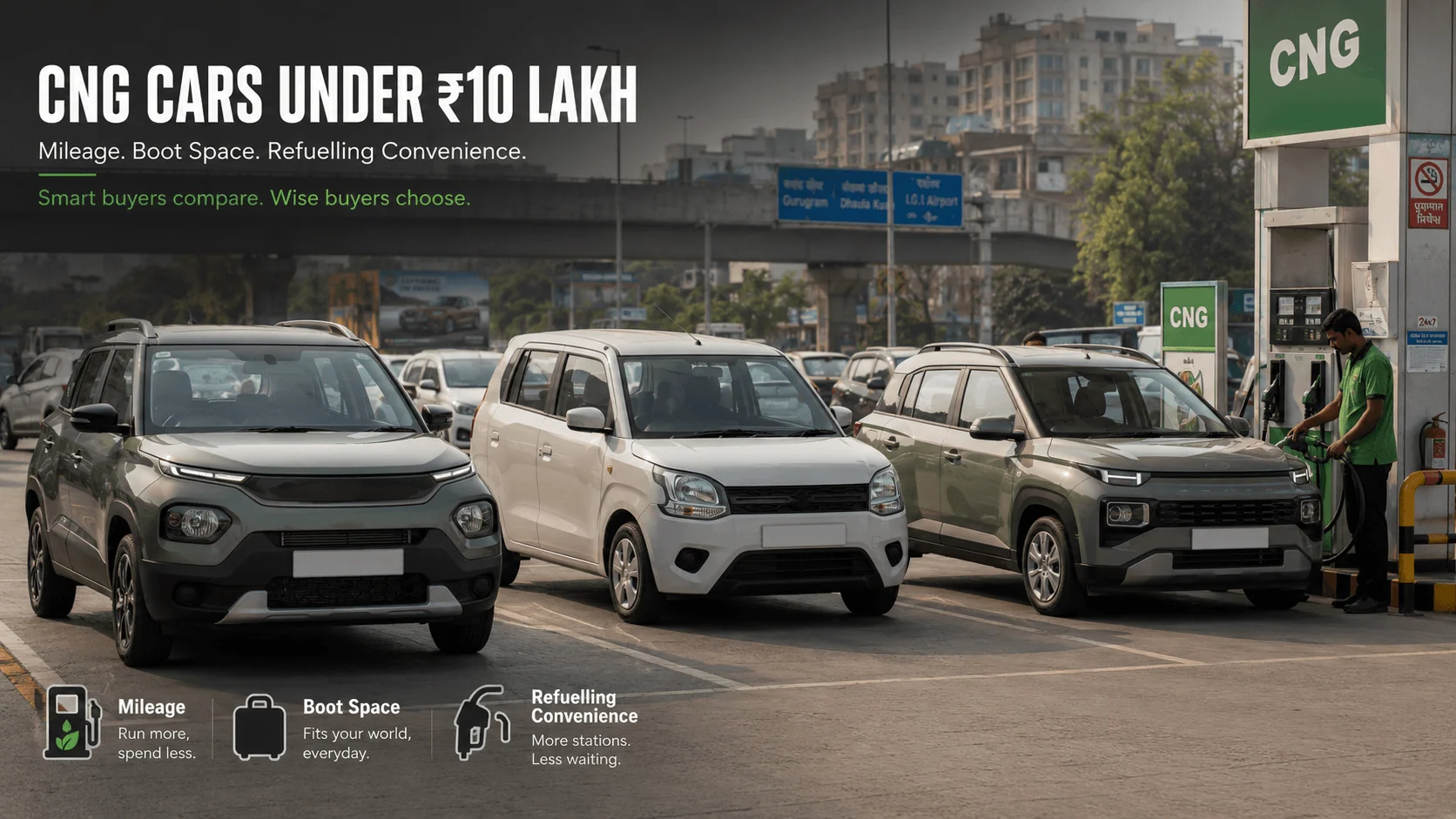
Factory-Fitted CNG Cars Under 10 Lakhs
Why factory-fitted only? A company-built CNG car uses stainless steel lines, leak sensors, and a micro-switch that stops the engine from starting while you refuel. The ECU is mapped for smooth petrol-to-gas switching, your warranty stays intact, and resale holds up in CNG-heavy markets. Aftermarket kits don’t give you any of that reliably, and they can void your insurance. Not worth the gamble.
The big 2026 shift is engineering. Tata and Hyundai now use twin or dual-cylinder layouts that tuck two smaller tanks under the boot floor, so you keep most of your luggage space. Maruti and Toyota still run a single large cylinder that sits in the boot, which maximises efficiency and keeps weight down but swallows most of the cargo area. So which camp does your shortlist fall into? Keep that split in mind as you read the table below.
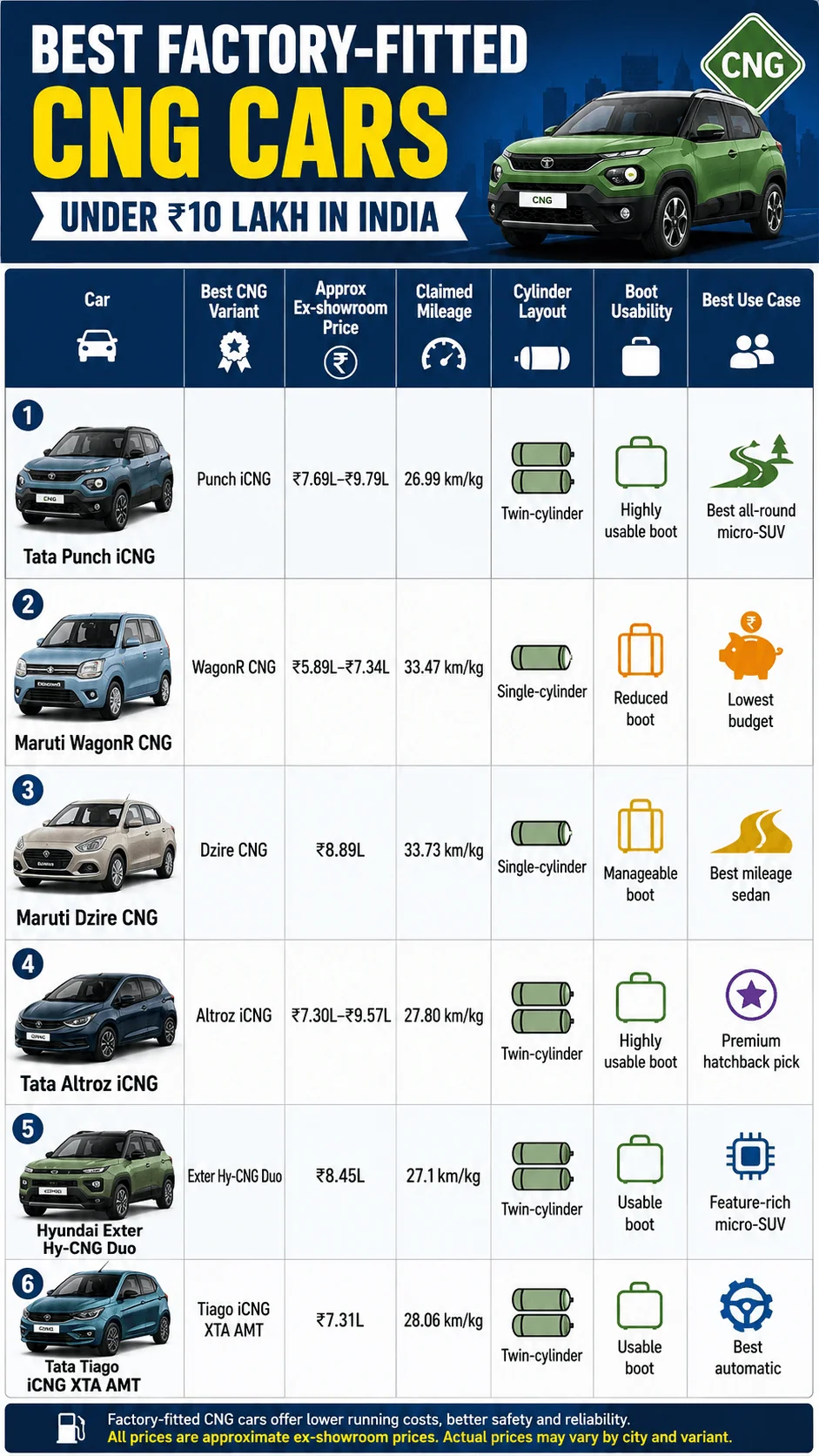
| Rank | Car | Best CNG Variant ≤10L | Approx Ex-Showroom | Claimed Mileage | Cylinder Layout | Boot Usability | Best For |
|---|---|---|---|---|---|---|---|
| 1 | Tata Punch iCNG | Pure Plus / Adventure | ₹7.69L–₹9.79L | 26.99 km/kg | Twin | Highly usable | All-round micro-SUV |
| 2 | Maruti WagonR CNG | LXi / VXi | ₹5.89L–₹7.34L | 33.47 km/kg | Single | Reduced | Lowest budget, headroom |
| 3 | Maruti Dzire CNG | VXi | ₹8.89L | 33.73 km/kg | Single | Manageable | Best mileage, sedan |
| 4 | Tata Altroz iCNG | Pure S / Creative | ₹7.30L–₹9.57L | 27.80 km/kg | Twin | Highly usable | Best boot, premium hatch |
| 5 | Hyundai Exter Hy-CNG Duo | SX Smart | ₹8.45L | 27.1 km/kg | Twin (Duo) | Highly usable | Feature-rich micro-SUV |
| 6 | Maruti Swift CNG | VXi / ZXi | ₹7.44L–₹8.38L | 32.85 km/kg | Single | Almost none | Solo city commuter |
| 7 | Hyundai Grand i10 Nios Hy-CNG Duo | Sportz | ₹7.72L | 27 km/kg | Twin (Duo) | Usable | Refined family hatch |
| 8 | Tata Tiago iCNG | XTA AMT | ₹7.31L | 28.06 km/kg | Twin | Usable | Best automatic |
| 9 | Maruti Fronx CNG | Sigma / Delta | ₹7.79L–₹8.59L | 28.51 km/kg | Single | Poor | Crossover styling |
| 10 | Hyundai Aura Hy-CNG Duo | E / S | ₹7.49L–₹7.76L | 28.40 km/kg | Twin (Duo) | Highly usable | Compact sedan, full boot |
| 11 | Toyota Glanza CNG | S | ₹8.17L | 30.61 km/kg | Single | Poor | Toyota badge, warranty |
| 12 | Maruti Brezza CNG | LXi | ₹9.16L | 25.51 km/kg | Single | Poor | Sub-compact SUV stance |
Need seven seats? The Maruti Ertiga CNG starts around ₹8.8 lakh in its base trim, making it the only factory CNG people-mover near this budget, though most variants climb past 10 lakh.
1. Tata Punch iCNG: The Best All-Rounder
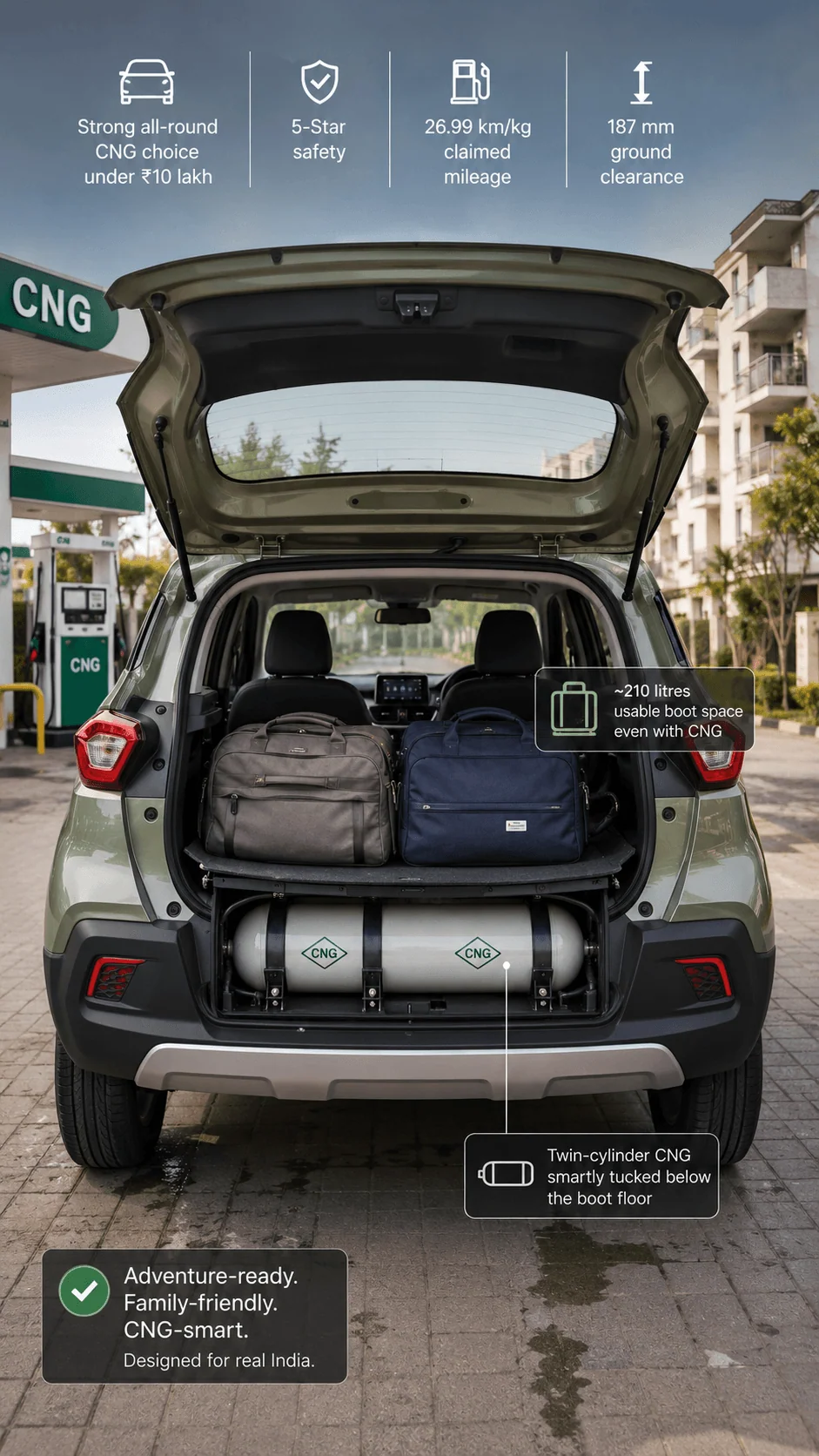
The Punch iCNG is the closest thing to a no-compromise pick under 10 lakh. What do you get? A 5-star GNCAP body, 187 mm of ground clearance, and a twin-tank setup that holds onto roughly 210 litres of usable cargo space, enough for two medium trolleys. The 1.2L Revotron is rated at 26.99 km/kg, and owners report 19 to 21 km/kg in city traffic, closer to 24 on the open road. The 2026 facelift even added a segment-first iCNG AMT, so you’ll get an automatic clutch with gas savings. Power dips noticeably during overtakes and uphill climbs, and the three-pot sounds a touch coarse when you push it. But for a first car that’s got to handle bad roads, family duty, and weekend bags? Nothing else here ticks as many boxes.
2. Maruti WagonR CNG: The Budget Workhorse
If running cost is everything, the WagonR CNG is hard to beat. It starts at around ₹5.89 lakh, the cheapest factory CNG car here, and its 1.0L K10C returns a claimed 33.47 km/kg with a real-world 25 to 27 km/kg in the city. That tall-boy shape gives unbeatable headroom and easy ingress for elderly passengers. The catch? The single-cylinder tank cuts the 341-litre boot down to roughly 150 litres of usable space. Groceries and soft bags fit. Large suitcases don’t. Its 56 bhp motor is strictly adequate and runs out of breath above 80 km/h. But as a cheap, bulletproof, low-maintenance city runabout with the widest service network in India, it’s still the logical budget king.
3. Maruti Dzire CNG: The Mileage Champion
Want the highest efficiency on this list? The Dzire tops it at a rated 33.73 km/kg, and owners genuinely see 25 to 26 km/kg in heavy traffic. Its new Z-series 1.2L motor feels impressively smooth for a three-pot, and the cabin serves up plush rear seating with AC vents. That’s exactly why fleet operators and chauffeur-driven families swear by it. Six airbags and ESP come standard too. The trade-off is luggage room: that lone tank leaves about 150 to 170 litres of deep floor ahead of it, fine for duffel bags but tight for hard-shell trolleys. Log serious monthly kilometres in a proper sedan and this Maruti pays for itself fastest.
4. Tata Altroz iCNG: The Boot Space King
The Altroz iCNG is the practicality answer. As the original pioneer of twin-tank tech in a premium hatchback, it keeps a genuinely useful flat-floor trunk of around 210 litres with the cylinders tucked underneath. A 5-star GNCAP rating on Tata’s ALFA platform covers safety, and the recent AMT version makes urban crawling far easier. Actual economy sits near 19.8 km/kg in dense traffic and stretches well past 30 on a steady highway run. Downsides? The heavy kerb weight blunts off-the-line acceleration on gas, and the touchscreen can stutter. But if your family wants a safe, solid premium hatch without surrendering its luggage hold, this is arguably the smartest buy here.
5. Hyundai Exter Hy-CNG Duo: The Feature-Loaded Micro-SUV
Hyundai cracked the luggage problem with its dual-tank Hy-CNG Duo layout, and the Exter shows it off best. It holds onto the vast majority of its 391-litre trunk, swallowing weekend bags that a single-tank rival simply can’t. You also get 6 airbags, ESC, a factory dashcam, and even a sunroof, an unusually rich kit at this price. The 1.2L four-cylinder Kappa motor stays refined and is managed well by tall gearing, returning 18 to 20 km/kg in town. No, it’s no rocket on gas. But for tech-savvy buyers who want SUV-style seating, real cargo room, and rock-bottom fuel bills together, the Exter Duo is a standout.
6. Maruti Swift CNG: The Solo Commuter’s Pick
The Swift delivers one of the lowest fuel bills in its class with a rated 32.85 km/kg and real figures of 24 to 25 km/kg in town, climbing past 28 on the open road. The new Z-series motor is genuinely smooth, and Maruti’s AC stays effective even under gas load. Six airbags and ESP across variants round it off. Here’s the dealbreaker, though. That fat single tank dominates the 265-litre trunk, leaving room for soft bags only, and buyers complain bitterly about not being able to carry hard luggage. Drive alone or two-up and prize economy over cargo? It’s a sweet little commuter. For anything else, look at the Dzire.
7. Hyundai Grand i10 Nios Hy-CNG Duo: The Refinement Leader
The Nios Hy-CNG Duo is the quietest, most refined gas car under 10 lakh. Its four-cylinder Kappa unit runs noticeably smoother than the three-pot competition, and the dual-tank layout protects about 260 litres of trunk, good for weekend family bags. Rear AC vents, a segment-leading recline angle, and a long feature list make it feel premium for the money. Expect 19 to 21 km/kg in dense traffic, up to 25 on the open road. Power delivery is linear rather than punchy, so you’ll want to plan your overtakes. For small families chasing a comfortable, hushed cabin, low fuel bills, and room to pack for a trip, the Nios Duo bridges budget and premium beautifully.
8. Tata Tiago iCNG: The Best Automatic
Want gas savings without the clutch work of bumper-to-bumper traffic? The Tiago iCNG AMT is your answer at around ₹7.31 lakh. Its 2026 update brought a segment-first set of paddle shifters and a rotary drive selector, so the self-shifter feels more premium than its price suggests. The twin-tank layout protects enough trunk for weekly groceries and two soft bags, and the 1.2L Revotron returns 20 to 22 km/kg in town. A 4-star GNCAP rating, dual airbags, and ABS with EBD cover the basics. AMT gearboxes still pause between shifts, sure, but those paddle shifters let you grab control when you need it. For anyone stuck in stop-and-go crawl who wants an automatic and cheap fuel, this is the one.
Running Cost Comparison: CNG vs Petrol
This is where gas earns its keep. A factory CNG trim usually costs ₹85,000 to ₹95,000 more upfront than the petrol version. So how do you know if that premium makes sense? You compare cost per kilometre, then work out your break-even distance. For our petrol vs CNG cost analysis we used May 2026 Delhi rates: petrol at ₹102.12 per litre and gas at ₹83.09 per kg.
| Model (MT) | Petrol Mileage | CNG Mileage | Petrol ₹/km | CNG ₹/km | Saving/km | Premium | Break-even |
|---|---|---|---|---|---|---|---|
| Maruti Swift | 16.0 km/l | 25.0 km/kg | ₹6.38 | ₹3.32 | ₹3.06 | ~₹90,000 | ~29,400 km |
| Tata Punch | 14.0 km/l | 20.0 km/kg | ₹7.29 | ₹4.15 | ₹3.14 | ~₹95,000 | ~30,250 km |
| Hyundai Nios | 14.5 km/l | 21.0 km/kg | ₹7.04 | ₹3.95 | ₹3.09 | ~₹95,000 | ~30,700 km |
| Maruti Dzire | 16.5 km/l | 26.0 km/kg | ₹6.18 | ₹3.19 | ₹2.99 | ~₹90,000 | ~30,100 km |
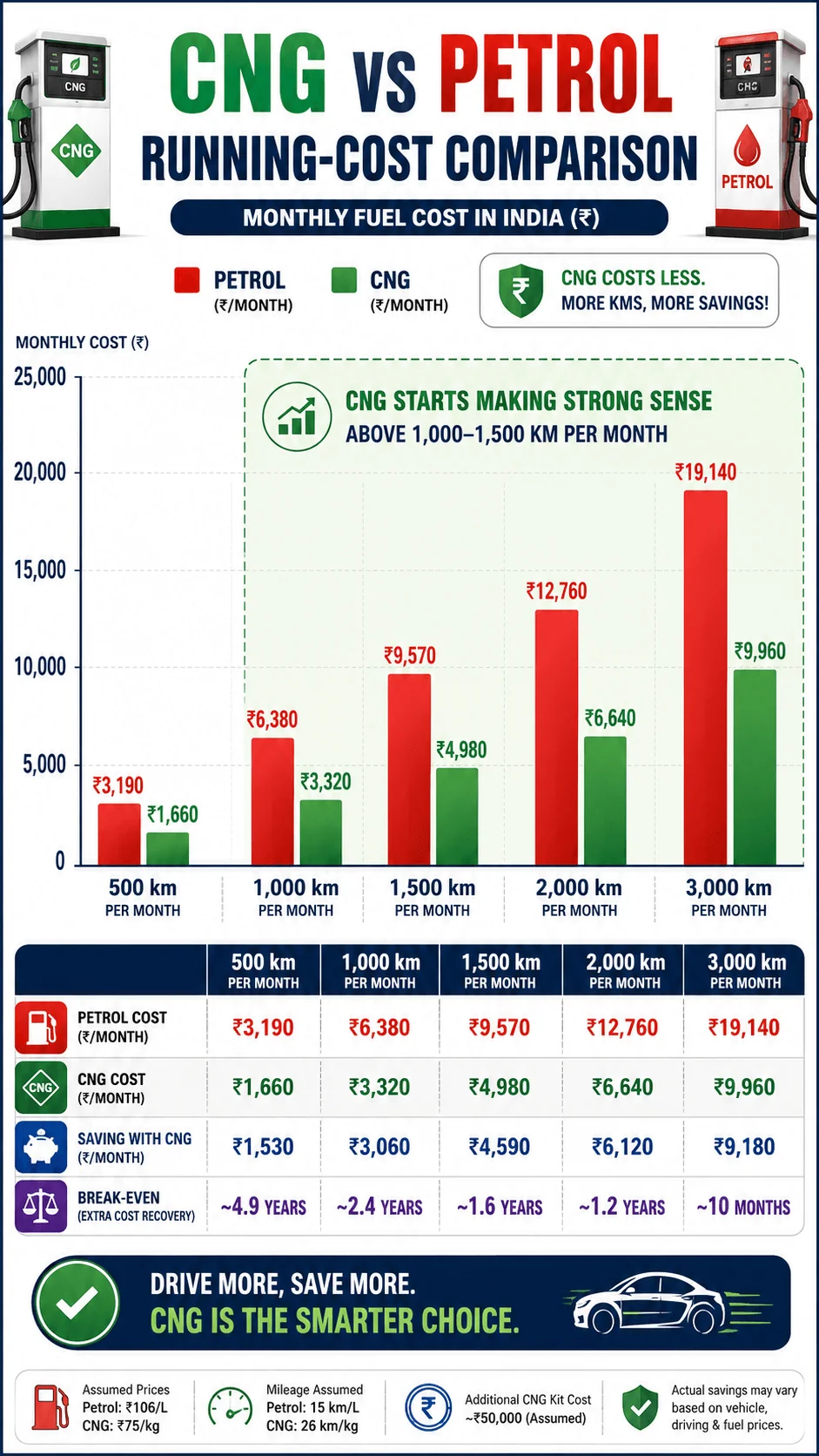
Now turn distance into time. Assuming a weighted saving of about ₹3.00 per kilometre against a ₹90,000 premium:
| Monthly Running | Petrol Cost | CNG Cost | Monthly Saving | Break-even |
|---|---|---|---|---|
| 500 km | ₹3,190 | ₹1,660 | ₹1,530 | ~4.9 years |
| 1,000 km | ₹6,380 | ₹3,320 | ₹3,060 | ~2.4 years |
| 1,500 km | ₹9,570 | ₹4,980 | ₹4,590 | ~1.6 years |
| 2,000 km | ₹12,760 | ₹6,640 | ₹6,120 | ~1.2 years |
| 3,000 km | ₹19,140 | ₹9,960 | ₹9,180 | ~10 months |
The pattern is clear. Drive more than 1,000 to 1,500 km a month and the extra cost comes back in under two years, after which every rupee saved is pure profit. Drive under 800 km a month and those savings trickle in too slowly to justify the upfront hit, the lost trunk, and the time you’ll burn in refuelling queues. One regional caveat: local taxation shifts the math. Gas in Hyderabad touches ₹97 per kg while petrol crosses ₹115 per litre, so the ratio stays favourable but the absolute spread changes.
CNG Car Boot Space Impact
Luggage space used to be the Achilles’ heel of every gas car. By 2026 the market has split into two camps. And which one your shortlist falls into? It matters more than almost any spec on the sheet.
Single-cylinder models (Maruti, Toyota) mount one large 55 or 60-litre water-capacity steel tank behind the rear seats. That single mass devours 70 to 90 percent of a hatchback’s trunk. Twin or dual-cylinder models (Tata iCNG, Hyundai Hy-CNG Duo) split the fuel into two smaller bottles under the load floor, then shift the spare wheel beneath the chassis. The payoff? A near-full cargo bay.
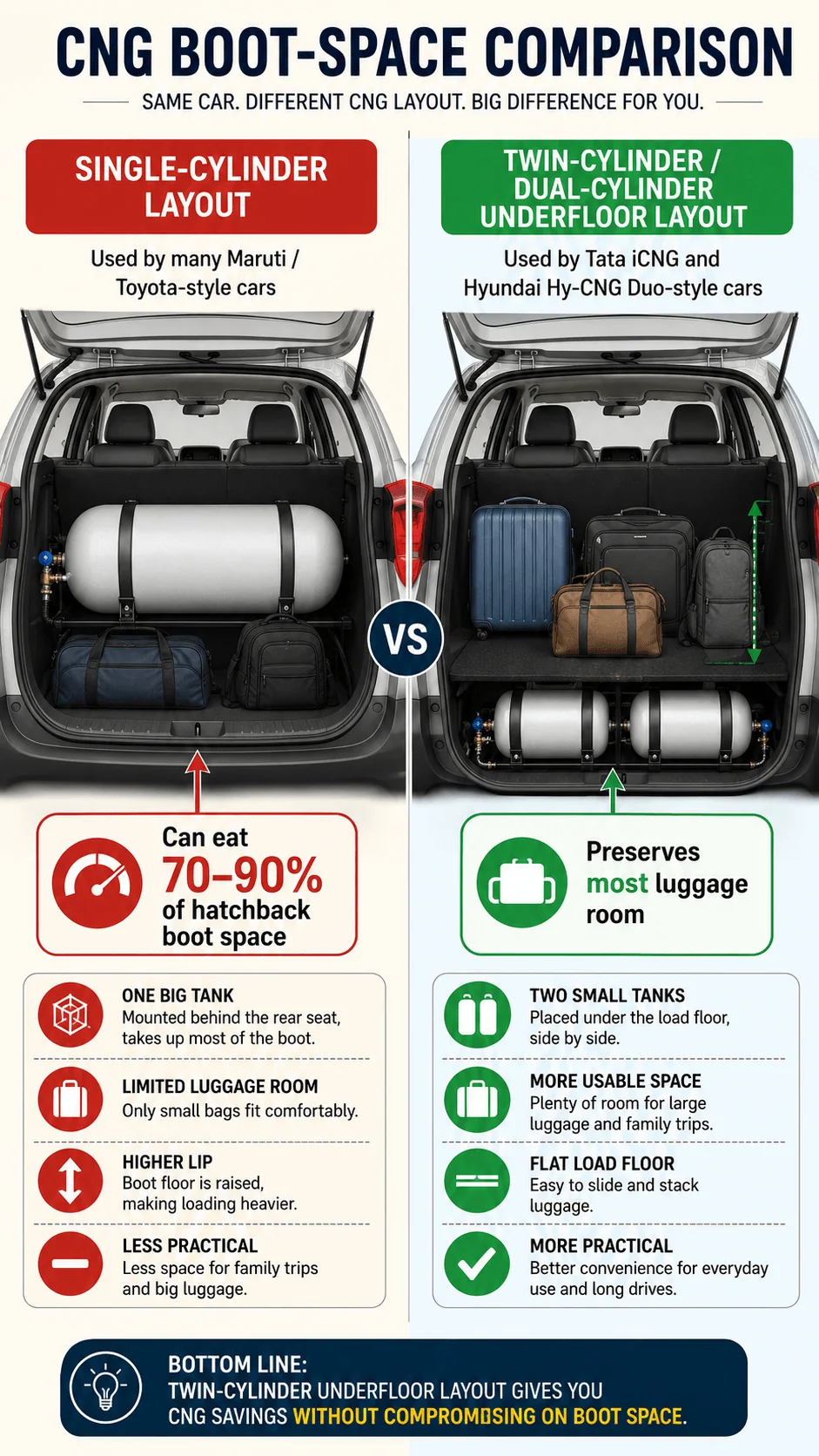
| Car | Petrol Boot | CNG Layout | Practical Luggage Verdict |
|---|---|---|---|
| Tata Punch iCNG | 366L | Twin | Highly usable: two medium trolleys plus soft bags |
| Tata Altroz iCNG | 345L | Twin | Highly usable: flat load floor, great for trips |
| Hyundai Exter Duo | 391L | Twin | Highly usable: best-in-class boot integration |
| Hyundai Aura Duo | 402L | Twin | Highly usable: deep sedan boot preserved |
| Hyundai Nios Duo | 260L | Twin | Usable: good for weekend family luggage |
| Maruti Dzire CNG | 378L | Single | Manageable: deep floor space ahead of the tank |
| Maruti Swift CNG | 265L | Single | Almost none: soft bags only |
| Maruti Baleno CNG | 318L | Single | Poor: large tank drastically cuts volume |
| Maruti Fronx CNG | 308L | Single | Poor: sloping roof plus tank leaves little |
| Maruti WagonR CNG | 341L | Single | Reduced: about 150L usable, groceries fit |
For families, the lesson here is refreshingly simple once you’ve seen the numbers above. Regularly carry suitcases, a stroller, or holiday luggage? Then lean toward a twin-tank Tata or a dual-tank Hyundai. And whatever you shortlist, go physically wedge your usual suitcase into the trunk at the showroom before booking. A single-tank model that saves you ₹5,000 a month isn’t a bargain if it can’t carry your life.
CNG Refueling Infrastructure by City
The economics collapse if there’s no pump nearby. Driving 10 km out of your way to refuel, or idling 45 minutes in a queue, burns the very money and time CNG is supposed to save. So before you fall for a model, check your city’s reality first.
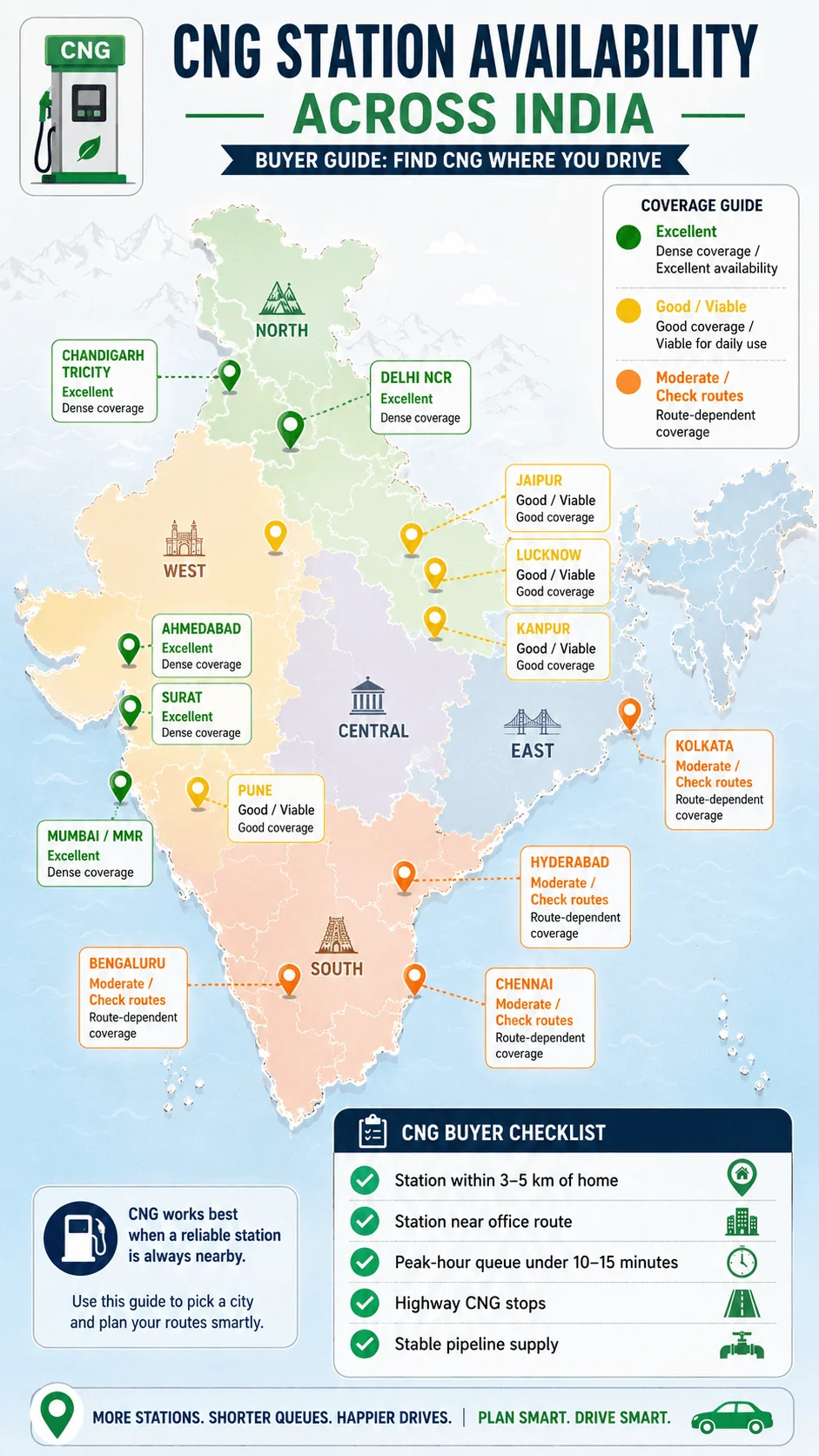
| City / Region | Station Availability | Refuelling Convenience | Buyer Verdict |
|---|---|---|---|
| Delhi NCR | Excellent | Good, peak-hour queues possible | Strong CNG city, go for it |
| Mumbai / MMR | Excellent | Good, queues at commercial hubs | Strong CNG city, go for it |
| Ahmedabad / Surat | Excellent | Mature pipeline | Strong CNG city, go for it |
| Pune | Good | Moderate, expanding fast | Viable, check daily route |
| Lucknow / Kanpur | Good | Generally reliable supply | Viable choice |
| Jaipur | Good | Moderate | Viable choice |
| Chandigarh / Tricity | Good | Good | Strong CNG city |
| Bengaluru | Moderate to Good | Mixed, heavy expansion underway | Check local routes and queues |
| Hyderabad | Moderate | Density lower than NCR | Check stations near home/office |
| Chennai | Moderate | Limited and mixed | Buy carefully, plan routes |
| Kolkata | Moderate | Limited, expanding slowly | Route-dependent, check corridors |
India had roughly 6,800 CNG stations in early 2024, and the network’s targeted to hit 17,700 by 2030, covering 98 percent of the population. The north and west are mature today. The south? That’s the gap. So if you live in Chennai, parts of Bengaluru, or a tier-2 town, treat gas as a maybe until you’ve confirmed pumps on your daily route.
A quick route checklist before you sign:
- Is there a CNG station within 3 to 5 km of home?
- Is there one near your office or commute?
- Are peak-hour queues short, say 10 to 15 minutes?
- Do your frequent highway routes have CNG stops?
- Is the city’s pipeline supply stable, so you’re not forced onto petrol during pressure drops?
Should You Buy CNG? Pros and Cons
Gas is a brilliant decision for the right driver and a frustrating one for the wrong driver. So which are you? Weigh these honestly before you commit. For a deeper breakdown, see our full guide to CNG pros and cons, and if you’re still torn between fuels, our fuel type selection guide compares petrol, diesel and CNG head to head.
Pros
- Running cost roughly half that of petrol, near ₹3 to ₹4 per km versus ₹6 to ₹7.
- Factory safety: leak sensors, auto cut-off, stainless lines, refuel lockout.
- Lower emissions than petrol or diesel.
- Full manufacturer warranty and service support retained.
- Strong resale in mature CNG markets like NCR, Mumbai and Gujarat.
Cons
- Boot space loss, total on single-cylinder cars and partial even on twin-cylinder ones.
- Power drops 10 to 15 percent on gas, felt during highway overtakes and hill climbs.
- Shorter range per fill, usually 180 to 230 km, means more frequent refuelling and queues.
- Upfront premium of ₹85,000 to ₹95,000 delays your real savings.
- Stiffer rear suspension for the tank weight can make the unladen ride firmer.
- Cylinders need hydrostatic testing and certification every few years.
| Buyer Type | Buy CNG? | Why |
|---|---|---|
| Daily commuter (>50 km/day) | Yes, if a station is nearby | High monthly savings, fast break-even |
| Low-running user ( | Usually no | Premium takes too long to recover |
| Family road-tripper | Depends | Boot space and highway CNG decide it |
| Buyer in Delhi or Mumbai | Yes | Dense network makes savings effortless |
| Buyer in a poor-network city | Cautious | Refuelling pain cancels the benefit |
| Performance-focused driver | No | Power drop and weight dull the drive |
The clean rule: buy CNG when all three line up, high monthly running, a dense local network, and a boot compromise you can live with. If even one of those fails, a frugal petrol car is the easier ownership story. It’s that simple.
FAQs
Which is the best CNG car under 10 lakhs in India? For an all-round pick, the Tata Punch iCNG leads with 5-star safety, high ground clearance, an AMT option, and twin-cylinder boot space. Want the lowest running cost? The Maruti WagonR CNG wins. And for pure mileage, the Maruti Dzire CNG tops the list at 33.73 km/kg.
Does CNG reduce boot space? Yes. A traditional single-cylinder layout eats up to 90 percent of usable boot volume. But modern twin-cylinder systems from Tata and dual-cylinder Hy-CNG Duo systems from Hyundai split the tank under the floor, so they keep most of the luggage space.
Which CNG car has the best boot space? The Tata Altroz iCNG and Hyundai Exter Hy-CNG Duo offer the most practical boots under 10 lakh. Both use twin-cylinder tech and a flat load floor that’ll take standard suitcases.
Is CNG available in my city? It varies widely. Delhi NCR, Mumbai, Ahmedabad, Surat and Pune have excellent dense networks. If you’re in Chennai, parts of Bengaluru, Hyderabad or a tier-2 town, verify pump availability and pipeline stability on your daily route before buying.
Which CNG SUV is available under 10 lakh? The Tata Punch iCNG, Hyundai Exter Hy-CNG Duo and Maruti Fronx CNG are the main SUV-styled options under the 10 lakh ex-showroom mark. The Maruti Brezza CNG and base Tata Nexon CNG offer a larger footprint but with a tighter boot.
Is factory-fitted CNG better than an aftermarket kit? Yes, clearly. Factory CNG comes with a manufacturer-calibrated ECU, upgraded valve seats, leak-detection safety, strengthened suspension, and full warranty cover. Aftermarket kits carry real safety and reliability risks, and they can void your warranty and insurance.
How much can I save with CNG versus petrol? At 2026 prices a petrol car costs about ₹6 to ₹7.50 per km while CNG runs around ₹3 to ₹4. Drive 1,500 km a month and that’s roughly ₹4,500 saved, every single month.
Does CNG reduce engine power? Yes, typically by 10 to 15 percent. You’ll barely notice it in slow city traffic, but it shows up during high-speed overtakes and steep climbs, where you’ll downshift more often.
Is Maruti CNG reliable? Very. Maruti pioneered factory CNG in India, its S-CNG systems are deeply integrated and durable, and it’s got the largest, cheapest service network in the country.
Should I buy a petrol or CNG car? Go CNG if you drive over 1,000 to 1,500 km a month and your local network is dense. Stick with petrol if your running is low, luggage space is a priority and twin-cylinder models don’t suit you, or if you want spirited performance.