
Indian roads make ground clearance a real buying factor, not just a number on a spec sheet. This guide covers 25+ cars from hatchbacks to crossovers, SUVs, MPVs plus EVs, with India ex-showroom prices and verified clearance figures from manufacturer data and recent reviews. Top picks first:
Below the shortlist, we’ve broken down the laden vs unladen confusion that makes brochure numbers misleading, plus a road-by-road guide to how much clearance you actually need.
Now here’s what most buyers miss. The clearance figure on a brochure is measured under very specific conditions, and those conditions changed in 2017 thanks to an ARAI rule revision. Older brochures showed unladen ride height, the figure with no passengers or cargo. Post-2017, ARAI mandated laden measurement at full Gross Vehicle Weight. Many numbers shrank overnight. The Toyota Fortuner fell from a stated 225 mm unladen to just 184 mm laden. The Volkswagen Tiguan dropped from 202 mm to 149 mm. The vehicles didn’t change. The yardstick did.
In 2026, most manufacturers have quietly reverted to marketing the higher unladen figure because it sells better. Volkswagen is one of the rare honest brands. Its Virtus brochure shows 179 mm unladen but a sobering 145 mm laden. So when you read a brochure, ask which figure you’re looking at. A loaded family car can sit 30 to 40 mm lower than the headline number.
Is ride height the whole story? Not quite. Three other geometry numbers matter for your bad-road confidence:
- Approach angle: how steep a ramp the front bumper can climb without scraping.
- Departure angle: the same idea, applied to the rear bumper.
- Breakover angle: how sharp a crest the underbelly can clear without high-centring.
A long sedan with 180 mm of clearance can still belly out on a tall hump because its wheelbase is too long. A short Maruti Jimny with the same body sitting 210 mm off the road can clear obstacles that would beach a much taller luxury SUV with a 3-metre wheelbase. So the number matters. Shape matters more.
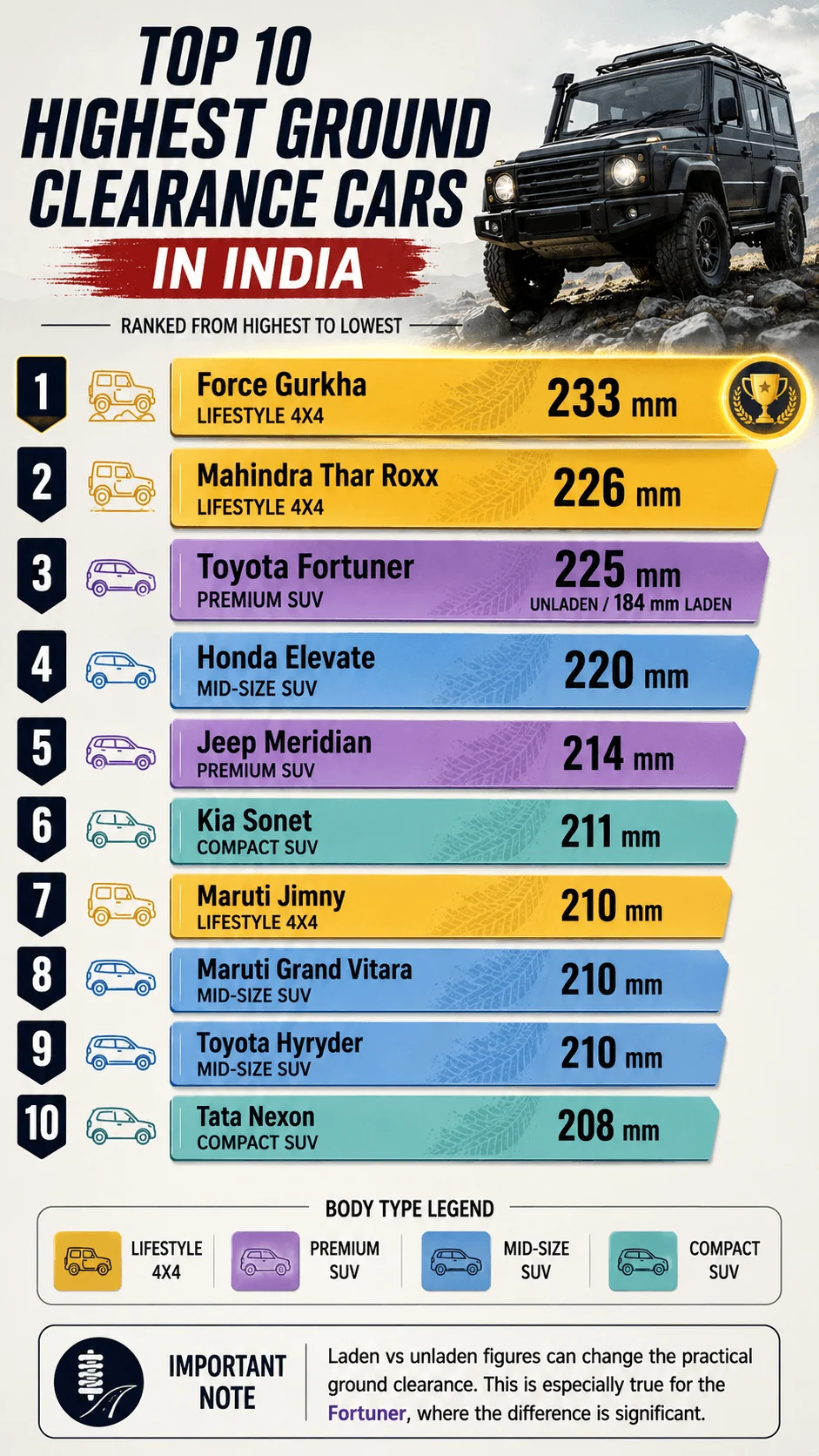
Top 25 Cars by Ground Clearance: The Master Table
This is the most comprehensive single ground clearance database you’ll find for the Indian market in 2026. Figures are unladen unless we’ve marked them otherwise. Where official sources conflict, we’ve shown you both numbers honestly rather than pick one.
| Rank | Car | Body Type | Ground Clearance | Starting Price (₹) |
|---|---|---|---|---|
| 1 | Force Gurkha | Lifestyle 4×4 | 233 mm | 16.31 lakh |
| 2 | Mahindra Thar Roxx (5-door) | Lifestyle 4×4 | 226 mm | 12.99 lakh |
| 3 | Toyota Fortuner | Premium SUV | 225 mm (unladen) / 184 mm (laden) | 33.64 lakh |
| 4 | Honda Elevate | Mid-size SUV | 220 mm | 11.91 lakh |
| 5 | Jeep Meridian | Premium SUV | 214 mm | 38.99 lakh |
| 6 | Kia Sonet | Compact SUV | 211 mm | 8.00 lakh |
| 7 | Maruti Jimny | Lifestyle 4×4 | 210 mm | 12.74 lakh |
| 8 | Maruti Grand Vitara | Mid-size SUV | 210 mm | 11.42 lakh |
| 9 | Toyota Hyryder | Mid-size SUV | 210 mm | 11.34 lakh |
| 10 | Tata Nexon | Compact SUV | 208 mm | 8.00 lakh |
| 11 | Tata Curvv (ICE) | Coupe-SUV | 208 mm | 10.00 lakh |
| 12 | Tata Harrier | Mid-size SUV | 205 mm (unladen) / 150 mm (laden) | 15.49 lakh |
| 13 | Tata Safari | Three-row SUV | 205 mm (unladen) / 150 mm (laden) | 16.19 lakh |
| 14 | MG Astor | Mid-size SUV | 205 mm | 11.30 lakh |
| 15 | Renault Kiger | Compact SUV | 205 mm | 6.15 lakh |
| 16 | Nissan Magnite | Compact SUV | 205 mm | 6.20 lakh |
| 17 | Mahindra XUV 3XO | Compact SUV | 201 mm | 7.99 lakh |
| 18 | Mahindra XUV 7XO | Premium SUV | 200 mm | 14.20 lakh |
| 19 | Maruti Brezza | Compact SUV | 200 mm | 8.34 lakh |
| 20 | Citroën Aircross | Compact SUV | 200 mm | 8.92 lakh |
| 21 | Tata Punch | Micro SUV | 187 / 193 mm (sources differ) | 6.13 lakh |
| 22 | Mahindra Scorpio-N | Premium SUV | 187 mm (India laden) / 227 mm (global unladen) | 13.99 lakh |
| 23 | Mahindra Bolero / Bolero Neo | Rural SUV | 180 mm | 7.99 lakh |
| 24 | Volkswagen Virtus | Sedan | 179 mm (unladen) / 145 mm (laden) | 11.56 lakh |
| 25 | Skoda Slavia | Sedan | 179 mm | 11.63 lakh |
A few numbers from that table deserve a closer look from you.
- The Gurkha isn’t just tall. Its bumpers also tuck out of the way (39° approach, 37° departure, 28° breakover angle), so the height is genuinely usable, not cosmetic.
- The Honda Elevate is the surprise standout here. Honda historically built sedans that bottomed out on Mumbai speed breakers, and buyers complained loudly through forums and reviews. The Elevate’s 220 mm is an over-correction, and Indian families love it for exactly that reason.
- The Tata Nexon at 208 mm beats the Toyota Fortuner’s laden 184 mm by 24 mm. Yes, you read that right. Visual size doesn’t equal underbody real estate.
- The Scorpio-N anomaly is the cleanest evidence of measurement gymnastics you’ll find. The same vehicle, built on the same assembly line, with the same suspension hardware, gets sold as 227 mm unladen in Australia but reported as 187 mm laden in India. Both numbers are technically correct under their own rules. The car is identical.
Ground Clearance by Segment
Not everyone is shopping for a 4×4. The honest answer? You don’t need a body-on-frame SUV to stop scraping on Indian streets. Here’s how each segment stacks up for your shortlist.
Hatchbacks With Good Ground Clearance
If your priority is a high-stance hatchback under ₹8 lakh, your shortlist starts here.
| Hatchback | Ground Clearance | Verdict |
|---|---|---|
| Citroën C3 | 180 mm | Best-in-class for a sub-₹6 lakh hatchback. SUV-ish stance without SUV pricing. |
| Renault Kwid | 184 mm | High-riding budget hatch with crossover styling. |
| Tata Tiago NRG | 181 mm | The off-road-styled Tiago variant. Far better than the regular 170 mm. |
| Maruti S-Presso | 180 mm | Tall-boy stance disguises that it’s a sub-₹5 lakh hatchback. |
| Maruti Ignis | 180 mm | Genuinely tall for a Maruti Arena hatchback. |
| Hyundai Exter | 185 mm | Crossover-style hatch from Hyundai. Comfortably tall enough for most cities. |
| Tata Tiago (regular) | 170 mm | Manageable for smooth city use. Not a bad-road hero. |
| Maruti Baleno | 170 mm | Mid-tier. Fine for normal roads, careful over tall breakers. |
| Maruti Swift | 163 mm (unladen) | One of the lowest in this list. Designed for handling, not for broken roads. |
Sedans With Good Ground Clearance
Worried that buying a sedan means you’ll always scrape over Indian speed breakers? The Volkswagen Group’s Virtus and Slavia have effectively ended that debate. At 179 mm unladen, both ride higher than the Jeep Compass (178 mm), a premium SUV that costs nearly twice as much.
| Sedan | Ground Clearance | Verdict |
|---|---|---|
| Volkswagen Virtus | 179 mm unladen / 145 mm laden | The dynamic sedan that handles Indian roads. Watch the laden figure. |
| Skoda Slavia | 179 mm | Same platform as Virtus, slightly more conservatively tuned. |
| Honda Amaze | 172 mm | Healthy for a compact sedan, still cautious over tall breakers. |
| Tata Tigor | 170 mm | Reasonable for a sub-₹7 lakh sedan. |
| Hyundai Verna | 170 mm | Better than older Hyundai sedans, fine for highways. |
| Honda City | 165 mm | Updated upward over the years, but still a sedan first. |
| Hyundai Aura | 165 mm | Compact sedan baseline. |
| Maruti Dzire | 163 mm (unladen) | Lowest mainstream sedan. Smooth roads only. |
Compact SUVs and Crossovers (185–211 mm)
If you’re an urban family with a mix of city and highway driving, this segment is your sweet spot. You get usable clearance without the price, fuel or parking penalty of a larger SUV.
| Compact SUV | Ground Clearance | Verdict |
|---|---|---|
| Kia Sonet | 211 mm | One of the highest sub-4-metre SUVs. |
| Tata Nexon | 208 mm | Class-leading for a structurally strong, 5-star Bharat NCAP compact SUV. |
| Renault Kiger | 205 mm | Big number for a budget compact SUV. |
| Nissan Magnite | 205 mm | Same platform as Kiger, same 205 mm. |
| Mahindra XUV 3XO | 201 mm | Refreshed XUV300 successor with proper Mahindra rural-road DNA. |
| Maruti Brezza | 200 mm | Reliable Maruti SUV with respectable clearance. |
| Citroën Aircross | 200 mm | Comfort-tuned French-made crossover for Indian potholes. |
| Skoda Kylaq | 189 mm | New entrant to the segment with a clean 189 mm figure. |
| Skoda Kushaq | 188 mm | Strong all-rounder. |
| Volkswagen Taigun | 188 mm (unladen) / 155 mm (laden) | Twin to Kushaq. Published laden figure is unusually honest. |
| Hyundai Exter | 185 mm | Urban entry SUV. Enough for most metros. |
Mid-Size SUVs (190–220 mm)
| Mid-Size SUV | Ground Clearance |
|---|---|
| Honda Elevate | 220 mm |
| Maruti Grand Vitara | 210 mm |
| Toyota Hyryder | 210 mm |
| Tata Harrier | 205 mm unladen / 150 mm laden |
| MG Astor | 205 mm |
| Mahindra XUV 7XO | 200 mm |
| Hyundai Creta | 190 mm |
| Kia Seltos | 190 mm |
| MG Hector | 192 mm (laden) |
Lifestyle 4x4s (210–233 mm)
If your weekends genuinely involve mud, rocks or river crossings, this is your club.
| 4×4 SUV | Ground Clearance | Hardware |
|---|---|---|
| Force Gurkha | 233 mm | Differential locks, snorkel, 700 mm water wading |
| Mahindra Thar Roxx | 226 mm | 4XPLOR 4WD, 650 mm water wading |
| Mahindra Thar (3-door) | 226 mm | Same drivetrain, shorter wheelbase |
| Toyota Fortuner | 225 mm unladen / 184 mm laden | Part-time 4WD, A-TRC |
| Maruti Jimny | 210 mm | AllGrip Pro 4WD, ladder frame, ultra-short wheelbase |
MPVs
| MPV | Ground Clearance | Best For |
|---|---|---|
| Mahindra Marazzo | 190 mm | Highest in segment. Family hauler with SUV-like clearance |
| Maruti Ertiga / XL6 | 185 mm | Mainstream 7-seater MPV baseline |
| Toyota Innova Hycross | 185 mm | Premium MPV. Lower than expected but compensated by suspension tuning |
| Renault Triber | 182 mm | Budget 7-seater, respectable for the price |
| Kia Carens | 190 mm | Crossover MPV with raised stance |
Electric Cars: The Battery Floorpan Penalty
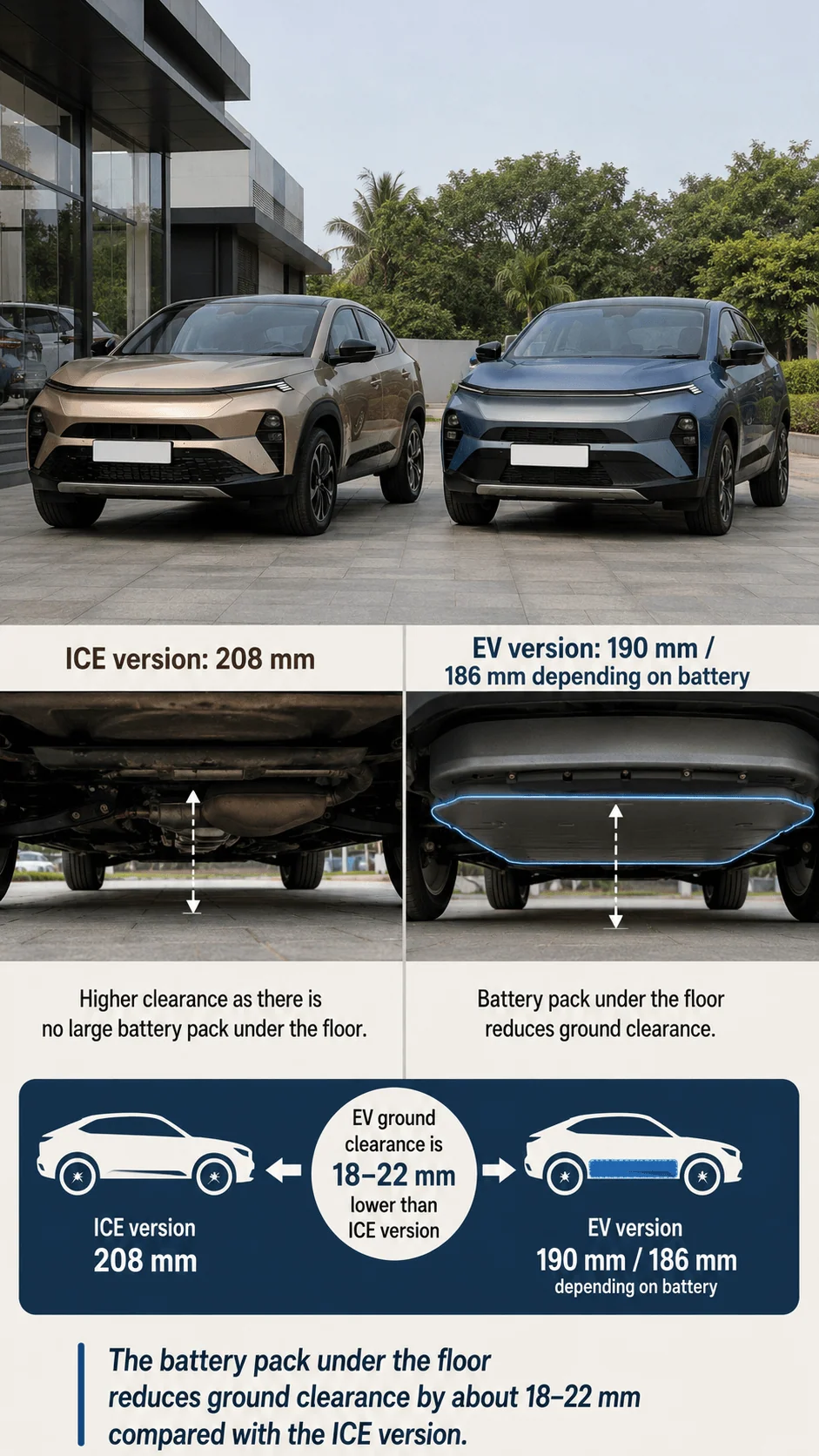
EVs lose ride height because the battery pack lives under the floor. The Tata Curvv proves the point neatly, because you can buy both versions of the same car. The ICE Curvv sits comfortably at 208 mm. Slot in a 45 kWh battery pack instead of the petrol drivetrain and you’re down to 190 mm. Opt for the heftier 55 kWh long-range version designed for highway commuters and the figure sinks further to 186 mm. A full 22 mm penalty for the bigger battery. Before you load up the boot.
| Electric Car | Ground Clearance | Notes |
|---|---|---|
| Tata Curvv EV (45 kWh) | 190 mm | 18 mm drop vs ICE Curvv |
| Tata Curvv EV (55 kWh) | 186 mm | 22 mm drop |
| Tata Nexon EV | 190–205 mm | Varies by battery (30 kWh / 45 kWh) |
| Tata Punch EV | 190–195 mm | Reasonable for converted platform |
| MG Windsor EV | 186 mm | Dedicated EV platform with rigid battery casing protects underbody |
| Citroën eC3 | 170 mm | Lower than ICE version. Watch for waterlogging |
If you’re buying an EV, ask one extra question of your salesperson. How well is the battery protected? A battery casing with a steel or aluminium skid plate matters more than the headline mm number ever will. Underbody battery damage repair can cost ₹3 to 5 lakh out of warranty, and that’s a number that should focus the mind.
Video Explaining How Much Ground Clearance You Actually Need

Minimum Ground Clearance for Indian Roads
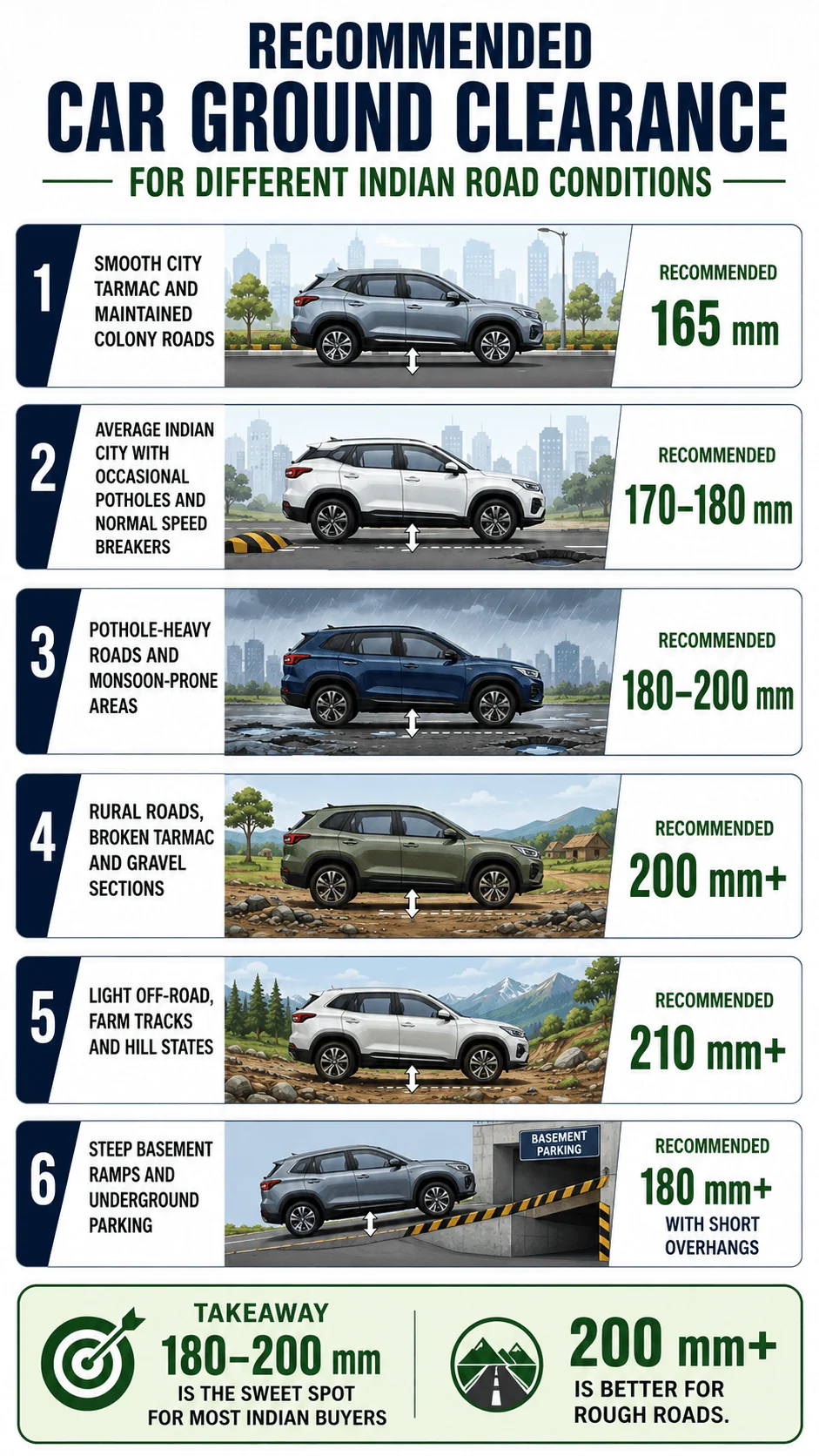
So how do you actually decide what you need? It depends on the roads you drive every day. Here’s a practical breakdown to help you match your usage to a clearance figure.
| Your Roads | Minimum Recommended | Body Type That Works |
|---|---|---|
| Smooth city tarmac, well-maintained colony roads | 165 mm | Hatchback or sedan |
| Average Indian city (occasional pothole, normal speed breakers) | 170–180 mm | Sedan, hatchback, or small crossover |
| Pothole-heavy roads, monsoon-prone areas | 180–200 mm | Compact SUV or crossover |
| Rural roads, broken tarmac, gravel sections | 200 mm+ | Compact or mid-size SUV |
| Light off-road, farm tracks, hill states | 210 mm+ | Lifestyle 4×4 or rugged SUV |
| Steep basement ramps and underground parking | 180 mm+ with short overhangs | Compact SUV |
A few practical rules to keep in mind:
For city use, 165 to 180 mm is genuinely enough. Cars like the Honda City, Volkswagen Virtus, Skoda Slavia and Hyundai Verna handle metro driving fine. The catch? Loaded-car behaviour. Pile in five adults plus boot luggage and you can drop 30 to 40 mm. If that takes you under 150 mm, expect scrapes on the worst speed breakers in your area.
For pothole-heavy areas, 180 to 200 mm is the comfort zone. The Hyundai Exter, Skoda Kylaq, Kushaq and Taigun, Citroën C3 and Aircross all sit comfortably in this band. You get noticeably more confidence than a sedan, without paying for a body-on-frame SUV or sacrificing fuel economy in the process. That’s the sweet spot for most metro buyers.
For rural use and bad roads, 200 mm plus is where your life gets noticeably easier. The Tata Nexon, Maruti Grand Vitara, Honda Elevate, Renault Kiger, Nissan Magnite and Kia Sonet all clear this bar comfortably. Below ₹10 lakh, the Magnite and Kiger at 205 mm are unbeatable value for buyers in tier-2 towns.
For lifestyle 4×4 use, 220 mm plus with proper approach and departure angles is your answer. Gurkha, Thar Roxx and Jimny aren’t just tall. Each one is geometrically designed to crawl over obstacles where lesser SUVs would belly out. The Fortuner sits in this club too, even with its laden 184 mm figure on paper.
So is higher always better for you? Not really. A taller centre of gravity means more body roll in corners and a less planted highway feel at three-digit speeds. For 90% of Indian buyers, 180 to 200 mm is the sweet spot. Enough to stop worrying about underbody hits. Not so much that you trade ride quality and handling for paranoia. That’s exactly why crossovers dominate Indian sales charts today.
If you’re still weighing whether to pick a hatchback, sedan or SUV in the first place, read our guide on choosing the right body type.
FAQs
What ground clearance is enough for Indian roads?
Short answer: 180 to 200 mm. That spread covers the vast majority of buyers across metros and tier-2 cities, with enough margin to handle tall speed breakers and most monsoon waterlogging even when the car is fully loaded with five adults and luggage. If your roads are mostly smooth tarmac, 165 to 180 mm works fine. Driving on broken roads, village routes, or unpaved diversions every day? Aim for 200 mm or more.
Which car has the highest ground clearance in India?
The Force Gurkha at 233 mm unladen is the tallest road-going car you can buy here today, paired with proper off-road geometry (39° approach, 37° departure, 28° breakover) that makes the number genuinely usable rather than just impressive on paper. Outside this list, the Land Rover Defender Octa goes up to 323 mm with air suspension fully raised. But it’s a ₹2 crore plus niche toy.
Which SUV has the highest ground clearance under ₹15 lakh?
The Mahindra Thar Roxx at 226 mm (starting ₹12.99 lakh) is your tallest SUV under ₹15 lakh. Honourable mentions: Maruti Jimny at 210 mm, Mahindra XUV 3XO at 201 mm.
Which hatchback has the best ground clearance?
The Citroën C3 at 180 mm is the tallest among true hatchbacks. The Renault Kwid (184 mm) edges past on paper. The Kwid sits in sub-compact crossover-hatchback territory rather than the traditional hatch class, so the C3 wins among proper hatches sold here. The Maruti Ignis, S-Presso and Tata Tiago NRG also breach the 180 mm line.
Which sedan has the best ground clearance in India?
The Volkswagen Virtus and Skoda Slavia at 179 mm unladen, both built on the same MQB-A0-IN platform that VAG localised heavily for Indian conditions over a multi-year engineering programme that included extensive bad-road testing across Uttarakhand and Rajasthan. The Virtus drops to 145 mm laden though. It’s the only mainstream sedan publishing both numbers honestly.
Is 180 mm ground clearance enough for India?
Yes for urban driving. 180 mm clears most speed breakers, normal potholes and basement ramps without scraping the underside of your car. Where it falls short for you: rural routes, deep monsoon waterlogging in cities like Mumbai or Chennai during the July-September peak, and unpaved farm tracks where the surface is uneven and rocky in unpredictable ways.
Is 200 mm ground clearance good?
Excellent, actually. 200 mm is the comfort zone for Indian conditions, and going much higher rarely adds practical benefit unless you genuinely venture off-road on a regular basis. It handles broken roads, deep potholes and most rural routes without stress. Compact SUVs like the Tata Nexon, Mahindra XUV 3XO, Maruti Brezza and Citroën Aircross all sit at or above this mark.
Does ground clearance affect ride quality?
Indirectly, yes. A taller stance allows more suspension travel, which can genuinely improve rough-road absorption when engineers have tuned the dampers properly to take advantage of that extra travel. But it also lifts the centre of gravity, and that increases body roll in fast corners. Real ride quality depends more on suspension tuning, tyre sidewall height and wheelbase than on raw mm figures.
Does ground clearance reduce when the car is loaded?
Yes. Significantly. The Volkswagen Virtus drops from 179 mm unladen to 145 mm laden, a 34 mm cut. That’s enough to change which speed breakers your sedan can clear on a Sunday family outing. The Toyota Fortuner falls from 225 mm to 184 mm. So when you’re shopping, always factor in your real-world passenger and luggage load before signing.
What’s the difference between laden and unladen ground clearance?
Unladen is measured with the car empty (just fluids, no people or luggage). Laden is measured at maximum permitted weight. ARAI mandated laden measurement in 2017, which made many brochure figures shrink overnight. Most brands now market the higher unladen number; some, like Volkswagen, publish both.
Does higher ground clearance mean better safety?
No. Ground clearance is about obstacle clearance, not crash safety. Crash safety depends on body structure, airbag count, ABS, ESC and Bharat NCAP rating, which together determine how well your car protects you in an actual collision. A taller car with a poor crash structure is not safer than a lower car with a 5-star Bharat NCAP rating.
Why is the Tata Punch listed as 187 or 193 mm?
Tata’s own current literature shows both figures across different product pages, and that’s a real source of buyer confusion at dealerships. Their specifications page lists 193 mm. Other Tata communications cite 187 mm. If the Punch is on your shortlist, verify the figure for your specific variant in the latest brochure before booking.
Why do EVs have lower ground clearance than petrol cars?
Because the battery pack lives under the floor. The Tata Curvv ICE has 208 mm. The same body as an EV drops to 186 to 190 mm depending on battery size. Battery casing armour matters as much as the headline mm number, so ask about underbody skid plate protection.
Why is the Mahindra Scorpio-N listed as 187 mm in India but 227 mm in Australia?
Same vehicle, two measurement standards. India uses ARAI laden (full Gross Vehicle Weight), while Australia uses the unladen state. That 40 mm gap is purely suspension compression under maximum passenger and cargo load. The physical hardware is identical, right down to the dampers. Only the measurement rule differs.
Should I buy an SUV only for ground clearance?
Honestly, no. Crossovers in the 180 to 189 mm band, including the Hyundai Exter, Skoda Kushaq, and VW Taigun, handle most Indian conditions perfectly well without the cost, fuel and dynamic compromises that come with a body-on-frame SUV. Pick an SUV for the full package, including capability, presence, seating position and resale value. Not just the biggest number on a spec sheet. For the all-round picks, see our best SUVs in India rankings.
Bottom line: match the figure to your roads, not to your ego. For most Indian buyers, anything from 180 mm to 210 mm is the practical sweet spot. That range covers your everyday city use, monsoon waterlogging, occasional rural commutes and steep basement ramps without making you trade off ride quality or fuel economy in the process. Save the 220 mm plus machines for when your weekends genuinely involve mud, rocks, and unpaved trails. Pick the right tool for your roads.