
Is a sunroof actually worth it in India? Over 25% of new cars sold here today come with one, up from just 7% five years ago. The same trim line can see up to 55% higher sales when a sunroof is added. But behind the showroom appeal sit some uncomfortable realities for Indian conditions: 45°C summer afternoons, dust-choked drain tubes, monsoon leaks, and panoramic glass that costs over a lakh to replace. If you still want one, see our pick of sunroof cars under ₹15 lakh.
This guide breaks down every sunroof type you’ll find in 2026 showrooms, what’s genuinely useful versus pure aesthetics, and whether the ₹50,000 to ₹1.5 lakh premium is worth it for your car and your city.
Types of Sunroofs in Cars
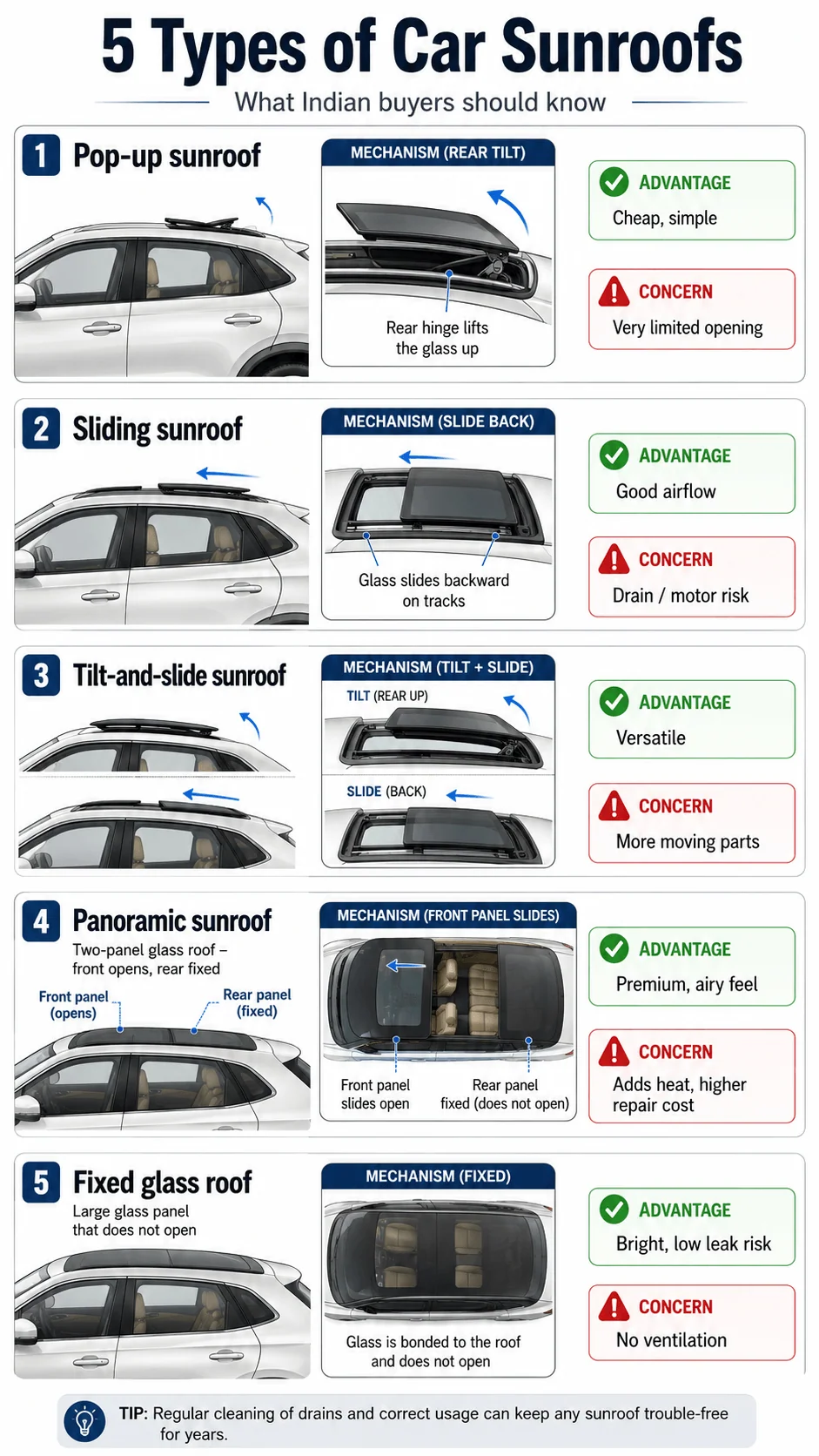
You’ll come across five sunroof types in Indian showrooms. Each one has a different mechanism, price tag, and set of long-term ownership trade-offs.
| Sunroof Type | How It Works | Main Advantage | Main Concern |
|---|---|---|---|
| Pop-up | Tilts open manually or electrically at the rear edge | Cheap, fewer moving parts | Limited opening, almost extinct on new cars |
| Sliding | Glass panel retracts on tracks, either internally or externally | More airflow, premium feel | Drain blockage, motor failure risk |
| Tilt-and-slide | Combines tilt and slide modes in one mechanism | Most versatile small sunroof | More moving parts to maintain |
| Panoramic | Massive multi-panel glass spanning most of the roof | Premium ambience, rear passenger view | Heat absorption, expensive repairs |
| Fixed glass roof | Bonded glass panel, doesn’t open | Bright cabin, no leak risk | Zero ventilation, costly to replace if damaged |
Pop-Up Sunroof
The oldest and simplest design. A small panel tilts upward at the rear edge via a manual latch or basic electric actuator. Almost extinct on new Indian cars in 2026, replaced by sliding mechanisms with bigger apertures.
Sliding Sunroof
This is the default on most mainstream Indian cars under ₹15 lakh. An electric motor drives the glass along longitudinal tracks, either inward between the roof and headliner, or externally over the rear roof. You’ll find this on your Hyundai i20, Tata Punch, Tata Nexon, Kia Sonet, Mahindra XUV 3XO and Hyundai Venue. The cassette houses internal drain channels that clog easily in your dusty city.
Tilt-and-Slide Sunroof
This is the most practical small-car version you can buy. The motorised panel either tilts up at the trailing edge for passive heat extraction, or slides back fully. Use the tilt mode to vent trapped cabin air before you switch on the AC. The trade-off? More moving parts and dual-axis motors that strain over time.
Panoramic Sunroof
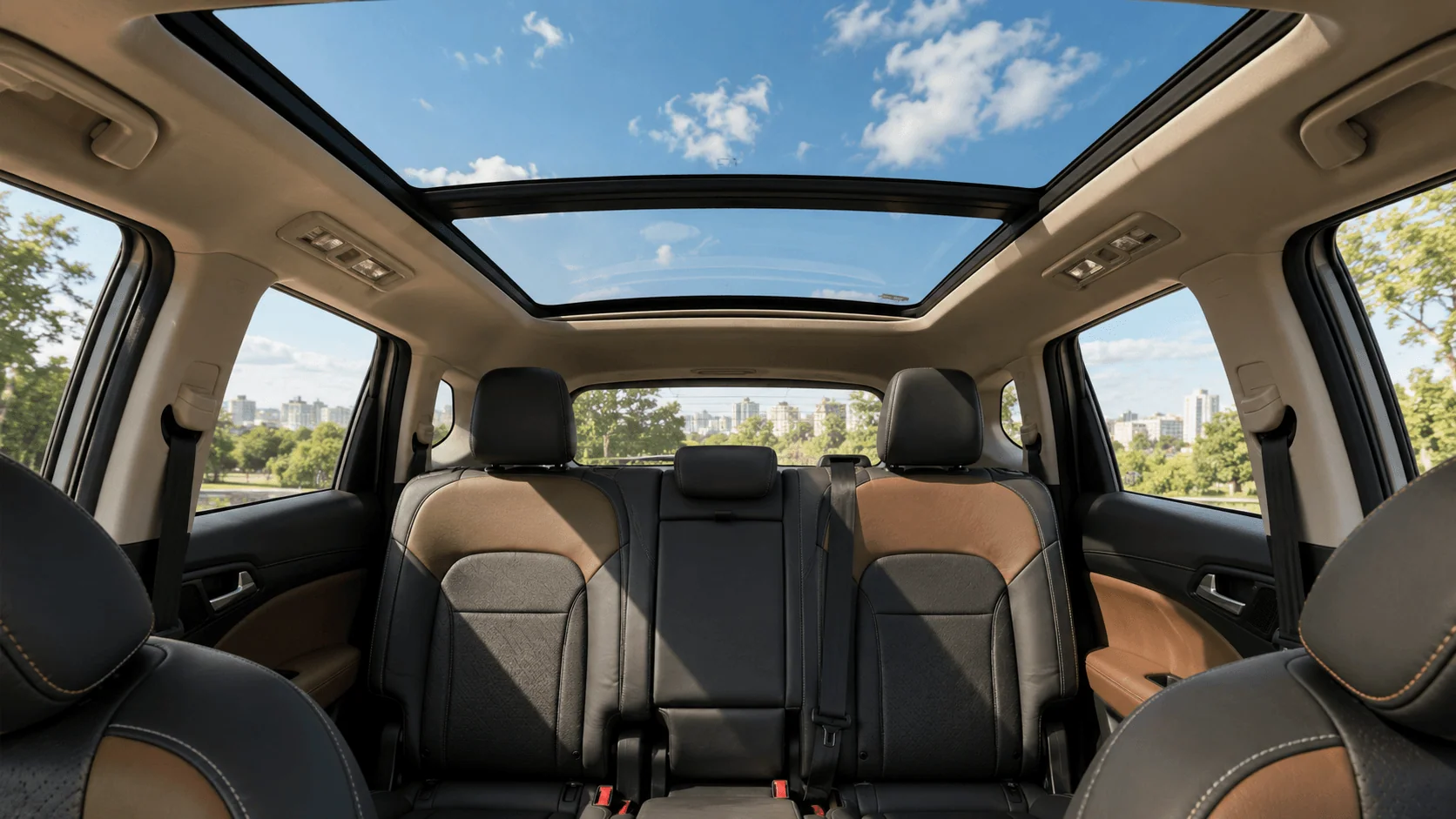
The current showroom hero. A massive glass panel, usually split in two, stretches across both rows. The front section tilts and slides; the rear is typically fixed. The Tata Nexon Pure+ PS at ₹9.59 lakh is currently the cheapest car in India with one. Above it: Hyundai Creta, Kia Seltos, Toyota Hyryder, VW Virtus, Skoda Kylaq, Honda Elevate and most premium SUVs.
Panoramic roofs sell on emotion. Your rear passengers, who get nothing from a small sunroof, finally have something to look at. But the heat penalty in Indian summers is substantial, and your out-of-warranty repair bills get uncomfortable fast.
Fixed Glass Roof
A stationary glass panel bonded to the body, common on premium EVs and luxury cars. No motors, no tracks, no drain cassette, so essentially zero leak risk. The catch is zero ventilation, and replacement after a shatter is alarmingly expensive because of the specialised bonding needed.
Advantages of Having a Sunroof
So what does a sunroof actually do for you? It improves the cabin feel more than it improves the car. Treat it as a comfort upgrade, not a functional one.
1. Premium cabin feel. Glass overhead makes your interior look bigger and airier, especially in cars with dark interiors and high beltlines (basically every modern Indian SUV).
2. More natural light. Modern cars have thicker pillars and smaller side windows for crash safety. Your sunroof partly compensates for that and cuts driver fatigue on long drives.
3. Real ventilation in mild weather. Hot air rises. Pop your sunroof to tilt position for 30 seconds before switching on the AC and you dump a lot of trapped cabin heat fast. At low city speeds or cool morning drives, you get fresh airflow with much less wind noise than rolling all four windows down.
4. Better resale appeal in mid-size SUVs. A factory-fitted sunroof on a Creta, Hyryder or Elevate noticeably improves your used-car desirability when you sell.
5. Family and lifestyle appeal. Kids love them. Family road trips, scenic highways and mild winter drives are where your sunroof actually earns its keep.
Disadvantages and Common Problems
Heat Build-up in Indian Summers
Live in Delhi, Chennai, Hyderabad, Ahmedabad or Bengaluru? Your summer afternoons regularly cross 40°C. A large glass area acts as a thermal amplifier, dumping infrared into the cabin and making your AC work harder. Most manufacturers fit thin perforated cloth sunshades that don’t block enough heat. For April–June, your shade stays shut all day, which means the expensive glass is doing nothing functional.
Dust and Drain Blockage
Fine dust and tree debris collect around rubber seals and inside drain channels. The dust mixes with factory track grease into an abrasive paste that grinds plastic glide shoes and strains the motor. Blocked drains are the biggest single cause of water entering the cabin during monsoon.
Monsoon Leakage Risk
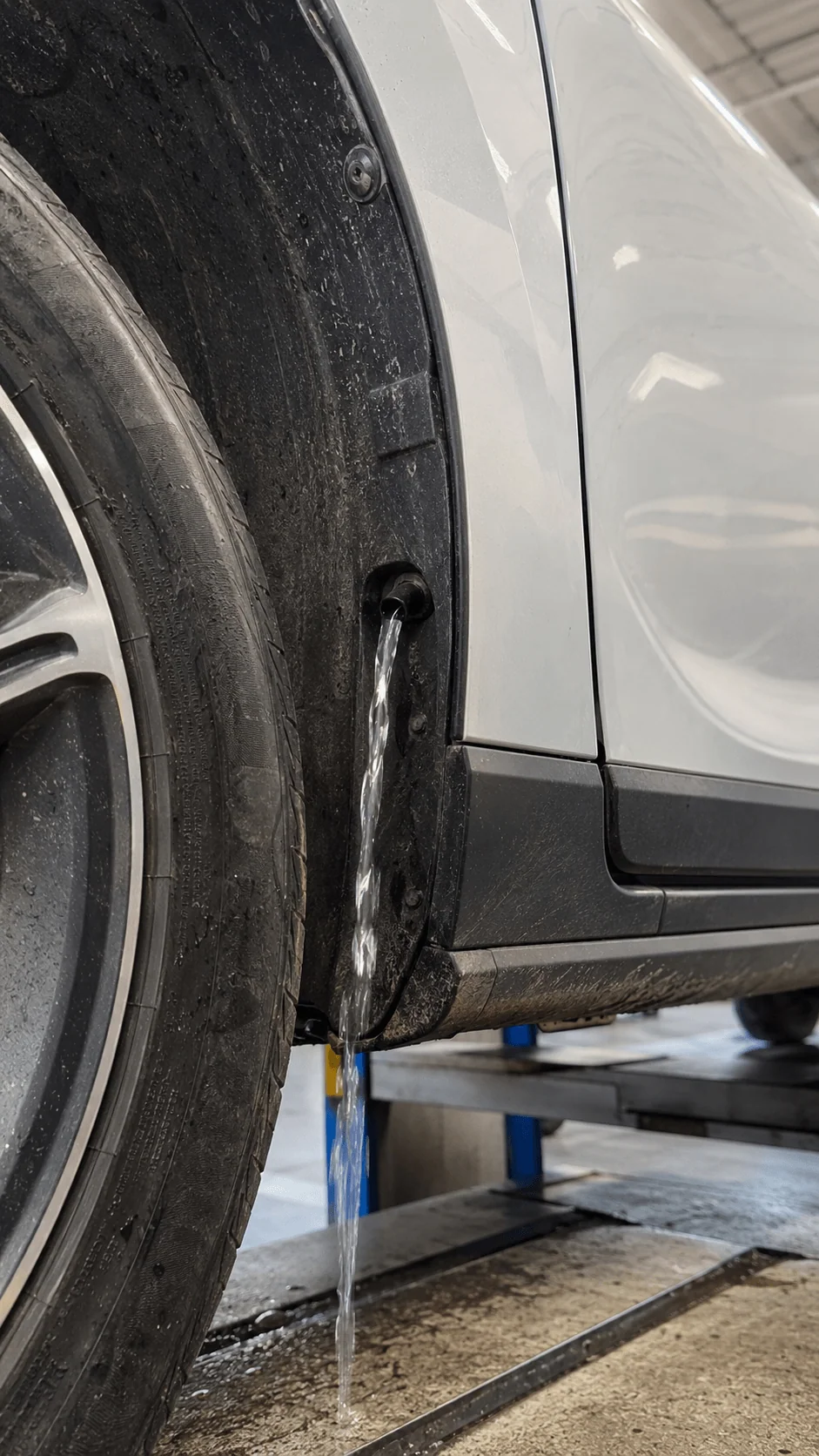
Does sunroof cause leakage? A properly designed and maintained one shouldn’t leak directly. Sunroofs aren’t perfectly sealed. Water bypassing the upper rubber seal is normal, and the cassette routes it down through narrow drain tubes inside the A-pillars and C-pillars, exiting near the wheel arches.
Leakage happens when those tubes clog. CarToq documented multiple Mahindra XUV700 owners reporting water streaming through the panoramic sunroof’s sunglass holder during heavy rains, eventually pushing Mahindra to redesign the drainage. Watch your headliner for damp patches, stains, or a musty smell. Those are your early warnings.
Higher Repair and Replacement Cost
A shattered panoramic panel can cost you ₹60,000 to over ₹1.5 lakh. Motor or regulator faults often need the entire headliner removed for repair. Your insurance? It’s a minefield. Comprehensive policies generally cover shattered glass from accidental damage but routinely exclude mechanical breakdown of motors, rails or aged seals as wear-and-tear. A shattered panoramic claim may even invoke your collision deductible rather than standard glass-replacement terms. Read the fine print before you sign.
Reduced Headroom and Added Weight
The mechanism, drainage cassette, motor housing and sunshade eat 25 to 35 mm of vertical space. If you’re tall, you’ll feel this immediately in sedans and hatchbacks. The assembly also adds 15 to 30 kg at the highest point of your vehicle, marginally raising the centre of gravity.
Noise, Rattles, and Long-Term Wear
Cutting a large hole into the unibody affects torsional rigidity. Over time, chassis flex over potholes transfers into your sunroof frame. Rubber seals harden, tracks dry up, and misaligned glass generates wind noise at highway speeds. Panoramic frames are particularly prone to creaks and rattles, a complaint you’ll hear repeatedly across Indian owner forums.
Safety Misuse and the Legal Side
A uniquely Indian problem: standing through a moving sunroof for selfies, social videos, or wedding processions. What are you risking? Sudden braking, low-hanging wires, kite strings, road debris, rollover crushing. Karnataka Police now actively penalise this under Section 177 of the Motor Vehicles Act, with fines of ₹100 to ₹300.
Thinking about an aftermarket sunroof? Don’t. Cutting structural roof bows on a car not designed for it compromises crash safety. Under Section 52 of the Motor Vehicles Act, reinforced by a 2019 Supreme Court ruling, this is illegal. You’re looking at ₹5,000 fines, immediate RC cancellation, and total insurance denial if you crash.
Sunroof Maintenance Tips for Indian Climate
Skip the maintenance and you’ll pay for it later. Indian dust, UV exposure and monsoon rain are unusually harsh on sunroof mechanisms, so treat this as a non-negotiable part of your overall car maintenance schedule.
| Task | Frequency | Why It Matters |
|---|---|---|
| Wipe seals and visible edges with damp microfiber cloth | Monthly | Prevents abrasive dust build-up around rubber |
| Pour a cup of water into each corner of the cassette gutter (sunroof open). Should drain within 10–15 seconds | Before and after monsoon | Confirms drain channels are clear |
| Inspect EPDM rubber seals for cracks, hardening, brittleness | Every service | Catches early water seepage and wind noise issues |
| Open and close the sunroof fully | At least weekly | Keeps motor and tracks active, lets you hear early grinding |
| Check headliner fabric for stains, dampness, musty smell | Monthly, more during monsoon | First warning sign of hidden drain failure |
| Avoid pressure washing directly at sunroof seals | Always | High PSI breaches the seal and forces water into the cabin |
Three critical don’ts:
- Don’t use WD-40, engine oil or chassis grease on the tracks. Use only PTFE dry lubricant, white lithium grease, or silicone-based track spray.
- Don’t open the sunroof during rain or right after a dusty drive. The mixture goes straight into the tracks.
- Don’t force a stuck sunroof. You’ll strip the motor gears or warp alignment brackets. That’s a five-figure repair.
Before every monsoon, get your service centre to flush the drain channels with compressed air. Most owners skip this step. Six months later, those same owners pay for a soaked headliner.
Is Sunroof Worth the Extra Cost?
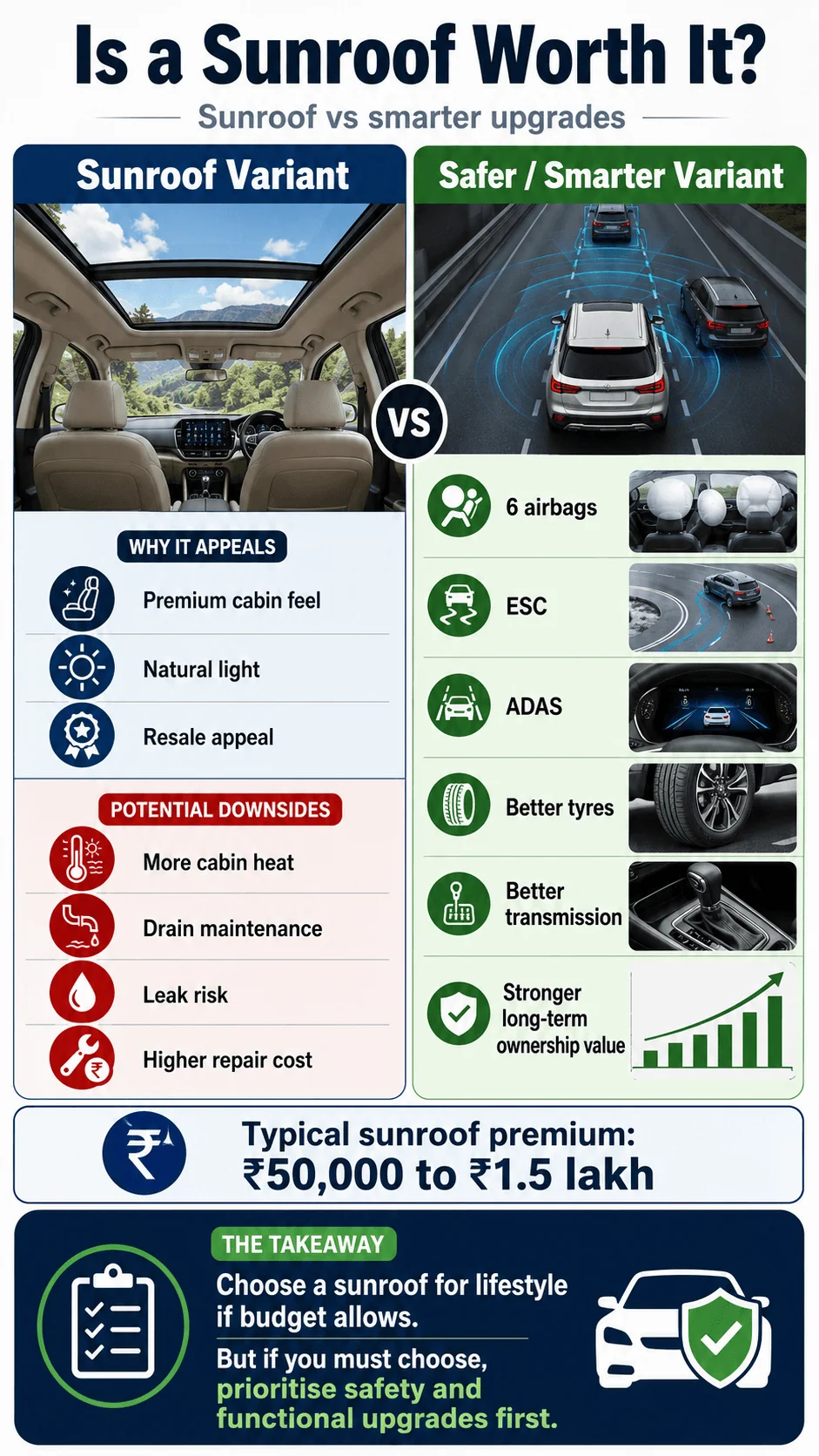
So how much extra do you pay? The price premium runs from ₹50,000 to ₹1.5 lakh depending on segment. Whether it’s worth it depends entirely on what kind of owner you are.
A sunroof is worth it if you value cabin ambience, park in covered spots most days, travel often on scenic or highway routes, are buying a mid-size SUV where the feature helps resale, and are committed to the maintenance schedule above.
A sunroof is not worth it if you live in a hot, dry city and park outdoors daily, you’re stretching budget to afford a higher variant just for the sunroof, you’re a tall passenger who needs maximum headroom, you plan to keep the car well past warranty, or you’d rather have six airbags, ESC, ADAS or a better transmission for similar money.
| Buyer Type | Recommendation |
|---|---|
| City commuter in hot climate | Nice to have, not essential |
| Family SUV buyer | Worth considering if budget allows |
| Budget hatchback buyer | Skip. Prioritise safety and essentials |
| Long-term owner (7+ years) | Buy only if ready for maintenance commitment |
| Scenic/highway traveller | Genuinely improves cabin experience |
| Outdoor parking user | Be cautious; heat and dust will accelerate wear |
Verdict: In the Indian context, a sunroof is worth it mainly as a lifestyle and premium-feel feature. It’s not an essential automotive upgrade. If you’re forced to choose between a sunroof variant and a variant offering six airbags, ADAS, ESC, better tyres, or a smarter transmission for similar money, those functional upgrades will matter more across your ownership cycle.
FAQs
Is sunroof safe in Indian heat? Yes. Factory-fitted sunroofs use toughened or laminated automotive safety glass. The real issue isn’t safety, it’s thermal load. A high-quality opaque sunshade and factory IR-rejection coating make a big difference.
Does sunroof cause leakage? Not if it’s working correctly. Leaks almost always come from clogged drain channels, hardened seals, or misaligned tracks after a poor service. Flush the drains before every monsoon and the risk drops sharply.
Is panoramic sunroof worth it? Worth it if you value the airy cabin feel and have covered parking. Not if you park outdoors daily in a hot city. The heat penalty and repair cost outweigh the experience for most buyers.
What are common panoramic sunroof problems? Excessive radiant heat, acoustic rattles from chassis flex, blocked drain channels causing headliner leaks, and steep replacement costs if the glass shatters from thermal stress.
Does sunroof affect car mileage? The 15–30 kg weight gain has negligible direct impact. The indirect hit is real though. Higher cabin heat makes the AC work harder, slightly reducing fuel efficiency in peak summers.
Should I choose sunroof or better safety features? Always prioritise safety. If you’re choosing between a sunroof variant and one with six airbags, ESC, or ADAS for similar money, take the safety features.
Is aftermarket sunroof a good idea? No. It’s structurally unsafe, illegal under Section 52 of the Motor Vehicles Act, and voids your insurance if you crash. Penalties include ₹5,000 fines and RC cancellation.
Buying a car with a sunroof? Pair this guide with our full car maintenance schedule to keep the mechanism healthy past warranty.