
Are handling charges by car dealers illegal? Not flatly, no. No law or Supreme Court judgment bans handling charges across India. But consumer commissions have repeatedly ordered dealers to refund charges that were never disclosed upfront, never explained or not backed by any real service, and charging separately for registration work beyond the notified fees is treated as impermissible.
That middle ground is exactly where your money sits. We read the actual judgments behind the internet folklore, including the one where the buyer lost, so this guide gives you the version you can act on at the counter.
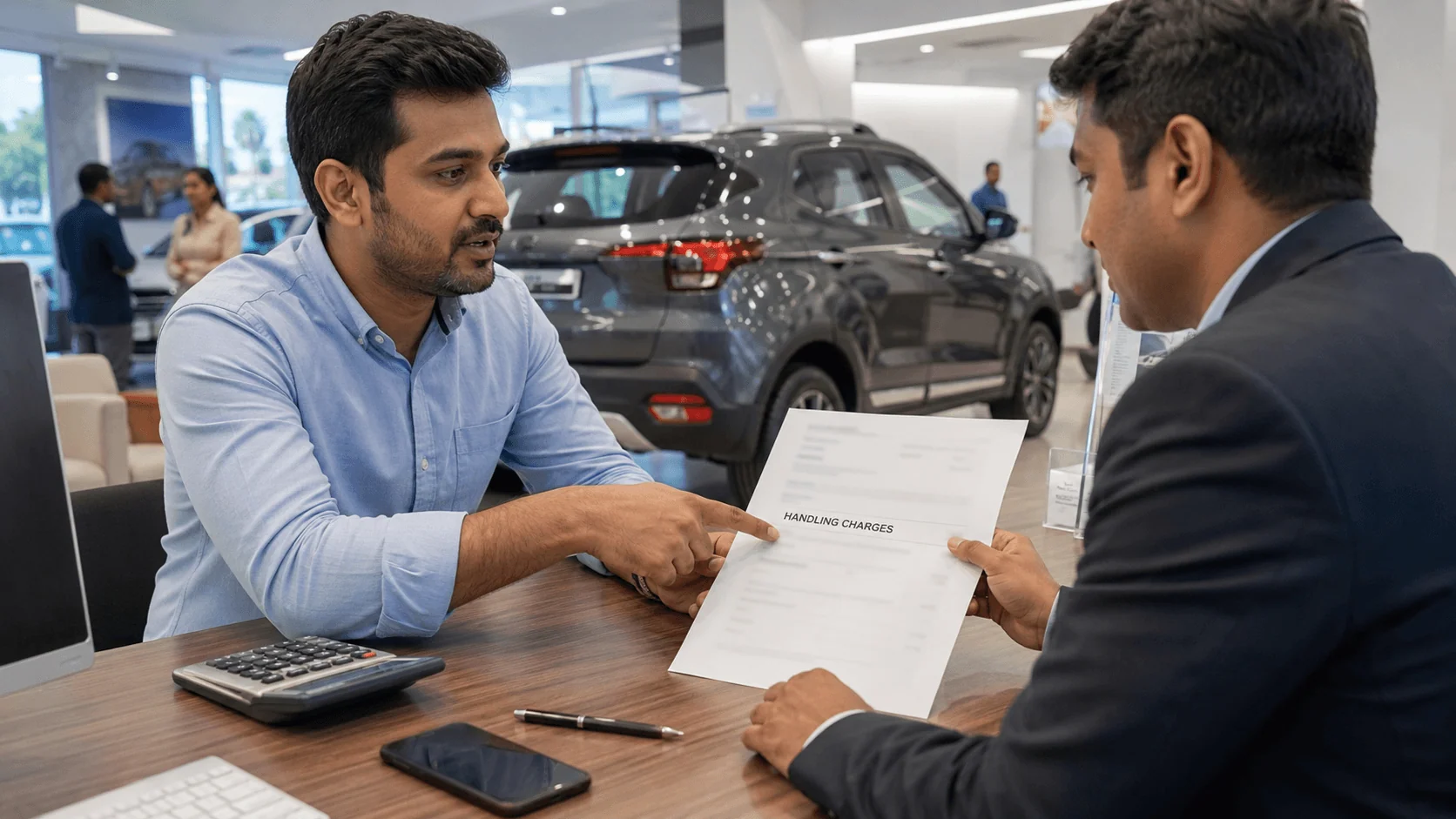
What the law actually says (and what the Supreme Court never said)
You’ll meet the same claim on every forum: “the Supreme Court declared handling charges illegal in 2017.” It never did. Here’s the actual paper trail.
In 2012, the Delhi High Court decided C. Rajaram v. GNCT of Delhi, a public interest petition that asked it to stop dealers from collecting anything beyond authorised registration charges. The court refused to issue a blanket ban. Whether an extra amount is really a disguised registration charge, it said, is a question of fact to be decided case by case. And if a dealer provides genuine extras such as services, goods or fuel, and the buyer agrees to pay for them, no law lets a court stop that. The one firm direction: the Transport Department must enquire into complaints that a dealer charged anything extra for the registration work itself.
An appeal against that ruling reached the Supreme Court, which declined to hear it in January 2017. That dismissal is the entire basis of the folklore. Under the Supreme Court’s own Kunhayammed doctrine, refusing to hear an appeal declares no law and affirms nothing. So the Supreme Court has never ruled on handling charges at all. It simply declined an appeal against a Delhi High Court decision, and that decision left the question to be settled case by case.
Why does the “illegal” language circulate anyway? Because consumer commissions really have ordered refunds, and state transport departments really have cracked down. Those are narrower stories, and they’re the ones worth knowing.
The three buckets: when a charge is impermissible, refundable, or legal
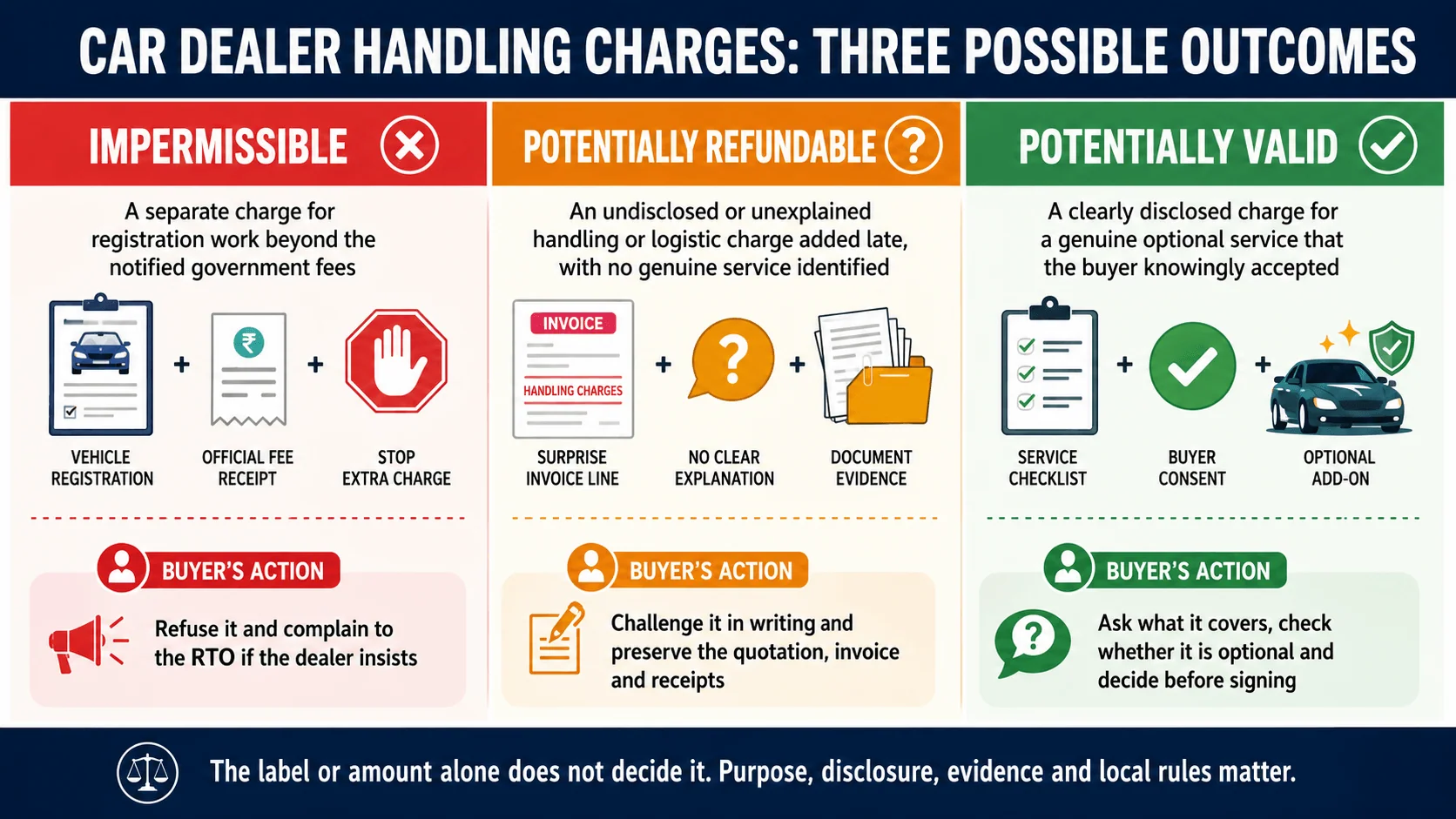
Read the judgments together and every handling charge lands in one of three buckets. This table is the whole page in one glance.
| The charge | Where the law stands | The authority | Your move |
|---|---|---|---|
| A fee for registration work, beyond the notified fees | Consistently impermissible | Delhi dealer undertakings and public notices, the Rule 42 CMVR logic, RTO enforcement drives | Refuse it, and complain to the RTO if the dealer insists |
| An undisclosed lump-sum “handling” or “logistic” add-on sprung at delivery | Consistently refunded as an unfair trade practice | Dada Motors (Punjab, 2017), Koncept Automobiles (NCDRC, 2023) | Demand its withdrawal in writing, or go to the consumer commission if you already paid |
| A disclosed charge for a genuine optional extra you agreed to | Legal | C. Rajaram (Delhi HC, 2012), and complaints without proof fail (Sagar Autotech, 2023) | Decide whether the service is worth the money before you sign |
What is a handling fee charge?
Ask the dealer and you’ll hear some mix of transport from the stockyard, pre-delivery prep, fuel and paperwork. Sometimes that work is real. The trouble is that the amount rarely maps to any of it. In the Koncept Automobiles case, the national commission looked at a ₹7,500 “logistic charge” on a Mahindra sold in Delhi and noted the manufacturer hadn’t charged the dealer anything for logistics. Its reasoning was blunt: when the manufacturer charges the dealer nothing for logistics, recovering it from the customer is an unfair trade practice.
There’s also now a central rule on how such charges must appear. Rule 5(1)(l) of the Consumer Protection (General) Rules, 2020 requires every invoice to show “the total price in single figure, along with the breakup price showing all the compulsory and voluntary charges, such as delivery charges, postage and handling charges, conveyance charges and the applicable tax”. Notice what that rule does and doesn’t do. It doesn’t make handling charges legal or illegal. It makes hiding them in a lump sum a breach of a written central rule, which strengthens your complaint if you’re ever in front of a commission. Where these lines sit within your final bill is its own topic. Our explainer on ex-showroom versus on road price walks through the full stack.
What is a normal handling fee?
Looking for an official rate card? There isn’t one. All we have are the amounts that ended up in front of judges. ₹5,000 in Dada Motors, on a Nissan sold in Ludhiana. ₹7,500 in Koncept Automobiles, on that Delhi Mahindra. ₹18,125 was the amount claimed as an unauthorised extra in Sagar Autotech, on a Skoda in Karnataka, though the buyer couldn’t prove it. Forum posts quote higher figures still.
Be careful with the word “normal” here. A common amount is not a lawful amount, and a lawful amount doesn’t need to be common. A ₹5,000 charge gets refunded when it’s arbitrary and undisclosed, while a bigger figure can stand when it’s a disclosed extra you agreed to. The rupee number tells you almost nothing. The disclosure, and the service behind it, tell you everything.
Who pays handling charges?
Getting the car from factory to showroom is the dealer’s cost of doing business. Freight and logistics sit in the invoice between manufacturer and dealer, priced into the margin, which is why commissions react badly when the same cost reappears on your bill as a separate line. What you actually owe is a shorter list: the car’s price, the notified registration fees and taxes, insurance and whatever extras you agreed to in writing. For the statutory side of that list, our road tax and registration guide covers every state’s rates, so we won’t repeat them here.
Why do I have to pay a handling fee?
You may not have to. Nothing obliges you to accept a charge that isn’t statutory and isn’t for a service you asked for. Question the line at the booking stage, in writing. Ask what specific service it buys you. If the answer is registration work, refuse. That’s the one bucket with a consistent answer across court orders, dealer undertakings and RTO drives. If the answer is a genuine extra, say an accessory kit or a service package, the charge is legitimate, and the only question left is whether you want it at that price.
What you shouldn’t do is discover the charge at delivery, pay it to avoid holding up the car, and hope for the best. That’s the exact fact pattern behind the refund orders, and it’s also the moment you’re weakest at the counter. That’s half the reason our new car delivery checklist exists.
State by state: where enforcement actually happened
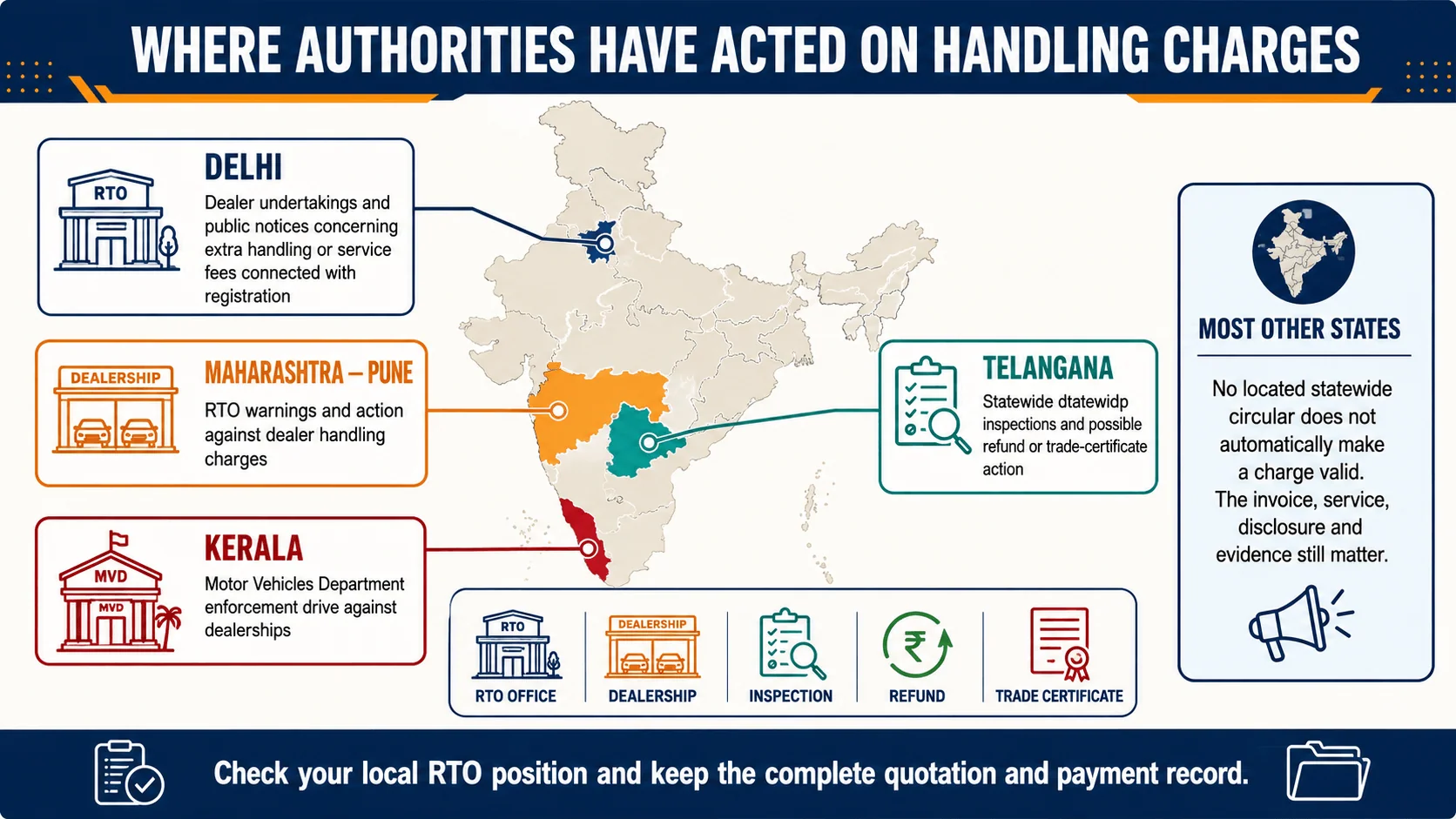
Delhi has the clearest written trail of any state, and it’s all on paper. Dealers there give the Transport Department an undertaking, recorded word for word in the C. Rajaram judgment: “We will not charge any other charges / fee like handling charges / service charges”. The department has backed that with public notices telling buyers not to pay service, handling or miscellaneous charges beyond the notified taxes and fees for registration, and a notification dated 30 December 2011, as recorded in the Koncept Automobiles order, supplied the prohibition that ₹7,500 refund rested on.
Elsewhere the trail is thinner but real. Kerala’s Motor Vehicles Department raided dealerships statewide in January 2016, acting against around 71 dealers and suspending trade certificates, per news reports from the time. Telangana ordered statewide inspections in 2026, with refunds to buyers and trade-certificate action on the table, again per news coverage. Pune RTO officials have gone on record calling handling charges illegal, and have told dealers to stop.
The regulatory logic behind all of this comes from Rule 42 of the Central Motor Vehicles Rules, 1989: a dealer cannot deliver a vehicle without at least temporary registration. Registering your car is part of the dealer’s own obligation in the sale, so transport departments treat a separate fee for that work, beyond the notified fees, as impermissible. That’s the departments’ position rather than a court holding, but it’s the position they enforce.
And the honest note: Karnataka and most other states have no located circular or notification on handling charges. There, your route is the consumer commission, decided on the facts of your bill.
The cases both sides cite (and their limits)
| Case | Forum and year | Outcome | The limit |
|---|---|---|---|
| Manish Kumar Goyal v. Dada Motors | Punjab State Commission, 2017 | ₹5,000 logistic charge refunded with interest, plus compensation and costs. The charge was arbitrary, undisclosed and an unfair trade practice | A state-level ruling that turned on the charge being unexplained and unproven |
| Koncept Automobiles v. Y.S.V.V. Rajan | NCDRC, 2023 | ₹7,500 refund upheld, plus ₹2,00,000 compensation | Rested on the Delhi notification recorded in the order, not a nationwide rule |
| Sagar Autotech v. M. Venkatesh | Karnataka State Commission, 2023 | Dealer won. The buyer’s complaint was dismissed | The buyer couldn’t prove the ₹18,125 was an unauthorised charge. No paperwork, no refund |
Two things follow from that table. The refund orders are real, but none of them adds up to a nationwide ban: commission decisions bind the parties before them, and even the national commission’s Koncept order leaned on a Delhi-specific notification. And Sagar Autotech is the case nobody on the forums quotes. Buyers lose when they can’t document what they were charged for.
One more trap. An older national commission matter, Jagrut Nagrik v. Baroda Automobiles (2010), sometimes surfaces as a handling-charges precedent. It was a defective-vehicle case that decided nothing about the charge, so don’t lean on it.
What to do at the showroom: your script
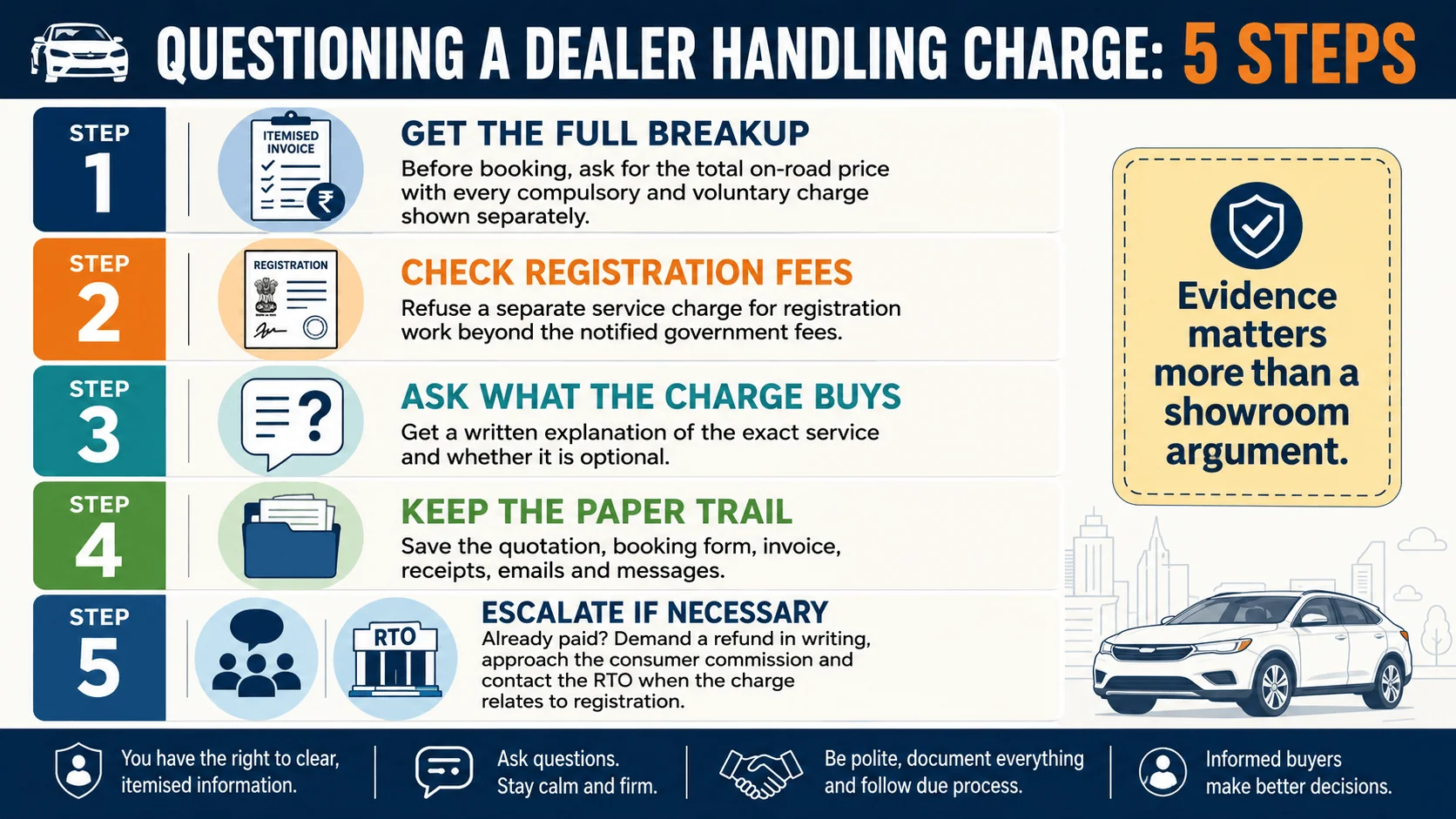
Here’s the sequence that the case law rewards, in the order you’d use it.
- Ask for the full invoice breakup before you book. Rule 5(1)(l) entitles you to the total price in a single figure plus every compulsory and voluntary charge named separately. A dealer who refuses is refusing a written central rule.
- Refuse anything labelled for registration beyond the notified fees. That bucket has a consistent answer everywhere.
- Ask in writing what service each remaining charge covers. A real answer names a real service you can accept or decline. A vague one is your cue to push back.
- Keep the quotation, the order form and every receipt. Sagar Autotech is what the ending looks like without paper.
- Already paid? A consumer commission complaint is the tested route, and refund with compensation and costs is the standard relief pattern in these cases. Where the charge touches registration, complain to your RTO as well.
The charge conversation usually happens inside a bigger price discussion, and our guide on negotiating car price at the dealership covers that side of the table. If you’re still shortlisting, run through what to check before buying a car first. And before you argue over a ₹7,500 line, make sure the bigger numbers are right: run your exact variant through our on road price calculator so you walk in knowing what the car should actually cost.