
Putting a used car’s RC into your own name costs ₹500 in central fees. That’s ₹300 for the transfer of ownership, plus ₹200 for the smart card RC that carries your name. Pay cash, file the papers yourself, and the government wants nothing beyond it. So why do two buyers get quoted wildly different amounts? The gap always sits outside those two lines: a loan on the car, a levy the state has added of its own, or an agent’s bill for the running around.
Where does the ₹300 come from? The December 2016 notification that rewrote Rule 81 of the Central Motor Vehicles Rules prices a transfer of ownership at half the registration fee, and a private car registers at ₹600. It’s central law, so the RC transfer charges for car buyers come out the same wherever you do this. What varies is whatever your state stacks on top. A transfer is also a much lighter errand than the full car registration process in India, because the record already exists and only the name on it changes.
What you pay, component by component
| Component | When it applies | Amount |
|---|---|---|
| Transfer of ownership fee | Every car transfer | ₹300 |
| Smart card RC in Form 23A | Every transfer where the RC is a smart card | ₹200 |
| Hypothecation endorsement | You’re taking a loan on the car | ₹1,500 |
| Cancelling a closed loan entry | Seller’s loan already cleared | Nothing in the central schedule |
| Postal charge for the new RC | Not a line in the central schedule | Nothing published centrally |
| Late submission of an NOC | Only where an NOC is involved | ₹500 a month or part of one |
| State add-ons for automation or value added services | Where a state levies them | Varies |
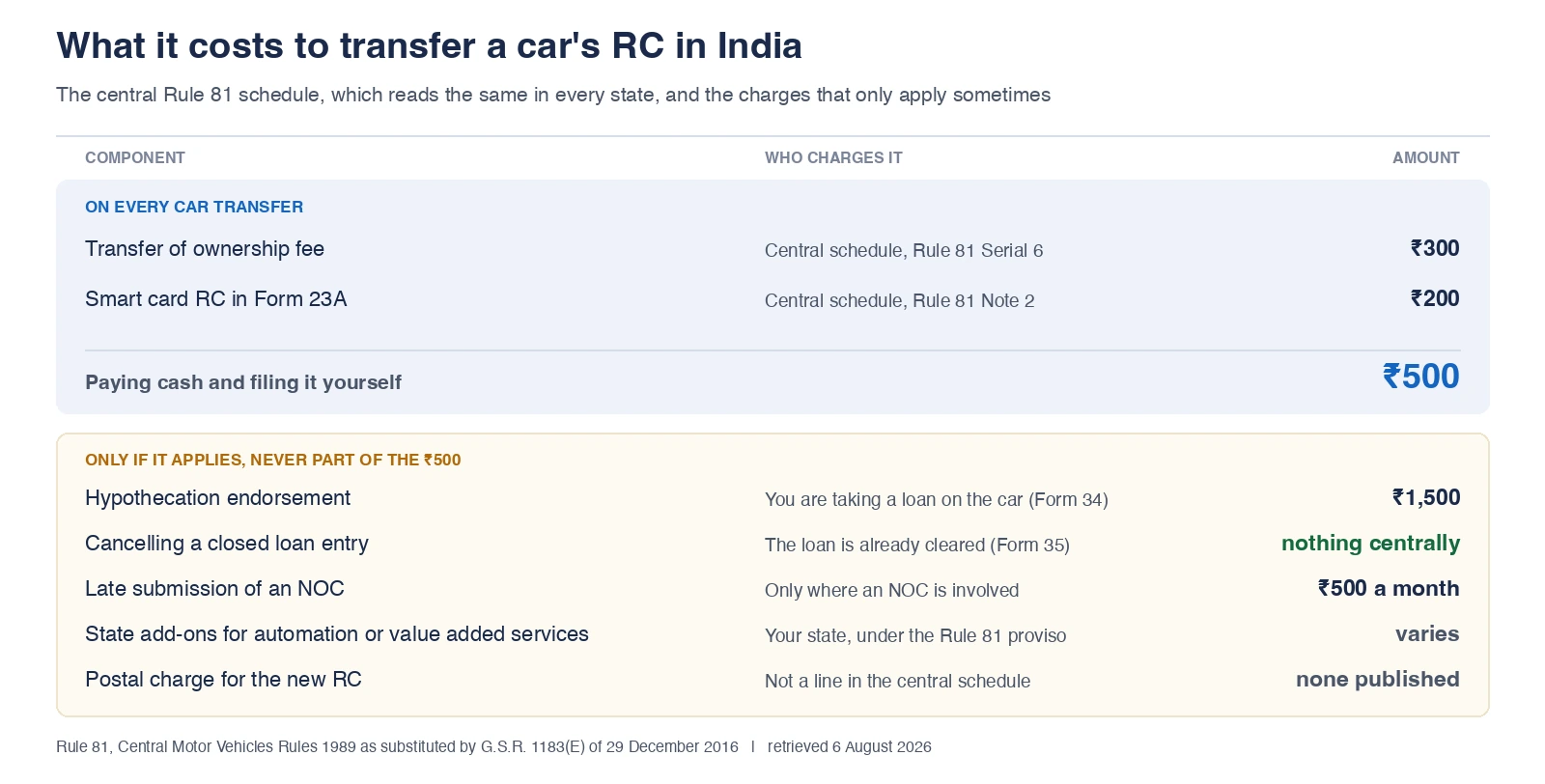
The ₹300 and the ₹200 are the entire central bill on an ordinary transfer, and both come from Rule 81 of the Central Motor Vehicles Rules, so they read the same in every state. A financed car adds ₹1,500 when the lender’s hypothecation goes on the new RC, while taking a closed loan off it carries no central fee at all.
Cash deal, own paperwork, ₹500. Borrow for that same car and the lender’s hypothecation becomes a line of its own on the new RC at ₹1,500, which puts the government total at ₹2,000. When a loan ends, the money runs the other way. Cancelling that entry costs nothing under the schedule, though your state can ask a small amount to process it, and the fresh RC issued afterwards is the single case where the ₹200 smart card fee gets waived outright. Anything else? There’s no postal line anywhere in the central table, so if your quote carries one, ask which rule it sits under.
Why the total differs by state
At the border, the fee stays put. So what actually moves? Two things. Rule 81 lets a state charge extra to cover automation and technology or value added services, and a state can also tax the resale itself, which is the one charge that can dwarf everything above. Gujarat publishes the central fee schedule on its transport portal. Uttar Pradesh applies the same central schedule through its own RTO process. Delhi runs the process through its own services portal. Telangana puts it plainly on its ownership transfer page: Forms 29 and 30, and the appropriate fee as specified in rule 81.
Read your own state’s page slowly and you’ll notice most of what it lists is that same central schedule, reprinted. The genuinely local money is a tax, or a small late-reporting amount. Hardly ever the transfer fee itself.
Buying from another state?
Bringing a car in from another state is a different process with its own costs. It’s also where that ₹500 a month tends to surface, because the schedule pins it to delay in submitting the no objection certificate, not to a late transfer.
Doing it yourself or paying an agent
Handle it yourself and the schedule above is the entire bill. The seller files Form 29, which is just the notice of sale, and you file Form 30 with the RC, the insurance certificate and the fee. A pollution certificate and your PAN or Form 60 are the usual state extras. Where your state has enabled the service, you can apply through the Vahan portal. Otherwise it’s a counter job at the RTO.
Is an agent worth paying? Sometimes, yes. If the RTO is far or the seller’s papers are patchy, the queuing and the chasing are the real cost of this errand, not the fees. Their charge is a service fee though. It isn’t a government one. Ask for the fee receipt, hold it against the components above, and you’ll know what the convenience cost you.
When you must transfer, and what being late costs
Section 50 of the Motor Vehicles Act runs two clocks at once, and most of us only ever hear about one. The seller reports the sale in Form 29 within 14 days when the car is registered in the same state, and gets 45 days to forward the no objection paperwork if it was registered elsewhere. You’ve got 30 days as the buyer to report the transfer and send in the RC, the fee and a copy of the seller’s report. Inherited the car? The heir has three months to apply in Form 31, so long as the registering authority hears about the death inside 30 days. Bought it at a government auction? Thirty days from possession, on Form 32.
Miss your window and the registering authority can take a set amount off you rather than prosecute under section 177. It won’t be much. The Act holds that amount to ₹100 and hands each state the job of fixing its own figure, expressly letting it scale with how long you took. Gujarat’s rules settle on a flat ₹100 whatever the delay. And it’s quite separate from the ₹500 a month on a late NOC.
Before you pay: a quick checklist
- RC, valid insurance and a pollution certificate in hand, plus your address proof and PAN or Form 60.
- Form 29 signed by the seller, Form 30 carrying both your signatures, and Form 28 as well if the car’s coming in from another state.
- Seller’s loan still running? Nothing gets recorded without the financier’s written consent, and the entry comes off later on Form 35, which the central schedule charges nothing for. Borrowing yourself? Budget ₹1,500 for the Form 34 endorsement.
- Two deadlines, not one. The seller reports within 14 days, or 45 across state lines, and you report within 30.
- Check the fee receipt line by line. Anything past the components above is a state charge or a service fee, and not the central transfer fee.