
Walk into any showroom in India and the salesperson will steer you to the variant with alloys. They look better. Feel premium. On the right car, they actually drive better too. But spend ten minutes on a monsoon-ravaged stretch of any Indian city and the alloy-vs-steel question stops being about looks. It becomes about whether your ₹15,000 wheel survives the next pothole.
So what’s the honest answer? Alloy wheels win on looks and highway driving. Steel wheels win on bad roads and ownership economics. OEM-fitted alloys on mid-size SUVs with tall tyres are usually safe enough. Cheap aftermarket alloys on low-profile rubber? That’s a financial accident waiting to happen.
This guide breaks down the actual ₹ numbers, the pothole physics behind alloy failure, plus a buyer matrix so you can decide for your specific car and city.
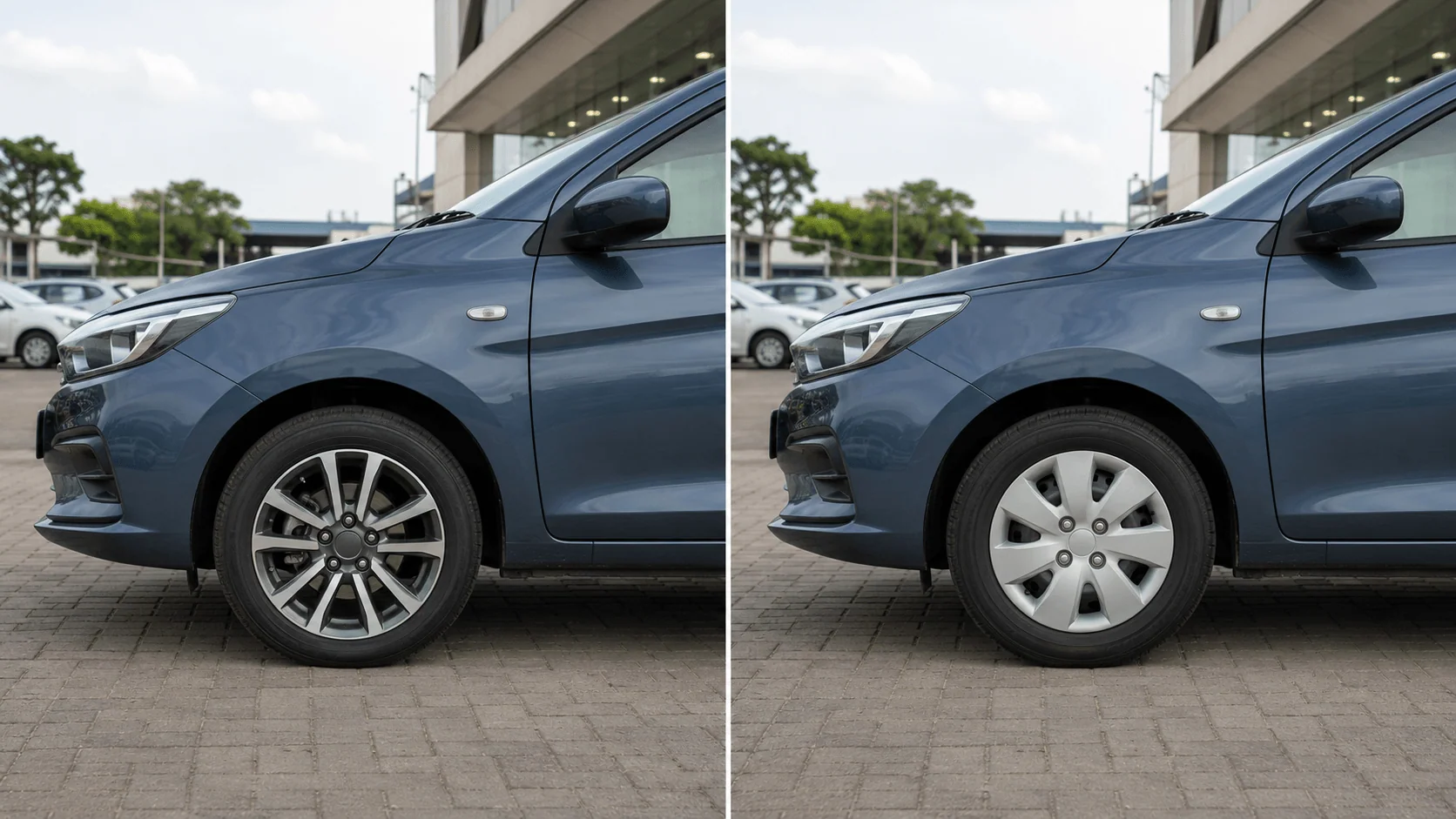
Alloy vs Steel Wheels: Key Differences
Why does this comparison even matter? Because the two wheel types come from completely different metals built using completely different processes. That one fact decides everything that follows. Weight, durability, repair invoices, even how your wheel behaves when you hit a crater on the Outer Ring Road.
| Factor | Alloy Wheels | Steel Wheels |
|---|---|---|
| Material | Aluminium + magnesium/nickel alloy | Pressed iron-carbon steel |
| Manufacturing | Cast, flow-formed, or forged | Stamped and welded |
| Weight (15-inch) | ~6-7 kg | ~8-9 kg |
| Pothole behaviour | May crack or fracture | Bends; rarely breaks |
| Repairability | Limited; cracks need replacement | High; can be hammered back |
| Cost per wheel (OEM) | ₹7,000-₹20,000+ | ₹700-₹2,500 |
| Looks | Premium, sporty | Basic, hidden behind plastic cover |
| Best for | City, highway, style | Bad roads, budget, long-term ownership |
Aluminium is lighter but brittle. Steel is heavier but ductile, which means it deforms before it fractures. That one property matters more on Indian roads than every other spec sheet entry combined. If rough roads are your daily reality, our pick of cars with the highest ground clearance is worth a look.
Are all alloys the same? Not even close. Cast alloys (molten aluminium poured into a mould) are cheapest and account for roughly 95% of OEM and aftermarket wheels you’ll see in India. Flow-formed alloys get spun under heat after casting, making them stronger and lighter. Forged alloys (₹25,000+ per wheel) are the toughest of the lot, but they mostly live on luxury cars and racing builds. Shopping OEM? You’re getting cast, almost guaranteed. The real danger zone is uncertified aftermarket cast replicas.
Pros and Cons of Alloy Wheels
Pros
Better looks. That’s why most buyers upgrade. Alloys transform the stance of even a mid-variant hatchback, and plastic wheel covers can’t match their visual depth.
Lower unsprung weight. A 15-inch alloy is roughly 1.5-2 kg lighter than its steel counterpart. The payoff? Sharper steering, quicker suspension reaction over bad surfaces. You’ll feel it on a Volkswagen Virtus or Hyundai Verna. Less so on a soft-sprung budget hatch.
Better brake heat dissipation. Aluminium conducts heat far better than steel, helping prevent brake fade on long ghat descents. On a city car? The benefit is modest. On a heavily loaded family SUV doing the Mumbai-Pune run? It actually matters.
Marginal fuel efficiency gain. Expect a 0.5-1 kmpl improvement at best, and only if your alloy is lighter than the OEM steel wheel. Heavy aftermarket alloys often hurt your mileage instead of helping it.
Better resale appeal. Used-car buyers associate alloys with top variants and careful ownership. Will it add ₹50,000 to your sale price? Probably not. But it does speed up the transaction.
Cons
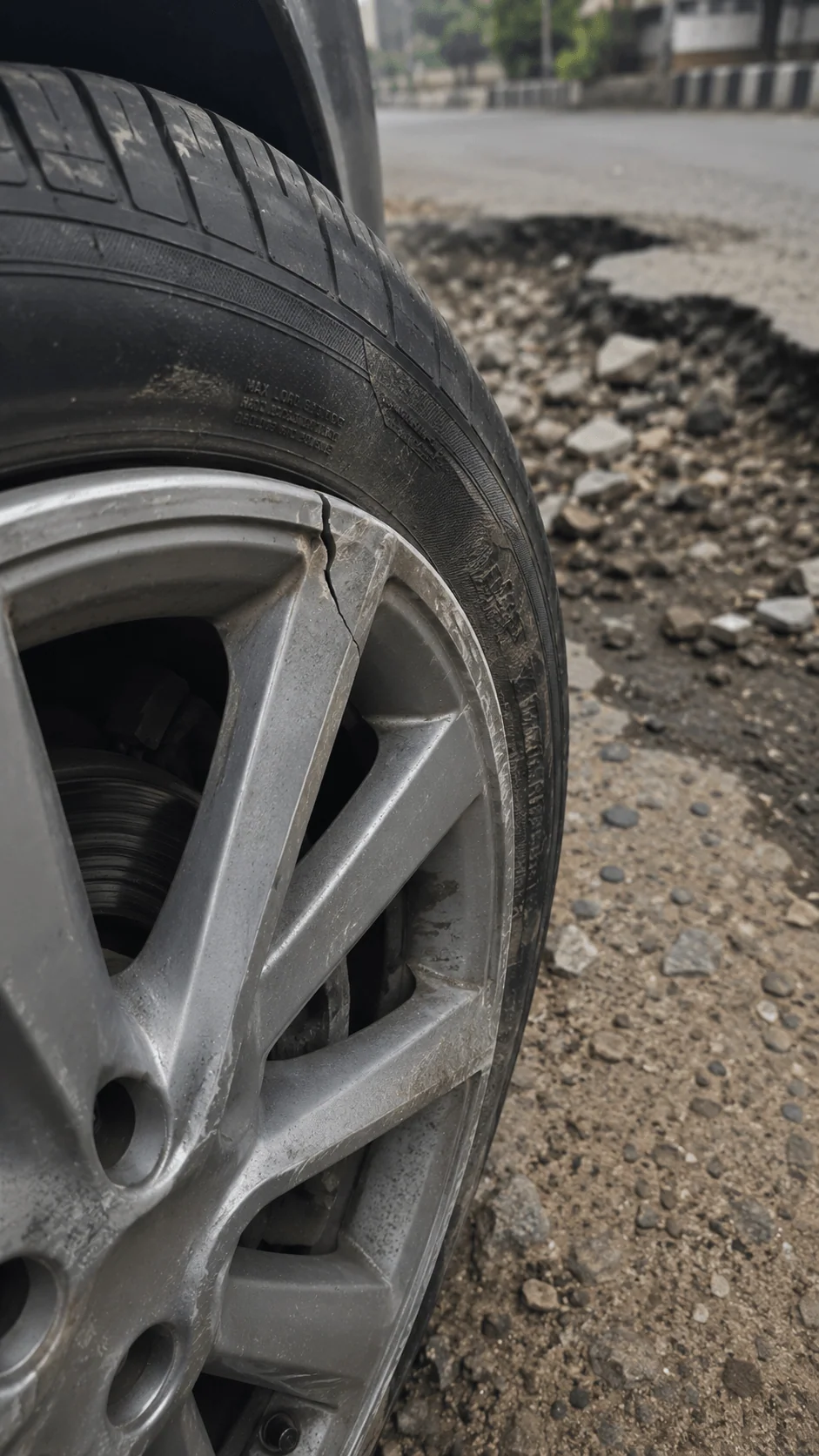
Pothole damage risk. Cast aluminium doesn’t flex like steel. Hit a sharp-edged pothole at 60+ kmph and your rim either chips, bends in a way nobody can straighten, or develops a hairline crack you only discover next week when air starts leaking out.
Expensive to replace. Think ₹7,000-20,000 per OEM wheel for mass-market cars. A full set of four diamond-cut alloys for a top-spec Creta or Seltos can cross ₹80,000. Replicas cost less but bring their own quality problems.
Cosmetic damage is permanent and obvious. Curb scratches on diamond-cut finishes? A nightmare. Refinishing requires a CNC lathe that shaves a micro-layer of metal off each time. Three refurbishments later and your wheel is structurally compromised.
Repair options are limited. Minor bends can be straightened. Cracks need TIG welding, and welded alloys are dangerous. The heat alters the metal’s temper, creates microscopic porosity, and your wheel will probably fail again at the same stress point.
Pros and Cons of Steel Wheels
Pros
Practically unkillable on bad roads. Steel bends and absorbs impact. A bent steel rim still holds air, still gets you home, and any roadside mechanic with a basic hammer can straighten it. That’s the killer feature for rural drives, monsoon roads, and Tier-2/3 city commutes.
Dirt-cheap to replace. ₹700 to ₹2,500 per wheel for a standard hatchback or sedan. Roughly a tenth of an OEM alloy. A full set for under ₹10,000 is normal.
Field-repairable everywhere. Stranded because your wheel “needs a specialist”? Won’t happen with steel. Bend it back, balance it, drive on.
Pairs naturally with taller tyres. Steel wheels typically come in 14 or 15-inch sizes, leaving room for taller, more flexible tyre sidewalls. That extra rubber compresses on impact and protects your wheel before any force reaches the metal. On Indian roads, sidewall height matters more than wheel material.
Forgiving with parking dings. Scrape a steel rim against a footpath? Your wheel cover takes the hit. Replace it for ₹300 and you’re done. Try that with a ₹12,000 diamond-cut alloy and you’ll cry.
Cons
Boring to look at. Even with modern wheel covers trying to imitate alloys, the eye knows. Your car looks budget. End of story.
Heavier, slightly stiffer ride dynamics. Higher unsprung mass means your suspension works harder. For normal city driving you genuinely will not notice. Above 100 kmph on twisty roads? You might.
Rust risk. Chip the paint coating with a stone or a curb, and steel starts oxidising. This is a major issue in Mumbai, Chennai, Goa, and Kochi. Anti-rust underbody coatings plus regular cleaning keep it manageable.
Wheel covers rattle and fall off. Plastic clips degrade over thermal cycles. Hit a deep enough pothole and your cover departs the vehicle entirely. Most Indian owners have lost at least one over the years.
Limited designs. Steel can’t be formed into elaborate spokes. You’re stuck with whatever cover your manufacturer ships.
Cost Comparison: Purchase and Replacement
This is where the math gets unforgiving. Steel wheels are dirt-cheap. Alloys aren’t.
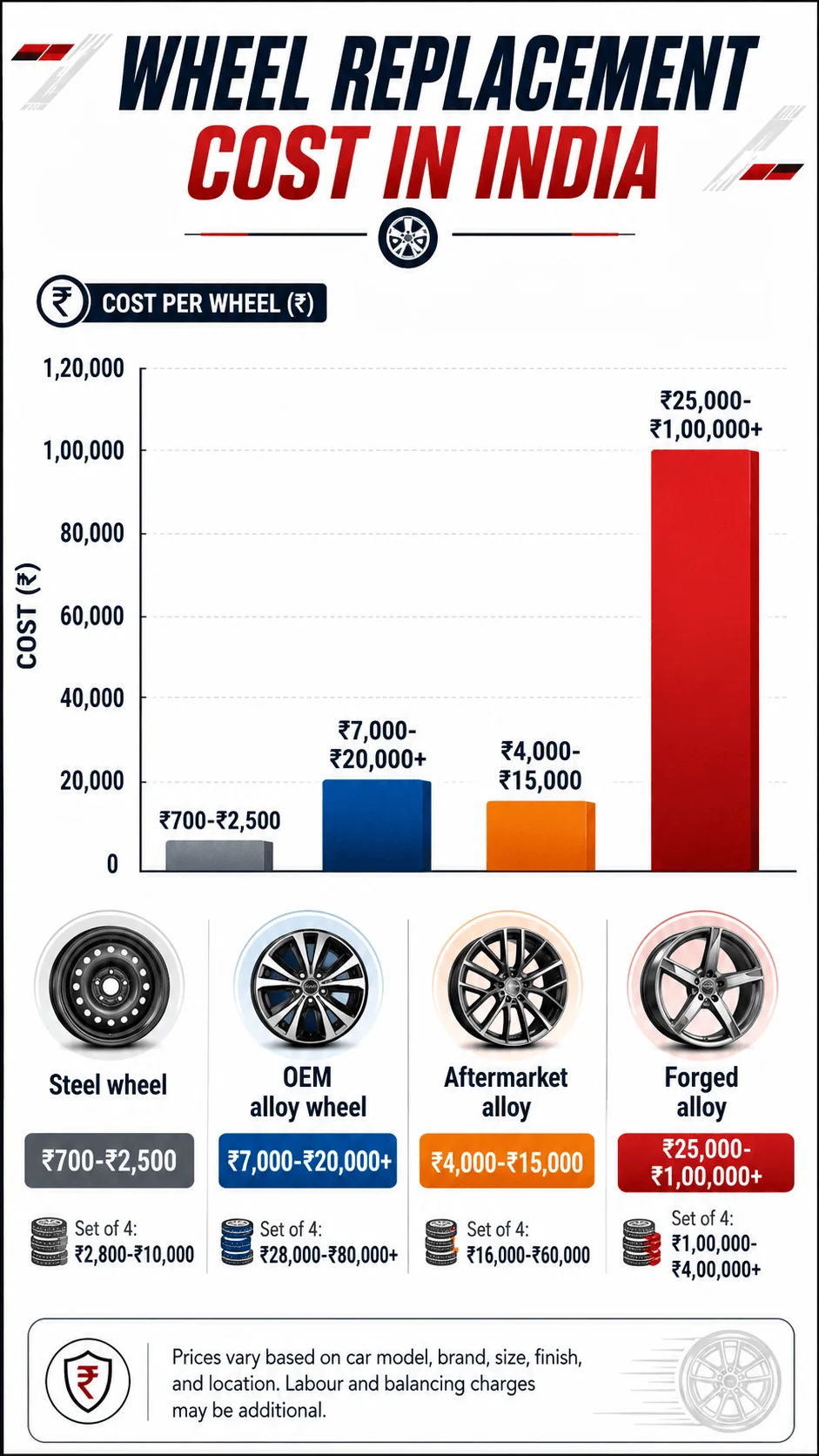
Replacement cost (per wheel, India, 2026)
| Wheel Type | Per Wheel | Full Set of Four |
|---|---|---|
| Steel wheel (OEM) | ₹700-₹2,500 | ₹2,800-₹10,000 |
| OEM alloy wheel | ₹7,000-₹20,000+ | ₹28,000-₹80,000+ |
| Aftermarket alloy | ₹4,000-₹15,000 | ₹16,000-₹60,000 |
| Forged alloy (premium) | ₹25,000-₹1,00,000+ | ₹1,00,000-₹4,00,000+ |
OEM alloys cost more but they’re crash-tested for your car’s specific weight, offset, and load. Aftermarket alloys vary wildly. A certified ARAI/BIS IS 16192 wheel from a reputed brand is safe. An uncertified replica is a liability.
Alloy repair cost (per wheel)
| Damage | Cost | Notes |
|---|---|---|
| Kerb scratch | ₹500-₹1,500 | Minor finish work |
| Bent rim straightening | ₹1,500-₹3,500 | Hydraulic press required |
| Crack welding | ₹2,000-₹5,000 | Risky, read below |
| Diamond-cut refurb | ₹4,000-₹8,000 | Needs CNC lathe |
| Full refurbishment | ₹3,000-₹7,000 | Single wheel |
The 60% rule: If repair cost exceeds 60% of a new OEM wheel’s price, just replace it. A welded wheel is always weaker than a new one. For safety-critical components, the maths is brutal but correct.
Hidden costs of upgrading to aftermarket alloys
Most upgrade decisions ignore these:
- New tyres if you upsize from 15″ to 16″. That’s another ₹16,000-30,000 for a set of four.
- Low-profile tyres cost more than standard ones and offer less pothole protection.
- TPMS sensor transfer: ₹500-1,500 per wheel, and improper fitment destroys the sensors.
- Wheel alignment and balancing every time you swap. Budget ₹2,000-3,500 for the set.
- Insurance declaration. Aftermarket alloys must be declared. Zero-dep policies do not cover rim damage by default. You need a Rim Damage Cover add-on.
- Spare wheel mismatch. Most cars ship with a steel spare, which restricts you to limp speeds if you blow out an alloy.
- Suspension wear. Oversized heavy alloys accelerate damage to wheel bearings and shock absorbers.
A ₹30,000 alloy upgrade easily balloons to a ₹55,000 commitment once the surrounding costs catch up. Worth knowing before you sign the order form.
Which Is Better for Indian Roads?
There’s no universal winner. Your right answer depends on where you drive and what your wallet can absorb when things go wrong.
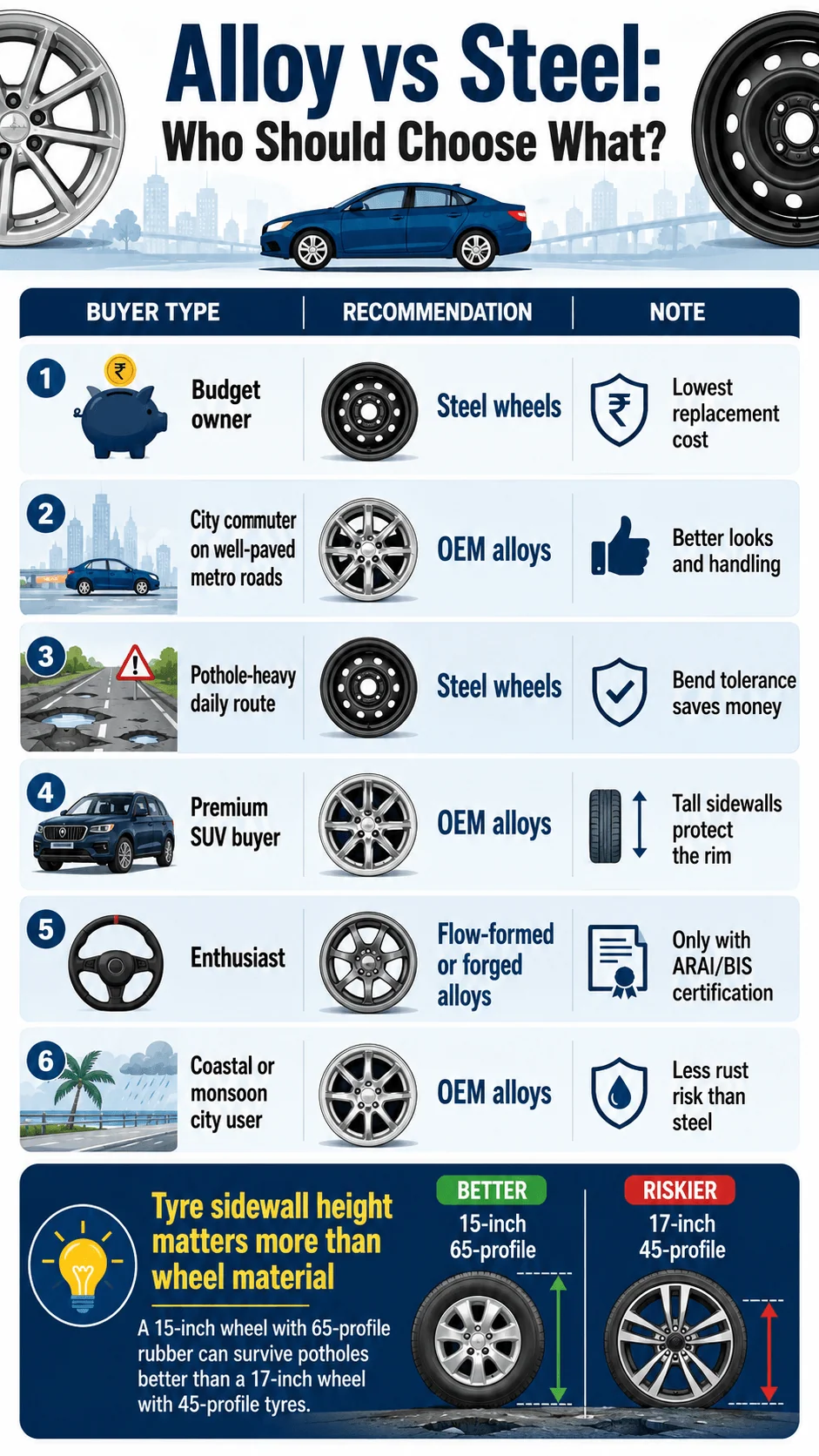
Buyer-type matrix
| Buyer Type | Better Choice | Why |
|---|---|---|
| Budget owner | Steel wheels | Lowest replacement cost, no specialist dependency |
| City commuter (well-paved metros) | OEM alloys | Looks plus handling, low pothole risk on good roads |
| Pothole-heavy daily route | Steel wheels | Bend tolerance saves money long-term |
| Premium SUV buyer | OEM alloys | Tall sidewalls already insulate the rim |
| Enthusiast | Flow-formed or forged | Only with ARAI/BIS certification |
| Coastal/monsoon city | OEM alloys (rust-free) | Steel rusts faster in humid air |
The most underrated insight: tyres protect wheels more than wheel material does
Here’s a fact that flips the whole debate. A 15-inch steel wheel wrapped in 65-profile rubber will survive a pothole that destroys a 17-inch alloy on 45-profile rubber. The thicker tyre sidewall compresses and soaks up impact before any force reaches the metal. Fitted oversized alloys with low-profile tyres on Indian roads? You’ve optimised for looks at the cost of safety.
So if pothole resilience matters more than aesthetics, spend your upgrade budget on better tyres, not bigger wheels. Premium rubber improves braking, wet grip, and ride comfort more measurably than any wheel swap. Our things to check before buying a car guide covers the full list of variant features worth paying extra for.
Safety rules if you’re upgrading to aftermarket alloys
- Buy only ARAI or BIS (IS 16192) certified wheels. Verify the marking before paying.
- Match PCD, offset, width, hub bore, and load rating exactly to OEM specs.
- Use proper hub-centric spigot rings. Don’t rely on wheel bolts alone to centre the wheel.
- Don’t oversize beyond +1 inch from OEM. Avoid low-profile rubber on Indian roads.
- Declare the modification to your insurer and add a Rim Damage Cover.
- Keep your stock wheels stored for warranty claims and resale.
FAQs
Are alloy wheels better than steel wheels?
Alloys win on looks and handling feel. Steel wins on pothole resilience and replacement cost. On Indian roads specifically? Steel is more practical for rough daily driving. Alloys make sense if you mostly drive well-paved metro routes.
Do alloy wheels get damaged on potholes?
Yes, and often. Cast aluminium is brittle compared to steel. Hard pothole impacts can bend, crack, or hairline-fracture your alloy. The risk multiplies when you pair alloys with low-profile tyres. Steel, in contrast, bends rather than cracks and is far more forgiving.
How much do alloy wheels cost to replace in India?
OEM alloys for mass-market cars run ₹7,000-₹20,000 each. Premium SUVs and diamond-cut finishes go higher. A full set for a top-spec Creta or Seltos can cross ₹80,000. Certified aftermarket alloys cost less (₹4,000-₹15,000) but quality varies wildly.
Can alloy wheels be repaired after pothole damage?
Minor bends can often be straightened on a hydraulic press for ₹1,500-3,500. Cracks are a different story. TIG welding cast aluminium introduces microscopic porosity and weakens the metal permanently. For any crack, replacement is your only safe option.
Are bigger alloy wheels better?
No, and this is one of the most expensive misconceptions in India. Bigger alloys with low-profile tyres look aggressive, but they compromise ride quality and leave your wheel dangerously exposed to pothole damage. Stick with OEM wheel size and prioritise tyre sidewall.
Do alloy wheels improve fuel efficiency?
Only marginally. Expect a 0.5-1 kmpl gain if your alloy is lighter than the OEM steel wheel. Upsize to a heavier aftermarket alloy and you’ll actually lose mileage from higher rotational inertia.
Are aftermarket alloy wheels safe?
Only if they carry ARAI or BIS (IS 16192) certification. Uncertified replica wheels are dangerously brittle and often have incorrect PCD or offset. Real-world wheel detachment incidents have happened on Indian highways. Don’t compromise here.
Should I choose alloy wheels or better tyres?
Better tyres, every time. Premium rubber improves your braking distance, wet grip, and ride comfort far more than any wheel material change. Alloys are cosmetic. Tyres are safety equipment.
The verdict: For Indian roads, steel wheels are cheaper and tougher. Alloys look better and drive marginally sharper. Want alloys anyway? Stick with OEM sizes and pair them with quality tyres of adequate sidewall height. Avoid cheap replicas. And buy a Rim Damage Cover the day you register the car. Your future self will thank you.