
Most Indian banks fund 80–90% of a new car’s on-road price, which means you’ll need to put down 10–20% from your own pocket. Just because a lender will let you borrow more doesn’t mean you should. The sweet spot for most salaried buyers in 2026 sits at 20–30% down with a 5-year tenure. Stretch beyond that? The math turns brutal.
So how much should you actually put down? This guide walks through the rupee figures: what banks demand, how every extra ₹1 lakh you put down changes your EMI, why a 7-year loan can quietly cost you a small hatchback in pure interest, plus the down payment range that protects you from negative equity if life forces a quick sale.

Minimum Down Payment for Car Loan in India
What’s the baseline answer most buyers want? 10% to 20% of the on-road price is the standard down payment range for a new car loan in India in 2026. Premier banks like SBI, ICICI, HDFC plus Axis typically fund 80–90% of the on-road price; you cover the rest from personal reserves.
Critical nuances change this number for individual buyers. Let’s break them down.
Standard financing (80–90% LTV). SBI, HDFC, ICICI, Axis, PNB, plus other prime lenders fund up to 90% of the on-road price. That figure covers ex-showroom cost, RTO registration, road tax, hypothecation fee (around ₹1,500), HSRP, temporary registration, plus the first year’s insurance premium. The remaining 10–20% comes out of your pocket upfront.
“Zero down” and 100% financing schemes. Aggressive dealer-lender partnerships advertise these heavily, but read the contract carefully because the 100% funding almost always applies only to the ex-showroom price, and state RTO road tax can scale beyond 15% of the car’s cost in southern states like Karnataka or Kerala (Maharashtra runs slightly lower). Insurance, accessories, plus the 1% TCS levy on cars priced above ₹10 lakh? All still come out of your pocket. Genuine 100% on-road financing remains restricted to high-income pre-approved customers with flawless credit histories.
Used car loans. Pre-owned vehicles attract stricter lending. Banks fund only 65–80% of the assessed market value, so used car buyers should budget for a 20–35% down payment. Interest rates also run higher, typically 11% to 16%. For where mainstream rates sit, compare mainstream car loan rates.
Credit profile tier. A CIBIL score of 750+ unlocks the best 10–20% down payment offers. Scores between 650 and 699 get classified as sub-prime. Expect lenders to demand 25–35% down plus a 1.5–3 percentage point rate premium.
| Buyer / Loan Type | Typical Loan Funding | Typical Down Payment |
|---|---|---|
| New car salaried buyer (CIBIL 750+) | 80–90% | 10–20% |
| Premium / luxury car buyer | 75–85% | 15–25% |
| Used car buyer | 65–80% | 20–35% |
| Low credit score buyer (650–699) | 65–75% | 25–35% |
| Pre-approved / special offer | Up to 100% (ex-showroom only) | Low / zero, but verify on-road costs |
One related decision matters more than buyers usually realise. Is your down payment calculated on the ex-showroom price or the on-road price? It changes how much cash you need to keep ready at the showroom. We’ve broken that down separately in our ex-showroom vs on-road price guide.
How Down Payment Affects EMI
Here’s the mechanical truth. Every additional rupee you put down upfront permanently kills a rupee of principal that would otherwise compound at the borrowing rate for the full term. So is a bigger upfront contribution just “less debt”? No. It’s a guaranteed, tax-free saving.
The EMI formula your bank uses:
E = P × r × (1+r)^n / [(1+r)^n − 1]
Where E is the EMI, P is the principal (loan amount = on-road price minus down payment), r is the monthly interest rate (annual rate ÷ 12, in decimal), and n is the tenure in months.
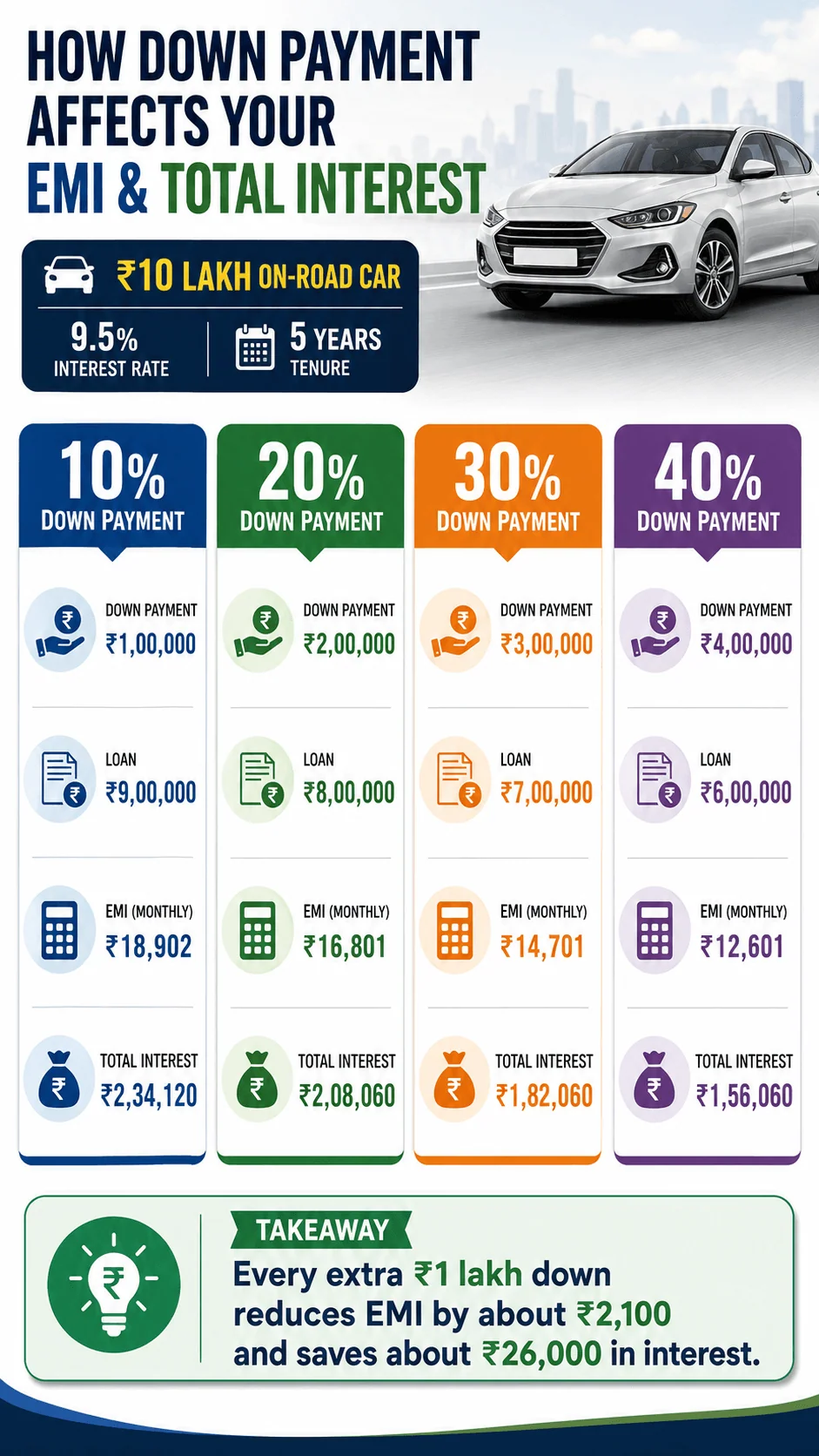
What does this look like in real numbers? Take a standard ₹10 lakh on-road car, financed at 9.5% (a realistic 2026 rate for a prime borrower) over 5 years.
| Down Payment | Loan Amount | 5-Year EMI | Total Interest |
|---|---|---|---|
| 10% (₹1,00,000) | ₹9,00,000 | ₹18,902 | ₹2,34,120 |
| 20% (₹2,00,000) | ₹8,00,000 | ₹16,801 | ₹2,08,060 |
| 30% (₹3,00,000) | ₹7,00,000 | ₹14,701 | ₹1,82,060 |
| 40% (₹4,00,000) | ₹6,00,000 | ₹12,601 | ₹1,56,060 |
For every additional ₹1 lakh you put down, the monthly instalment drops by roughly ₹2,100 while total financing charges fall by about ₹26,000 over the borrowing’s life. That ₹26,000 saving? Risk-free, tax-free, locked in the moment the cheque clears. Can you replicate that return through fixed deposits or debt mutual funds after tax? Almost never. Which is why over-capitalising the upfront contribution usually beats parking the same money in safe instruments.
This compounding effect amplifies sharply at higher interest rates. Loan at 11% instead of 9.5%? Typical for buyers with CIBIL between 700 and 749, or for premium cars. The saving from a higher down payment grows even larger.
Optimal Down Payment Strategy
So how much down payment for a car loan should you actually make? Forget the 10% minimum. For most Indian buyers, the optimal car loan down payment percentage sits between 20% and 30% of the on-road price.
Each tier serves a different financial profile.
20%: the pragmatic minimum. Why this exact number? Because a new vehicle loses roughly 20% of its value the moment it leaves the dealership floor, and a 20% upfront stake keeps you “above water” from day one. Lose your job in month six and need to sell the car? You can clear the lien without writing a cheque out of pocket.
30%: strategically superior. A 30% initial outlay drastically compresses total financing charges. It also keeps your monthly instalment well under 15% of take-home income for most ₹8–12 lakh buyers, giving you genuine flexibility if the bank floats a prepayment offer later.
40%+: niche use case. Putting down 40% or more eliminates debt the fastest. Best suited for borrowers with deep aversion to leverage. It only makes sense if your emergency fund stays untouched and you don’t have higher-return investment opportunities (a growing business, an equity SIP that’s beaten 10% historically).
Never let an upfront payment destroy your emergency fund. Remember: a vehicle is a depreciating utility asset, not a wealth-building one. Keep a separate six-month living-expense buffer that doesn’t touch this purchase under any circumstance. Putting down 20% drains your savings? Then buy a cheaper car.
The Modified 20/4/10 Rule for Indian Buyers
Heard of the 20/4/10 rule? It’s a useful guardrail but conservative for most 2026 buyers. Here’s the realistic Indian version:
- 20–30% of the on-road price as down payment
- 5-year tenure (4 years if cash flow allows; never 7)
- EMI under 10–15% of monthly take-home income
Take-home of ₹1,00,000 a month? Your car EMI shouldn’t cross ₹10,000–₹15,000. At a 9.5% rate over 5 years, that supports a loan of ₹4.7–₹7 lakh, which works out to an on-road budget of roughly ₹5.8–₹8.7 lakh after a 20% down payment. First-time buyers especially shouldn’t stretch beyond this ceiling. Our first car buying guide for India walks through dealership negotiation tactics that pair well with a strong down payment.
When to Hold Cash Instead
A bigger upfront payment isn’t always the right call. Should you hold back? Yes, if:
- The transaction wipes out your emergency fund
- You operate a business that needs constant working capital
- You have higher-return investment options that historically beat 9–10%
- You’re financing an EV under a subsidised lender programme (SBI Green Car Loan, for example, runs 20 basis points below standard ICE rates)
- You’re a self-employed professional with variable monthly income, where keeping liquid cash matters more than minimising interest
Loan Tenure: 3 vs 5 vs 7 Years
After down payment, tenure is the second most consequential lever you control. Most buyers fixate on the lowest possible EMI and walk straight into a 7-year contract without doing the maths. Almost always a costly mistake.
3-Year Car Loan (36 months)
Want the fastest path to debt freedom and the cheapest total cost? This is it. Same ₹10 lakh car, 20% down at 9.5%? A 3-year term costs ₹25,627 a month with ₹1,22,572 in cumulative borrowing costs.
Best for: High-income buyers, smaller loan amounts (under ₹6 lakh), or anyone with rock-solid monthly cash flow and a genuine dislike of debt.
5-Year Car Loan (60 months)
The industry standard and the realistic sweet spot for most salaried Indian buyers. On the ₹10 lakh / 20% down / 9.5% example, the monthly outflow drops to ₹16,801 with ₹2,08,060 in total financing charges. Sure, you’ll pay ₹85,488 more in interest than the 3-year version, but you’ll free up ₹8,826 every month for everything else life throws at you.
Best for: The vast majority of salaried buyers and family-oriented purchasers seeking budget balance. The “5” in our modified 20/5/10 rule.
7-Year Car Loan (84 months)
The high-risk option, dressed up as the affordable one. Stretch the same ₹10 lakh / 20% down / 9.5% borrowing to 84 months and it costs ₹13,038 a month, but you’ll pay ₹2,95,192 in cumulative financing charges, which is ₹87,132 more than the 5-year option. The monthly saving? Only ₹3,763.
The hidden costs of a 7-year loan are worse than the headline interest figure:
- Prolonged negative equity. New cars lose roughly 20% in year one and around 50% by year five. Stretch the tenure to seven years and you’ll owe more than the vehicle’s market value for the first 3–4 years. If you need to sell early because of a sudden job loss or a forced relocation, you’ll write a cheque out of pocket to settle the lien.
- Foreclosure penalty trap. Almost all Indian auto loans are fixed-rate, which means the January 2026 RBI ban on prepayment charges (which applies only to floating-rate retail products) does not protect you. Fixed-rate car borrowings still attract foreclosure penalties. HDFC Bank charges 6% of outstanding principal in year one, 5% in months 13–24, then 3% after that. ICICI charges 5% in the first six months, then 3%. Closing a 7-year contract early can cost ₹15,000–₹50,000 in penalties alone.
- Lifestyle inflation. The artificially low monthly payment tempts buyers into a vehicle they can’t actually afford. Make no mistake: the 7-year tenure is a financing tool designed to make a Creta look affordable to someone who should be buying a Brezza.
Best for: Almost no one. Use a 7-year structure only when immediate monthly affordability is an absolute hard constraint and you’ve genuinely committed to holding the vehicle for the full term without selling, upgrading, or refinancing midway.
| Tenure | EMI Level | Total Interest | Best For | Warning |
|---|---|---|---|---|
| 3 years | High | Lowest | Strong cash flow, small loans | EMI pressure |
| 5 years | Medium | Moderate | Most salaried buyers | Standard recommendation |
| 7 years | Low | Highest | Cash-flow constrained only | Negative equity + foreclosure penalty |
EMI Examples at Different Down Payments
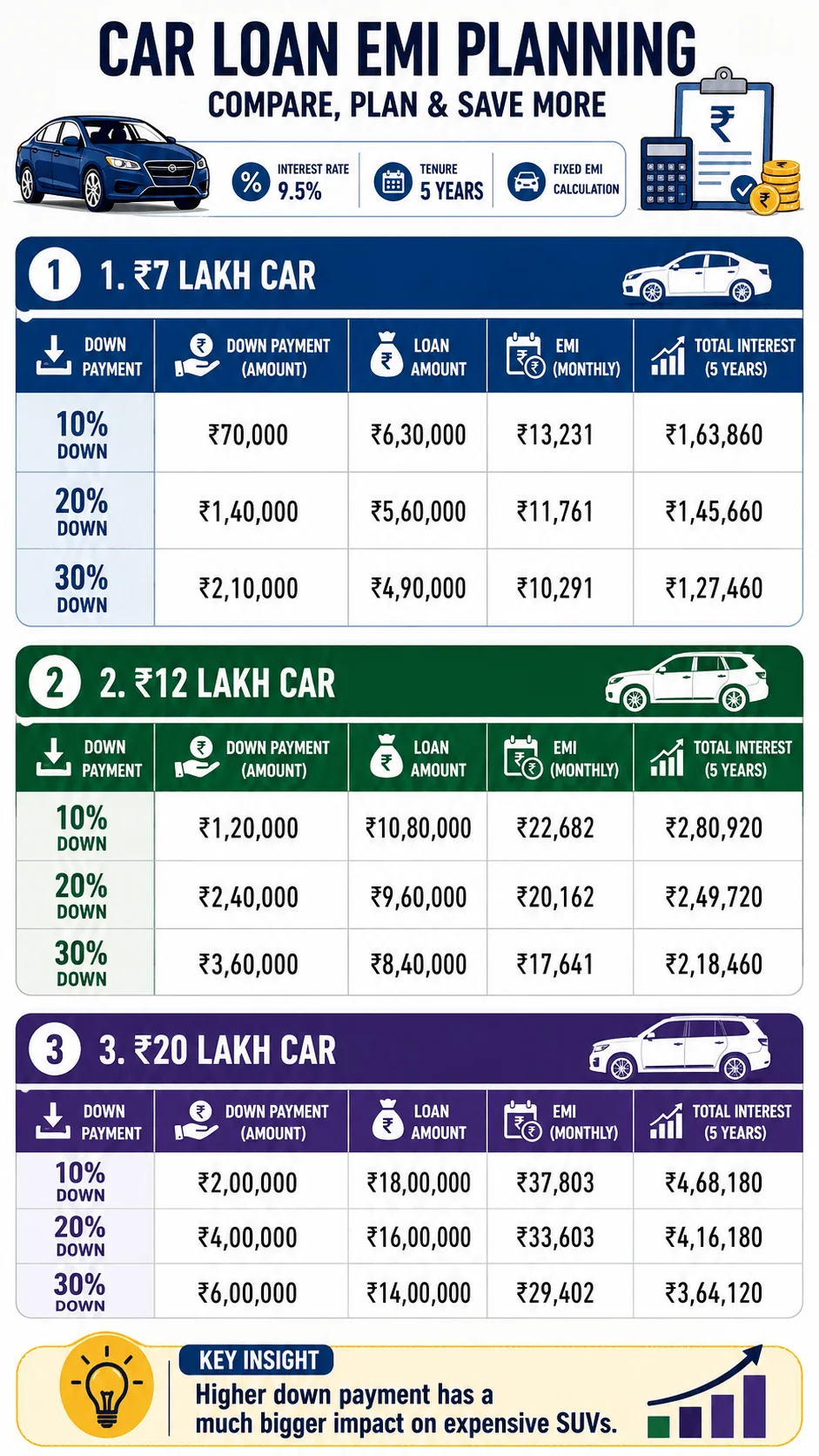
The compounding math gets sharper as the car gets pricier, and the tables below illustrate exactly how a 10% versus 30% down payment plays out across three common Indian budget brackets at a 9.5% benchmark rate.
₹7 Lakh Car (entry-level hatchback or compact sedan, 5-year tenure)
| Down Payment | Loan Amount | 5-Year EMI | Total Interest |
|---|---|---|---|
| 10% (₹70,000) | ₹6,30,000 | ₹13,231 | ₹1,63,860 |
| 20% (₹1,40,000) | ₹5,60,000 | ₹11,761 | ₹1,45,660 |
| 30% (₹2,10,000) | ₹4,90,000 | ₹10,291 | ₹1,27,460 |
₹12 Lakh Car (compact SUV like Creta, Seltos, Taigun, 5-year tenure)
| Down Payment | Loan Amount | 5-Year EMI | Total Interest |
|---|---|---|---|
| 10% (₹1,20,000) | ₹10,80,000 | ₹22,682 | ₹2,80,920 |
| 20% (₹2,40,000) | ₹9,60,000 | ₹20,162 | ₹2,49,720 |
| 30% (₹3,60,000) | ₹8,40,000 | ₹17,641 | ₹2,18,460 |
| Down Payment | Loan Amount | 5-Year EMI | Total Interest |
|---|---|---|---|
| 10% (₹2,00,000) | ₹18,00,000 | ₹37,803 | ₹4,68,180 |
| 20% (₹4,00,000) | ₹16,00,000 | ₹33,603 | ₹4,16,180 |
| 30% (₹6,00,000) | ₹14,00,000 | ₹29,402 | ₹3,64,120 |
A 10% upfront contribution on a ₹20 lakh vehicle? Brace yourself. It costs you ₹4.68 lakh in interest over five years, which is the price of an entirely new Maruti S-Presso paid purely as financing charges to the bank. Bump the deposit to 30%, though, and you save over ₹1 lakh while shaving ₹8,401 off the monthly instalment.
Bank Interest Rate Reality Check (May 2026)
The 9.5% rate used in these tables is a working benchmark for prime borrowers. Actual rates from major lenders right now:
- SBI: 8.70–9.85%
- HDFC Bank: 8.15% onwards (plus ₹3,500–8,000 processing fee)
- ICICI Bank: 8.50% onwards (up to ₹8,500 + GST processing)
- Axis Bank: 8.95–11.75%
- PNB: 8.60–10.65%
- Union Bank: 7.50–9.45% (often the lowest PSU rate)
- Canara Bank: 7.45–11.45%
Your actual rate hinges on four levers: CIBIL score, employer category, loan-to-value ratio, plus the tenure you pick. A 50-basis-point difference (0.5%) on a ₹10 lakh, 5-year loan changes total interest by roughly ₹13,000–14,000.
FAQs
How much down payment is required for a car loan in India?
The minimum is typically 10–20% of the on-road price. Major lenders like SBI, ICICI, HDFC Bank, plus Axis fund 80–90% of the on-road cost, so you cover the remainder. Some pre-approved schemes offer 100% financing on the ex-showroom price, but you still pay RTO road tax, insurance, accessories, and 1% TCS (on cars over ₹10 lakh) from your pocket.
How much down payment should I make for a car?
For most Indian buyers, an optimal car loan down payment sits between 20% and 30% of the on-road price. A 20% down payment insulates you from immediate depreciation; a 30% down payment drastically reduces total interest and keeps your EMI manageable. Don’t go below 20% unless cash flow is severely tight.
Is higher down payment better for car loan?
Yes, mathematically. A higher down payment lowers your principal, reduces both EMI and total interest, and protects you from negative equity if you need to sell early. The exception: if making a higher down payment wipes out your emergency fund or forces you to pull money from investments earning more than your loan rate.
What is the best car loan tenure?
A 5-year (60-month) tenure is the most balanced choice for most salaried buyers in India. A 3-year tenure saves the most in total interest but requires a much higher EMI. A 7-year tenure should be avoided unless absolutely necessary because it maximises total interest and traps you in a negative-equity position for years.
Is a 7-year car loan a good idea?
Generally no. While the monthly EMI looks attractive, you’ll pay significantly more in total interest and owe more than the car is worth for the first 3–4 years. Fixed-rate car loans (which most Indian car loans are) also attract steep foreclosure penalties of 3–6%, so refinancing or closing early isn’t free.
Is a 3-year or 5-year car loan better?
A 3-year contract is financially superior if your cash flow can absorb the higher instalment. It cuts borrowing costs and builds positive equity faster. A 5-year structure is practically better for buyers who need lower monthly outflow and want to keep the family budget breathable.
How does down payment affect EMI?
A higher down payment directly reduces your principal loan amount. Lower principal means lower monthly EMI and lower total interest over the tenure. On a typical 5-year, 9.5% car loan, every additional ₹1 lakh you put down reduces the EMI by roughly ₹2,100 and total interest by about ₹26,000. See how each change moves the maths in our EMI calculator and formula guide.
Should I pay more down payment or keep cash?
Keep at least six months of living expenses as an untouchable emergency fund. Use only surplus capital beyond that buffer to increase your down payment. A higher down payment beats keeping cash in a fixed deposit (post-tax FD yields rarely beat 9.5% loan rates), but it shouldn’t compromise liquidity.
Can I get 100% car loan in India?
Yes, certain pre-approved schemes and dealer-tied promotions offer 100% financing, but almost always restricted to the ex-showroom price. You still need cash for RTO charges, comprehensive insurance, plus the mandatory accessories and TCS levy. True 100% on-road financing is rare and limited to high-net-worth customers with pre-approved credit lines.
What is a good EMI for a car loan?
A prudent car EMI should not exceed 10–15% of monthly take-home income. If your take-home is ₹1,00,000, the EMI cap is ₹10,000–₹15,000. Going beyond 15% squeezes your ability to save, invest, or absorb unexpected expenses.
What is the minimum down payment for a used car loan?
Used car buyers should plan for 20–35% down. Banks fund only 65–80% of the assessed market value of pre-owned vehicles, and interest rates run 2–4 percentage points higher than new car loans (typically 11–16%).

The down payment call is the single most consequential financial choice in any car purchase, and yet headline interest rates and EMI calculators tend to dominate buyer attention instead. But the leverage you apply at signing? It determines your total cost more than any other variable. Aim for 20–30% down on the on-road price, stick to a 5-year tenure unless cash flow genuinely demands shorter, and never sign a 7-year contract unless you’ve modelled the depreciation curve yourself.
Once you’ve fixed the down payment percentage, the next step is matching the right lender to your CIBIL profile. Compare interest rates across SBI, ICICI, HDFC plus the PSU banks before signing anything, and use a proper EMI calculator to model the exact arithmetic banks use.