
Buying a car in India means buying car insurance. The law gives you no choice on that. What can you choose? The type of cover, the depth of protection, and the add-ons you bolt on. And that’s where most first-time buyers get tripped up.
The dealership pushes one product. The aggregator app pushes another. The renewal SMS quotes a number with no breakdown of what’s actually inside. Confusing? Of course.
Here’s a clean walk-through of every car insurance type sold in India in 2026, what each one really covers, and the add-ons worth your money.
Types of Car Insurance in India
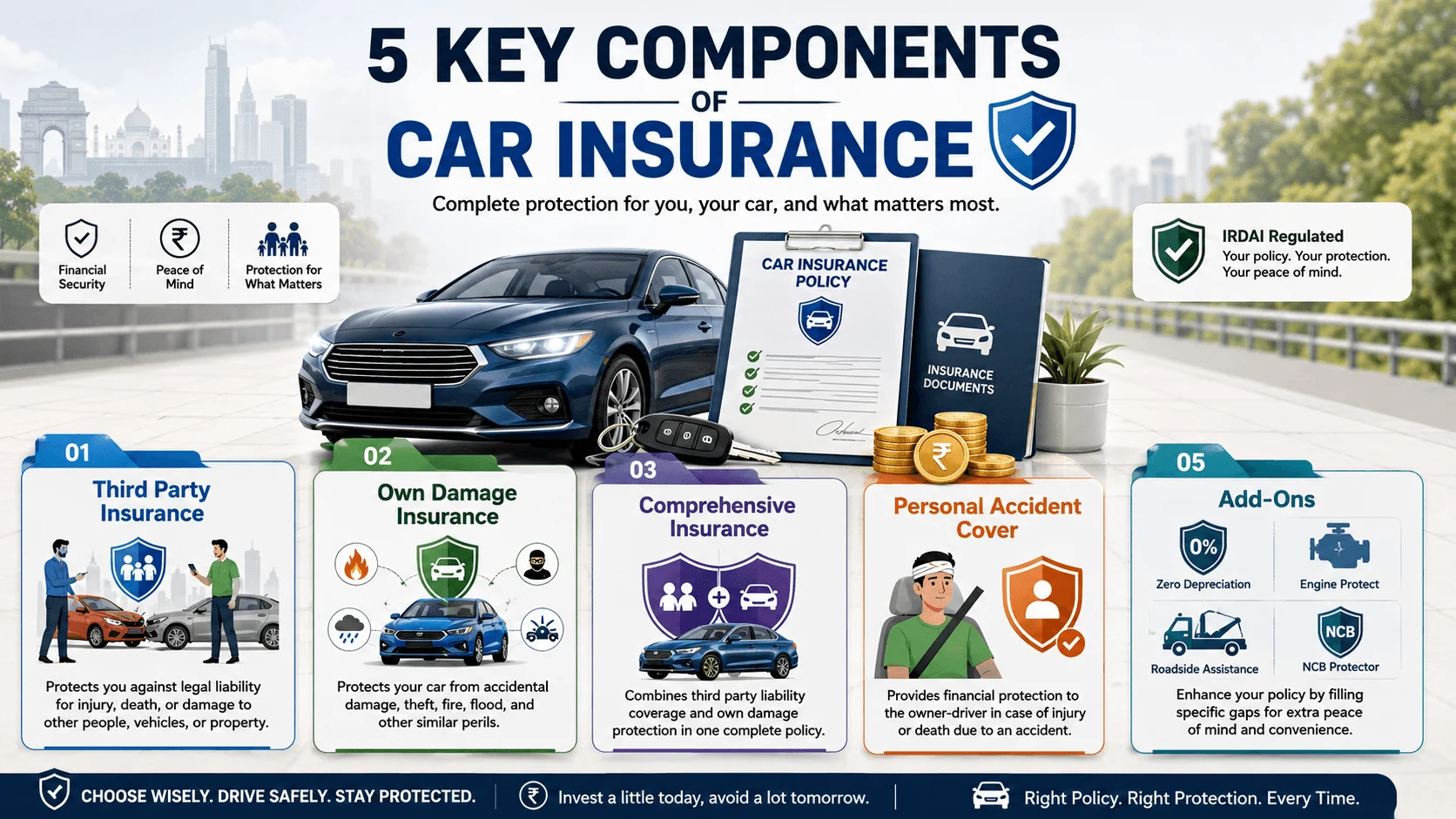
India sells five distinct types of car insurance under IRDAI regulation. Most “policies” you see quoted are actually bundles of two or three of these.
- Third-Party Insurance. Legally mandatory. Pays for damage or injury you cause to others.
- Own-Damage (OD) Insurance. Covers damage to your own car from accidents, theft, fire and natural disasters.
- Comprehensive Insurance. Bundles third-party and own-damage into one policy. The default choice for most buyers.
- Compulsory Personal Accident (CPA) Cover. A statutory ₹15 lakh cover for the registered owner-driver.
- Add-Ons. Optional riders like zero depreciation, engine protect, RSA and NCB protector that fix specific gaps in a standard policy.
| Insurance Type | What It Covers | Mandatory? | Best For |
|---|---|---|---|
| Third Party | Damage/injury caused to others | Yes | Legal minimum, very old cars |
| Own Damage | Damage to your own car | No | Cars with separate long-term TP policy |
| Comprehensive | Third party + own damage bundled | No, but recommended | Most car owners |
| Personal Accident | Owner-driver disability/death payout | Yes (for the owner-driver) | Statutory |
| Add-Ons | Extra protection beyond base policy | Optional | Risk-specific coverage |
The Motor Vehicles Act, 1988 makes only third-party cover compulsory. Comprehensive isn’t required by law. So why does almost every new car owner buy it? Because driving without it on a new ₹15 lakh car is financial roulette. One serious accident, one flood, one theft, and you’re paying out of pocket.
For new private cars, IRDAI now mandates a continuous three-year third-party policy at the time of registration. You can buy a separate annual own-damage cover on top of that. It’s a structural change that’s reshaped how dealerships quote insurance.
Third-Party Insurance: What It Covers
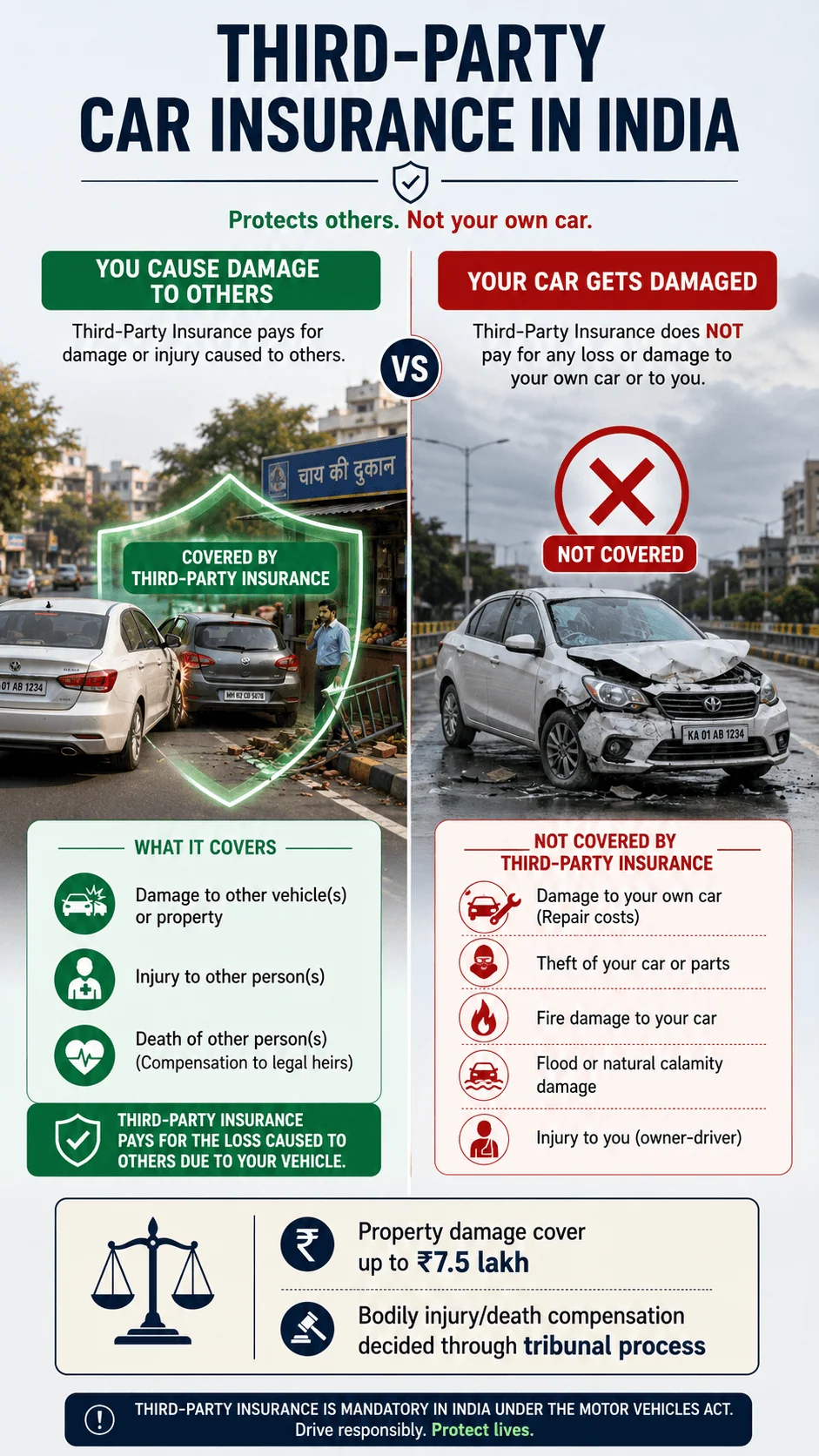
Third-party is the foundation. Who is it protecting? Other people from you. Hit a pedestrian, ram another car, knock down a boundary wall, and third-party insurance steps in to cover the legal and financial liability.
What’s covered:
- Bodily injury or death of a third party. Theoretically unlimited liability, with the actual payout decided by the Motor Accidents Claim Tribunal (MACT) based on the victim’s age, earning capacity and dependents.
- Damage to third-party property. Capped at ₹7.5 lakh under standard private car policies.
- Legal defence costs during tribunal hearings.
What’s not covered, and this is where buyers get burned:
- Damage to your own car (zero coverage for self-damage)
- Theft of your vehicle
- Fire, flood, or natural disaster damage to your car
- Damage from vandalism or riots
- Personal belongings inside the vehicle
| Scenario | Third-Party Pays? | Why |
|---|---|---|
| You hit another car | Yes | Damage to their car is third-party damage |
| You injure a pedestrian | Yes | Bodily injury is covered |
| Your own bumper breaks in the same accident | No | Your car isn’t covered |
| Your car is stolen | No | Theft isn’t covered |
| Flood damages your car | No | Natural calamity isn’t covered |
So what does it actually cost? Premiums are fixed by IRDAI and identical across every insurer:
- Up to 1,000 cc: ₹2,094 per year
- 1,000 cc to 1,500 cc: ₹3,416 per year
- Above 1,500 cc: ₹7,897 per year
These are the published basic premiums, excluding GST. The Ministry of Road Transport has a 10-25% FY26 revision under discussion. Watch for an April or October rate change.
Third-party insurance keeps you legally compliant. It does nothing to protect your own car from a repair bill.
Own-Damage Insurance: The Standalone Option
Own-damage cover protects your own car. After the 2019 IRDAI unbundling rules, this can now be bought as a standalone annual policy. But only if you already hold a valid third-party policy.
Most buyers encounter it when their three-year mandatory TP cover from the dealership is still active and they want to top up OD protection.
What it covers:
- Accident damage to your car
- Theft of the vehicle (paid out at Insured Declared Value)
- Fire, self-ignition, explosion
- Natural calamities like floods, cyclones, earthquakes, landslides
- Malicious acts, vandalism, riots, strikes, terrorism
- Damage during transit by rail, road, air or sea
What it doesn’t cover:
- Third-party liability (you still need your TP policy active)
- Normal wear and tear, mechanical breakdown
- Damage when driving without a valid licence or under the influence
- Consequential damages. More on this later. It’s the engine hydrostatic lock issue.
A standalone OD policy is also a legal contingent. If your underlying three-year TP policy lapses, your OD cover becomes void. Buy it as an annual renewal alongside the mandatory long-term TP cover, not as a replacement.
Comprehensive Insurance: What It Covers
When most Indian buyers say “full insurance,” what they actually want is comprehensive. It’s a single bundled policy that combines mandatory third-party liability with own-damage protection. Both you and others, covered in one go.
What’s inside a comprehensive policy:
- Everything third-party insurance covers (damage to others)
- Everything own-damage insurance covers (damage to your car)
- Compulsory Personal Accident cover for the owner-driver. A ₹15 lakh statutory payout for death or permanent disability while driving, travelling in, or boarding/alighting from the vehicle.
| Scenario | Comprehensive Pays? | Notes |
|---|---|---|
| Accident damage to your car | Yes | Subject to deductibles and depreciation |
| Damage to another vehicle | Yes | Third-party section handles it |
| Car theft | Yes | Paid at IDV |
| Flood damage | Yes | Engine damage may need a separate add-on |
| Fire damage | Yes | Subject to policy terms |
| Normal wear and tear | No | Excluded under all policies |
| Mechanical breakdown | No | Insurance covers external events, not aging parts |
What comprehensive doesn’t automatically cover, the costly misconception:
A comprehensive policy isn’t an unconditional maintenance warranty. Read the exclusions carefully.
- Consequential damages. Drive through a flooded street and water enters the engine causing a hydrostatic lock? The insurer treats this as driver negligence, not flood damage. Claim rejected unless you have engine protect.
- Consumables. Engine oil, coolants, nuts, bolts, washers used during repairs are excluded.
- Depreciation deductions. This is the big one. When parts are replaced, the insurer applies steep depreciation cuts of up to 50% on plastic, rubber, tyres and airbags regardless of car age. Your “full” claim payout for a ₹25,000 bumper might land at just ₹12,500 without a zero-dep add-on.
- Tyres and tubes in isolation. Only covered if simultaneous accident damage to the vehicle exists, and even then with 50% depreciation.
- Driving violations. No valid licence, drunk driving, using a private car for commercial hire. Claim rejected outright.
Comprehensive insurance doesn’t mean every repair is free. Deductibles, depreciation, exclusions and add-on gaps still apply.
For an annual premium roughly equal to 3-4% of your car’s Insured Declared Value (IDV) in year one, comprehensive cover is the prudent default for any car under 7-8 years old.
Third Party vs Comprehensive: Comparison Table
Which one should you actually pick? The choice between standalone third-party and comprehensive is the single most important insurance decision you’ll make.
| Factor | Third Party Insurance | Comprehensive Insurance |
|---|---|---|
| Legal requirement | Mandatory | Optional (but includes TP) |
| Own car damage | Not covered | Covered |
| Damage to others | Covered | Covered |
| Theft | Not covered | Covered |
| Fire | Not covered | Covered |
| Flood / natural calamity | Not covered | Covered |
| Vandalism, riots | Not covered | Covered |
| Annual premium (1500cc petrol) | Around ₹3,400 | ₹10,000 to ₹25,000+ depending on IDV |
| Add-ons available | Limited or none | Full range |
| Best for | Very old, low-value cars | New, financed, expensive or daily-driven cars |
| Main risk | You pay for your own repairs | Higher premium outlay |
Choose third-party only if your car is old, low-value, and you’re prepared to absorb your own repair bills. Choose comprehensive if your car is new, financed, expensive to repair, parked outdoors, or used regularly. For a deeper breakdown of premium math, IDV mechanics and claim scenarios, see our detailed comparison
Add-Ons Worth Buying
Add-ons (also called riders or endorsements) attach to a comprehensive or standalone own-damage policy. Each one rewrites a specific exclusion in the base policy. The trap most buyers fall into? Stacking every add-on the agent recommends. That bloats the premium and negates the economics of risk transfer.
So how should you actually pick? Buy add-ons based on your real exposure. Not a checklist.
1. Zero Depreciation Cover
Easily the most valuable add-on for newer cars. What does it actually do? It overrides the India Motor Tariff depreciation schedule entirely. When damaged parts are replaced, the insurer absorbs the full cost without applying the mandatory 50% deduction on plastics, rubber, glass or age-based metal depreciation.
A ₹25,000 plastic bumper replacement that pays out ₹12,500 under a base policy? Pays the full ₹25,000 with zero dep.
- Best for: New cars, cars under 5 years old, vehicles with expensive bumpers, lamps, sensors or body panels, city drivers with frequent parking damage risk.
- Skip if: Your car is over 7-8 years old and the premium markup outweighs the depreciated parts cost. Read our zero dep insurance analysis for full payback math.
2. Engine Protection Cover
Here’s something most buyers miss. The engine is excluded from standard policies for any non-collision damage. Drive through a waterlogged street and the engine seizes (hydrostatic lock)? Claim rejected. Same if a severe underbody hit ruptures the oil sump.
Engine protect rewrites this exclusion. It covers internal child parts, gearbox, crankcase and engine block damage caused by water ingression, oil leakage or consequential damage.
- Best for: Mumbai, Chennai, Bengaluru and other flood-prone cities. Owners parking in basement garages. Turbo petrol, diesel and automatic transmission cars where engine repair bills easily cross ₹1.5 lakh.
- Skip if: You drive a small hatchback in a dry, high-altitude city with no monsoon flooding risk.
3. Consumables Cover
Ever read the fine print on a repair invoice? A typical bill lists ₹3,000-8,000 worth of consumables. Engine oil, coolant, brake fluid, AC refrigerant gas, nuts, bolts, washers, sealants, bearings. Standard policies refuse to reimburse any of these.
Consumables cover is what gets you to a truly cashless claim experience. Without it, even a fully approved claim leaves you with the consumables bill.
- Best for: New cars, premium models with expensive synthetic lubricants and specialised AC gas, owners who want zero out-of-pocket claim experience.
- Skip if: You drive an older basic hatchback and consumable replenishments are minor.
4. Return to Invoice (RTI) Cover
Why is this rider non-negotiable for new buyers? Brand-new cars depreciate 5% the moment they leave the showroom and 15% in the first year. If your one-month-old car is stolen or totalled, the IDV payout will fall significantly short of the original ex-showroom price. RTI bridges the gap between depreciated IDV and original invoice value. Most variants also reimburse road tax and registration charges.
- Best for: New cars, vehicles under 3 years old, financed cars where loan outstanding exceeds depreciated market value.
- Skip if: Your car is more than 3 years old. The economics no longer make sense.
5. Roadside Assistance (RSA)
Think of it as a 24/7 logistical safety net for non-accident emergencies. Flat tyre help, dead battery jump-start, fuel delivery, flatbed towing to the nearest network garage, extraction from ditches, emergency on-site electrical repairs.
- Best for: Highway commuters, new drivers, older cars prone to electrical or mechanical issues, EV owners (running out of charge), apartment dwellers without easy access to mechanics, anyone travelling outside their home city often.
- Skip if: You drive locally in your home city, have a reliable mechanic on call, and your car is under warranty.
6. NCB Protector
The No Claim Bonus is a powerful discount on the OD premium. How much? 20% after one claim-free year, scaling up to 50% after five clean years. Under standard rules, a single small claim wipes your accumulated NCB to zero.
NCB Protector acts as a firewall. It lets you make one or two claims (depending on insurer) within the policy term without losing your bonus.
- Best for: Owners with high NCB already accrued (35-50%), premium cars where the OD premium is large enough that protecting 50% of it is worth the rider cost.
- Skip if: Your NCB is still under 25% or you’re a careful driver who’s unlikely to claim anyway.
7. Tyre Protection
Did you know standard policies only entertain tyre damage if the car was simultaneously accident-damaged? And they apply a 50% depreciation cut even then. Tyre protect isolates this risk, covering tyre bursts, sidewall cuts, bulges, or severe pothole damage independent of any broader accident.
- Best for: Premium SUVs and cars with expensive low-profile tyres or large alloy wheels, owners regularly traversing bad-road infrastructure.
- Skip if: You drive a budget car with standard ₹4,000 tyres on city tarmac.
8. Key Replacement Cover
Lost a smart key recently? Modern transponder keys cost ₹15,000-40,000 to replace and require electronic reprogramming of the vehicle’s immobiliser. This add-on covers lost, stolen or damaged smart keys including the full lockset replacement.
- Best for: Premium cars with push-button start, luxury models, anyone who has lost a key in the past.
- Skip if: Your car uses a basic mechanical key.
Add-On Recommendations by Driving Pattern
Don’t buy every rider. Buy what matches your specific risk profile.
| Buyer Type | Recommended Add-Ons |
|---|---|
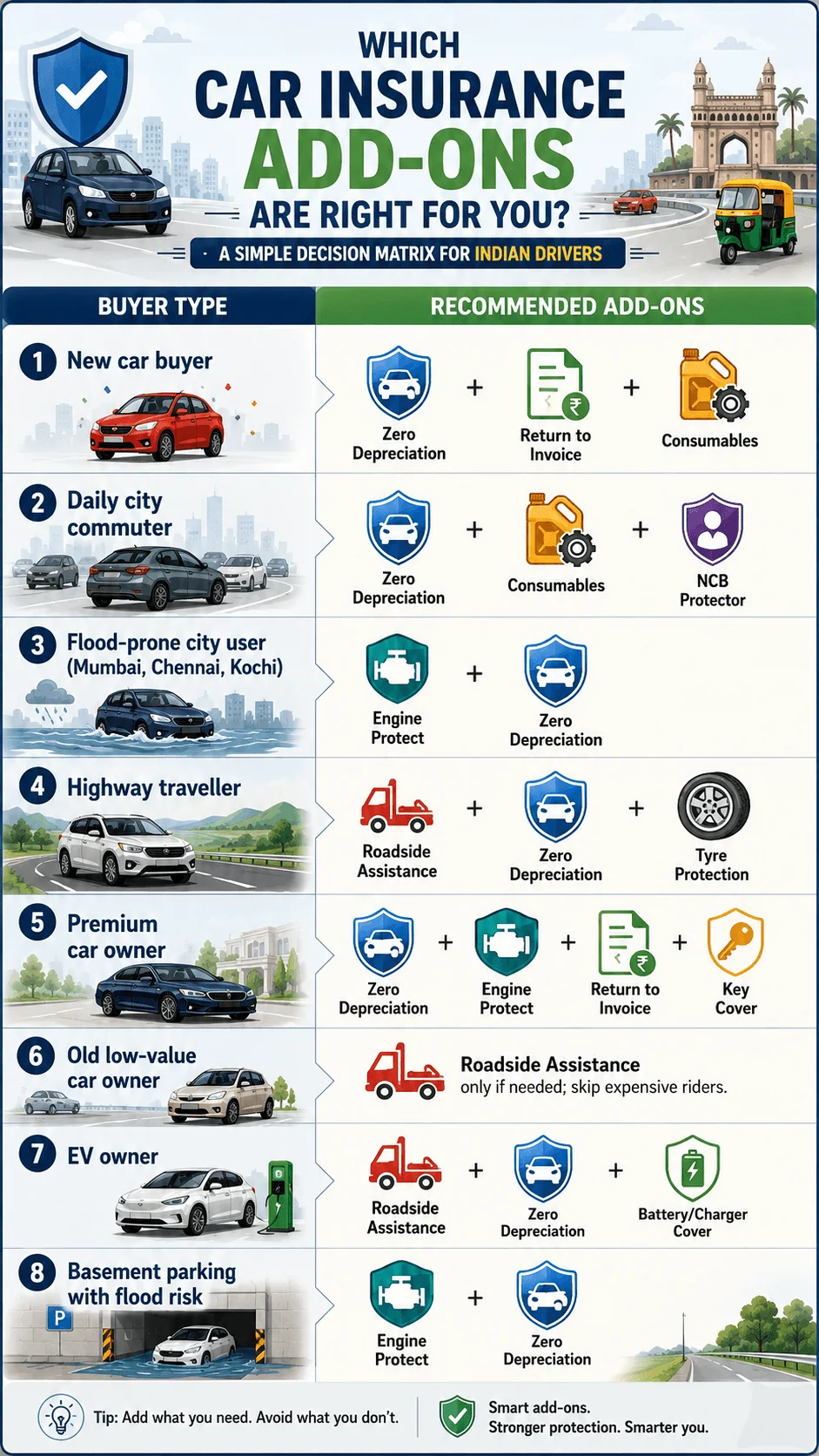
| New car buyer | Zero dep + RTI + consumables |
| Daily city commuter | Zero dep + consumables + NCB protector |
| Flood-prone city user (Mumbai, Chennai, Kochi) | Engine protect + zero dep |
| Highway traveller | RSA + zero dep + tyre protection |
| Premium car owner | Zero dep + engine protect + RTI + key cover |
| Old, low-value car owner | RSA only if needed; skip expensive riders |
| EV owner | RSA + zero dep + battery/charger cover |
| Apartment parking with basement flood risk | Zero dep + engine protect |
EV and CNG Insurance: What’s Different
What if you drive an EV or have retrofitted a CNG kit? Two segments have insurance quirks worth flagging.
Electric vehicles get a standardised 15% IRDAI discount on the base third-party premium to encourage adoption. Premiums by motor output: up to 30 KW at ₹1,761, 30-65 KW at ₹2,738, above 65 KW at ₹6,707. But comprehensive cover gets pricier because the high-voltage battery accounts for 40-50% of the car’s total IDV and repair networks are still thin. EV owners should specifically ask about battery protection covers and charger/accessories covers. These aren’t included by default.
CNG kit retrofits must be formally declared to your insurer. The kit needs ARAI certification and an RC endorsement by the RTO. Insurance-wise, you pay an extra ₹60 on the TP premium and roughly 4-6% more on the OD component (because the kit increases the IDV). Skip the declaration and any future claim, whether or not related to the CNG kit, will be rejected outright. This is non-negotiable.
How to Choose the Right Car Insurance Type
So how do you actually choose? Match the policy to the car’s age, your usage and your risk appetite.
Choose Third Party only if:
- Your car is over 8-10 years old
- Market value is low (under ₹1-1.5 lakh)
- You drive rarely
- You can comfortably pay your own repair bills
- You only need legal compliance
Choose Comprehensive if:
- Your car is new or under 7-8 years old
- It’s still financed
- It has expensive electronics, sensors, ADAS or LED lighting
- You drive frequently
- You park outdoors or in flood-prone areas
- You cannot absorb a sudden ₹50,000+ repair bill
Choose Standalone Own Damage if:
- You already have a long-term (3-year) third-party policy from the dealership
- The OD portion is up for annual renewal
- You want flexibility to switch OD insurers each year
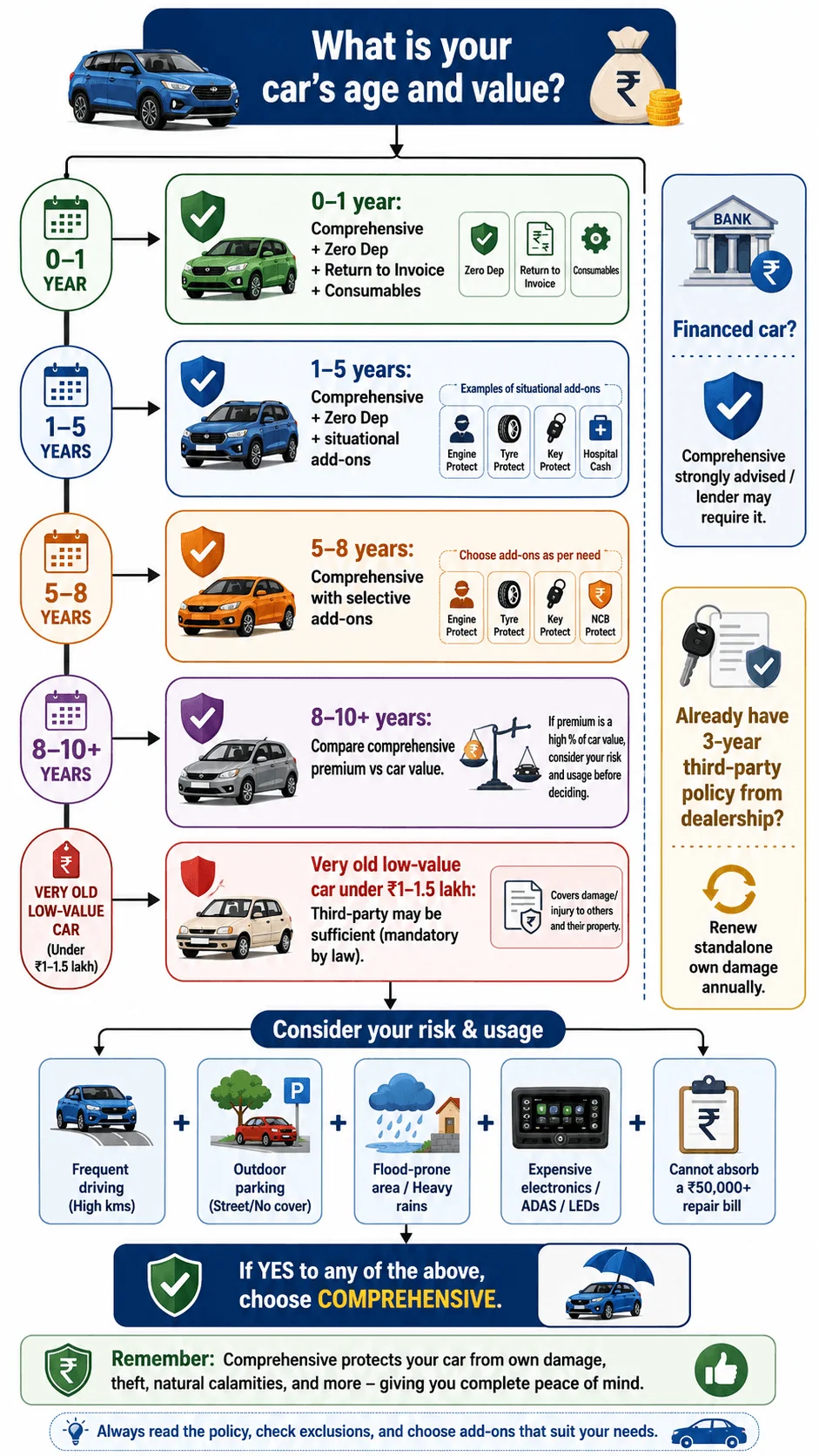
| Car Age | Suggested Cover |
|---|---|
| New (0-1 year) | Comprehensive + zero dep + RTI + consumables |
| 1-5 years | Comprehensive + zero dep + situational add-ons |
| 5-8 years | Comprehensive, selective add-ons only |
| 8-10+ years | Compare comprehensive vs third-party premium-to-value ratio |
| Very old, low-value | Third-party may be sufficient |
| Financed car | Comprehensive is strongly advised (lender often mandates it) |
A Note on Premiums and the 2026 Cost Picture
Anything changing in 2026? Three recent developments are worth tracking.
FY26 third-party hike. The Ministry of Road Transport and IRDAI have been in discussions on revising statutory third-party rates upward by anywhere from 10% to 25%, citing rising claim costs. Implementation could land in April or October 2026.
Pay As You Drive (PAYD). IRDAI approved usage-based insurance in 2022, and as of 2026 multiple insurers including Digit, Bajaj Allianz, ICICI Lombard and Bharti AXA offer it. You declare an annual kilometre band (5,000 / 10,000 / 15,000 km), pay a discounted OD premium, and a telematics device or odometer reading verifies. Light users like second-car households, work-from-home buyers, weekend drivers can save up to 90% on OD.
IRDAI 2024 claims rule. Insurers must now settle motor claims within 15 working days of receiving complete documentation (down from 30 days). Stuck waiting? Escalate citing this regulation.
Don’t pick the cheapest quote in isolation. Look at the insurer’s claim settlement ratio, the cashless garage network density in your city, and the IDV they’re offering. A policy that’s ₹2,000 cheaper from an insurer with no network garages in your city becomes an expensive headache the day you actually need to claim. For practical guidance on what to verify and compare at renewal, see our renewal tips.
FAQs
What are the types of car insurance in India?
There are five. Third-party (legally mandatory), own-damage (standalone), comprehensive (bundles third-party and own-damage), compulsory personal accident cover for the owner-driver (₹15 lakh statutory), and optional add-ons that attach to comprehensive or own-damage policies.
Is comprehensive insurance mandatory?
No. Only third-party insurance is mandated by the Motor Vehicles Act, 1988. Comprehensive isn’t required by law. But it’s strongly recommended for any car under 7-8 years old because it’s the only way to protect your own car from accident, theft, fire and natural disaster losses.
Is third-party car insurance mandatory?
Yes. Driving without an active third-party policy is illegal under Section 146 of the Motor Vehicles Act and attracts fines of ₹2,000 for a first offence, ₹4,000 for repeat offences, plus up to three months imprisonment. New private cars must come with a mandatory three-year continuous third-party cover at registration.
What is own-damage car insurance?
Own-damage (OD) insurance covers losses from accidents, theft, fire, malicious acts and natural disasters affecting your own car. Since the IRDAI unbundling rules in 2019, you can buy it as a standalone annual policy. The condition: a valid third-party policy must already be active.
Does comprehensive insurance include third-party cover?
Yes. A comprehensive policy is a bundled product. The mandatory third-party liability section is built into it, so you don’t need a separate third-party policy alongside.
Does third-party insurance cover my own car?
No. Third-party insurance covers only damage or injury caused to others by your vehicle. Repairs to your own car, theft, fire and natural disaster damage are entirely excluded.
What add-ons should I buy?
Depends on your real risk. Zero dep is the most universally useful (new and under-5-year-old cars). Engine protect is critical if you live anywhere prone to monsoon flooding. Consumables and RTI suit brand-new or financed cars. Roadside assistance helps highway travellers and EV owners. Don’t buy every add-on by default. Match them to your exposure.
Is zero depreciation cover worth it?
For cars under 5 years old, yes. It overrides the standard 50% depreciation on plastic, rubber and age-based metal parts, ensuring full payout. For cars over 7-8 years old, the premium markup typically outweighs the depreciation savings.
Is engine protection cover necessary?
It’s close to indispensable if you live in a flood-prone city or drive a car with an expensive turbo or automatic transmission. Standard comprehensive policies refuse claims for hydrostatic lock and oil sump damage. Engine protect is the only rider that fixes this exclusion.
What is IDV in car insurance?
The Insured Declared Value is the maximum payout your insurer will make in a total loss or theft claim. It’s calculated by applying the IRDAI’s age-based depreciation schedule to the manufacturer’s listed selling price. 5% for cars under 6 months old, scaling to 50% for vehicles between 4-5 years.
What is NCB in car insurance?
The No Claim Bonus is a discount on your OD premium for every consecutive claim-free year. It starts at 20% after year one and scales to 50% after five clean years. A single claim normally wipes the NCB to zero. Unless you have an NCB Protector add-on.
Which insurance is best for a new car?
A comprehensive policy with zero dep, return to invoice, consumables cover and engine protect (in flood-prone areas) is the most defensible setup for a new car. It protects against rapid depreciation, secures the financed amount, and neutralises high-cost repair bills typical of modern vehicles.
Which insurance is best for an old car?
For cars over 8-10 years old where the IDV has dropped significantly, a comprehensive policy without expensive add-ons works well. For very old, low-value vehicles, third-party alone may suffice. Focus the spend on legal compliance, not asset protection.
Can I switch from third-party to comprehensive insurance?
Yes, you can upgrade at the next renewal. The insurer will require a fresh physical inspection of the vehicle by an authorised surveyor before activating the own-damage component, to document pre-existing condition.
How long can I delay car insurance renewal without losing NCB?
A 90-day grace window from policy expiry. Renew within those 90 days and you keep your accrued No Claim Bonus. Cross 90 days and the entire bonus, even a hard-earned 50%, resets to zero permanently.