
Transferring a car’s registration into a new name in Uttar Pradesh costs ₹500 in government fees: ₹300 for the transfer of ownership and ₹200 for the smart card RC. You apply online through the Vahan 4.0 portal and pay there too, because all 76 RTO and ARTO offices in the state now run on it. Uttar Pradesh levies no transfer tax of its own, so nothing gets stacked on top of that ₹500.
What decides whether the RC transfer fees in UP stay at ₹500 isn’t the fee table at all. It’s the seller’s tax record. State law makes you answerable for road tax the previous owner never cleared, which is why a tax clearance certificate sits on the document list next to the forms. Ask to see it before you part with any money.
What you pay in UP, component by component
| Component | When it applies | What you pay |
|---|---|---|
| Transfer of ownership fee | Every car transfer | ₹300 |
| Smart card RC in Form 23A | Where the new RC is a smart card | ₹200 |
| Hypothecation endorsement | Buyer is taking a loan | ₹1,500 |
| Cancelling a hypothecation entry | Loan closed | No separate fee |
| Reporting the transfer late | Either side misses its deadline | ₹25 a week, ₹100 maximum |
| NOC submitted late | Only where an NOC is involved | ₹500 per month or part of one |
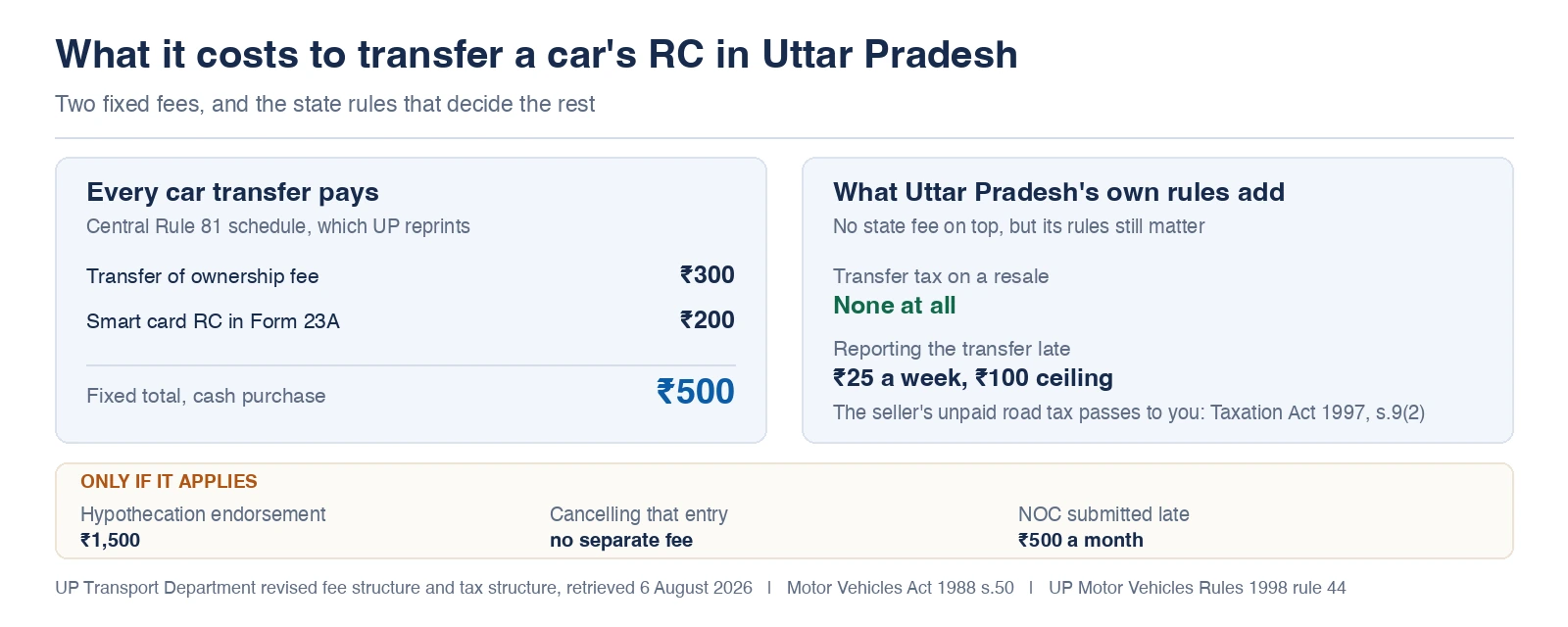
So where does the ₹300 come from? The transport department’s revised fee structure prices a transfer at half the registration fee, and registering a private car sits at ₹600. That’s the central Rule 81 schedule, which Uttar Pradesh publishes as its own, and the department’s transfer of ownership page puts it in those exact terms: fees as specified in Rule 81, paid online. No UP-only surcharge appears on either page.
Working out the total on a used car
Paying cash and filing your own paperwork? Budget ₹500, nothing more. Take a loan on the same car and your lender’s hypothecation goes onto the new RC as its own entry at ₹1,500, which lifts the government total to ₹2,000. Report the transfer three weeks late and you add ₹75, and even if it slips your mind for six months the charge stops at ₹100. That’s the entire range. Anything quoted well above it isn’t a government charge. It’s someone’s service fee.
How to apply in UP
Do you have to queue at the RTO for this? The department doesn’t route you that way. It lists transfer of ownership among the services running online on the Vahan 4.0 portal, Forms 29 and 30 are filled there, and the fee is paid on the same portal. One thing trips people up before they even start: the mobile number sitting on the vehicle record has to be the one in your hand, because the department needs that number to let you use its online services and verifies any change to it by OTP. It publishes a mobile update route for exactly that reason.
Keep the rest ready in advance. The registration certificate, the insurance certificate, a tax clearance certificate, passport size photographs of both buyer and seller, and an NOC if the car was registered outside UP. The department’s own step by step document has the applicant downloading and printing the RC once the concerned authority approves it. It’s a far shorter errand than the car registration process guide describes for a brand new car, because the record already exists and only the name on it changes.
Financed cars, and what being late costs
Still a loan running on the car? Then nothing moves until the seller’s financier signs. Section 51(4) of the Motor Vehicles Act stops the RTO recording a transfer on a hypothecated vehicle at all without the written consent of the financier named on the RC. Closing a loan later costs nothing: the fee schedule levies no separate charge for cancellation, the application is Form 35, and the central notification exempts the fresh RC issued afterwards from the ₹200 smart card fee.
Then there are the deadlines, and two clocks run at once. Section 50 gives the seller fourteen days to report a sale inside the state, and the buyer thirty days to report the transfer and send the RC in with the fee. Where the car was registered outside UP, the seller gets forty five days instead, to forward the no objection paperwork. Miss your window and Rule 44 of the Uttar Pradesh Motor Vehicles Rules 1998 sets the compounding fee at ₹25 for each week or part of a week on a private car, capped at ₹100 however long you leave it. One caution about the ₹500 a month in the table above. That’s the charge for submitting an NOC late, not a penalty for a late transfer.
How UP compares nationally
Almost nothing on this bill is Uttar Pradesh’s own doing. The ₹300, the ₹200 and the ₹1,500 all come from the central schedule the state reprints, and our breakdown of RC transfer charges across India sets out how those components sit elsewhere. Delhi’s transfer fees read much the same, with a graded late amount and a faceless process as the local touches. Two things genuinely are the state’s: that weekly compounding scale, and Section 9(2) of the Uttar Pradesh Motor Vehicles Taxation Act 1997, which makes the buyer liable for the arrears of tax, additional tax and penalty the seller left behind. So ask to see tax receipts before you sign, not after.