
Gujarat charges ₹300 to move a car’s registration into a new name, plus ₹200 for the smart card RC. On top of those two fees the state levies a transfer tax, and that’s the number that decides your bill: 15% of the lump sum tax already paid on the car if it’s up to eight years old, or 1% of that tax (₹100 minimum) once it’s older. You file Forms 29 and 30 at the RTO where you live, with a pencil print of the chassis number.
So the part of the RC transfer charges in Gujarat that catches buyers out isn’t the fee at all. Two people transferring identical paperwork on the same day can pay very different amounts, because the tax is pegged to what the car’s first owner paid rather than to what you’re paying now. Not something you can negotiate.
What you pay in Gujarat, component by component
| Component | When it applies | What you pay |
|---|---|---|
| Transfer of ownership fee | Every car transfer | ₹300 |
| Smart card RC in Form 23A | Every transfer | ₹200 |
| Transfer tax, car up to 8 years old | Cars paying lump sum tax | 15% of the lump sum tax paid |
| Transfer tax, car over 8 years old | Same | 1% of that tax, or ₹100, whichever is more |
| Hypothecation endorsement | Buyer is taking a loan | ₹1,500 |
| Cancelling a hypothecation entry | Loan closed | No separate fee |
| NOC submitted late | Only where an NOC is involved | ₹500 per month or part of one |
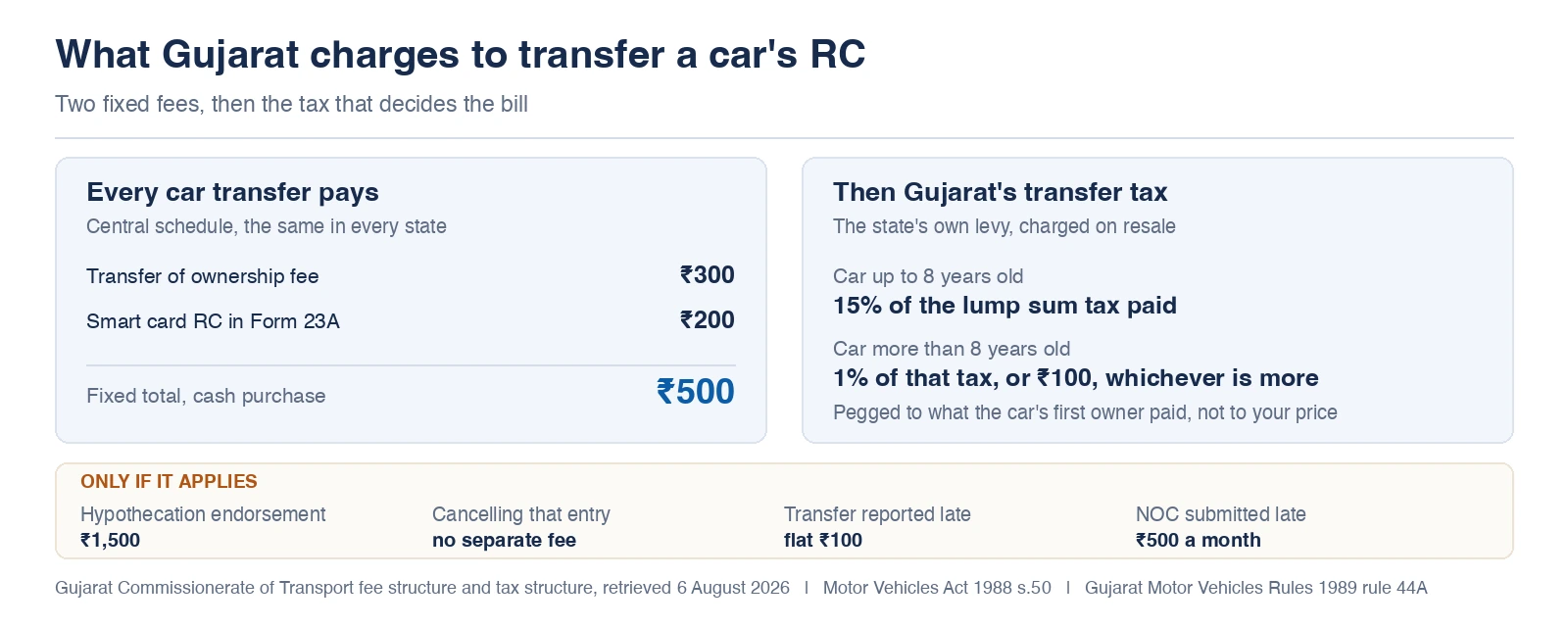
So where does the ₹300 come from? Gujarat’s transport department fee table prices a transfer at half the registration fee, and registering a private car sits at ₹600. That schedule’s the central one Gujarat publishes as its own, so every rupee in the table above apart from the tax reads the same in any state. The department’s vehicle registration page states the car figure outright rather than making you do the arithmetic.
The tax is the state’s own, and it works differently. Gujarat collects lump sum tax at 6% of the cost of the vehicle when a private car is first registered, and the transfer tax is a slice of whatever that came to. So before you budget anything, ask the seller what they were charged at registration. A company-owned or imported car paid double the lump sum rate, which means 15% of it comes to double as well.
Working out the total on a ₹7 lakh car
Say you’re buying a car that cost ₹7,00,000 new and was first registered to an individual. Lump sum tax then would’ve been 6% of that, so ₹42,000, and transferring it in year five puts you at 15% of that ₹42,000, which is ₹6,300. Add the fee and the smart card and you’re looking at ₹6,800. Buy the same car on a loan and it’s ₹8,300 once the hypothecation is endorsed.
What about the identical car at nine years old? The rate drops to 1%, so ₹420, which clears the ₹100 floor comfortably and settles the whole transfer at ₹920. Same paperwork, a fraction of the tax. Crossing eight years is a genuine cliff edge, so check the registration date before you agree on who pays what.
How to apply in Gujarat
Forms 29 and 30 go to the RTO signed by both sides, along with a pencil print of the chassis number. Take the car along. You’ll need it in front of you to get that print, and Gujarat also wants the original RC book, the insurance certificate, the PUC certificate and proof of your identity and address attached to the application. An inherited car runs on Form 31 instead, and one bought at a public auction on Form 32.
Is any of this online? Only partly. The department insists on Form 20 going in online for a brand new vehicle and routes re-registration through the parivahan portal, but it publishes no online route for a transfer, describing that as the two forms with the documents attached. The department points fee and tax payments at the central Vahan e-payment service. Its registration procedure has the smart card RC travelling by speed post to the address written on the form, and the schedule sets no charge for that post. It’s a thinner errand than how car registration works for a showroom-fresh car, because the record already exists and only the name on it changes.
Financed cars, and what being late costs
A loan changes who signs first. Section 51(4) of the Motor Vehicles Act stops the RTO recording a transfer on a financed car at all without the written consent of the financier named on the RC, so the seller’s lender has to sign off before anything else moves. If you’re the one borrowing, your lender’s hypothecation then goes onto the new RC as its own entry, which the schedule prices at ₹1,500 for a car. Closing it later is free: the fee table says no separate fee applies to cancellation, and the application is Form 35.
So what does being late cost you? Section 50 gives the seller fourteen days to report a sale inside the state and the buyer thirty days to report the transfer and send the RC in with the fee. Where the car was registered outside Gujarat the seller gets forty-five days instead, to forward the NOC paperwork. Miss your window and the registering authority can take a set amount from you instead of prosecuting, and Rule 44A of the Gujarat Motor Vehicles Rules puts that amount at a flat ₹100 however late you are. The Act caps it there in any case. Refuse to pay and you’re back on the prosecution route, where Gujarat’s published penalty structure prices an offence with no penalty of its own at ₹500 for a first instance and ₹1,000 for a repeat. One caution on the ₹500 a month in the table. That’s the charge for submitting an NOC late, not a penalty for a late transfer.
How Gujarat compares nationally
So is Gujarat costly or not? Only two things on your bill are the state’s own doing: the transfer tax, and that flat ₹100. Pegging the tax to a percentage of what the car’s first owner paid is a Gujarat method rather than a national one. Our breakdown of state-wise RC transfer charges covers how the components stack up elsewhere. Uttar Pradesh’s transfer bill is the plainer case, reprinting the central schedule almost unchanged. Bringing a car into Gujarat from another state is a different job again, with an NOC and fresh road tax of its own.