
Walking into a showroom this year? The automatic-or-manual question isn’t the same one your parents answered in 2010. Five different automatic technologies are on sale in India right now. Which one matters most for you? Read on. The price gap has narrowed. Automatics fetch a resale premium in metros. And one of those automatic types can ruin your wallet at 80,000 km if you pick the wrong one.
Want the short answer first? Here it is. The full breakdown follows below.
Automatic vs Manual at a Glance
| Factor | Manual Car | Automatic Car |
|---|---|---|
| Driving effort in traffic | Higher (clutch fatigue) | Much lower |
| Purchase price | Lower (₹50,000–₹2 lakh cheaper) | Higher |
| Mileage | Slightly better in most cars | Depends on AMT / CVT / DCT / TC type |
| Routine maintenance | Low and predictable | Low to high depending on type |
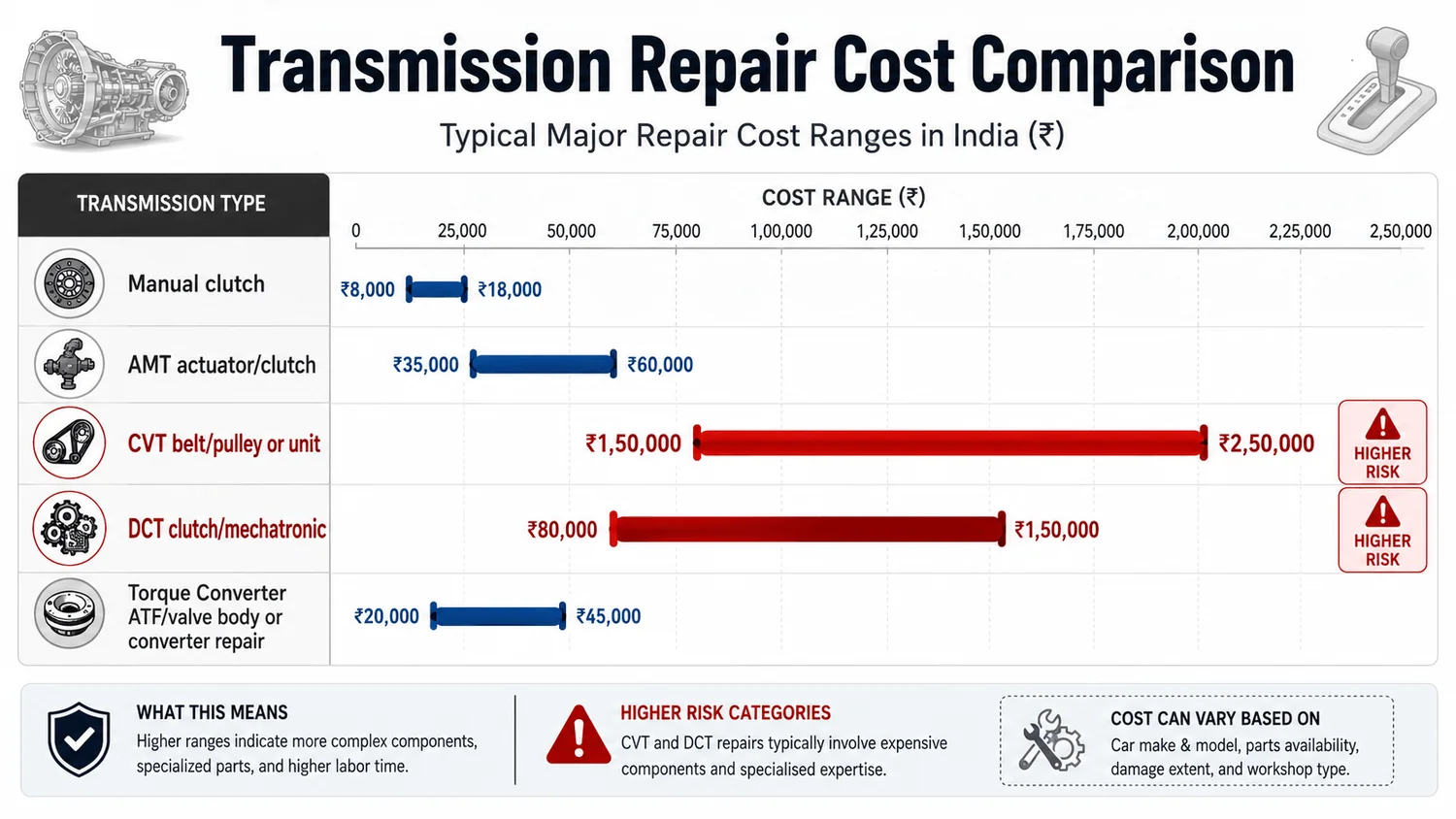
| Major repair risk | Low (clutch ₹8,000–₹18,000) | AMT manageable; CVT/DCT can shock |
| Learning curve | Steeper | Beginner-friendly |
| Resale demand (metros) | Lower | 8–15% premium in urban markets |
| Best for | Budget buyers, highway commuters | City drivers, multi-driver families |
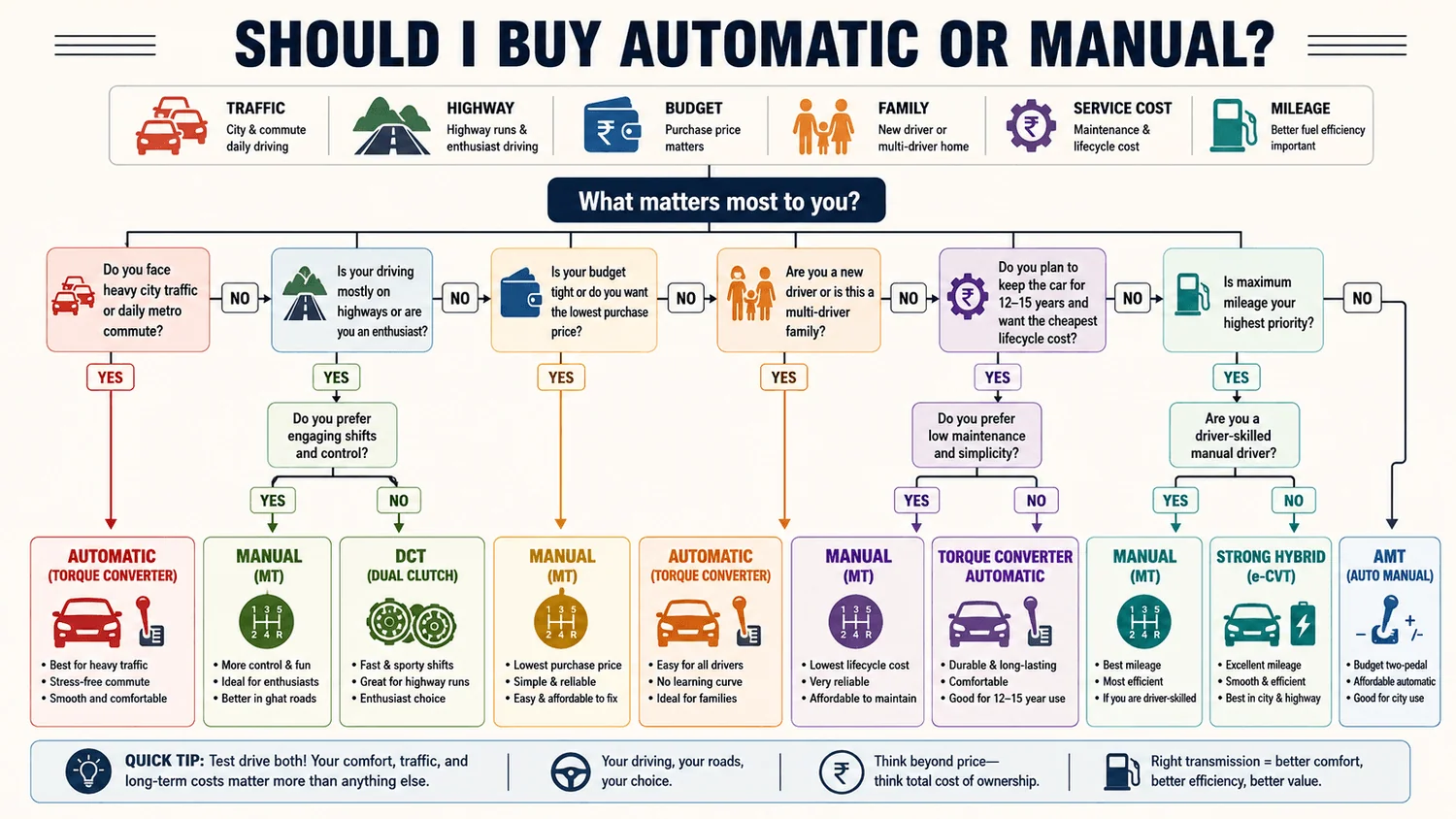
Our 2026 verdict in one line: if your daily commute is Mumbai, Bengaluru, Delhi NCR, Pune, Hyderabad, or any city where traffic crawls more than it flows, an automatic’s worth your premium. If you’re on a tight budget, you mostly drive highways, or you’re planning to own your car for 12-15 years and you want the cheapest possible lifecycle, manual still wins for you. And which automatic you pick? That matters as much as your manual-vs-auto decision itself.
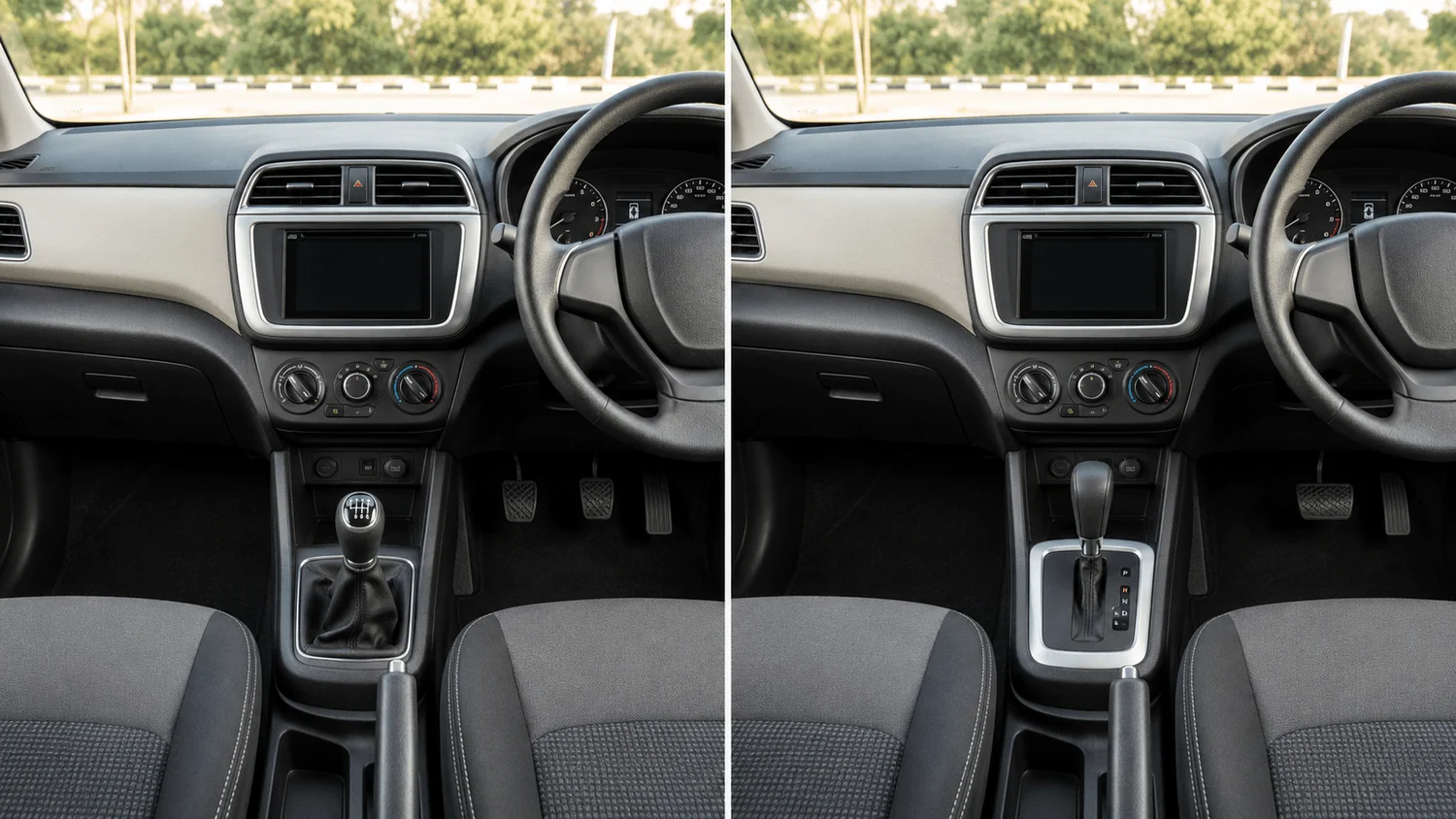
Manual vs Automatic: Key Differences
The core difference isn’t the clutch pedal. It’s who decides when to shift: you, or a computer. That single choice ripples through your price tag, your fatigue, your mileage, your repair risk, your resale, and what your daily commute actually feels like.
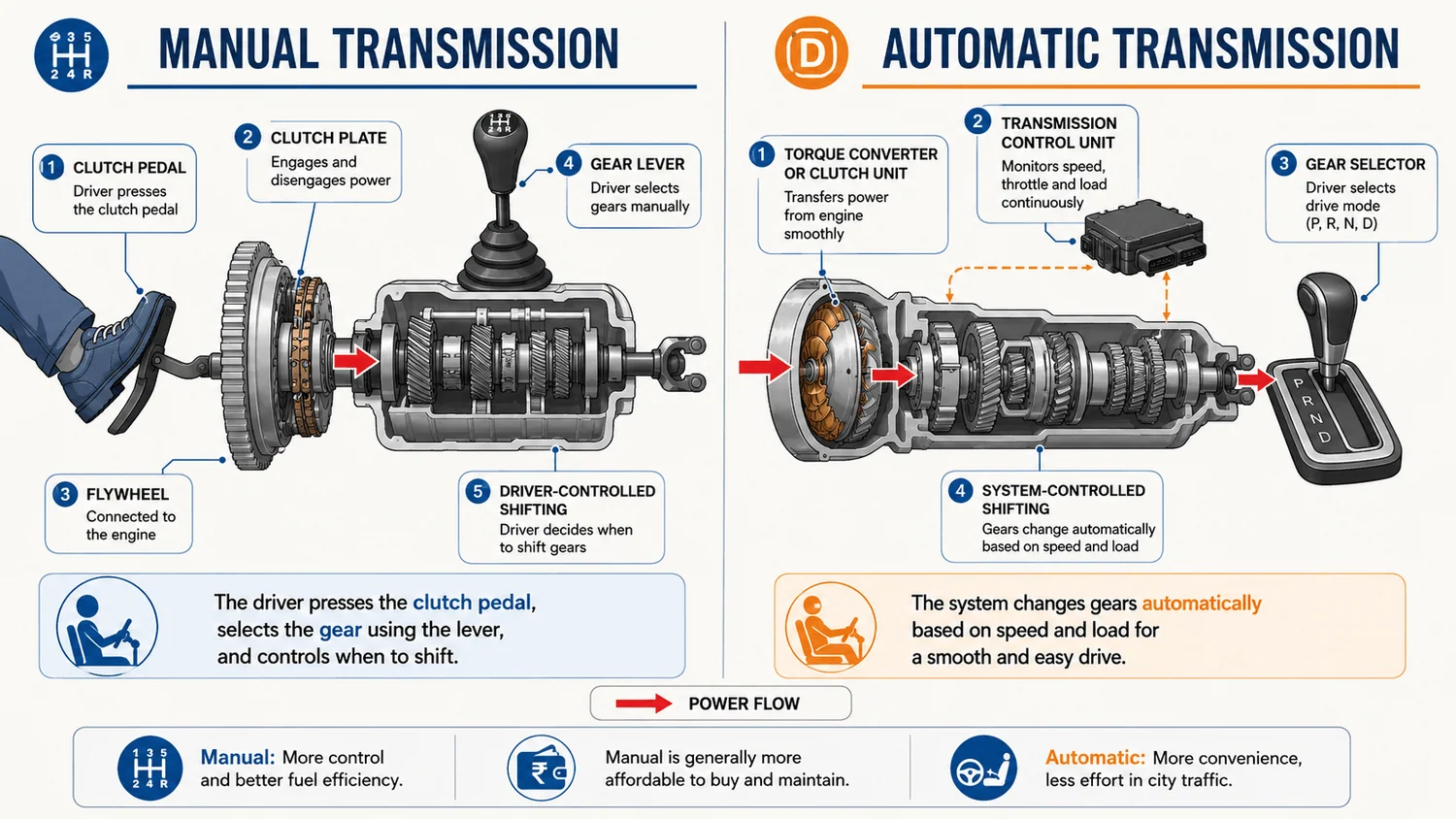
In a manual, you control everything. You match engine revs to the gear. You decide when to engage and disengage power, and you can drop two gears instantly to overtake a slow truck on a state highway. The cost? Your left leg works hard in stop-and-go traffic, and you’re juggling three pedals worth of cognitive load every kilometre.
An automatic hands gear selection to a Transmission Control Unit that runs the clutch (or fluid coupling) on its own. You operate the accelerator and brake, plus a D/R/N/P selector. In bumper-to-bumper traffic, that’s the difference between you arriving relaxed and you arriving with a sore knee.
Your financial picture lines up the same way. Automatics typically cost you ₹50,000 to ₹2 lakh more than the same variant in manual, depending on the model. Your insurance premium is also marginally higher because transmission repairs cost more if your gearbox is damaged in a claim. On the resale side? The equation has flipped in metros. Automatic variants of cars like the Brezza, Nexon, Creta, and Venue now command 8-15% premiums over manual siblings in cities. Meanwhile, manuals still hold value better in rural and Tier-3 markets where your local garage can fix them on a Saturday morning.
There’s one more dimension nobody discusses: reliability over a decade-plus. A manual gearbox with no electronics and no hydraulics will outlast almost any automatic. Plan to keep your car for 15 years? Manual is statistically the safer bet. If you change cars every 4-6 years, that durability advantage doesn’t really matter to you.
| Difference | Manual | Automatic |
|---|---|---|
| Clutch pedal | Yes | No (except some semi-auto setups) |
| Gear shifting | Driver-controlled | System-controlled |
| Traffic comfort | Lower | Higher |
| Driver involvement | Higher | Lower |
| Purchase cost | Lower | Higher |
| Repair complexity | Lower | Higher |
| Long-term reliability (10+ years) | Higher | Depends on type |
Types of Automatic Transmissions in India
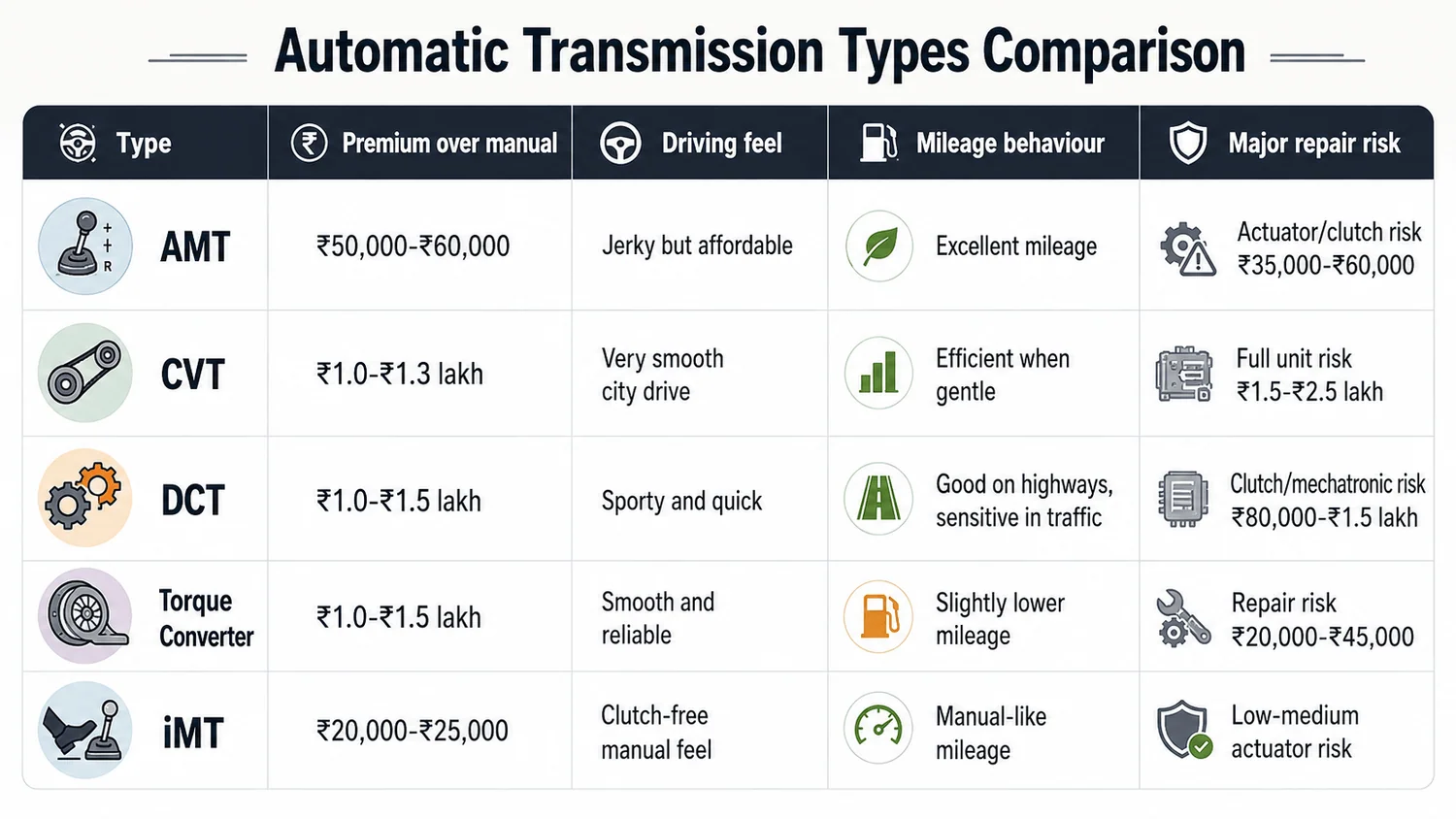
Here’s where buyers trip up. “Automatic” isn’t one technology in 2026. The Indian market sells five distinct self-shifting systems, and each behaves very differently in city traffic, on highways, on ghats, and at the service centre. Which one is in the car you’re test-driving? That matters more than the badge on the boot.
For a deeper technical comparison of the three main automatic gearboxes, see our transmission types deep-dive. The summary below focuses on what each one actually feels like to drive and own.
AMT: Automated Manual Transmission
AMT is your budget automatic. Mechanically? It’s a regular manual gearbox with a robotic actuator doing the clutch work for you. The dominant automatic technology in the sub-₹10 lakh segment you’re shopping.
- Price premium: ₹50,000–₹60,000 over the equivalent manual
- Behind the wheel: Functional but notably jerky. There’s a distinctive “head-nod” pause between gear changes because the actuator physically interrupts power to shift.
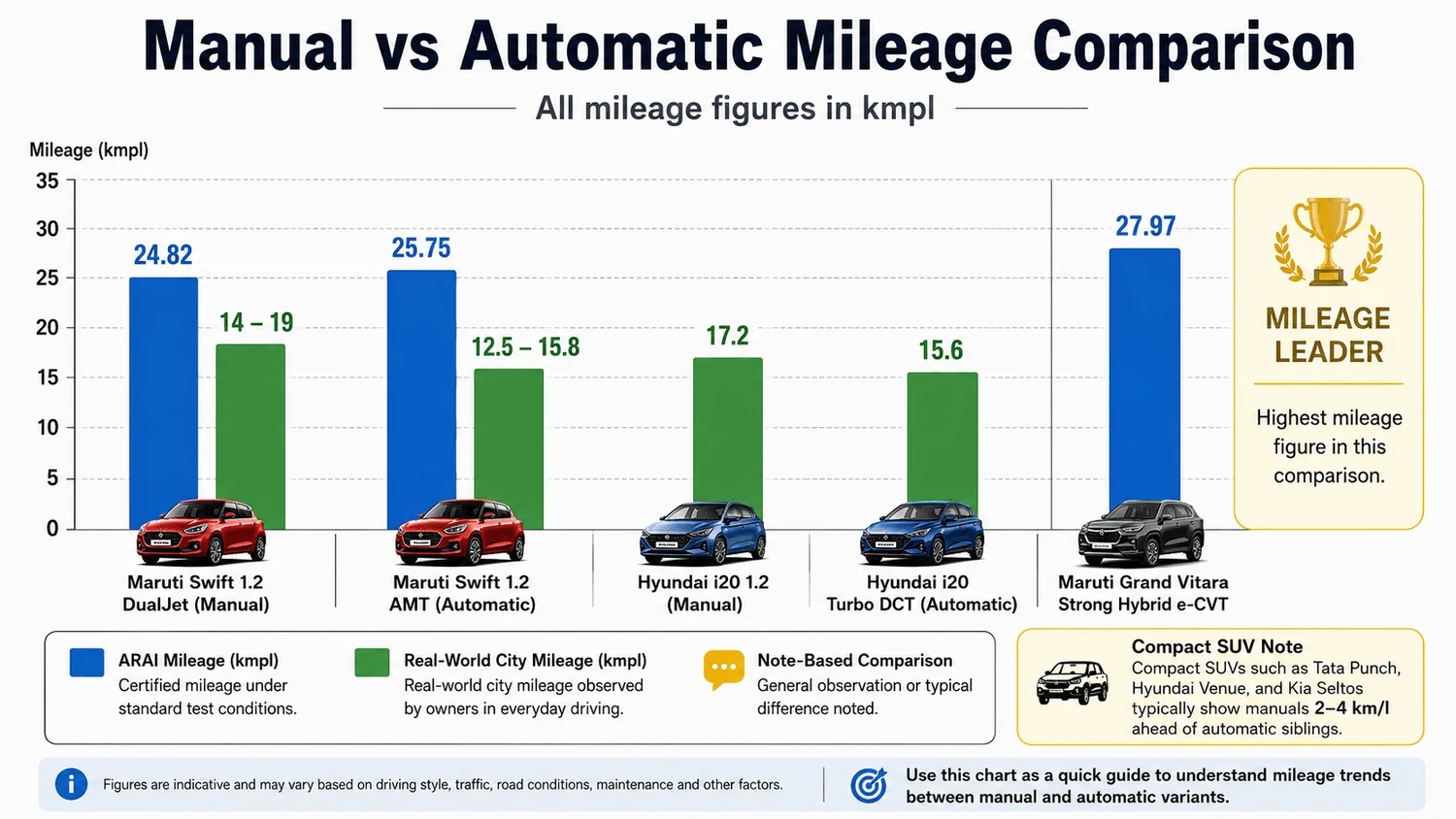
- Fuel economy: Excellent. The Swift AMT is ARAI-certified at 25.75 kmpl, actually higher than the 24.82 kmpl manual.
- Workshop reality: Low to medium overall. Around 70,000–1,00,000 km the actuator unit can fail (₹15,000–₹25,000 to replace), and a combined clutch-plus-actuator service runs ₹35,000–₹60,000.
- Where you’ll find it: Maruti Alto K10 AGS, Swift VXi AMT, Tata Punch AMT, Hyundai Grand i10 Nios AMT, Renault Kwid AMT.
Honest take? AMT gives you the cheapest path to two-pedal driving. But the jerkiness is real. Not everyone tolerates it. Test-drive specifically in stop-and-go traffic before you commit. Don’t test on an empty Sunday road. Try Tuesday peak hour, and follow the rest of our pre-purchase checklist while you’re there.
CVT: Continuously Variable Transmission
CVT has no fixed gears. Two pulleys connected by a steel belt change their effective diameter continuously, keeping your engine in its sweet spot all the time. The result? The smoothest power delivery you can get without going electric.
- Price premium: ₹1,00,000–₹1,30,000 over manual
- On the road: Buttery smooth in city traffic. No shift shock at all. Push the accelerator hard, though, and you get the “rubber band” effect. The engine revs scream while the car catches up slowly.
- At the pump: Strong in steady-state city cruising. Drops sharply under aggressive driving.
- Service centre bills: Medium for routine work (fluid changes every 30,000–40,000 km at ₹6,000–₹10,000). The big risk? Belt or pulley scoring. A full unit replacement costs ₹1.5–₹2.5 lakh because parts aren’t separately serviceable.
- Where you’ll see it: Honda City CVT, Nissan Magnite CVT, Renault Kiger CVT, Hyundai i20 IVT.
e-CVT (Strong Hybrids): A Different Beast
Don’t confuse the steel-belt CVT above with the e-CVT in strong hybrid cars. The e-CVT uses a planetary gearset paired with electric motors and has no friction belt at all. What you get: instantaneous torque, no rubber-band lag, and the best mileage in the Indian market today. The Maruti Grand Vitara Strong Hybrid is rated at 27.97 kmpl. Toyota Urban Cruiser Hyryder and Innova HyCross use the same architecture.
Buying an automatic primarily for mileage? e-CVT in a strong hybrid is the right answer in 2026.
DCT: Dual-Clutch Transmission
DCT uses two clutches: one for odd gears, one for even. While you’re driving in third, the system has already pre-selected fourth on the second shaft. Shifts happen in milliseconds. The performance automatic.
- Price premium: ₹1,00,000–₹1,50,000 over manual
- What it feels like: Lightning-quick shifts, sporty on highways, paired beautifully with turbo-petrol engines. In heavy stop-go traffic, dry-clutch DCTs can feel hesitant or even judder, and the clutch heats up if you crawl on the accelerator.
- At the pump: Strong on open highways thanks to multiple overdrive gears. Drops in heavy traffic because the clutches slip more.
- Long-term costs: This is the expensive one. Routine DCT fluid changes cost ₹8,000–₹12,000. A failed mechatronic unit or worn dual-clutch pack runs ₹80,000–₹1.5 lakh.
- Cars that use it: Hyundai Venue DCT, Kia Sonet DCT, Tata Nexon DCA (wet-clutch), VW Taigun and Skoda Kushaq 1.5 TSI DSG.
Wet vs dry clutch matters: Tata’s DCA in the Nexon and modern Hyundai/Kia 7-speed DCTs use wet-clutch systems that run cooler and last longer. Older dry-clutch DCTs? Brutal reputation in Indian traffic. Kia now offers 7-year extended warranties on DCT cars specifically to address your buyer anxiety.
Torque Converter: The Old Reliable
The torque converter is your traditional automatic. A fluid coupling, not a friction clutch, transfers power to a set of planetary gears. It’s the most mechanically proven automatic in the world.
- Price premium: ₹1,00,000–₹1,50,000 over manual
- Day-to-day feel: Smooth, rounded, dependable. Handles both city crawling and highway cruising without drama. The fluid coupling provides natural creep, which is perfect for traffic.
- Fuel economy: Slightly lower than AMT or manual because of hydraulic slippage, but modern lock-up clutches close the gap on highways.
- Cost to keep running: Routine ATF changes are an affordable ₹4,000–₹8,000. Repairs are typically minor solenoid or seal jobs at ₹8,000–₹25,000. Units commonly cross 1,50,000+ km without major surgery.
- Models in 2026: Mahindra XUV 3XO AT, Skoda Kylaq, Maruti Brezza AT, VW Taigun and Skoda Kushaq 1.0 TSI (new 8-speed Aisin unit).
Planning 10+ years of ownership? Torque converter is the only true automatic that competes with manual on lifecycle cost.
iMT: The Hybrid You Should Know About
iMT (Intelligent Manual Transmission) is a clutchless manual. You still shift gears with an H-pattern lever, but there’s no clutch pedal at all for your left foot. Electronic sensors and a small actuator engage the clutch automatically when you move the stick.
- Price premium: ₹20,000–₹25,000 (cheapest clutch-free option going)
- Behind the wheel: Engaging, like manual. Kills left-leg fatigue without AMT’s shift jerks.
- Fuel economy: Same as manual.
- Servicing: Same as manual, with one extra electronic actuator to worry about.
- Where to find it: Kia Sonet iMT, Seltos iMT, Carens iMT.
iMT doesn’t show up in many “automatic” comparison articles because it isn’t a true automatic. But if you want clutch-free driving on a manual budget and you don’t mind shifting? It’s an underrated middle path.
Video Comparing the Automatic vs Manual Driving Experience

Driving Experience Comparison
Spec sheets don’t tell you how a car actually feels in Indian conditions. So we pulled together owner reports from Team-BHP and r/CarsIndia, journalist long-term reviews, and our own test drives. Here’s how each transmission behaves in the four driving scenarios that matter most for you as an Indian buyer: city traffic, highways, ghats, and your local service centre.
In City Traffic (Stop-and-Go)
This is where your automatic earns its premium.
- Manual: Tiring for you, end of story. Constant clutch modulation in slow-crawling traffic causes your left-leg fatigue and, over years, knee strain.
- AMT: Convenient, but jerky for you in crawl. The actuator’s clutch bite is aggressive at low speeds, and your box hunts awkwardly between 1st and 2nd.
- CVT: Exceptionally smooth for you. Infinite ratios mean a buttery, shock-free crawl. Your best mainstream choice for daily city driving.
- DCT: Generally smooth, but watch out: dry-clutch versions can become sensitive and prone to overheating warnings if you creep on partial throttle for too long. Wet-clutch DCTs handle your traffic much better.
- Torque Converter: Excellent for you here. The fluid coupling delivers a perfectly natural creep with no thermal stress, even in long traffic jams.
On Highways and Open Roads
- Manual: Excellent control in your hands. You can drop two gears instantly for an overtake, hold a lower gear through a bend, and use engine braking on descents.
- AMT: Frustrating for you on the highway. Floor the accelerator and your AMT takes a noticeable, anxiety-inducing pause before it disengages, downshifts, and re-engages. Plan your overtakes early.
- CVT: Relaxed cruiser, but uninspiring for you. The rubber-band drone under hard acceleration kills the joy of your hill-climb run.
- DCT: Your highway king. Twin-clutch instant downshifts make this the choice for enthusiasts like you who frequent open roads.
- Torque Converter: Strong, competent, and smooth for your highway runs. Modern 6-speed, 7-speed, and 8-speed units cruise as efficiently as DCTs without the drama.
In Hills and Ghats
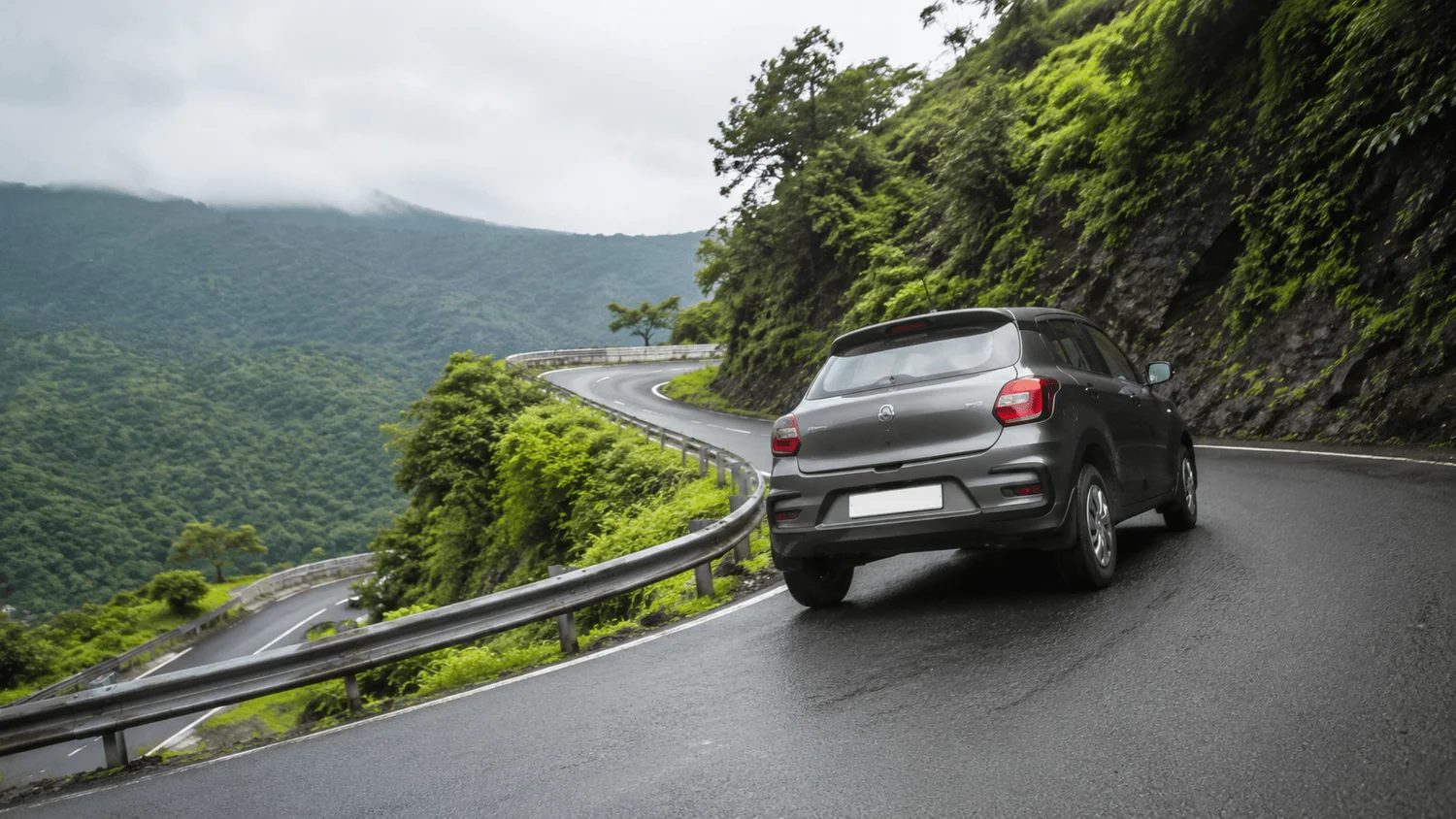
Live in Pune and drive to Lonavala on weekends? Commute up to Kodaikanal? Headed for the Western or Eastern Ghats this summer? This section is for you.
- Manual: Good with your skill behind the wheel. You can use engine braking on long descents and hold a low gear for sustained climbs. Your hill starts need practice though.
- AMT: The riskiest hill option for you. Many basic AMTs lack dedicated Hill Hold Control and can roll back briefly before your clutch engages. Always use your handbrake on steep upward stops, and shift to manual override mode for engine braking on descents.
- CVT: Adequate climbing power, but lack of fixed gears limits your engine braking on long downhill stretches. Brake fade becomes a real concern for you.
- DCT: Good climbers, but watch out: holding a DCT car stationary on a steep incline using just the accelerator (instead of the brake) will burn through your expensive clutch plates fast. Use your foot brake or handbrake instead.
- Torque Converter: Ideal for you in ghats. Fluid coupling provides natural torque multiplication for steep climbs, and the system holds your car against mild inclines without wearing friction plates.
| Scenario | Manual | AMT | CVT | DCT | Torque Converter |
|---|---|---|---|---|---|
| Stop-go traffic | Tiring | Convenient but jerky | Very smooth | Smooth but sensitive | Smooth |
| Highway overtaking | Good | Slow | Relaxed | Strong | Good |
| Hill driving | Good with skill | Average | Average | Good (with brake discipline) | Excellent |
| Beginner-friendliness | Medium | High | High | High | High |
| Enthusiast appeal | High | Low | Low-medium | High | Medium |
Maintenance and Repair Cost
Your routine maintenance for an automatic isn’t dramatically more expensive than for a manual. Where the gap opens up? The risk of a major component failure. That’s the part of automatic ownership most first-time buyers underestimate, and what we’ll cover for you next.
Manual Transmission (Baseline)
This is the cheapest gearbox to live with in India, and it’s been that way for decades. Few electronics, fewer hydraulics, and a single wearable part you’ll eventually need to swap.
- Your routine cost: Effectively zero between clutch replacements.
- The wear part: A single friction clutch.
- When it goes: Typically 60,000–80,000 km in Indian city conditions. Highway-heavy drivers stretch this comfortably past 1,00,000 km, sometimes well beyond.
- What you’ll pay: ₹8,000–₹18,000 including labour at most independent workshops, and any neighbourhood mechanic in your area can do the job.
- The gearbox itself: Rarely needs major work in your car’s lifetime.
AMT
- Your routine cost: Low.
- Wear parts: The clutch (same as manual) plus an electromechanical actuator.
- When trouble shows up: Clutch wear starts around 50,000–60,000 km if you’re city-only. Actuator failures emerge near 1,00,000 km.
- What you’ll pay: Actuator ₹15,000–₹25,000. Combined clutch and actuator service ₹35,000–₹60,000.
Manageable, in other words. Parts stay cheap because the underlying gearbox is a regular manual.
CVT
- Your routine cost: Medium. Mandatory fluid changes every 30,000–40,000 km at ₹6,000–₹10,000.
- When trouble shows up: Belt or pulley scoring between 80,000–1,00,000 km, especially if you skip fluid changes.
- What you’ll pay: Localized fixes are rare. A full replacement unit runs you ₹1.5–₹2.5 lakh.
Welcome to the “value cliff.” A high-mileage out-of-warranty CVT car can be effectively worthless if the gearbox goes.
DCT
- Your routine cost: Medium-high. Fluid changes ₹8,000–₹12,000.
- When trouble shows up: Mechatronic unit and clutch pack issues at 60,000–80,000 km, especially on dry-clutch variants if you drive in heavy urban traffic.
- What you’ll pay: Clutch pack ₹40,000–₹80,000. Mechatronic valve body ₹80,000–₹1.5 lakh.
Pay for the extended warranty. No exceptions. Kia’s 7-year warranty exists precisely because DCT failures in the 5-7 year window have spooked buyers.
Torque Converter
- Your routine cost: The lowest among automatics. ATF change ₹4,000–₹8,000.
- When trouble shows up: Rarely before 1,50,000 km, if at all.
- What you’ll pay: Most repairs are minor solenoid or seal jobs at ₹8,000–₹25,000. A full converter replacement caps at ₹25,000–₹45,000.
Picking an automatic and planning to keep the car beyond 8 years? Torque converter is your answer.
| Transmission | Routine Maintenance | Major Repair Risk | Cost Level |
|---|---|---|---|
| Manual | Low | Clutch ₹8,000–₹18,000 | Low |
| AMT | Low-medium | Actuator/clutch ₹35,000–₹60,000 | Low-medium |
| CVT | Medium | Belt/pulley ₹1.5–₹2.5 lakh | Medium-high |
| DCT | Medium-high | Clutch/mechatronic ₹80,000–₹1.5 lakh | High |
| Torque Converter | Medium | ATF/valve body ₹20,000–₹45,000 | Medium-high |
One caveat: actual costs depend on the specific car, dealer network pricing, how religiously you follow service schedules, and your driving style. The brackets above are typical market ranges, not commitments. Need brand-specific numbers? Our car service cost by brand in India guide breaks it down further.
Mileage: Automatic vs Manual
The old saying “automatics give worse mileage”? Not universally true anymore. Modern transmission mapping, lock-up torque converters, and hybrid integration have closed or reversed the gap in many cars.
What’s still true? A skilled driver in a manual can squeeze maximum fuel economy by coasting, upshifting early, modulating the throttle, and reading traffic ten cars ahead. Most drivers in heavy traffic? They don’t do any of that.
Real-world examples:
- Maruti Swift 1.2 DualJet: Manual 24.82 kmpl ARAI / 14–19 kmpl real-world city. AMT 25.75 kmpl ARAI / 12.5–15.8 kmpl real-world city. The AMT actually beats the manual on ARAI because the computer hits optimal shift points more consistently than human drivers. In real-world city traffic though, a conservative manual driver still edges ahead.
- Hyundai i20: 1.2 Manual returns ~17.2 kmpl real-world city. The 1.0 Turbo DCT does about 15.6 kmpl real-world city. Manual leads here because the turbo engine paired with DCT works harder in stop-go.
- Tata Punch, Hyundai Venue, Kia Seltos, and similar compact SUVs: Manuals typically deliver 2–4 km/l more than their automatic siblings in real-world conditions.
- Maruti Grand Vitara Strong Hybrid (e-CVT): 27.97 kmpl. Beats every manual petrol in the segment by a wide margin.
The rule of thumb:
| Transmission | Mileage vs Manual | Practical Insight |
|---|---|---|
| Manual | Baseline | Best when you drive consciously |
| AMT | Similar or slightly higher on ARAI | Efficient but sacrifices smoothness |
| CVT | Similar in city, lower under hard acceleration | Drops sharply on heavy throttle |
| DCT | Good on highway, lower in traffic | Performance-focused; heavy traffic hurts |
| Torque Converter | Slightly lower in many cars | Smooth and reliable; minor efficiency penalty |
| e-CVT (Hybrid) | Significantly higher | Mileage king of 2026 |
Does automatic give less mileage? A little, usually. The gap is much smaller than buyers think though. AMTs and e-CVTs frequently match or beat manuals. DCT and torque converter mileage depends heavily on traffic density, engine displacement, your right-foot habits, and AC usage. Want mileage from a true automatic? AMT or a strong-hybrid e-CVT is the answer. For specific picks, see our roundup of automatic cars under ₹10 lakh.
Which to Choose for City vs Highway?
The right transmission depends on a few things: where you drive, how long you’ll keep the car, what kind of driver you are, and how much you care about the service centre experience. Get those four right and the rest falls into place.
Choose a Manual Car If
- You want the lowest possible purchase price, full stop.
- Your driving is primarily on open roads, rural highways, or intercity routes where clutch fatigue isn’t a daily issue.
- You actively enjoy mechanical control. Heel-and-toe, engine braking, holding a low gear for a corner. These things matter to you.
- You’re planning to keep the car for 12-15 years and want the cheapest possible lifecycle cost.
- You’re physically comfortable operating a clutch in moderate traffic.
- You live in a Tier-3 city or rural area where automatic specialists are rare, and your local manual-savvy mechanic is a phone call away.
Choose an Automatic Car If
- Your daily commute is dominated by stop-and-go metropolitan traffic.
- You’re a new driver and want to focus on spatial awareness, mirror checks, lane discipline, and braking without juggling a clutch.
- Multiple family members of different skill levels will be driving your car.
- You actively value reduced physical and mental load over driving engagement.
- You’re willing to pay the upfront premium and slightly higher maintenance for daily comfort.
- You’re in a metro and you care about strong resale demand when you eventually sell.
Best Automatic by Use Case
| Use Case | Best Transmission |
|---|---|
| Budget city driving | AMT (cheapest two-pedal option with strong mileage) |
| Smooth daily city driving | CVT or Torque Converter (zero shift shock) |
| Performance / highway-heavy driving | DCT (instant shifts, strong acceleration) |
| Long-term reliability (10+ years) | Manual or Torque Converter |
| Lowest running cost | Manual or AMT |
| Beginner-friendly daily driver | CVT, Torque Converter, or AMT |
| Heavy bumper-to-bumper traffic | CVT or Torque Converter (best creep behaviour, no overheating) |
| Maximum mileage | Manual (driver-skilled) or Strong Hybrid e-CVT |
| Clutch-free driving on a manual budget | iMT |
Our 2026 Practical Verdict
For a typical buyer commuting in any Indian metro on a daily 25-40 km route, the automatic premium pays for itself within months. You get reduced fatigue, fewer arguments at home, and easier multi-driver flexibility. The specific type matters a lot though. CVT or torque converter for smooth daily city use. AMT if budget is tight. DCT only if you genuinely value performance and you’ve budgeted for the extended warranty. e-CVT if mileage is the deciding factor and you’re shopping in the ₹17 lakh-plus hybrid bracket.
What about manual buyers? If you’re on a tight budget, you commute mostly on highways, or you plan to drive the same car for 12-15 years, manual is still the most economically rational choice. No shame in that whatsoever.
Frequently Asked Questions
Is an automatic car more expensive to maintain?
Generally yes, but it depends heavily on the type. Routine fluid changes for automatics? Only marginally more expensive than manual servicing. The real difference? The statistical risk of a major failure. A mechatronic unit going on a DCT (₹80,000–₹1.5 lakh) or a snapped CVT belt (₹1.5–₹2.5 lakh) is far more financially painful than the ₹8,000–₹18,000 clutch replacement of a manual. AMT and torque converter automatics? They keep this risk much lower than CVT or DCT do.
Does an automatic car give less mileage?
Traditionally yes, but the gap has narrowed dramatically. AMTs often match or beat their manual variants on ARAI tests (Swift AMT 25.75 vs Swift Manual 24.82 kmpl). Hybrid e-CVTs like the Maruti Grand Vitara deliver 27.97 kmpl, far ahead of any manual petrol. Traditional torque converters and aggressively driven DCTs and CVTs still consume slightly more fuel than a skilfully driven manual, but for the average driver in city traffic, the difference is negligible.
Which is better for city driving?
For pure smoothness and reduced fatigue in stop-and-go traffic? CVT and torque converter automatics are mechanically the best. Their low-speed creep is shudder-free. AMTs are budget-friendly and convenient, but they suffer from noticeable shift jerks in slow traffic. Manual cars? Tiring in heavy congestion no matter how experienced you are.
Is AMT better than a manual transmission?
Purely for left-leg convenience and city traffic comfort? Yes. From a refinement standpoint? No. AMTs shift slower on overtakes and feel jerky compared to a skilled manual driver. Over a decade, AMTs are also slightly more expensive to maintain than a pure manual because of the actuator. Best to understand AMT as “manual with a robotic clutch” rather than “premium automatic.”
Is a manual car more reliable than an automatic?
Yes, in a long-term sense. The mechanical simplicity of a traditional manual gearbox (no electronics, no hydraulic valve bodies, no mechatronic modules) makes it inherently more durable over decades. How long? Most manual gearboxes never need a major overhaul in the vehicle’s lifetime. Compare that with CVTs, DCTs, and even AMTs, which all have known failure points around the 60,000–1,00,000 km mark.
Which automatic transmission is best in India?
No single answer here. For long-term reliability and smooth daily driving? Torque converter. For relaxed city commuting on a moderate budget? CVT. For highway performance and driving enthusiasts? DCT. For the cheapest two-pedal driving with strong mileage? AMT. For maximum mileage? An e-CVT in a strong hybrid. Match the transmission to your driving pattern, not just your budget.
Should a first-time buyer choose manual or automatic?
For first-time buyers in urban India, an automatic is generally recommended (CVT, torque converter, or AMT). It removes a whole cluster of cognitive load: clutch biting points, stalling at signals, hill starts on flyovers, gear hunting in traffic. With those off your plate, you can focus on the things that actually keep you safe: spatial awareness, mirror checks, lane discipline, and braking. The slightly higher cost is worth the easier learning curve and reduced traffic stress.
Is automatic good for hill driving?
Some automatics are excellent in hills, others are tricky. Torque converters are phenomenal because the fluid coupling provides massive torque multiplication for steep climbs and holds your car against inclines without wear. AMTs can be problematic in ghats. Many lack Hill Hold Control and may roll back slightly before the clutch engages. DCTs climb well but can burn clutches if you hold the car on a steep incline with the accelerator instead of the brake. CVTs climb adequately but offer weak engine braking on long descents, so you’ll lean on your brakes more.
Are automatic cars good for long-term (10+ year) ownership?
Yes, if you pick the right type and maintain it religiously. Torque converters routinely cross 1,50,000 km without major work and are your safest bet for 10-15 year ownership. CVTs and DCTs demand strict adherence to fluid change intervals. Skip them and you risk a ₹1.5–₹2.5 lakh failure. AMTs are decent for long-term use given their manual-gearbox foundation. For maximum lifecycle peace of mind beyond 10 years, manual still wins.
Is DCT reliable in Indian traffic?
Modern DCTs have improved significantly, especially wet-clutch systems like Tata’s DCA (Nexon) and Hyundai/Kia’s 7-speed units. Early dry-clutch DCTs had genuine reliability problems in Indian gridlock. Overheating, judder, premature clutch wear, all of it. Today’s wet-clutch DCTs are far more durable, but you still benefit from careful driving (avoid riding the throttle to hold the car on inclines) and an extended warranty for genuine peace of mind. Kia and Hyundai now offer extended warranties up to 7 years specifically for this reason.
Is an automatic car worth the extra ₹1-2 lakh?
For daily metro commuters, yes. The reduction in your daily fatigue and the resale premium (8-15% over manual in cities) typically justify the upfront cost within 4-5 years. For highway drivers or rural buyers, no. Your manual saves money up front and on every service for 10+ years. Either way, test-drive the specific variant in your real traffic before deciding.