
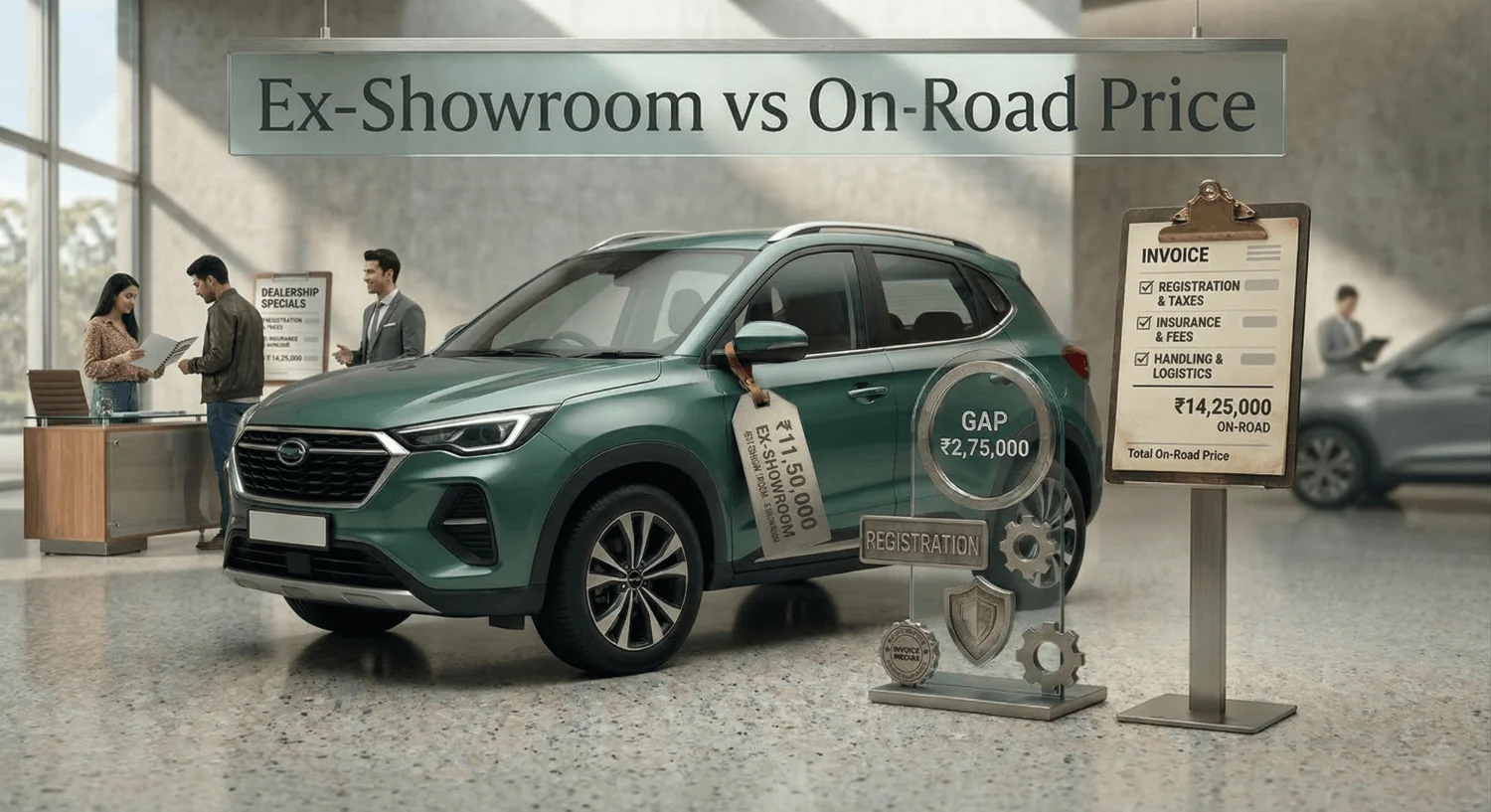
The ex-showroom price is what the manufacturer advertises. The on-road price is what you actually pay. In simple terms: On-road price = Ex-showroom price + road tax + registration + insurance + other charges. The gap between the two can range from ₹50,000 to over ₹2.5 lakh depending on the car and your state.
If you’ve ever wondered why the car you liked at ₹8 lakh online suddenly costs ₹9.5 lakh at the dealership, this breakdown explains every rupee of that difference.
What Is Ex-Showroom Price?
What does this price actually include? The ex-showroom price is the base cost of the car as it sits on the dealership floor. Three components make it up:
- Manufacturing cost (raw materials, assembly, R&D, factory-to-dealer transport)
- Dealer’s profit margin (typically 2-5% of the manufacturer’s base price)
- GST (Goods and Services Tax) charged by the central government
That’s it. The ex-showroom price doesn’t include road tax, registration, or insurance. You can’t legally drive the car home by paying only this amount.
How GST 2.0 Affects the Ex-Showroom Price
The September 2025 GST reforms changed car pricing significantly. The old system charged 28% GST plus a variable cess (1-22%). The new structure is simpler:
| Vehicle Category | Old Rate (GST + Cess) | New GST 2.0 Rate |
|---|---|---|
| Small petrol/CNG cars (under 1200cc, under 4 metres) | 29% | 18% |
| Small diesel cars (under 1500cc, under 4 metres) | 31% | 18% |
| Mid-size cars and SUVs (over 4 metres or larger engines) | 43-50% | 40% |
| Electric vehicles (all sizes) | 5% | 5% |
So a Maruti Swift LXi (sub-4-metre, 1197cc petrol) sits in the 18% slab. A Hyundai Creta E (1497cc, over 4 metres) gets hit with 40%. The GST gap alone inflates the Creta’s sticker price well beyond what the raw manufacturing cost would suggest.
Here’s an interesting quirk: manufacturers engineer cars specifically around these thresholds. Ever noticed how many Indian cars measure exactly 3,995 mm? Or carry engines at 1199cc? Cross the line by a single millimetre or cubic centimetre, and the tax jumps from 18% to 40%. That one millimetre can mean lakhs.
What Is On-Road Price?
The on-road price is everything you pay to legally drive the car home. It takes the ex-showroom price and adds mandatory government charges plus insurance.
Here’s what gets added:
| Component | Who Sets It | Can You Negotiate? |
|---|---|---|
| Road tax (lifetime) | State government | No |
| Registration (RTO fee + HSRP) | State RTO | No |
| Insurance (minimum 1+3 year) | IRDAI + private insurers | Partly (OD portion) |
| FASTag | Central government | No |
| TCS (1% if car exceeds ₹10 lakh) | Central government | No |
| Handling/logistics charges | Dealer | Yes (these are illegal) |
| Accessories/extended warranty | Dealer | Yes (optional, decline freely) |
Some of these are fixed by law. Others? Dealer add-ons you can and should push back on.
Video Explaining Ex-Showroom vs On-Road Price

Complete Breakdown of On-Road Price Components
1. Road Tax
This is the biggest single addition to your bill. You pay it once, at the time of registration, directly to your state government. How much? It’s a percentage of the ex-showroom price. And the percentage varies wildly depending on where you live. For real, city-specific numbers, see the Hyundai Venue on-road price in Bangalore, the Maruti Baleno on-road price in Patna, or a full city-wise on-road price breakdown.
Delhi (petrol cars, private registration):
| Ex-Showroom Slab | Road Tax Rate |
|---|---|
| Up to ₹6 lakh | 4% |
| ₹6 lakh to ₹10 lakh | 7% |
| Above ₹10 lakh | 10% |
Delhi also penalises diesel. A diesel car under ₹6 lakh pays 5% instead of 4%. Above ₹10 lakh, diesel pays 12.5% vs. 10% for petrol.
Karnataka (private ICE vehicles):
| Ex-Showroom Slab | Lifetime Road Tax |
|---|---|
| Under ₹5 lakh | 13% |
| ₹5 lakh to ₹10 lakh | 14% |
| ₹10 lakh to ₹20 lakh | 17% |
| Above ₹20 lakh | 18% |
Karnataka is consistently one of the most expensive states for car registration. A car with an ex-showroom price of ₹10.79 lakh (like the Creta E in Bangalore) falls into the 17% bracket here. That’s ₹1,83,430 in road tax alone.
EVs get a massive break. Karnataka charges just 4-5% road tax for standard EVs, and Delhi charges 0% on many electric models.
For a full state-by-state guide, check our road tax rates by state guide.
2. Registration Fee and HSRP
How much does RTO registration actually cost? For a full step-by-step walkthrough, see our car registration process guide. The base fee for a private four-wheeler is ₹600 across India. The High Security Registration Plate (HSRP) adds ₹1,100 to ₹1,500 for cars. These plates are tamper-proof and linked to the national Vahan database.
Financing the car? Add ₹1,500 for hypothecation, which records the bank’s lien with the RTO.
One small scam to watch for: dealers charging ₹500-600 for plastic HSRP frames. No legal requirement for these whatsoever.
3. Insurance (The “1+3” Mandate)
Expect ₹25,000 to ₹55,000+ added to the on-road price for insurance alone. Why so steep for a brand-new car?
Because IRDAI mandates that every new car must be sold with 3 years of third-party liability insurance upfront, plus 1 year of own-damage cover. This is called the “1+3” structure. The idea is to prevent owners from letting insurance lapse after Year 1, which used to be a massive problem.
Third-party premiums are fixed by IRDAI based on engine capacity. You can’t negotiate these. But the own-damage (OD) portion is competitive. Dealers quote OD at the ceiling because they earn commissions of around 1% from partner insurers. You’ve got the right to buy your own policy from an online aggregator (PolicyBazaar, Acko, Digit) and save 30-40% on the OD portion.
4. FASTag
₹500 for the RFID toll device. Mandatory at the point of sale. Small cost, non-negotiable.
5. TCS (Tax Collected at Source)
If the car’s invoice value exceeds ₹10 lakh, the dealer collects an additional 1% as TCS under Section 206C of the Income Tax Act. On a Hyundai Creta E at ₹10.79 lakh, that’s ₹10,790 collected upfront.
But here’s what most people miss: TCS isn’t money you lose. It shows up as a pre-paid tax credit in your Form 26AS. File your ITR, and it adjusts against your tax liability. Zero tax liability? The full amount comes back to you within 4-5 weeks.
Still, it locks up your cash at the worst possible moment. On a tight budget, that extra ₹10,000-₹20,000 upfront pinch is real.
6. Handling/Logistics Charges (Illegal, But Still Common)
Dealers routinely add ₹5,000 to ₹50,000 under names like “handling charges,” “logistics fees,” or “dealer prep.” These are illegal. The Supreme Court, multiple High Courts, and state consumer forums have all ruled that the ex-showroom price already includes all logistics and dealer costs.
Some dealers get creative and inflate the road tax line item on your invoice to hide the charge. Cross-check the RTO amount on your dealer’s quote against the official Vahan portal calculation. If the numbers don’t match, you’ve found the hidden fee.
If the dealer won’t budge, email the manufacturer’s customer care or the regional CEO’s office. That typically resolves it within days.
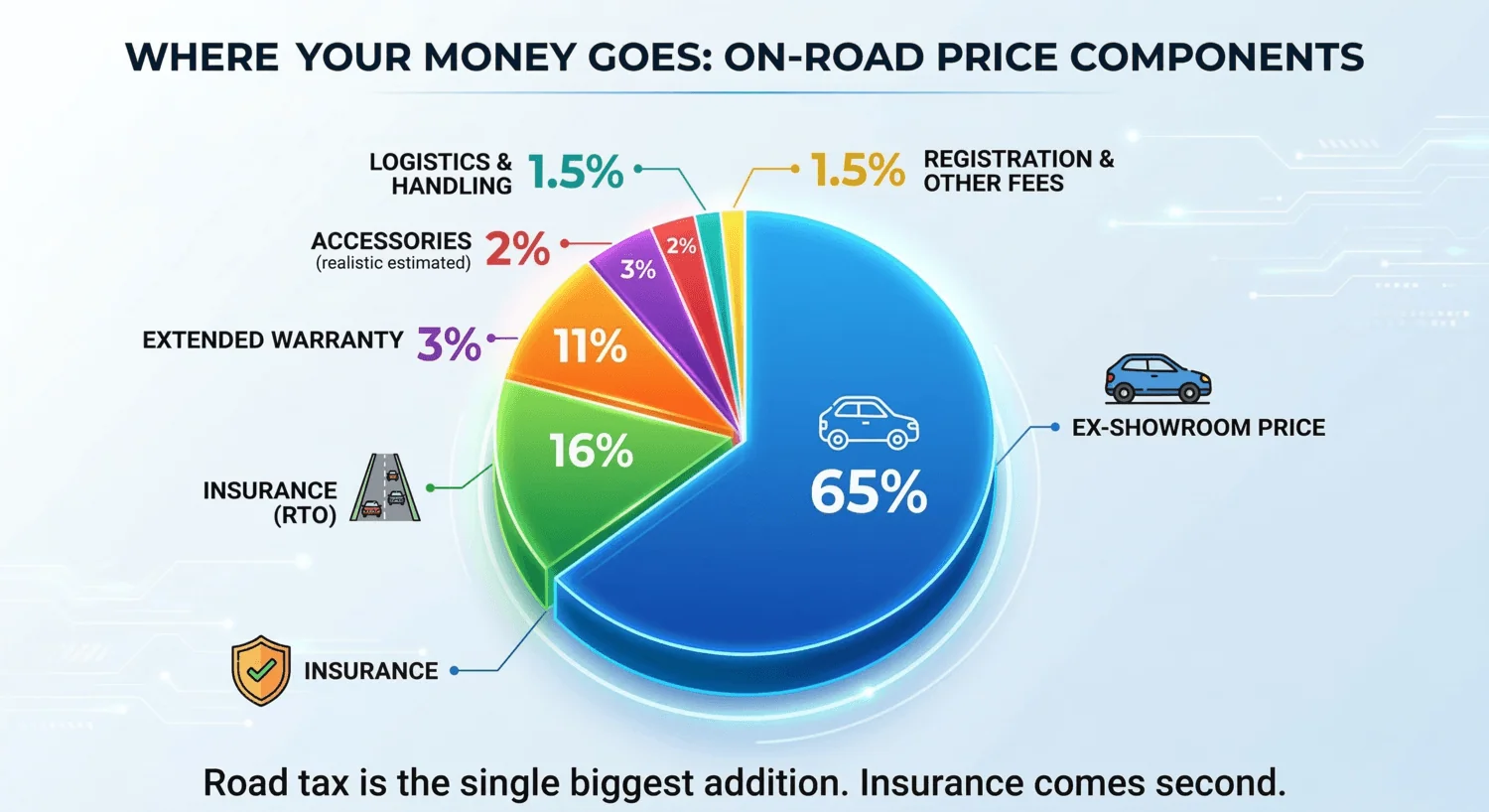
Is GST added to ex-showroom prices?
No. Nothing extra appears on your bill for GST. The tax is already sitting inside the ex-showroom sticker: the manufacturer’s base price, the dealer’s margin, and GST together make up the number you see advertised. Buyers sometimes read “18% GST on small cars” and brace for an 18% addition at the showroom. That never happens, because the tax was collected before the price reached the brochure.
You can work out how much of your sticker is tax. On a ₹10 lakh ex-showroom car in the 18% slab, ₹1,52,542 of that amount is GST. If the car sits in the 40% slab instead, ₹2,85,714 of the same ₹10 lakh sticker is tax. The formula runs backwards from the sticker (price × rate ÷ (100 + rate)), which is why the GST inside is smaller than a flat 18% or 40% of the sticker.
Does on-road price include GST?
Yes, through the ex-showroom component. Every rupee of GST you pay on a car travels inside that first line of the dealer’s quote. The remaining lines (road tax, registration, insurance, FASTag) then stack on top of it.
There’s a sting in how that works. Road tax is calculated as a percentage of the ex-showroom price, and the ex-showroom price already contains GST. So your state charges its tax on a figure that includes central tax. Tax on tax, and it’s a big reason the sticker-to-on-road gap widens so fast on pricier cars. Put GST and road tax together on a ₹10 lakh small car and the combined cut lands between ₹2.23 lakh and ₹3.09 lakh depending on your state, which is 22 to 31 percent of the sticker. We’ve broken that stack down rupee by rupee in how much tax you actually pay on a ₹10 lakh car.
Ex-Showroom vs On-Road Price: Example Calculations
Here’s where this gets real. Two popular cars, both registered in Bangalore (Karnataka). Watch how the gap grows as the car’s price climbs.
Maruti Swift LXi (Base Variant) vs Maruti Swift ZXi+ AMT (Top Variant)
| Component | Swift LXi (Base) | Swift ZXi+ AMT (Top) |
|---|---|---|
| Ex-showroom price | ₹5,78,900 | ₹8,80,000 |
| Road tax (Karnataka, 14%) | ₹81,046 | ₹1,23,200 |
| Registration + HSRP | ₹1,500 | ₹1,500 |
| Insurance (1+3 structure) | ₹34,060 | ₹42,000 |
| FASTag | ₹500 | ₹500 |
| TCS (1%) | Not applicable | Not applicable |
| Total on-road price | ₹6,96,006 | ₹10,47,200 |
| Premium over ex-showroom | ₹1,17,106 (20.2%) | ₹1,67,200 (19%) |
The base Swift costs ₹1.17 lakh more than its ex-showroom price. The top variant adds ₹1.67 lakh. Neither triggers TCS because both stay under ₹10 lakh on-road invoice value.
Hyundai Creta E (Base Variant) vs Hyundai Creta SX(O) Diesel AT (Top Variant)
| Component | Creta E Petrol MT (Base) | Creta SX(O) Diesel AT (Top) |
|---|---|---|
| Ex-showroom price | ₹10,79,000 | ₹20,19,000 |
| Road tax (Karnataka, 17-18%) | ₹1,83,430 | ₹3,63,420 |
| Registration + HSRP + Hypo | ₹2,500 | ₹2,500 |
| Insurance (1+3 structure) | ₹55,000 | ₹85,000 |
| FASTag | ₹500 | ₹500 |
| TCS (1%) | ₹10,790 | ₹20,190 |
| Total on-road price | ₹13,31,220 | ₹24,90,610 |
| Premium over ex-showroom | ₹2,52,220 (23.4%) | ₹4,71,610 (23.4%) |
Want the full variant-wise breakdown? Check the Hyundai Creta on-road price in Bangalore with all 11 variants, or compare prices in Chennai, Delhi, and Mumbai.
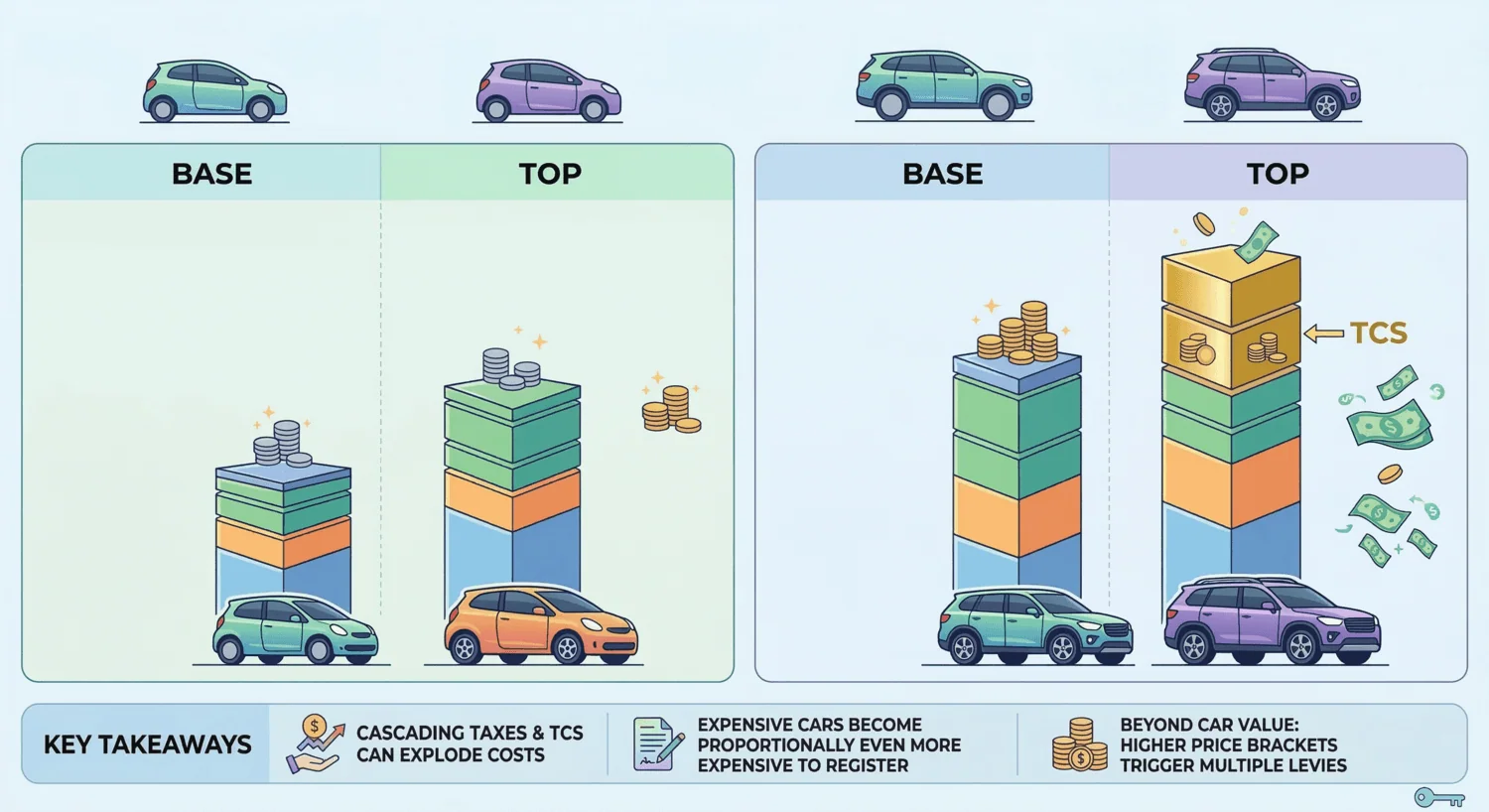
Why does the Creta’s gap balloon? It triggers the 40% GST slab (over 4 metres), falls into Karnataka’s 17-18% road tax bracket, and crosses the ₹10 lakh TCS threshold. Triple hit.
The key takeaway: The ex-showroom gap between the Swift LXi and Creta E is ₹5 lakh. But the on-road gap expands to ₹6.35 lakh. Cascading taxes make expensive cars proportionally even more expensive to register.
Why On-Road Price Varies by City
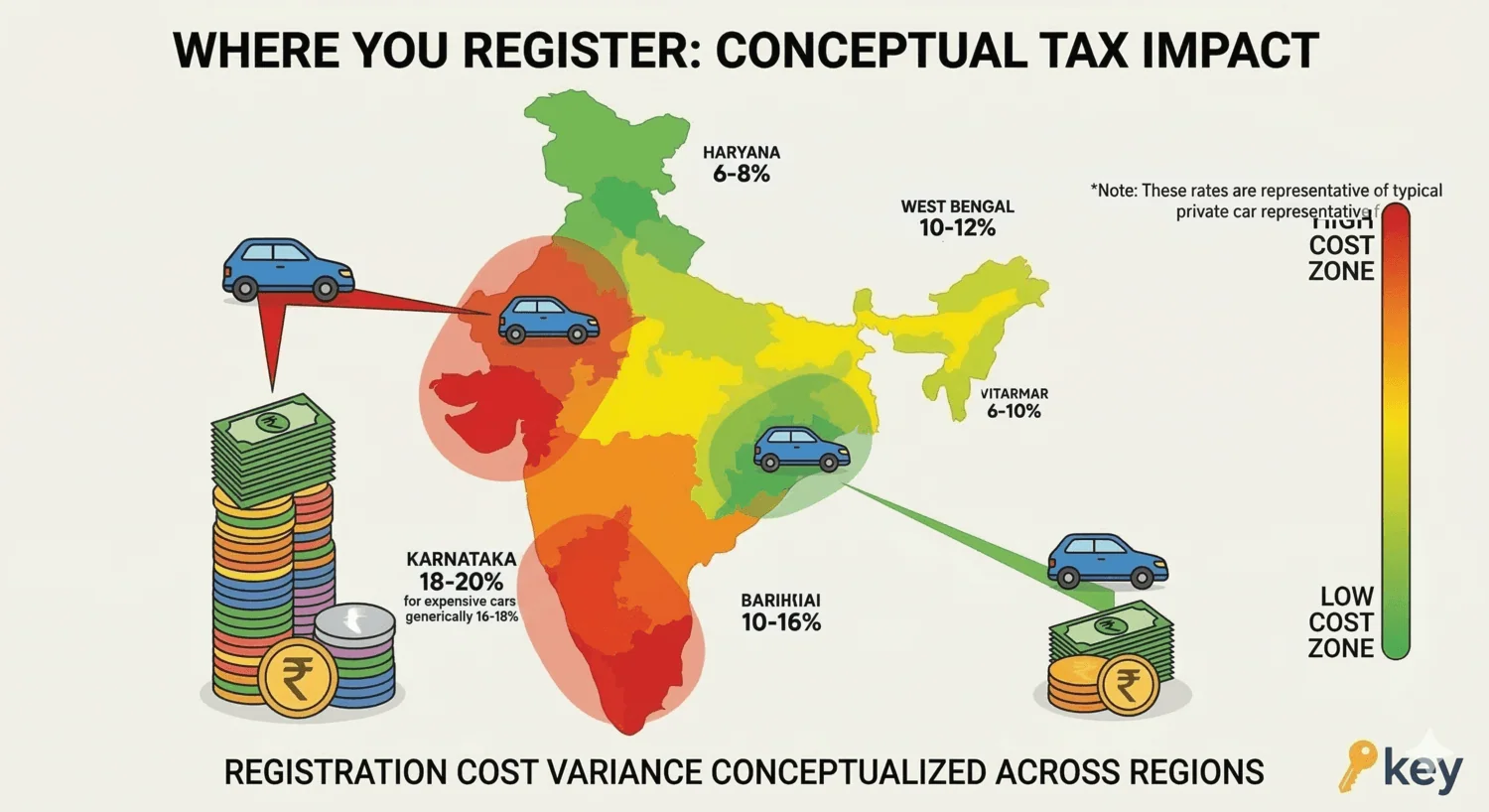
Same car. Same variant. Completely different on-road price depending on where you register. Why? Road tax. You can check the on-road price by city for any model on our pricing pages.
Here’s the Maruti Swift LXi registered across four cities:
| City | Ex-Showroom | Road Tax/RTO | Insurance | Other Charges | On-Road Price |
|---|---|---|---|---|---|
| Delhi | ₹5,78,900 | ₹23,156 (4%) | ₹34,060 | ₹2,000 | ₹6,38,116 |
| Mumbai | ₹5,78,617 | ₹63,647 (11%) | ₹33,452 | ₹2,000 | ₹6,77,716 |
| Bangalore | ₹5,78,900 | ₹81,046 (14%) | ₹34,060 | ₹2,000 | ₹6,96,006 |
| Chennai | ₹5,78,900 | ₹75,257 (13%) | ₹33,463 | ₹2,000 | ₹6,89,620 |
The same Swift LXi costs ₹57,890 more in Bangalore than in Delhi. That’s entirely road tax.
And the gap only widens for pricier cars. A Hyundai Creta E registered in Karnataka pays ₹1,83,430 in road tax. In Delhi, the same car pays around ₹75,000. Over a lakh of difference on a single charge.
This is why some buyers register cars in low-tax states through family addresses. But RTOs actively monitor this, and if you’re caught using an out-of-state registration while residing permanently in a high-tax state, you face penalties and forced re-registration.
The BH Series Alternative
If you’re in a transferable job (government, defence, or private sector companies with offices in 4+ states), the Bharat (BH) Series registration helps. Instead of paying massive lifetime road tax upfront, BH uses a biennial (2-year) system:
| Car Value | BH Tax Rate (every 2 years) |
|---|---|
| Under ₹10 lakh | 8% |
| ₹10 lakh to ₹20 lakh | 10% |
| Above ₹20 lakh | 12% |
Diesel cars pay an extra 2%. EVs get a 2% discount.
This lowers your initial on-road cost significantly. But it’s a recurring payment, and some state RTOs (Karnataka, Telangana, Kerala) have challenged BH registrations and demanded tax differentials. If you go this route, keep your employment proof and biennial payment receipts accessible.
For a detailed look at how our first car buying guide covers the full buying process, including loans, negotiation, PDI, and more.
FAQs
What is included in ex-showroom price?
Three things: the car’s manufacturing cost, the dealer’s profit margin (2-5%), and the central GST. For sub-4-metre cars with engines under 1200cc (petrol) or 1500cc (diesel), the GST rate is 18% after the September 2025 reforms. Larger cars pay 40%. EVs pay just 5%.
Why is on-road price different in every city?
Road tax. It’s set by each state government and ranges from 4% (Delhi, for petrol cars under ₹6 lakh) to 18% (Karnataka, for cars above ₹20 lakh). Insurance premiums also vary slightly by city since risk zones affect own-damage rates. Registration fees are mostly uniform at ₹600 nationally. The car registration process guide walks through the full RTO procedure.
How much extra do I pay over ex-showroom?
For budget hatchbacks (₹5-7 lakh range), expect 15-20% above ex-showroom. For mid-size SUVs (₹10-15 lakh), the premium is 20-25% because higher road tax brackets kick in and TCS applies. For premium cars above ₹20 lakh, the gap can cross 25%.
Can I buy insurance separately instead of from the dealer?
Yes. You’re legally allowed to purchase your own motor insurance and present it to the dealer before delivery. Online aggregators (PolicyBazaar, Acko, HDFC Ergo) consistently offer 30-40% lower premiums on the own-damage portion compared to dealer-quoted policies. The third-party premium is fixed by IRDAI, so that stays the same regardless of where you buy.
What is TCS, and do I lose that money?
TCS (Tax Collected at Source) is 1% of the invoice value, applicable on cars exceeding ₹10 lakh. The dealer collects it and remits it to the government. It appears in your Form 26AS and gets adjusted when you file your income tax return. If your total tax liability is lower than the TCS amount, the excess gets refunded. You don’t lose it permanently, but it does increase your upfront cash outflow.
The gap between ex-showroom and on-road isn’t a scam. It’s taxes and regulation doing their job. But knowing what each charge actually is, which ones you can negotiate, which ones are flat-out illegal, that puts you in control of the final number.