
Your car’s paint is thinner than you’d expect. The full paint system on a modern vehicle measures just 100 to 180 microns. And the clear coat that actually gives your car its gloss and UV protection? Only 35 to 50 microns. That’s roughly half the thickness of a human hair.
Every rubbing compound, every “detailing package” at a local garage physically shaves off a portion of this irreplaceable layer. So before you spend money on any car polish or detailing service, you should know what you’re actually paying for, what your car genuinely needs, and where the Indian market is quietly ripping you off.
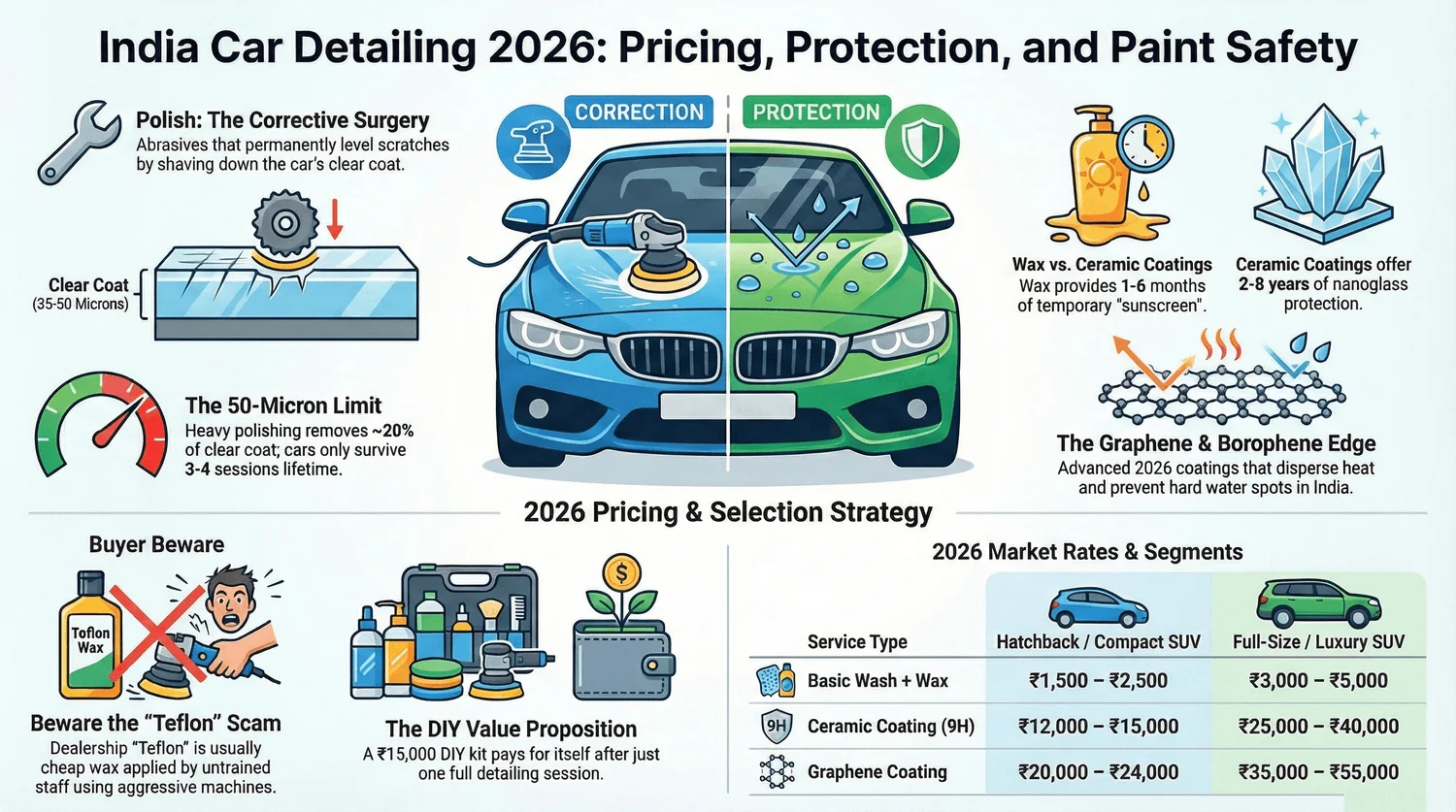
This guide breaks down realistic 2026 prices for every level of car detailing in India. From a basic wash-and-wax to a full graphene coating. We’ve also put together a DIY polishing guide with specific products and costs so you can decide what makes financial sense for your situation.
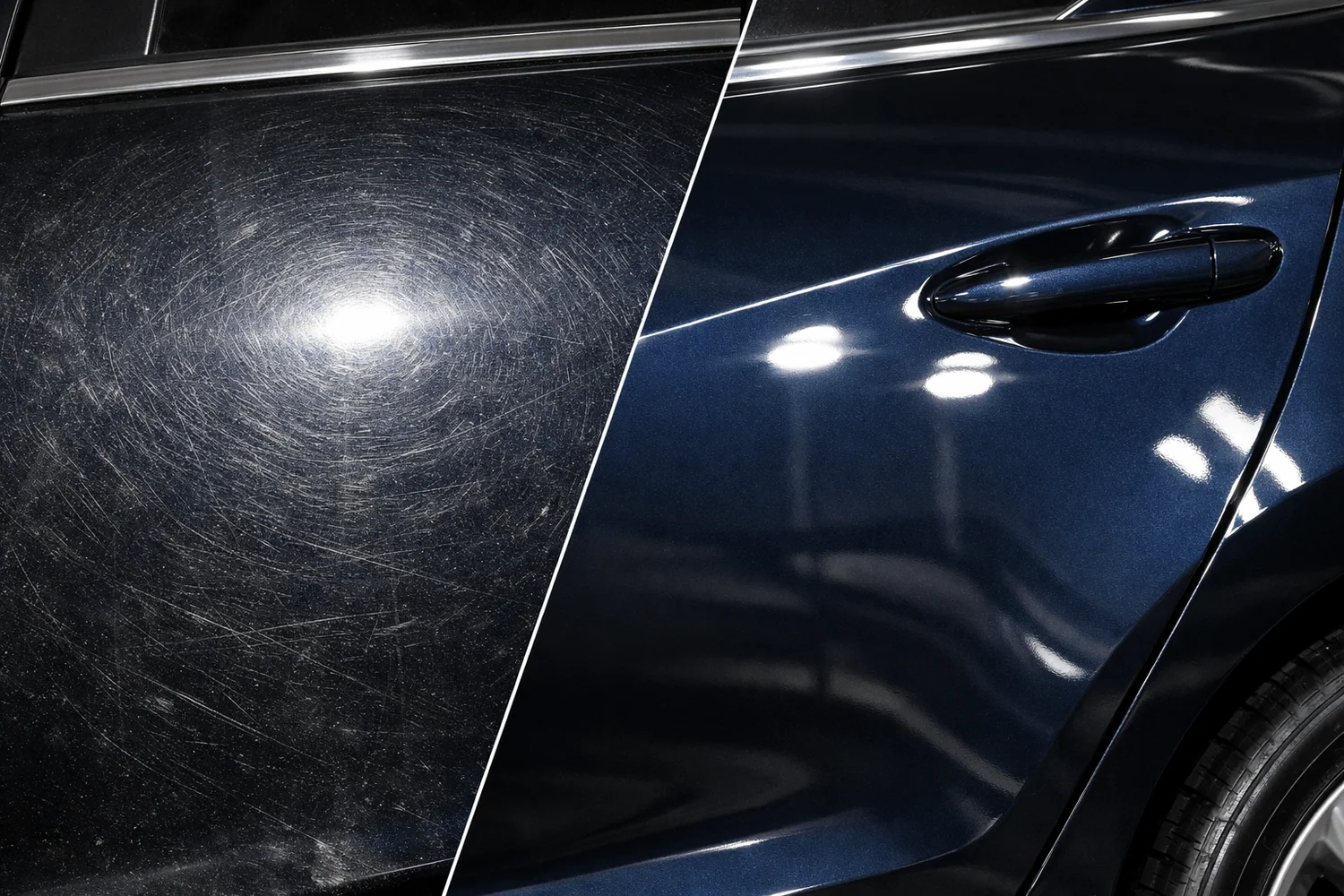
Car Polish vs Wax vs Ceramic Coating
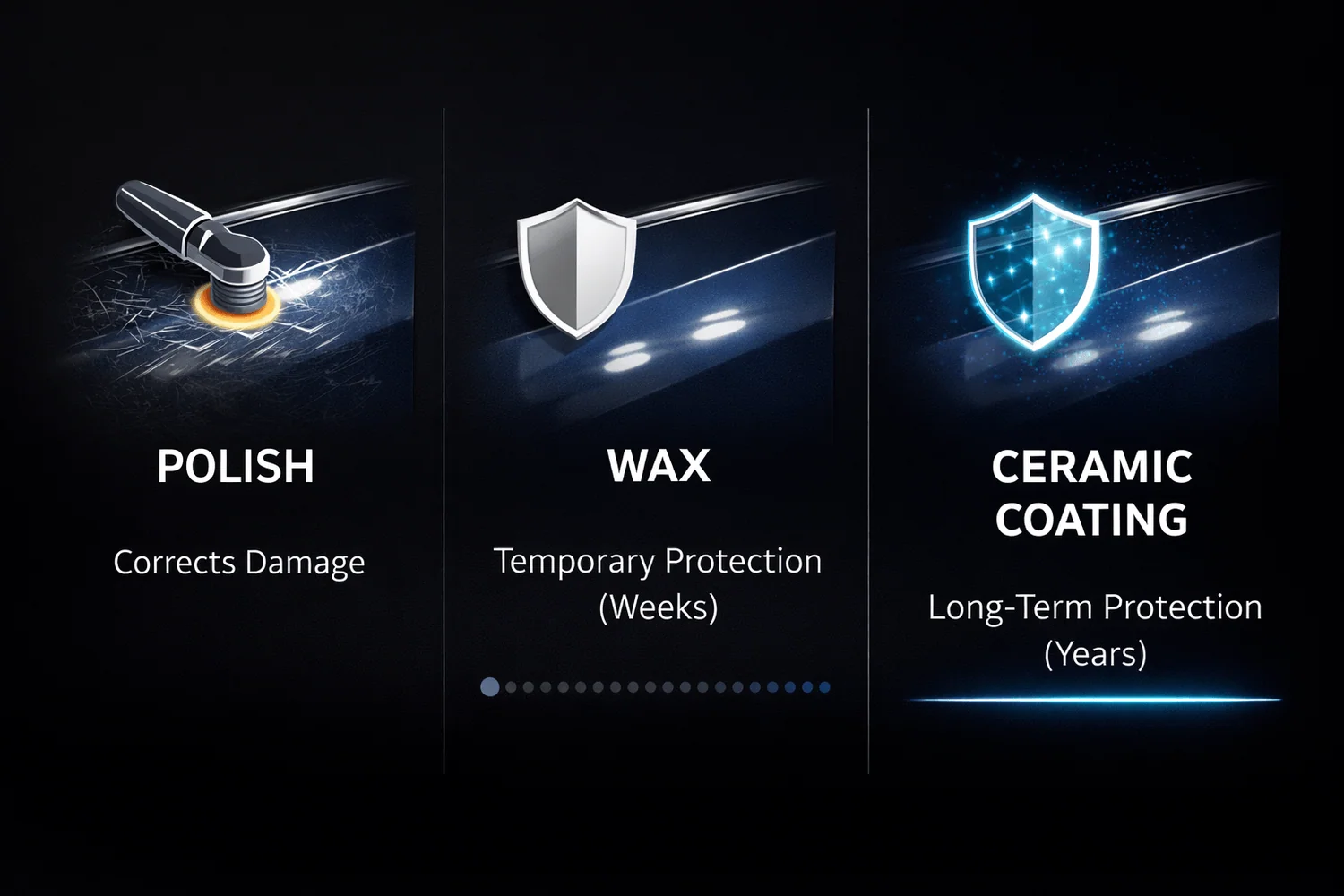
Here’s the biggest problem in the Indian detailing market. Most people use “polish,” “wax,” and “coating” interchangeably. Dealership staff do it, local garage workers do it, and even some detailing studios blur these terms. But they’re completely different products that serve completely different purposes.
Car Polish: Corrective, Not Protective
Car polish is an abrasive liquid compound. Its job? Fix paint damage, not protect it. When you apply polish, the suspended micro-abrasives physically level your clear coat surface by shaving down the area around a scratch until it’s flush with the lowest point of the defect. The scratch doesn’t get “filled.” It gets leveled out permanently.
That’s why polishing works but also why it’s risky when overdone. You’re permanently removing clear coat material every single time.
Within paint correction, there are two distinct levels:
- Rubbing Compound: A highly aggressive abrasive designed for deep scratches, heavy oxidation, acid etching from bird droppings, and severe hard water spots. It cuts fast but leaves its own micro-haziness that needs refining afterward.
- Finishing Polish: A much finer abrasive used after compounding. It smooths out the haziness left by the rubbing compound, restoring optical clarity and that deep, mirror-like gloss.
Car Wax: Temporary Protection
Wax is entirely non-abrasive. It sits on top of the clear coat as a sacrificial protective barrier against UV rays and environmental contaminants. Think of it as sunscreen for your paint.
Traditional carnauba wax gives a warm, deep gloss. Sounds great, right? But it has a serious weakness in Indian conditions. When ambient temperatures cross 45 degrees and dark-coloured panels hit 70 degrees on a summer afternoon, natural carnauba wax physically melts and washes away within four to five weeks. It also tends to remain slightly tacky, which means Indian road dust sticks to it faster.
Synthetic sealants fix this problem for you. Engineered from synthetic polymers, they handle heat far better and last four to six months. But here’s the catch: neither wax nor sealants remove scratches. They temporarily mask them by filling microscopic grooves, and the masking washes away over time.
The simple rule: You polish a car to fix the paint. You wax a car to protect the fixed paint.
Ceramic Coating: Long-Term Protection
Ceramic coating is liquid silica dioxide (SiO2) suspended in a solvent. Unlike wax that sits loosely on the surface, ceramic chemically bonds with your clear coat’s porous structure, forming a rigid, transparent nanoglass shield. What does that actually mean for you in daily use? Extreme water repellency where droplets bead and roll off, strong chemical resistance against acidic bird droppings and monsoon rain, and UV blocking that prevents oxidation.
How long does it last? A genuine professional ceramic coating gives you 2 to 5 years of protection depending on the SiO2 concentration and number of layers applied.
What about graphene coating? It’s the 2026 upgrade. Graphene oxide (a single-atom-thick carbon lattice) gets integrated into the ceramic matrix. The key advantage for Indian conditions: graphene disperses heat across the panel, which drastically reduces hard water spot formation caused by India’s mineral-heavy municipal water. These coatings last 5 to 7 years.
And borophene? That’s the newest ultra-premium option, using crystalline boron monolayer technology. It addresses ceramic’s weakness of micro-cracking from years of thermal expansion and contraction. Borophene adds structural flexibility alongside extreme chemical resistance. Lasts 5 to 8 years. Currently though, it’s strictly a luxury-segment product.
The Dealership “Teflon Coating” Scam
This needs to be said directly. When a dealership finance manager pushes a “Teflon Coating” package for around ₹10,000 during your new car purchase, decline it.
Teflon (PTFE) is a fluoropolymer by DuPont designed for non-stick cookware. For PTFE to properly bond to any surface, it requires curing temperatures between 400 and 500 degrees Celsius. That kind of heat would incinerate your car’s paint, melt the bumpers, and destroy the wiring harness. DuPont itself stopped supplying PTFE for automotive cosmetic use years ago.
So what do dealerships actually apply on your car? A cheap, generic synthetic wax. And they often use aggressive rotary buffer machines operated by untrained yard attendants. This process frequently introduces severe swirl marks and hologramming into your brand-new factory paint. Basically? You’re paying ₹10,000 to have your new car’s paint damaged.
Car Detailing Prices in India
What you’ll pay depends on your car’s size, the service level you pick, where you’re located, and how bad your paint’s current condition is. Here’s what you should realistically expect to pay in 2026.
Service-Level Pricing by Car Segment
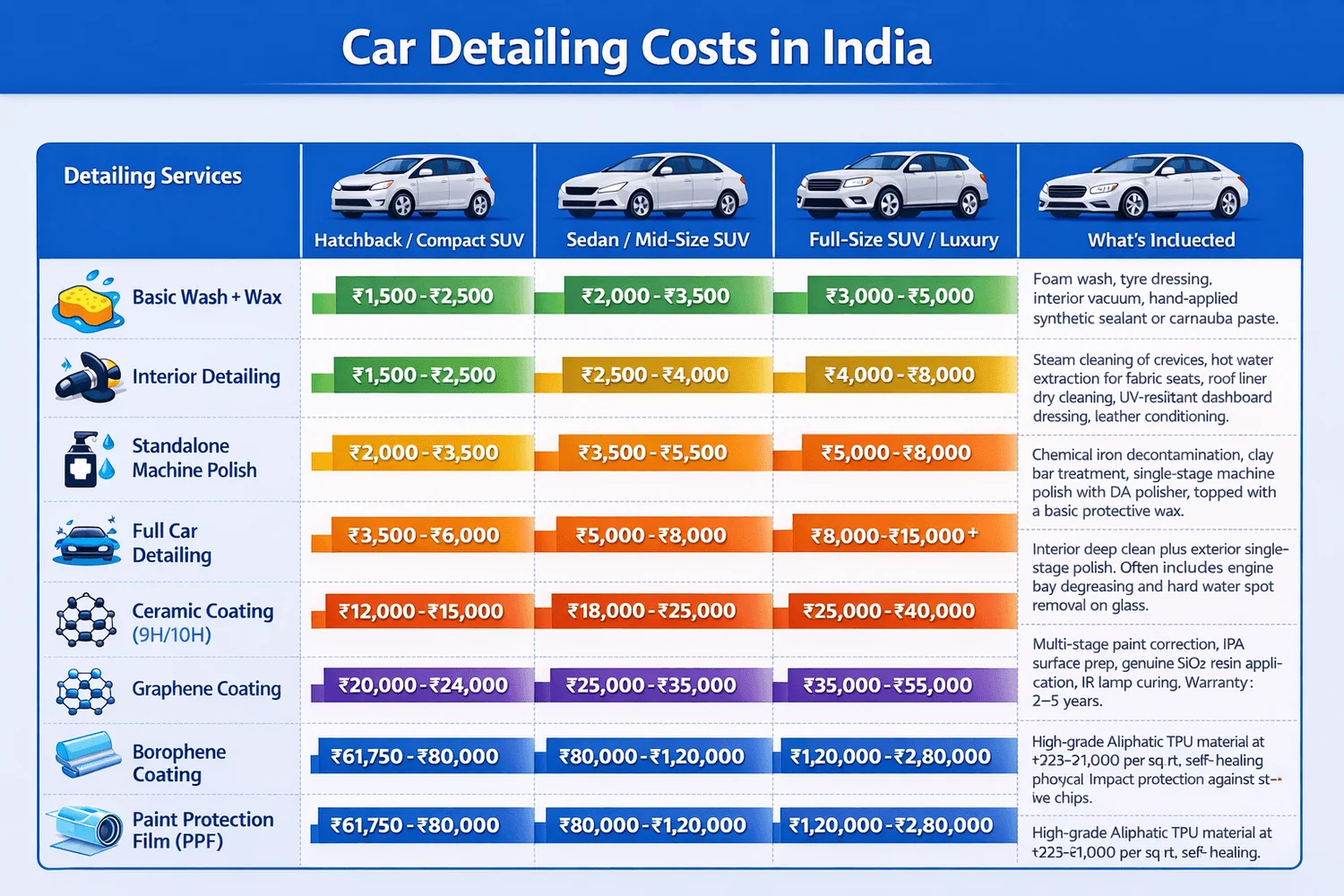
| Detailing Service | Hatchback / Compact SUV | Sedan / Mid-Size SUV | Full-Size SUV / Luxury | What’s Included |
|---|---|---|---|---|
| Basic Wash + Wax | ₹1,500 – ₹2,500 | ₹2,000 – ₹3,500 | ₹3,000 – ₹5,000 | Foam wash, tyre dressing, interior vacuum, hand-applied synthetic sealant or carnauba paste. Takes 1-2 hours. |
| Interior Detailing | ₹1,500 – ₹2,500 | ₹2,500 – ₹4,000 | ₹4,000 – ₹8,000 | Steam cleaning of crevices, hot water extraction for fabric seats, roof liner dry cleaning, UV-resistant dashboard dressing, leather conditioning. |
| Standalone Machine Polish | ₹2,000 – ₹3,500 | ₹3,500 – ₹5,500 | ₹5,000 – ₹8,000 | Chemical iron decontamination, clay bar treatment, single-stage machine polish with DA polisher, topped with a basic protective wax. |
| Full Car Detailing | ₹3,500 – ₹6,000 | ₹5,000 – ₹8,000 | ₹8,000 – ₹15,000+ | Interior deep clean plus exterior single-stage polish. Often includes engine bay degreasing and hard water spot removal on glass. |
| Ceramic Coating (9H/10H) | ₹12,000 – ₹15,000 | ₹18,000 – ₹25,000 | ₹25,000 – ₹40,000 | Multi-stage paint correction, IPA surface prep, genuine SiO2 resin application, IR lamp curing. Warranty: 2-5 years. |
| Graphene Coating | ₹20,000 – ₹24,000 | ₹25,000 – ₹35,000 | ₹35,000 – ₹55,000 | Heavy paint correction, carbon lattice technology for heat dispersion. Studio curing takes 3-5 days. Warranty: 5-7 years. |
| Borophene Coating | ₹20,000 – ₹25,000 | ₹30,000 – ₹45,000 | ₹50,000 – ₹70,000 | Ultra-premium borosilicate technology with climate-controlled curing. Warranty: 5-8 years. |
| Paint Protection Film (PPF) | ₹61,750 – ₹80,000 | ₹80,000 – ₹1,20,000 | ₹1,20,000 – ₹2,80,000 | High-grade Aliphatic TPU material at ₹325-₹1,000 per sq.ft. Self-healing physical impact protection against stone chips. |
Why Does Paint Correction Drive the Cost?
Ever wondered why a ceramic coating costs ₹25,000 when the coating liquid itself costs just ₹3,000 to ₹8,000? The answer is paint correction. The preparation work before coating application accounts for 35% to 50% of your total bill.
Here’s how the correction stages break down:
- Stage 1 Correction: Light finishing polish with a soft foam pad. Suited for brand-new or well-maintained cars. It’s a single pass over the vehicle and adds minimal cost.
- Stage 2 Correction: This is the standard for most cars driven on Indian roads. A dedicated cutting phase with heavy compound followed by a refining polish phase. It doubles the labour hours compared to Stage 1, so your quote goes up significantly.
- Stage 3 Correction: Reserved for severely neglected, heavily oxidized paint. It’s a multi-day process involving wet-sanding with abrasive papers followed by intermediate compounding, then a final jeweling stage. This commands the highest pricing.
One thing you absolutely shouldn’t do: get a ceramic coating applied over unpolished, swirl-marked paint. The rigid glass layer locks in the existing defects permanently. Fixing them later means sanding off the expensive coating first.
Tier-1 vs Tier-2 City Pricing
Detailing in metros like Delhi NCR and Mumbai costs more because of higher commercial rents, certified technician salaries, and a higher concentration of luxury vehicles. Tier-2 and Tier-3 cities (which hold 48% of India’s registered vehicles but only 28% of premium detailing jobs) typically offer identical service packages at 15% to 25% lower prices.
But there’s a catch. Smaller cities often have unorganized local shops that lack certified applicators, IR curing lamps, and safe DA polishers. Many still rely on archaic rotary buffing machines and manual waxing, both of which can cause long-term paint damage. Before you commit, always verify the studio’s equipment and ask to see their technician certifications.
Hidden Charges You Should Watch For
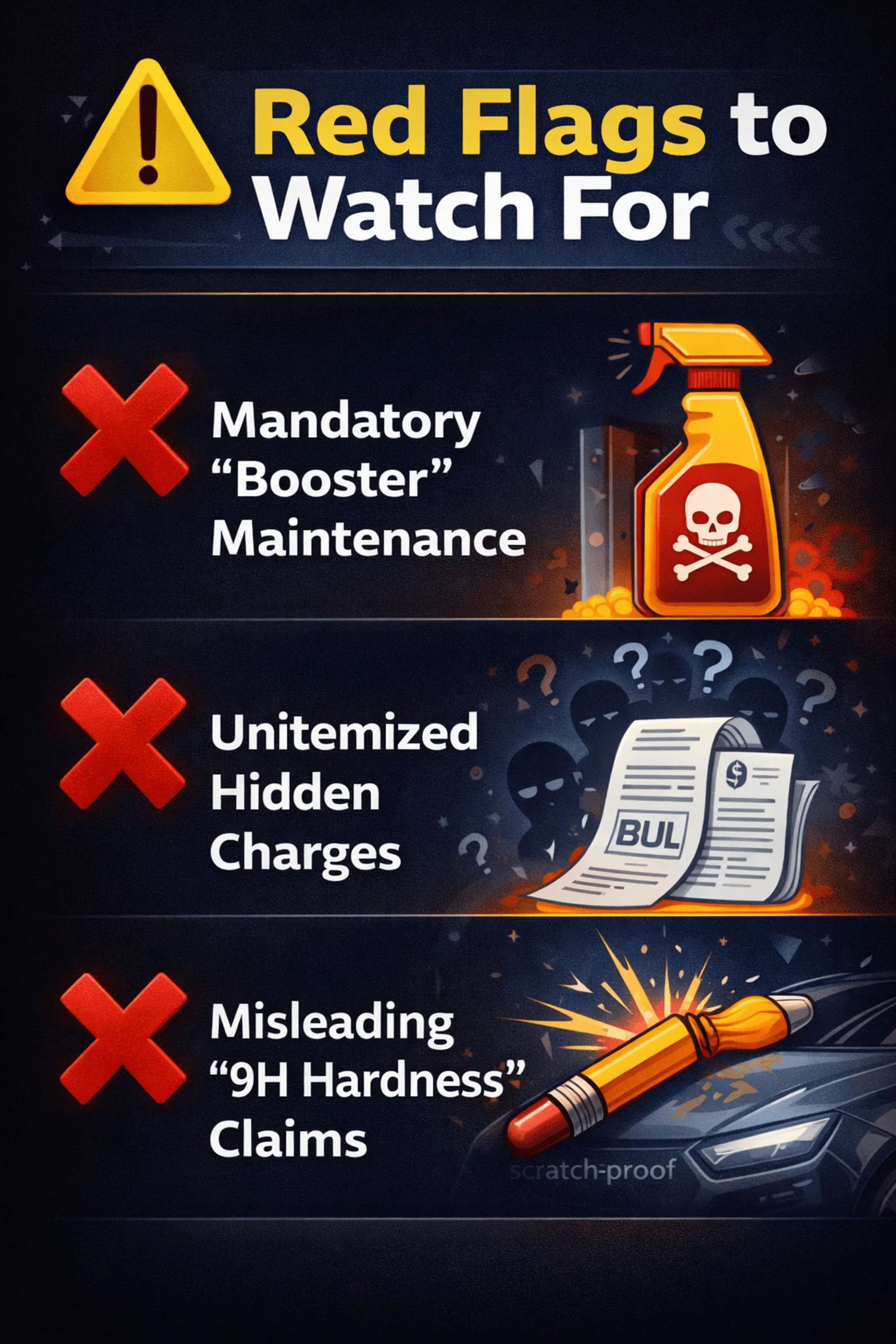
- The “Booster” Maintenance Trap: Some franchises mandate a paid “booster spray” visit every six months at ₹1,500 to ₹3,000 per visit to keep your coating warranty valid. In many cases, this is just a premium wash with a temporary spray sealant. Authentic SiO2 and graphene coatings don’t need synthetic boosters if you’re washing with pH-neutral shampoo.
- Unitemized Interior Add-ons: A studio quotes ₹2,500 for interior detailing, then tacks on ₹1,500 to ₹3,000 for ozone treatment or acidic gel for windshield hard water spots. Always demand an itemized, all-inclusive quote before handing over your keys.
- The “9H Hardness” Marketing Trick: Studios market “9H” or “10H” pencil hardness ratings to justify premium pricing. This has convinced many Indian consumers that their car will become scratch-proof. It won’t. Ceramic coatings offer scratch resistance, not scratch immunity. They’ll protect against wash-induced micro-marring, but they can’t stop gravel, keys, or aggressive dry-wiping.
DIY Polishing Guide
Can you get professional-grade results in your own driveway? In 2026, yes. Professional detailing tools are now widely available in India, and the prices have come down significantly. But there are firm boundaries on what you should and shouldn’t attempt at home.
The Right Machine: DA Polisher Only
First rule: don’t try to hand-polish for paint correction. Polishing by hand takes 8 to 10 hours of exhausting physical labour and fundamentally can’t generate the consistent friction needed to break down modern clear coats. Machine polishing is mandatory for real results. No shortcuts here.
Your only safe option for DIY is a Dual-Action (DA) polisher. It spins on a central spindle while oscillating in a wider random orbit (15mm or 21mm throw). This dispersed movement prevents the pad from aggressively cutting into one spot for too long. And here’s why it’s safe for beginners: if you apply too much pressure or tilt the machine at a wrong angle, the pad simply stops rotating. The process halts on its own, preventing damage.
Never use a rotary polisher at home. Rotary machines spin on a single, fixed axis with concentrated rotational energy. In untrained hands, one can burn through clear coat in seconds, permanently warp plastic bumper panels, or tear paint off body line edges. Rotary polishers are strictly for trained professionals doing Stage 3 correction work.
DIY Product Kit and Costs (India, 2026)
So what do you actually need to buy, and how much will it set you back?
Machine Polisher:
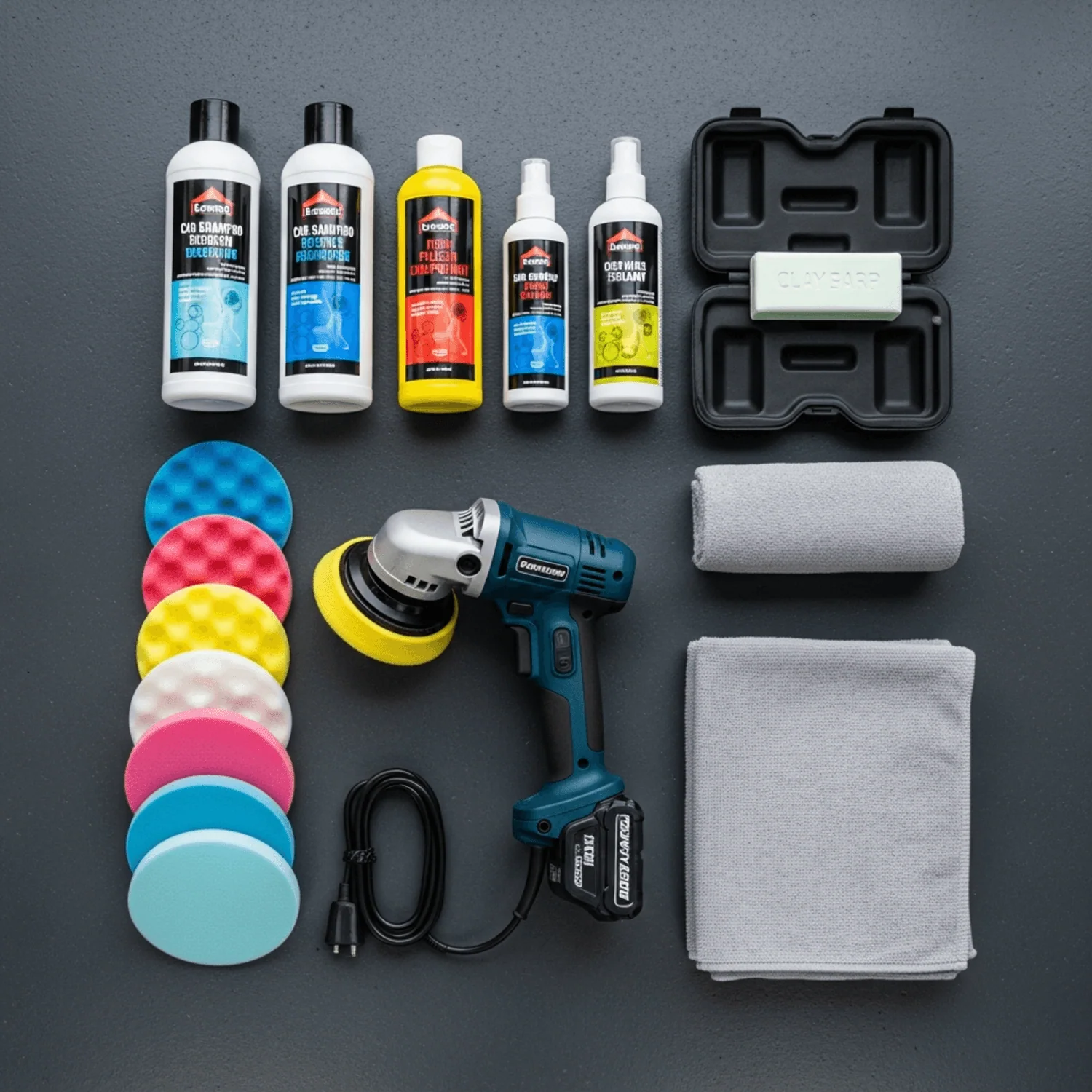
- Budget/Beginner: Shakti Technology 1000W Long Throw DA Polisher at ₹7,900. Solid entry-level machine with enough torque for weekend projects.
- Premium/Enthusiast: ShineMate EX618 15mm DA Polisher at ₹17,495. Professional-grade, smooth operation for frequent use.
Foam Pads:
- A set of three 5-inch pads (Heavy Cut, Medium Polish, Fine Finish): approximately ₹1,500 total. You’ll need to replace pads every 2-3 panels during a session.
Chemical Products:
- pH-Neutral Car Shampoo: WaveX Auto Care or Meguiar’s Gold Class at ₹600 to ₹900. Don’t use household dish soap. It strips wax and accelerates trim oxidation.
- Iron Remover Spray + Clay Bar Kit: approximately ₹1,200. Dissolves embedded brake dust and extracts industrial fallout from the paint surface.
- Hard Water Spot Remover: WaveX Water Spot Remover Gel at ₹450. If you’re in Delhi, Jaipur, or any city with hard municipal water, this is non-negotiable. It neutralizes the alkaline calcium and magnesium carbonate deposits that regular washing won’t touch.
- For Deeper Defects: Meguiar’s Ultimate Compound at ₹2,900 for 450ml. This one’s your heavy hitter for serious oxidation and deeper scratches that lighter products can’t handle.
- For Light Defects/Budget: 3M Scratch Remover at ₹299 or WaveX Car Polish at ₹447. Good enough for beginners tackling light wash-marring.
- Protection (Post-Polish): Turtle Wax Hybrid Solutions Ceramic Spray Coating at ₹1,999. A fast-curing spray-on SiO2 layer that’s far easier to apply than bottled ceramic resins.
- Microfiber Towels: Minimum 10 high-GSM, edgeless towels at ₹1,000 total. These prevent introducing new scratches during wipe-down.
Total DIY Setup Cost: ₹15,000 to ₹17,000 for everything. That’s roughly equal to one professional basic ceramic coating for a hatchback. But the equipment serves multiple vehicles and years of ongoing maintenance.
Step-by-Step DIY Polishing Process
Follow this exact sequence. Why? Because skipping any step can cause collateral damage to your paint.
- Chemical Decontamination Wash: Wash using the two-bucket method (one bucket for soapy water, one for rinsing the wash mitt). Apply iron remover spray to lower panels and wheels to dissolve embedded ferrous brake dust particles.
- Mechanical Decontamination (Claying): Lubricate the wet paint with a detailing spray and gently glide a clay bar across the surface. The clay physically pulls out contaminants like tree sap, industrial fallout, road tar, and other grime embedded in the clear coat. Don’t skip this step. If you polish un-clayed paint, the spinning pad rips out those embedded particles and drags them across the surface, effectively sanding your own car.
- Hard Water Treatment: Apply acidic water spot gel to persistent hard water rings and let the chemical neutralize the mineral deposits. This is especially important if you’re in a city with hard municipal water like Delhi, Jaipur, or Ahmedabad.
- Test Spot and Polishing: Tape off rubber gaskets, unpainted plastic trims, and panel gaps to prevent compound staining. Apply four pea-sized drops of compound to the DA pad. Spread across a 2×2 foot section at Speed 1, then increase to Speed 4 or 5. Work in a slow, overlapping cross-hatch pattern with minimal downward pressure. Wipe away the residue and inspect under a bright LED light.
- IPA Wipe: Mist the polished panels with Isopropyl Alcohol dilution and wipe clean. This strips the oily lubricants left by the polish. You’ll see the true state of your clear coat, and the clean surface gives your protective coating maximum bonding strength.
- Protection Application: Apply your chosen synthetic sealant or ceramic spray coating to lock in the finish. Follow the manufacturer’s specific flash-time instructions carefully.
When Should You Stop DIY and Visit a Professional?
If your car shows deep white scratches where a fingernail catches in the groove, severe clear coat peeling from UV failure, or heavily mismatched repainted panels, stop immediately. These defects need wet-sanding and rotary correction by a trained professional. Not something you should tackle yourself. Attempting these fixes with a DA polisher won’t work, or worse, it’ll cause further clear coat failure.
How Often Should You Polish Your Car?
This is where you need to be careful, because the Indian market spreads some genuinely dangerous misinformation. Lots of local garages push “polish your car every three months to keep it shining.” Sounds reasonable? It’s not. That advice will wreck your paint.
The Clear Coat Math
Every machine polish permanently removes clear coat material:
- A light, single-stage finishing polish removes about 1 to 2 microns.
- A heavy compounding session (Stage 2 or 3) removes 5 to 7 microns per session. That’s 15% to 20% of your total clear coat gone in a single afternoon.
Your car’s clear coat is only 35 to 50 microns thick. Do the math. A vehicle can realistically undergo heavy compounding a maximum of three to four times in its entire life before risking total clear coat failure. Once that’s breached, the base colour gets exposed to oxygen and UV radiation. The paint starts chalking and peeling. Eventually it fades to a dull white. The only fix at that point? A full, expensive repaint at a body shop.
The correct approach: Polishing is restorative surgery, not routine maintenance. Use it sparingly, only when defects become visually unbearable. For regular gloss upkeep, stick to non-abrasive wax or synthetic sealant instead.
Recommended Frequency by Car Type and Environment
- Dark-coloured cars (black, navy blue, deep red): These show swirl marks more aggressively because of optical contrast. You may need a light polish annually combined with disciplined microfiber washing. A white or silver car? It camouflages micro-marring for years.
- Garaged vehicles driven occasionally: Minimal intervention needed. A quality synthetic sealant every 4 to 6 months does the job. Polish once every 2 to 3 years at most.
- Open-parked, daily-driven city cars: These face the harshest conditions. Your best bet is a ceramic or graphene coating applied every 3 to 5 years. It eliminates the need for frequent waxing and protects against UV damage, dust, bird droppings, acid rain, and road grime. Between coating applications, stick to pH-neutral washes only.
- Highway commuters: Focus on quarterly chemical decontamination (iron remover and tar remover sprays) rather than abrasive polishing to deal with insect impacts and road tar buildup.
The Annual Paint Care Schedule for India
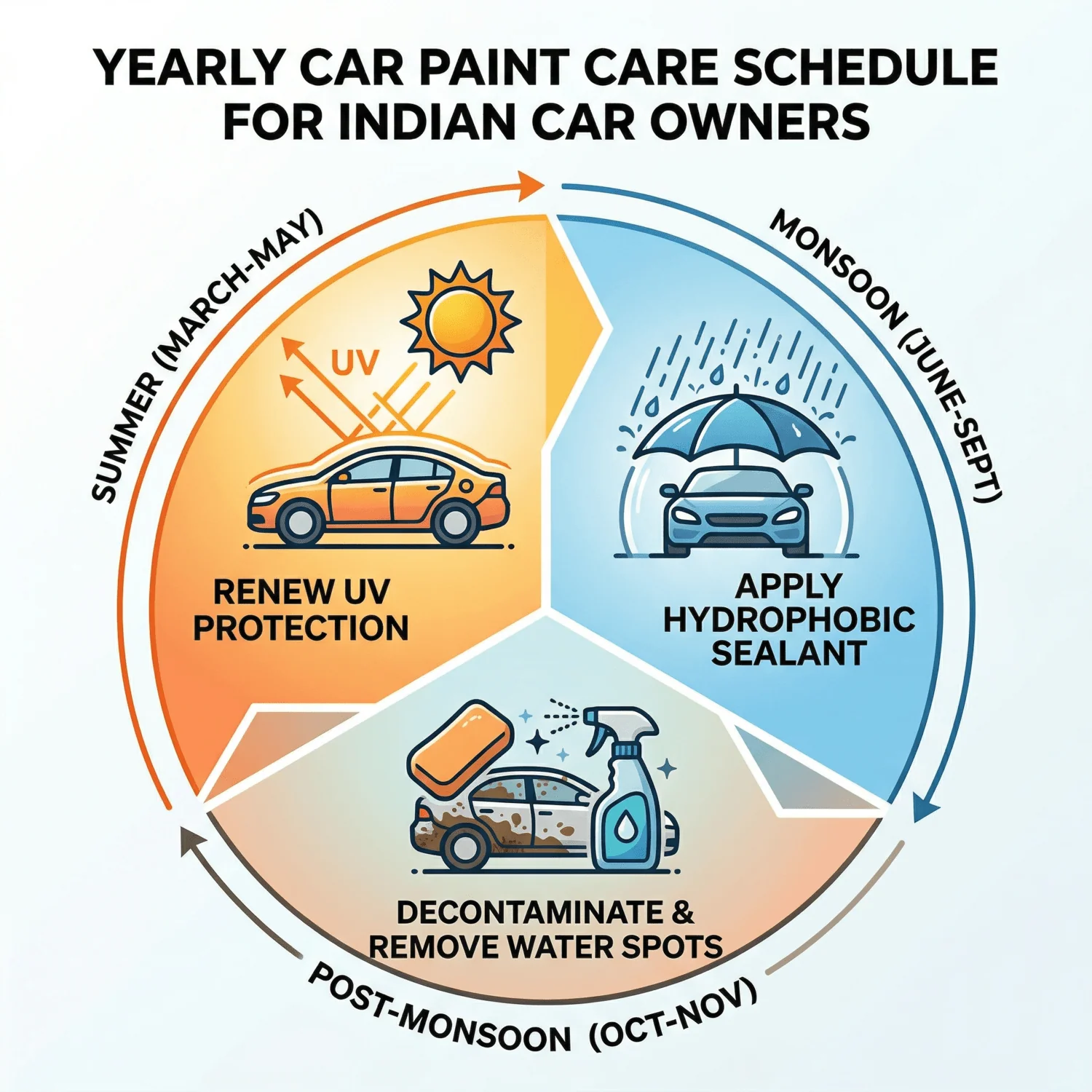
Instead of polishing on a fixed schedule, align your paint care with India’s seasons:
- Monsoon Prep (May-June): Strip any degraded wax and apply a durable synthetic sealant or ceramic spray coating. You want maximum hydrophobicity here to repel acidic rainwater and prevent muddy road spray from adhering to lower panels and door sills.
- Post-Monsoon Recovery (October): Do a thorough decontamination wash. Use clay bars and acidic hard water spot removers to clear the mineral deposits left by months of pooling rainwater and driving through stagnant water. Only machine-polish if severe water etching remains visible in the clear coat after chemical treatment.
- Summer Protection (March): Reapply UV-blocking synthetic sealants. Inspect any existing ceramic or graphene coating. If the water-beading has diminished, use a compatible ceramic detail spray to rejuvenate the SiO2 layer before the intense summer heat arrives.
How Paint Condition Affects Your Car’s Resale Value
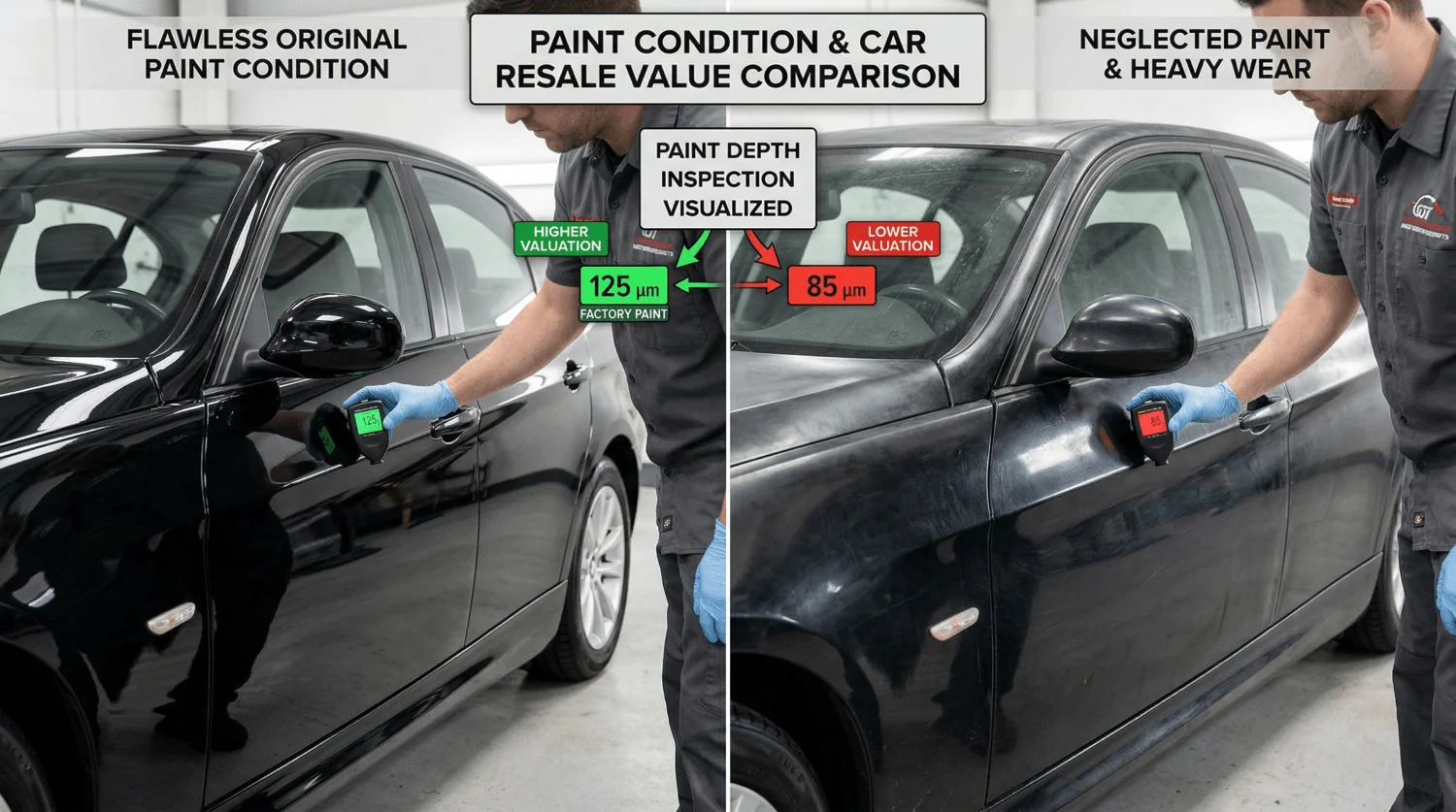
Here’s something you probably don’t know about. Used-car platforms like Cars24 and Spinny now use electromagnetic ultrasonic thickness gauges to measure paint micron depth across every panel during their pre-purchase inspections. If an owner has repeatedly polished their car to the point of thinning the clear coat, or if a panel shows repaint-level thickness (300+ microns vs factory 120 microns), the valuation algorithm flags it and penalizes the offer.
But if your vehicle has a carefully preserved, thick OEM clear coat and a clean interior, you could unlock ₹15,000 to ₹30,000 in additional resale value. Think of disciplined paint care not as an expense but as a direct investment in your car’s residual value.
Want to go beyond just paint care? For a complete approach to maintaining your car’s mechanical health alongside its appearance, check out our full maintenance guide.
FAQs
How much does car polishing cost?
A standalone professional machine polish costs ₹2,000 to ₹3,500 for a hatchback and ₹5,000 to ₹8,000 for a luxury SUV. This covers surface decontamination and a single-stage gloss enhancement. It doesn’t include ceramic coating application.
Is ceramic coating worth it?
For new or premium vehicles exposed to daily urban commuting and open parking, yes. Over a 5-year ownership cycle, a ₹25,000 ceramic coating prevents cumulative bi-monthly waxing costs, reduces paint correction needs, and preserves resale equity. For an older budget car nearing the end of its lifecycle, a ₹2,000 synthetic sealant makes more sense.
Can I polish my car at home?
Yes, but only with a Dual-Action (DA) polisher. Invest around ₹15,000 in a beginner-friendly DA machine (like the Shakti Technology 1000W), foam pads, and a reliable compound like Meguiar’s Ultimate or WaveX. You’ll get professional-grade results safely. Never use a rotary polisher at home.
What’s the difference between rubbing compound and polish?
Rubbing compound uses aggressive, large abrasives to cut the paint rapidly and remove deep scratches and oxidation. It leaves the surface slightly hazy. Polish uses ultra-fine abrasives to refine that haziness, achieving perfect optical clarity and a mirror-like gloss. You compound first, then polish.
Does polish remove scratches permanently?
Yes. Polish permanently removes micro-scratches and swirl marks by physically abrading the surrounding clear coat until the surface is level with the scratch’s lowest point. It doesn’t fill or mask anything. But new scratches will form over time from washing and environmental exposure.
Is dealership detailing worth it?
Usually not. Dealership packages (marketed as “Teflon,” “Diamond Cut,” or “Ceramics”) are almost always poor value. They carry heavy financial markups, use inferior spray waxes instead of genuine SiO2 resins, and are often applied by untrained stockyard staff with aggressive rotary buffers. Independent, certified detailing studios offer vastly better results and transparency.
How often should I detail my car?
A full interior deep clean and exterior chemical decontamination should happen twice a year, ideally post-monsoon and pre-summer. Abrasive machine polishing should be strictly limited to once every 2 to 3 years to prevent dangerous clear coat thinning.
Can polishing damage paint?
Absolutely. Polishing works by permanently removing clear coat, and aggressive compounding can strip 5 to 7 microns per session. Since your clear coat is only 35 to 50 microns thick, excessive or improper polishing (especially with a rotary machine lingering on panel edges) can breach the clear coat entirely. That leads to irreversible paint failure requiring a full repaint.
Should I choose wax, polish, or ceramic coating?
They’re not interchangeable. If your paint is dull, oxidized, or scratched, you need polish to physically correct the damage first. Once corrected, choose wax for cheap, temporary 1-month shine. Or go with ceramic coating for durable 3 to 5-year protection against Indian dust, UV damage, hard water etching, and acidic monsoon rain.