
Your tyres are the only part of your car that actually touches the road. Four palm-sized patches of rubber decide how fast you stop, how planted you feel at 100 on the expressway, and whether you keep control when the monsoon turns tarmac into a sheet of water. So the set you choose matters more than most buyers think.
Here’s the honest truth about the best car tyres in India: there’s no single winner. The right tyre for a Swift doing school runs in Pune isn’t the right tyre for a Scorpio loaded with five people on a Ghat road. This guide skips the noise. You get brand mini-reviews, a plain-English tyre size guide, segment-wise picks, and real 2026 price bands, so you buy the right rubber for your car instead of a famous logo.
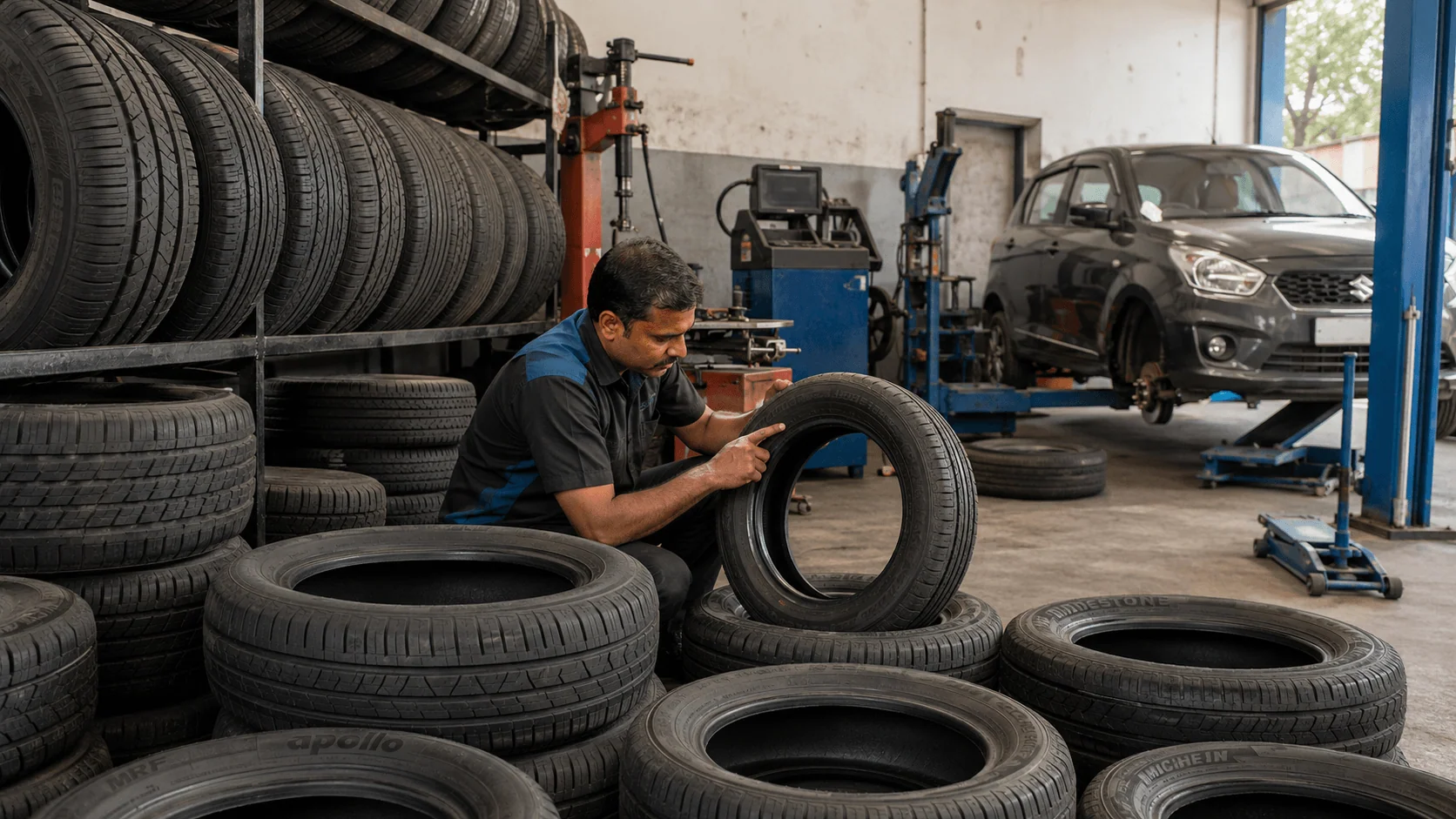
Quick answer: which tyre should you buy?
Want the short version? Match your main priority to the pick below, then read the detailed section for your exact car.
| Your priority | Smart picks | Best for |
|---|---|---|
| Lowest cost, easy replacement | MRF ZLX/ZVTV, JK Taximax, entry CEAT | Small hatchbacks, tight budgets, smaller towns |
| Long life and mileage | Apollo Amazer 4G Life, CEAT Milaze X3, Bridgestone Sturdo | Daily city commuters, high-km drivers |
| Comfort and low cabin noise | Michelin Energy XM2+/Primacy 4 ST, Continental UC6, Yokohama | Sedans, highway cruisers |
| Wet grip for monsoon safety | CEAT SecuraDrive, Continental UC6, Michelin Primacy 4 ST | Anyone driving through heavy rains |
| SUV durability and bad roads | Goodyear Assurance SUV, Apollo Apterra, MRF Wanderer Street | Compact and mid-size SUVs |
One rule covers almost every Indian passenger car: fit a tubeless radial tyre in your factory size, with the same or higher load rating and speed rating. Don’t go bigger just because it looks good on the car. We’ll get to why a little later.
Top Car Tyre Brands in India
This is a practicality ranking, not a prestige ladder. It weighs what a regular Indian owner actually cares about: can you get your size, how easy is the next replacement across cities, what does it cost, and does the brand serve everyday hatchbacks rather than only luxury cars. Indian brands now rank among the world’s strongest tyre makers by brand-value studies, and the gap to the imported names has narrowed sharply.
1. MRF (Madras Rubber Factory)
The default Indian tyre, and for good reason. MRF’s real strength is availability. You’ll find a shop stocking your size in almost any town, which makes replacing a single damaged tyre painless. The compounds and sidewalls are built tough for broken roads and pothole hits, and owners routinely report 50,000 km-plus before the tread gives up. What’s the catch? Refinement. The harder patterns can feel firmer and a touch noisier than premium rivals as they age. Popular models: ZVTS and ZLX for hatchbacks, ZVTV for sedans, Wanderer Street for SUVs. Buy it if easy sourcing and toughness top your list. Skip it if a whisper-quiet cabin is your main goal.
2. Apollo Tyres
The best-balanced Indian range. Apollo covers everything from budget hatchback rubber (Amazer 4G Life) to genuinely good SUV tyres in the Apterra family, and the wet and dry grip beats what most “value” buyers expect. It also looks ahead with the Amperion, an EV-specific tyre. The ALNAC 4GS carries a 5-year manufacturing warranty, and the dealer network is wide. The longest-life patterns can feel a bit stiff. For most owners, though, Apollo is the safest all-round bet. Pick it if you want one brand that does hatch-to-SUV well. Look elsewhere if you want the plushest possible ride above all.
3. CEAT Tyres
The value pick that’s also strong in the wet. CEAT has a huge dealer footprint, sharp pricing in smaller and mid sizes, and a real focus on rain performance, which counts for a lot in an Indian monsoon. It markets the Milaze X3 as a long-life tyre, advertising up to 1,00,000 km, while SecuraDrive handles wet roads and high-speed stability well. Some older CEAT patterns do harden as they age. Standout models: Milaze X3, SecuraDrive, SecuraDrive SUV, plus EnergyDrive for EVs. Buy it if you want a modern, safety-focused Indian brand at a fair price. Skip it if you’re chasing the last word in plush refinement.
4. JK Tyre
A value workhorse with real pedigree in radial technology and motorsport. JK leans toward strong tyre life and stable pricing, with enough range to cover everyday hatchback and sedan use. Its newer Levitas Ultra range pushes into performance and EV territory. The brand still lacks the comfort-first image of the European premium names. The value and shop access, though, are genuinely good. Popular models: Taximax, UX Royale, UX Touring, Levitas Ultra. Go for it if you want dependable, serviceable rubber that won’t break the bank. Avoid it if cabin refinement is your only priority.
5. Bridgestone
The OE favourite, split neatly between tough daily tyres and polished touring ones. Bridgestone supplies many cars straight from the factory and is a go-to for highway stability on long drives. Sturdo is the long-life daily pick. Turanza and Alenza are the quieter premium touring options. Ecopia chases fuel efficiency. Standard warranty runs 5 years from manufacturing or 3 years from purchase, whichever comes first. Entry patterns aren’t as plush as Michelin’s. Buy it if you want a polished but practical upgrade. Skip it if you only want the cheapest replacement going.
6. Goodyear
One of the most SUV-relevant brands on sale. Goodyear’s Assurance SUV and Wrangler lines target exactly what Indian SUVs need: impact protection, wet grip and load strength, some with reinforced sidewalls. For small hatchback sizes it doesn’t dominate on value the way MRF or CEAT do, and the harder long-life compounds can feel a little firm and noisy. Pick it if you drive a compact or mid-size SUV on mixed roads. Look elsewhere if you need the cheapest 14-inch hatchback tyre on the shelf.
7. Yokohama
A comfort-led upgrade with a loyal following among enthusiasts. The Earth-1 series was tuned for abrasive Indian tarmac, and the Geolandar line stretches it into SUV duty. Yokohama balances a soft ride against durable tread nicely, which makes it a popular step-up from hard factory tyres on cars like the Honda City and Hyundai Creta. Availability is metro-strong but thinner in small towns. Buy it if you’re moving up from harsh OE tyres without paying Michelin money. Skip it if you need a tyre stocked in every remote town.
8. Michelin
The comfort and wet-braking benchmark. Michelin’s Primacy 4 ST is one of the clearest ride-quality upgrades a sedan can get, with acoustic compounds that genuinely quieten the cabin. Energy XM2+ is the long-life premium mainstream choice. The catch? Price, the odd gap in less common sizes, and softer sidewalls that need a bit more care over sharp potholes. Worth it if you value silence and rain confidence. Not for you if your roads are brutal and you want the toughest sidewall for the least money.
9. Continental
German engineering tuned for wet grip and quietness. The UltraContact UC6 has one of the best wet-braking stories in the premium space, and owners note its sidewalls feel slightly tougher than other soft premium tyres, which helps on Indian roads. Availability leans metro and larger sizes, so it isn’t always a same-day fix in smaller cities. Buy it if you want a quiet, rain-sure premium sedan or crossover tyre. Skip it if you’re on a strict budget or far from a big city.
10. Pirelli
The premium performance specialist. Pirelli’s Cinturato, Scorpion and P Zero lines are built for high-performance sedans and large premium SUVs on 17-inch and bigger fitments. The technology is real. So is the price, and availability in everyday sizes is sparse. Most mass-market buyers simply won’t need it. Buy it if you run a premium car on large performance fitments. Skip it if you’re shopping on value.
Also worth knowing: Hankook makes quiet mainstream touring tyres in select sizes, good when you find a deal. Maxxis covers niche budget and all-terrain options. Both are available, but with thinner mass-market depth, so confirm stock in your exact size before counting on either.
| Brand | Price tier | Best for | Watch-out |
|---|---|---|---|
| MRF | Budget to upper-mid | Bad roads, easy sourcing | Firmer ride as it ages |
| Apollo | Mid-range | Balanced hatch-to-SUV use | Long-life patterns feel stiff |
| CEAT | Budget to mid | Wet grip, value, monsoons | Some patterns harden with age |
| JK Tyre | Budget to mid | Value, tyre life | Less premium feel |
| Bridgestone | Mid to premium | Highway stability, OE feel | Costs more |
| Goodyear | Mid to premium | SUVs, impact resistance | Average comfort, some noise |
| Yokohama | Mid to premium | Comfort upgrade | Metro-heavy availability |
| Michelin | Premium | Comfort, wet braking | Price, softer sidewalls |
| Continental | Upper-mid to premium | Quiet, wet grip | Limited rural reach |
| Pirelli | Premium | Performance fitments | Expensive, sparse sizes |
Tyre Types Explained (Tubeless, Radial, All-Season)
Tyre jargon trips up plenty of buyers, so here’s the plain version. The words point at different things. Tubeless is about how the tyre holds air. Radial describes how it’s built, while all-season is about the conditions it’s tuned for. A modern car tyre is usually all three at once.
| Tyre type | What it means in plain language | Best for |
|---|---|---|
| Tubeless | No inner tube; a nail leaks air slowly instead of bursting | Almost every modern car |
| Tube type | Older design with a separate inner tube; can deflate suddenly | Old rims and some commercial use |
| Radial | Flexible sidewall, modern standard construction | Daily driving, comfort, efficiency |
| All-season | One tyre for warm, wet, and mild conditions | India’s year-round, monsoon-heavy roads |
| Highway-terrain (HT) | Road-biased SUV tyre, quiet and smooth | Crossovers and mostly-tarmac SUVs |
| All-terrain (AT) | Tougher tread with more bite | Broken roads, gravel, occasional trails |
| Performance | Soft, grippy, low-profile | Premium sedans and enthusiastic driving |
| EV-specific | Built for heavier weight, instant torque, low noise | Electric cars and some hybrids |
So why does tubeless win? When it picks up a nail, the rubber grips around the object and air escapes slowly. That buys you time to pull over safely instead of fighting a sudden blowout. A tube-type tyre tends to deflate fast and violently, which is the last thing you want at speed.
Radial is the standard for a simple reason. The construction lets the sidewall flex on its own, separate from the tread. You get a bigger contact patch, lower rolling resistance for better mileage, less heat build-up, and a smoother ride than the old bias-ply tyres they replaced.
Where does all-season fit? For most of India, a road-biased all-season tyre is the right call. It copes with summer heat, monsoon water and mild winters without forcing you into specialist rubber. Stray from it only when you have a real reason, like a genuine off-roader or a performance car.
A quick word on EV tyres. Electric cars are heavier, deliver instant torque, and run silent, so tyre noise stands out. EV-specific tyres like the Apollo Amperion, CEAT EnergyDrive and JK Levitas Ultra use stronger sidewalls, sound-absorbing foam, and low rolling resistance to protect range. Own an EV? Fit tyres designed for one.
The practical verdict is short. For the vast majority of hatchbacks, sedans, compact SUVs and MPVs, buy a tubeless radial all-season road tyre in your factory size. Everything else is a special case.
How to Read Tyre Size (205/55 R16 Explained)
This is the bit most buyers find confusing, and it’s actually simple once you see it laid out. The code on your sidewall is the single most important thing to get right, because the wrong size affects safety, your speedometer, even your ABS. This tyre size guide decodes a common sedan and premium-hatchback marking, 205/55 R16 91V.
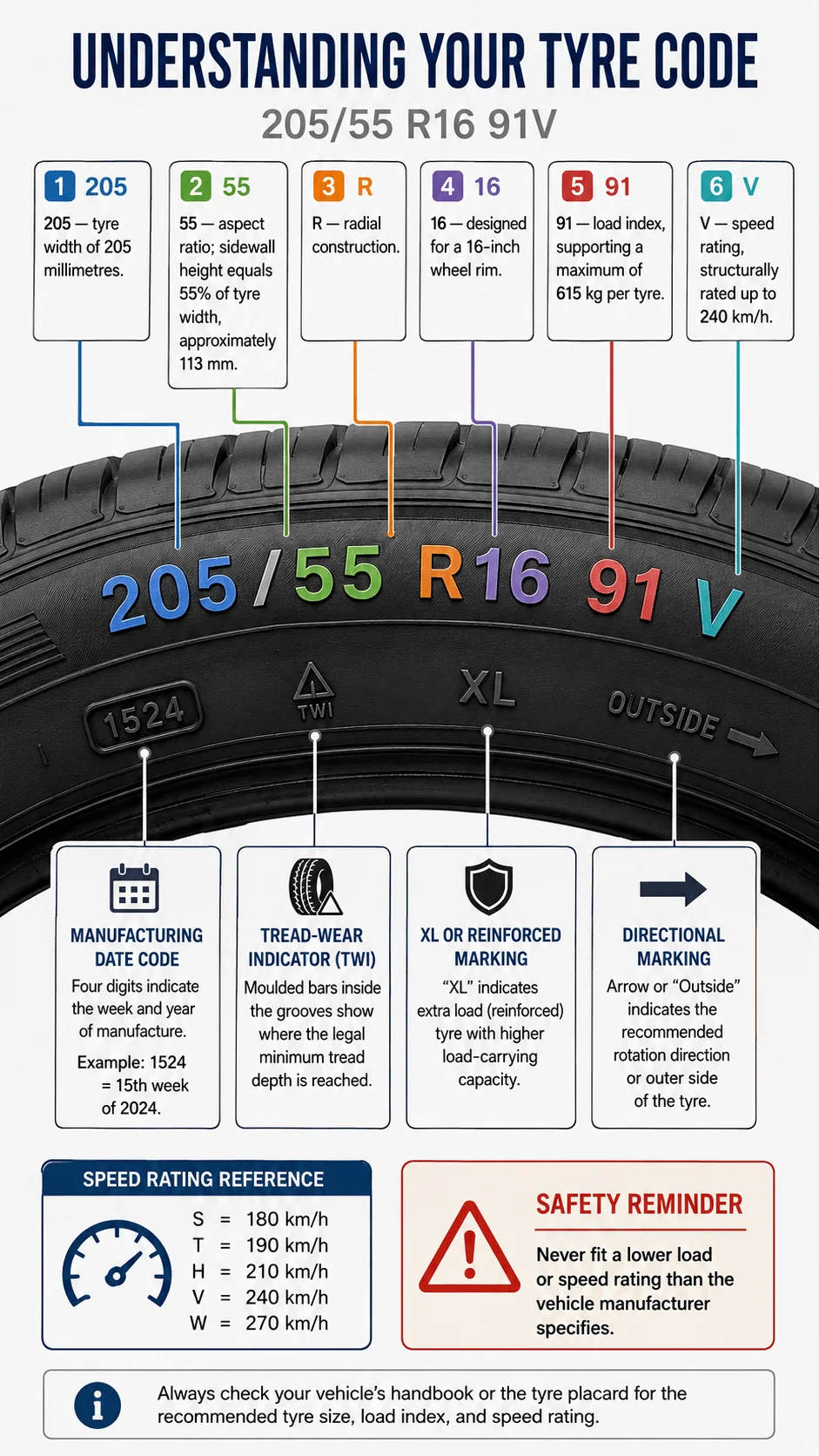
Here’s what each part means:
| Code | Meaning | Why it matters |
|---|---|---|
| 205 | Tyre width in millimetres | Wider grips more but can cost mileage and comfort |
| 55 | Aspect ratio: sidewall height is 55% of the width (here, about 113 mm) | Lower numbers look sporty but bruise easily on potholes |
| R | Radial construction | The modern standard |
| 16 | Rim diameter in inches | The tyre fits a 16-inch wheel only |
| 91 | Load index: max 615 kg per tyre | Never fit a lower load rating than your car needs |
| V | Speed rating: safe up to 240 km/h | Keep the same or higher than factory spec |
The speed rating is a single letter. The common ones: S = 180, T = 190, H = 210, V = 240, W = 270 km/h. These are structural limits, not a hint to drive that fast.
A few other sidewall markings are worth checking before you pay:
- DOT / date code: a four-digit number in an oval. “4725” means the 47th week of 2025. Rubber ages and hardens even unused, so refuse any “new” tyre older than 12 to 18 months.
- TWI (tread wear indicator): small raised blocks inside the grooves. Once the tread wears flush with them, the tyre is done.
- XL or Reinforced: higher load capacity, often needed on heavy SUVs and 7-seaters. Don’t downgrade from it.
- Direction arrow / Outside marking: directional and asymmetric tyres have to be fitted the right way round, or they won’t clear water properly.
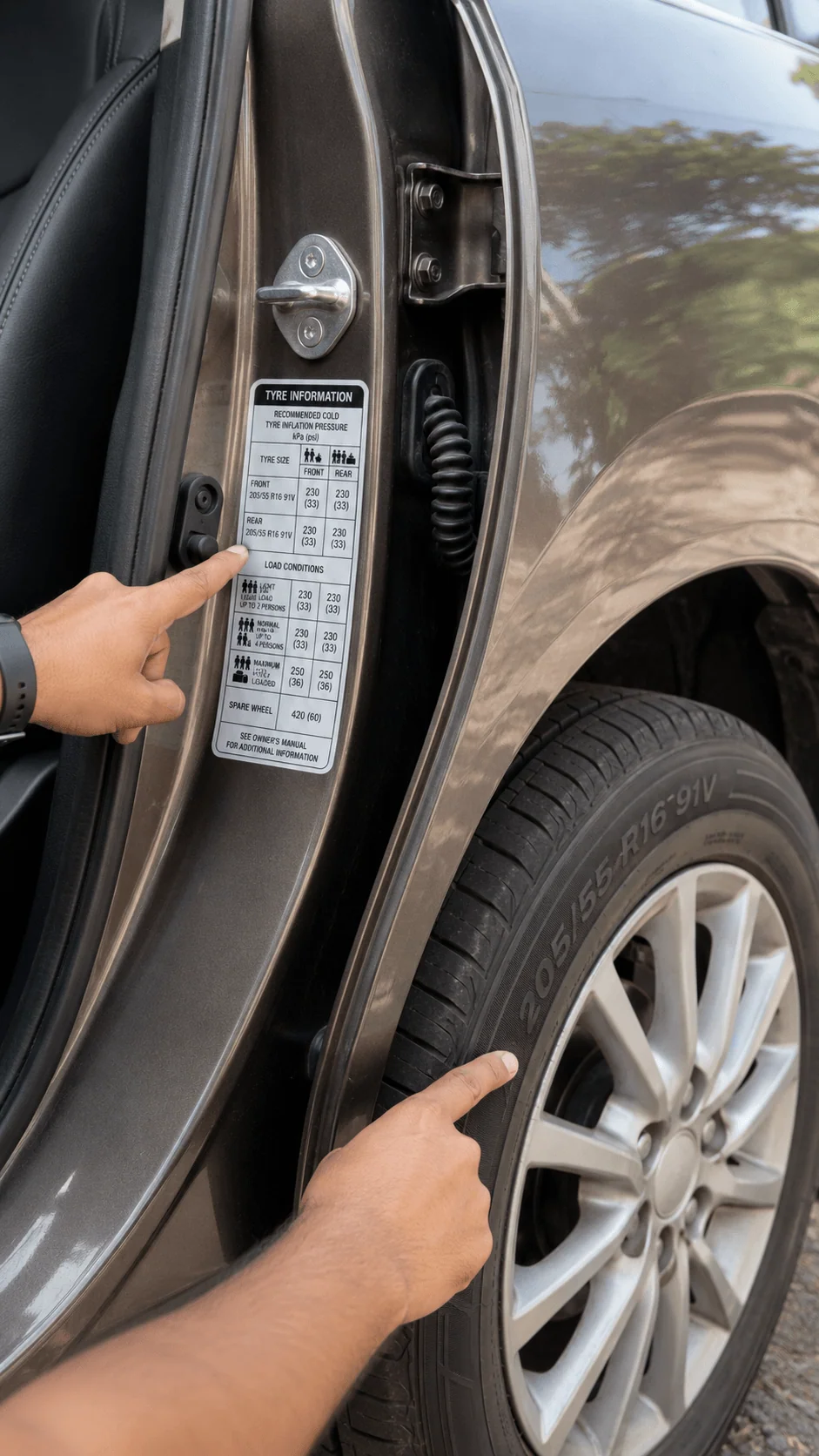
Where do you find your size? Check the sidewall of your current tyre first. Then confirm it against the sticker inside the driver’s door jamb or fuel-flap, or your owner’s manual. The carmaker’s recommended size and pressure on that placard always beat guesswork.
Common Indian tyre sizes and the cars that use them:
| Tyre size | Typical cars |
|---|---|
| 145/80 R12 | Maruti Alto, older entry hatchbacks |
| 155/65 R14 / 165/80 R14 | Wagon R, Celerio, base Swift |
| 185/65 R15 | Top Swift, Baleno, Dzire, i20 |
| 195/55 R16 / 205/55 R16 | Altroz, Honda City, Verna, Slavia |
| 215/60 R16 | Tata Nexon, Brezza, Venue |
| 215/55 R17 / 215/60 R17 | Creta, Seltos, Innova Crysta |
| 235/60 R18 | XUV 7XO, Safari, Tucson |
Should you upsize? A bigger or wider tyre can look sharper and grip a bit better, but on Indian roads it usually costs you. Low-profile tyres bruise and bulge against potholes, ride harder and can dent your mileage. The safe rule is narrow. Keep the new tyre’s overall rolling diameter within about ±3% of factory, keep the load and speed ratings at or above stock, and ideally stay within a one-inch wheel jump. Push past that and you risk speedometer errors, confused ABS and stability control, and faster wear on suspension parts. For most owners, sticking close to the factory size is simply the smarter move.
Best Tyres by Car Type (Hatchback, SUV, Sedan)
This is where generic “best tyres” lists fall short. The right pick shifts with your car’s weight, its size and how you use it. Get the size and load rating right first. Then match the tyre to your priority.
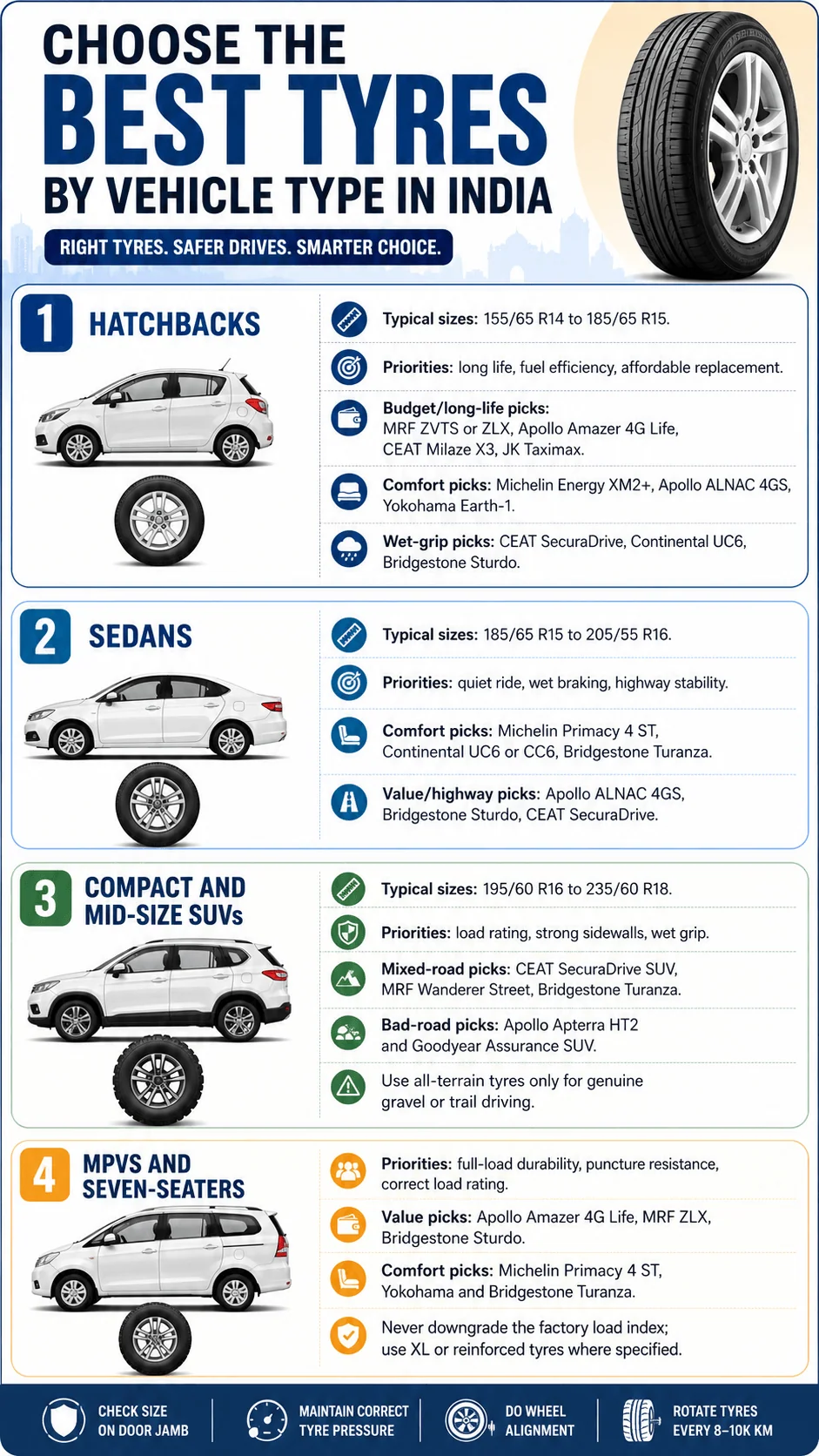
Best tyres for hatchbacks
Think Swift, Baleno, i20, Altroz, Tiago, Grand i10 Nios and Glanza. Hatchback owners usually want long life, good mileage and a sensible price. Sizes run from 155/65 R14 up to 185/65 R15, roughly ₹3,000 to ₹7,300 per tyre.
| Need | Best picks |
|---|---|
| Budget and long life | MRF ZVTS/ZLX, Apollo Amazer 4G Life, CEAT Milaze X3, JK Taximax |
| Comfort and low noise | Michelin Energy XM2+, Apollo ALNAC 4GS, Yokohama Earth-1 |
| Wet grip and highway | CEAT SecuraDrive, Continental UC6, Bridgestone Sturdo |
Best tyres for sedans
Think Dzire, Amaze, Aura, Tigor, Honda City, Verna, Virtus and Slavia. A sedan rewards a tyre upgrade more clearly than a hatchback, because cabin quiet and high-speed stability are easier to feel. Sizes run 185/65 R15 to 205/55 R16, roughly ₹4,100 to ₹14,000 per tyre.
| Need | Top picks |
|---|---|
| Comfort and low noise | Michelin Primacy 4 ST, Continental UC6/CC6, Bridgestone Turanza |
| Highway stability and value | Apollo ALNAC 4GS, Bridgestone Sturdo, CEAT SecuraDrive |
| Performance (turbo variants) | JK Levitas Ultra, Michelin Pilot Sport 4, Pirelli Cinturato |
Best tyres for SUVs
For the best tyre for SUVs in India, load index, sidewall strength and wet grip matter far more than badge value. Compact SUVs like the Nexon, Brezza, Venue, Sonet, Punch, XUV 3XO, Fronx, Magnite and Kiger use 195/60 R16 to 215/60 R16, roughly ₹5,800 to ₹12,800 per tyre. Mid-size and larger SUVs like the Creta, Seltos, Grand Vitara, Harrier, Safari and XUV 7XO move to 215/55 R17 and 235/60 R18, where four tyres get expensive fast.
| Need | What to fit |
|---|---|
| City and highway mix | CEAT SecuraDrive SUV, Bridgestone Turanza, MRF Wanderer Street |
| Bad roads and durability | Apollo Apterra HT2, Goodyear Assurance SUV, MRF Wanderer Street |
| Comfort and grip | Yokohama Geolandar, Bridgestone Ecopia/Alenza |
| Genuine off-road use | Apollo Apterra AT, Goodyear Wrangler, all-terrain patterns |
One caution for SUVs. Don’t fit aggressive all-terrain tyres if you mostly drive on tarmac. They’re louder, grip less in the rain, and dent your mileage. Most SUV owners are better off with a strong road-biased HT tyre.
Best tyres for MPVs and 7-seaters
Think Ertiga, XL6, Carens, Innova Crysta, Innova Hycross and Rumion. Loaded to the roof, the rear tyres take real punishment, so the load rating is non-negotiable. Sizes overlap sedans at the low end and SUVs at the top, roughly ₹4,100 to ₹13,600 per tyre.
| Need | Recommended |
|---|---|
| Full-load life and value | Apollo Amazer 4G Life, MRF ZLX, Bridgestone Sturdo |
| Comfort and low noise | Michelin Primacy 4 ST, Yokohama, Bridgestone Turanza |
| Load and puncture resistance | Keep OE load index or an XL/reinforced equivalent |
The biggest MPV mistake? Buyers go soft on the tyre and drop the load rating to save money. Don’t. Keep the same or higher service rating than your factory tyre.
Tyre Price Comparison
Treat the numbers below as approximate live market bands for 2026, not fixed quotes. Real prices swing by city, dealer margin, manufacturing week, online offers and whether the price includes fitting. Always ask for the all-inclusive on-road invoice, not just the sticker on the tyre.
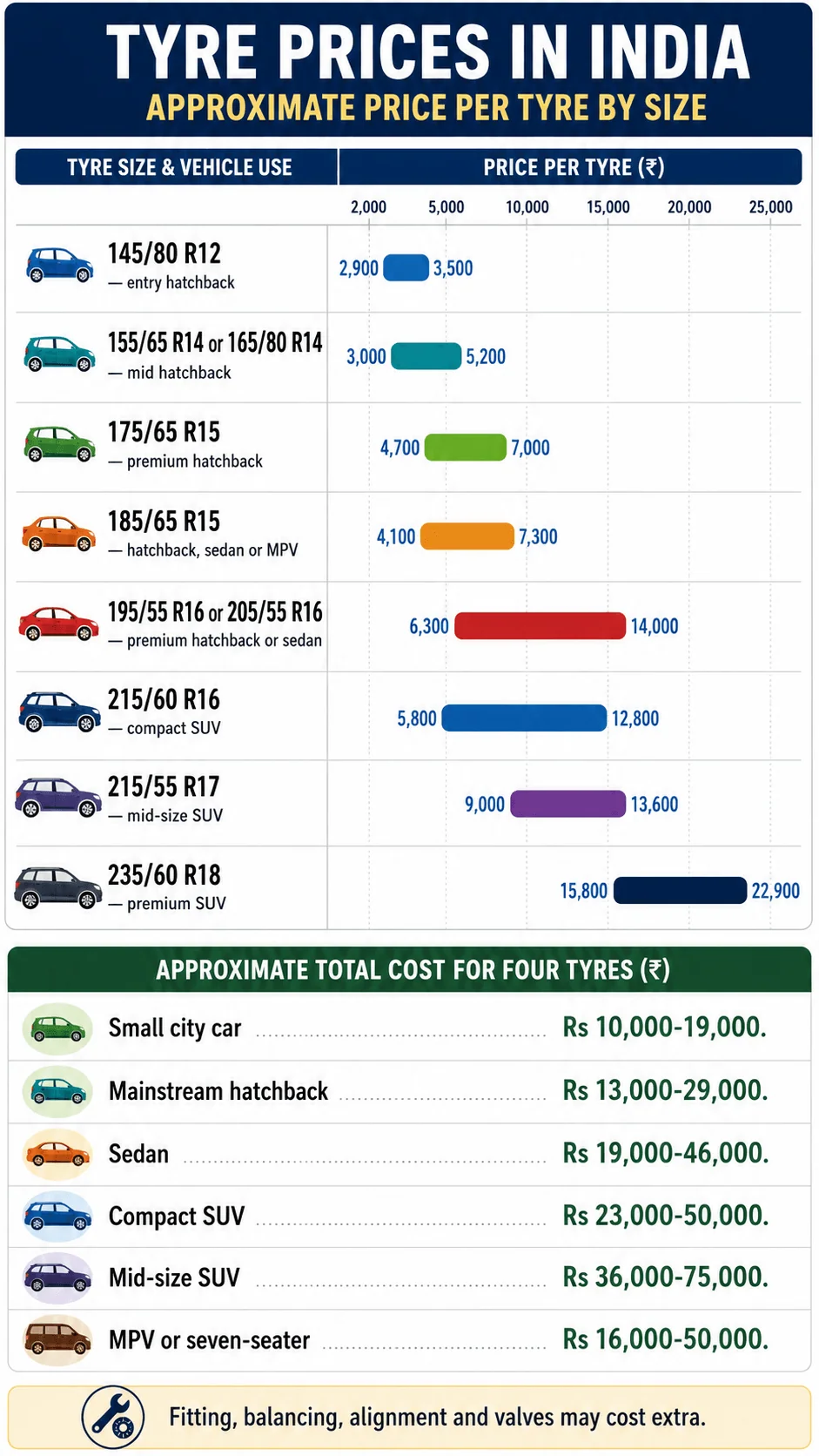
Approximate price per tyre by size:
| Tyre size | Common segment | Approx. per-tyre band |
|---|---|---|
| 145/80 R12 | Entry hatchback | ₹2,900 to ₹3,500 |
| 155/65 R14 / 165/80 R14 | Mid hatchback | ₹3,000 to ₹5,200 |
| 175/65 R15 | Premium hatchback | ₹4,700 to ₹7,000 |
| 185/65 R15 | Hatchback, sedan, MPV | ₹4,100 to ₹7,300 |
| 195/55 R16 / 205/55 R16 | Premium hatch, sedan | ₹6,300 to ₹14,000 |
| 215/60 R16 | Compact SUV | ₹5,800 to ₹12,800 |
| 215/55 R17 | Mid-size SUV | ₹9,000 to ₹13,600 |
| 235/60 R18 | Premium SUV | ₹15,800 to ₹22,900 |
A sensible budget for a full set of four:
| Car type | Set of 4 (approx.) |
|---|---|
| Small city car | ₹10,000 to ₹19,000 |
| Mainstream hatchback | ₹13,000 to ₹29,000 |
| Sedan | ₹19,000 to ₹46,000 |
| Compact SUV | ₹23,000 to ₹50,000 |
| Mid-size SUV | ₹36,000 to ₹75,000 |
| MPV / 7-seater | ₹16,000 to ₹50,000 |
Those bands exclude the extras. Budget separately for fitting and balancing (about ₹300 to ₹600 per tyre), 4-wheel alignment (₹500 to ₹1,500), new valves, and any nitrogen or tyre-protection add-on.
Where do the three price tiers leave you? Here’s each in a line:
- Budget (MRF, JK, entry CEAT): lowest cost, easiest small-town availability, firmer feel. Right for small hatchbacks and strict budgets.
- Mid-range (Apollo, CEAT SecuraDrive, mainstream Bridgestone and Goodyear): the best all-round balance of comfort, life and wet grip. Right for most private owners.
- Premium (Michelin, Continental, higher Yokohama, Bridgestone Turanza/Alenza, Pirelli): quieter, better wet braking, more high-speed composure, higher cost. Right for sedans, highway users and premium SUVs.
One reality to make peace with: you can’t max out comfort, ultimate wet grip, long life and low price all at once. Something has to give, or you pay more. Pick the one or two that matter most to you.
How Often Should You Change Tyres?
Tyres don’t fail on a fixed date. They fail on a mix of wear, age and damage. Replace them the moment any one of these is true:
- Tread hits the limit. The legal minimum tread depth in India is 1.6 mm, marked by the TWI blocks. For monsoon safety, many drivers replace below 3 mm, because water evacuation drops sharply past that.
- Age catches up. Even with tread left, rubber hardens and micro-cracks with age. Plan to replace around 5 to 6 years from the manufacturing date, however good the tread still looks.
- Damage you can’t repair. A sidewall bulge, a deep cut, or repeated punctures mean replacement, not another patch.
For typical Indian driving, that usually works out to roughly 40,000 to 50,000 km. Want a fast home check? Slot a ₹1 coin into the tread groove. If the top of the Ashoka emblem stays fully visible above the tread, your tyres are dangerously worn and need replacing.
Making your tyres last longer comes down to a few habits, and they do most of the work:
- Check pressure every 2 to 4 weeks and before long trips, using the figure on your door sticker, not the max printed on the tyre.
- Rotate tyres around every 10,000 km, or as your owner’s manual specifies, to even out wear.
- Get a wheel alignment after any hard pothole hit, or when the car pulls to one side. Balancing is a must on every new tyre and after every puncture repair.
- Inspect the spare too. An old, cracked spare is no help before a highway trip.
Tyres are only one line in your running costs. For the full picture, build them into a regular maintenance schedule, and if you’re planning ahead, compare car service cost by brand and your likely annual maintenance cost by model.
Is nitrogen worth it? Not really, for most drivers. Regular air is already 78% nitrogen, so the upgrade is marginal. Nitrogen does hold pressure a little more steadily, but checking your pressure regularly matters far more than the gas inside. Free or cheap? Fine. Don’t pay a premium for it.
And if you replace only two tyres, put the new pair on the rear axle, not the front. The rear tyres keep the car tracking straight, and worn rubber at the back makes it far easier to lose control in the wet. It surprises a lot of owners, but it’s the safe way to do it.
FAQs
Which tyre brand is best in India? There’s no single best. For value and easy replacement, MRF, Apollo, CEAT and JK Tyre lead. For comfort and wet braking, Michelin, Continental and Yokohama are stronger. The best brand is the one with the right tyre in your size for how you drive.
Which car tyre is best for Indian roads? A tubeless radial road tyre in your factory size, with good wet grip. For SUVs on rough roads, choose a stronger SUV-specific tyre such as the Goodyear Assurance SUV, Apollo Apterra or MRF Wanderer Street rather than a soft performance tyre.
How often should I change car tyres? When the tread reaches 1.6 mm, when the rubber is 5 to 6 years old, or after unrepairable damage, whichever comes first. For most drivers that’s around 40,000 to 50,000 km.
What tyre size does my car need? Read it off your current sidewall, then confirm on the sticker inside the driver’s door jamb, the fuel-flap, or the owner’s manual. That placard lists the exact width, profile, rim size, load index and speed rating.
How do I read a tyre size like 205/55 R16? 205 is the width in millimetres, 55 is the sidewall height as a percentage of the width, R means radial, and 16 is the rim diameter in inches. A trailing code like 91V gives the load index (615 kg) and speed rating (240 km/h).
Which tyre is best for hatchbacks? For value and life: Apollo Amazer 4G Life, CEAT Milaze X3, or MRF ZLX. For comfort: Michelin Energy XM2+ or Apollo ALNAC 4GS.
Which tyre is best for SUVs in India? For road-biased use: CEAT SecuraDrive SUV, Bridgestone Turanza, or Yokohama Geolandar. For bad roads and durability: Apollo Apterra or Goodyear Assurance SUV.
Are tubeless tyres better than tube tyres? For modern cars, yes. Tubeless tyres lose air slowly when punctured instead of bursting, which is much safer at speed, and they’re the default in today’s replacement market.
Should I replace all four tyres together? Ideally, yes, so grip and braking match at all four corners. If budget forces two, fit the new pair on the rear axle and match the existing size and type.
Can I use different tyre brands on the same car? It’s best not to, especially across an axle. Different brands or tread patterns across the same axle make handling and braking less predictable. Match all four where you can.
How do I avoid old-stock tyres? Check the four-digit DOT date code before the tyre is fitted. Refuse anything older than 12 to 18 months, since rubber degrades even in storage and you lose useful life and warranty.
The bottom line
The best car tyres in India aren’t the most expensive or the most famous. They’re the ones that match your car’s size, load rating, road conditions and how you drive. Get the factory size and load rating right first. After that, if you own a small hatchback, start with Apollo Amazer 4G Life, CEAT Milaze X3, or an MRF in the exact OE size. Drive a sedan and want comfort? Spend up on Michelin Primacy 4 ST, Continental UC6, or Bridgestone Turanza. Own an SUV? Put load index and wet grip ahead of looks, and don’t ignore sidewall strength. Whatever you buy, check the date code, fit a tubeless radial, and never drop below your factory load and speed ratings to save a few rupees.