
Buying a new car in India in 2026? You’ll run into an alphabet soup at the dealership. AMT, CVT, DCT, IVT, AGS, DCA, DSG. Most sales executives will just tell you it’s an “automatic” and move on.
That’s not enough.
Why does this matter so much? Because each of these transmissions behaves completely differently in Bangalore peak-hour traffic, on a Mumbai-Pune Expressway overtake, and on a hill climb to Lonavala. They also age very differently. One can cost you ₹4 lakh to fix at 60,000 km, while a different gearbox in the next showroom will quietly run for 1,20,000 km on routine service alone, asking nothing more from your wallet than fresh oil.
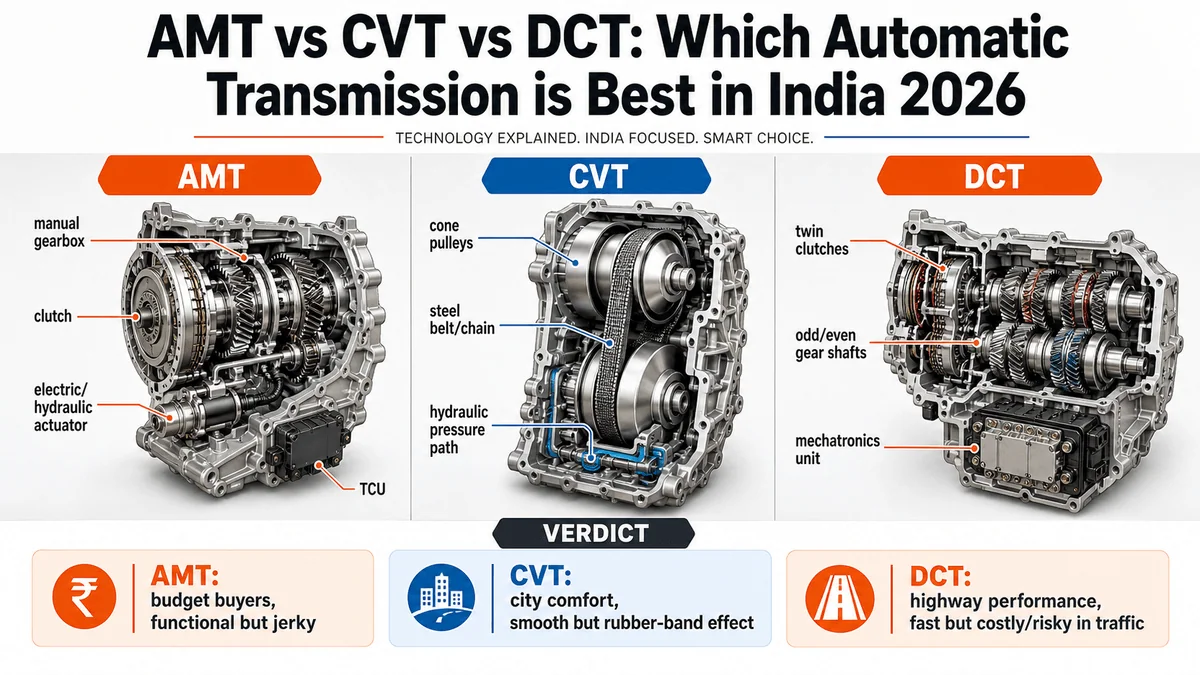
So before you sign that booking form, you really do need to know which one is sitting under the bonnet, and whether it actually fits your life.
Here’s an honest, no-nonsense breakdown of AMT, CVT and DCT. How they work. How they actually feel from behind the steering wheel. What they cost to maintain over six years. And which one quietly fits your real driving life better than the salesman’s “sir, it’s all the same automatic.”
Quick Verdict: AMT vs CVT vs DCT at a Glance
| Transmission | Best For | Driving Feel | Premium Over Manual | Routine Service | Long-Term Risk |
|---|---|---|---|---|---|
| AMT | Budget buyers, first-time automatic owners, light city use | Functional but jerky head-nod between 1st and 2nd gear | ₹40,000 – ₹60,000 | ₹4,000 – ₹8,000 | Low |
| CVT | Heavy city traffic, fuel-efficiency seekers, relaxed drivers | Effortless, silent, “rubber-band” drone under hard throttle | ₹80,000 – ₹1.3 lakh | ₹6,000 – ₹10,000 | High if abused, low if serviced |
| DCT | Highway driving, enthusiasts, turbo-petrol cars | Lightning-fast, sporty, hesitant at crawl speeds | ₹1 lakh – ₹1.5 lakh | ₹8,000 – ₹12,000 | Very high (especially dry-clutch DCTs) |
In one line: CVT for city sanity. DCT for highway thrills. AMT for staying within budget.
Now let’s break each one down properly. No jargon. No marketing fluff.
AMT: How It Works, Pros and Cons
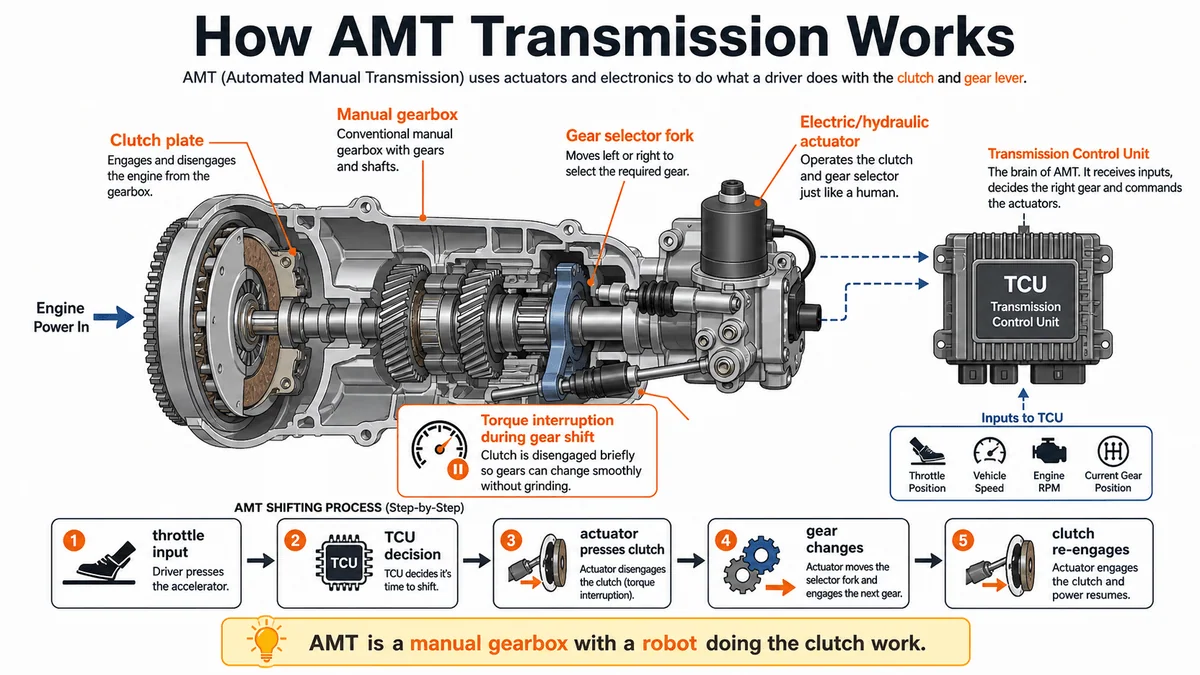
The Automated Manual Transmission is exactly what its name says. A normal manual gearbox, with a robot doing the clutch and shift work for you. Same gears. Same clutch. Just no third pedal. Still deciding between two pedals and three? Our automatic vs manual guide weighs up the trade-offs.
Maruti markets it as AGS (Auto Gear Shift). Tata calls it Advanced AMT. Renault has its own “Easy-R” branding. Different stickers, identical mechanical idea.
A small computer (the Transmission Control Unit) reads your speed, throttle input and engine RPM. When it decides a shift is due, it tells an electro-hydraulic or electric actuator to press the clutch, move the gear selector, and let the clutch back out. No clutch pedal for you. But the mechanical motion under the bonnet is identical to what your driving instructor taught you.
That mechanical simplicity is why AMT is so cheap. Manufacturers don’t redesign the gearbox. They just bolt actuators onto an existing manual. R&D cost is low, manufacturing cost is low, and the price you pay is low.
Pros of AMT
- Cheapest automatic in the market. AMT variants are typically only ₹40,000 to ₹60,000 more than the manual variant. CVT and DCT can demand ₹80,000 to ₹1.8 lakh.
- Fuel efficiency that matches manual. AMT has no torque converter and no fluid coupling sapping power, so mileage figures are nearly identical to the manual sibling. In some highway scenarios it’s even slightly better.
- Cheap, simple maintenance. The core gearbox is a proven manual unit. Routine service is just gear oil at scheduled intervals. ₹4,000 to ₹8,000 a service. No exotic fluid needed.
- Useful creep function. Most modern AMTs (post-2019) creep forward at around 6 km/h when you release the brake. That alone takes the pain out of bumper-to-bumper traffic.
- Familiar, repairable architecture. Any roadside garage in a Tier-2 town can crack open a manual gearbox. Try saying that about a CVT.
Cons of AMT
The biggest complaint, and it’s universal: the head-nod.
Every time the actuator physically interrupts torque delivery during a shift, you feel a clear pause in acceleration. Your body lurches forward, ever so slightly, like the car hiccupped. It’s most obvious in the 1st-to-2nd shift, where the gear ratio jump is widest and the engine has the most torque to manage. Once you’ve felt it, you can’t un-feel it.
Other limitations:
- Slow overtakes on highways. Stamp the throttle and the AMT has to register the input, disengage the clutch, drop a gear (sometimes two), and re-engage. By then the overtaking gap has closed. You learn to plan overtakes seconds in advance.
- Hill rollback in older units. Base AMT cars without hill-hold assist will roll back the moment you release the brake on an incline. Modern AMTs (Tata Tiago, Maruti WagonR, Hyundai Exter) now bundle hill-hold, but in slow uphill traffic the dry clutch still overheats from constant slipping.
- Actuator sensitivity to vendor. Maruti and Tata mostly use Magneti Marelli hydraulic actuators. They’re cost-effective but feel heavier and produce a more pronounced jerk. Hyundai built its AMT in-house with electric actuators, and the result is a noticeably smoother shift. The Hyundai Exter and Grand i10 Nios are widely considered the best-calibrated AMTs in the budget segment.
Veteran AMT owners learn one trick that flattens the jerk almost entirely. Lift off the accelerator slightly just before each shift. This “throttle lift-off” technique cooperates with the actuator instead of fighting it. Once you learn it, an AMT feels surprisingly civilised. Until you forget, and the head-nod returns.
CVT: How It Works, Pros and Cons
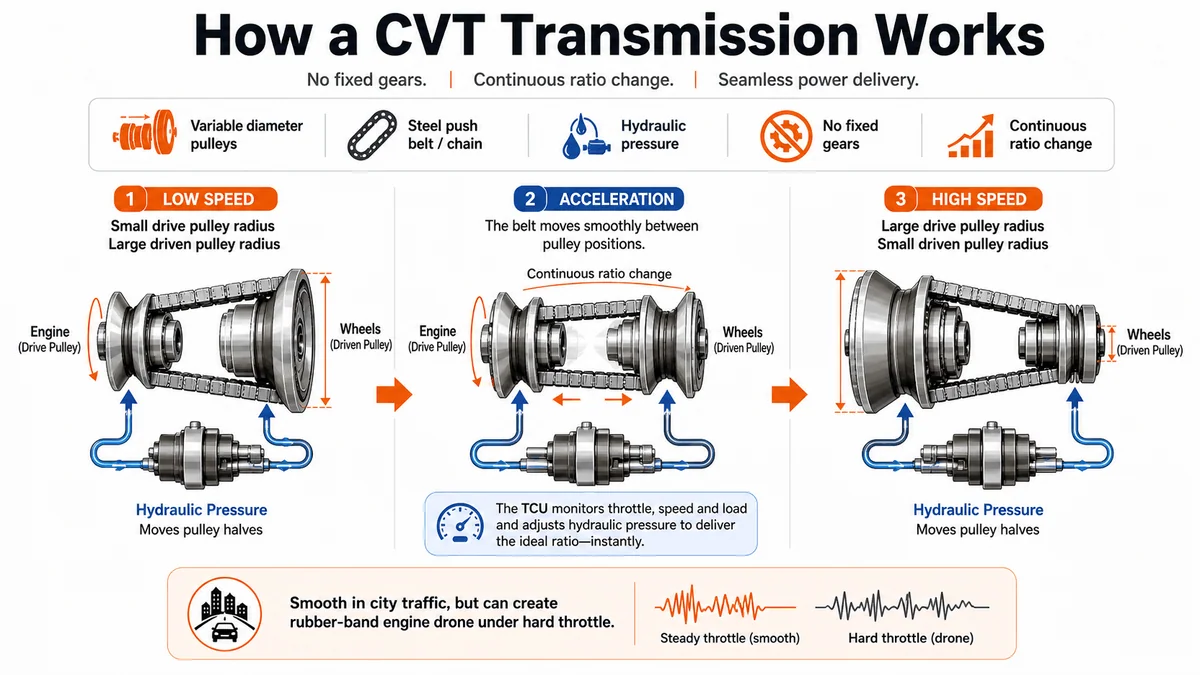
The Continuously Variable Transmission throws out gears entirely. No first. No second. No fourth, fifth, or sixth either. Just two cone-shaped pulleys connected by a heavy steel push-belt or a chain.
So how does it actually work?
As the car accelerates, hydraulic pressure changes the diameter of each pulley. One pulley widens. The other narrows. The belt rides at different points across both, changing the effective ratio with every nudge of the throttle. That continuous adjustment gives you an infinite number of gear ratios between the lowest and highest, which means the engine can theoretically sit in its sweetest, most efficient RPM all the time, sipping fuel while you sit comfortably in traffic.
Hyundai and Kia call their version IVT (Intelligent Variable Transmission) and use a chain instead of a belt, which slightly reduces the rubber-band feel and improves durability. Maruti Suzuki and Toyota take it a step further in their strong-hybrid SUVs (Grand Vitara Hybrid, Urban Cruiser Hyryder Hybrid) with an e-CVT, where electric motor-generators handle the ratio variation instead of pulleys. The e-CVT eliminates the rubber-band drone almost entirely and routinely returns over 25 kmpl.
Pros of CVT
- The smoothest commute money can buy. No shift shock. No torque interruption. Acceleration is one unbroken wave. In Bangalore traffic at 4 pm, this is genuinely life-changing.
- Excellent city fuel economy. The TCU keeps the engine at its optimal RPM at all times. Honda Amaze CVT returns ~22.94 kmpl. Strong-hybrid e-CVTs in the Grand Vitara push close to 28 kmpl.
- Quiet on highways. At cruise, the CVT lets engine RPM drop to a low, barely audible idle. Long highway runs are surprisingly refined.
- Fatigue-free for long city drives. No interruption means no micro-jolt to your spine every 20 seconds. After a 90-minute commute, you actually arrive less tired.
Cons of CVT
The infamous “rubber-band effect”.
Press the throttle hard for an overtake and the engine immediately revs to its peak power RPM, often 5,000+. But the pulleys take a few seconds to physically adjust the ratio, which means you hear an angry, screaming engine while the car only slowly builds speed underneath you, like a rubber band stretching out before it actually moves anything forward. Auditory feedback and actual acceleration are completely disconnected. It feels unnatural. Some drivers learn to ignore it. Others never make peace with it.
Try one on a test drive before you decide.
Other downsides:
- Lacks driving excitement. A CVT is engineered for efficiency and smoothness, not engagement. No shift points to enjoy. It feels emotionally numb.
- Struggles under heavy load. A 1.2L petrol with a CVT, AC running full, four adults inside, and a slight incline? You’ll hear the engine drone constantly as the system hunts for a ratio that can move the load.
- Catastrophic failure cost is high. This is the part nobody talks about at the showroom. If the specialised CVT fluid degrades or the system overheats, the steel belt can slip. Once the belt slips, it scores the pulley faces, sends metal shavings into the hydraulic valve body, and the transmission is essentially totalled.
There’s a real-world Team-BHP case where a Honda City CVT failed at just 56,000 km. The authorised service centre quoted ₹4 lakh for a complete replacement. Independent specialists can rebuild Honda and Jatco CVTs for around ₹1.5 lakh, but that’s still a brutal financial hit.
The takeaway? CVTs are bulletproof if you change the fluid on schedule (every 40,000 km), drive smoothly, and avoid hauling. Abuse one, skip a fluid change, and you’re looking at a ₹2 lakh+ surprise.
DCT: How It Works, Pros and Cons
The Dual-Clutch Transmission is the most mechanically sophisticated of the three. Volkswagen famously brands it DSG (Direct Shift Gearbox). Tata calls its version DCA (Dual Clutch Automatic). Hyundai and Kia just call it “7-DCT” and leave it at that. The underlying principle is identical across all of them.
Picture two manual gearboxes squeezed into one casing.
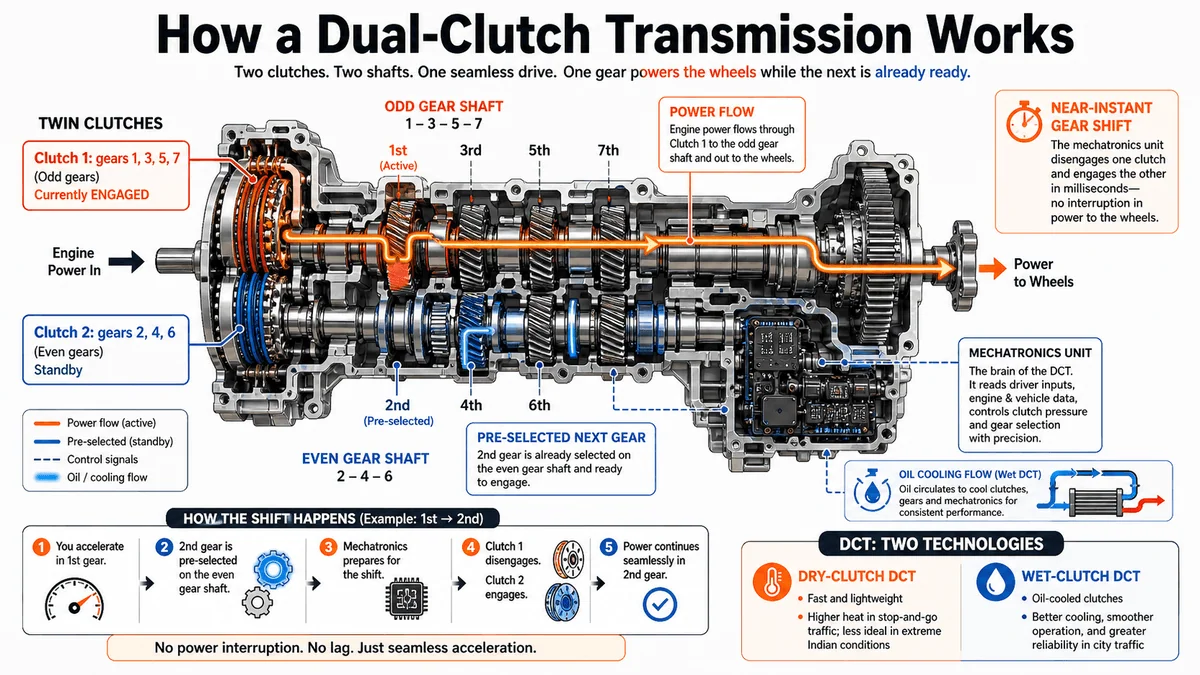
That’s basically what a DCT is. Two complete manual gearboxes and two clutches stacked inside a single housing. One clutch handles the odd gears (1, 3, 5, 7). The other handles the even gears (2, 4, 6). At any moment, one gear is engaged and powering the wheels, while the other clutch has already pre-engaged the next gear in line on the second shaft, primed and ready.
When it’s time to shift, the mechatronics unit just releases one clutch and engages the other. The whole transfer happens in milliseconds, with virtually no torque interruption. That’s why a DCT feels so seamless and so fast. You don’t shift. You glide.
Wet Clutch vs Dry Clutch: the Single Most Important DCT Decision in India
This is the detail competitor articles skip, and it is the single biggest factor that decides whether your DCT will survive Indian traffic.
- Dry-clutch DCT: Clutches sit in open air inside the bell housing and rely only on ambient airflow for cooling. Used by Hyundai-Kia (i20 N-Line, Venue, Verna, Creta turbo, Seltos, Sonet, Carens) and by Volkswagen-Skoda (Virtus, Taigun, Slavia, Kushaq) in their DQ200 unit. Brilliant on highways. Vulnerable in stop-go traffic.
- Wet-clutch DCT (DCA): Clutches are submerged in transmission oil that acts as a heat sink. Used by Tata (Altroz DCA, Nexon DCA). Tata specifically engineered this to survive Indian heat and traffic. Loses a sliver of shift speed compared to a DSG. Gains a huge amount of reliability.
Spend most of your time in heavy city gridlock? A dry-clutch DCT is risky. A wet-clutch DCT (or a different transmission entirely) is the safer choice.
Pros of DCT
- Fastest shifts of any transmission, full stop. No technology shifts faster than a DCT. Upshifts are near-instant. Downshifts arrive rev-matched.
- Closest automatic to a manual feel. Because a DCT uses real clutch plates and not a slipping torque converter or a CVT belt, there is almost no parasitic power loss. The engine’s torque goes straight to the wheels. Sharp, immediate, engaging.
- Highway brilliance. A DCT executes flawless double-downshifts when you need a sudden burst for an overtake. No hesitation. You feel in total command.
- Pairs perfectly with turbo-petrol engines. The 1.0L and 1.5L turbo-petrols in modern Hyundai-Kia and VW cars are designed around DCTs. The combination is genuinely fun.
Cons of DCT
- Overheating in city traffic (dry-clutch versions). This is the headline risk. An engine has a minimum idle speed that translates to roughly 7 km/h in 1st gear. Indian traffic regularly crawls at 3 to 5 km/h. To stop the engine stalling, the mechatronics unit must constantly slip the dry clutches. Slipping generates heat. Heat with no oil bath spikes temperatures fast. Severe cases trigger thermal protection, lock the gear selector, and you sit there in the middle of traffic until the gearbox cools. Owners of Kia Seltos and Hyundai Venue dry-DCTs have reported exactly this on Team-BHP and r/CarsIndia.
- Hesitant at crawl speeds. Even when it isn’t overheating, a DCT can feel confused below 10 km/h. The mechatronics unit hesitates between holding 1st and shifting to 2nd. The result? A clunky, juddering crawl that’s the polar opposite of the smooth DCT highway character.
- Eye-watering repair bills. Clutch packs wear out. In a dry-clutch DCT used in Indian conditions, plan for clutch pack replacement around the 80,000 to 1,00,000 km mark. That alone is ₹80,000 to ₹1,50,000. A complete mechatronics failure or full rebuild crosses ₹2 lakh and can hit ₹3.5 lakh. Buy a DCT and you must extend the warranty to the maximum the manufacturer allows. Five to seven years. Non-negotiable.
To survive Indian city traffic with a dry DCT, owners learn habits that protect the clutch. Shifting to Neutral at long traffic lights. Using auto-hold or the handbrake on inclines instead of holding the car on the clutch. Letting a clear gap form ahead before accelerating instead of constantly inching at 2 km/h. If that sounds tiring, it is. A DCT in heavy gridlock isn’t a relaxing daily driver.
Video Explaining AMT vs CVT vs DCT for Indian Buyers

Driving Feel Comparison: Real Indian Scenarios
Brochures lie. Real driving doesn’t.
So forget the marketing one-liners and the dealership coffee-table slideshows. Here’s how each transmission actually behaves in the four scenarios you and I drive in every day, every week, every monsoon, every summer holiday road trip with the family.
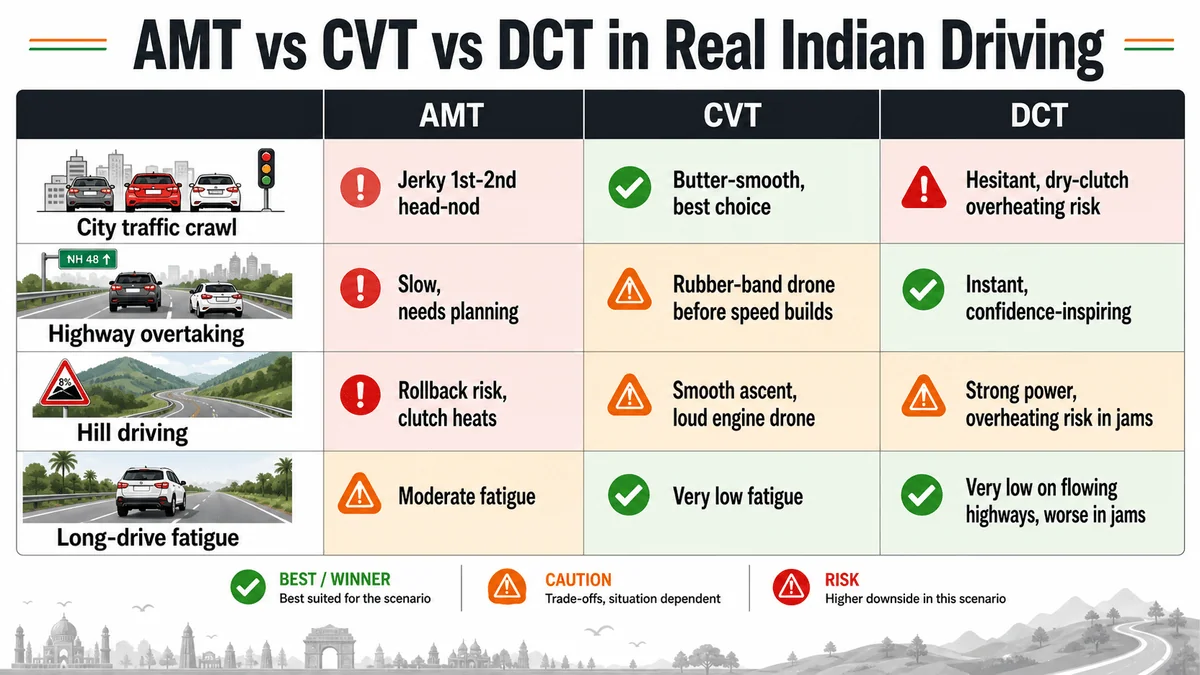
Bangalore / Mumbai / Delhi Traffic Crawl
CVT wins, hands down. It glides forward in absolute silence with zero mechanical interruption. You can have a phone conversation, sip coffee, listen to a podcast. The cabin stays serene.
AMT is a chore here. Every time the traffic clears and the car climbs past 15 km/h, the AMT shifts to 2nd and gives you a head-nod. If the traffic stops immediately, it drops back to 1st. Repeat for 90 minutes. You’ll arrive cranky.
DCT feels nervous and out of place at crawl speeds. The clutches slip continuously, you feel a faint vibration through the steering, and you start mentally counting how much heat is building up. It induces driver anxiety, which is the opposite of why you bought an automatic.
Highway Overtaking
DCT wins. When you need a quick burst to pass a Volvo bus on a two-lane state highway, the DCT delivers an instant double-downshift and you’re past it in a heartbeat. The driver feels in total command.
CVT responds to aggressive throttle by revving the engine to redline immediately. You hear a long, loud, straining drone while the car slowly builds road speed. Tight overtaking windows can become genuinely stressful.
AMT just takes a deep breath. It registers the throttle, pauses entirely to mechanically disengage the clutch, drops a gear, and finally provides a surge. Spontaneous overtakes? Dangerous. You learn to plan them.
Hill Driving and Steep Inclines
CVT handles inclines with real smoothness, adjusting the pulleys to deliver maximum torque. Though the engine drone will be loud and constant.
DCT offers excellent direct power for climbing. But if you get stuck in slow-moving traffic on a steep incline, a dry-clutch DCT will overheat faster than in any other situation. The transmission is fighting the car’s weight against gravity using slipping clutches.
AMT without hill-hold will roll backward the moment you release the brake. Even with hill-hold, crawling uphill in slow traffic causes the dry clutch plate to heat up rapidly. Watch the temperature warning lights.
Long Drive Fatigue
CVT and DCT (on flowing highways) are equally fatigue-free. AMT trails because of constant shift interruptions on undulating roads. If your monthly drives include lots of long-distance ghats and expressways, prioritise CVT or DCT. If they include lots of dense city, prioritise CVT. Once you know which gearbox you want, our automatic cars under ₹10 lakh list shows what is actually on sale.
| Driving Scenario | AMT | CVT | DCT |
|---|---|---|---|
| City Traffic Crawl | Jerky 1st-2nd head-nod | Butter-smooth, the best | Hesitant, dry-clutch overheating risk |
| Highway Overtaking | Slow, advance planning needed | “Rubber-band” drone before speed builds | Instant, confidence-inspiring |
| Hill Driving | Rollback on base models, clutch heats | Smooth ascent, loud engine drone | Excellent power, but overheating risk in jams |
| Driver Engagement | Low (functional, unrefined) | Lowest (dull, artificial feel) | Highest (sporty, sharp) |
| Long Drive Fatigue | Moderate (shift interruptions) | Very low (relaxed cruising) | Very low (except in jams) |
Maintenance Cost Comparison: The 6-Year Reality
The marketing brochure shows you the EMI. It does not show you the rebuild quote at 60,000 km. Here is the real ownership cost picture across a typical six-year, 1,20,000 km lifecycle.
Routine Service Cost (per service)
- AMT: ₹4,000 – ₹8,000. Standard manual gear oil changes.
- CVT: ₹6,000 – ₹10,000. High-friction CVT-specific fluid is non-negotiable. Skip it once and the transmission can self-destruct.
- DCT: ₹8,000 – ₹12,000. High-grade synthetic DCT fluid plus precise filter changes.
Long-Term Repair Risk (when things go wrong)
| Transmission | Primary Failure Scenario | Estimated Repair Cost (India 2026) | Long-Term Risk |
|---|---|---|---|
| AMT | Clutch plate wear, TCU/actuator failure | Clutch kit ₹8,000 – ₹18,000. Actuator replacement ₹50,000 – ₹83,000 | Moderate. Actuator is expensive, but the gearbox itself is cheap and robust |
| CVT | Steel belt snapping or pulley scoring from fluid degradation | Full rebuild/replacement ₹1,50,000 – ₹2,50,000. OEM quotes go up to ₹4,00,000 | High. Low probability with proper care, but catastrophic financial cost if it fails |
| DCT | Dry clutch pack burnout or mechatronics failure from thermal stress | Clutch pack ₹80,000 – ₹1,50,000. Mechatronics/full rebuild ₹2,00,000 – ₹3,50,000 | Very high. Clutch replacement is almost guaranteed in city traffic |
The Reality Check
Over a typical six-year, 1,20,000 km ownership cycle, the AMT is demonstrably the cheapest automatic to own. Even if the actuator fails, total non-routine repair cost rarely crosses ₹60,000 to ₹80,000. Independent specialists are increasingly capable of repairing AMT actuators for around ₹45,000.
A CVT is highly reliable if driven sedately and serviced meticulously, but it is fragile under abuse. A snapped push-belt essentially totals the gearbox. Authorised service centres rarely repair CVTs and instead push for a full replacement that can cost ₹4 lakh.
A DCT in Indian conditions represents a known, accepted financial risk. Clutch pack replacement at the 80,000 km mark should be budgeted as a guaranteed maintenance item, not an unexpected repair.
E20 fuel mandates and ethanol blending are also introducing new variables into engine and powertrain wear. For cautious, long-term buyers, minimising drivetrain complexity is becoming a priority.
The single biggest piece of transmission wisdom for any Indian car owner: A ₹8,000 fluid service every 40,000 km prevents a ₹2 lakh rebuild. Skipping CVT or DCT fluid changes is the most expensive false economy in car ownership.
For more on this, see our full guide to annual car maintenance cost by model and car service cost by brand in India.
Which Transmission for Your Needs?
Generic advice fails here. The right transmission is entirely about your daily route, ownership horizon and driving temperament.
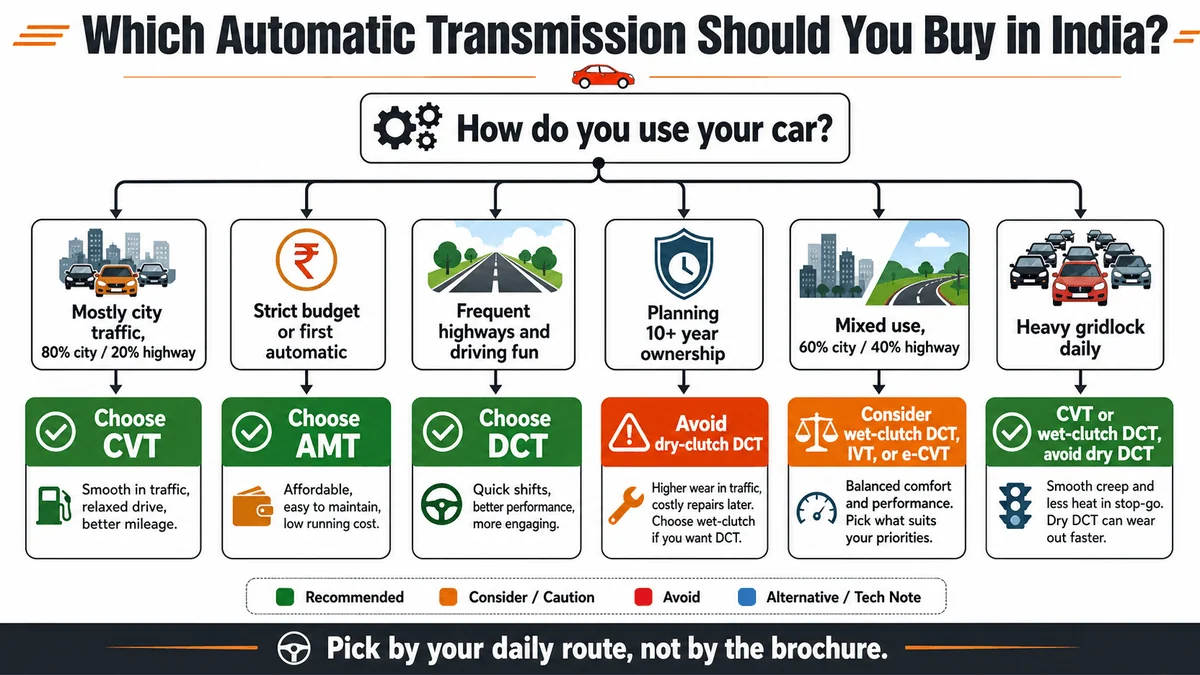
For the Pure City Commuter (80% city / 20% highway): Choose CVT
Is your day mostly Bangalore tech-park traffic, Mumbai Western Express, or Delhi Ring Road? The CVT will save your sanity.
The rubber-band effect is irrelevant at 20 km/h, and the lack of shift shock gives you a luxurious, fatigue-free cabin experience no other transmission matches. Honda City CVT. Hyundai Creta IVT. Maruti Grand Vitara e-CVT. All strong picks for your daily grind.
For the Enthusiast or Frequent Highway Driver: Choose DCT
Do you actually enjoy driving? Frequently use expressways? Want instant throttle response that feels almost telepathic?
Then the DCT is dynamically unmatched. You’ll have to accept higher maintenance costs and adopt defensive driving habits in city traffic to protect the clutch assembly, but the reward is a gearbox that turns every overtaking lane into pure entertainment. Volkswagen Virtus GT DSG. Hyundai Verna Turbo DCT. Kia Seltos GT-Line DCT.
For the First-Time Buyer or Budget-Conscious Driver: Choose AMT
Upgrading from a two-wheeler or a manual car on a strict budget? AMT delivers the core benefit of clutchless driving without a fuel-economy penalty or a financial cliff at 80,000 km.
One nudge though. Strongly favour Hyundai’s electric-actuator AMTs (Exter, Grand i10 Nios) over hydraulic-actuator units found in Maruti and Tata. The shift quality difference is real, and you’ll notice it within five minutes of driving.
For the High-Mileage Long-Term Owner (7+ Years): Avoid Dry DCTs
Plan to keep your car a decade? Run it well past 1,00,000 km? Then dry-clutch DCTs will cripple the residual value with inevitable repair bills you’d rather not budget for.
For ultimate longevity, a wet-clutch DCT (Tata DCA), a meticulously maintained CVT, or a traditional torque-converter automatic are all vastly better long-term picks.
For Mixed Use (60% city / 40% highway): The Hardest Call
You’re the trickiest case. A wet-clutch DCT (Tata Altroz DCA, Nexon DCA), a chain-driven IVT (Hyundai Creta, Kia Seltos NA petrol), or a strong-hybrid e-CVT (Maruti Grand Vitara, Toyota Hyryder) all balance city smoothness with highway capability without the dry-DCT thermal risk. Test drive at least two of these back-to-back on your daily route before you commit.
Cars by Transmission Type in India (2026)
Automakers don’t randomly pair engines with transmissions. The choice tells you a lot about how the car is meant to be used.
AMT Cars (Budget and Compact Segments)
AMTs dominate the sub-4-metre and entry-level space because they keep ex-showroom prices fiercely competitive.
- Maruti Suzuki AGS: Alto K10, Celerio, WagonR, Swift, Dzire, Baleno, Fronx, Ignis. Affordable, ubiquitous service network, but noted for a pronounced 1st-2nd head-nod and basic calibration. The Fronx AMT feels sluggish during spirited driving.
- Tata Motors: Punch, Nexon (lower variants), Tiago, Altroz. The 2026 Tata Punch features an industry-first CNG-AMT combination that prioritises extreme running cost efficiency. Cheap to run, but the heavy CNG tank and AMT lag make highway overtakes laborious.
- Hyundai Grand i10 Nios, Exter: Universally praised for the best-calibrated, smoothest shifts in the budget segment. Hyundai’s electric-actuator AMT minimises the head-nod significantly better than Maruti or Tata rivals. If smoothness in an AMT matters to you, this is the segment leader.
CVT Cars (Comfort-Oriented Sedans and SUVs)
CVTs are almost exclusively paired with naturally aspirated petrol engines, targeting buyers who prioritise refinement over outright speed.
- Honda (City, Elevate, Amaze): Honda is the original CVT pioneer in India. Implementations are supremely smooth and reliable when serviced correctly, though the rubber-band engine drone can intrude on cabin NVH under hard acceleration.
- Hyundai / Kia IVT (Creta, Seltos): These systems use a robust chain drive rather than a steel push-belt. The tweak slightly reduces rubber-band feel and improves durability, making the 1.5L NA petrol Creta and Seltos IVT highly recommended for pure city dwellers.
- Maruti Suzuki / Toyota strong-hybrid (Grand Vitara, Urban Cruiser Hyryder): These use an advanced e-CVT. Electric motors blend power and vary ratios, eliminating the rubber-band feel entirely while delivering EV-like smoothness in traffic and fuel efficiency that often crosses 25 kmpl.
- Nissan Magnite: Most affordable CVT in India, paired with a 1.0L turbo-petrol. Surprisingly capable.
DCT Cars (Performance and Premium Segments)
DCTs are reserved for premium segments and are almost exclusively mated to high-torque turbocharged engines that exploit their rapid shifting capability.
- Hyundai / Kia (i20 N-Line, Venue, Verna, Creta turbo, Seltos, Sonet, Carens, Syros): Predominantly use a 7-speed dry-clutch DCT paired with 1.0L or 1.5L turbo-petrols. Brilliant on the highway. Owners routinely report juddering, hesitation and dashboard overheating warnings when trapped in severe city gridlock.
- Volkswagen / Skoda (Virtus, Taigun, Slavia, Kushaq): Equipped with the famous DSG (DQ200 dry-clutch) unit. While early-generation DQ200 units were notoriously unreliable, modern 2026 iterations feature dramatically improved thermal management and software calibration. They still shift faster than any competitor and still demand mechanical sympathy in stop-go traffic.
- Tata Motors (Altroz DCA, Nexon DCA): A notable exception. Tata uses a wet-clutch DCA specifically engineered to combat Indian heat, dust and traffic. It sacrifices a fraction of a second in shift speed compared to a VW DSG but drastically improves reliability and thermal endurance in urban gridlock. The Tata Altroz is also the cheapest DCT on sale in India, starting at around ₹6.30 lakh ex-showroom.
Frequently Asked Questions
Which is better, AMT, CVT or DCT?
There’s no single “best” transmission. It depends entirely on where you drive.
The CVT is objectively the best for comfort and fatigue reduction in dense city traffic. The DCT is the absolute best for highway performance, rapid acceleration and driving enthusiasts. The AMT is the best functional option for budget-conscious buyers who want maximum fuel efficiency without paying for a clutch pedal.
Is AMT jerky?
Yes, by design. Always has been.
Because an AMT uses a robotic actuator to physically engage and disengage a standard manual clutch, there’s a mandatory interruption in engine torque during every gear shift. That’s what causes occupants to lurch forward slightly, especially during the 1st-to-2nd gear shift under acceleration. Veteran owners flatten this by lifting off the accelerator just before each shift, which sounds fiddly but becomes muscle memory in a week.
Which automatic transmission is most fuel-efficient?
Depends how you measure it.
In purely mechanical terms, the AMT is the most fuel-efficient because it has no parasitic power losses from a torque converter or hydraulic fluid coupling. But in heavy real-world city traffic, a CVT can match or exceed AMT efficiency by keeping the engine at its optimal RPM. Strong-hybrid e-CVTs (Maruti Grand Vitara, Toyota Hyryder) deliver the highest mileage of all, often crossing 25 kmpl in real driving conditions, not just on the brochure.
Which transmission is best for city driving?
The CVT. Hands down. Not even close.
The complete absence of physical gears eliminates shift shock, giving you a continuous, seamless and silent glide that prevents driver fatigue in endless stop-and-go gridlock. After a 90-minute traffic crawl, you actually arrive less tired than you left.
Is DCT reliable in India?
It’s complicated. Reliability is highly contextual.
Dry-clutch DCTs (Hyundai, Kia, VW DQ200) are prone to premature wear and thermal shutdowns in constant bumper-to-bumper traffic where the clutch is forced to slip continuously. They’re highly reliable on open highways. Wet-clutch DCTs (Tata DCA) are far more robust in Indian conditions. If you’re buying any DCT in India, purchasing the maximum extended warranty available (5 to 7 years) isn’t optional. It’s mandatory.
Which transmission has the lowest maintenance cost?
The AMT. By a wide margin.
The core unit is a rudimentary manual gearbox, so routine service is cheap (₹4,000 to ₹8,000). More importantly, AMT completely avoids the catastrophic, financially ruinous repair costs associated with mechatronics failures in DCTs (₹2 to ₹3.5 lakh) or snapped steel belts in CVTs (₹1.5 to ₹4 lakh).
What’s the difference between AMT and CVT?
An AMT is a manual gearbox with an automated clutch, so it has fixed gears and shifts feel like an automated manual. A CVT has no fixed gears at all, just two pulleys and a belt that vary ratios continuously. AMT is cheaper and more fuel-efficient on paper. CVT is dramatically smoother and far better for city traffic. Different mechanical philosophies. Different driving experiences.
Wet DCT or dry DCT, which should I buy in India?
For Indian conditions? A wet-clutch DCT is significantly more reliable.
The transmission oil bath dissipates heat from the clutches in stop-go traffic, doubling effective lifespan compared to dry-clutch units. If you’re buying a Hyundai, Kia or VW DCT (all dry-clutch), commit to the maximum extended warranty and adopt traffic-friendly driving habits like shifting to N at long lights. Tata’s wet-clutch DCA was engineered specifically for Indian heat. It costs Tata more to build, but it costs you less to own.
The Bottom Line
There is no single “best” automatic transmission in India. There’s only the one that matches your real driving life:
- Drive mostly in city traffic? CVT.
- Drive mostly on highways and want fun? DCT (preferably wet-clutch).
- On a strict budget or buying your first automatic? AMT (favour Hyundai’s electric-actuator units).
- Plan to keep the car 10+ years? Avoid dry-clutch DCTs entirely.
Buy the right transmission for your route, change the fluid on schedule, and any of these gearboxes will serve you well for a decade. Buy the wrong one, or skip a fluid service, and you’ll be the next ₹4 lakh case study on Team-BHP.
Whichever you pick, never let your fluid service intervals slide. That single habit is the cheapest car insurance you’ll ever buy.
Now go test drive. And ignore anyone who tells you “automatic is automatic.”