CNG cars have officially crossed diesel in Indian passenger vehicle sales. FY26 numbers tell the story. Alternative-fuel cars hit 13.4 lakh units, accounting for 29% of the market. CNG alone crossed 7 lakh.
So you’re standing in a Maruti or Tata showroom in 2026, staring at the petrol vs CNG variant choice. You’re not the only one who’s confused.
The short answer? A factory-fitted CNG car saves roughly ₹2 per kilometre over petrol. But the upfront premium of ₹80,000 to ₹1,00,000 only pays back if you drive a lot, live in a metro with reliable CNG stations, and don’t mind giving up boot space and a chunk of engine power. For everyone else, it’s a romantic idea that turns sour by month six.
This guide spells out every advantage and every downside. Who CNG genuinely makes sense for. Who should walk away. We’ve used current 2026 data: Delhi CNG at ₹77.09/kg, Mumbai at ₹81/kg, petrol around ₹95/litre. Plus real owner feedback from forums and long-term tests.
CNG Car Advantages
The case for CNG rests on hard economics. The benefits are real, but they only show up if your usage pattern matches. Here’s what you actually get.
1. Running Cost Savings of Roughly ₹2 Per Kilometre
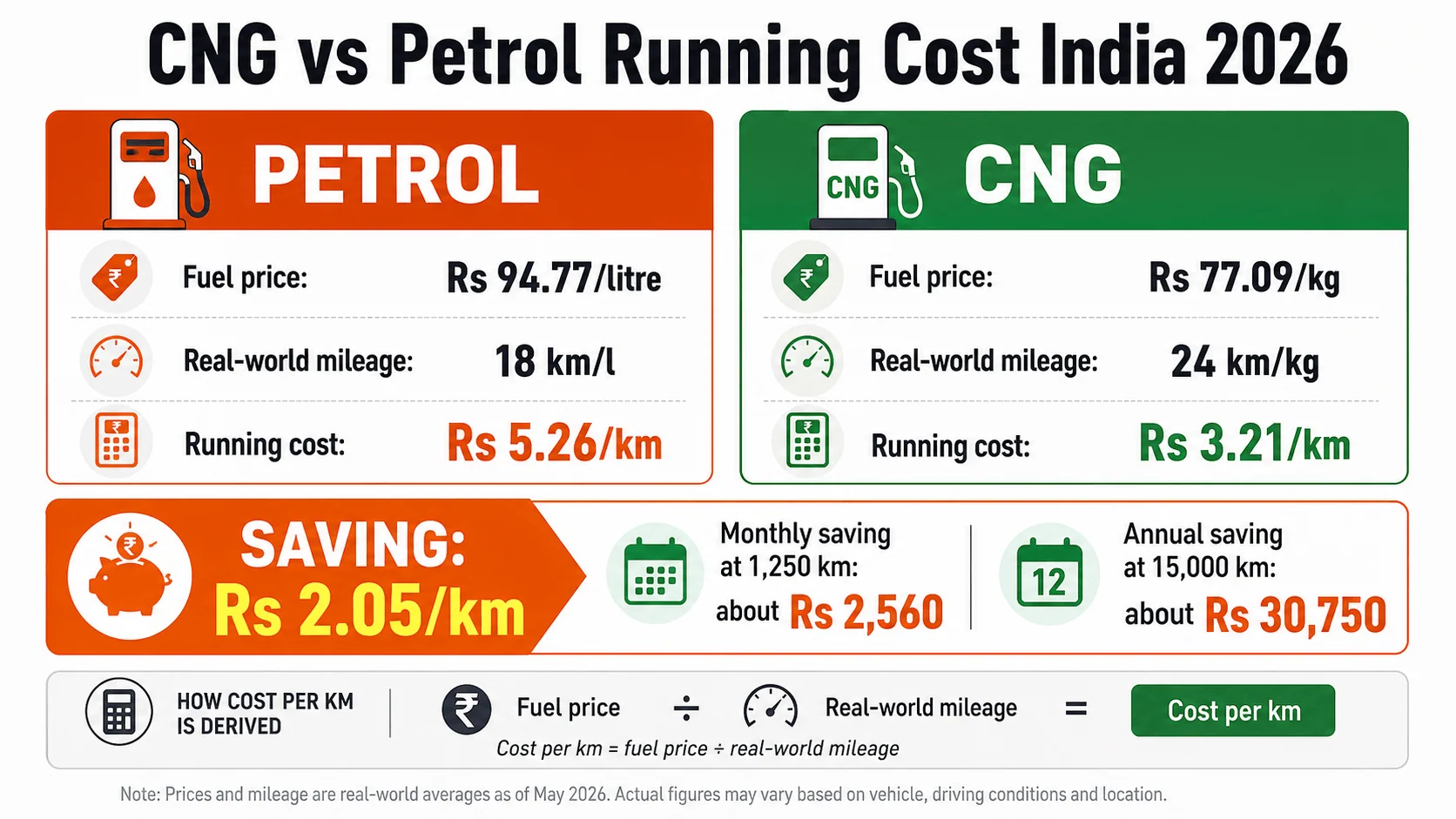
This is the single reason most of you are considering CNG in the first place. Look at the math, using May 2026 Delhi prices:
| Fuel | Pump price | Real-world mileage | Cost per km |
|---|---|---|---|
| Petrol | ₹94.77/litre | 18 km/l | ₹5.26/km |
| CNG | ₹77.09/kg | 24 km/kg | ₹3.21/km |
That’s a direct saving of ₹2.05 per kilometre. Drive 1,250 km a month and you save about ₹2,560. Push that to 2,000 km and the saving climbs to ₹4,100. Over a year at 15,000 km, you’re looking at roughly ₹30,750 in fuel savings alone.
ARAI lab figures for hatchbacks like the WagonR and Celerio go up to 32–34 km/kg. Real-world numbers in Indian traffic with the AC running come in closer to 22–26 km/kg for hatches and 17–19 km/kg for compact SUVs like the Brezza CNG and Nexon iCNG.
2. Better Real-World Mileage Than Petrol
CNG burns leaner. A typical hatchback that returns 18 km/l on petrol will give you 22–26 km/kg on CNG. Useful margin. The mileage advantage holds even in city traffic, which is exactly where most CNG buyers spend their kilometres. CNG burns leaner. The mileage advantage holds even in city traffic, which is exactly where most CNG buyers spend their kilometres.
3. State-Level Road Tax Discounts
Several states actively reward you for choosing CNG at the registration counter. Your savings aren’t trivial.
Maharashtra runs a steeply progressive structure. Road tax is 11% on petrol cars under ₹10 lakh, 13% on diesel, and just 7% on factory-fitted CNG. On a ₹9 lakh ex-showroom car, that 4% gap saves you about ₹36,000 upfront. Almost half the CNG variant’s price premium recovered before you’ve even left the showroom.
Haryana offers a flat 20% rebate on the prevailing road tax rate for CNG models. Several other states have smaller concessions. Check your local RTO before booking.
For full state-wise details, see our RTO road tax by state guide.
4. Cleaner Combustion, Cleaner Engine Internals
This one surprises buyers because the popular myth runs the other way. CNG enters the combustion chamber as a dry, homogeneous gas. Unlike petrol, it doesn’t wash unvaporised liquid droplets across the cylinder walls during cold starts (the “cylinder wash” problem). Almost no carbon soot. Your spark plugs stay cleaner for longer, and your engine oil holds its viscosity well past the standard service interval.
If the manufacturer has properly engineered the engine for CNG with hardened valve seats, the bottom end of a factory CNG engine can theoretically outlast a strictly petrol equivalent. That’s a big “if.”
5. Lower Tailpipe Emissions
CNG combustion produces near-zero particulate matter and virtually no sulphur emissions. NOx and CO2 outputs are meaningfully lower than petrol or diesel. Why does this matter? Because in a city like Delhi or Bengaluru where AQI numbers haunt every winter, you’re picking the fuel that puts less of that grey haze into the air your kids breathe.
6. Resale Value Has Quietly Inverted
For years, CNG cars carried a stigma in the used market. Most second-hand CNGs were ex-fleet taxis with tired engines. The story has flipped in 2026. Diesel is facing 10-year bans in NCR and stricter taxation in several metros. So if you maintain your factory CNG car well, you’ll see it hold value as well as the petrol sibling in three-year-old listings, sometimes better. The WagonR CNG, Dzire CNG, Ertiga CNG, and Brezza CNG specifically command strong resale demand in metro used-car markets. If the pros win you over, our guide to the CNG cars on sale in India lists every factory-fitted option.
7. Bi-Fuel Safety Net
Every factory CNG car in India is bi-fuel by design. The petrol tank stays. The petrol injection system stays. If you run out of CNG on a highway, the ECU silently switches you over to petrol without a hiccup. You’ll never be stranded for fuel as long as one of the two tanks has something in it. Most cars are programmed to start on petrol every time anyway, to make sure the engine gets proper lubrication before switching to gas.
8. Factory CNG Kits Are Genuinely Safe
The hysteria around CNG cylinders exploding? It belongs to old, badly installed aftermarket kits. Modern factory cylinders go through crash testing and metallurgical certification. They sit on reinforced suspension. You also get automated leak-detection sensors and automatic shut-off valves built in. The high-tension steel cylinders are considerably thicker than a standard plastic petrol tank.
CNG Car Disadvantages
Now the honest part. Most articles online tiptoe around these because dealers don’t want you reading them before you sign. We’re going to spell them out clearly so you can decide with both eyes open.
1. Power Loss of 10–15% in CNG Mode
This is the disadvantage owners feel every single day. CNG is a gas, so it physically displaces oxygen in the cylinder, cutting volumetric efficiency. The result? Factory-fitted CNG cars typically experience an 8% to 15% drop in horsepower and torque the moment they switch from petrol to gas.
A real example. The 2026 Maruti Brezza puts out 101 hp and 137 Nm of torque on petrol. On CNG, those numbers fall to 88 hp and 122 Nm. In city traffic at 30–40 km/h you’ll barely notice. On a single-lane state highway when you’re trying to overtake a truck, the gap shows up immediately. On a steep gradient with four people and luggage, the engine struggles for breath.
Most CNG owners on long highway drives end up manually toggling back to petrol mode for overtakes and inclines. The exception is turbocharged CNG models like the Tata Nexon iCNG (1.2L turbo, 170 Nm), where forced induction masks much of the volumetric loss.
2. Severe Boot Space Compromise
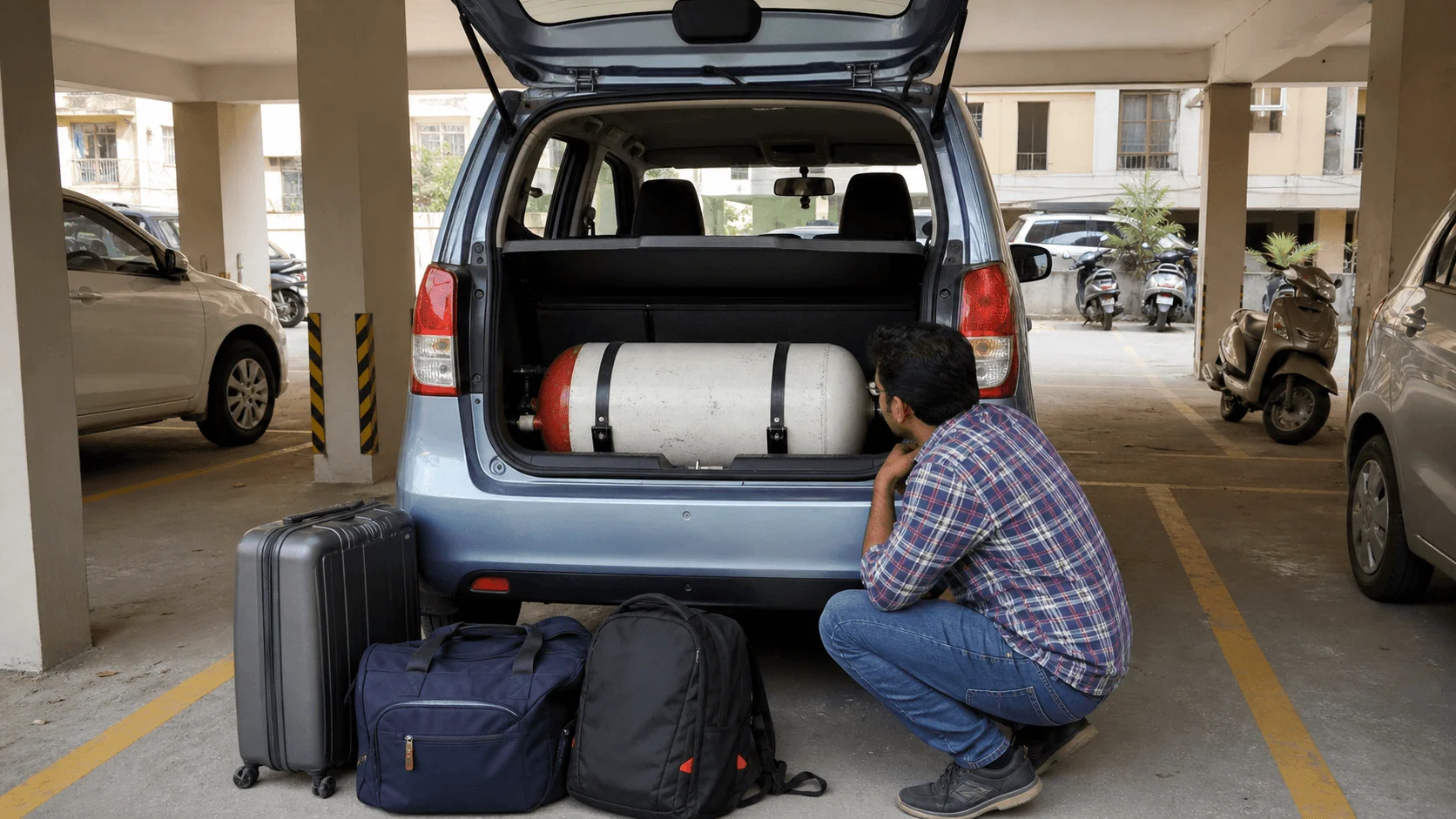
A traditional 60-litre water-capacity CNG cylinder takes up 60–70% of a hatchback’s boot. Try fitting an airport suitcase plus a cabin bag plus a kid’s school backpack. You can’t.
Tata Motors has partly solved this with twin-cylinder packaging. Two smaller cylinders tucked under the boot floor instead of one big one in the boot. The Nexon iCNG keeps 321 litres of usable boot space and the Punch iCNG keeps 210 litres. The Altroz iCNG uses the same layout. Maruti and Hyundai are still on single-cylinder designs across most of their lineup.
Tata’s clever packaging has a hidden cost though. The spare wheel gets relegated to an exterior underbody mount, like an old ladder-frame SUV. Changing a flat on a rainy night means crawling under the rear bumper with a winch tool. Several lower-spec variants have removed the spare entirely and replaced it with a puncture repair kit, which is useless against a sidewall tear.
3. Refuelling Friction Is the Real Daily Pain
India had 8,600+ CNG stations by early 2026. Sounds like a lot, doesn’t it? It isn’t enough for the user pattern.
You’re sharing those pumps with thousands of auto-rickshaws, city taxis, light commercial vehicles, and the occasional fleet sedan. In Delhi, Mumbai, Pune, Ahmedabad, and Surat, queues during morning and evening rush hours routinely run 20 to 40 minutes per fill. Safety regulations require all passengers to step out of the car during high-pressure fueling. So a family with a sleeping toddler or an elderly parent has to wake everyone up and stand outside in the heat or rain every three to four days.
Outside metros and along most highways, CNG stations are still sparse. A 600 km Delhi–Jaipur–Ajmer round trip on CNG involves planning your fuel stops the way you plan an EV road trip.
4. Real Range Is Just 190–220 km Per Fill
A 60-litre tank should hold roughly 12–14 kg of CNG by water capacity. In practice, due to dispensing pressure limits and ambient heat in the cylinder, you rarely get more than 8–9 kg per fill. At 24 km/kg real-world efficiency, that’s a working range of 190–220 km. A high-mileage commuter doing 60 km a day is back at the pump every three to four days.
Cold mornings actually let the dispenser push slightly more gas in than hot afternoons, because cold gas is denser. Owners notice this. Your tank “reads fuller” after a winter morning fill than a summer noon fill.
5. NVH Is Noticeably Worse
Noise, Vibration, and Harshness levels in CNG variants are measurably worse than the same petrol car. The high-pressure regulator, the gas lines running under the body, the altered combustion characteristics. All of it introduces structure-borne vibrations into the cabin.
Owners of the Tata Tiago CNG and Punch iCNG specifically report:
- Steering wheel buzz at idle
- Audible engine drone during cold starts
- Gear lever vibration in stop-and-go traffic
- Engine “screaming” or “gasping” sound under hard acceleration
Upgrading from a petrol car at the ₹10–12 lakh mark and expecting a refined cabin? The CNG variant will feel like a step backwards.
6. Higher Insurance Premiums and Mandatory RTO Endorsement
Adding the CNG kit changes the insurance equation in three ways:
- Your IDV (Insured Declared Value) goes up by ₹30,000 to ₹50,000 because the kit itself gets insured.
- The own-damage premium on your policy rises by 10–15% annually because the CNG kit increases actuarial risk.
- The kit must be legally endorsed on the RC by your RTO. Endorsement fees range from ₹1,000 to ₹3,000, plus an insurance endorsement fee.
That last one matters more than people realise. If your RC isn’t endorsed for CNG and you have an accident, even a simple rear-end collision with no fire or kit damage, your insurer can legally repudiate the entire claim. Get the RC endorsed the moment you take delivery, before the car leaves the showroom if possible.
7. Stricter, Costlier Maintenance Schedule
CNG burns about 80°C hotter than petrol in the combustion chamber. That heat targets the valve seats and forces tighter service intervals:
- Air filter: Clean every 5,000 km, replace every 10,000 km
- Spark plugs: Replace every 15,000–20,000 km (CNG needs a hotter spark)
- Reducer system cartridge: Replace every 20,000 km
- Low-pressure filter: Replace every 40,000 km
- Cylinder hydro-test: Mandatory every 3 years at a PESO-authorised facility, ₹500–₹1,000 per test plus a half-day of vehicle downtime
Skip the hydro test and your cylinder is illegal to refill. Plus your insurance is automatically void.
8. Upfront Premium of ₹80,000 to ₹1,00,000
Factory-fitted CNG variants demand ₹80,000–₹1,00,000 over the equivalent petrol model. You’re paying for the high-pressure cylinder, the reinforced rear suspension, the dual-mapped ECU, and the upgraded valve seat metallurgy. State tax rebates claw some of this back in Maharashtra and Haryana. But the gap is still real, and you only pay it off through the kilometres you actually drive.
Pros vs Cons at a Glance
| Pros | Cons |
|---|---|
| ₹2.05/km cheaper than petrol | 10–15% power and torque loss in CNG mode |
| 22–26 km/kg real-world hatchback mileage | 60–70% boot space lost on single-cylinder models |
| Lower road tax in MH, HR, and other states | 20–40 minute refuelling queues in metros |
| Cleaner combustion, longer engine oil life | Real range only 190–220 km per fill |
| Near-zero PM and lower NOx/CO2 emissions | Noticeably more cabin vibration and engine drone |
| Strong resale demand for factory CNG cars | Insurance premium up 10–15%, mandatory RTO endorsement |
| Bi-fuel: never stranded, ECU auto-switches | Stricter service intervals, mandatory 3-year hydro test |
| Factory kits are crash-tested and safe | ₹80,000–₹1,00,000 upfront premium over petrol |
Who Should Buy a CNG Car?
CNG isn’t a universally good or bad choice. It’s a specialised tool for a specific user. Do you fit one of these profiles? Then the math works in your favour.
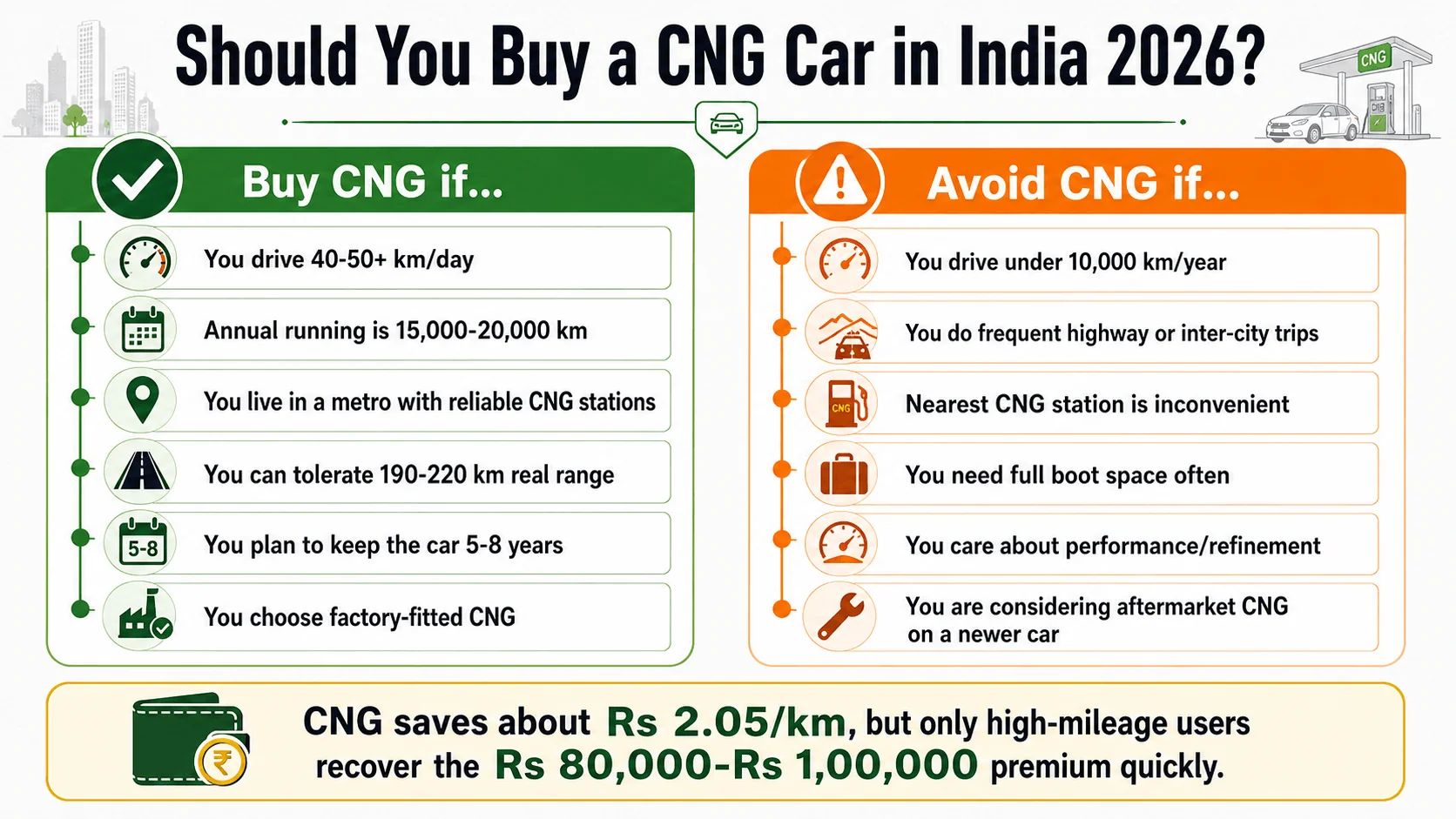
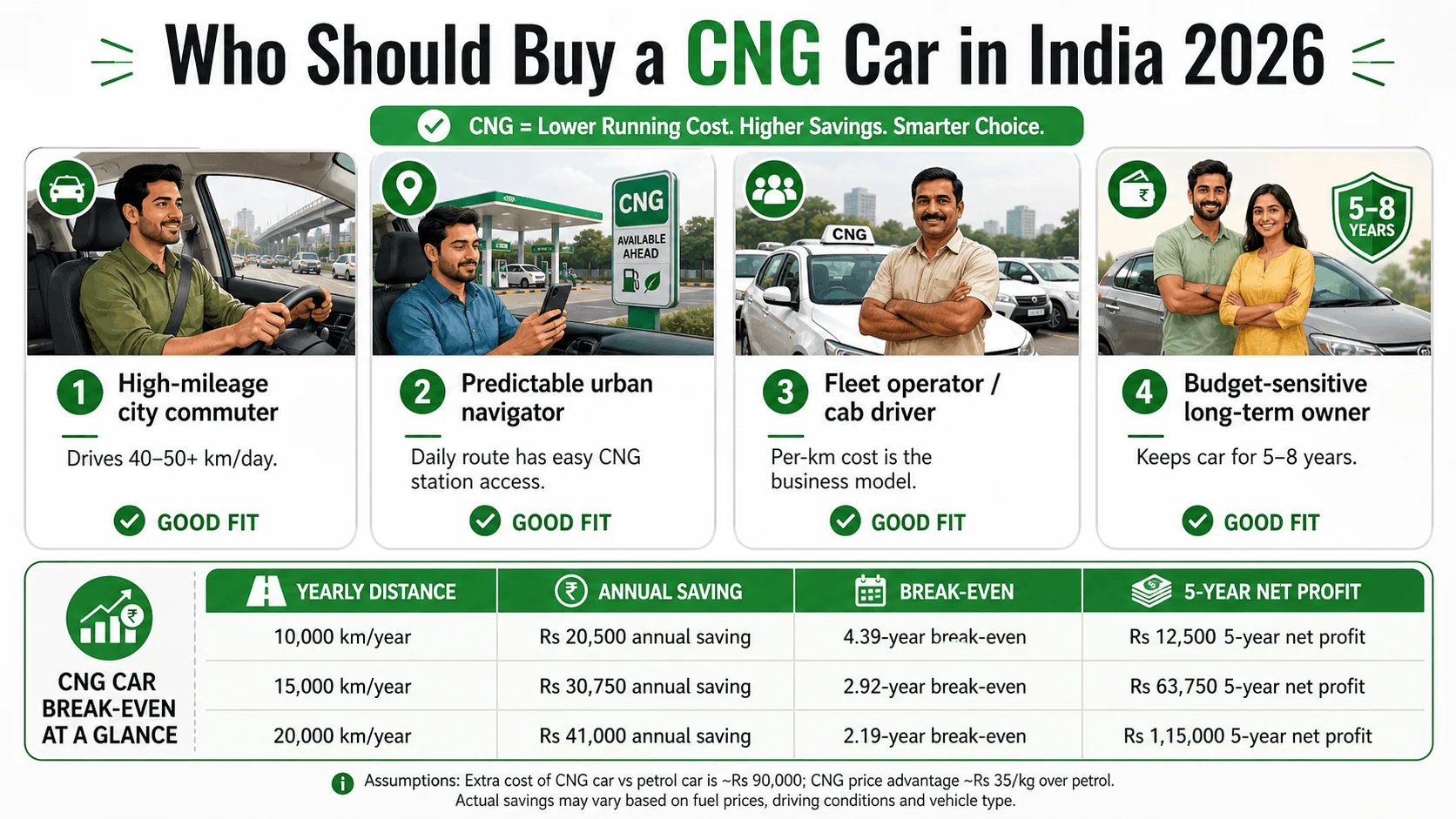
The High-Mileage City Commuter (40+ km/day)
Doing more than 40–50 km daily? Long office commute, school drop-and-pickup, two grocery runs a week, the odd weekend trip into town. The upfront premium evaporates fast. By year three, your daily savings have compounded into pure, ongoing profit that just keeps adding up every month for the rest of the time you own the car.
Your daily route passes a reliable CNG station at a sensible time of day. You don’t have to detour into traffic to refuel. You can fill up while you grab a coffee. The friction that breaks most CNG ownership simply doesn’t apply to you.
Fleet Operators and Cab Drivers
For commercial use, CNG is non-negotiable. Why? Because per-kilometre cost is the entire business model when you’re driving for a living, and every paisa you save per kilometre lands directly in net profit. This is why every Ola or Uber operator in NCR you ride with runs CNG.
Budget-Sensitive Long-Term Owners (5–8 Year Horizon)
Planning to keep the car for five to eight years? You’ll absorb the upfront premium across enough kilometres to make it irrelevant, and benefit from the now-strong secondary market resale. The full financial value of a factory CNG only shows up over a long ownership tail.
The Break-Even Math, Made Simple
Assume a ₹90,000 premium and ₹2.05/km savings:
| Annual mileage | Annual fuel savings | Break-even time | 5-year net profit |
|---|---|---|---|
| 10,000 km | ₹20,500 | 4.39 years | ₹12,500 |
| 15,000 km | ₹30,750 | 2.92 years | ₹63,750 |
| 20,000 km | ₹41,000 | 2.19 years | ₹1,15,000 |
Below 10,000 km a year? You’re paying ₹90,000 upfront for a 5-year payback that gets eaten by higher insurance and maintenance costs anyway. Don’t do it.
Who Should Avoid CNG?
Do you see yourself in any of the profiles below? Then CNG is a financial and lifestyle mistake for you, however attractive the per-litre signage looks.
Low-Usage Buyers (Under 800 km/Month)
Driving less than 10,000 km a year? The break-even runs past four years. Add inflation, factor in higher insurance, throw in stricter maintenance, and your slim profit margin disappears entirely. Stick with petrol.
Highway and Inter-City Drivers
Regularly driving Delhi–Manali, Mumbai–Goa, Bengaluru–Coorg type routes? The 200 km range and the dependence on hard-to-find highway CNG stations turn every trip into a logistics exercise. Range anxiety is real.
Performance-Oriented Drivers
If you actually enjoy driving, the 10–15% power loss, the engine drone, the sluggish overtakes will frustrate you within a month. Premium hatchbacks like the Hyundai i20 or Maruti Baleno feel meaningfully duller in CNG mode.
Utility-Focused Families
Buyers who regularly need full hatchback boot capacity (large groceries, prams, monthly Costco-style hauls, regular airport drops) will find the spatial compromise unacceptable. The Tata twin-cylinder cars are the exception, but lose spare wheel access in the bargain.
Premium Car Buyers (₹12 Lakh and Above)
Anyone spending ₹12–15 lakh expects a certain refinement. Quiet idle. Smooth throttle. Refined cabin. CNG actively undermines all three. The vibration through the steering and the “gasping” engine note in the Hyundai Aura CNG and Maruti XL6 CNG variants get old fast at this price point.
Apartment Dwellers Without Easy CNG Access
If your nearest CNG station is 8 km away through traffic and you have to go out of your way every refuel, the time cost alone wipes out the fuel savings.
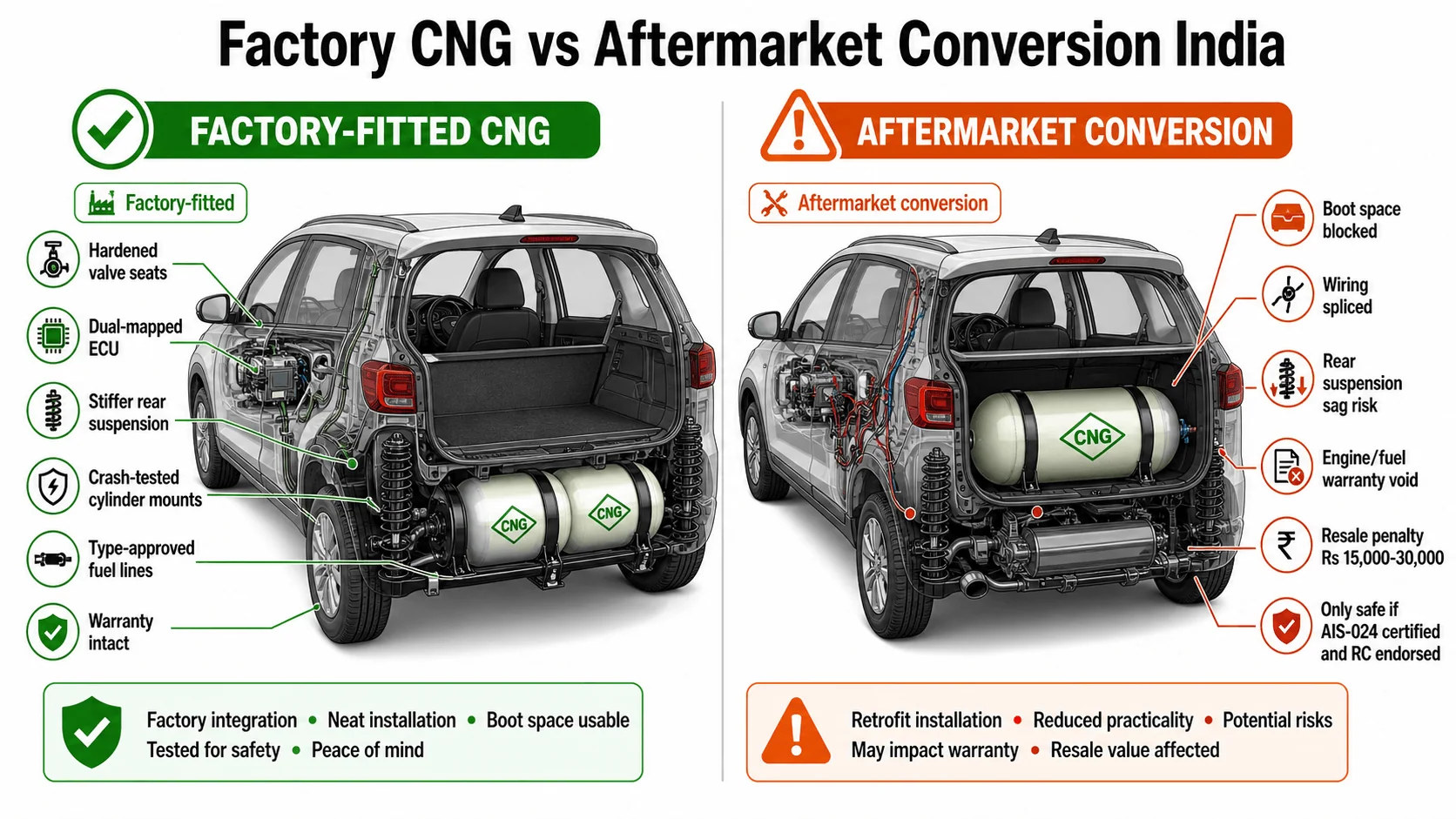
Factory-Fitted vs Aftermarket CNG: Why It’s Not Even a Debate
A common mistake? Buying a petrol variant and getting an aftermarket CNG kit fitted later for ₹40,000–₹60,000. On paper it looks like you’re saving ₹40,000 versus the factory premium. In practice, you’re walking into a much worse deal.
Engineering Integration
Factory CNG isn’t a cylinder bolted into the boot of a petrol car. The whole car gets re-engineered:
- High-Speed Steel valve seats in the cylinder head, designed for CNG’s hotter combustion
- Dual-mapped ECU that optimises ignition timing separately for petrol and gas modes
- Stiffer rear springs and dampers to handle the permanent 100–120 kg cylinder payload
- Crash-tested cylinder mounts that survive Indian NCAP impact testing
- Type-approved fuel lines that meet AIS-024 safety standards
Aftermarket installers ignore most of this. They drop a cylinder into your boot, splice the wiring loom (often badly), and send you on your way. Within 18 months you’ll see rear suspension sag, valve seat micro-welding, and intermittent ECU faults.
Warranty Implications
Installing an aftermarket CNG kit on a vehicle still under its manufacturer warranty (typically 2–3 years or 80,000–1,00,000 km) instantly and permanently voids the engine and fuel system warranty at every major OEM. That includes Maruti Suzuki, Hyundai, Tata, Mahindra, Honda, Toyota, and Kia.
If a botched aftermarket install causes a sensor failure, an engine fire, or a fuel pump issue, you pay the entire repair bill yourself. We’ve seen workshop bills of ₹80,000–₹1,50,000 for fires traced back to spliced wiring on aftermarket conversions.
Resale Penalty
The used market in 2026 actively penalises aftermarket conversions. A factory CNG WagonR holds resale parity with petrol. An aftermarket-converted petrol WagonR drops in value by an additional ₹15,000–₹30,000. Buyers are wary, dealers downgrade the listing, finance companies price the loan higher.
When Aftermarket Actually Makes Sense
Three narrow scenarios:
- The vehicle is well outside its factory warranty (5+ years old).
- It’s a simple, older naturally aspirated engine (older 1.0L or 1.2L K-series engines, for example) that’s mechanically forgiving.
- You use a government-certified installer with an AIS-024 compliant sequential kit from a reputable brand (Lovato, BRC, or Tomasetto Achille), and you immediately update the RC at the RTO.
Can’t tick all three? Walk away.
Best-Selling Factory CNG Cars in India 2026
Based on FY26 sales data, the cars Indians are actually buying with factory CNG:
- Maruti Suzuki Ertiga CNG with 1,45,480 units sold. The seven-seater MPV that owns the family-and-Uber-fleet market.
- Maruti Suzuki Dzire CNG with 1,35,330 units. India’s default sub-compact sedan.
- Maruti Suzuki WagonR CNG with 96,381 units. Tall-boy hatchback, built for city.
- Maruti Suzuki Brezza CNG with 71,329 units. The first compact SUV with factory CNG.
- Tata Nexon iCNG with 69,168 units. Turbo petrol and Tata’s twin-cylinder packaging.
- Tata Punch iCNG with 67,468 units. Micro-SUV with the same twin-cylinder design.
- Maruti Suzuki Eeco CNG with 66,675 units. Almost entirely commercial demand.
- Hyundai Aura CNG with 62,612 units. The only non-Maruti, non-Tata sedan in serious volume.
- Maruti Suzuki Fronx CNG, the newest CNG launch in the Maruti coupe-SUV lineup.
- Tata Altroz iCNG, the only premium hatchback running twin-cylinder packaging.
Check the manufacturer websites or our future best-CNG-cars roundup for current prices and variant-wise mileage figures.
FAQs
Is CNG safe for cars?
Yes, factory-fitted CNG systems are exceptionally safe. Modern automotive cylinders go through rigorous metallurgical and crash testing. They include automated leak-detection sensors and automatic shut-off valves. The high-tension steel cylinders are considerably thicker than a standard plastic petrol tank. Safety becomes genuinely compromised only when you rely on uncertified, poorly installed aftermarket kits.
Does CNG damage the engine?
Not in a properly engineered factory CNG car. Manufacturers like Maruti (S-CNG), Tata (iCNG), and Hyundai install hardened High-Speed Steel valve seats specifically designed to handle CNG’s 80°C-higher combustion temperatures. Under normal maintenance, valve wear is minimal and the engine often lasts as long as or longer than the petrol equivalent. Where engines do get damaged is when an aftermarket kit gets installed on a petrol engine that wasn’t built for CNG. That’s where you see accelerated valve seat erosion and micro-welding.
Is CNG car resale value good or bad in 2026?
Good, with one important condition. It must be factory-fitted. Three-year-old factory CNG models like the WagonR CNG, Dzire CNG, Ertiga CNG, and Brezza CNG now retain value as well as their petrol siblings, and sometimes better, because diesel is being squeezed out of metro markets. Aftermarket-converted CNG cars, on the other hand, take a ₹15,000–₹30,000 hit on resale value compared to a clean petrol car of the same model and age.
How much can I actually save with CNG annually?
At Delhi 2026 prices (CNG ₹77.09/kg, petrol ₹94.77/L), a driver covering 15,000 km a year saves roughly ₹30,750 in direct fuel costs. At 20,000 km a year, the saving rises to about ₹41,000. Below 10,000 km a year, the saving (₹20,500) gets offset by higher insurance and maintenance costs.
Can a CNG car run only on petrol if needed?
Yes. Every CNG car sold in India is bi-fuel. The petrol tank, fuel pump, injectors, and ECU mapping for petrol all stay. If your CNG cylinder runs empty, the ECU auto-switches you to petrol with no driver input needed. In fact, most cars start on petrol every time and only switch to CNG once the engine is warm, which protects the engine from cold-start wear.
What’s the real-world mileage of CNG cars in India?
ARAI test figures claim 32–34 km/kg for compact hatchbacks like the WagonR and Celerio. Real-world city driving with traffic and AC running drops that to roughly 22–26 km/kg for hatchbacks and 17–19 km/kg for compact SUVs like the Brezza CNG and Nexon iCNG.
Is CNG good for highway driving?
No, CNG is sub-optimal for serious highway use. The 190–220 km real-world range means frequent stops on long drives, and high-pressure CNG stations are sparse on most national highways outside the NCR–Mumbai–Pune corridor. The 10–15% power deficit also makes overtakes harder. Many owners manually switch to petrol mode the moment they hit the highway.
What does cylinder hydro-testing involve?
Every three years, government regulations under PESO require the high-pressure cylinder to be removed, visually inspected and pressure-tested for metal fatigue at an authorised facility. Cost is typically ₹500–₹1,000 plus a half-day of vehicle downtime. Skip it and the cylinder is illegal to refill, and your insurance is automatically void.
Yes. Adding a CNG kit raises your IDV by ₹30,000–₹50,000 (the kit gets insured) and the own-damage premium goes up by 10–15% annually. Plus a one-time RTO endorsement fee of ₹1,000–₹3,000. Critically, if you don’t get the RC endorsed for CNG, your insurer can repudiate any claim, including ones unrelated to the CNG system.
How long does it take to refuel a CNG car?
The dispensing itself takes 3–5 minutes. Your real time killer is the queue. In metro CNG stations during peak hours, your total time can run 20–40 minutes per fill. In smaller cities and off-peak hours, you can be in and out in 10 minutes total.
Should I buy a CNG car or wait for an EV?
If your daily run is under 100 km, you live in a metro, and you can install a home charger, an EV is the better long-term play. If you need 800+ km on tap, drive long distances, or live somewhere with weak EV charging infrastructure, a factory CNG car is the more pragmatic 2026 choice. The decision often comes down to where you live and how patient you are with charging infrastructure roll-out.
The Honest Verdict
CNG in 2026 is a brilliant, financially logical, technically mature choice for the right person. For a Delhi commuter doing 60 km a day, picking a Tata Nexon iCNG or Maruti Dzire CNG is one of the smartest financial decisions in the entire passenger car market. The break-even comes inside three years. The resale is solid. The running cost saving is genuine pure profit thereafter.
For a low-mileage weekend driver, a highway tourer, an enthusiast who wants a refined cabin, anyone in a city with thin CNG infrastructure? It’s an actively bad choice. The premium doesn’t pay off. The daily friction wears you down. The spatial and performance compromises will quietly poison the ownership experience.
Calculate your honest annual mileage. Map your daily route against the nearest CNG stations on Google Maps. Sit in the car you’re considering, in CNG mode, in real traffic, for an hour. Then decide.