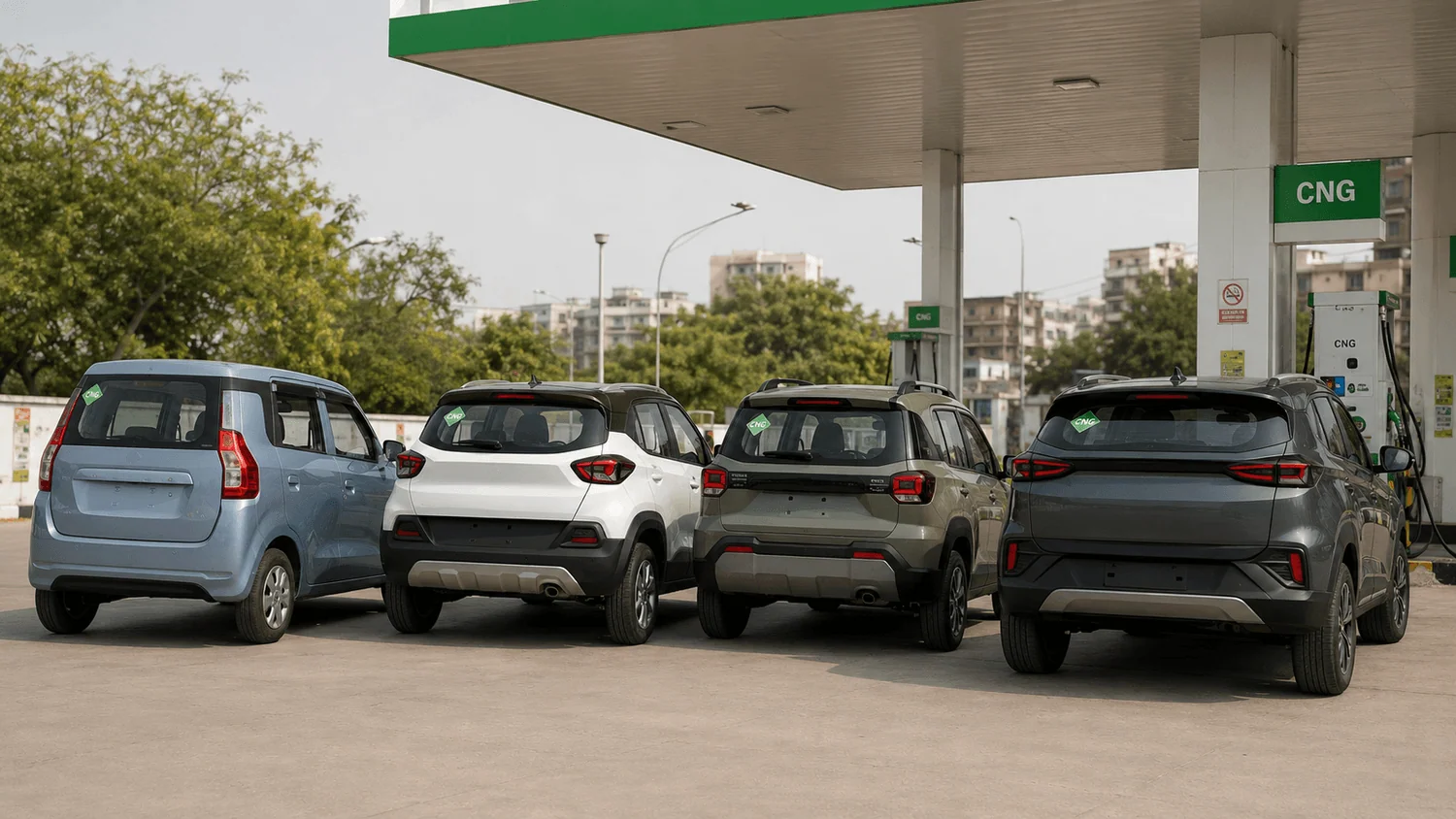
CNG vehicles just crossed a historic milestone in India. In FY2026, factory-fitted CNG cars overtook diesel as the preferred alternative fuel, capturing nearly 22% of all passenger vehicle sales with over 10 lakh units sold. That’s not a fad. With petrol hovering between ₹94 and ₹107 per litre across metros, and CNG networks now blanketing more than 600 cities, the question has shifted. It’s no longer “should I buy a CNG car?” It’s “which CNG car fits my city, my boot, and my budget?”
This guide is the answer.
Quick Snapshot: Top 10 Factory-Fitted CNG Cars in India 2026
Got a minute? Here’s the shortlist. Prices are ex-showroom starting figures as of May 2026, and real-world mileage is owner-reported.
| Rank | Model | Brand | Starting Price | Real-World Mileage | Best For |
|---|---|---|---|---|---|
| 1 | Maruti Wagon R CNG | Maruti Suzuki | ₹6.75 lakh | 24–26 km/kg | Budget city commuters |
| 2 | Maruti Celerio CNG | Maruti Suzuki | ₹6.65 lakh | 27–28 km/kg | Lowest running cost |
| 3 | Tata Punch iCNG | Tata Motors | ₹7.55 lakh | 20–22 km/kg | Safety-focused families |
| 4 | Hyundai Exter Hy-CNG Duo | Hyundai | ₹8.50 lakh | 24–27 km/kg | Premium city buyers |
| 5 | Tata Altroz iCNG | Tata Motors | ₹8.70 lakh | 23–24 km/kg | Premium hatch with usable boot |
| 6 | Maruti Dzire CNG | Maruti Suzuki | ₹8.03 lakh | 24–26 km/kg | Taxi, fleet, sedan users |
| 7 | Maruti Fronx CNG | Maruti Suzuki | ₹8.42 lakh | 20–22 km/kg | Stylish crossover commuters |
| 8 | Maruti Ertiga CNG | Maruti Suzuki | ₹10.76 lakh | 18–20 km/kg | Large families, fleet operators |
| 9 | Tata Nexon iCNG | Tata Motors | ₹8.30 lakh | 14–16 km/kg | Highway-focused SUV buyers |
| 10 | Toyota Hyryder CNG | Toyota | ₹13.40 lakh | 19–21 km/kg | High-running SUV users |
The verdict in one line: pick Maruti if running cost and service reach matter most, Tata if you want a safer car with a usable boot, and Hyundai if you care about refinement and engine smoothness.
All Factory-Fitted CNG Cars in India 2026
The CNG portfolio in India has matured well beyond the old Wagon R / Alto duo. Four mainstream brands now offer factory-integrated CNG powertrains: Maruti Suzuki, Tata Motors, Hyundai, and Toyota (which sells rebadged Marutis as the Glanza, Taisor, and Rumion). Nissan and Kia currently route their CNG offerings through dealer-fitted but manufacturer-approved kits, which is a different ownership proposition.
Here’s the complete factory-fitted CNG lineup as of May 2026.
| Model | Brand | Segment | Ex-Showroom Price | ARAI Mileage | Real-World | Boot Impact |
|---|---|---|---|---|---|---|
| Alto K10 CNG | Maruti Suzuki | Entry hatch | ₹5.74–6.20 lakh | 33.85 km/kg | 22–23 km/kg | Severe (single cyl) |
| S-Presso CNG | Maruti Suzuki | Tall-boy hatch | ₹4.60–5.30 lakh | 32.73 km/kg | 21–23 km/kg | Severe |
| Celerio CNG | Maruti Suzuki | Hatchback | ₹5.98–7.10 lakh | 34.43 km/kg | 27–28 km/kg | Severe |
| Wagon R CNG | Maruti Suzuki | Family hatch | ₹6.75–7.30 lakh | 34.05 km/kg | 24–26 km/kg | Severe |
| Tiago iCNG | Tata Motors | Hatchback | ₹5.54–8.10 lakh | 26.49–28.06 km/kg | 20–22 km/kg | Moderate (twin cyl) |
| Swift CNG | Maruti Suzuki | Premium hatch | ₹7.45–8.80 lakh | 32.85 km/kg | 22–25 km/kg | Severe |
| Grand i10 Nios CNG | Hyundai | Hatchback | ₹7.59–8.56 lakh | 27.89 km/kg | 22–24 km/kg | Moderate (dual cyl) |
| Baleno CNG | Maruti Suzuki | Premium hatch | ₹8.30–9.10 lakh | 30.61 km/kg | 22–24 km/kg | Severe |
| Glanza CNG | Toyota | Premium hatch | ₹8.17–9.14 lakh | 30.61 km/kg | 22–24 km/kg | Severe |
| Altroz iCNG | Tata Motors | Premium hatch | ₹8.70–10.77 lakh | 26.20–27.80 km/kg | 23–24 km/kg | Moderate (210L) |
| Aura CNG | Hyundai | Compact sedan | ₹7.76–8.54 lakh | 28.40 km/kg | 20–22 km/kg | Severe (402→150L) |
| Dzire CNG | Maruti Suzuki | Compact sedan | ₹8.03–8.74 lakh | 33.73 km/kg | 24–26 km/kg | Moderate |
| Tigor iCNG | Tata Motors | Sedan | ₹8.30–8.90 lakh | 28.06 km/kg | 20–22 km/kg | Moderate (twin cyl) |
| Punch iCNG | Tata Motors | Micro SUV | ₹7.55–10.60 lakh | 26.99 km/kg | 20–22 km/kg | Moderate (210L) |
| Exter Hy-CNG Duo | Hyundai | Micro SUV | ₹8.50–9.41 lakh | 27.10 km/kg | 20–22 km/kg | Moderate (~225L) |
| Fronx CNG | Maruti Suzuki | Crossover | ₹8.42–11.98 lakh | 28.51 km/kg | 20–22 km/kg | Severe |
| Taisor CNG | Toyota | Crossover | ₹8.24 lakh | 22.79 km/kg | 18–20 km/kg | Severe |
| Brezza CNG | Maruti Suzuki | Compact SUV | ₹9.17–13.01 lakh | 25.51 km/kg | 18–20 km/kg | Severe |
| Nexon iCNG | Tata Motors | Compact SUV | ₹8.30–14.22 lakh | 17.44 km/kg | 14–16 km/kg | Minimal (321L) |
| Victoris CNG | Maruti Suzuki | Midsize SUV | ₹11.50–14.57 lakh | 27.02 km/kg | 19–21 km/kg | Severe |
| Hyryder CNG | Toyota | Midsize SUV | ₹13.40–15.85 lakh | 26.60 km/kg | 19–21 km/kg | Severe |
| Ertiga CNG | Maruti Suzuki | MPV | ₹10.76–11.84 lakh | 26.11 km/kg | 18–20 km/kg | Severe (rows up) |
| Rumion CNG | Toyota | MPV | ₹11.40 lakh | 26.11 km/kg | 18–20 km/kg | Severe (rows up) |
A few standouts deserve a closer look.
Maruti Suzuki Wagon R CNG
The Wagon R remains the rational default for the cost-conscious Indian buyer. Its ARAI-claimed 34.05 km/kg actually holds up in the real world. Owners report 24–26 km/kg in city traffic. The tall-boy stance makes ingress easy for parents and grandparents, and Maruti’s 6,000-plus service touchpoints mean you’re never far from help. The trade-off is honest. The single 60-litre cylinder takes the entire 341-litre boot, so you’re looking at small soft bags only. Best for high-usage city drivers and small families that rarely pack for trips.
Tata Punch iCNG
Tata changed the CNG conversation when they slid two 30-litre cylinders under the boot floor instead of one big tank behind the rear seat. The Punch iCNG keeps 210 litres of usable boot space, which is enough for a stroller, a duffel, and a few cabin bags. It also carries a 5-star Global NCAP rating, a direct-CNG start (no petrol-first), and now an optional 5-speed AMT, the first automatic in this price band on gas. The 1.2-litre naturally aspirated petrol does feel strained on highways with a full load. But if you want a safe, automatic, family-friendly CNG SUV under ₹10 lakh, this is your answer.
Hyundai Exter Hy-CNG Duo
Hyundai responded to Tata’s twin-cylinder challenge with the Exter Hy-CNG Duo in 2026. The 60-litre tank is split into two 30-litre cylinders under the boot floor, recovering roughly 225 litres of the standard 391-litre boot. The 1.2-litre Kappa 4-cylinder engine is noticeably smoother than the 3-cylinder rivals from Tata and Maruti, and you get features like an electric sunroof, an 8-inch touchscreen, and six standard airbags. The catch? Hyundai removed the spare wheel entirely to fit the twin tanks, leaving you with a puncture repair kit. That’s a real concern on Indian rural highways.
Tata Nexon iCNG
The Nexon iCNG is India’s only turbocharged factory-fitted CNG car, and it shows. The 1.2-litre Revotron turbo delivers 98 bhp and 170 Nm on gas. That’s enough to dispatch highway overtakes without the usual CNG lethargy. Twin-cylinder packaging preserves 321 litres of boot space, the spare wheel is winched under the chassis SUV-style, and you get a sophisticated 6-speed AMT option. The downside? Efficiency. 14–16 km/kg in the real world is the worst on this list. If you mostly drive long distances and refuse to compromise on power, this is your car. If you want CNG purely for fuel savings, look elsewhere.
Maruti Suzuki Ertiga CNG
The Ertiga CNG is the backbone of India’s fleet industry. With 7 seats, a real-world 18–20 km/kg, and a Maruti service badge, it makes pure financial sense for anyone moving people around. The catch is absolute. With all three rows up, the boot is fully consumed by the cylinder, leaving literally zero room for luggage. Most owners just install roof carriers. If you regularly travel with 7 people *and* luggage, look at the Carens CNG instead. If you carry people *or* luggage but rarely both at once, the Ertiga remains untouchable on cost-per-seat economics.
Maruti Suzuki Dzire CNG
The Dzire CNG is the quiet champion of the sedan segment. An ARAI-claimed 33.73 km/kg, a real-world return of 24–26 km/kg, and the new 5-star Bharat NCAP rating make this an exceptionally complete package. Yes, the single 60-litre cylinder eats into the 382-litre boot. But the sedan shape leaves enough cavity for soft bags and a couple of small cases. For private taxi operators and high-mileage commuters, the Dzire CNG is hard to beat.
CNG Cars by Price Range
Different price brackets demand different compromises. Here’s how the segments break down.
| Budget | Models Available | Best Pick | Why |
|---|---|---|---|
| Under ₹7 lakh | Alto K10, S-Presso, Celerio, Wagon R, Tiago base, Punch base | Tata Tiago iCNG | 4-star safety, twin-cylinder boot, optional AMT |
| ₹7–10 lakh | Swift, Dzire, Baleno, Glanza, Fronx, Grand i10 Nios, Aura, Exter, Altroz, Punch higher trims, Tigor | Hyundai Exter Hy-CNG Duo | Best boot-space-to-feature ratio in this band |
| ₹10–15 lakh | Brezza, Ertiga, Rumion, Nexon, Victoris, Carens | Tata Nexon iCNG | Turbocharged power + 321L boot, no CNG-lethargy |
| Above ₹15 lakh | Hyryder upper trims, Nexon top trims | Usually skip CNG | At this budget, strong-hybrid Hyryder or EVs make more sense |
Under ₹7 Lakh: Pure Utility
This bracket is about getting your first car at the absolute lowest running cost. Maruti dominates here with the Alto K10, S-Presso, and Celerio, all of which exceed 32 km/kg claimed. They aren’t safe (most carry 1- or 2-star ratings) and they aren’t luggage-friendly. But they’re honest budget transport. Our pick is the Tata Tiago iCNG because it adds a 4-star GNCAP rating, twin-cylinder boot, and an optional AMT at a comparable price.
₹7–10 Lakh: The Sweet Spot
This is where most private buyers shop, and twin-cylinder technology has transformed the segment. The Hyundai Exter Hy-CNG Duo wins on cabin features, engine smoothness, and that crucial 225-litre boot. The Tata Punch iCNG wins on chassis ruggedness, 5-star safety, and AMT availability. Sedans like the Swift and Dzire deliver phenomenal mileage but still carry the old single-cylinder boot penalty.
₹10–15 Lakh: Premium Compromises
At this price, buyers expect features, space, and performance. Traditional CNG cars struggle on all three counts. The Tata Nexon iCNG stands out because its turbo engine eliminates the CNG power deficit. The Maruti Ertiga and Toyota Rumion twins remain the gold standard for large families willing to manage the luggage problem.
Above ₹15 Lakh: Skip CNG
Above ₹15 lakh, the maths gets tricky. Strong-hybrid Hyryder, Grand Vitara hybrid, or even sub-₹20 lakh EVs (Tata Punch EV, Tata Tigor EV) deliver lower running costs without queue anxiety or boot compromise. Buy CNG at this budget only if you’re clocking 3,000-plus km a month.
Video Guide: CNG vs Petrol Running Costs and the Best CNG Cars in 2026

Running Cost: CNG vs Petrol per Km
Financial maths is the entire reason CNG exists. Let’s use real May 2026 fuel prices, not brochure mileage.
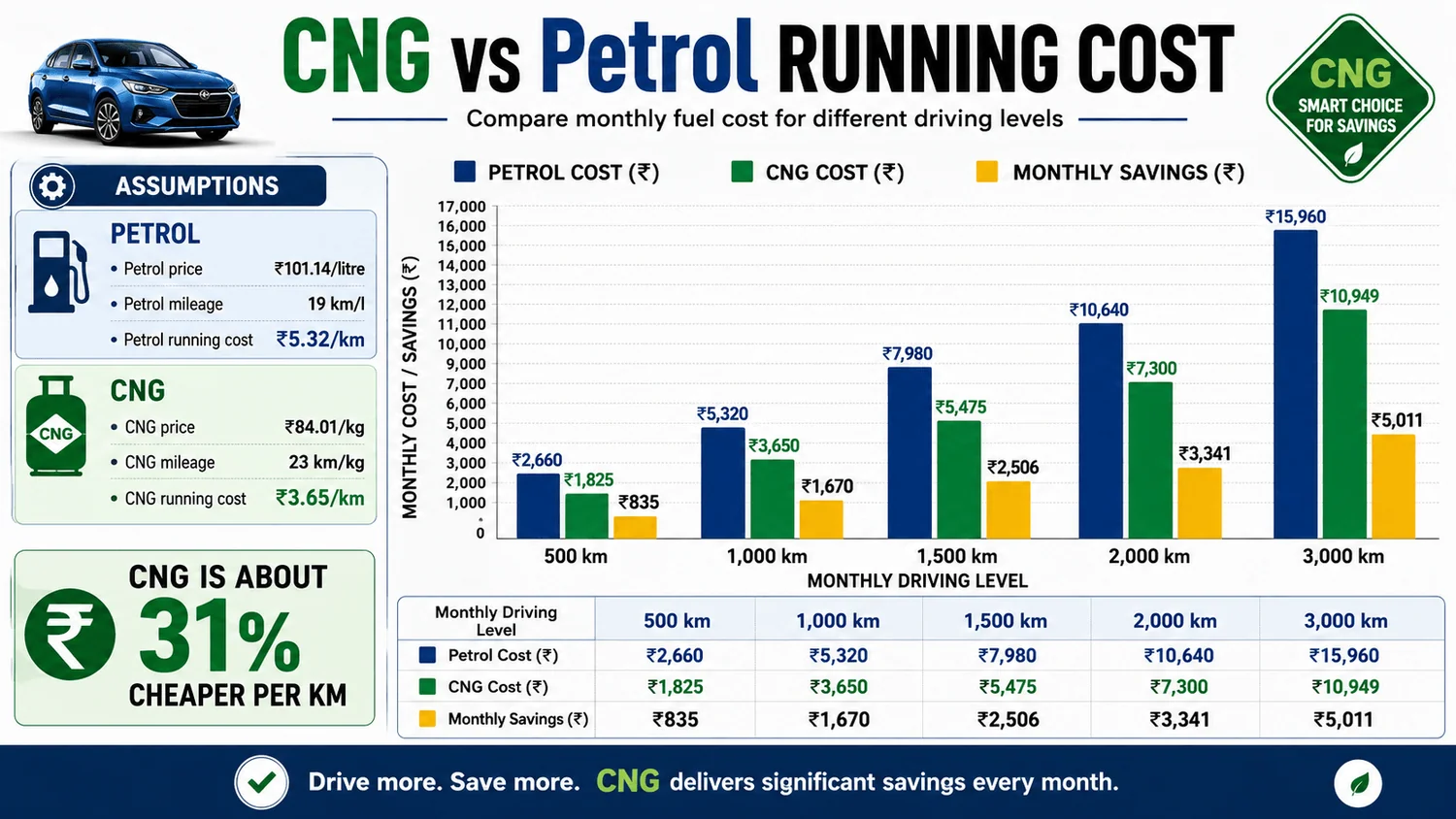
We’ve used illustrative metropolitan averages for May 14, 2026: petrol at ₹101.14 per litre (averaged across Delhi, Mumbai, Kolkata, Chennai) and CNG at ₹84.01 per kg (averaged across Delhi, Mumbai, Ahmedabad, Pune, Surat).
| Fuel Type | Price | Representative Real-World Mileage | Cost per Km |
|---|---|---|---|
| Petrol | ₹101.14 / litre | 19 km/l | ₹5.32 / km |
| CNG | ₹84.01 / kg | 23 km/kg | ₹3.65 / km |
That works out to a CNG running cost that is roughly 31% cheaper per kilometre. Across realistic monthly usage, the savings stack up fast.
| Monthly Driving | Petrol Cost | CNG Cost | Monthly Savings | Annual Savings |
|---|---|---|---|---|
| 500 km | ₹2,662 | ₹1,826 | ₹835 | ₹10,023 |
| 1,000 km | ₹5,323 | ₹3,653 | ₹1,670 | ₹20,046 |
| 1,500 km | ₹7,985 | ₹5,479 | ₹2,506 | ₹30,068 |
| 2,000 km | ₹10,646 | ₹7,305 | ₹3,341 | ₹40,091 |
| 3,000 km | ₹15,969 | ₹10,958 | ₹5,011 | ₹60,137 |
Break-Even: How Long Until CNG Pays for Itself?
Factory-fitted CNG variants typically carry a premium of ₹80,000 to ₹1 lakh over the same-spec petrol model. Use this simple rule:
CNG premium recovery period = extra price of CNG variant ÷ monthly fuel savings.
A ₹90,000 premium recovers in:
- 36 months at 1,500 km/month
- 22 months at 2,000 km/month
- 18 months at 3,000 km/month
If you drive less than 1,000 km a month, recovery stretches well beyond 4 years. And that’s before you factor in the time you’ll spend queuing at peak hours. For more detailed maths and a city-by-city calculator, see our CNG cost savings calculator.
Maintenance and Hidden Costs
CNG maintenance runs marginally higher than petrol. Spark plug replacements come around earlier (every 30,000 km versus 50,000 km for pure petrol), and CNG-specific filters need annual replacement. Across five years, you’ll spend about ₹3,000–5,000 more in scheduled service than the petrol equivalent.
Resale Value: A Quiet Win
Here’s what most guides miss. CNG resale value has flipped dramatically in 2026. With multiple state-level diesel bans and tightening BS6 norms accelerating diesel depreciation, used CNG cars now command a premium in the secondary market. A 3-year-old Dzire CNG or Wagon R CNG sells faster and at a stronger price than the same car in petrol or diesel, because secondary buyers actively seek immediate running-cost relief.
Boot Space Impact Comparison
This is the single most-skipped purchase factor. It’s also where modern CNG technology has split into two camps.
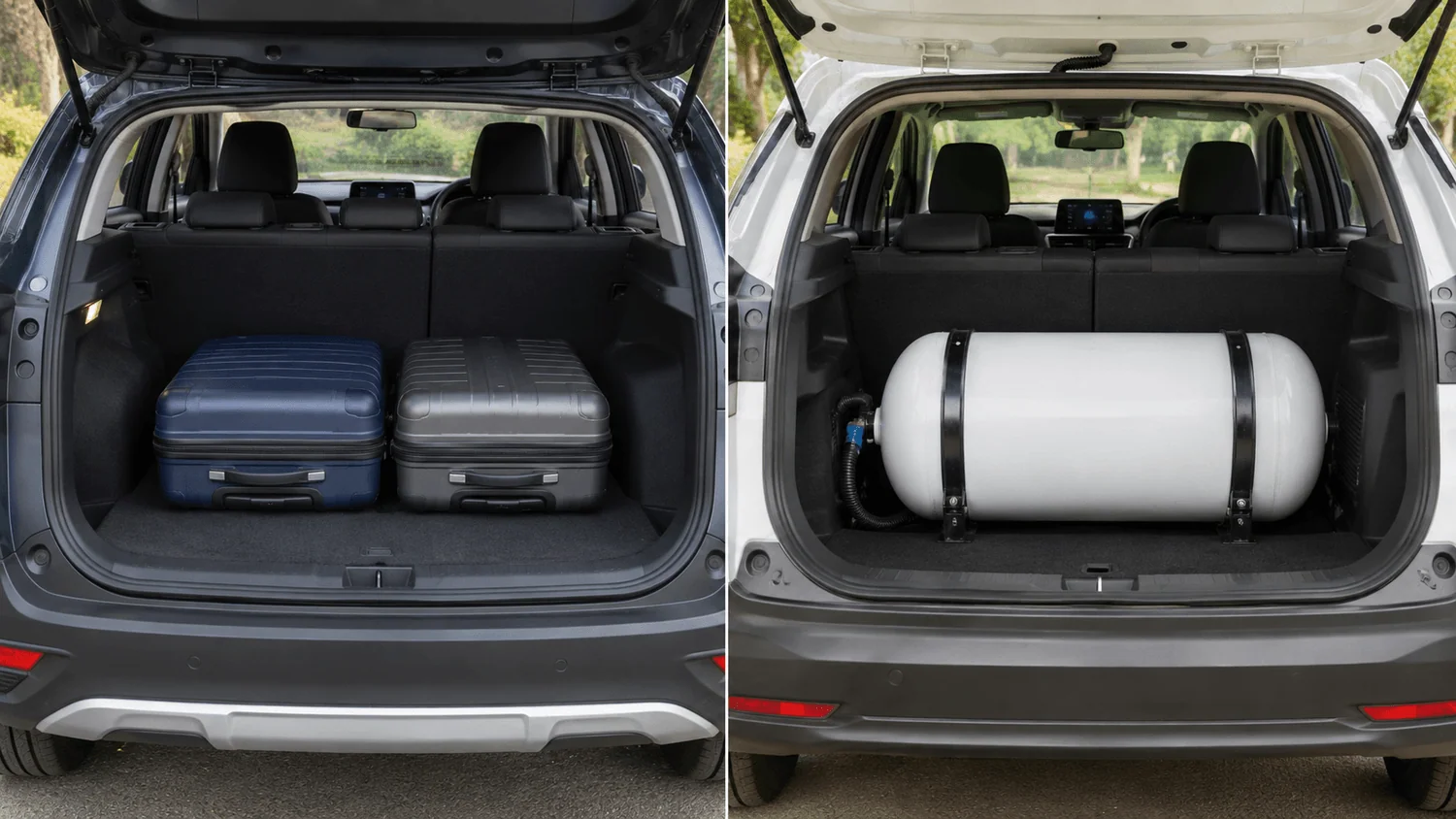
The Engineering of Twin Cylinders
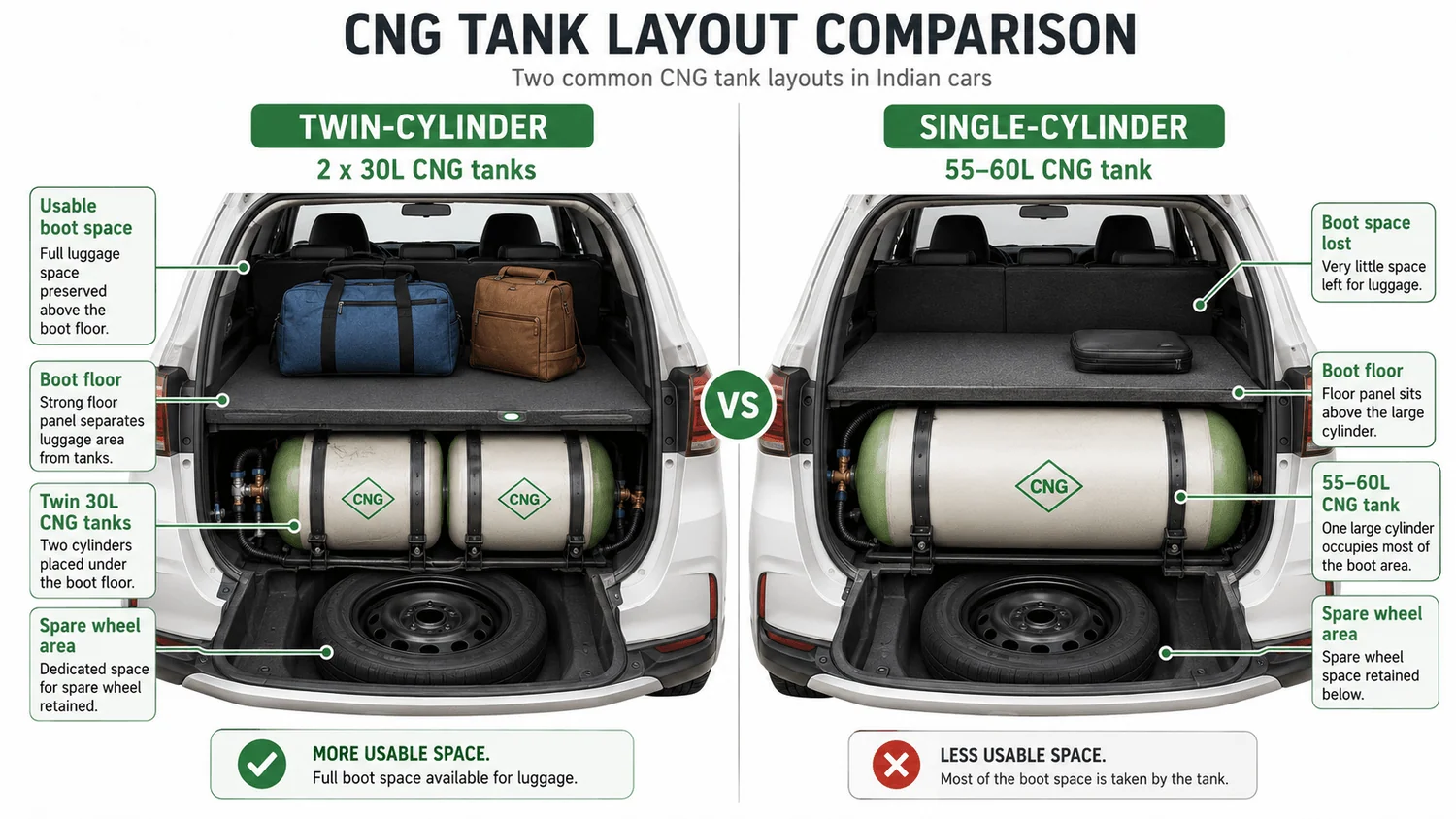
Tata Motors fundamentally altered the CNG market by splitting the conventional 60-litre cylinder into two 30-litre tanks seated inside the spare wheel well, beneath the boot floor. To make room, Tata winches the spare wheel to the underbody, similar to large SUVs. Hyundai adopted the same twin-tank approach for the 2026 Exter and Grand i10 Nios, but with a critical difference: Hyundai removed the spare wheel entirely, replacing it with a puncture repair kit. It saves weight, but it introduces real risk on India’s poorly maintained rural highways.
Practical Boot Space by Model
| Model | Petrol Boot | CNG Usable | CNG Tank Layout | Practical Verdict |
|---|---|---|---|---|
| Maruti Wagon R | 341 L | ~0 L | Single 60L | Soft bags only |
| Maruti Swift | 265 L | ~0 L | Single 60L | Daily-use only |
| Maruti Brezza | 328 L | Severely reduced | Single 55L | Daily commuting |
| Hyundai Aura | 402 L | ~150 L | Single 60L | Moderate soft luggage |
| Tata Punch iCNG | 366 L | 210 L | Twin 30L | Fits medium suitcases |
| Hyundai Exter Hy-CNG Duo | 391 L | ~225 L | Twin 30L | Two cabin bags fit |
| Tata Tigor iCNG | 419 L | Mostly retained | Twin 30L | Best CNG sedan boot |
| Tata Altroz iCNG | 345 L | ~210 L | Twin 30L | Best premium-hatch boot |
| Tata Nexon iCNG | 382 L | 321 L | Twin 30L | Uncompromised |
| Maruti Ertiga | 209 L (rows up) | 0 L (rows up) | Single 60L | Family OR luggage, not both |
Real-World Luggage Verdict
| Use Case | Single-Cylinder Cars | Twin/Dual-Cylinder Cars |
|---|---|---|
| Daily grocery run | Acceptable | Excellent |
| Office bag + laptop | Fine | Fine |
| Airport pickup (1 large + 1 cabin) | Fail | Pass |
| Family weekend trip (stroller + 2 bags) | Fail | Pass |
| Highway road trip (3 suitcases) | Fail | Pass on Nexon, Punch, Tigor, Altroz |
The honest takeaway? If you ever pack for airport runs or family vacations, single-cylinder CNG cars will frustrate you. The cheapest car here is rarely the cheapest car you can actually live with. Pay the ₹50,000–80,000 premium for a Tata iCNG or Hyundai Hy-CNG Duo, and your boot stays usable.
CNG Station Availability by City
A vehicle’s mileage is irrelevant if refuelling means a 90-minute queue. India had over 8,600 CNG stations covering 600-plus cities by mid-2026, but local density and queue patterns vary enormously. Add to that the May 2026 supply disruptions from West Asian geopolitical events, which triggered rationing and price hikes in several non-coastal metros. Where you live matters as much as which car you pick.
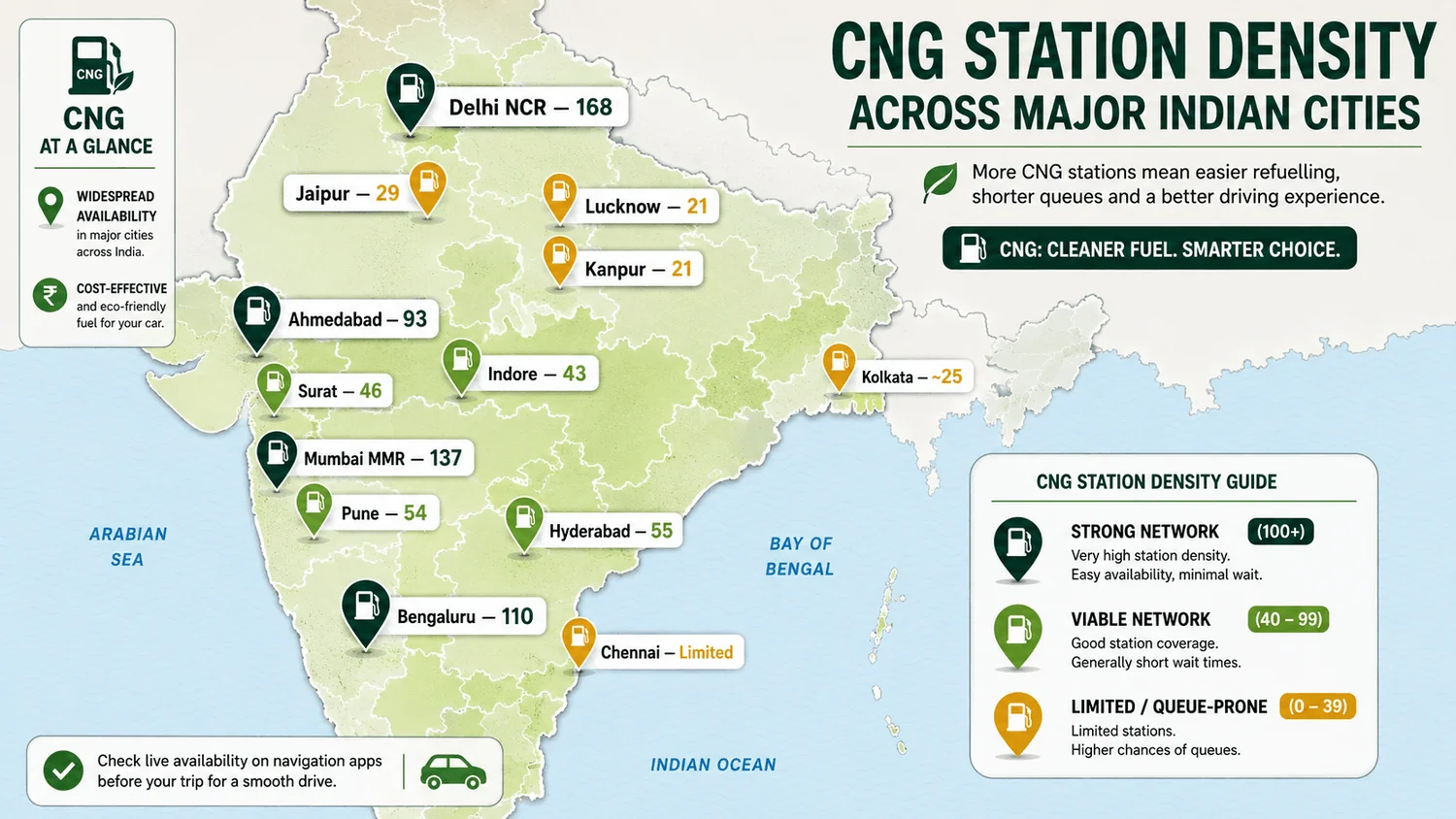
Here’s the buyer-facing verdict for the top 10 CNG cities, built from city-gas distributor data and recent local reporting.
| City | Stations (approx) | CNG Price (May 2026) | Queue Risk | Buyer Verdict |
|---|---|---|---|---|
| Delhi NCR | 168 | ₹77.09/kg | Medium–High at peaks | Best city in India for CNG ownership |
| Mumbai MMR | 137 | ₹84/kg | High | Good network, plan queues |
| Ahmedabad | 93 | ₹82.25/kg | Low–Medium | Most mature CNG market in India |
| Bengaluru | 110 | ₹90/kg | Medium | Verify route-level station presence |
| Pune | 54 | ₹92.25/kg | Medium | Works if your daily run is high |
| Hyderabad | 55 | ₹97/kg | High | Severe queues reported Q2 2026 |
| Surat | 46 | ₹82.25/kg | Low–Medium | Excellent for daily commuting |
| Indore | 43 | Varies | Medium | Viable along main corridors |
| Jaipur | 29 | Varies | Medium | Works if home/office route covers it |
| Lucknow / Kanpur | 21 each | Varies | Medium | Reliable along main highway corridors |
| Chennai | Low–Medium | Varies | High | Check station strictly on your route |
| Kolkata | ~25 | Varies | Medium–High | Possible, but less relaxed than NCR |
What to Check Before You Buy
Don’t trust a manufacturer’s “CNG network growing” line. Verify three things in the real world:
- A station within 3 km of home.
- A station within 3 km of office.
- A station on your regular weekend or highway route.
Use dedicated apps like CNGWALA, IGL Connect (Delhi), MGL Connect (Mumbai), or GAIL Gas apps (Bengaluru/Pune) instead of Google Maps. Distributor locator apps show real-time queue status and operational hours. Google Maps simply doesn’t.
Highway Corridors Worth Knowing
Three intercity routes are now reliably CNG-friendly:
- Delhi → Jaipur (NH-48)
- Mumbai → Pune (NH-48)
- Delhi → Chandigarh (NH-44)
Beyond these corridors, especially in Tier-3 towns, you’ll need to switch to petrol for stretches. That negates some of the per-kilometre savings, but factory-fitted dual-fuel systems handle the switch automatically and safely.
Pressure Realities
Real-world driving range varies with the pressure at which your tank gets filled. A station running at the optimal 200 bar will deliver a fuller fill than one operating at 160 bar during a peak-demand summer afternoon. Cooler morning fills give you more range than midday refuels in May or June. Owners in Delhi and Mumbai report a 10–15% range variation based purely on fill pressure.
Factory-Fitted vs Aftermarket CNG: A Quick Word
If you’re buying a new car, factory-fitted CNG is almost always the right answer. Here’s why.
| Factor | Factory-Fitted | Aftermarket Retrofit |
|---|---|---|
| Warranty | Full OEM warranty maintained | Engine warranty voided |
| Engine tuning | ECU tuned for both fuels | Standalone CNG ECU, often misaligned |
| Safety certification | ARAI / crash-tested in CNG mode | Compliant if RTO-endorsed kit, lower assurance |
| Mileage guarantee | ARAI-certified | None |
| Resale value | Strong | 20–30% lower than factory CNG |
| Upfront cost | ₹70,000–₹95,000 premium | ₹40,000–₹55,000 kit + installation |
Aftermarket makes sense in exactly one scenario. You own an out-of-warranty petrol car in great condition that you intend to keep, and you have a reputed RTO-endorsed installer (Lovato, Tomasetto, BRC). For a new purchase, always go factory. To understand the broader trade-offs, our guide on CNG car pros and cons and petrol vs CNG comparison breaks this down in detail.
Are Automatic CNG Cars Available?
Yes, but only from Tata Motors. The Tiago iCNG AMT, Tigor iCNG AMT, Punch iCNG AMT, Altroz iCNG AMT, and Nexon iCNG AMT (6-speed) are all on sale in 2026. Nissan also offers an AMT on the Magnite CNG dealer-fit kit. Maruti Suzuki, despite leading CNG sales, still doesn’t offer a single automatic CNG option. That’s a real gap if you drive in heavy city traffic. On a tighter budget, our shortlist of CNG cars under ₹10 lakh narrows it down.
If you’ve ever sat through Mumbai or Bangalore traffic on a manual, you know exactly why this matters.
Frequently Asked Questions
Which CNG car is best in India in 2026?
It depends on your priority. For lowest running cost and unmatched service reach, the Maruti Wagon R CNG or Celerio CNG wins. If you want a safety-focused family car with a usable boot, the Tata Punch iCNG is unmatched. For premium refinement and the best boot in its class, pick the Hyundai Exter Hy-CNG Duo. For highway performance without the CNG power deficit, the Tata Nexon iCNG.
Which is the cheapest factory-fitted CNG car in India?
The Maruti Suzuki S-Presso CNG and Alto K10 CNG sit at the bottom of the price ladder, both starting from around ₹4.60–5.74 lakh ex-showroom.
Is factory-fitted CNG better than aftermarket CNG?
In almost every case, yes. Factory CNG cars retain full warranty, use ECU-integrated dual-fuel tuning, ship with heavy-duty suspension to handle the tank weight, and clear official crash-testing in CNG mode. Aftermarket kits void your engine warranty and rarely match factory-grade calibration.
Which CNG car gives the best mileage?
The Maruti Suzuki Celerio CNG leads with an ARAI-claimed 34.43 km/kg, closely followed by the Wagon R CNG at 34.05 km/kg and Alto K10 CNG at 33.85 km/kg. Real-world figures hold up reasonably well, with the Celerio returning 27–28 km/kg in mixed driving.
Which CNG car has the best boot space?
The Tata Nexon iCNG keeps the most usable boot at 321 litres, thanks to twin-cylinder packaging and an underbody-mounted spare wheel. Among smaller cars, the Hyundai Exter Hy-CNG Duo (~225 L) and Tata Punch iCNG (210 L) are the practical winners.
Is a CNG car good for long drives?
Yes, but only if you’ve mapped your route for CNG stations in advance. The Tata Nexon iCNG (turbocharged) and Maruti Victoris CNG handle highway speeds comfortably. Single-cylinder hatchbacks like the Maruti Swift or Brezza CNG can do the distance fine, but their lack of luggage space makes long family trips painful.
Is CNG safe in cars?
Factory-fitted CNG is engineered for safety. Cylinders use seamless high-tensile steel rated for extreme impact and pressure. Modern systems include micro-switches that cut ignition if the fuel lid is open, leak sensors that automatically switch to petrol mode if pressure drops, and thermal relief valves that vent gas safely in a fire. The risk equation is no worse than petrol, as long as you stick to scheduled servicing.
Does CNG damage the engine?
A properly engineered factory-fitted CNG car uses hardened valve seats and CNG-specific calibration to handle the hotter, drier combustion of natural gas. With timely spark plug and gas-filter replacements, your engine will comfortably cross 1.5 lakh km without abnormal wear. The “CNG damages the engine” myth? It comes from poorly installed aftermarket kits, not factory variants.
Is CNG cheaper than petrol?
Significantly. Using May 2026 prices, CNG runs at roughly ₹3.65 per km against petrol’s ₹5.32 per km, a 31% saving. Across 15,000 km a year, that’s ₹30,000-plus straight back in your pocket.
How much money can I save with a CNG car?
At 1,500 km a month, you’ll save roughly ₹2,500 a month, or ₹30,000 a year. Heavier drivers (3,000 km/month) save about ₹5,000 a month, or ₹60,000 annually. Recovery of the ₹90,000 CNG premium typically takes 18 to 36 months depending on your usage.
Is CNG car resale value good?
Yes, and the gap has widened in 2026. As diesel cars face 10-year bans and stricter emission norms, used CNG cars now hold value better than diesel and roughly on par with petrol. For popular Maruti models, sometimes even better. A 3-year-old Wagon R CNG or Dzire CNG sells faster than its petrol sibling, because secondary buyers want immediate fuel-cost relief.
Which brands offer factory-fitted CNG cars in India?
Four mainstream brands: Maruti Suzuki (the market leader, controlling roughly 71% of CNG sales), Tata Motors (the safety and twin-cylinder pioneer), Hyundai (refinement-focused), and Toyota (rebadged Maruti models like the Glanza, Taisor, and Rumion). Nissan and Kia offer dealer-fitted but manufacturer-approved CNG kits on the Magnite/Gravite and Carens respectively.
How do I check CNG station availability in my city?
Skip Google Maps. Use city-gas distributor apps directly: IGL Connect (Delhi), MGL Connect (Mumbai), Mahanagar Gas, or aggregators like CNGWALA. Verify three locations before you sign the booking form: home, office, and your typical weekend route.
Is CNG worth buying if I drive less than 1,000 km a month?
Usually no. The ₹90,000 upfront premium, slightly higher scheduled maintenance, and the time cost of queueing at peak hours outweigh fuel savings for low-mileage drivers. Break-even stretches past 4 years. You’re better off with a standard petrol variant or a hybrid (if your budget allows).
The Verdict
The Indian CNG market in 2026 is no longer about choosing between a cheap car with a useless boot or no CNG at all. Factory-integrated dual-fuel engineering, twin-cylinder packaging, AMT availability, and an 8,600-station network have made CNG a genuinely viable primary fuel for high-mileage urban buyers.
So what should you actually buy?
Here’s the honest summary:
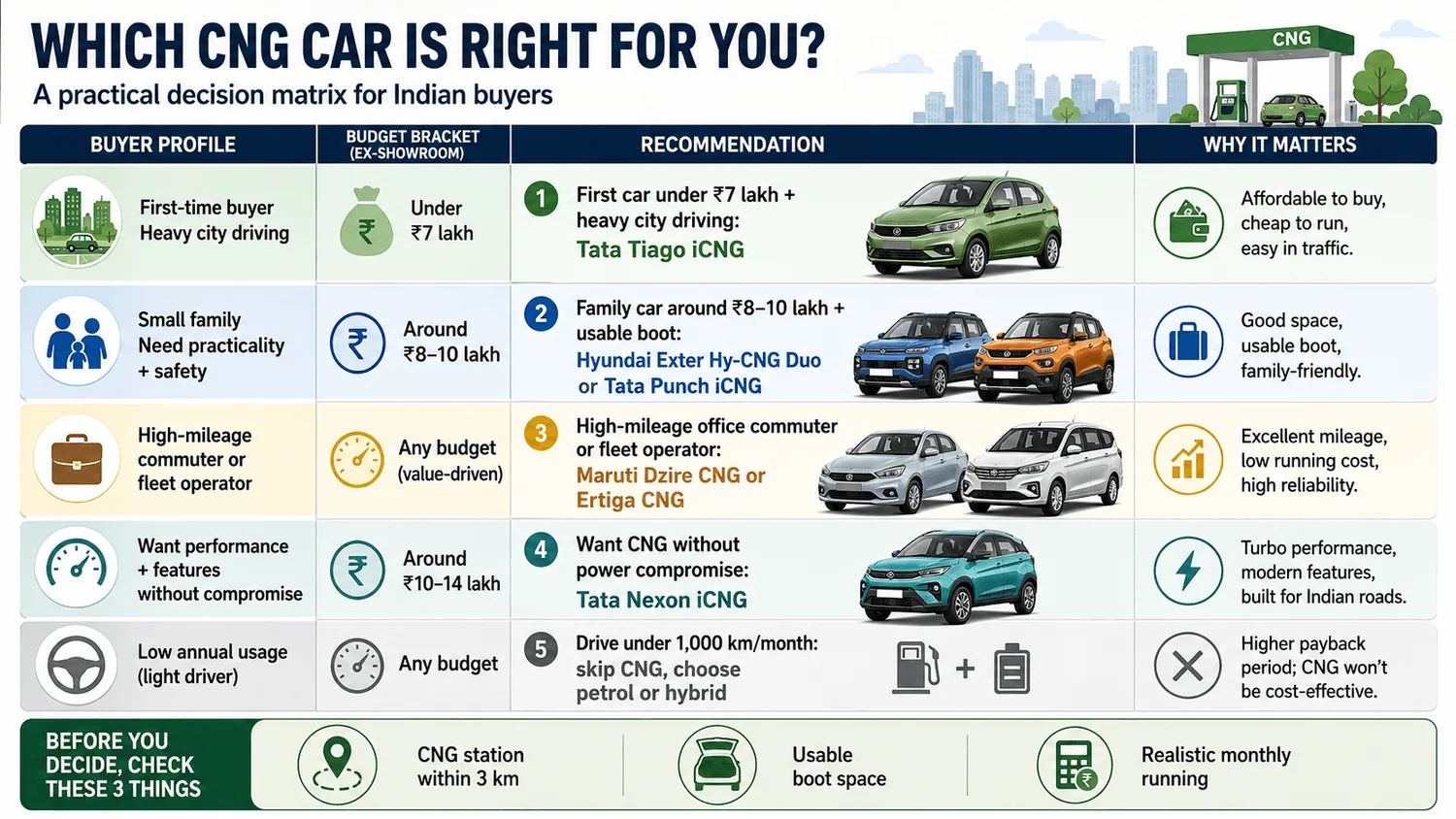
- Buying first car under ₹7 lakh and driving heavy in city? Tata Tiago iCNG.
- Family car around ₹8–10 lakh, want a real boot? Hyundai Exter Hy-CNG Duo or Tata Punch iCNG.
- High-mileage office commuter or fleet operator? Maruti Dzire CNG or Ertiga CNG.
- Want CNG without the power compromise? Tata Nexon iCNG.
- Drive less than 1,000 km a month? Skip CNG entirely. Buy petrol or a hybrid.
Your CNG decision should hinge on three checks: a station within 3 km of home, a usable boot for your family’s needs, and a realistic monthly running pattern. Get those right and CNG genuinely saves you ₹25,000 to ₹60,000 a year. That’s money that compounds over the life of the car.