
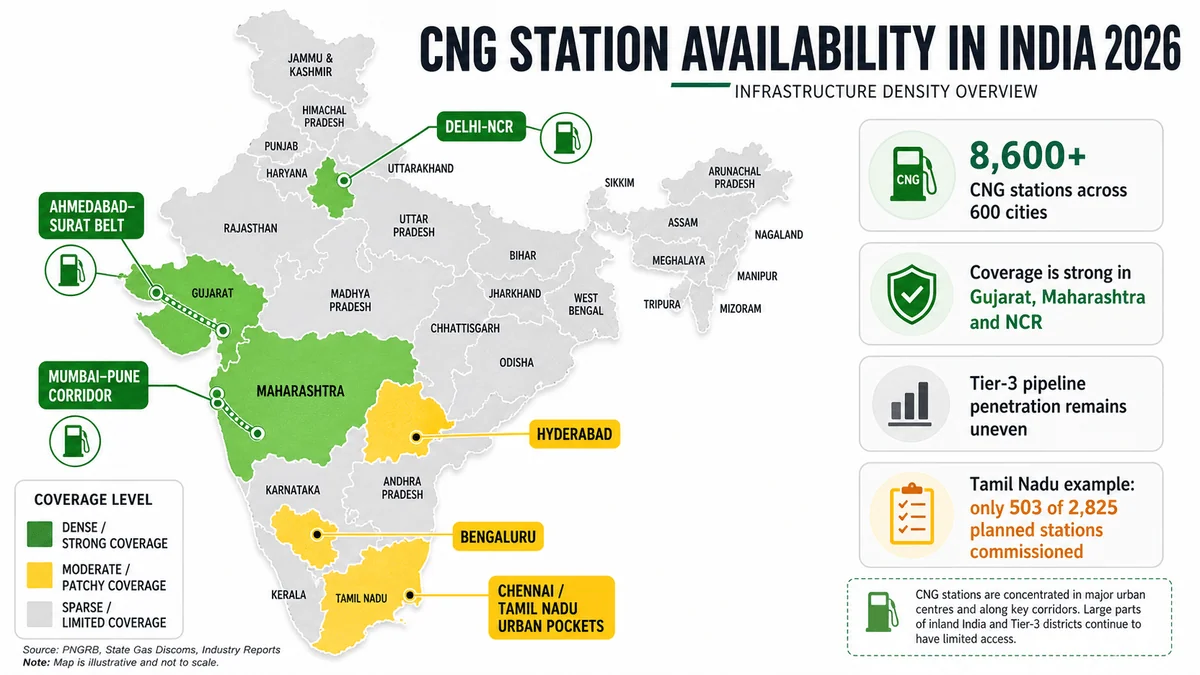
If you’re shopping for a new car in 2026, the petrol vs CNG running cost question isn’t academic. It’s the single biggest variable in your five-year ownership budget. By the close of FY2026, CNG quietly overtook diesel as India’s second-biggest passenger fuel. The numbers? 10.34 lakh CNG cars sold out of 47.05 lakh total passenger vehicles. That’s a 21.98% market share. Roughly one in four new cars rolling out of Indian dealerships now runs on natural gas, supported by 8,600+ CNG stations across 600 cities. For the cars themselves, see our guide to the CNG cars available in India.
So the real question isn’t whether CNG is cheaper. It is. The question you actually need answered: exactly how much will you save based on how much you drive, and at what point does your upfront premium pay itself off?
This guide answers both, in rupees, using May 2026 fuel prices.
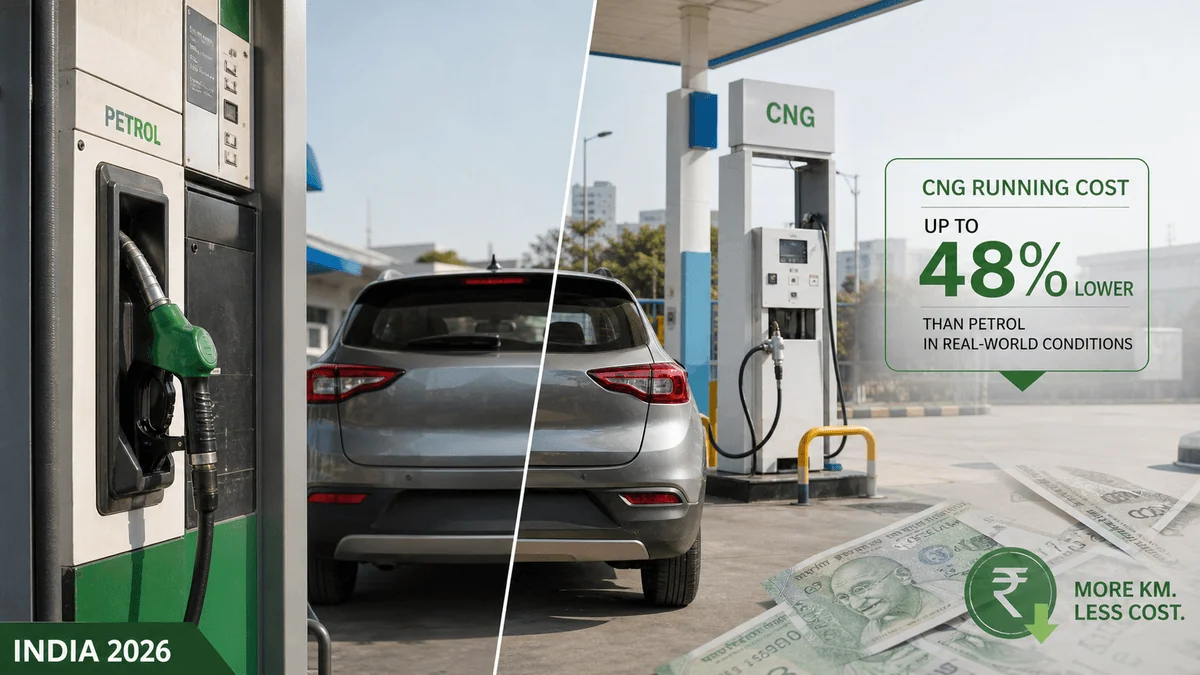
Current CNG vs Petrol Price per Km
Here’s the bottom line, calculated using real-world mileage on a typical compact SUV or premium hatchback (think Brezza, Nexon, Swift, Punch) in standard Indian driving conditions. We’re using Delhi retail prices as the baseline because Delhi-NCR has the densest CNG car ownership in the country.
| Fuel Type | Price per Unit (May 2026, Delhi) | Real-World Mileage | Cost per Km |
|---|---|---|---|
| Petrol | ₹94.77 / litre | 15.00 km/l | ₹6.32 / km |
| CNG | ₹77.09 / kg | 23.50 km/kg | ₹3.28 / km |
| Net Savings | ₹3.04 saved per km |
Operating a CNG car costs you roughly 48% less per kilometre than running the same model on petrol. Not marketing spin. Just the math, with the actual fuel prices on Indian Oil pumps this morning.
Quick city-level reality check on the inputs we just used:
| City | Petrol (₹/L) | CNG (₹/kg) | Spread |
|---|---|---|---|
| Delhi | 94.77 | 77.09 | ₹17.68 |
| Mumbai | 103.54 | 81.00 | ₹22.54 |
| Bengaluru | 102.96 | 88.95 | ₹14.01 |
| Hyderabad | ~100.50 | 97.00 | ~₹3.50 |
The savings story holds across every metro, but the per-kg CNG price varies sharply by state due to local VAT and pipeline transport costs. Hyderabad’s narrow ₹3.50 spread is the cautionary tale: if your city is at the wrong end of the CGD pricing curve, the running cost edge shrinks fast.
Why ARAI mileage doesn’t match what you’ll actually get
Manufacturer mileage figures (the ones plastered on brochures, ranging from 26 to 35 km/kg for popular CNG cars) come off ARAI dynamometers in laboratory conditions: no traffic, no AC, no payload, no aerodynamic drag. Useful for cross-model comparison, useless for predicting your fuel bill.
Three variables eat into that lab number in the real world:
- City vs highway split. A car that delivers 25 km/kg on the highway often drops to 18 km/kg in dense city traffic. The 23.5 km/kg baseline above assumes a 70:30 city-highway mix, which is what most Indian private owners actually drive.
- AC load. Continuous 100% AC use, which is non-negotiable in Indian summers, cuts CNG efficiency by 10 to 15%. CNG burns drier and cooler than petrol, so the torque deficit when the compressor kicks in is more pronounced.
- Payload. A standard 60-litre water-capacity CNG cylinder adds 60 to 70 kg of dead weight to the rear axle when fully pressurised. Combine that with four passengers and the engine has to spin harder to maintain speed, especially on smaller 1.0L and 1.2L motors like the WagonR and Tiago.
We’ve baked these into the calculations. Drive gently? Mostly highway, light AC, solo commute? Your real cost per km will trend better than ₹3.28. Stuck in Mumbai monsoon gridlock with five people and the AC on full? You’ll see worse numbers.
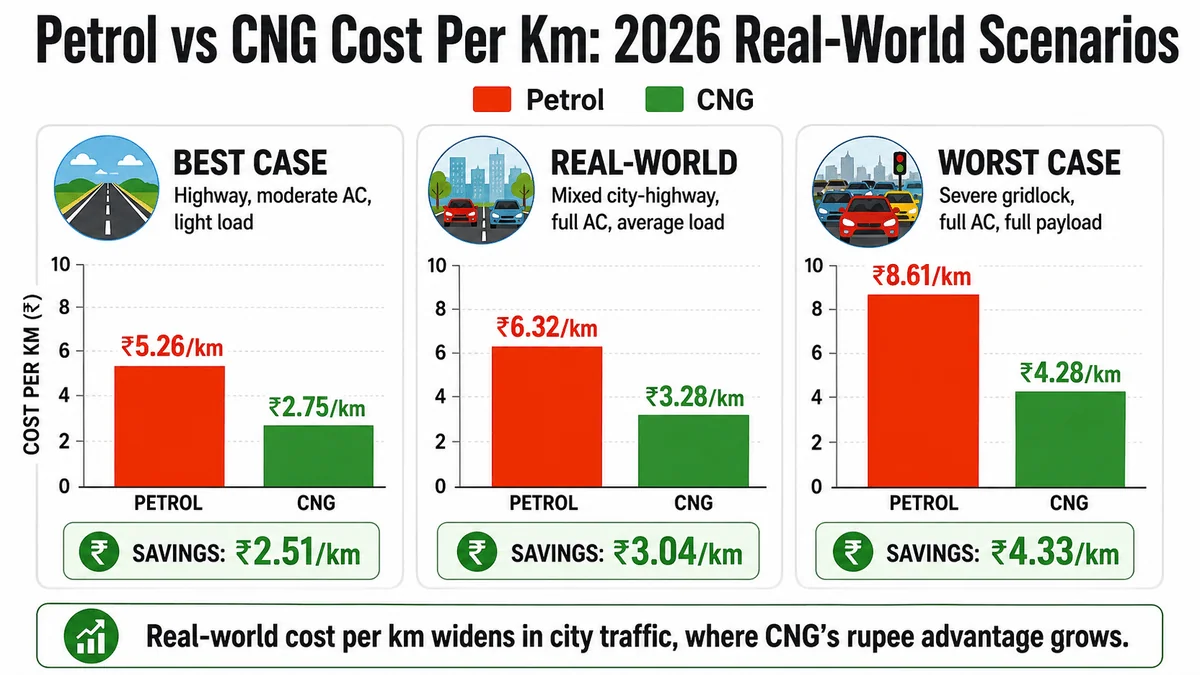
Three operating scenarios at a glance
| Scenario | Petrol Cost/Km | CNG Cost/Km | You Save |
|---|---|---|---|
| Best case (highway, moderate AC, light load) | ₹5.26 | ₹2.75 | ₹2.51/km |
| Real-world (mixed city-highway, full AC, average load) | ₹6.32 | ₹3.28 | ₹3.04/km |
| Worst case (severe gridlock, full AC, full payload) | ₹8.61 | ₹4.28 | ₹4.33/km |
Here’s the counter-intuitive bit. The absolute monetary savings increase in worse traffic. Both fuels lose efficiency in stop-go conditions, but petrol degrades at a more expensive monetary rate per kilometre. This is why CNG has near-monopoly status among Ola/Uber drivers and city taxi fleets: the worse the operating environment, the bigger the rupee gap.
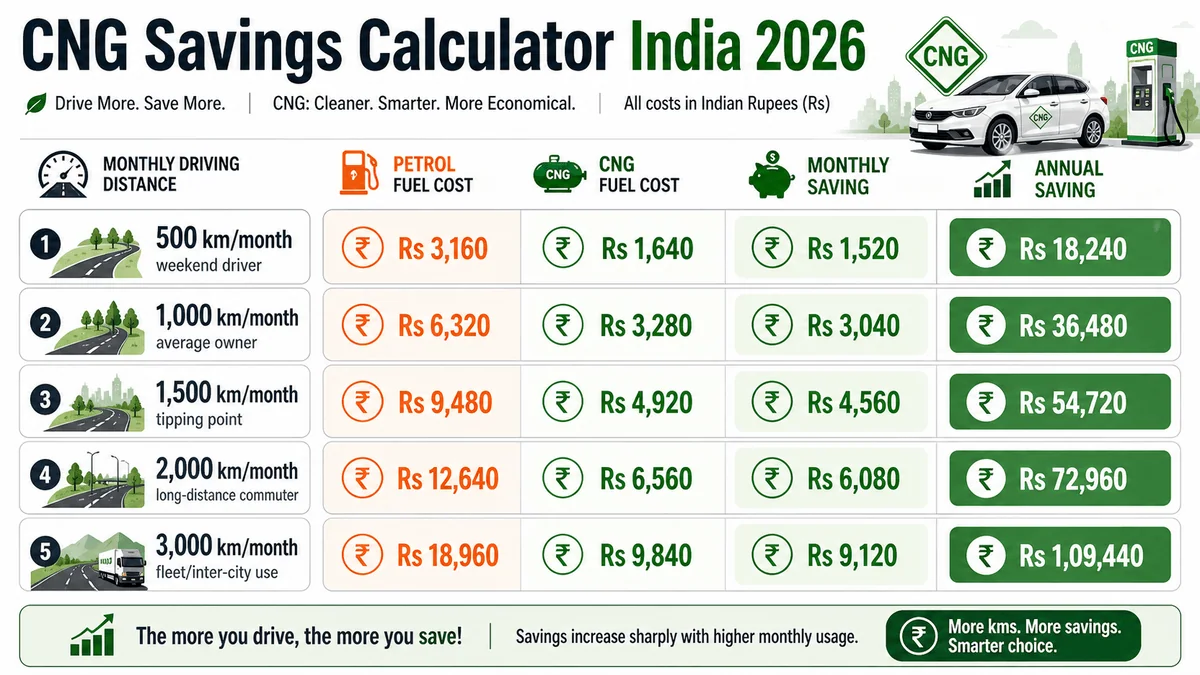
Annual Savings Calculator: Find Your Driving Level
This is the table that should drive your buying decision. We’ve used the real-world delta of ₹3.04 per km (Delhi prices, mixed city-highway, full AC, average load) and projected it across five common usage tiers.
Find your tier. The annual figure is what you’ll actually retain in your bank account compared to running the same model on petrol.
| Monthly Driving | Petrol Fuel Cost | CNG Fuel Cost | Monthly Savings | Annual Savings |
|---|---|---|---|---|
| 500 km/month (~17 km/day) | ₹3,160 | ₹1,640 | ₹1,520 | ₹18,240 |
| 1,000 km/month (~33 km/day) | ₹6,320 | ₹3,280 | ₹3,040 | ₹36,480 |
| 1,500 km/month (~50 km/day) | ₹9,480 | ₹4,920 | ₹4,560 | ₹54,720 |
| 2,000 km/month (~67 km/day) | ₹12,640 | ₹6,560 | ₹6,080 | ₹72,960 |
| 3,000 km/month (~100 km/day) | ₹18,960 | ₹9,840 | ₹9,120 | ₹1,09,440 |
What each tier means in real life
500 km/month, the weekend driver. You use the car for grocery runs, school pickups and the odd Sunday outing. Your daily commute is metro, auto or company cab. The ₹18,240 annual saving sounds nice, but as you’ll see in the next section, you won’t amortise the CNG hardware premium fast enough. For this profile, a petrol car is your rational choice.
1,000 km/month, the average Indian car owner. Roughly 30 to 35 km a day. A tier-1 city commute plus weekend errands. ₹36,480 a year is a moderate but legitimate case for CNG, especially if you’ll keep the car for five years or more. Your break-even arrives around year three.
1,500 km/month, the tipping point. You’re the suburban professional doing a 25 km one-way commute. ₹54,720 a year is where the economic argument decisively beats the logistical inconvenience of more frequent refuelling. At this tier, CNG is your smart choice unless your local infrastructure is genuinely unreliable.
2,000 km/month, the long-distance commuter. Think Gurgaon to Noida, or Navi Mumbai to BKC. ₹72,960 in annual fuel savings essentially funds your entire insurance and routine maintenance budget for the year. Your total cost of ownership turns close to neutral against a petrol equivalent.
3,000 km/month, fleet and inter-city use. Commercial operators, app-cab drivers, sales reps logging daily intercity miles, owners running long-distance Sales territories week after week. At this volume, ₹1.09 lakh a year of retained fuel money is non-negotiable territory and your hardware premium gets recovered inside the first year of ownership. Pure profit retention from there.
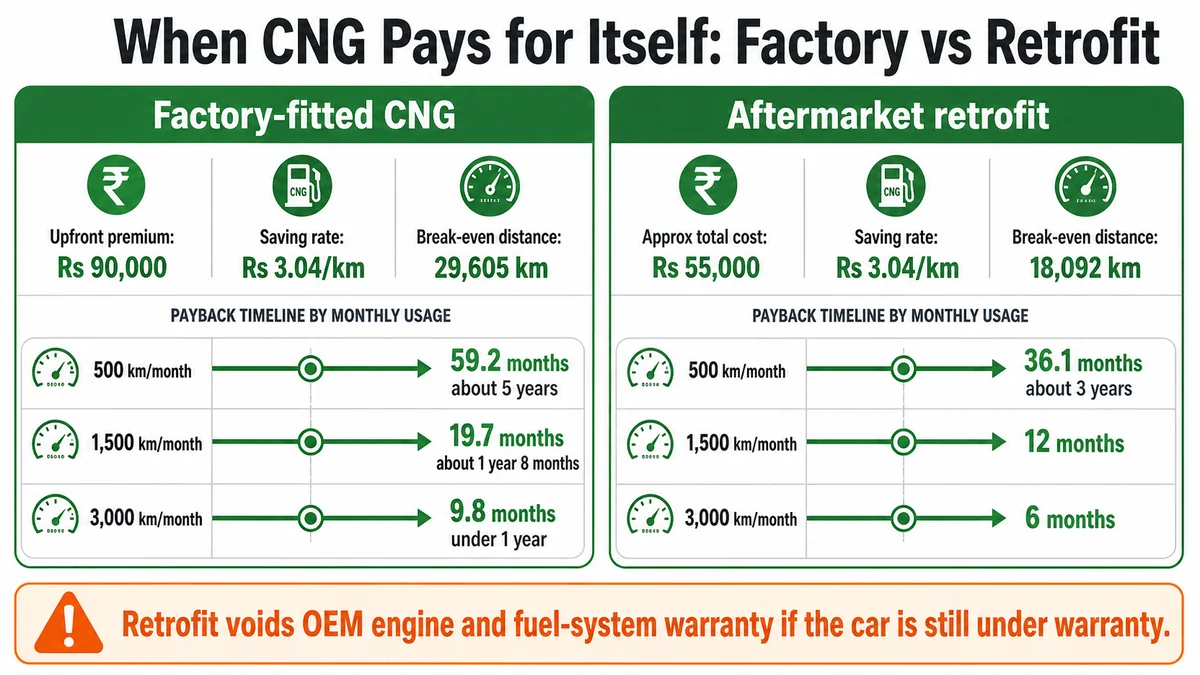
When CNG Pays for Itself
Fuel savings are only one side of the ledger. CNG cars cost you more to acquire, whether you’re paying the OEM premium on a factory-fitted variant or the retrofit cost on your existing petrol car. Your break-even point is where cumulative fuel savings finally cancel out that upfront capital outlay.
We’ve run your math two ways. Factory CNG, and aftermarket retrofit.
Factory-fitted CNG break-even
The 2026 CNG market is dominated by factory-fitted cars. Maruti Suzuki alone holds roughly 70% of the pie with the Ertiga, Dzire, Brezza, Celerio and WagonR. Tata Motors holds the next-biggest slice with the Nexon iCNG, Punch iCNG and Altroz iCNG.
A factory-fitted CNG variant typically costs ₹80,000 to ₹1,00,000 more than the equivalent petrol variant. That premium isn’t arbitrary. It pays for dual interconnected ECUs, reinforced rear suspension to carry the cylinder mass, hardened stainless-steel valve seats engineered for the higher combustion temperatures, factory-routed high-pressure fuel lines and a full warranty on the entire CNG system.
For the calculations below, we’ve used the average premium of ₹90,000 and the real-world savings rate of ₹3.04/km. Break-even distance: 29,605 km.
| Usage Tier | Distance to Break-Even | Time to Recover Premium |
|---|---|---|
| Low (500 km/month) | 29,605 km | 59.2 months (~5 years) |
| Medium (1,500 km/month) | 29,605 km | 19.7 months (~1 year 8 months) |
| High (3,000 km/month) | 29,605 km | 9.8 months (under 1 year) |
Driving 15,000 to 20,000 km a year? Your OEM premium pays itself off in 18 to 20 months. After that, every ₹3.04/km saving is yours to keep. For most Indian buyers in mass-market segments (₹8 lakh to ₹15 lakh), this is the validating math behind CNG’s surge in 2026.
Aftermarket retrofit break-even
If you already own a petrol car and want to convert, an aftermarket sequential CNG kit makes the recovery timeline far more aggressive. The 2026 aftermarket is dominated by BS6-compliant, OBD-2 sequential multi-point injection (MPI) kits from brands like Lovato, BRC, Tartarini, Landi Renzo and Mijo Auto Gas.
Avoid the older Venturi (open-loop) kits available at ₹15,000 to ₹35,000. They cause power loss, unstable idling and can cause valve damage on modern fuel-injected engines.
A legal, AIS-024 compliant retrofit in 2026 looks like this:
- Sequential kit + 60L cylinder: ₹42,000 to ₹55,000
- RTO endorsement and RC update (mandatory under Section 52 of the Motor Vehicles Act 1988): ₹1,200 to ₹3,500
- PESO hydro test certificate: ₹500 to ₹1,000
- Insurance policy endorsement: ₹1,500 to ₹3,500
- Total out-of-pocket: approximately ₹55,000
Break-even distance against the same ₹3.04/km saving: 18,092 km.
| Usage Tier | Distance to Break-Even | Time to Recover Cost |
|---|---|---|
| Low (500 km/month) | 18,092 km | 36.1 months (~3 years) |
| Medium (1,500 km/month) | 18,092 km | 12 months (1 year) |
| High (3,000 km/month) | 18,092 km | 6 months (half a year) |
There’s a serious caveat. Retrofitting an aftermarket kit immediately voids your manufacturer’s engine and fuel-system warranty. So this route suits you only if your car is out of warranty and you’re no longer protected against catastrophic powertrain failure anyway. Still in your first three years and under warranty? Factory-fitted is your only rational path.
Hidden Costs of CNG You Won’t See on the Brochure
Here’s where most cost comparisons go wrong. Your fuel savings are not the same as your total ownership savings. CNG introduces a series of secondary costs and practical compromises that erode that headline ₹3.04/km figure. We’ve quantified each one so you can adjust the math for your situation.
1. Boot space loss
The traditional Achilles heel. A 60-litre water-capacity CNG cylinder mounted in the boot of a hatchback or subcompact SUV (Brezza, WagonR, older Nexon designs) functionally eliminates your luggage space. That forces a ₹15,000 to ₹25,000 outlay on a roof carrier, which then chews into highway fuel efficiency through aerodynamic drag. An indirect penalty, but a real one.
The good news: 2026 engineering has solved this on newer launches:
- Twin-cylinder packaging. Tata’s iCNG line (Punch iCNG, Nexon iCNG, Altroz iCNG) uses two interconnected 30-litre cylinders mounted under the luggage floor. The Nexon iCNG retains 321 litres of fully usable boot space. Functionally equivalent to the petrol car.
- Underbody packaging. Maruti’s newer Victoris CNG integrates a 55-litre equivalent tank entirely beneath the floorpan, preserving 439 litres of cargo capacity.
If your boot space matters, prioritise twin-cylinder or underbody designs over older single-tank layouts.
2. Refuelling time and queues
A standard 60-litre tank holds only 8 to 9 kg of CNG at 200 bar pressure. At 23.5 km/kg, you get a usable range of just 180 to 210 km per refuel. Most CNG owners visit the pump every four to five days, compared to once every two to three weeks for petrol on a typical 35-litre tank.
The bigger hidden cost? The queue. The CGD network has grown to 8,600+ stations, but hasn’t kept pace with vehicle sales. During peak hours or supply disruptions (the Mumbai GAIL pipeline incident, the Bengaluru supply surges), queues regularly stretch from 15 minutes to 2-4 hours. For commercial operators that’s billable hours destroyed. For private owners it’s still real opportunity cost. Factor 2-3 hours a week if you live in a city with constrained CNG infrastructure.
3. Maintenance: more frequent service intervals
CNG burns dry and hot. Petrol enters the combustion chamber as an atomised liquid mist and provides a small amount of evaporative cooling and lubrication to the intake valves. CNG enters as a dry vapour and does neither. The result is more thermal stress on the engine internals.
Concrete service implications:
- Oil change interval drops from 10,000 km (petrol) to 7,500 km (CNG). Roughly 33% more frequent.
- Spark plugs must be heat-resistant, specialty grade. Higher unit cost, replaced at the same interval as petrol.
- CNG filter needs replacement every 15,000 to 20,000 km at ₹400 to ₹900 per service. This is on top of the regular air and oil filter changes.
- Valve clearance adjustments are needed more often. Neglecting these on aftermarket retrofits can cause valve seat recession, eventually requiring a full cylinder head rebuild.
In rupee terms: your moderately driven petrol car costs ₹6,000 to ₹8,000 a year in routine service. Your CNG equivalent runs ₹9,000 to ₹12,000. Over a five-year ownership window, you’ll spend roughly ₹15,000 more on routine servicing.
Add the mandatory PESO hydrostatic test on your cylinder every three years (₹1,200 to ₹3,000 each time, plus a day of vehicle downtime to physically unmount and remount the tank), and your maintenance overhead is real but manageable.
4. Performance impact
Bi-fuel engines lose 10 to 15% of their peak horsepower and torque when running on CNG. Gaseous fuel displaces ambient air in the intake manifold, which reduces the oxygen mass available for combustion.
The Maruti Victoris is your textbook example. Its K15C engine produces 101.65 bhp and 137 Nm on petrol, dropping to 86.63 bhp and 121.5 Nm in CNG mode. You’ll feel this on highway overtakes and steep inclines, especially with a full passenger load. Push harder to compensate and you’ll burn more fuel, which subtly erodes your running cost advantage.
Adding a CNG kit, factory or aftermarket, raises your Insured Declared Value (IDV) by ₹30,000 to ₹50,000. That triggers a proportional 10% to 15% increase in the Own Damage component of your annual car insurance premium.
On top of that, IRDAI mandates a fixed ₹60 per financial year third-party surcharge on bi-fuel vehicles. It’s small, but it’s structural.
6. Resale value: bifurcated by geography
The secondary market for CNG cars in 2026 has split sharply along urban lines.
- Tier-2 and Tier-3 cities: Demand for high-efficiency pre-owned CNG cars is intense. Models like the Maruti Alto K10 CNG, WagonR CNG and Hyundai Aura CNG retain up to 73% of their original ex-showroom price after three to four years. Fuel savings matter more than ever in these markets.
- Major metros: Your depreciation curve is steeper. Delhi-NCR’s rigid 15-year age cap on petrol/CNG vehicles caps your residual life. Many metro CNG cars have been used hard in ride-hailing fleets, which dents your private resale once second-owner inspections start.
Live in a Tier-2 city? CNG resale is a strong upside for you. In Delhi-NCR? Plan to sell before year 10 to maximise your return.
7. Limited Tier-3 availability
The 8,600+ stations headline hides serious geographical unevenness. Petroleum and Natural Gas Regulatory Board data shows pipeline penetration in vast tracts of Tier-3 India remains thin. In Tamil Nadu, only 503 of the 2,825 planned stations are commissioned. Chennai and Tiruvallur have completed just 43% of their planned pipeline length, stalled by road-cutting and sewer-shifting permissions.
Live outside the dense CGD corridors of Gujarat, Maharashtra and NCR? Your “CNG car” may end up running on petrol for stretches at a time, especially on inter-city travel. That defeats your entire financial premise. Verify your local CGD coverage on the PNGRB pipeline map before you sign your booking form.
Adding it up at the medium usage tier (1,500 km/month):
- Annual fuel saving: ₹54,720
- Higher routine maintenance: -₹3,000 to -₹5,000
- PESO hydro test (amortised over 3 years): -₹400 to -₹1,000
- Insurance premium hike: -₹500 to -₹1,500
- Net retained saving: ₹47,000 to ₹50,000 a year
The hidden costs absorb roughly ₹4,000 to ₹7,500 of the headline number. CNG is still substantially cheaper, but the gap is 85-90% of what the per-km math implies, not 100%.
So, Should You Buy a CNG Car?
Here’s your decision-grade summary based on the math:
- Drive less than 800 km/month? No. Your hardware premium won’t amortise inside a reasonable ownership window. Buy a petrol variant.
- Drive 800-1,500 km/month? Marginal. Run your numbers against your local CNG price (Hyderabad and small-town buyers, especially) and confirm CGD availability before committing.
- Drive 1,500-2,500 km/month? Yes. This is your financial sweet spot for factory CNG.
- Drive 2,500+ km/month? Absolutely yes. Factory CNG pays you back inside a year. If you’re a commercial operator, the math isn’t even close.
For ownership profiles where CNG makes sense for you, prioritise factory-fitted variants over aftermarket retrofits unless your car is comfortably out of warranty. Give serious weight to twin-cylinder or underbody designs (Tata iCNG, Maruti Victoris) if your boot routinely carries luggage. And if you’re still weighing CNG against petrol and diesel as a first principles question, your decision comes down to monthly mileage, local fuel-station coverage and how long you intend to keep the car.
FAQs
How much can I save with CNG per month?
Savings scale linearly with how much you drive. A standard compact SUV or hatchback driven 1,500 km a month, in real-world Indian conditions and at May 2026 Delhi fuel prices, will save you approximately ₹4,560 a month, or ₹54,720 a year. That’s compared to running the same model on petrol. At 3,000 km a month (commercial drivers, intercity commuters), your savings rise to ₹9,120 a month. Roughly ₹1.09 lakh a year. Your exact figure depends on your city pricing, real-world mileage and AC habits.
Is CNG cheaper than petrol in India?
Yes, significantly. As of May 2026, CNG retails at ₹15 to ₹20 per unit cheaper than petrol across major metros. Combine that with the higher calorific density of CNG (one kg goes further than one litre of petrol). Your operational cost per kilometre drops by roughly 48% under standard real-world conditions.
Is CNG cheaper in the long run?
For drivers who cross the break-even threshold, yes, comfortably so. Factory-fitted CNG breaks even at roughly 29,605 km of cumulative driving, while an aftermarket retrofit gets you there at just 18,092 km. Past that distance? Every kilometre delivers ₹3.04 in retained savings, straight to your wallet. Annual fuel savings of ₹50,000 to ₹1,00,000 easily absorb the higher maintenance, hydro test and insurance overheads, leaving a substantial net positive cash flow over a five-year ownership cycle.
Does a CNG engine last as long as a petrol engine?
A factory-fitted OEM CNG engine, with hardened valve seats and proper preventative maintenance, will match the lifespan of a petrol equivalent. Skip the 7,500 km oil change interval or ignore valve clearance checks, though, and you’ll see premature valve seat recession and eventually cylinder head damage. Aftermarket retrofits on engines never designed for gaseous fuel are more vulnerable, especially poorly calibrated budget kits, which is why we recommend factory-fitted options for buyers planning long ownership.
What is the real-world CNG mileage in India?
ARAI claims for popular CNG cars range from 26 to 35 km/kg. Real-world figures, accounting for full AC use, mixed city-highway driving and average payload, settle at 22 to 25 km/kg for typical hatchbacks and subcompact SUVs. Pure highway cruising at moderate AC can briefly push that to 28 to 30 km/kg.
Is CNG worth it for low usage?
No. If you’re driving under 500 to 800 km a month, the break-even period stretches well beyond four to five years on a factory-fitted CNG. Add boot space loss, insurance premium hikes and the opportunity cost of weekly refuelling queues, and the marginal monthly fuel saving doesn’t justify the trade-off. For low-usage urban buyers, petrol remains the smarter purchase.
Do CNG cars require more maintenance?
Modestly more, yes. Routine service intervals run roughly 33% tighter (oil changes every 7,500 km vs 10,000 km), spark plugs need a heat-resistant grade, the CNG filter is an extra service item, and a PESO-mandated hydrostatic cylinder test is required every three years. Annual service cost is typically ₹3,000 to ₹4,000 higher than petrol, which is meaningful but small relative to the fuel savings.
Should I get a factory CNG car or retrofit my existing petrol car?
If your car is in warranty, never retrofit. An aftermarket kit voids the OEM engine and fuel-system warranty. Factory CNG is the only safe choice for cars within their first three years. If your car is out of warranty and you drive 1,500+ km a month, an AIS-024 compliant sequential MPI kit (Lovato, BRC, Tartarini, Landi Renzo, Mijo) from a certified retrofit centre is a reasonable economic move. Avoid Venturi open-loop kits at all costs.
Last updated: May 2026. Fuel prices and city retail rates are revised daily by Indian OMCs and monthly by CGD operators. We refresh this guide quarterly to keep the running cost calculations current.