
A hybrid car uses both a petrol engine and an electric motor to move the wheels, which cuts your fuel use and tailpipe emissions. In India in 2026, you’ll see three types on sale: mild hybrids (electric assist only, can’t drive on electricity alone), strong hybrids (can drive short distances on pure electricity, self-charging), and plug-in hybrids or PHEVs (larger battery you plug into a socket, longer EV range). Mild and strong hybrids are common. PHEVs are still rare and mostly luxury. Weighing full electrification too? Compare these with the electric cars on sale in India.
| Hybrid Type | What It Does | Can Run on Electric Only? | Charging Needed? | Common in India? |
|---|---|---|---|---|
| Mild Hybrid | Electric assist for the petrol engine | No | No | Yes, most Maruti petrol cars |
| Strong Hybrid | Petrol + electric drive together or independently | Yes, short distances | No (self-charging) | Limited but growing fast |
| Plug-In Hybrid (PHEV) | Larger battery, longer EV range | Yes, longer distances | Yes (external socket) | Rare, luxury imports only |
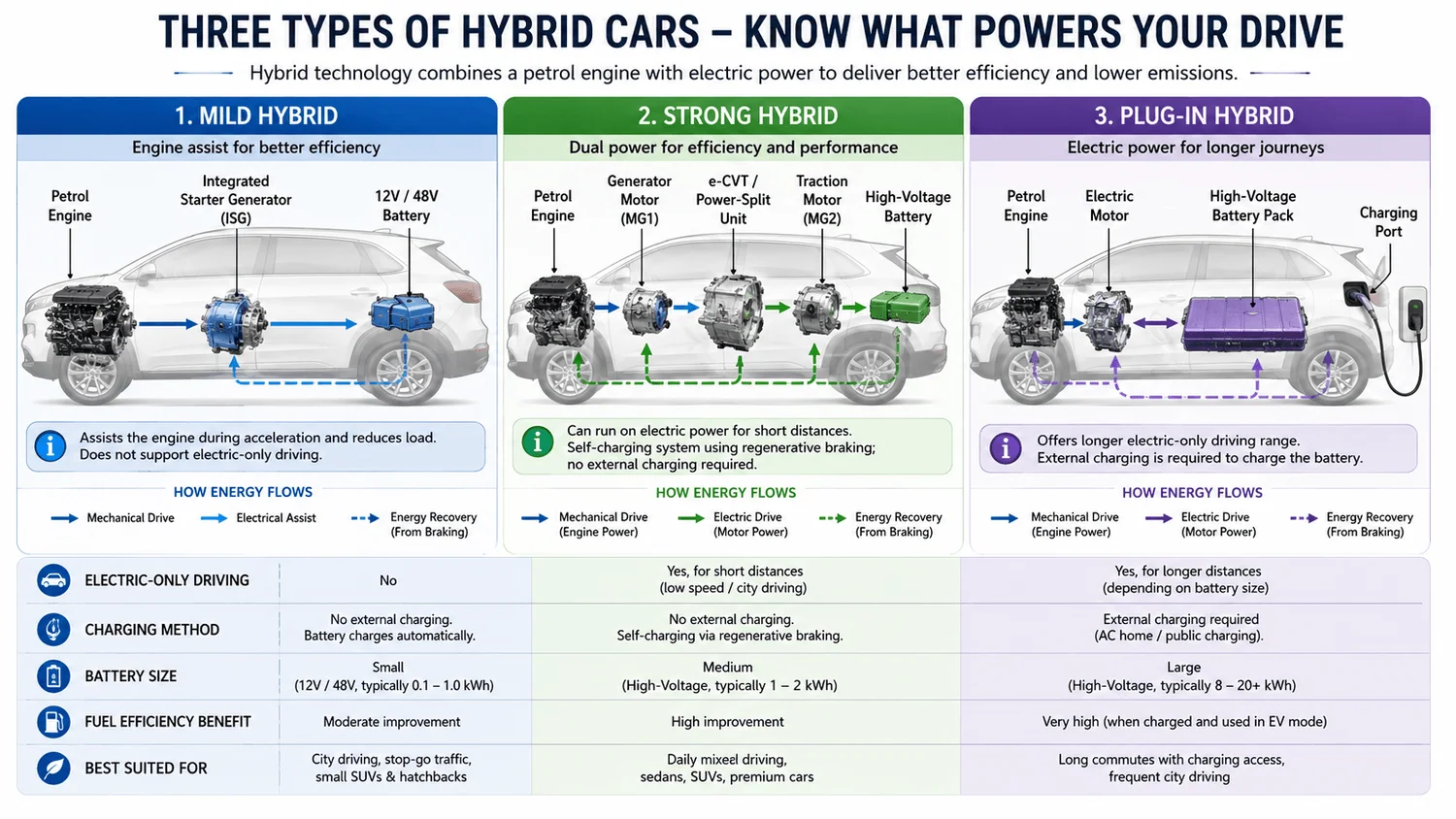
What Is a Hybrid Car?
A hybrid vehicle pairs a regular petrol engine with one or more electric motors and a battery pack. The idea is simple. The petrol engine does what it’s good at, like highway cruising and sustained loads. The electric motor steps in where the engine is weakest, like creeping in traffic, pulling away from a stop, or idling at lights.
Why this matters for you: in stop-and-go city traffic, a regular petrol engine wastes a huge amount of fuel. It burns petrol while you idle. It struggles to pull a heavy car from rest. Most of the energy it sends to your brake discs just dissipates as heat. Pure loss. A hybrid attacks every one of those weak spots:
- At standstill: the petrol engine switches off entirely. Zero fuel burned.
- From rest up to roughly 30–40 km/h: the electric motor takes over. Still no petrol burned, at least in a strong hybrid.
- Under braking: the motor reverses itself and works as a generator. It captures the kinetic energy and stores it back in the battery. This is called regenerative braking, and it’s the reason most Indian hybrids don’t need to be plugged in.
- At higher speeds or hard acceleration: the petrol engine and motor work together, sharing the load.
A useful analogy if you’re new to hybrids: think of one as a regular petrol car with an intelligent electric boost sitting in the background. It decides moment by moment whether to use petrol, electricity, or both. You don’t have to do anything.
Why does this matter in India specifically? Indian cities are some of the worst environments in the world for a petrol engine. Bengaluru. Mumbai. Delhi. Pune. Average commute speeds often drop below 20 km/h, with constant idling. That’s the exact condition where a strong hybrid saves you the most fuel. With petrol at ₹102.96 per litre in Bengaluru as of May 14, 2026, and similar rates across most metros, the running cost gap between a hybrid and a regular petrol car has never been wider.
But is a hybrid an electric vehicle? No. It still has a petrol tank, still needs petrol to operate, and still produces tailpipe emissions, just fewer of them. If your petrol tank runs dry, the small battery drains within minutes and the car stops. So if you’re hoping for “an EV without the charging hassle”, a hybrid is closer to the truth than the marketing pitch. It isn’t a zero-emission vehicle, though.
Mild Hybrid vs Strong Hybrid vs Plug-In Hybrid
Most of the confusion here comes from manufacturers using the word “hybrid” loosely. A car badged “Smart Hybrid” might give you a 5% fuel saving. Another car badged “Intelligent Hybrid” might deliver 100% more mileage in the city. Huge difference. So which one are you actually buying?
Mild Hybrid (also called 12V/48V mild hybrid, SHVS, Neo Drive)
Mild hybrid is the most basic level of electrification.
- Battery: small, typically 0.37–0.5 kWh, 12V or 48V
- Motor: an Integrated Starter Generator (ISG), 10–12 kW, belt-driven, replaces the alternator and starter motor
- Electric-only driving: no. Your car cannot move an inch without the petrol engine firing.
- Fuel saving: about 3–7% over a non-hybrid petrol, which works out to 1–2 km/l extra
The ISG captures a small amount of braking energy, smooths out the auto start-stop so the engine restarts silently at traffic signals, and gives the petrol engine a gentle assist when you accelerate. That’s the whole job.
Maruti calls this system SHVS (Smart Hybrid Vehicle by Suzuki) and fits it across most petrol variants of the Brezza, Ertiga, XL6, Grand Vitara, and Fronx. Toyota uses the same idea under the Neo Drive branding on the Hyryder, and has slipped a 48V mild hybrid into recent Fortuner diesel variants to smooth out the start-stop too.
Honest take: a mild hybrid is a real fuel-economy gain over a comparable non-hybrid petrol, and the start-stop refinement in traffic is genuinely nice. Should you pay a separate “hybrid premium” for one? No. If the brand is charging significantly more for the mild-hybrid version, you’re being marketed at.
Strong Hybrid (also called Full Hybrid, Parallel Hybrid, e-CVT Hybrid)
A strong hybrid is what most people picture when they hear “hybrid car”. This is the technology Toyota pioneered with the Prius and now licenses to Maruti for the Grand Vitara and Invicto.
- Battery: a much bigger high-voltage pack, typically 1–2 kWh, lithium-ion or nickel-metal hydride
- Motors: a powerful traction motor (often 60–100 kW) plus a separate generator motor
- Engine: usually an Atkinson-cycle petrol tuned for efficiency over outright power
- Transmission: e-CVT (electronic continuously variable transmission) with a planetary power-split device
- Electric-only driving: yes, at low speeds and light loads
- Fuel saving: 60–100% better than a comparable petrol-automatic in city traffic
The car automatically switches between pure-EV mode, pure-petrol mode, and combined mode. At a crawl in Bengaluru traffic the petrol engine often shuts off completely and you glide on the electric motor. Silent. Zero fuel burn. Ask for more speed or let the battery dip, and the engine fires up almost imperceptibly.
Indian strong hybrids on sale in May 2026: Maruti Suzuki Grand Vitara (Intelligent Electric Hybrid), Toyota Urban Cruiser Hyryder (V and G Hybrid), Toyota Innova Hycross (ZX and VX Hybrid), Maruti Suzuki Invicto, Honda City e:HEV, and the premium Toyota Camry. Maruti’s new Victoris also enters this segment.
The trade-offs:
- Price premium: ₹2.5–4 lakh more than the comparable petrol-automatic
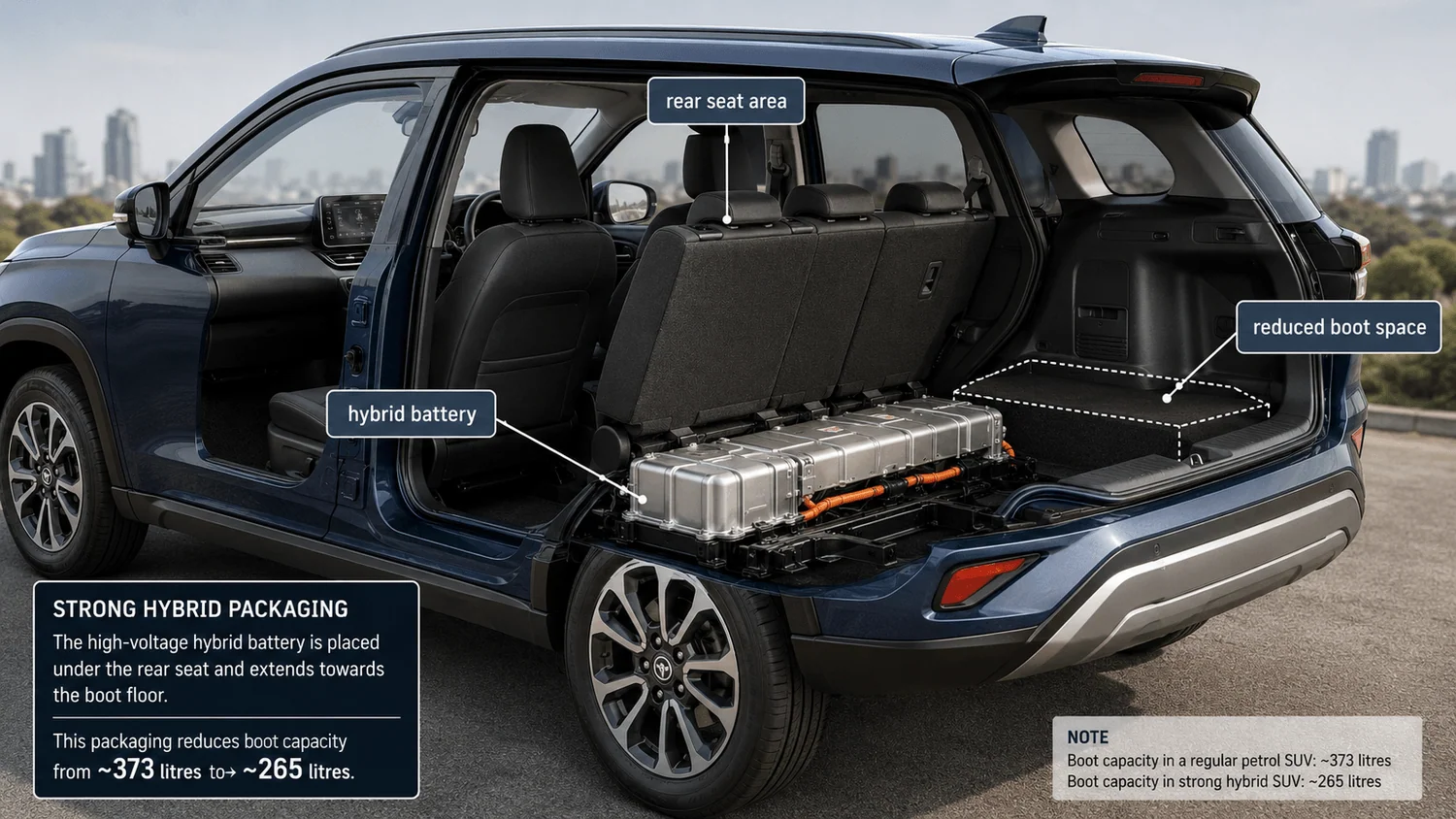
- Boot space: the battery sits where boot space used to. The Grand Vitara strong hybrid offers 265 litres versus 373 litres on the mild-hybrid petrol. That’s a 108-litre haircut, and you’ll notice it the first time you load airport luggage.
- Weight: 70–100 kg heavier than the petrol version, which slightly blunts highway response
- Out-of-warranty battery worry: addressed in the warranty section below
Plug-In Hybrid (PHEV)
A plug-in hybrid is essentially a strong hybrid with a much bigger battery that you charge from a wall socket, just like an EV.
- Battery: 15–25 kWh, about 10× larger than a strong hybrid’s
- Pure-EV range: typically 40–100 km on a single charge
- Charging: required from an external source for full benefit
- Beyond the EV range: it works as a normal strong hybrid using the petrol engine
If your daily commute fits inside the EV range, and you can plug in at home each night, a PHEV can drive on electricity for weeks at a time. Going on a long road trip? It switches to petrol-hybrid mode without you doing anything. No range anxiety either way.
So why aren’t they everywhere? Cost. A PHEV is mechanically a strong hybrid plus a much bigger battery, so the manufacturing cost is high. Worse, in India, PHEVs are taxed in the same slabs as regular hybrids, not at the 5% GST that pure EVs enjoy. That makes them uncompetitive against EVs of similar price.
PHEVs in India in May 2026 are essentially confined to luxury imports. Audi A4 35 TFSI e, Volvo XC60 Recharge, BMW M5 and X7, Mercedes-Benz C-Class and E-Class, and the Range Rover lineup. Mass-market PHEVs are coming. The MG Starlight 560 is the most anticipated launch, with a promised 100 km of pure-electric range at roughly ₹40 lakh. BYD’s Leopard 8 PHEV off-roader is also expected. For now though, if you want plug-in capability in India, you’re either spending crore-rupees or waiting.
Series Hybrid / Range Extender, the new entrant
There’s a fourth flavour worth mentioning because it’s about to land in the Indian market. The series hybrid, also called a range extender. Unlike a parallel strong hybrid where both engine and motor can drive the wheels, in a series hybrid only the electric motor drives the wheels. The petrol engine runs at one constant, highly efficient RPM purely to generate electricity for the motor.
What does it feel like? Like an EV. Silent, smooth, instant torque. But you fill it with petrol instead of plugging in. The upcoming Maruti Fronx facelift hybrid is expected to use this layout and target a claimed ~35 km/l. If it launches at a reasonable price, it will democratise serious fuel economy in the sub-₹15 lakh segment.
Hybrid Cars Available in India 2026
Want to know what’s actually on sale in showrooms right now? Here’s the full list. Not the marketing brochure, but a clean breakdown with pricing, claimed and real-world mileage, and what each car is best for.
Mild Hybrid Cars
| Model | Engine + Hybrid | Claimed Mileage | Real-World | Ex-showroom Price |
|---|---|---|---|---|
| Maruti Grand Vitara Smart Hybrid | 1.5L K15C + 12V ISG | 20.58–21.11 km/l | 15–18 km/l | ₹10.77–16.63 lakh |
| Toyota Urban Cruiser Hyryder Neo Drive | 1.5L + 12V ISG | 21.12 km/l | 15–18 km/l | ₹10.99–14.50 lakh |
| Maruti Ertiga / XL6 | 1.5L + 12V/48V SHVS | 20.30 km/l | 14–17 km/l | ₹8.69–13.79 lakh |
| Maruti Brezza | 1.5L + 12V SHVS | 17.38 km/l | 13–16 km/l | ₹8.34–14.14 lakh |
| Maruti Fronx | 1.0L Boosterjet + 12V SHVS | 21.79 km/l | 16–18 km/l | ₹7.51–13.04 lakh |
| Volkswagen Tiguan | 2.0L TSI + 48V mild hybrid | 15.00 km/l | 10–12 km/l | ₹30.50–36.50 lakh |
| Toyota Fortuner diesel (select) | 2.8L + 48V mild hybrid | 14–15 km/l | 11–13 km/l | ₹34.76 lakh onwards |
The mild-hybrid Grand Vitara and Hyryder are the practical sweet spot in this list for you. You retain the full 373-litre boot space, you pay the same as comparable non-hybrid SUVs, and you get a small real-world bump in efficiency. Solid baseline.
Strong Hybrid Cars
| Model | Engine + Hybrid | Claimed Mileage | Real-World | Ex-showroom Price | Best For |
|---|---|---|---|---|---|
| Maruti Grand Vitara Intelligent Electric Hybrid | 1.5L Atkinson + e-CVT | 27.97 km/l | 20–24 km/l (city) | ₹18.73–19.72 lakh | Entry strong hybrid, city commuters |
| Toyota Urban Cruiser Hyryder Hybrid (V/G) | 1.5L Atkinson + e-CVT | 27.97 km/l | 20–24 km/l (city) | ₹16.71–21.99 lakh | Same powertrain as Grand Vitara, Toyota service network |
| Maruti Victoris Strong Hybrid | 1.5L Atkinson + e-CVT | TBD | TBD | From ~₹17.50 lakh | Newest entrant, larger Grand Vitara-platform SUV |
| Toyota Innova Hycross ZX/VX | 2.0L + strong hybrid | 23.24 km/l | 16–21 km/l | ₹26.76–31.84 lakh | 7/8-seater families, replacement for diesel Crysta |
| Maruti Suzuki Invicto | 2.0L + strong hybrid (Hycross rebadge) | 22.85 km/l | 18–21 km/l | ₹24.97–28.61 lakh | Nexa-network buyers wanting Innova Hycross experience |
| Honda City e:HEV | 1.5L + dual-motor strong hybrid | 26.20 km/l | 22–25 km/l | ₹18.89–20.00 lakh | Sedan buyers, ADAS at this price |
| Toyota Camry | 2.5L + strong hybrid | 21.70 km/l | 18–20 km/l | ₹47.48 lakh | Luxury sedan reliability |
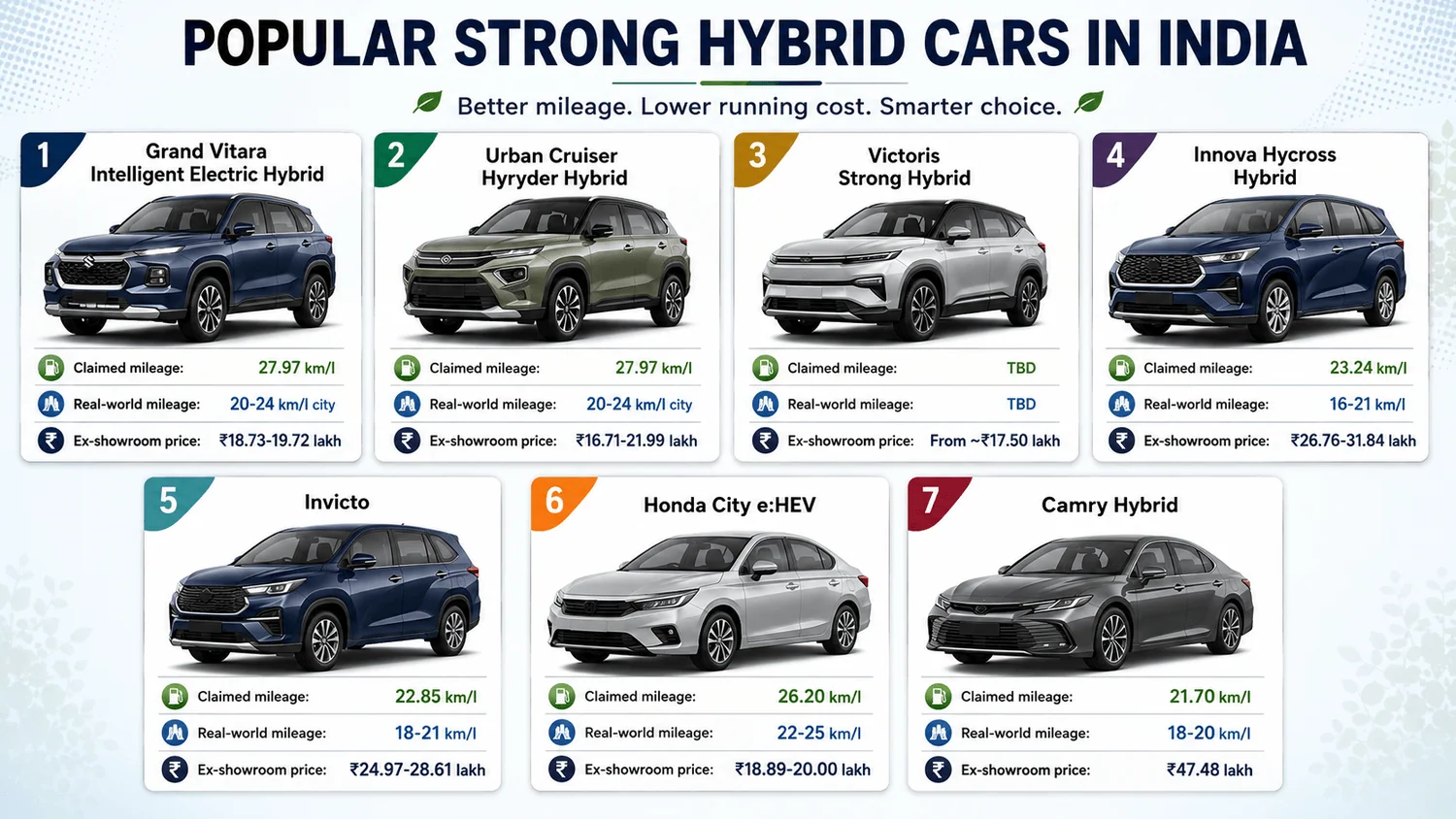
A few practical notes for you on this list:
- The Grand Vitara and Hyryder are mechanically identical strong hybrids. Same Toyota TNGA powertrain, same Atkinson engine, same e-CVT, same battery. Choose between them based on your local dealer service experience and warranty terms. The hybrid technology itself is the same.
- The Honda City e:HEV uses a fundamentally different hybrid system than Toyota’s. Honda’s setup keeps the electric motor as the primary drive source and uses the petrol engine mostly as a generator at low speeds, clutching in directly only at higher speeds. Different engineering, similar real-world result.
- The Innova Hycross hybrid is the only mass-market 7/8-seater strong hybrid in India today. If you want low running costs in a large vehicle, it has effectively replaced the diesel Innova Crysta as your default choice.
Plug-In Hybrid Cars
| Model | Brand | Claimed Range | Real-World | Best For |
|---|---|---|---|---|
| Audi A4 35 TFSI e | Audi | 38.7 km/l (ARAI)* | Depends on charging | Luxury sedan with daily commutes under 40 km |
| Volvo XC60 Recharge | Volvo | 35.8 km/l (ARAI)* | Depends on charging | Safety-focused luxury PHEV buyers |
| MG Starlight 560 (upcoming) | JSW MG Motor | 100 km EV range | N/A | Early mass-market PHEV adopters |
*PHEV ARAI numbers combine electric and petrol usage under specific test cycles. They’re wildly optimistic unless you charge daily.
For most Indian buyers, PHEVs aren’t a real option yet. High prices, no specific tax incentive, and almost no mass-market availability mean your practical hybrid choice in 2026 is between mild and strong.
Video Explaining How Hybrid Cars Save Fuel in City Traffic

Hybrid vs Petrol Mileage Comparison
So how much fuel does a hybrid actually save you? This is where the strong hybrid’s value becomes obvious, and where mild hybrids quietly underdeliver.
Why petrol engines lose in the city
A regular petrol engine is at its absolute worst in heavy stop-and-go traffic. Idling, creeping at 10 km/h, repeatedly accelerating from rest. These are the conditions where the engine is forced to operate far from its efficient power band. A standard petrol-automatic compact SUV in dense Indian city traffic typically delivers 10–12 km/l in the real world. Not the brochure number. The actual number you’ll see on a tankful in Mumbai or Bengaluru.
Where the strong hybrid wins
In the same city traffic, a strong hybrid spends a huge chunk of its time on the electric motor alone, with the petrol engine completely off. The battery keeps getting topped up through regenerative braking at every red light. Real-world automotive testing has shown the Grand Vitara strong hybrid delivering 23.77 km/l in pure city conditions, roughly a 100% improvement over the same SUV in petrol-automatic form. Even the heavier Innova Hycross MPV consistently returns 18–21 km/l in urban driving. Unheard of for a vehicle of that size.
Where the strong hybrid wins less
What about long highway cruises at 100 km/h? The electric motor helps far less here. The petrol engine does almost all the work, and the heavier kerb weight of the hybrid (70–100 kg of extra battery and motor) actually pushes back slightly on efficiency. The Grand Vitara hybrid averages around 20.39 km/l on the highway, while a regular petrol-automatic might pull around 15.30 km/l on the same route. The hybrid still wins. But the gap narrows.
| Vehicle Type | City Mileage (Real-World) | Highway Mileage (Real-World) | Best Use Case |
|---|---|---|---|
| Petrol Automatic | 10–12 km/l | 14–16 km/l | Low/medium usage, frequent highway runs |
| Mild Hybrid (Automatic) | 11–13 km/l | 15–17 km/l | Slight efficiency gain, general purpose |
| Strong Hybrid (e-CVT) | 20–24 km/l | 18–21 km/l | City-heavy daily commutes |
| CNG (Manual) | 16–19 km/kg | 18–22 km/kg | Lowest non-EV running cost in CNG cities |
| Electric Vehicle (EV) | ~7–8 km/kWh | ~6–7 km/kWh | Home-charging users, intra-city or planned routes |
The takeaway is sharp. Strong hybrids deliver their absolute biggest benefit in city traffic, the very condition where petrol cars are at their worst. The worse your commute, the more sense a strong hybrid makes. If you spend more time on the expressway than in city traffic, the gap shrinks and a regular petrol or diesel car becomes harder to argue against.
Are Hybrid Cars Worth It in India?
The honest answer? It depends entirely on how you drive and how long you keep the car. A strong hybrid pays back its premium beautifully for some buyers. For others, it’s a financial mistake.
When a strong hybrid is worth it
- You drive mostly in city traffic. Heavy stop-and-go conditions are where your hybrid will drastically lower fuel use.
- You want low running cost but can’t deal with CNG compromises. A hybrid gives you near-CNG running cost without the boot-space sacrifice or refuelling queues.
- You can’t reliably charge an EV at home. If you live in an apartment without a dedicated parking socket, or if you frequently drive long inter-city trips, a hybrid gives you EV-like efficiency without the charging dependency.
- You’ll keep your car for 5+ years. The accumulated fuel savings need time to pay back the ₹2.5–4 lakh hybrid premium.
- You value refinement. The silent low-speed electric crawl is a genuinely premium driving experience.
When a strong hybrid is NOT worth it
- You drive less than 800–1,000 km a month. Your savings are too small to recover the premium in any reasonable time.
- You drive mostly on highways. The electric motor barely helps you at sustained 100+ km/h speeds.
- The hybrid variant is priced excessively. When the gap to the comparable petrol stretches beyond ₹3.5 lakh, the math gets ugly fast.
- You have reliable home EV charging. An EV will be drastically cheaper per kilometre for you.
- You’re worried about out-of-warranty battery costs and plan to keep your car 10+ years. A valid concern, even though warranties have improved.
The break-even calculation, using real May 2026 prices
This is the math nobody at the dealership will sit down and do for you. Let’s do it with the Grand Vitara, the cheapest mass-market strong hybrid in India.
Assumptions (verified for May 14, 2026):
- Bengaluru petrol price: ₹102.96 per litre
- Grand Vitara petrol-automatic real-world mileage: ~13.5 km/l, which gives a running cost of ₹7.62 per km
- Grand Vitara strong hybrid real-world mileage: ~22.0 km/l, which gives a running cost of ₹4.68 per km
- Fuel saving per km: ₹2.94
- Hybrid premium over comparable petrol-AT: assume ₹2.5 lakh on-road
| Monthly Running | Annual Running | Petrol Annual Fuel | Hybrid Annual Fuel | Annual Savings | Premium Recovery Time |
|---|---|---|---|---|---|
| 500 km | 6,000 km | ₹45,720 | ₹28,080 | ₹17,640 | 14.1 years |
| 1,000 km | 12,000 km | ₹91,440 | ₹56,160 | ₹35,280 | 7.0 years |
| 1,500 km | 18,000 km | ₹1,37,160 | ₹84,240 | ₹52,920 | 4.7 years |
| 2,000 km | 24,000 km | ₹1,82,880 | ₹1,12,320 | ₹70,560 | 3.5 years |
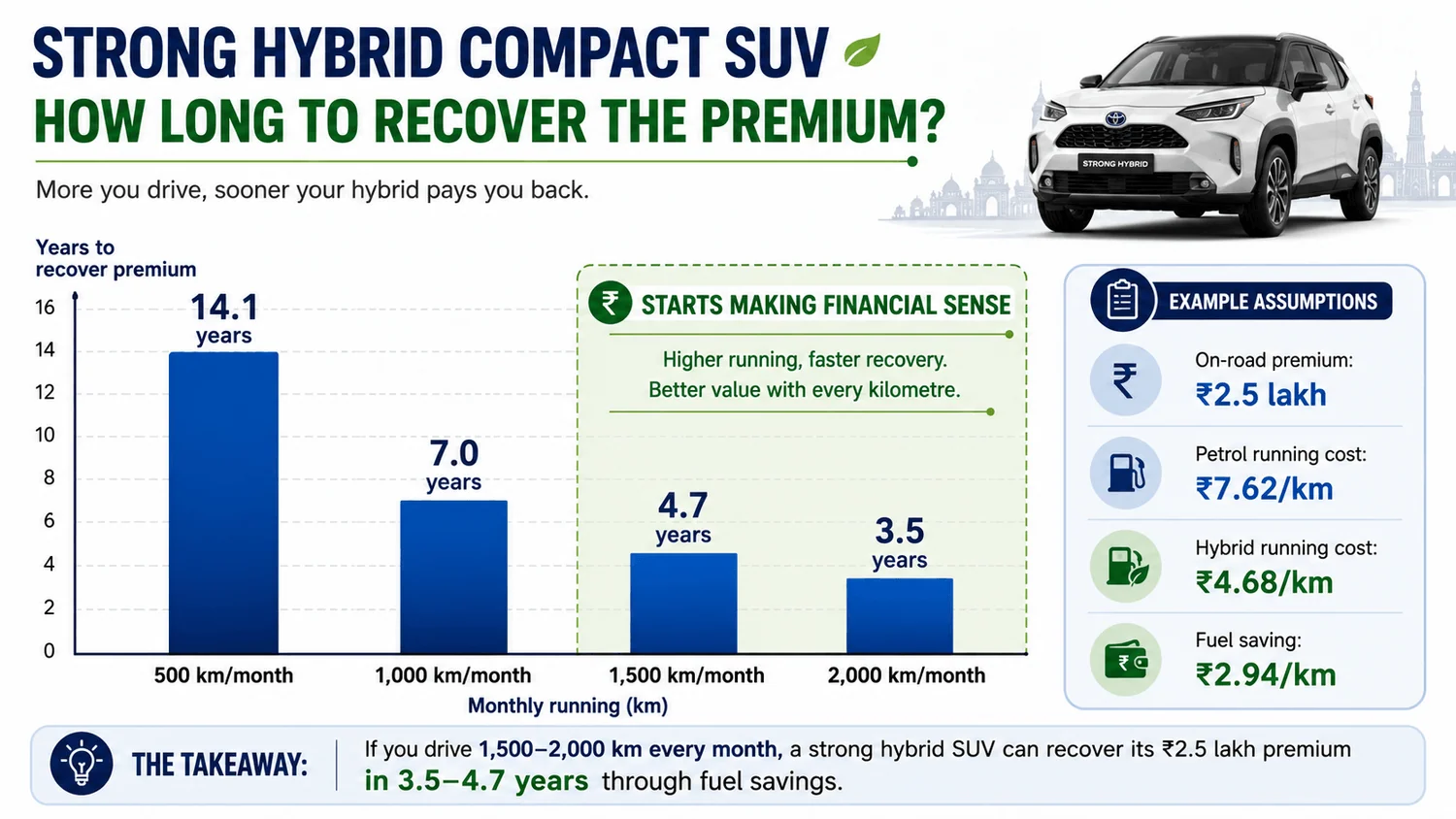
These numbers exclude loan interest on the higher principal and the time value of money, so they’re slightly optimistic. They also exclude maintenance, which generally stays comparable between hybrid and petrol versions.
The practical verdict. Driving 1,500 km a month or more? That’s typical for a single-car family in a metro, and a strong hybrid will pay back its premium in under five years. After that, it’s pure savings. Below 800 km a month, a plain petrol car is the cheaper overall proposition.
Hybrid vs CNG vs EV, The India-Specific Decision
A hybrid decision in India doesn’t exist in a vacuum. You’re also weighing it against CNG (cheap to run, ubiquitous in north India) and EVs (long-term cheapest, but limited by charging infrastructure). Which one fits your life?
| Powertrain | Best For | Main Advantage | Main Compromise |
|---|---|---|---|
| Petrol | Low-usage buyers | Lowest initial purchase cost | Highest per-km fuel cost |
| CNG | High city usage, commercial drivers | Lowest non-EV running cost | Boot space gone, refuelling queues, weaker performance |
| Strong Hybrid | City commuting + intercity travel | High mileage, no range anxiety, smooth automatic | Higher purchase price, moderate boot loss |
| EV | Home-charging users, intra-city | Cheapest to run (₹1–2/km) | Highest purchase price, charging dependency, range anxiety on long trips |
The CNG context. CNG costs ~₹90/kg in Bengaluru as of May 2026, and a Grand Vitara CNG returns ~17 km/kg combined, which works out to ₹5.30 per kilometre. A strong hybrid is at ₹4.68 per kilometre. CNG is marginally cheaper to operate. But the initial price difference is much smaller, and you give up boot space and refuelling convenience. The hybrid wins on lifestyle. CNG wins on entry-cost-to-running-cost ratio.
The EV context. Charging an EV at home in Bengaluru on BESCOM domestic tariffs (₹6.82–₹7.74 per unit) works out to roughly ₹1–2 per kilometre. That’s drastically lower than any hybrid. EVs also enjoy a massive 5% GST advantage versus the 18–40% GST on hybrids. But the EV needs you to live somewhere you can install a home charger, and the highway charging network is still developing unevenly. For apartment dwellers without dedicated parking, a hybrid is the realistic route to electrification.
Hybrid Battery, Warranty, and Maintenance
“What happens when the battery dies?” That’s the single biggest worry first-time hybrid buyers raise. Here’s the honest picture for 2026.
Routine maintenance is similar to a petrol car, sometimes cheaper. Regenerative braking dramatically extends your brake pad and rotor life because most of your slowing is done by the motor, not the friction brakes. Service intervals match the petrol versions exactly.
Is the high-voltage battery as fragile as you think? No, it’s far more durable than people assume. A sophisticated Battery Management System (BMS) keeps your battery between roughly 30% and 80% state-of-charge at all times. It never fully discharges, never fully charges. This is why hybrid batteries routinely last 10–15 years in real-world use, well beyond the warranty period.
Standard warranty in India as of 2026:
- Toyota: 8 years / 1,60,000 km on the hybrid battery
- Honda: 8 years / 1,60,000 km on the hybrid battery
- Maruti: 8 years / 1,60,000 km on strong hybrid battery (matches Toyota for shared powertrain models)
Out-of-warranty replacement cost, if you ever face it:
- Mild-hybrid lithium-ion battery (Maruti SHVS): approximately ₹65,000 at dealer
- Strong hybrid full pack (Innova Hycross / Camry): ₹3.5–4.5 lakh at official dealership
Here’s the kicker. Most first owners will sell or upgrade their car before they ever face this bill. And third-party hybrid battery refurbishment is becoming available globally, so you’ll have cheaper options as the Indian parc ages.
The state-policy variable you must check
GST on hybrids is set centrally. Post-GST 2.0 reform (effective September 22, 2025), small hybrids face 18% GST and larger hybrids face 40% GST, with the older compensation cess abolished. EVs continue to enjoy a concessional 5% GST.
But road tax is decided by each state, and the policies are volatile. Two recent examples show why you must check current local RTO rules before finalising your budget:
- Delhi: The 2026 Delhi EV Policy draft offers a 50% road tax and registration fee waiver for strong hybrids priced under ₹30 lakh, valid until March 31, 2030. If finalised, that’s a ₹50,000–₹1,00,000 saving on a hybrid SUV registered in NCR.
- Uttar Pradesh: Did exactly the opposite. The state had a 100% road tax waiver for hybrid vehicles introduced in 2024, which caused major price drops. In October 2025, the government allowed the hybrid waiver to expire while keeping it for pure EVs. Overnight, on-road hybrid prices in UP jumped by ₹1–2 lakh.
State policy can swing the on-road price of an identical hybrid by ₹1–2 lakh in either direction. Always verify the current RTO rule in your specific state before locking in a hybrid purchase. Our state-wise road tax breakdown for cars covers current rates.
Hybrid Cars FAQs
What does hybrid mean in cars? A hybrid car uses two power sources to move, a regular petrol engine and one or more electric motors with a battery. The car decides moment by moment whether to use petrol, electricity, or both. The goal? Cut your fuel use, lower emissions, and smooth out your low-speed driving.
What is the difference between mild hybrid and strong hybrid? A mild hybrid has a small 12V or 48V motor that only assists the petrol engine and cannot drive the car on its own. A strong hybrid has a high-voltage battery and a powerful traction motor that can drive the car on pure electricity at low speeds, with the petrol engine staying off entirely.
Can hybrid cars run without petrol? Only briefly. A strong hybrid can drive on pure electricity at low speeds, but the system needs the petrol engine to recharge the battery. If your petrol tank runs dry, the battery drains in minutes and the car stops.
Do hybrid cars need charging? Not for mild hybrids and strong hybrids. Both self-charge through the petrol engine and through regenerative braking. Only plug-in hybrids (PHEVs) need to be charged from an external socket to get their full benefit.
Is a hybrid car worth buying in India? Yes, conditionally. A strong hybrid makes excellent financial sense if you cover more than 1,200–1,500 km a month in heavy city traffic and plan to keep your car 5 or more years. If you’re a low-mileage owner or you mostly drive highways, a regular petrol car is cheaper overall for you.
Which hybrid cars are available in India in 2026? For strong hybrids, you have a choice between the Toyota Urban Cruiser Hyryder, Maruti Suzuki Grand Vitara, Maruti Victoris, Honda City e:HEV, Toyota Innova Hycross, Maruti Suzuki Invicto, and Toyota Camry. Mild hybrids are heavily represented across Maruti’s lineup (Brezza, Ertiga, XL6, Fronx, Grand Vitara petrol) and on select models like the Volkswagen Tiguan and Toyota Fortuner diesel.
Is Grand Vitara a strong hybrid? Yes, but only the top “Intelligent Electric Hybrid” trims. The lower petrol variants are mild hybrids with a 12V SHVS system. The strong hybrid uses Toyota’s TNGA powertrain with an Atkinson-cycle petrol engine and an e-CVT, and it’s capable of low-speed electric-only driving.
Is Toyota Hyryder a strong hybrid? Yes, the V and G Hybrid trims of the Toyota Urban Cruiser Hyryder use the same strong hybrid powertrain as the Grand Vitara. The lower trims labelled “Neo Drive” are mild hybrids.
Is hybrid better than CNG? A strong hybrid gives you per-kilometre running cost similar to CNG but without the lifestyle drawbacks. No boot-space sacrifice, no waiting in CNG queues, smoother automatic transmission. CNG cars are cheaper to buy upfront, though. Our CNG car pros and cons and petrol vs CNG running cost guides cover this trade-off in detail.
Is hybrid better than EV? A hybrid is more practical and versatile than an EV if you often drive long highway trips or you lack dedicated home charging. EVs offer significantly lower running costs thanks to subsidised electricity rates and 5% GST. But hybrids remove your range anxiety and don’t depend on the developing public charging network.
What is the mileage of hybrid cars in India? Strong hybrid compact SUVs like the Grand Vitara and Hyryder claim ARAI figures of ~28 km/l and deliver 20–24 km/l in dense city conditions. Larger vehicles like the Innova Hycross MPV claim ~23 km/l and consistently deliver 16–21 km/l in real-world urban driving. Mild hybrids deliver only 1–2 km/l better than a non-hybrid petrol.
Are hybrid batteries expensive to replace? Out-of-warranty, yes. A mild-hybrid lithium-ion battery replacement (Maruti SHVS) will cost you roughly ₹65,000. A full strong-hybrid battery pack (Innova Hycross or Camry) costs ₹3.5–4.5 lakh through an official dealership. In-warranty replacement? Free.
How long do hybrid batteries last? Hybrid batteries are remarkably durable thanks to the Battery Management System, which prevents the battery from ever fully depleting or fully charging. Toyota, Honda, and Maruti all provide an 8-year or 1,60,000 km warranty in India, and real-world data shows hybrid batteries routinely last 10–15 years before any significant capacity loss.
Is mild hybrid worth it? A mild hybrid gives you refined start-stop and a small fuel-economy bump. Useful if it comes standard with the car at no extra premium. Don’t pay a separate “hybrid premium” for one, though. Your savings won’t justify it. Spend that budget on a higher trim, ADAS, or stretch to a strong-hybrid variant if you can.
Is strong hybrid good for highway driving? Strong hybrids cruise smoothly on highways and the e-CVT delivers a refined high-speed experience. But the hybrid’s biggest efficiency edge, electric-only driving, fades at sustained high speeds. So the mileage gap between a strong hybrid and a petrol or diesel narrows significantly on long highway journeys. If you’re a mostly-highway driver, a petrol manual or even a diesel can be the more sensible buy for you.
Are hybrid cars taxed differently in India? Yes, and not favourably for you. Post-GST 2.0 (September 2025), small hybrids face 18% GST and larger hybrids face 40% GST, while EVs continue to enjoy 5% GST. State-level road tax varies wildly. Delhi’s 2026 draft policy offers a 50% waiver for strong hybrids under ₹30 lakh, while Uttar Pradesh let its hybrid waiver expire in October 2025. Always verify your state’s current RTO rules before you buy.
The bottom line. A hybrid car is the most pragmatic path to electrification for the typical Indian buyer in 2026. You get most of the city-driving efficiency of an EV, with none of the range anxiety, charging-infrastructure dependency, or apartment-parking headache. Want the start-stop refinement and a small economy bump at no premium? Pick a mild hybrid. Doing 1,200–1,500+ km a month in bad city traffic? Pick a strong hybrid. The ₹2.5–4 lakh premium pays back in under five years. Skip a plug-in hybrid for now unless you specifically need it and can afford the luxury price tag.
Shopping right now? The Grand Vitara strong hybrid and Toyota Hyryder strong hybrid remain the two most rational mass-market choices. Same powertrain, different badge, different service network. Need 7 seats for the family? The Innova Hycross or its Maruti Invicto twin are the only mass-market strong-hybrid MPVs on sale. Sedan buyer? The Honda City e:HEV stands alone with ADAS at a reasonable price.
Watch this space later in 2026. The Maruti Fronx series hybrid, the MG Starlight 560 PHEV, and a wave of Korean and Japanese hybrid launches will reshape this list significantly.