
The Indian EV market in 2026 isn’t a fringe experiment any more. Tata Motors holds around 39.2% market share, JSW MG Motor India is at 26.4%, and Mahindra has risen to 21.2%. Three Indian brands now sell more than 85% of every electric car bought in the country. New launches like the Maruti Suzuki e Vitara, Mahindra BE 6, XEV 9e and XEV 9S, plus Tata’s Harrier EV and Curvv EV, have pushed the segment well past the city-toy stage.
So what’s the catch nobody tells you upfront? The best electric car in India in 2026 isn’t a single model. It depends entirely on where you live, where you can charge, and how much you actually drive. A 600 km claimed range is meaningless if your apartment’s RWA blocks a home charger. And a ₹6.99 lakh sticker price is meaningless if you do 50 km a day on highways.
This guide is built on real-world road tests from Indian publications, verified ex-showroom prices as of 2026, and charging cost math you can replicate at your own electricity tariff. No ARAI fairy tales. No marketing brochure copy.
Best Electric Cars in India 2026: Quick Answer
For most Indian buyers in 2026, here are the eight EVs worth shortlisting based on price, real-world range and ownership confidence:
| # | Model | Ex-Showroom Price | Real-World Range | Best For |
|---|---|---|---|---|
| 1 | Tata Punch EV | ₹9.69–13.94 lakh | 260–350 km | City-first sub-₹15L buy |
| 2 | Tata Nexon EV | ₹12.49–17.49 lakh | 220–360 km | Safest mainstream pick |
| 3 | MG Windsor EV | ₹13.99–18.50 lakh | 250–330 km | Best urban comfort EV |
| 4 | Maruti Suzuki e Vitara | ₹15.99–20.01 lakh | 350–400 km | Best service reach |
| 5 | Tata Curvv EV | ₹17.49–22.24 lakh | 350–400 km | Best styled family EV |
| 6 | Hyundai Creta Electric | ₹17.99–23.50 lakh | 320–380 km | Most refined first EV |
| 7 | Mahindra BE 6 | ₹18.90–28.49 lakh | 380–430 km | Best range-for-money |
| 8 | Mahindra XEV 9e | ₹21.90–31.25 lakh | 450–460 km | Best long-range cruiser |
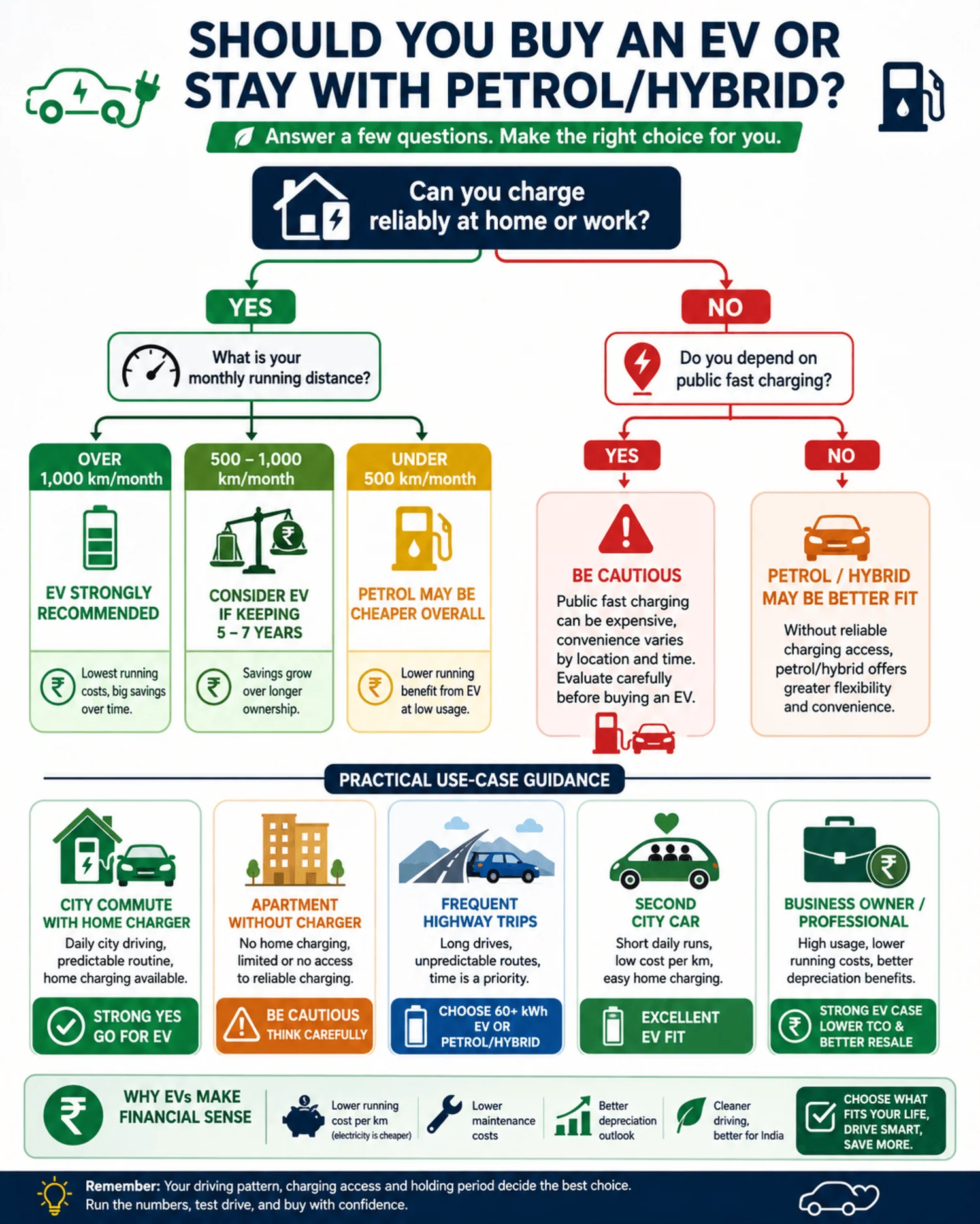
Want the shortest honest answer to “should I buy an EV in India in 2026?” Buy one only if you can charge reliably at home or work. If that single condition is met, a city-heavy user can save ₹70,000 to over ₹1 lakh a year on fuel, and the right EV becomes the most pleasant car you’ve ever owned. If that condition isn’t met, even a great EV turns into a daily chore.
All Electric Cars in India 2026: Complete List
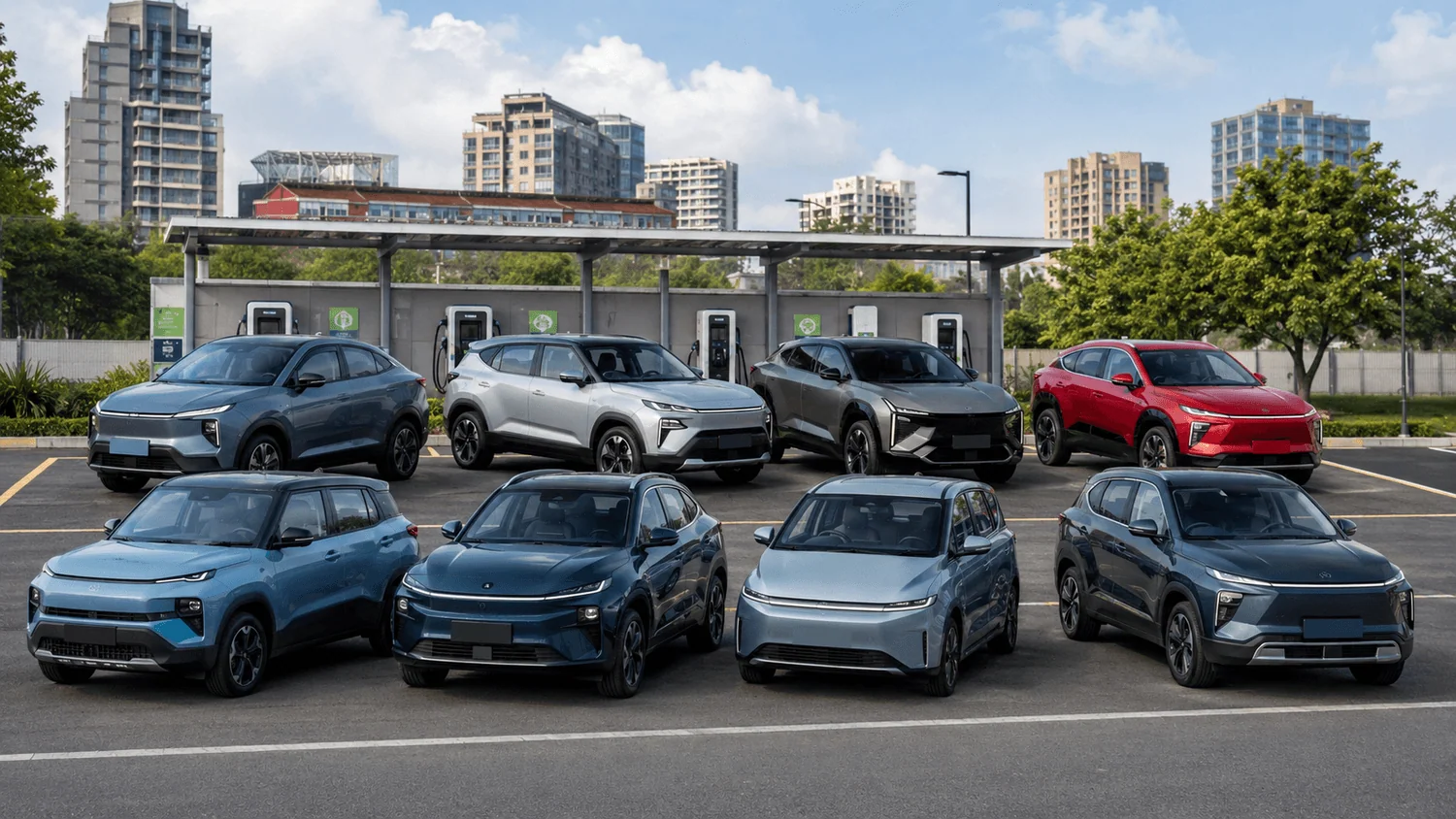
Most mainstream EVs sold in India today are built on dedicated electric platforms. Mahindra’s INGLO and Tata’s Acti.ev architectures have replaced the older approach of stuffing a battery into a petrol chassis. That means bigger battery capacities, flat floors, more cabin room, and better weight distribution. The other big shift is Battery-as-a-Service (BaaS). It lets you buy the car without owning the battery and pay a per-km fee instead.
Here’s every mainstream EV on sale in India in 2026, with verified ex-showroom prices, claimed range, and real-world tested figures where available.
| Model | Brand | Segment | Battery | Ex-Showroom Price | Claimed Range | Real-World Range |
|---|---|---|---|---|---|---|
| MG Comet EV | MG Motor | Micro hatch | 17.3 kWh | ₹6.99–10.00 lakh | 230 km | 160–193 km |
| Tata Tiago EV | Tata | Hatchback | 19.2 / 24 kWh | ₹7.99–11.89 lakh | 250–315 km | 180–220 km |
| Tata Punch EV | Tata | Micro SUV | 25 / 35 kWh | ₹9.69–13.94 lakh | 315–421 km | 260–350 km |
| Citroën eC3 | Citroën | Crossover hatch | 29.2 kWh | ~₹11.50–13 lakh | 320 km | 200–230 km |
| Tata Tigor EV | Tata | Sedan | 26 kWh | ~₹12.49 lakh | 315 km | 180–200 km |
| Mahindra XUV 3XO EV | Mahindra | Compact SUV | 39.4 kWh | ₹13.89–14.96 lakh | 351 km | up to 285 km |
| MG Windsor EV | MG Motor | CUV | 38 / 52.9 kWh | ₹13.99–18.50 lakh | 332–449 km | 250–330 km |
| Tata Nexon EV | Tata | Compact SUV | 30 / 45 kWh | ₹12.49–17.49 lakh | 275–489 km | 220–360 km |
| Maruti Suzuki e Vitara | Maruti | Compact SUV | 49 / 61 kWh | ₹15.99–20.01 lakh | up to 543 km | 350–400 km |
| Tata Curvv EV | Tata | Coupe-SUV | 45 / 55 kWh | ₹17.49–22.24 lakh | 430–502 km | 350–400 km |
| MG ZS EV | MG Motor | Compact SUV | 50.3 kWh | ₹17.99–20.50 lakh | 461 km | 330–380 km |
| Kia Carens Clavis EV | Kia | 7-seat MPV | 42 / 51.4 kWh | ₹17.99–21.99 lakh | 404–490 km | 360–410 km |
| Hyundai Creta Electric | Hyundai | Compact SUV | 42 / 51.4 kWh | ₹17.99–23.50 lakh | 390–473 km | 320–380 km |
| Mahindra BE 6 | Mahindra | Mid-size SUV | 59 / 79 kWh | ₹18.90–28.49 lakh | up to 682 km | 380–430 km |
| Tata Harrier EV | Tata | Mid-size SUV | 65 / 75 kWh | ₹21.49–28.99 lakh | up to 627 km | 380–420 km |
| Mahindra XEV 9e | Mahindra | Premium SUV | 59 / 79 kWh | ₹21.90–31.25 lakh | 542–656 km | 450–460 km |
| BYD Atto 3 | BYD | Premium SUV | 49.9 / 60.4 kWh | ₹24.99–33.99 lakh | 468–521 km | 380–420 km |
| BYD eMAX 7 | BYD | MPV | 55.4 / 71.8 kWh | ₹26.90–29.90 lakh | 420–530 km | 320–350 km |
| BYD Seal | BYD | Premium sedan | 61–82 kWh | ₹41.00–53.51 lakh | 510–650 km | 400–500 km |
| Hyundai Ioniq 5 | Hyundai | Luxury crossover | 72.6 kWh | ₹46.05 lakh+ | 631 km | 450–480 km |
A quick note on BaaS pricing. Standard prices above assume outright purchase. Several models offer dramatically lower entry prices if you take the BaaS route. The Tata Punch EV starts at ₹6.49 lakh with a ₹2.60/km battery rental. The MG Windsor EV starts at ₹9.99 lakh with a ₹3.90–4.50/km rental depending on battery size. Should you go BaaS? Only if you do the math honestly for your own monthly running. High-mileage users often end up worse off than they would on outright purchase.
Beyond this list sit the premium imports like Tesla Model Y, BMW iX, Mercedes EQS SUV, Volvo EX30, Audi e-tron GT, Kia EV6 and EV9. But for 99% of Indian EV buyers under ₹40 lakh, the table above is the real shortlist.
EVs Under ₹15 Lakhs
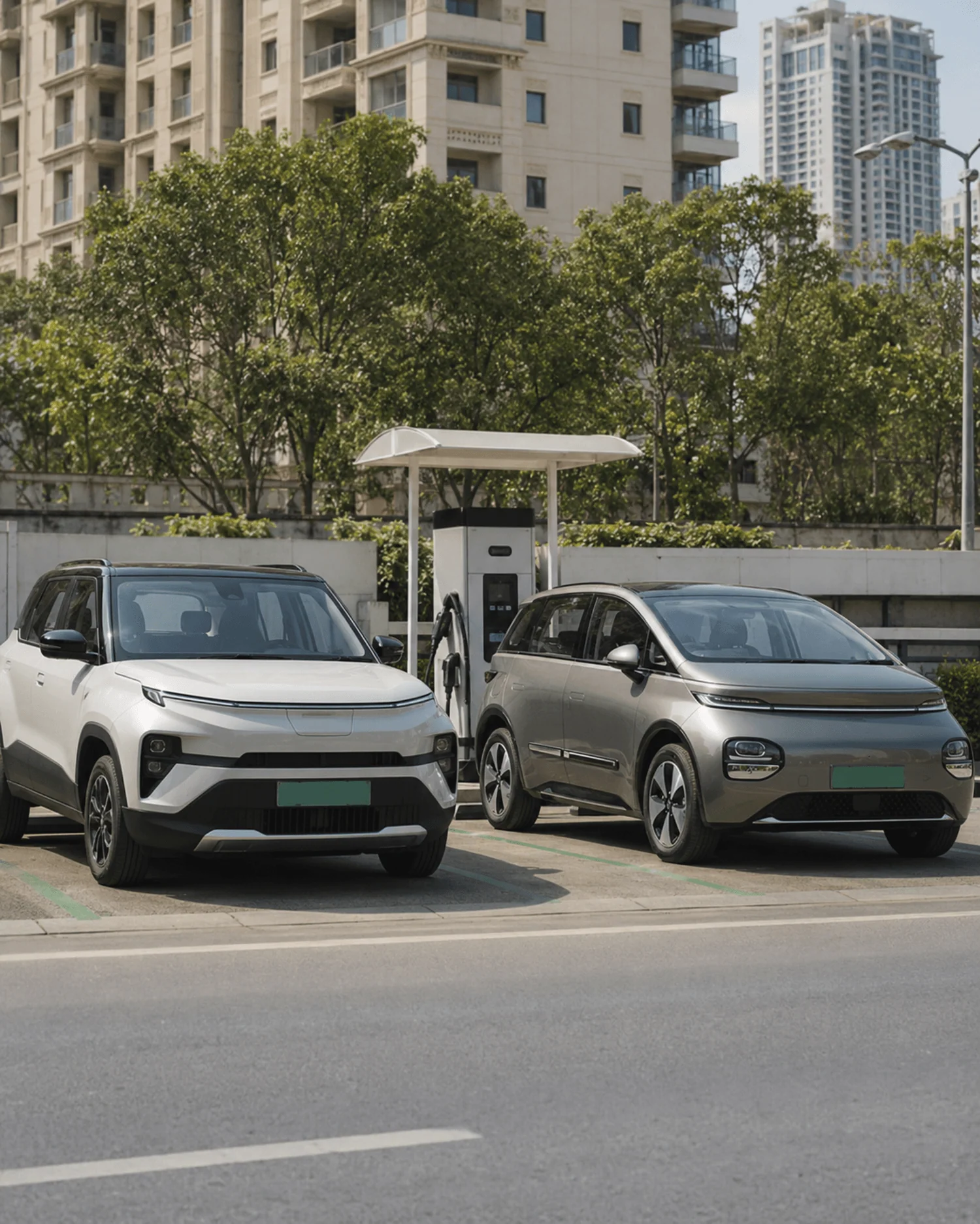
This is where electric cars stop being aspirational and start becoming practical for Indian buyers. The under-₹15 lakh segment has seen the most aggressive change in 2026, largely because BaaS has cut entry prices by up to 30%. The Tata Punch EV is now technically cheaper to buy than several mid-spec petrol Maruti Baleno variants. That’s if you accept the per-km battery fee, of course.
But there’s a hard truth in this price band you should know upfront. Below ₹15 lakh, most EVs are excellent city cars and only a few are convincing primary cars.
| EV Under ₹15 Lakh | Real-World Range | DC Fast Charging | Best For | Main Compromise |
|---|---|---|---|---|
| MG Comet EV | 160–180 km | Not supported (AC only) | Pure intra-city use | Two-door layout, no fast charging |
| Tata Tiago EV | 180–220 km | ~60 min 10–80% | Cheapest entry EV | Older platform, halogen lights |
| Tata Punch EV | 260–350 km | ~56 min 10–80% | Primary city commute | Highway aerodynamics |
| MG Windsor EV (38 kWh) | 250–330 km | ~55 min 10–80% | High-running urban use | BaaS recurring cost |
| Citroën eC3 | 200–230 km | ~50 min 10–80% | Basic A-to-B transit | Sparse features |
Tata Punch EV mini-review
Want one EV below ₹15 lakh that feels closest to a normal Indian family car rather than an experiment? The Punch EV is still your smartest option. Built on Tata’s Acti.ev architecture, it brings features like ventilated seats, a 360-degree camera and active safety packages into the sub-₹15L segment. Stuff that used to be reserved for premium SUVs.
Real-world range expectations are honest here. The 25 kWh standard battery delivers about 260 km in city use, while the 35 kWh long-range variant stretches to about 350 km. DC fast charging peaks at around 50 kW, taking roughly 56 minutes for a 10–80% top-up. The Punch EV’s biggest non-spec advantage is Tata’s 15-year lifetime battery warranty for the first owner on select variants. That directly defuses the biggest fear of first-time EV buyers, which is what happens to the battery after warranty.
City usability is excellent. Highway usability is acceptable, not great. The upright SUV shape works against it once you cross 90 km/h, and rear-seat knee room is tight for taller adults on long trips.
- Key advantage: Lifetime battery warranty, high ground clearance, India-friendly feature list
- Main compromise: Tight rear-seat knee room, poor highway aerodynamics
- Best variant to buy: Long Range (35 kWh) Empowered for the balance of range and tech
- Who should avoid it: Buyers who do 200+ km highway days regularly
MG Windsor EV mini-review
The Windsor isn’t styled like an SUV, and that’s the point. It’s a crossover that puts cabin space and rear-seat comfort ahead of road presence. Rear seats recline to 135 degrees, the panoramic glass roof is massive, and overall it’s the most comfortable chauffeur-driven EV under ₹20 lakh.
Real-world range from the 52.9 kWh Pro battery is around 330 km city, with the 38 kWh base at about 250 km. The fast charging curve is conservative compared to rivals. You’ll wait longer at public chargers than the spec sheet suggests. But the BaaS plan is genuinely disruptive in pricing. You can drive the Windsor off the lot for ₹9.99 lakh by subscribing to a ₹3.90–4.50/km battery fee, and MG backs the car with a 15-year unlimited-kilometre warranty for the first owner.
Run the numbers honestly though. Add the ₹3.90/km BaaS fee to your home electricity (~₹1.20/km) and your running cost works out to about ₹5.10/km. Still cheaper than petrol’s ₹7.10/km, but nowhere near the almost-free EV economics you may expect.
- Key advantage: Class-leading rear comfort, BaaS lowers entry barrier, 15-year warranty
- Main compromise: Slower DC charging curve, polarising styling
- Best variant to buy: Exclusive Pro 52.9 kWh for proper range buffer
- Who should avoid it: Highway-heavy drivers who need fast charging turnarounds
Best EV picks under ₹15 lakhs by use case
- Best city commute EV: MG Comet, if you live in a dense metro where parking matters more than range
- Best low-running EV: MG Comet again. Tiny battery, ridiculously cheap to run
- Best high daily running EV: MG Windsor (38 kWh). Interior comfort makes 50+ km/day in traffic bearable
- Best second car: MG Comet under BaaS (~₹4.99 lakh starting) for school runs and errands
- Best family EV under ₹15 lakh: Tata Punch EV (outright purchase). Safest, most feature-rich, real warranty backbone
EVs Under ₹25 Lakhs
This is the most important EV price band in India. It’s where electric cars compete head-to-head with the Hyundai Creta, Kia Seltos, Maruti Grand Vitara, Toyota Hyryder and diesel SUV budgets. Buyers here are replacing their primary household vehicle and expect zero compromises. Your car must handle both daily commutes and inter-city runs without inducing range anxiety.
Here’s how the ₹15–25 lakh shortlist stacks up:
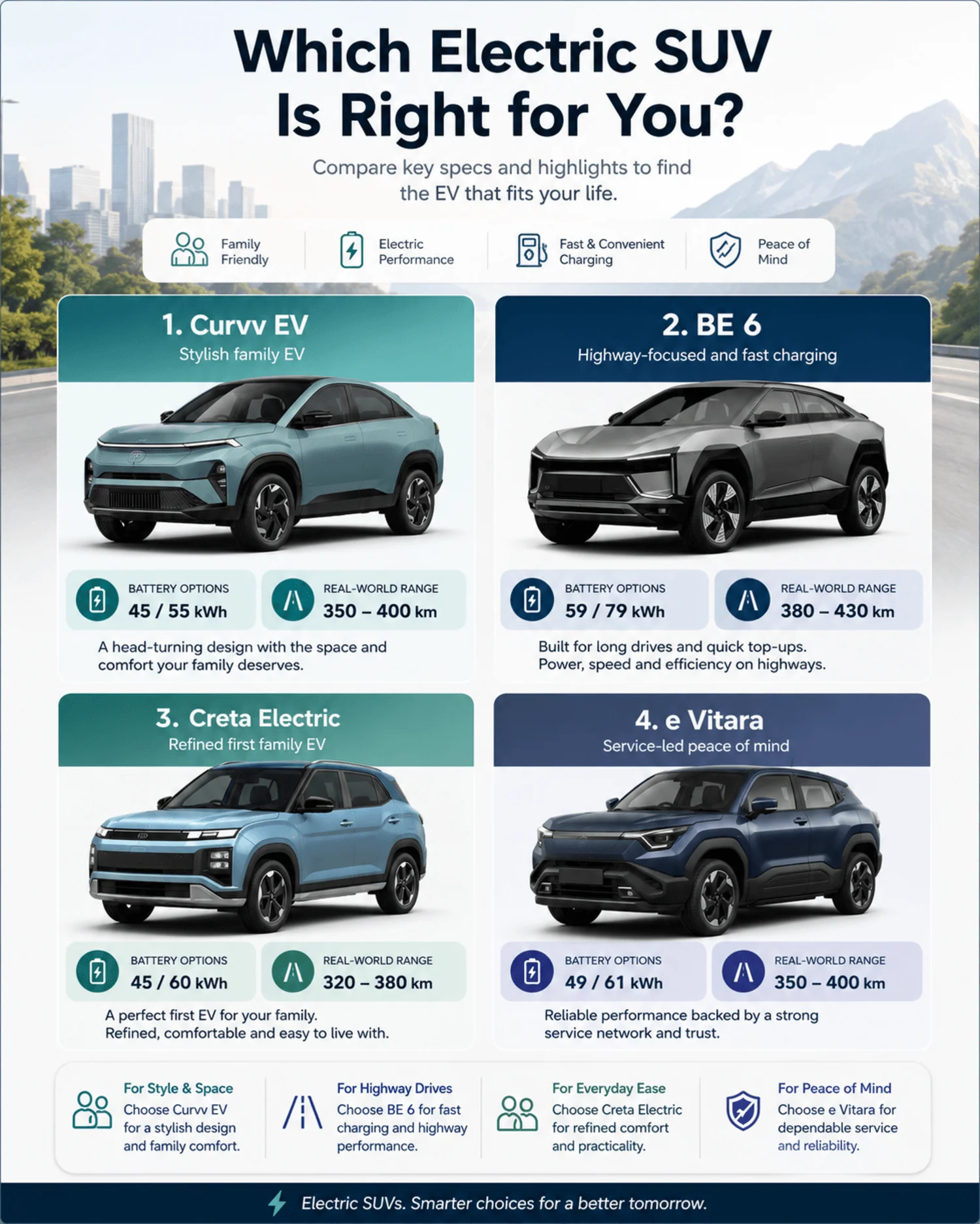
| EV Under ₹25 Lakh | Battery | Real-World Range | Fast Charging | Best For |
|---|---|---|---|---|
| Maruti Suzuki e Vitara | 49 / 61 kWh | 350–400 km | up to 70 kW | Service-led ownership peace of mind |
| Tata Curvv EV | 45 / 55 kWh | 350–400 km | up to 70 kW | Style-conscious family buyers |
| MG Windsor EV Pro | 52.9 kWh | 330–360 km | ~55 kW | Urban family with rear-seat focus |
| MG ZS EV | 50.3 kWh | 330–380 km | up to 76 kW | Mature compact family SUV |
| Hyundai Creta Electric | 45 / 60 kWh | 320–380 km | up to 100 kW | Refined first family EV |
| Kia Carens Clavis EV | 42 / 51.4 kWh | 360–410 km | up to 100 kW | 7-seat family duty |
| Mahindra BE 6 | 59 / 79 kWh | 380–430 km | up to 175 kW | Highway-focused buyers |
| Tata Harrier EV (entry) | 65 kWh | 350–390 km | up to 70 kW | Big-SUV form factor in EV |
| Mahindra XEV 9e (entry) | 59 kWh | 380–430 km | up to 175 kW | Premium EV under luxury money |
A 60+ kWh battery is roughly the threshold in Indian conditions where a fully loaded car running maximum AC at 100 km/h can reliably clear 300 km between charges. Smaller 30–45 kWh batteries are excellent for city duty, but they force you to stop every 180–200 km on the highway. That doesn’t always line up with where reliable fast chargers actually exist.
Hyundai Creta Electric mini-review
For a first-time EV buyer coming from a Creta, Seltos or mid-size petrol SUV, the Creta Electric is the easiest transition you can make. It looks like a petrol Creta, drives like a refined petrol Creta, and Hyundai’s service reach (over 1,500 service touchpoints) means parts and warranty work get handled like any other Hyundai.
In Autocar India’s real-world testing, the 51.4 kWh long-range version returned roughly 432 km overall, with city/highway split at about 480 km city and 375–380 km highway. That’s one of the best efficiency numbers in this segment. Hyundai gives an 8-year/160,000 km battery warranty as standard, with extensions available on premium variants.
The Creta Electric also supports 100 kW DC fast charging, faster than most rivals in this price band, and 11 kW AC home charging. It isn’t the cheapest path to EV ownership, but it’s almost certainly the least intimidating.
- Key advantage: Unmatched refinement, real 100 kW fast charging, stellar service network
- Main compromise: Looks too similar to the petrol Creta, FWD only
- Best variant to buy: Long Range 60 kWh for unrestricted highway use
- Who should avoid it: Buyers who want a distinct born-electric design
Maruti Suzuki e Vitara mini-review
The e Vitara matters less for its spec sheet and more for what’s behind it. Maruti Suzuki operates 5,400+ service touchpoints across over 3,000 cities and towns in India. That’s roughly 3x Hyundai’s reach and 6x Tata’s. For a first-time EV buyer worried about service availability outside metros, that single fact may matter more than any range or feature comparison.
The car itself is sensible. The 61 kWh top variant delivers around 350–400 km real-world depending on use, with the 49 kWh base targeting city-first buyers. Fast charging tops out at 70 kW. That’s slower than Creta Electric’s 100 kW. But Maruti’s BaaS-style charger installation support and EV-trained dealer technicians address the parts of ownership that actually frustrate buyers.
Early Indian impressions suggest a clear city efficiency advantage over highway efficiency. Expect a comfortably usable city primary car and a more planning-heavy highway car. The Maruti badge also brings the strongest resale market trust in India. That isn’t a small thing in a segment where battery degradation worries depress prices fast.
- Key advantage: India’s largest service network, ownership familiarity, sensible pricing
- Main compromise: Slower fast charging, conservative styling
- Best variant to buy: 61 kWh top trim for proper range buffer
- Who should avoid it: Buyers who want long-term Indian ownership data right now (it’s a new launch)
Tata Curvv EV mini-review
The Curvv EV is what most Nexon EV shoppers end up stretching to once they see it. More boot space, more style, better main-car presence. The 55 kWh long-range version returned about 365 km in Autocar India’s real-world test, with city and highway figures close enough that intercity use feels less fragile than smaller-battery EVs.
Tata gives a 15-year lifetime battery warranty on the 55 kWh Curvv EV for the first private owner. That’s an unusually strong long-term reassurance. The trade-off? You’re paying ₹17.49–22.24 lakh, and you’re still inside Tata’s ecosystem with its strong hardware value but service consistency that can vary by workshop and city.
- Key advantage: 15-year battery warranty, real-world range you can plan around
- Main compromise: Coupe styling cuts rear headroom, service consistency varies by city
- Best variant to buy: 55 kWh long-range
- Who should avoid it: Buyers who want maximum rear headroom or hate the coupe shape
Mahindra BE 6 mini-review
The BE 6 changes the value equation. For ₹18.90 lakh starting, you get a 59 kWh battery, with the 79 kWh option pushing into territory that used to belong only to ₹35 lakh+ imports. Mahindra claims roughly 500 km real-world for the 79 kWh version, while independent testing has shown a combined real-world figure of about 449 km. Still one of the highest in the Indian market under ₹30 lakh.
The BE 6 is built on Mahindra’s INGLO skateboard platform. Flat floor, low CG, rear-wheel-drive dynamics that genuinely feel engaging. It supports up to 175 kW DC fast charging, which (when you find a charger that fast) unlocks 10–80% in roughly 20 minutes. Mahindra now extends a lifetime battery warranty for the first registered private owner on select variants.
The catch is first-generation tech. The infotainment software has shown early-generation lag, and Mahindra’s EV-specific service network is still scaling up in Tier-2 locations. Conservative buyers should wait six months and watch the owner forums.
- Key advantage: Massive real-world range, 175 kW fast charging, lifetime battery warranty
- Main compromise: New-product complexity, infotainment software bugs
- Best variant to buy: Pack Three (79 kWh) to fully use the platform
- Who should avoid it: Risk-averse buyers who want a settled, proven product
Mahindra XEV 9e mini-review
Think of the XEV 9e as the more premium, more spacious, more polished sibling of the BE 6. Same 79 kWh battery option, same INGLO platform. But it’s in a broader, more imposing package targeting Creta Electric, Harrier EV and entry-luxury EV shoppers.
In real-world testing, the 79 kWh XEV 9e returned 456 km overall against an MIDC claim of 656 km. That works out to an efficiency of about 5.78 km/kWh despite its heavy kerb weight. More importantly, its highway range (488 km in Autocar’s test) was actually higher than its city range (425 km). That’s unusual for an EV and suggests excellent aerodynamics. It also gets ultra-fast 175 kW DC charging support and a triple-screen futuristic dashboard layout.
Need an EV that can do 400 km between fast-charge stops without anxiety? This is the cheapest way to get there in 2026.
- Key advantage: Highest real-world range under ₹35 lakh, engaging RWD handling, fast charging
- Main compromise: Large footprint makes urban parking cumbersome, software still maturing
- Best variant to buy: Pack Three (79 kWh). Pack One is too compromised on range
- Who should avoid it: Buyers who do mostly short city commutes and won’t exploit the big battery
Real-World Range Comparison: ARAI vs Reality
This is the section most EV listicles in India don’t write honestly. ARAI and MIDC numbers are useful for comparing two EVs against each other under the same test cycle. But they consistently overstate what you’ll see in real Indian driving. Dense traffic, summer heat, AC on full, mixed road quality, irregular highway speeds. They all eat into range.
Across India-based road tests, real-world range is 20–30% lower than ARAI on average. The bigger the battery, the wider the gap tends to be. Partly because larger EVs are heavier, and partly because the highway aerodynamic penalty scales with the square of speed.
| Model | Claimed Range (ARAI/MIDC) | Real-World City | Real-World Highway | Range Confidence |
|---|---|---|---|---|
| MG Comet EV | 230 km | ~190 km | Not recommended | High for city |
| Tata Tiago EV | 275 km | 187 km combined | n/a | Moderate |
| Citroën eC3 | 246 km | 228 km combined | n/a | High |
| MG Windsor EV (38 kWh) | 332 km | 308 km combined | n/a | High for city |
| Tata Punch EV (40 kWh) | 421 km | 335–350 km | 270–290 km | Moderate |
| Tata Nexon EV (45 kWh) | 489 km | 340–360 km | 290–310 km | High |
| MG ZS EV | 461 km | 339 km combined | n/a | High |
| Tata Curvv EV (55 kWh) | 502 km | 371 km city | 358 km highway | High |
| Kia Carens Clavis EV (51.4 kWh) | 490 km | 370 km city | 350 km highway | Moderate |
| Hyundai Creta Electric (60 kWh) | 473 km | 380–400 km | 330–350 km | High |
| Tata Harrier EV (75 kWh AWD) | 627 km | 409 km city | 393 km highway | High |
| Mahindra BE 6 (79 kWh) | 682 km | 440–460 km | 440–460 km | High |
| Mahindra XEV 9e (79 kWh) | 656 km | 480–500 km | 430–450 km | Excellent |
Why does highway range drop faster than city range? Petrol engines use multi-speed gearboxes that stay near optimal RPM at high speed. EVs have a single-speed reduction gear, so the motor spins exponentially faster as speed climbs. Worse, aerodynamic drag rises with the square of velocity. Cruising at 120 km/h pulls battery roughly 35% faster than at 80 km/h. That’s why the same EV that returns 380 km in mixed city use might struggle past 300 km on a Mumbai-Pune Expressway run.
Range by use case
| Use Case | Range Impact | What This Means |
|---|---|---|
| City traffic (regen active) | Better efficiency | EVs love stop-and-go. Regen recovers braking energy |
| 80–100 km/h highway | 15–20% drop | Plan one buffer charging stop on routes over 250 km |
| 110+ km/h highway | 30–40% drop | Range collapses fast. Avoid sustained high speed |
| Full load + AC at peak summer | 10–15% drop | AC compressors draw 1–2 kW continuously |
| Monsoon / night driving | 5–10% drop | Wipers, headlights, road resistance all add up |
Practical rule for Indian EV buyers: Always plan with a 20–30% range buffer below the ARAI number. A 450 km claimed EV is actually a 320–360 km real-world car on the highway. And range anxiety is really charging anxiety in disguise. A 450 km range is meaningless if the only DC fast charger on your 300 km route is offline. Always verify charger uptime using PlugShare or operator apps before a long trip.
Video Explaining Electric Car Charging Cost and Running Cost in India 2026

Charging Infrastructure Status: The Real Picture
India’s charging network has expanded dramatically. By early 2026, the country has approximately 39,500 public chargers operational, including 8,414+ DC fast chargers. The government’s PM E-DRIVE scheme has allocated ₹2,000 crore specifically for public charging and battery-swapping infrastructure under the larger ₹10,900 crore programme.
But raw numbers hide the real story. India currently has about one charger per 235 EVs. The global benchmark is one per 6–20 EVs. We’re not yet at parity with our own fleet growth, which is why your experience of public charging depends heavily on where you live.
The major operators in 2026:
- Tata Power EZ Charge: 6,700+ public/fleet points across 630+ cities, plus 200,000+ home chargers
- ChargeZone: 13,500+ stations nationally
- Statiq: 7,000–8,000+ stations across 63+ cities
- Jio-bp pulse, Kia K-Charge, MG Charge, Hyundai charger network: thousands more, with overlap
Tata Motors has announced a target of 400,000 charge points by 2027 under its Open Collaboration framework with Tata Power, Statiq, ChargeZone and Zeon. The government, working with BHEL, is developing a unified Super App that promises UPI-like interoperability across operators. So you don’t need a dozen apps to charge on a single road trip.
The reality of home and apartment charging
Home charging is the single biggest factor in EV ownership satisfaction. Only about 55% of Indian EV owners currently have access to a dedicated home charger. The other 45% rely on a mix of public AC, public DC, office or fleet charging. And it’s the harder ownership experience.
For apartment dwellers, the friction is real. Upgrading an electrical panel in an older residential complex to support a 3.3 kW or 7.2 kW EV meter typically costs ₹10,000 to ₹50,000 per parking slot. Resident Welfare Associations (RWAs) frequently block installations over fire safety concerns, disputes about shared infrastructure costs, or simple lack of awareness about state EV-readiness mandates. Delhi and Maharashtra have building codes mandating 20% EV-ready parking in new projects, but retrofitting older buildings is still stuck in coordination limbo across most cities.
Living in an apartment? Get RWA written approval and a quote for the meter upgrade before booking your EV. Not after.
City-wise charging reality
| City | Public Charging | Apartment Charging Ease | Highway EV Suitability | Buyer Verdict |
|---|---|---|---|---|
| Delhi NCR | High | Medium | Good on most routes | Excellent EV city. Dense infra, progressive state policy |
| Bengaluru | High but uneven | Challenging | Improving | Good with home charging. Fleet demand congests public points |
| Mumbai | Medium / High | Challenging | Improving | Works if you have fixed parking. Older buildings resist EV infra |
| Pune | Medium / High | Medium | Good (Mumbai E-way) | Excellent highway connectivity, growing IT hubs |
| Hyderabad | High | Medium | Good | Domestic tariffs (₹5–9/kWh) make home charging economical |
| Chennai | Medium | Medium | Improving | Strong corridors building toward Bengaluru |
| Ahmedabad | Medium / High | Medium | Good | Gujarat corridor infrastructure is among India’s strongest |
| Kochi | Medium | Medium | Improving | Kerala network growing fast. DC chargers still sparse |
| Chandigarh | High | Easy | Excellent | Planned-city architecture eases home charger installation |
| Jaipur | Medium | Medium | Good (Delhi E-way) | Strategic NCR corridor location |
| Kolkata | Low / Medium | Challenging | Fair | Infra still nascent. Rely strictly on home charging |
| Lucknow | Low / Medium | Medium | Fair | UP EV policy is helping, but rollout outside city is slow |
| Indore | Medium | Medium | Improving | Emerging Tier-2 hub with dedicated EV zones |
| Surat | Medium | Medium | Good | Mumbai-Ahmedabad corridor strength |
| Coimbatore | Medium / High | Medium | Excellent | Benefits from Tamil Nadu highway infra push |
For your specific route, don’t trust a charger marker on a map. Use PlugShare or EV Yatra to check user check-ins from the last few days, verify connector compatibility, and have a backup station identified. A nearby charger that’s been offline for three weeks is worse than no charger at all.
EV Running Cost vs Petrol: Honest Math for 2026
This is where electric cars genuinely win in India, but only under specific conditions. If you’re a high-mileage user with home charging, the economic case is overwhelmingly positive. If you’re a low-usage buyer who depends on public DC fast charging, the math is much closer than EV marketing suggests.
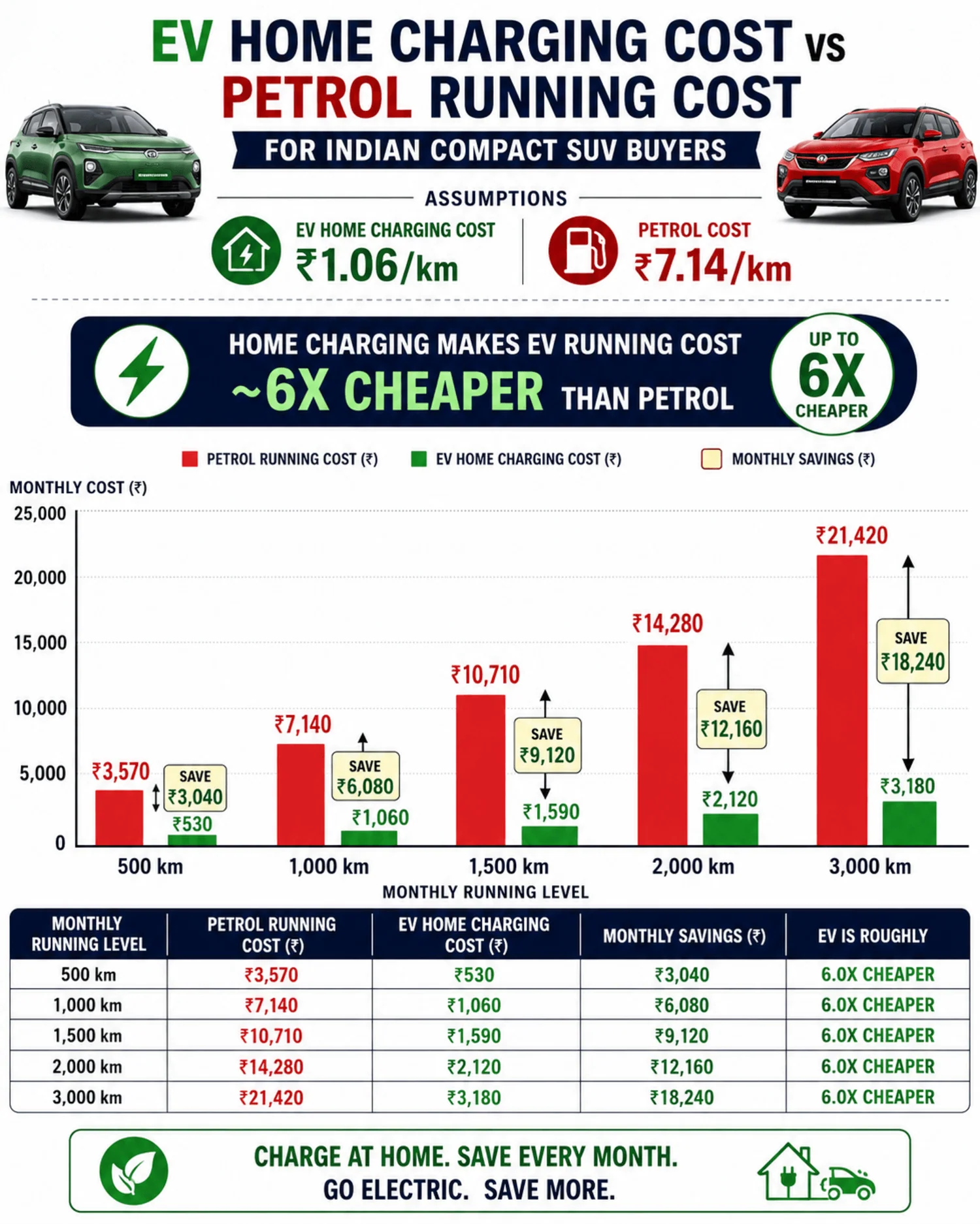
Here’s the 2026 cost-per-km breakdown using verified assumptions. Home electricity at ₹8/kWh (national average), public AC at ₹11–12/kWh, public DC fast charging at ₹20/kWh, petrol at ₹101.33/litre (2026 metro average), EV efficiency at 7.5 km/kWh, petrol efficiency at 14 km/litre for an equivalent compact SUV.
| Vehicle Type | Energy/Fuel Price | Efficiency | Cost per Km |
|---|---|---|---|
| EV (Home AC charging) | ₹8/kWh | 7.5 km/kWh | ₹1.06/km |
| EV (Public AC charging) | ₹12/kWh | 7.5 km/kWh | ₹1.60/km |
| EV (Public DC fast charging) | ₹20/kWh | 7.5 km/kWh | ₹2.66/km |
| Petrol car (compact SUV) | ₹101.33/litre | 14 km/litre | ₹7.14/km |
That’s a real 6–7x savings on home charging. And even on public DC fast charging, EVs still come out about ₹4.50/km cheaper than petrol.
Monthly and annual savings
| Monthly Running | Petrol Cost | EV Home Charging Cost | Monthly Savings | Annual Savings |
|---|---|---|---|---|
| 500 km | ₹3,570 | ₹530 | ₹3,040 | ₹36,480 |
| 1,000 km | ₹7,140 | ₹1,060 | ₹6,080 | ₹72,960 |
| 1,500 km | ₹10,710 | ₹1,590 | ₹9,120 | ₹1,09,440 |
| 2,000 km | ₹14,280 | ₹2,120 | ₹12,160 | ₹1,45,920 |
| 3,000 km | ₹21,420 | ₹3,180 | ₹18,240 | ₹2,18,880 |
For a buyer doing a realistic 1,200 km/month, the annual operational saving is around ₹91,000. That figure already includes the lower EV maintenance bill, roughly ₹3,500/year against petrol’s ₹7,500/year because EVs skip engine oil, spark plugs and timing belts.
The break-even reality
The EV Green Premium, which is the extra upfront cost over a comparable petrol car, sits around ₹3.5–4 lakh for compact SUVs on outright purchase. Using the ₹91,000/year operational saving, the break-even period is roughly 4.4 years for a moderate-mileage buyer. If you drive 2,000+ km a month, break-even drops to under 3 years. Drive under 500 km a month and you’ll need over a decade to recover the premium. Petrol is genuinely cheaper for you overall in that case.
A few honest nuances most EV-vs-petrol comparisons skip:
- Insurance is higher on EVs. Expect approximately ₹1.25 lakh in EV insurance premiums over 5 years versus ₹70,000 for an equivalent petrol car. Insurers price in the higher vehicle value, battery replacement cost and repair complexity.
- Tyre wear is faster. The heavy battery pack increases load on tyres. Budget for replacements every 35,000–40,000 km versus 45,000–50,000 km on petrol.
- Public DC charging cuts savings sharply. If you’re forced to rely on ₹20+/kWh DC fast charging because you can’t charge at home, monthly costs for 1,200 km rise to ₹3,200+ instead of ₹1,300. Still cheaper than petrol’s ₹8,500, but the gap narrows significantly.
- Business owners get extra benefits. EVs qualify for a 40% income tax depreciation benefit annually against just 15% for ICE vehicles. That’s a substantial hidden saving for SMEs and self-employed buyers.
For most Indian buyers, the cost equation comes down to one variable: can you charge at home? If yes, EV economics are dramatic. If no, the gap narrows but EVs still win on cost per km, just not by the headline 6x multiplier.
Battery Warranty, Degradation and Long-Term Ownership
The largest psychological hurdle to EV adoption isn’t price or range. It’s the fear of what happens to your battery in year 8. Real-world telematics data across tens of thousands of EVs shows average annual battery degradation of just 2.3%. In Indian conditions, a mainstream EV battery is expected to last 10–12 years (or 1,500–3,000 charge cycles) before its capacity drops below the 70% useable threshold.
Degradation depends heavily on charging habits. Repeatedly charging to 100% and holding there, or letting the battery drop below 10% for long periods, accelerates wear. Habitual reliance on 100+ kW DC fast charging also speeds up degradation. India’s hot climate adds a mild penalty, which is why every modern Indian EV in this guide ships with active liquid thermal management.
Out-of-warranty replacement is still expensive. A full pack replacement costs ₹4.2 lakh for a small 30 kWh Tata Nexon pack and up to ₹8.8 lakh for a 50 kWh MG ZS EV pack. That’s exactly why the new wave of warranty offers matters so much.
The 2026 warranty landscape at a glance:
- Tata Motors: 15-year / unlimited km lifetime battery warranty for the first private owner on Curvv EV, Nexon EV 45, and select Punch EV variants
- MG Motor: 15-year / unlimited km lifetime battery warranty for the first owner on Windsor EV, ZS EV and Comet
- Mahindra: Lifetime battery warranty for the first registered private owner on select BE 6 and XEV 9e variants
- Hyundai, Kia: Standard 8-year / 160,000 km on traction battery with longer coverage on premium trims
- Maruti Suzuki: 8-year / 160,000 km on e Vitara
- BYD: 8-year / 160,000 km on traction battery, motor and motor controller
Resale value remains complex. Early-generation EVs with sub-25 kWh batteries depreciate 55–60% over 5 years, far worse than petrol. But the new 15-year warranties and larger 50+ kWh packs are stabilising the secondary EV market. Modern EVs are projected to retain value closer to traditional ICE depreciation curves.
Safety, AVAS and 2026 regulations
EVs in India now comply with AIS-038 Rev.2 safety standards, which require rigorous thermal runaway propagation testing and IP67 water ingress protection on battery packs. That means modern EVs are sealed and rated to handle submersion in up to one meter of water for 30 minutes without electrical leakage. They’re genuinely safer in monsoon flooding than ICE cars, which can take in water through the exhaust.
From October 2026, India also mandates an Acoustic Vehicle Alerting System (AVAS) on all EVs. That’s a synthetic low-speed sound to warn pedestrians of the otherwise silent vehicle.
For state-wise EV road tax benefits, most Indian states still offer significant exemptions in 2026, though policies are tightening. Delhi, Maharashtra, Tamil Nadu and Rajasthan continue with 100% road tax exemption on EVs. But Karnataka changed its policy in April 2026 and now applies a 5–10% tiered road tax on four-wheeler EVs. Always confirm the current position with your local RTO before booking.
Are EVs Worth Buying in India in 2026?
The short answer? Yes, but only under specific conditions. Here’s the honest decision matrix.
| Buyer Situation | EV Recommendation | Why |
|---|---|---|
| Home charger + city commute | Strong yes | Optimal use case. Zero friction, max savings |
| Apartment without home charger | Be cautious | Public charging adds friction, cost and battery wear |
| Frequent unplanned highway trips | Choose 60+ kWh EV or stick with petrol | Range buffer matters. Route planning required |
| Low usage under 500 km/month | Petrol may be cheaper overall | Break-even stretches beyond 10 years |
| High daily running (50+ km/day) | EV saves significantly | Unlocks ₹10,000+ monthly savings |
| Second car for city errands | Excellent fit | MG Comet, Tata Tiago EV, Punch EV are perfect |
| Business owner / GST registered | Strong yes | 40% income tax depreciation is a hidden ₹2 lakh/year benefit |
EVs are worth buying if:
- You have a reliable home or office parking spot where a 3.3 kW or 7.2 kW dedicated charger can be installed safely
- Your daily running is highly predictable, primarily within city limits or suburban corridors
- Your monthly distance exceeds 1,000 km. That’s the threshold where operational savings actively recover the EV premium
- You’re comfortable with some route planning for highway trips, verifying charger uptime before departure
- You plan to keep the car for at least 5–7 years to maximise return on the upfront investment
EVs may not be worth buying if:
- You rely entirely on street parking or live in an older apartment where RWA permission for wiring is impossible
- Your monthly running is very low (under 500 km). Capital deployed into the EV premium would do better in fixed deposits
- Your primary use case involves spontaneous long-distance interstate travel through remote regions where fast charging is non-existent
- You depend almost entirely on public DC fast charging, which both accelerates battery wear and triples your running cost
- Complete fuel-station flexibility with zero trip planning is non-negotiable for your lifestyle
Buy a Tata Punch EV or Nexon EV if you want the most familiar mass-market EV ownership experience. Buy a Hyundai Creta Electric if you want refinement and reduced ownership anxiety. Buy an MG Windsor Pro if rear-seat comfort and urban family use matter more than driver appeal. Buy a Mahindra BE 6 or XEV 9e if long real-world range is your primary requirement. Buy a Kia Carens Clavis EV if you genuinely need three rows. Stay with petrol or a strong hybrid if home charging is uncertain or your driving is too irregular to justify the EV premium.
For first-time buyers, also check our new car delivery checklist and the list of things to check before buying a car so you don’t miss EV-specific PDI items like battery health certificate, charger box delivery and AVAS testing.
FAQs
Which is the best electric car in India in 2026?
It depends on usage. For mass-market buyers, the Tata Nexon EV and Punch EV are the safest all-rounders thanks to wide service support. The MG Windsor EV offers the best comfort-and-value combo under BaaS. The Mahindra XEV 9e delivers class-leading highway range. The Hyundai Creta Electric is the most refined first EV with stellar service backing.
Which is the best EV under ₹20 lakh in India?
The Tata Curvv EV, MG Windsor EV Pro and Maruti Suzuki e Vitara dominate the sub-₹20 lakh segment. They offer battery capacities above 45 kWh, real-world ranges crossing the 350 km mark, and the safety and feature density that make them capable primary family cars.
Is an EV worth buying in India in 2026?
Yes, if you can charge at home and drive over 1,000 km a month. Operational savings of about ₹1.20/km against petrol’s ₹7.10/km actively recover the EV premium within 4–5 years. No, if you depend on public charging for daily use or drive less than 500 km a month.
How much does EV charging cost in India?
Home charging on a standard domestic tariff (averaging ₹8/kWh) costs ₹250–450 for a full charge depending on battery size. Public AC costs ₹10–15/kWh. Public DC fast charging ranges from ₹18 to ₹25 per kWh, which reduces the cost advantage over petrol.
What is the running cost of an electric car per km?
Charged at home, an EV in India costs approximately ₹1.06–1.20/km. Using public DC fast charging pushes it to ₹2.50–3.30/km. An equivalent petrol car costs ₹7.00–7.50/km at 2026 fuel prices.
What is the real-world range of electric cars in India?
Real-world range is typically 20–30% lower than the ARAI/MIDC claim because of AC loads, traffic and highway speeds. A 30 kWh battery delivers roughly 220–250 km. A 50 kWh battery yields about 330–380 km. A 79 kWh battery (BE 6, XEV 9e) returns 430–460 km in Indian conditions.
Are EVs good for long drives?
Only the right ones. EVs with 50+ kWh batteries (the Mahindra XEV 9e, Tata Harrier EV, Hyundai Creta Electric LR, Mahindra BE 6) handle long drives comfortably. Smaller-battery EVs like the Comet, Tiago EV and base Nexon EV aren’t built for sustained highway use. Speeds above 100 km/h hurt EV range noticeably due to aerodynamic drag.
Is home charging necessary for an EV?
Not legally, but practically it’s essential for a frictionless ownership experience. Most Indian EV owners charge primarily at home, and relying exclusively on public charging accelerates battery wear, multiplies running cost, and is operationally inconvenient.
How long does an EV battery last?
Real-world telematics data shows average battery degradation of about 2.3% per year. In Indian conditions, EV batteries are expected to last 10–12 years (1,500–3,000 charge cycles) before dropping below 70% capacity. Tata and MG now offer 15-year lifetime warranties on key models, which effectively neutralises the long-term degradation concern.
What is the battery replacement cost of electric cars in India?
Out-of-warranty replacement costs ₹3.5 lakh for a small 25 kWh pack and up to ₹8.8 lakh for a 50 kWh pack. With 8-to-15-year warranties now standard on most mainstream EVs, very few first owners will actually pay this cost during the car’s typical lifecycle.
Which brand has the best EV service network in India?
Tata Motors has the largest EV-specific service network aligned with its market leadership. Maruti Suzuki (5,400+ touchpoints) and Hyundai (1,500+ service centres) have the largest overall networks and are rapidly upskilling technicians for EVs. Mahindra and MG are expanding fast, particularly in metros. BYD’s network is still limited. Check your nearest dealer before buying.
Are EVs cheaper to maintain than petrol cars?
Yes. EVs have roughly 20 moving parts in the drivetrain versus 2,000+ in a petrol engine. Annual scheduled maintenance for an EV costs ₹3,500–7,000 against ₹7,500–20,000 for a comparable petrol car. But budget for slightly higher tyre replacement costs and noticeably higher insurance premiums.
Which EV has the longest range in India?
In the mass-market and premium segment, the Mahindra XEV 9e (79 kWh) offers one of the highest real-world ranges at 450–460 km. The Tata Harrier EV (75 kWh AWD) and Mahindra BE 6 (79 kWh) are close behind. Luxury options like the Hyundai Ioniq 5 (72.6 kWh) and Mercedes-Benz EQS can approach or exceed 500 km real-world.
Are EVs safe in Indian rain and floods?
Yes. All modern EV battery packs comply with AIS-038 Rev.2 safety standards and are IP67-rated. That means they’re completely sealed and can withstand submersion in up to one meter of water for 30 minutes. They’re actually more resilient in monsoons than petrol cars because they don’t have exhaust pipes that can ingest water. Driving through severe floods remains dangerous for any vehicle though.
Should I buy an EV or petrol car?
Buy an EV if your daily commute is predictable, home charging is available, and your monthly running exceeds 1,000 km. Buy petrol or a strong hybrid if charging infrastructure in your residential area is non-existent, your monthly running is very low, or frequent unplanned long-distance travel through remote areas is a regular part of your life.
Prices and specifications are as of 2026 and may change. Always verify current ex-showroom price and on-road price with your local dealer before booking. Real-world range figures are based on independent Indian road tests where available, otherwise on buyer-planning estimates from comparable battery sizes and Indian use conditions.