Buying a new car is one of the biggest financial decisions you’ll make. Start by checking the on-road price in your city to know what you’ll actually pay. And yet, most buyers walk into a dealership focused entirely on the model and colour, only to miss critical checks that cost them lakhs in the long run.
This isn’t another vague “do your research” article. Below is a structured, 25-point checklist that covers exterior paint, VIN decoding, engine checks, document verification. Print it out. Save it on your phone. Take it to the dealership. That’s exactly what it’s built for.
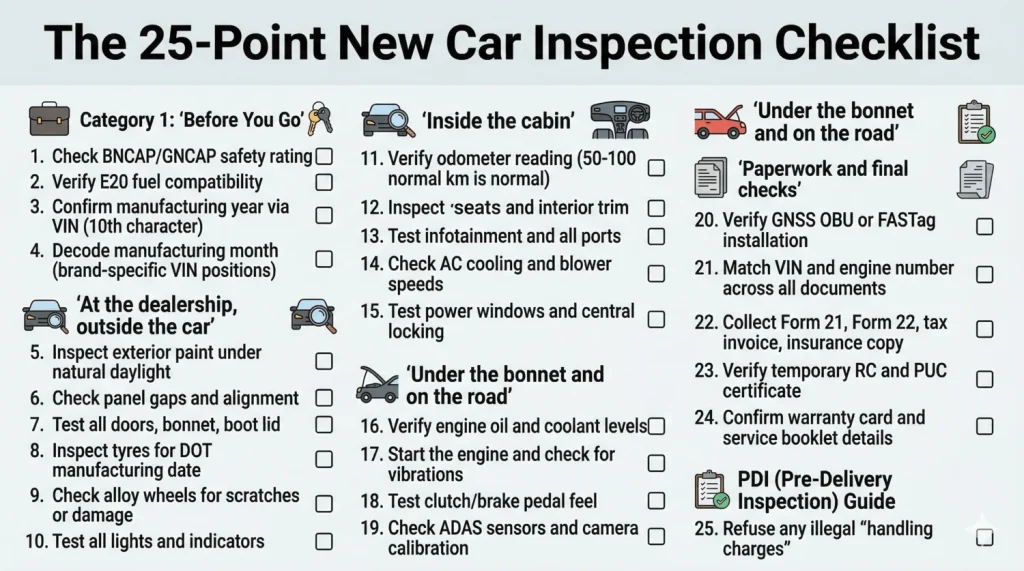
Here’s the quick checklist before we break each point down:
Before you even go to the dealership:
- Check BNCAP/GNCAP safety rating
- Verify E20 fuel compatibility
- Confirm manufacturing year via VIN (10th character)
- Decode manufacturing month (brand-specific VIN positions)
At the dealership, outside the car:
- Inspect exterior paint under natural daylight
- Check panel gaps and alignment
- Test all doors, bonnet, boot lid
- Inspect tyres for DOT manufacturing date
- Check alloy wheels for scratches or damage
- Test all lights and indicators
Inside the cabin:
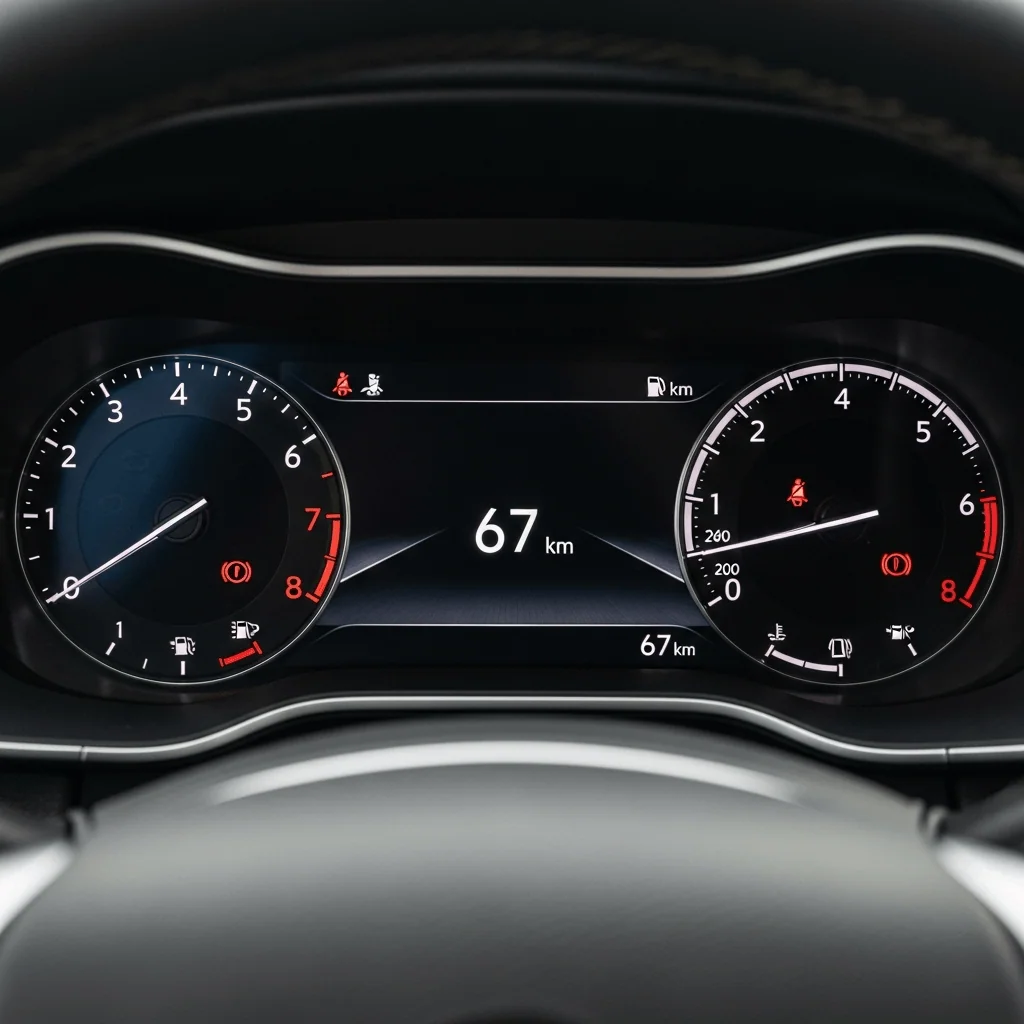
- Verify odometer reading (50-100 km is normal)
- Inspect seats and interior trim
- Test infotainment and all ports
- Check AC cooling and blower speeds
- Test power windows and central locking
Under the bonnet and on the road:
- Verify engine oil and coolant levels
- Start the engine and check for vibrations
- Test clutch/brake pedal feel
- Check ADAS sensors and camera calibration
Paperwork and final checks:
- Verify GNSS OBU or FASTag installation
- Match VIN and engine number across all documents
- Collect Form 21, Form 22, tax invoice, insurance copy (use our delivery day checklist for the full list)
- Verify temporary RC and PUC certificate
- Confirm warranty card and service booklet details
- Refuse any illegal “handling charges”
Now, here’s exactly what to look for at each step.
Exterior Inspection Points
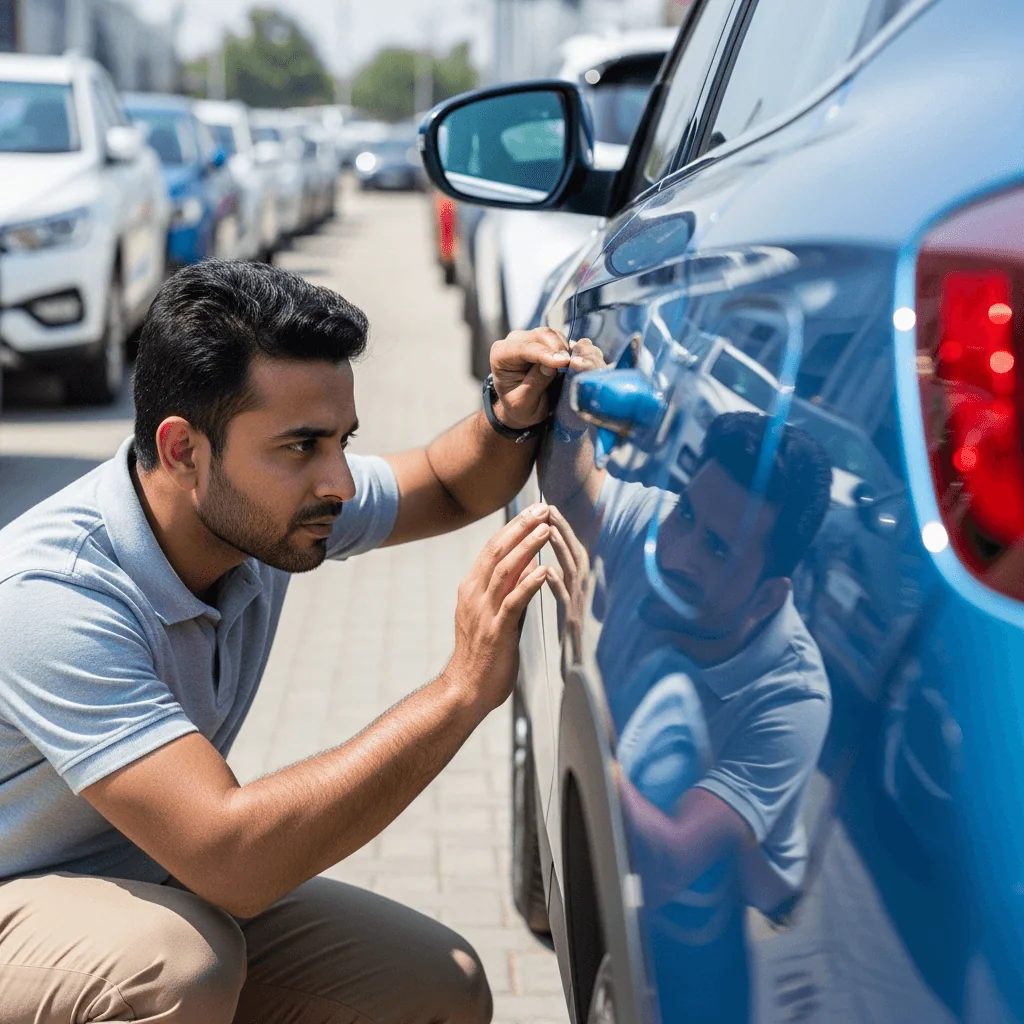
Your exterior check needs to happen in broad daylight. Not under showroom fluorescent lights. Not in a covered parking area. Direct sunlight is the only reliable way to catch paint inconsistencies and shade differences between body panels. Trust me on this one.
1. Paint Finish and Body Panel Inspection
Walk slowly around the entire car. What are you looking for?
- Scratches and swirl marks from rough dealership washing or transit damage
- Paint bubbles or orange peel texture that point to factory defects
- Colour shade differences between panels. If the bonnet looks slightly different from the fender, that panel was probably repainted after transit damage
Crouch down and look along the body panels at eye level. This angle makes dents and waviness pop out immediately. Run your hand lightly over surfaces too. Your fingers will catch what your eyes miss.
2. Panel Gaps and Body Alignment
Examine the gaps between doors, between the bonnet and fenders, and between the boot lid and rear quarter panels. These gaps should be uniform on both sides. If the left door gap is 4mm and the right is 8mm, something is off.
Uneven panel gaps usually mean one of two things: poor factory assembly or hidden transit damage. Either way, ask for a different unit.
3. Doors, Bonnet, Boot Lid
Open and close every single door. They should swing smoothly and shut with a solid, consistent thud. A door that needs extra force to close, or one that doesn’t latch properly, points to alignment issues.
Pop the bonnet and boot lid. Check the rubber seals around all openings for cracks or poor fitment. These seals are your monsoon defence. Damaged ones will leak water into the cabin within months.
4. Tyre Inspection and DOT Code
Tyres are where most buyers get lazy. Don’t just kick them and move on.
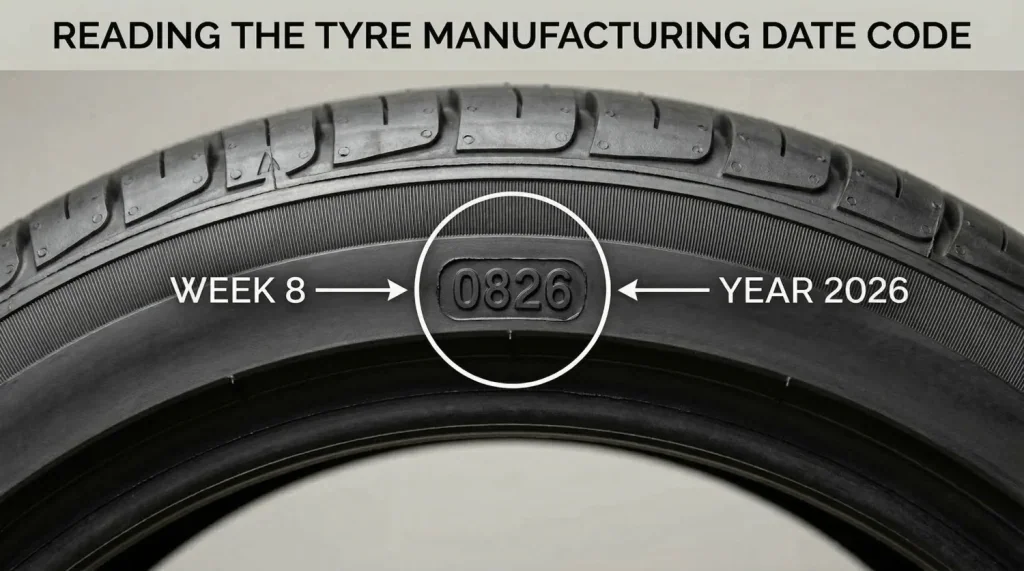
Check the DOT code on each tyre’s sidewall. Look for a four-digit number stamped after “DOT.” The last two digits are the year, and the first two are the week of manufacture. For example, “DOT XXXX 4825” means the tyre was made in week 48 of 2025.
Your tyres should not be older than 6-8 months from the delivery date. Rubber degrades even when unused, especially in Indian heat. Older tyres have reduced grip and are more prone to blowouts on highways.
Also check:
- All four tyres should be the same brand and model (some dealers swap tyres between cars)
- Tread depth should be uniform with no flat spots
- Tyre pressure should match the specification on the driver’s door sticker
5. Alloy Wheels and Wheel Covers
Inspect each alloy wheel for curb rash or scratches. Cars get moved around dealership yards with little care, so alloy damage from tight parking is surprisingly common. Got wheel covers instead of alloys? Make sure none are cracked or missing clips.
6. All Exterior Lights
Turn on every light one by one. Headlights (low and high beam), tail lights, brake lights, reverse lights, indicators, fog lamps, DRLs. Have someone stand behind the car while you press the brake pedal.
Pay specific attention to the inside of the headlamp and tail lamp housings. Moisture condensation inside the lights is a serious red flag. It indicates a factory sealing failure that will cause electrical shorts down the line. If you see even a slight fog inside any lamp, reject that unit.
Interior and Features Check
Once the exterior passes, move inside. Sit in every seat, not just the driver’s seat.
7. Seats, Dashboard, Trim
Check the upholstery on all seats for stains or stitching defects. Press down on the seat foam to feel for consistency. Run your hand across the dashboard and door pads. You’re feeling for scratches, loose panels, anything that doesn’t sit flush.
Open the glovebox, centre armrest, every storage compartment. Do the sun visors flip smoothly? Is the vanity mirror (if equipped) crack-free?
8. Infotainment System and Audio
Boot up the infotainment system. Navigate through every menu. Test:
- Touchscreen responsiveness across all corners of the display
- Bluetooth pairing with your phone
- Apple CarPlay / Android Auto connectivity (use a cable and wireless if supported)
- FM/AM radio reception
- USB ports (try all of them, not just one)
- All speakers individually using the fader and balance controls. Listen for crackling, buzzing, or dead speakers
9. Air Conditioning
Start the AC on full blast. Within 3-5 minutes, the cabin should feel noticeably cold. Switch between all blower speeds and check that air flows from every vent, including rear vents if equipped. Test the recirculation mode toggle.
For cars with automatic climate control, set a temperature and verify the system adjusts fan speed and compressor cycling on its own.
10. Power Windows, Central Locking, ORVMs
Operate every power window from the driver’s master switch and from each individual door switch. They should glide smoothly. Any jerking or grinding? That’s a motor issue.
Lock and unlock the car using the key fob from 10-15 metres away. Test central locking from inside too. If your car has auto-fold mirrors, cycle them. Adjust both ORVMs electrically through their full range of motion.
11. Odometer Reading
A new car’s odometer should read between 50 and 100 kilometres. This accounts for factory testing, yard logistics, the drive from unloading depot to dealership.
If the odometer reads 0 km, that’s actually a concern. It means no road testing was conducted, and you have no idea if the car drives properly.
If it reads over 150 km, ask the dealer to explain. Some legitimate scenarios exist (the stockyard is far from the showroom), but anything significantly higher could mean the car was used as a demo or test drive vehicle. Get a written explanation.
Engine and Mechanical Checks
You don’t need to be a mechanic for these checks. They’re straightforward, and any issue here is a non-negotiable reason to reject the unit.
12. Fluid Levels
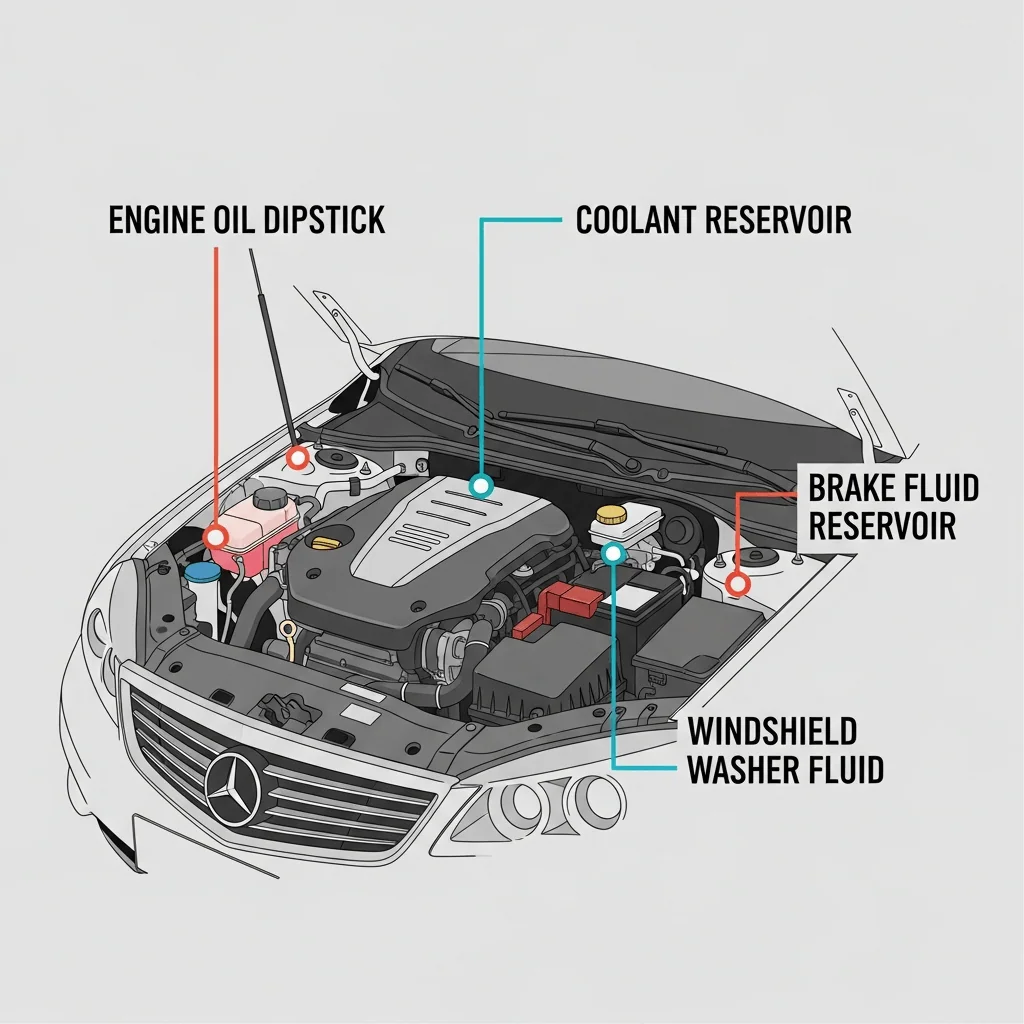
Pop the bonnet and check:
- Engine oil via the dipstick (should be between the min and max marks, honey-coloured for a new car)
- Coolant in the reservoir (should be at the “full” mark)
- Brake fluid reservoir (should be at max level)
- Windshield washer fluid (should be topped up)
Low fluid levels in a brand-new car indicate either a factory fill issue or a leak. Neither is acceptable.
13. Engine Start and Idle
Start the engine. It should fire up smoothly on the first crank. Let it idle for 2-3 minutes and pay attention to:
- Vibrations through the steering wheel or seats. Diesels vibrate a bit naturally, but a petrol car should be smooth. If it shakes, that’s not right
- Unusual noises. Any tapping or knocking from the engine bay is a red flag
- RPM stability. The tachometer should settle at a steady idle RPM without fluctuating wildly
- Exhaust. Walk to the rear and check. White smoke on a cold start is normal condensation. Blue or black smoke is not acceptable on any new car
14. Clutch and Brake Pedal Feel
For manual transmission cars, press the clutch pedal through its full range. It should feel smooth with consistent resistance. A spongy clutch or one that engages at an unusual point (too high or too low) needs adjustment.
Press the brake pedal firmly. It should feel solid and progressive, not spongy or mushy. In cars with a soft-touch electronic parking brake, verify it engages and disengages without error messages on the instrument cluster.
15. E20 Fuel Compatibility
Since April 2026, all petrol sold in India is blended with 20% ethanol (E20) and meets RON 95 standards. This is a major change from the earlier E10 fuel.
For any new car purchased in 2026, verify that the manufacturer has explicitly certified E20 compatibility. This information is usually on a sticker near the fuel filler cap or in the owner’s manual.
All major manufacturers (Maruti Suzuki, Hyundai, Tata, Mahindra, Toyota, Kia, Honda) have rolled out E20-compatible models. But if you’re buying remaining stock from late 2024 or early 2025, double-check. Non-compliant vehicles can see a 3-7% drop in fuel efficiency, plus faster degradation of rubber seals and fuel delivery components.
16. ADAS Sensor and Camera Check
If your car comes with Advanced Driver Assistance Systems (ADAS), these sensors need to be verified at delivery:
- Front camera (usually behind the rearview mirror): Check the windshield for any obstruction or misalignment
- Radar sensors (behind the front grille or bumper): Ensure the bumper area is free of damage
- Reverse camera: Turn on the ignition and engage reverse. The camera feed should activate instantly with clear image quality and proper grid line overlay
- Parking sensors: Place your hand close to each front and rear sensor. Does each one beep correctly?
- 360-degree camera (if equipped): Activate it and verify the image stitching is clean, with no blind spots or misaligned feeds
If any ADAS feature throws a calibration error on the instrument cluster, do not accept delivery. Sensor calibration requires specialized equipment and should be resolved at the dealership before you sign anything.
Document Verification Checklist
This is where carelessness costs the most. A mismatch between your vehicle’s physical numbers and the paperwork can cause rejected insurance claims and RTO complications that haunt you for years.
17. VIN Decoding: Verify Manufacturing Year and Month
The Vehicle Identification Number (VIN) is a 17-character alphanumeric code that tells you exactly when and where your car was made. You need to decode it to make sure you’re not accepting old stock that sat in a yard for months.
The 10th character of the VIN indicates the manufacturing year:
- ‘S’ = 2025
- ‘T’ = 2026
If you’re buying in 2026 and the 10th character is ‘S’, you’re getting a 2025-manufactured unit. That’s not necessarily a deal-breaker, but you should know about it and may have grounds to negotiate the price.
For the manufacturing month, the method varies by brand:
Maruti Suzuki: If the 10th and 11th characters are NOT ’00’ or ’11’, the 11th character represents the month (‘A’ for January, ‘B’ for February, ‘C’ for March, and so on). If they ARE ’00’ or ’11’ (common in Nexa models like the Baleno or XL6), you’ll need to open the bonnet and inspect the metal chassis plate. The second-to-last digit of the stamped sequence gives the month, and the final digit gives the year.
Tata Motors and Mahindra: The 12th character represents the manufacturing month. Tata uses alphabetical sequencing (A = January, B = February) but deliberately skips the letters I, L, M, O to avoid visual confusion with numerals. So December is represented by ‘P’, not ‘L’.
Hyundai and Kia: The 10th character gives you the year. But for the exact month, you’ll need to punch the full 17-character VIN into the dealer’s software or use a third-party online VIN decoder.
Where to find the VIN:
You’ll find the VIN in multiple spots: the metal plate on the dashboard (visible through the windshield), the sticker on the driver’s door jamb, the physical stamping in the engine bay. Check all of them. Every character must match.
18. VIN and Engine Number Cross-Verification
The VIN and Engine Number physically stamped on the car’s metal chassis must match, character for character, with the numbers printed on:
- The dealership tax invoice
- The RTO registration receipt (temporary RC)
- The insurance policy document
Even a single transposed character will cause insurance claim rejections and legal problems during police verification. When you eventually try to sell the car? Nightmare. Verify this carefully before signing anything.
19. Collect All Required Documents
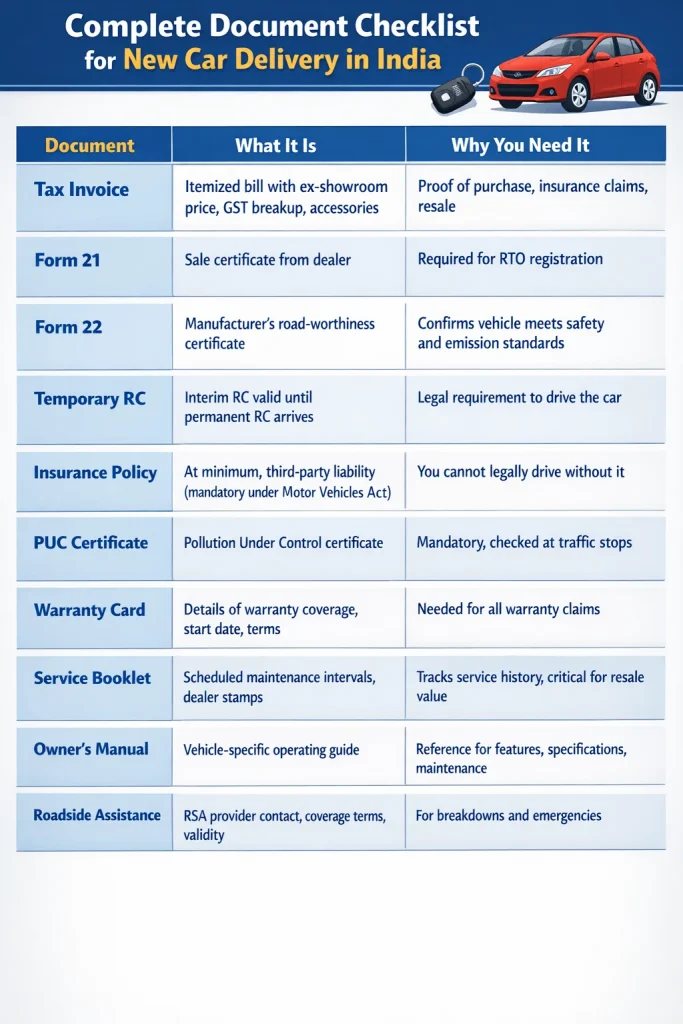
Make sure the dealer hands over every one of these before you leave:
| Document | What It Is | Why You Need It |
|---|---|---|
| Tax Invoice | Itemized bill with ex-showroom price, GST breakup, accessories | Proof of purchase, insurance claims, resale |
| Form 21 | Sale certificate from dealer | Required for RTO registration |
| Form 22 | Manufacturer’s road-worthiness certificate | Confirms vehicle meets safety and emission standards |
| Temporary RC | Interim RC valid until permanent RC arrives | Legal requirement to drive the car |
| Insurance Policy | At minimum, third-party liability (mandatory under Motor Vehicles Act) | You cannot legally drive without it |
| PUC Certificate | Pollution Under Control certificate | Mandatory, checked at traffic stops |
| Warranty Card | Details of warranty coverage, start date, terms | Needed for all warranty claims |
| Service Booklet | Scheduled maintenance intervals and dealer stamps | Tracks service history, critical for resale value |
| Owner’s Manual | Vehicle-specific operating guide | Reference for features, specifications, maintenance |
| Roadside Assistance | RSA provider contact, coverage terms, validity | For breakdowns and emergencies |
20. Verify GNSS OBU or FASTag
India is transitioning from RFID-based FASTag to GNSS (Global Navigation Satellite System) based satellite tolling. MoRTH has geo-fenced nearly 1.4 lakh kilometres of the National Highway network, and dedicated “GNSS lanes” are already operational on several corridors.
For your new car, confirm one of the following:
- A GNSS On-Board Unit (OBU) is factory-fitted or available for installation
- A valid FASTag is properly affixed to the windshield and linked to your bank account/wallet
Vehicles entering dedicated GNSS corridors without a valid OBU face double the standard toll fee. This is not optional, it’s a financial penalty.
21. Refuse Illegal “Handling Charges”
Some dealerships still slip in “handling charges” or “logistics charges” on your final bill. These typically range from ₹5,000 to ₹25,000. Courts in India have ruled these charges illegal. A dealership can be fined for levying them.
See any unexplained line item beyond the ex-showroom price, RTO charges, insurance, accessories you explicitly ordered? Challenge it. Ask the dealer to show the manufacturer’s price circular. If they can’t justify a charge, you don’t pay it. Simple.
PDI (Pre-Delivery Inspection) Guide
The PDI is your final audit before the car gets registered in your name. Why does this matter so much? Before registration, you can demand a replacement unit. After? You’re stuck with warranty repairs. That’s a massive difference.
When and How to Do Your PDI
Timing matters. Inform the dealer in advance that you want to conduct a pre-registration inspection. The PDI should happen at the dealer’s yard, before any delivery formalities or registration paperwork. Always bring someone with you for a second pair of eyes.
The golden rule: Complete your PDI first, pay afterwards. Never let a dealer pressure you into signing acceptance documents or making final payment before you’ve finished your inspection.
22. BNCAP/GNCAP Safety Rating Check
Before you even visit the dealership for delivery, look up your car’s BNCAP (Bharat New Car Assessment Programme) or Global NCAP crash test rating. This is a pre-purchase research step that most buyers skip entirely.
A 5-star rated car with just 2 airbags and a stable body structure is inherently safer than a 1-star car stuffed with 6 airbags. The bodyshell integrity matters more than airbag count. The Citroen eC3 scored 0 stars, the Maruti Swift got 1 star, the Renault Kwid also 1 star. All failed because of unstable body structures. The passenger cabin collapses in a high-speed crash regardless of how many airbags deploy.
At minimum, verify your car has:
- 6 airbags (dual front, side thorax, curtain)
- Electronic Stability Control (ESC/ESP)
- ISOFIX child seat anchorages
- ABS with EBD
23. Connected Car and Firmware Check
Modern cars are defined as much by their software as their hardware. Before accepting delivery:
- Ask the delivery executive to navigate to Settings > About/System Information on the infotainment system
- Note the firmware/software version displayed
- Cross-check this against the latest version published on the manufacturer’s website or app
- If a newer OTA (Over-The-Air) update is available, ask the dealership to install it before delivery
Also test the connected car app pairing:
- Download the manufacturer’s companion app (Suzuki Connect, Hyundai Bluelink, Tata iRA, MG i-SMART, etc.)
- Pair it with the vehicle using the car’s embedded eSIM
- Verify remote functions work: lock/unlock, AC pre-cooling, vehicle location, trip history
24. EV-Specific Checks (If Buying an Electric Vehicle)
Electric vehicles demand additional verification beyond what ICE cars require:
- Battery State of Health (SoH): Ask the dealer for a formal diagnostic readout confirming the battery pack’s SoH is at 100%. This is your baseline reference for future degradation claims under warranty.
- Charging port: Physically inspect the port locking mechanism. Plug in the supplied portable AC charger and verify it initiates charging. Check the charging indicator on the dashboard.
- Range estimate: With a full charge, the displayed range should be within 10-15% of the manufacturer’s claimed range. Significant deviation could indicate a battery calibration issue.
- Warranty terms: Understand exactly what the battery warranty covers. The industry standard is 8 years or 1,00,000-1,60,000 km. But standard warranties often exclude natural, gradual capacity loss unless battery health drops below a specific threshold (typically 70% retention). The high-voltage electronics like BMS, DC-DC converters, and inverters usually fall under the standard 3-5 year vehicle warranty, not the 8-year battery warranty.
25. Insurance Add-On Awareness
The dealer will push their bundled insurance policy hard, because they earn commission on it. Before you sign:
Know which add-ons are actually worth paying for in the first three years:
- Return to Invoice (RTI): Covers the full ex-showroom price (not just depreciated IDV) in case of total loss or theft. Critical in the first 3 years when the IDV drops fastest.
- Zero Depreciation (Bumper-to-Bumper): Eliminates depreciation deductions on plastic, rubber, glass, metal parts during claims. Without this, you’ll pay significant out-of-pocket costs for even minor repairs.
- Engine and Gearbox Protector: Covers hydrostatic lock (engine failure from water ingestion) and oil sump damage from bad roads. Essential during Indian monsoons.
- Consumables Cover: Forces the insurer to pay for oils, coolants, nuts/bolts, brake fluid consumed during repairs. Without it, these costs come straight out of your pocket.
- NCB Protection: Protects your No Claim Bonus discount history from being wiped out after a single minor claim.
You’re not obligated to buy insurance from the dealer. Compare quotes from PolicyBazaar, Acko, or directly from insurers. The dealer cannot refuse delivery if you bring your own insurance policy.
FAQs
What should I inspect before accepting delivery of a new car?
At minimum, inspect the exterior paint in daylight for scratches and shade differences, check panel gaps for uniformity, verify the odometer is between 50-100 km, test all electrical features (windows, AC, infotainment, lights), check fluid levels under the bonnet, read the tyre DOT codes to confirm they’re recent, and cross-verify the VIN and engine number against all documents. Use the 25-point checklist above to make sure you don’t miss anything.
How do I check if a new car has defects?
Do a thorough Pre-Delivery Inspection (PDI) in broad daylight, before the car gets registered in your name. Walk around slowly. Check the paint at multiple angles. Run your hands over the panels. Look inside the light housings for moisture. Start the engine, listen for anything unusual. Test every feature one by one. If you find a defect before registration, you have the right to demand a replacement unit.
What documents should the dealer provide with a new car?
The dealer must provide: a detailed tax invoice with GST breakup, Form 21 (sale certificate), Form 22 (manufacturer’s compliance certificate), temporary registration certificate, insurance policy (minimum third-party), PUC certificate, warranty card, service booklet, owner’s manual, and roadside assistance details. Never leave the dealership without every one of these documents. A missing Form 22 or mismatched VIN on any document will cause problems down the line.
Can I refuse delivery if I find defects during PDI?
Yes, absolutely. Before registration, you have every right to refuse the unit and demand a replacement or a complete repair. Under the Consumer Protection Act, 2019, you are entitled to receive a defect-free vehicle. Once the car is registered in your name, the legal dynamic changes significantly, and getting a replacement becomes extremely difficult. This is precisely why your PDI must happen before registration paperwork is completed.
Is it okay if the odometer shows 0 km on a new car?
Actually, a 0 km reading is a concern. It suggests the car was never road-tested after arriving at the dealership. Factory testing, yard movement, the drive from depot to showroom, all that typically adds 20-50 km. So 50-100 km is completely normal. Over 150 km? Get a written explanation from the dealer.
Should I take someone along for the inspection?
Yes, absolutely. A second person catches things you miss. They can stand behind the car while you test brake lights. And if you ever need to dispute a defect claim later, having a witness helps your case. Pick someone detail-oriented. They don’t need to be a “car person.” Fresh eyes often spot what yours have gotten used to.
Ready to take delivery? Once you’ve cleared this checklist, move on to our delivery day checklist for the step-by-step process of getting your car home safely. And if you haven’t done your test drive checklist yet, do that first.