
Five years ago, this was a two-minute decision. Petrol for city cars, diesel for highway SUVs. Move on. But 2026? The fuel choice has gotten genuinely complicated. CNG went from auto-rickshaw fuel to a legitimate mainstream contender. Diesel is fighting regulatory pressure from every direction. And petrol now runs on E20 ethanol-blended fuel that quietly eats into your mileage.
So which one actually saves you money? We ran the numbers with real March 2026 fuel prices. No vague “it depends” answers here.
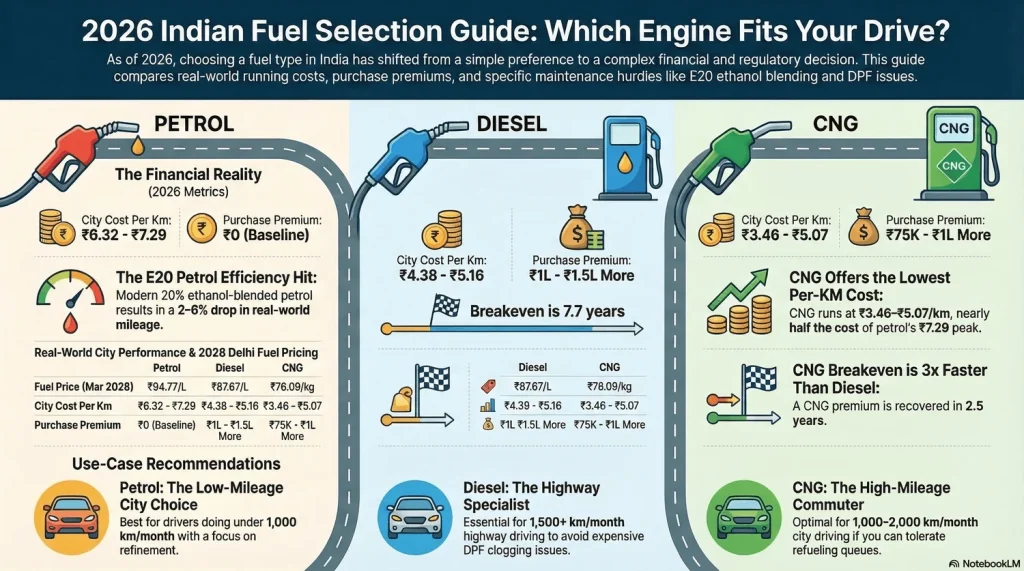
| Factor | Petrol | Diesel | CNG |
|---|---|---|---|
| Fuel Price (Delhi, Mar 2026) | ₹94.77/L | ₹87.67/L | ₹76.09/kg |
| Real-World City Mileage | 13-15 km/L | 17-20 km/L | 15-22 km/kg |
| Cost Per Km | ₹6.32-7.29 | ₹4.38-5.16 | ₹3.46-5.07 |
| Extra Cost Over Petrol | Base price | ₹1-1.5 lakh more | ₹75K-1 lakh more |
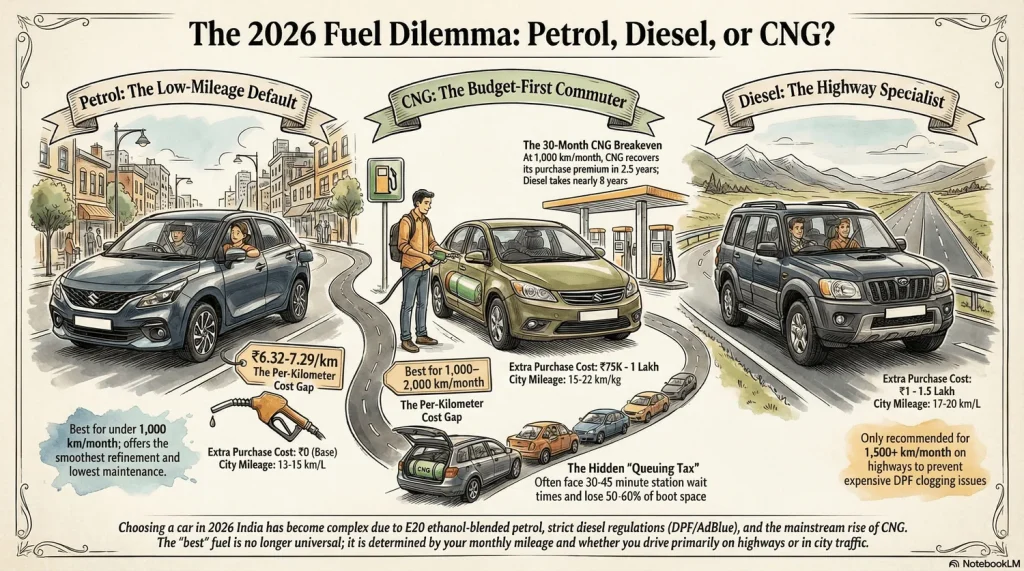
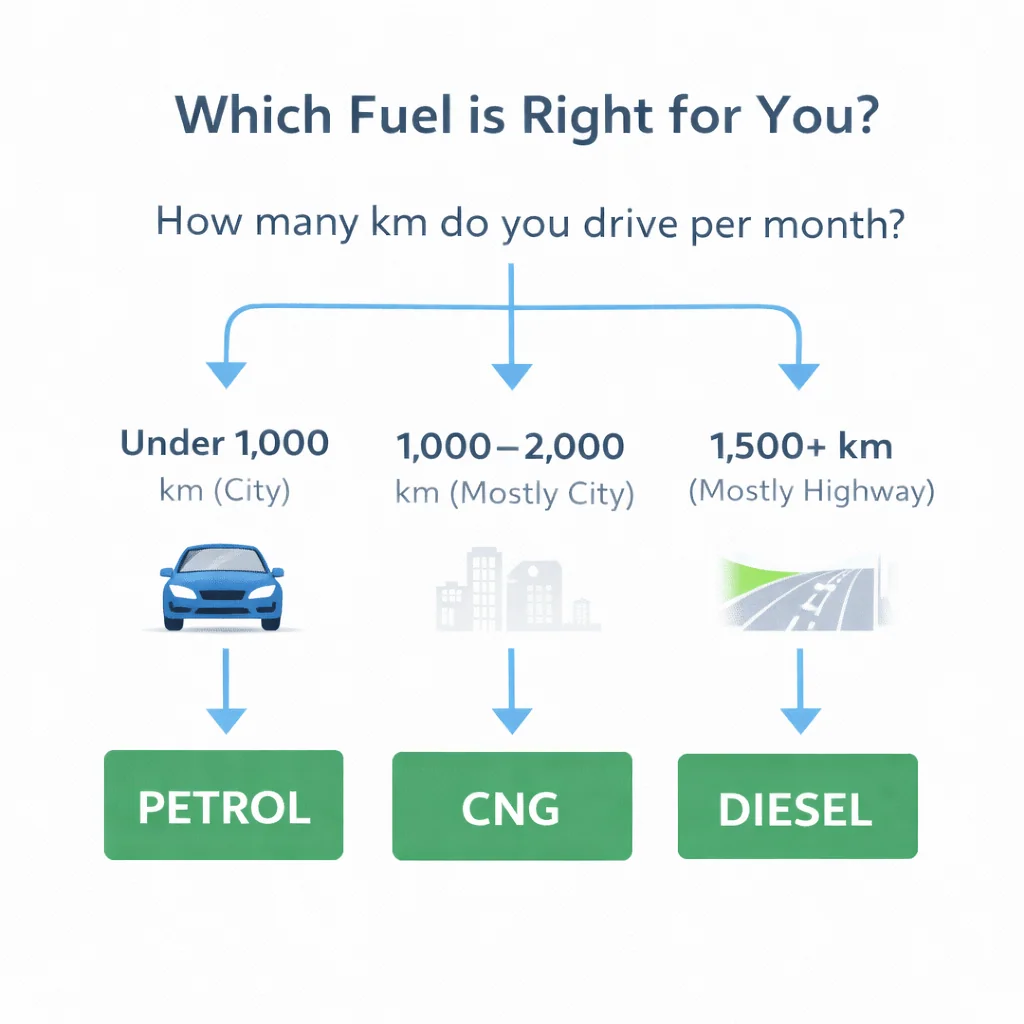
| Best For | Under 1,000 km/month | 1,500+ km/month highway | 1,000-2,000 km/month city |
Petrol Cars: Pros, Cons, and Who Should Buy
Petrol still powers over 53% of new cars sold in India. There’s good reason it remains the default.
Why Petrol Works
You pay less upfront. A petrol variant is always the cheapest trim. You’re saving ₹75,000 to ₹1.5 lakh compared to CNG or diesel right at the showroom. That money stays with you from day one.
Smoothest driving experience. No turbo lag. No CNG power drop. No diesel clatter at idle. Petrol engines respond cleanly at low RPMs, which matters more than you’d expect when you’re crawling through Bangalore or Mumbai traffic every morning.
Maintenance is straightforward. No AdBlue refills, no DPF regeneration headaches, no valve seat recession checks. Service intervals run 10,000-15,000 km apart, and the bills are predictable. You won’t get blindsided by an ₹80,000 DPF bill.
Fuel stations everywhere. Every pump in India sells petrol. You can drive from Kashmir to Kanyakumari without a single fueling anxiety moment. Can’t say that about CNG.
Every model comes in petrol. You get the full spread of variants, features, automatic options (CVT, DCT, torque converter). CNG and diesel trim ranges are always narrower.
Where Petrol Falls Short
Most expensive per km. At ₹94.77/litre and 13-15 km/L city mileage, you’re burning ₹6.32 to ₹7.29 per km. That’s roughly 40-50% more than what CNG costs.
E20 ethanol changed the equation. All petrol in India is now blended with 20% ethanol. Ethanol has lower energy density, so your mileage drops 2-6% compared to pure petrol. Some owners of pre-2023 cars report worse drops, with city mileage falling to 7-8 km/L. Newer cars (2023 onward) have ECU mapping tuned for E20, so the hit is smaller. But here’s something most buyers don’t realize: there’s a difference between “E20 material compatible” (fuel lines can handle it) and “E20 compliant” (engine optimized for it). Only post-2023 cars are truly compliant.
No cost advantage at any km level. Whether you drive 500 or 3,000 km a month, petrol is always the priciest fuel to run. The lower purchase price offsets this only for low-mileage drivers.
Who Should Pick Petrol?
If you drive under 1,000 km per month and mostly within the city, petrol is your pick. The lower purchase price compensates for higher fuel costs over 5-7 years of ownership. It’s also the right choice if you need automatic transmission options, value cabin refinement, or travel regularly to areas without CNG pumps.
Diesel Cars: Pros, Cons, and Who Should Buy
Diesel once commanded 58% of India’s passenger vehicle market. That number? About 18% in 2026. The fuel still dominates one specific use case, but the world around it has shifted hard.
Why Diesel Still Makes Sense (for Some Buyers)
Highway mileage is unbeatable. Diesel engines deliver 22-26 km/L on open roads. High compression ratios plus torque-rich delivery make diesel the king of long-distance cruising. Nothing else comes close for sustained highway runs.
Torque for heavy vehicles. Buying a Tata Safari, Mahindra Scorpio-N, or a Fortuner? Diesel gives you the low-end grunt for confident overtaking and hauling loads uphill. These are vehicles that genuinely need diesel’s character.
Cheaper fuel per litre. Diesel at ₹87.67/L is roughly ₹7 cheaper than petrol. Combined with better efficiency, the per-km cost drops to ₹4.38-5.16. Around 25-30% less than petrol.
Resale holds strong for large SUVs. A 3-year-old diesel Scorpio or XUV700 still fetches excellent resale because the secondary buyer (often a commercial or highway-heavy user) wants that diesel torque. This doesn’t apply to small diesel hatchbacks though.
The Problems You Need to Know About
Purchase premium is steep. Diesel variants cost ₹1 lakh to ₹1.5 lakh more. The Hyundai Creta diesel, for instance, starts about ₹1.2 lakh above petrol.
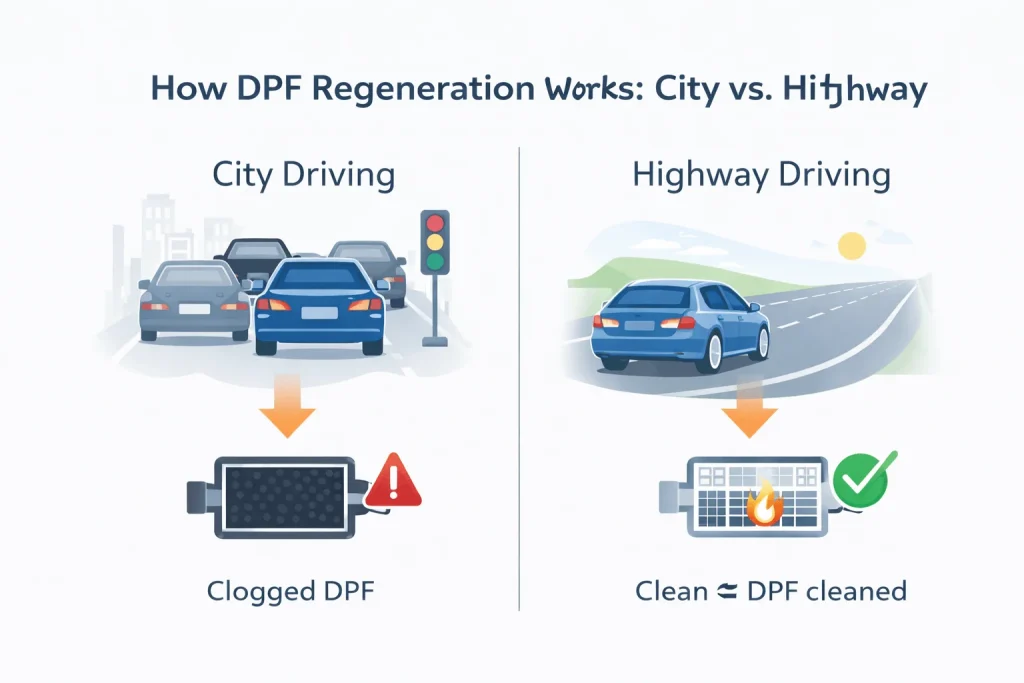
The DPF problem is real, and expensive. Every BS6 Phase 2 diesel has a Diesel Particulate Filter that traps soot and needs to “regenerate” at highway speeds (60+ km/h for 15-20 minutes). Drive mostly in city traffic with short trips? The DPF clogs. Badly clogged DPF puts your car in limp mode. A forced regeneration at the service center runs ₹3,000-5,000. Full DPF replacement? ₹80,000 to ₹1.2 lakh. And the worst part: dealerships routinely blame “driving style” rather than covering it under warranty. Owners of brand-new diesel SUVs in cities like Noida have reported facing ₹2 lakh DPF replacement quotes within months of purchase.
AdBlue isn’t optional. BS6 diesels use AdBlue (urea solution) in the SCR system. It depletes every 9,000-10,000 km and costs ₹60-100 per litre. Manageable cost, yes. But if the AdBlue tank runs completely dry, the ECU locks out your engine. Won’t start. Not a warning you can ignore, a hard lockout that leaves you stranded.
Fewer manufacturers even offer diesel now. Maruti exited diesel entirely in 2020. Honda dropped it across the lineup. In 2026, only Hyundai, Tata, Mahindra, and Kia still sell diesel passenger cars (Toyota too, through its Maruti partnership). With BS7 norms aligned to Euro 7 expected soon, the cost of keeping small diesel engines compliant may push more brands to walk away.
10-year bans are killing resale in metros. Delhi already bans diesel vehicles older than 10 years. NGT is pushing similar restrictions in other metros. Buy diesel in 2026 in Delhi-NCR, and your car’s resale window within the city is capped. After year 7-8, your buyer pool shrinks to Tier-2 and rural markets at steep discounts. At 5 years, resale already shows accelerated depreciation compared to petrol because the next buyer does the same math.
Long-term maintenance costs escalate. Oil changes every 10,000 km (petrol gets 15,000 km intervals). Fuel injectors degrade from carbon fouling over time. Turbocharger servicing adds up. Timing belt replacement around 90,000 km costs tens of thousands. Cross 1,00,000 km, and engine mounts start wearing out. Injector spray patterns degrade. NVH levels creep up. The maintenance curve shifts upward noticeably.
Who Should Pick Diesel?
Only if you drive 1,500+ km per month, mostly on highways. You’re an intercity commuter, a frequent road-tripper, or you’re buying a mid-size to large SUV where diesel torque is genuinely necessary. If your daily drive is 10-15 km city commutes with short trips, stay away. The DPF alone will cost you more than you’ll ever save on fuel.
CNG Cars: Pros, Cons, and Who Should Buy
CNG is the breakout story of Indian automotive. Market share jumped from 17.76% to 21.15% in recent fiscal periods. Over 30 factory-fitted models are available now. But the savings come with trade-offs that the brochure conveniently glosses over.
Why CNG Is Winning Buyers
Lowest running cost of any fuel type. CNG at ₹76.09/kg with real-world city efficiency of 15-22 km/kg gives you ₹3.46 to ₹5.07 per km. At the efficient end, that’s nearly half of petrol. Over 12,000 km a year, you save roughly ₹39,720 versus petrol.
Breakeven is fast. CNG costs ₹75,000 to ₹1 lakh more than petrol. At 1,000 km/month, you recover that in about 30 months. Drive 2,000 km/month? Just 15 months. Compare that with diesel, where breakeven at 1,000 km/month takes over 7 years.
Cleanest ICE emissions. Significantly lower CO2 and NOx output versus petrol or diesel. No DPF to clog. No AdBlue to monitor. If environmental impact factors into your decision, CNG is the best internal combustion option available today.
Infrastructure is expanding fast. India had about 7,000 CNG stations in early 2024. The government targets 18,336 by 2032. The CGD network covers 307 geographic areas across 733 districts. Highway corridors and Tier-2 cities are getting pumps at a pace that would have been unthinkable five years back.
Model range is genuinely good now. This isn’t Wagon R-only territory anymore. Tata Nexon iCNG (turbocharged CNG SUV), Maruti Fronx, Hyundai Exter, Maruti Brezza, Tata Punch, Maruti Dzire. Upcoming: Kia Sonet CNG, Tata Curvv CNG, Hyundai Verna CNG.
The Trade-Offs Nobody Tells You at the Showroom
You lose 15% power. It’s noticeable. CNG enters the combustion chamber as gas, not liquid. It displaces oxygen in the intake, reducing volumetric efficiency. Tata Tiago petrol: 86 PS, 113 Nm. Same car on CNG: 73 PS, 95 Nm. That’s a 15% HP cut and 16% torque reduction. You’ll notice it when overtaking on highways with a full car. Going uphill with four passengers and the AC on full blast in May? The car struggles.
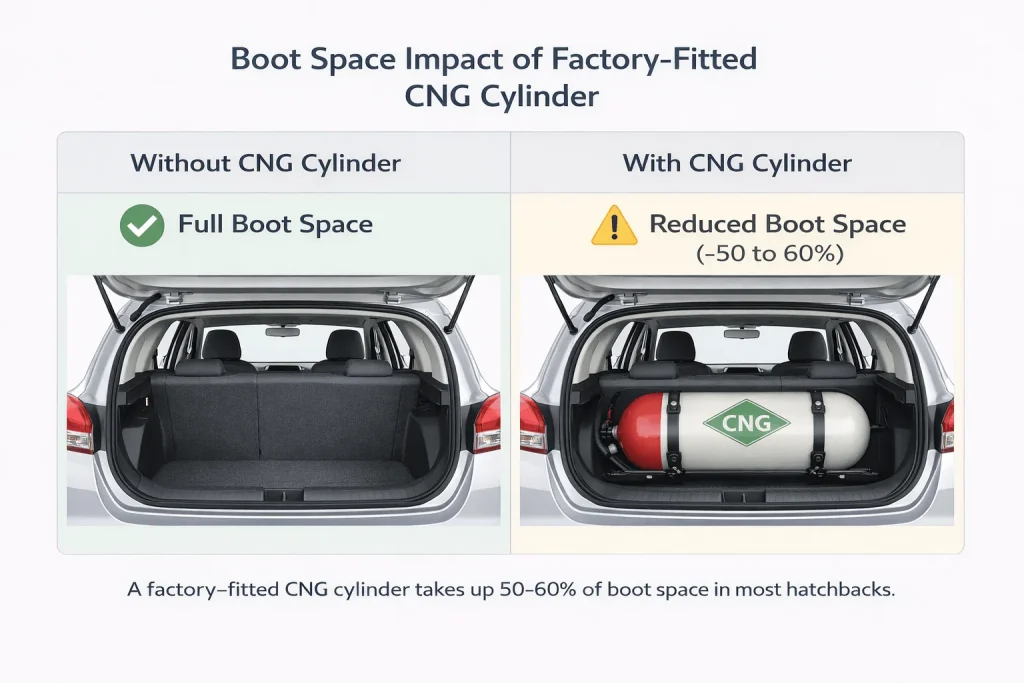
Boot space takes a serious hit. The CNG cylinder lives in the boot. In hatchbacks and compact sedans, 50-60% of your luggage space disappears. Even in SUVs like the Brezza or Nexon, the cylinder claims a significant chunk. Traveling with family and luggage? This becomes a daily frustration.
Range per fill is limited. A standard 60-litre cylinder holds 8-10 kg of gas depending on pump pressure. Real-world range: 150-200 km per fill. You’ll visit CNG stations 2-3 times more often than a petrol driver covers the same monthly distance.
CNG station queues are brutal in metros. Popular stations in Delhi-NCR and Mumbai service 200-300 vehicles daily. Wait times of 30-45 minutes during peak hours are normal. CNG fills slower than liquid fuel. Safety rules require all passengers to exit the vehicle during filling. And there’s no reliable app to check real-time queue lengths. Factor in 2-3 fills per week, and you could lose 1.5-3 hours weekly just waiting at pumps. This is the hidden “queuing tax” that shaves away the convenience you’d expect from cheap fuel.
Valve Seat Recession is a real long-term risk. CNG burns completely dry. Unlike petrol, it gives zero lubrication to engine valves during combustion. Over tens of thousands of kilometres, dry hot exhaust gases erode the valve faces and seats. The valve embeds deeper into the cylinder head, tappet clearance drops to zero, compression falls, misfires start. Factory-fitted CNG cars use hardened valve seats to delay this, but it doesn’t eliminate the risk entirely. You need valve clearance inspections every 50,000 km and low-pressure CNG filter replacements every 20,000-25,000 km. Skipping this maintenance isn’t optional.
Insurance costs more. IRDAI mandates an additional ₹60 flat fee on third-party premiums for CNG. The “Own Damage” component also scales higher because a pressurized 200-bar gas cylinder carries inherent fire risk. For aftermarket kits, failing to update the RTO RC gives insurers legal grounds to reject claims entirely.
ARAI mileage figures are misleading. Tata Tiago CNG claims 26.49 km/kg. Real-world city driving? 15-16 km/kg. Highway cruising: 23-24 km/kg. Always use real-world figures for your calculations, not the sticker.
Who Should Pick CNG?
City commuters driving 1,000 to 2,000 km per month who can tolerate queuing and boot space loss. Daily office commuters, ride-hailing drivers, anyone whose driving is mostly intra-city. If you frequently take long highway trips or need full boot space for family luggage, the practical limitations will frustrate you.
One critical check before buying: Verify CNG station availability in your city. Infrastructure is excellent in Delhi-NCR, Mumbai, Gujarat, parts of UP and Rajasthan. But if the nearest CNG pump is 15 km away, your savings evaporate in detour time and fuel burned getting there.
Running Cost Comparison (Per Km)
This is where your decision should start. Forget brochure claims. Here are the numbers using March 2026 Delhi fuel prices and real-world mileage from verified owner data.
Fuel Cost Per Km: The Raw Math
| Parameter | Petrol | Diesel | CNG |
|---|---|---|---|
| Fuel Price (Delhi, Mar 2026) | ₹94.77/L | ₹87.67/L | ₹76.09/kg |
| ARAI Claimed Mileage | 18-22 km/L | 24-28 km/L | 26-32 km/kg |
| Real-World City Mileage | 13-15 km/L | 17-20 km/L | 15-22 km/kg |
| Real-World Highway Mileage | 17-20 km/L | 22-26 km/L | 23-28 km/kg |
| Cost/km (City) | ₹6.32-7.29 | ₹4.38-5.16 | ₹3.46-5.07 |
| Cost/km (Highway) | ₹4.74-5.57 | ₹3.37-3.99 | ₹2.72-3.31 |
What You Actually Spend Each Month
Using mid-range real-world city figures (Petrol: 14 km/L, Diesel: 17 km/L, CNG: 22 km/kg):
| Monthly Km | Petrol | Diesel | CNG | CNG Saves vs Petrol |
|---|---|---|---|---|
| 500 km | ₹3,384 | ₹2,578 | ₹1,730 | ₹1,654/month |
| 1,000 km | ₹6,769 | ₹5,157 | ₹3,459 | ₹3,310/month |
| 1,500 km | ₹10,153 | ₹7,735 | ₹5,189 | ₹4,964/month |
| 2,000 km | ₹13,537 | ₹10,313 | ₹6,918 | ₹6,619/month |
When Does the Purchase Premium Pay Off?
Everyone asks this. Here’s the answer, broken down.
CNG vs Petrol (assuming ₹1,00,000 premium):
| Monthly Driving | Monthly Fuel Savings | Breakeven Point |
|---|---|---|
| 500 km | ₹1,654 | ~60 months (5 years) |
| 1,000 km | ₹3,310 | ~30 months (2.5 years) |
| 1,500 km | ₹4,964 | ~20 months (1.7 years) |
| 2,000 km | ₹6,619 | ~15 months (1.3 years) |
Diesel vs Petrol (assuming ₹1,50,000 premium):
| Monthly Driving | Monthly Fuel Savings | Breakeven Point |
|---|---|---|
| 500 km | ₹806 | ~186 months (15+ years, never) |
| 1,000 km | ₹1,612 | ~93 months (7.7 years) |
| 1,500 km | ₹2,418 | ~62 months (5.2 years) |
| 2,000 km | ₹3,224 | ~47 months (3.9 years) |
The pattern is clear. CNG breaks even fast at almost any reasonable monthly km. Diesel’s breakeven only makes financial sense above 1,500 km/month, and even then you’re waiting 4-5 years. Below 1,000 km/month, diesel never pays for itself within a typical 7-year ownership cycle.
What these tables don’t capture: diesel’s higher maintenance costs like DPF servicing, AdBlue top-ups, and turbo upkeep. CNG has its own extras too: valve adjustments, filter changes, cylinder testing. Factor all of that in, and diesel’s breakeven stretches out even further.
Which Fuel Type for Your Driving Pattern?
Skip the generic advice. Your choice comes down to three variables: monthly km, where you drive, and how long you’ll keep the car.
Under 1,000 km/month, City Driving: Pick Petrol
You commute short distances, run errands on weekends, maybe one highway trip a month. At this usage, the ₹75K-1.5L premium for CNG or diesel doesn’t pay back within a reasonable timeframe. Diesel breakeven is 7+ years away. Even CNG takes 5 years at 500 km/month.
Petrol gives you the lowest upfront cost and widest model selection. Cabin refinement is the best of the three, and there are zero surprise maintenance bills. The E20 mileage impact exists but stays manageable if you buy a post-2023 E20-compliant car.
Quick tip: Buying a used pre-2023 petrol car? Check whether it’s E20-compliant or just E20 material-compatible. The distinction matters for long-term engine health.
1,000-2,000 km/month, Mostly City: Pick CNG
You commute 30-50 km daily, mostly within the city or between nearby towns. Fuel is a real budget item for you every month. CNG saves ₹3,000 to ₹6,600 per month versus petrol, breaking even on the purchase premium within 15-30 months.
Go in with eyes open, though. You’ll lose boot space. You’ll queue at CNG pumps. The car feels noticeably sluggish on CNG mode with AC running and passengers aboard. And you need to stay on top of CNG-specific maintenance: valve clearance checks at 50K km, CNG filter changes at 20-25K km, cylinder hydrostatic testing per schedule.
Always buy factory-fitted CNG over aftermarket. Factory kits integrate properly with the engine management system and carry manufacturer warranty. No insurance complications either.
1,500+ km/month, Mostly Highway: Pick Diesel
You drive intercity regularly. Long road trips. Heavy loads. You need a vehicle that cruises at 100+ km/h for hours without strain. Diesel’s torque and highway efficiency make it the right fit. Regular sustained speeds also keep the DPF healthy, so it works out.
But only if:
- Most of your driving is genuinely highway, not city stop-and-go
- You’re buying a mid-size SUV or larger (small diesel cars are being phased out)
- You plan to sell before the 8-year mark in metro cities
Avoid diesel completely if your routine is short 5-10 km city trips. The DPF will clog. Forced regenerations will stack up. And you could face a ₹1 lakh+ replacement bill within 3-4 years.
Budget-First Family Decision: CNG if Infrastructure Exists, Petrol Otherwise
If the question is purely about saving money over 5-7 years and your city has decent CNG infrastructure, CNG wins at almost every monthly km level above 800. The savings compound every month, and breakeven arrives quickly.
No CNG stations near you? Petrol remains the safest, most hassle-free choice.
Resale Value: How Fuel Type Affects What Your Car Is Worth Later
This rarely comes up in fuel comparison articles, but it should. Fuel type has a measurable impact on depreciation.
| Ownership Period | Petrol | Diesel | CNG |
|---|---|---|---|
| 1-3 Years | Stable demand, predictable pricing | Strong for large SUVs, poor for small cars | Growing demand, limited used inventory |
| 5 Years | Strong urban demand (15-year legal window) | Depreciation accelerates in metros due to 10-year ban fears | Moderate, depends on cylinder condition and service records |
| 7+ Years | Retains solid value, huge buyer pool | Collapses in Tier-1 cities, only viable in Tier-2 and rural | Still developing as a secondary market |
The diesel resale trap in metros. A diesel car bought in 2026 in Delhi has 10 years of legal life. By year 7-8, any buyer in Delhi-NCR knows they’ll get only 2-3 years of use. That crushes the price. The same car sold to someone in a Tier-2 city without such restrictions fetches considerably more.
Petrol holds steady. 15-year registration, no fuel-type restrictions, massive buyer pool across all markets. The most predictable resale trajectory.
CNG resale is a newer story. As adoption grows, the used CNG market is expanding too. But buyers inspect cylinder condition carefully and ask about valve maintenance history. Keep your service records clean if you want a strong resale.
FAQs
Should I buy petrol or diesel in 2026?
For most buyers, petrol. Diesel justifies its premium only if you drive 1,500+ km/month on highways and plan to sell before year 8 in metro cities. DPF complexity, shrinking model availability, and metro bans make diesel a risky long-term bet for city drivers. Upcoming BS7 norms will only tighten the squeeze further.
Is CNG worth it for a daily commute?
Yes, if two conditions are met: CNG stations are conveniently located along your route, and you can live with boot space loss plus refueling queues. Driving 1,000+ km/month in the city, CNG saves you ₹3,000-6,600 monthly versus petrol. The ₹75K-1L premium pays back in 15-30 months.
At what monthly km does diesel become cheaper than petrol?
On pure fuel cost, diesel is always cheaper per km. But factoring in the ₹1-1.5L purchase premium, breakeven happens around 1,500 km/month over 5 years. Below 1,000 km/month, you’ll probably never recover the diesel premium within typical ownership. Higher diesel maintenance costs push that breakeven even further out.
Is CNG safe for cars?
Factory-fitted systems are thoroughly tested with pressure relief valves and leak detectors built in. Fire-resistant piping is standard. Cylinders are tested at 300 bar while operating pressure is 200 bar. Safety profile is comparable to petrol. Aftermarket kits carry more risk because installation quality varies, and failing to register the modification with RTO can void your insurance entirely.
Does CNG damage the engine over time?
Not directly. But the dry combustion characteristics cause Valve Seat Recession at higher mileages (50K+ km). Factory-fitted engines use hardened valve seats to slow this down. Following the manufacturer’s maintenance schedule, especially valve clearance inspections and CNG filter replacements, is non-negotiable.
Which fuel type has the best resale value?
Petrol offers the most consistent resale across all markets and ownership durations. Diesel commands strong values for large SUVs within the first 3-5 years but drops sharply after that in metro cities with age restrictions. CNG resale is growing but the secondary market is still maturing.
Can I convert my petrol car to CNG?
Aftermarket kits are available for ₹50,000-80,000. But you must register the modification with RTO and update your insurance policy. Without this, insurers can flat-out reject any claim. Aftermarket kits also don’t work as well with the engine management system, so expect rougher performance. If factory-fitted CNG is available for your model, go with that instead.
What about strong hybrids? Better than all three?
Strong hybrids (Maruti Grand Vitara Hybrid, Toyota Hyryder Hybrid) deliver 22-27 km/L in real-world city driving without any DPF, boot space, or infrastructure headaches. They cost ₹2-3L more than petrol equivalents, though. Worth considering if budget allows, but that’s a separate comparison entirely.
The Verdict
No single fuel type wins across the board in 2026. Your driving pattern is the answer.
Under 1,000 km/month, city driving? Petrol. Lowest hassle, lowest upfront cost. The per-km difference doesn’t compound into enough savings to justify the CNG or diesel premium.
1,000-2,000 km/month, mostly city? CNG, provided your city has infrastructure. The savings are substantial and grow every month.
1,500+ km/month, mostly highway? Diesel, but only in a mid-size SUV or larger. Maintain it properly, drive on highways regularly, plan your resale window around the 7-8 year mark.
Use the breakeven tables above with your own monthly km. Your situation is the formula. Not anyone’s opinion.