
So you’ve got some extra cash and your car EMI keeps showing up every month. Tempting to wipe out the loan, isn’t it? But should you actually do it, or is your money better off elsewhere?
Here’s the short version. Yes, you can prepay or foreclose a car loan in any Indian bank. But whether it actually saves you money depends on five things: your lender’s foreclosure charges, how many EMIs are left, your interest rate, your outstanding principal, and whether your money could earn more after taxes somewhere else. Prepayment delivers the biggest savings early in the loan, because that’s when interest eats up most of your EMI. It helps to know your starting point, so see how current loan rates compare.
This guide walks you through the rules currently in force, exact bank-by-bank charges for 2026 across 14 leading lenders and NBFCs, two real rupee calculations showing precisely when prepayment is worth it (and when it isn’t), the prepay-vs-invest decision math, the difference between part-payment and full foreclosure, and the complete closure process all the way through to RTO hypothecation removal on the Parivahan portal.
Quick decision framework:
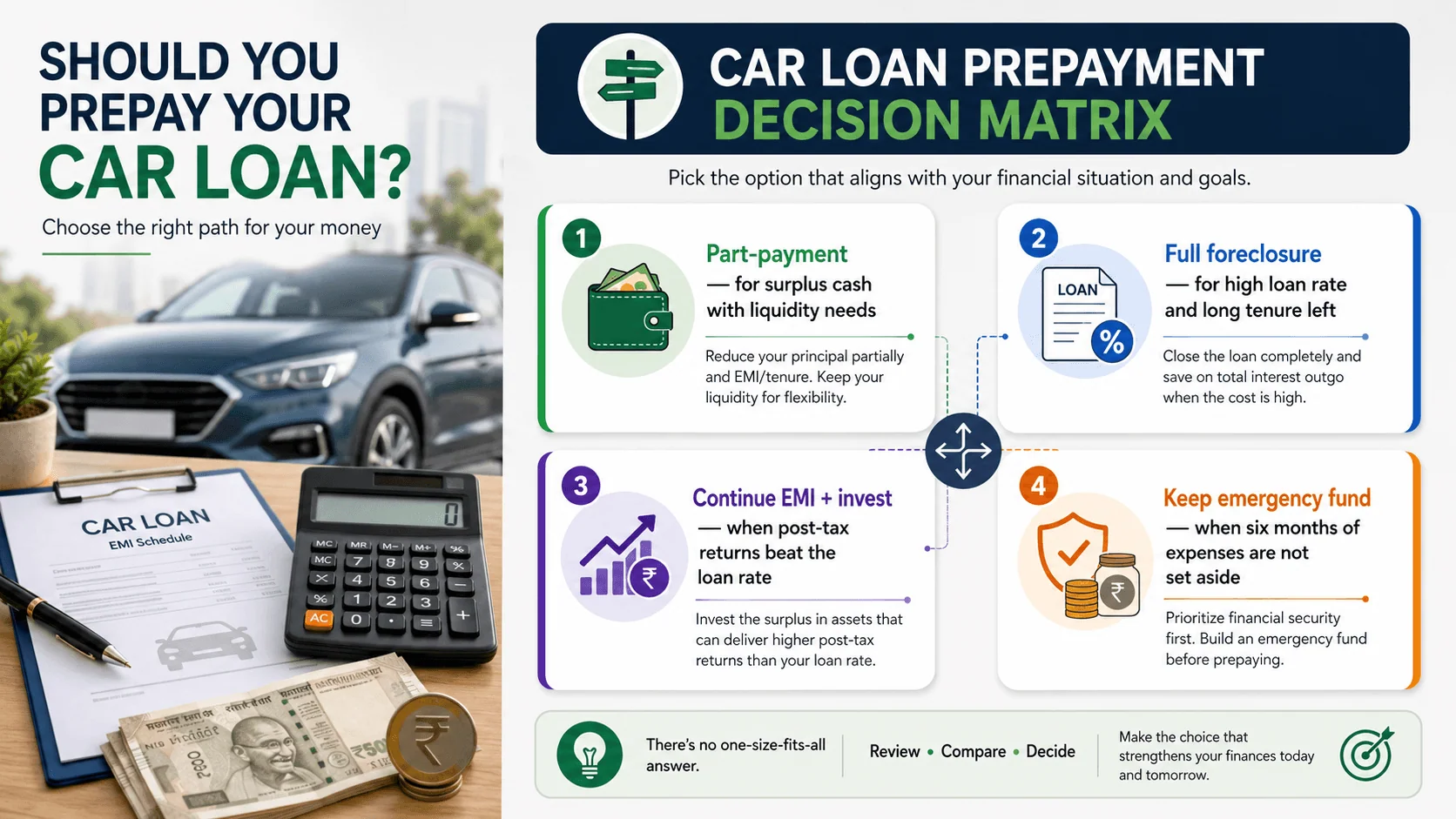
| Decision | Best When | Main Risk |
|---|---|---|
| Part-payment | You have surplus cash but want to keep some liquidity | Bank may impose minimum amount or frequency limits |
| Full foreclosure | Interest rate is steep and a chunk of tenure remains | High foreclosure charges can wipe out interest savings |
| Continue EMI + invest | Post-tax investment return clearly beats the loan rate | Market returns aren’t guaranteed in the short term |
| Keep emergency fund | You don’t have 6 months of expenses set aside | Aggressive prepayment can leave you cash-strapped in a crisis |
Car Loan Prepayment Rules in India
Indian car loans run on a tightly regulated framework, with the Reserve Bank of India setting the broad rules while individual banks layer their own internal policies, lock-in periods, fee schedules, and product-specific carve-outs on top. Why does knowing the difference between prepayment methods matter? Because the wrong call can wipe out half your savings.
What is car loan prepayment?
Car loan prepayment simply means paying extra money toward your loan’s outstanding principal before the scheduled EMI dates. Why does this matter? Because Indian banks use the daily reducing balance method. Every rupee of extra principal payment shrinks the base on which all future interest gets calculated.
You can prepay in two ways. Pay a lump sum while keeping the loan active (part-payment). Or settle the entire outstanding balance in one shot (full foreclosure). Both end up with the same goal: cut the total interest you’ll pay over the life of the loan.
Part-payment, explained
Part-payment is when you drop a lump sum onto the principal but the loan account stays alive. What happens after? You get to pick one of two adjustments to the amortization schedule. Either keep the EMI constant and shorten the tenure. Or keep the tenure intact and shrink the EMI.
Which is better? Tenure reduction wins by a wide margin on interest savings. EMI reduction only makes sense if your monthly budget is feeling the squeeze.
But banks don’t make this free or easy. Most lenders impose a lock-in period of 6 to 12 months from your first EMI. Many cap how many partial payments you can make in a financial year, often just 1 or 2. Some limit each payment you make to 20-25% of your outstanding balance. A few will also set a minimum threshold, usually equal to one or two of your monthly EMIs.
Full foreclosure, explained
Full foreclosure is the complete, premature termination of your loan contract. What does that involve? You have to remit the entire outstanding principal, the daily-accrued interest up to the closure date, any applicable foreclosure penalty, plus the mandatory 18% GST that the government levies on banking service charges.
Once the bank receives the full amount, it’s legally obligated to release you from the contract. You’ll get a No Objection Certificate (NOC) and two physical copies of Form 35. Don’t lose these. They’re non-negotiable for removing the lender’s hypothecation from your car’s Registration Certificate via the RTO or the Parivahan portal.
The 2026 RBI rule that changes the game (sort of)
Through the Reserve Bank of India (Pre-payment Charges on Loans) Directions, 2025, which kicked in across every regulated entity on January 1, 2026, the central bank prohibited banks and NBFCs from levying any prepayment charges whatsoever on floating-rate loans granted to individuals for non-business purposes. The rule also covers Micro and Small Enterprises.
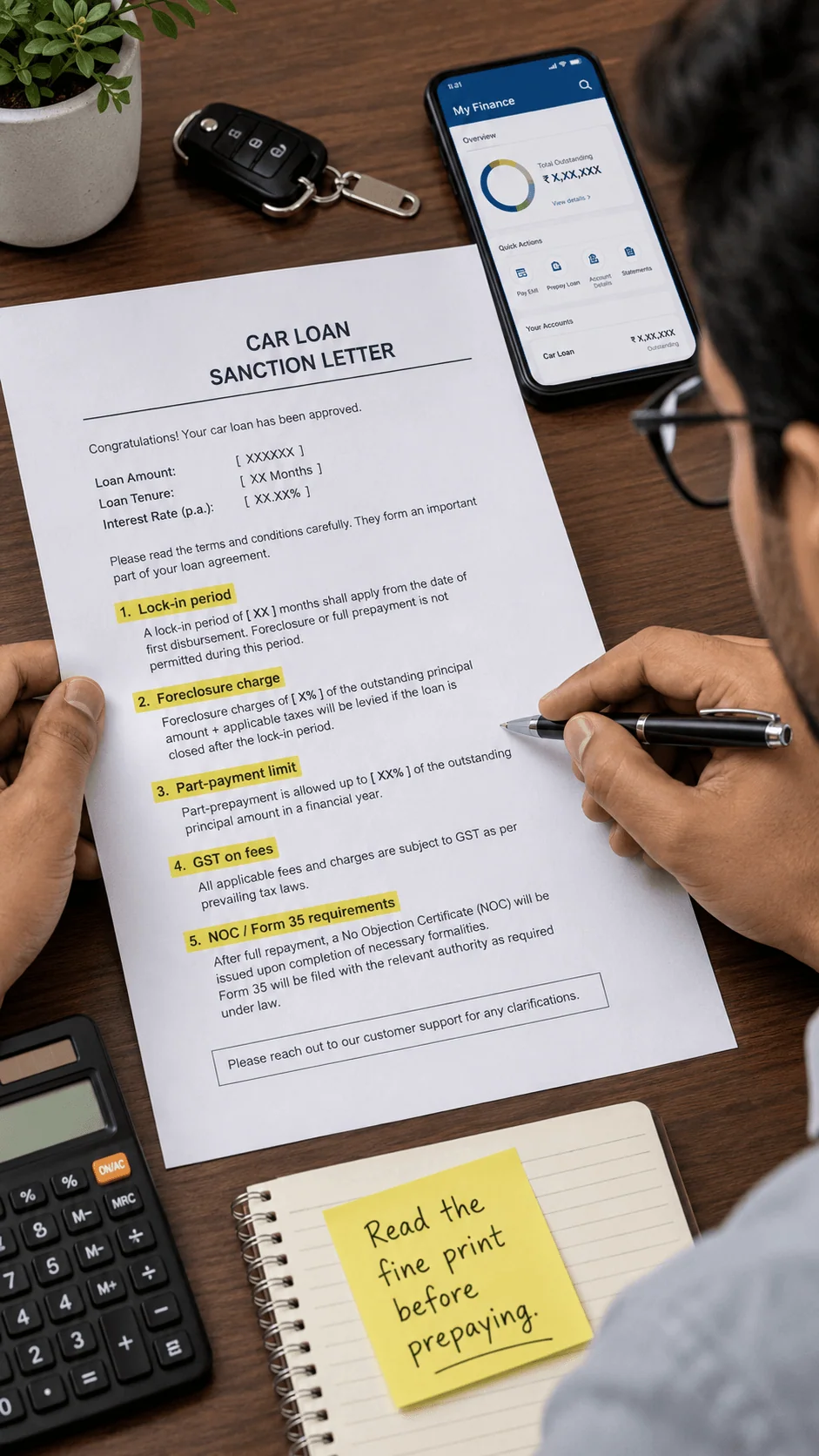
Here’s the catch though. The overwhelming majority of car loans in India aren’t on floating rates. They’re fixed. So while this is fantastic news for home loan customers, retail car buyers on standard fixed-rate auto loans still face penalties. Read your sanction letter carefully. The exact terms govern your account, not the headline rule.
What you absolutely must verify before prepaying
| Rule | What It Means | Why It Matters |
|---|---|---|
| Lock-in period | Minimum months you must wait before prepayment is allowed | Closing earlier triggers punitive flat fees or outright rejection |
| Foreclosure charge | Percentage fee on outstanding principal at full closure | Directly reduces net savings; high rates can negate the benefit |
| Part-payment charge | Fee applied to the lump-sum part-payment amount | Affects whether deploying cash into the loan beats investing it |
| Minimum payment | Smallest acceptable lump sum, often 1 EMI equivalent | Stops micro-payments; you must aggregate funds correctly |
| Tenure reduction option | EMI stays the same, loan closes months/years earlier | Yields the maximum mathematical interest saving |
| EMI reduction option | Tenure stays the same, monthly cash outgo drops | Improves liquidity, sacrifices long-term saving |
One critical step before you transfer any money: always ask the bank for a formal, written foreclosure statement. Why bother? The exact settlement figure shifts daily because interest keeps accruing right up to the closure date, principal recalculations happen overnight, and 18% GST gets layered onto every applicable fee. A generic online calculator will almost never match the bank’s internal ledger to the rupee.
Foreclosure Charges by Bank in 2026
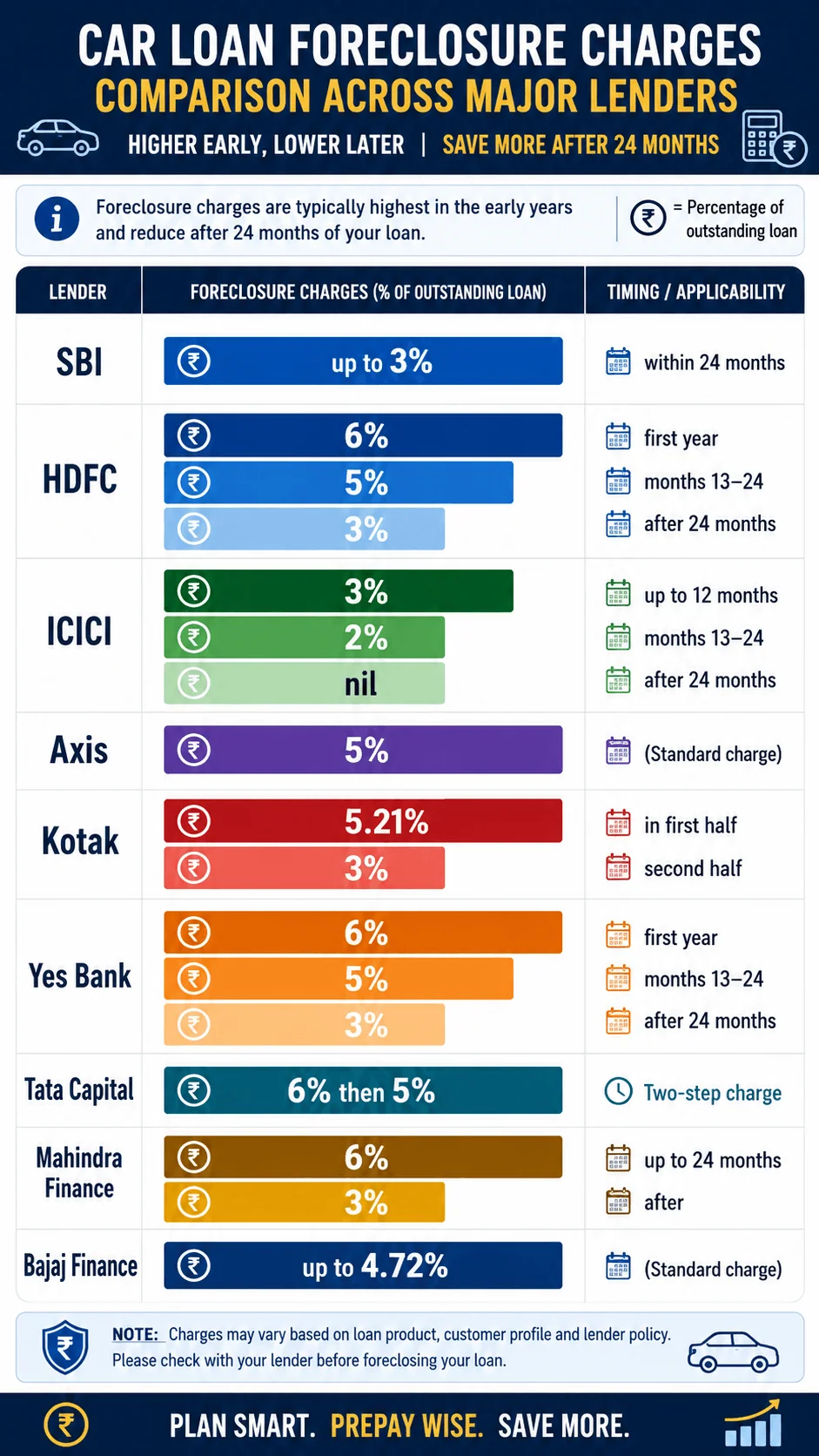
Indian banks and NBFCs are nowhere near uniform on this. Penalties vary by lender, loan seasoning (how old your loan is), interest rate type, and borrower category. The general pattern? Banks front-load their penalties to recover acquisition costs and projected interest, then taper down as the loan matures.
State Bank of India (SBI)
SBI takes a relatively friendly stance. But the scheme you’re on changes everything. Standard fixed-rate auto loans attract a settlement fee of up to 3% on the outstanding balance plus GST. Lump-sum partial payments cost 1% of the amount you push in. These penalties only apply within the first 24 months from disbursement. After that? Both drop to nil. SBI also runs promotional offers (the Loyalty Car Loan Scheme, certain floating-rate retail products) where pre-closure fees are completely waived from day one.
HDFC Bank
HDFC enforces one of the harshest tiered systems out there. Try to close the loan within the first 12 months from your first EMI? You’ll cop a steep 6% penalty on the outstanding balance. Months 13-24 drop the fee to 5%. Past 24 months it stabilises at 3%. There’s also a 12-month lock-in before any lump-sum payment is even allowed. Once you cross that threshold, partial payments cost 5% (months 13-24) and 3% after that. Worth noting: HDFC caps you at a maximum of two such payments across the entire tenure, with each capped at 25% of what’s outstanding.
ICICI Bank
ICICI uses a loan seasoning model. Close out within the first 12 months and you’ll face a 3% penalty plus GST. Months 13-24? That comes down to 2%. Anything beyond two years on the books? Zero fees, both for full payoff and partial payments. That makes ICICI one of the more attractive picks if you can hold out for the mid-tenure exit. The lender also waives all such fees entirely for eligible MSE customers.
Axis Bank
Axis applies a flat structure: 5% on the outstanding balance for full payoff and 5% on the amount you push toward partial payments. The big plus? No lock-in whatsoever. You can shut down the account or chip away any time after disbursement, as long as you can absorb the 5% hit. Fixed-rate loans up to ₹50 lakh granted to Micro and Small Enterprises are exempt from both kinds of fees.
Kotak Mahindra Bank
For loans sanctioned on or after April 1, 2026, Kotak has rolled out a structure pegged to the halfway point of the tenure. Try to clear the debt in the first half of the original term (so on a 60-month loan, the first 30 months)? You’ll pay 5.21%. Cross the midpoint and the fee drops to 3%. There’s a 6-month wait before you can shut down the entire amount. Kotak also bills ₹300 for physical copies of closure reports, though digital copies cost nothing.
Bank of Baroda
BoB stands out by aggressively marketing zero-penalty policies. For individual customers on floating-rate auto loans, the lender applies absolutely zero early-payment or partial-payment fees. Why does this matter? Daily reducing balance math. Every rupee you push in immediately compresses what’s owed for the very next day. For fixed-rate vehicle loans, sanction letter terms govern. That said, public sector banks generally maintain materially lower ceilings than their private peers.
Punjab National Bank (PNB)
PNB aligns broadly with the rest of the public sector. Under floating-rate options, the lender levies absolutely zero early-payment or shutdown fees. For vehicle loans on fixed rates? A standard processing charge of 2% on the outstanding sum during full payoff. PNB also offers the Combo Loan Scheme (home + car) and the PNB Pride Car Loan for government employees, both of which may carry distinct early-exit terms.
Canara Bank
One of the most transparent structures on this list. Per its 2026 disclosures, Canara doesn’t levy any early-exit fees whatsoever if your vehicle loan is wound down before maturity. The policy applies across the board. That makes it highly competitive for retail buyers expecting lump-sum cash inflows.
Union Bank of India
Union Bank’s penalty structure pivots on the source of funds. The lender charges a flat 2% fee on the amount you settle early. But here’s the exception. Pay from “own verifiable sources” (organic savings, asset sales) and you face zero penalty. Shutting down because another bank is taking over the debt (a balance transfer)? Union Bank strictly enforces a 2% takeover charge on the average balance of the previous 12 months. The intent? Deter customer poaching by rivals.
IDFC FIRST Bank
IDFC FIRST splits its rules between new and used vehicle loans. New car loans on fixed-rate ROI attract a 5% early-shutdown fee plus GST. Partial payment? Also 5% plus GST. Used car loans face the same 5% fee but, importantly, lump-sum partial payments aren’t permitted at all. Watch out for the cancellation clause. Request loan cancellation beyond 30 days of booking? It’s officially treated as a payoff and attracts the full 5% hit.
IndusInd Bank
IndusInd front-loads its penalties heavily. For early payoffs executed after the 1st EMI up to the 11th, the lender charges 5% of the outstanding balance plus GST. Pay the 12th EMI? The fee drops slightly to 4%. The same applies to lump-sum payments and swap replacements. Worth knowing: IndusInd also charges substantial fees for physical documentation and outstation collection. Use digital channels where you can.
Yes Bank
Yes Bank essentially mirrors HDFC’s tiered methodology, with a hard prohibition on full payoff until 6 EMIs have been cleared and aggressively front-loaded penalties that gradually taper as your loan matures. Shutting down between months 7-12 attracts 6% on the outstanding balance. Months 13-24 drop to 5%. Past two years? It settles at 3%. Lump-sum payments need 12 EMIs cleared first, then cost 5% (months 13-24) or 3% (post 24). Two hard caps: such payments are limited to two during the tenure, and each one can’t exceed 25% of what’s outstanding.
Tata Capital, Mahindra Finance & Bajaj Finance (NBFCs)
NBFCs run slightly higher ceilings than traditional banks. Tata Capital charges 6% on standard auto loans shut down within 12 months, dropping to 5% thereafter. Used car loans face an aggressive 7% in the first 6 months. Mahindra Finance pivots around 24 months: 6% in months 1-24, dropping to 3% after. The NBFC also applies a ₹1,500 cash handling charge for non-mandate repayment modes. Bajaj Finance offers a complex matrix with fees up to 4.72% (inclusive of taxes) on the outstanding sum. All such charges get waived after 24 months if you pay from your own funds and have no EMI bounces in the previous 12 months.
Bank-wise summary table
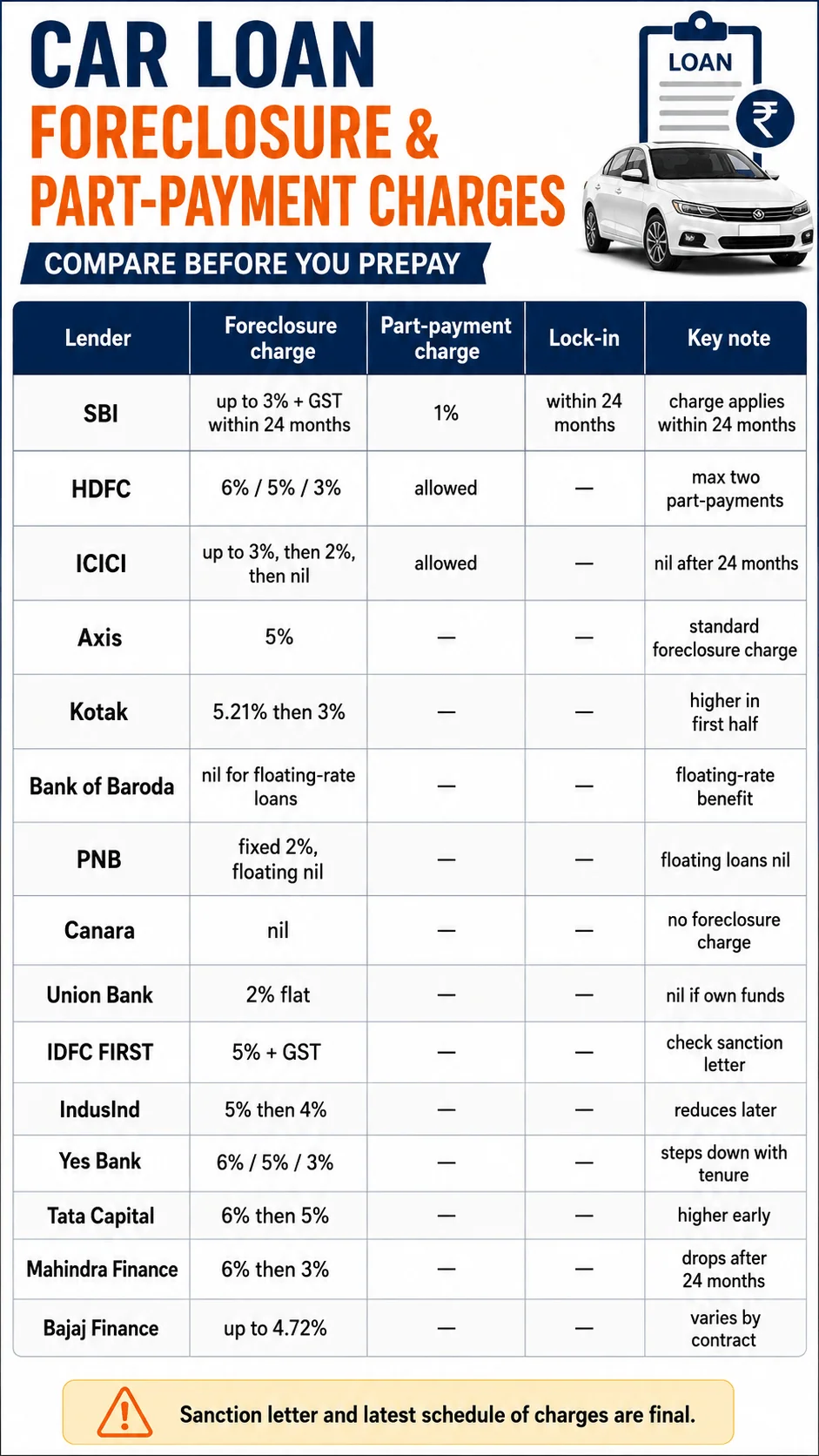
| Bank / Lender | Foreclosure | Part-Payment | Lock-In | Notes |
|---|---|---|---|---|
| SBI | Up to 3% + GST (within 24m) | 1% + GST (within 24m) | Verify agreement | Nil for specific floating schemes |
| HDFC Bank | Yr 1: 6%; 13-24m: 5%; Post 24m: 3% | 13-24m: 5%; Post 24m: 3% | 12 months for part-pay | Max 2 part-payments |
| ICICI Bank | Up to 12m: 3%; 13-24m: 2%; Post 24m: Nil | Up to 24m: 3%; Post 24m: Nil | Verify agreement | Nil for eligible MSE |
| Axis Bank | 5% of principal | 5% on prepaid amount | None | MSE up to ₹50L exempt |
| Kotak Mahindra | First half: 5.21%; Second half: 3% | Same as foreclosure | 6 months | Based on 2026 sanction rules |
| Bank of Baroda | Nil (floating) | Nil (floating) | Verify | Highly favourable for floating |
| PNB | Fixed: 2%; Floating: Nil | Verify | Verify | Different terms for combo loans |
| Canara Bank | Nil before maturity | Nil | Verify | Zero-fee structure |
| Union Bank | 2% flat; Nil if own funds | Verify | Verify | 2% takeover penalty applies |
| IDFC FIRST | 5% on fixed ROI + GST | 5% + GST (new); Not allowed (used) | Verify | Used car loans block part-pay |
| IndusInd Bank | Post 1st-11th EMI: 5%; After 12th: 4% | Same as foreclosure | Verify | Heavy first-year penalty |
| Yes Bank | 7-12m: 6%; 13-24m: 5%; Post 24m: 3% | 13-24m: 5%; Post 24m: 3% | 6 months | 25% cap on part-payments |
| Tata Capital | Within 12m: 6%; After 12m: 5% | After 12m: 5% | Verify | Used car loans 7% early |
| Mahindra Finance | Up to 24m: 6%; Post 24m: 3% | 13-24m: 5%; Post 24m: 3% | Verify | ₹1,500 non-mandate cash fee |
| Bajaj Finance | Up to 4.72%; Nil post 24m (own funds) | Up to 4.72% | No minimum seasoning | Tiered for smaller loans |
Important regulatory note: the sanction letter and the institution’s latest schedule of charges are the final legal authority for any specific loan account. They supersede any generic aggregator table, including this one.
When Prepayment Saves You Money
Now to the part everyone really cares about. When does paying ahead actually save you meaningful money, and when is it just a waste of time? The answer comes down to amortization math, which is much less intimidating than it sounds.
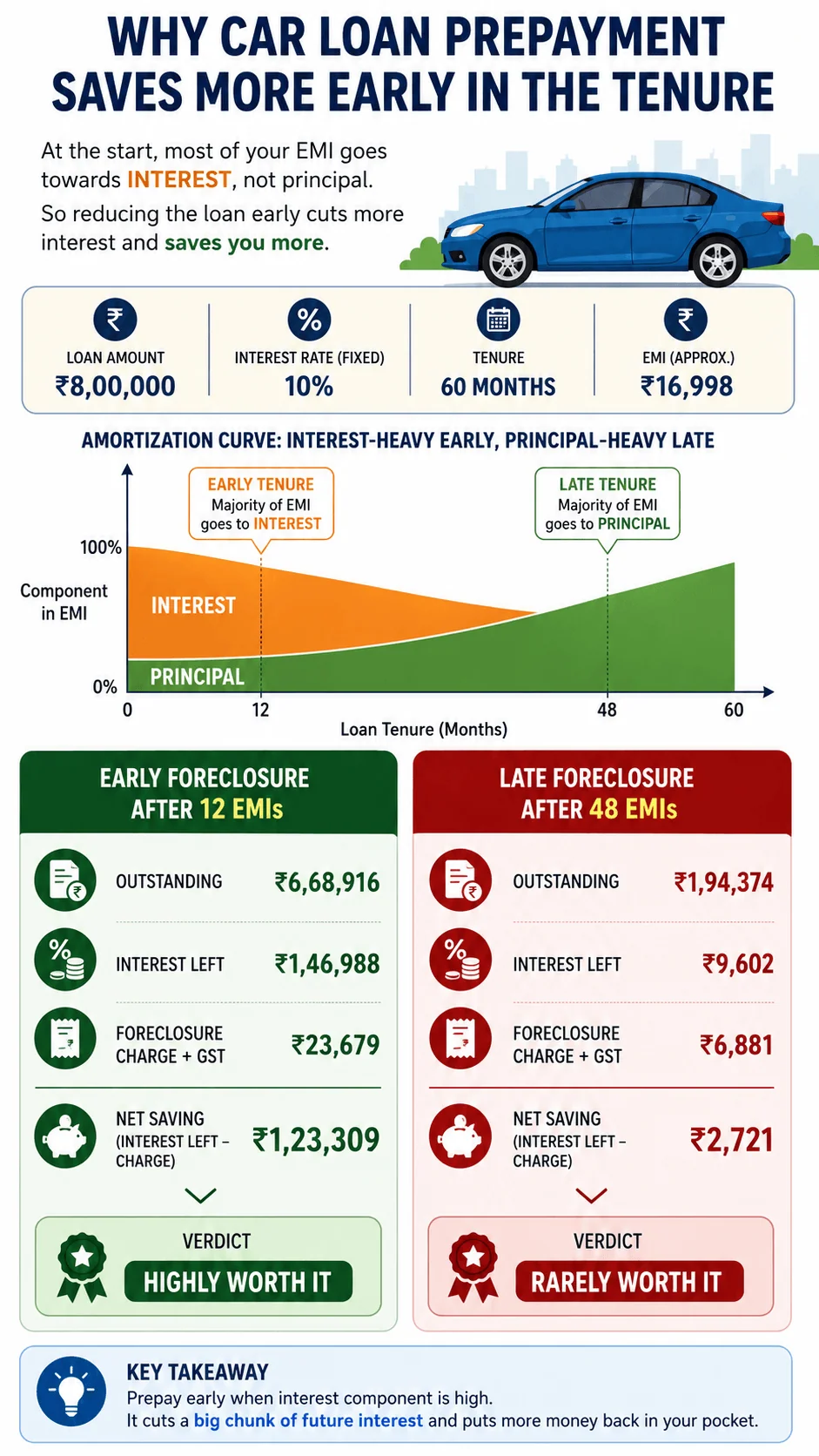
Every EMI splits into two pieces: balance repayment and interest charge. Indian banks universally use the reducing balance method, which calculates the borrowing cost on whatever’s outstanding at the start of every payment cycle. Because the balance is at its absolute peak in the early stages of the loan, the interest piece consumes the vast majority of every initial EMI.
In year 1 of your 5-year loan? Mostly borrowing cost. By year 5? Almost entirely balance reduction. That’s why paying ahead early delivers compounding savings. Wait too long and the math gets ugly. By then, your lender has already extracted most of its projected profit.
Example 1: Early Foreclosure (Worth It)
Let’s run a realistic scenario with numbers you can sanity-check against any online amortization calculator.
- Original loan amount: ₹8,00,000
- Interest rate: 10% p.a. (fixed)
- Tenure: 5 years (60 months)
- Monthly EMI: approximately ₹16,998
- Total expected interest over 5 years: ₹2,19,880
- Loan age at prepayment: 1 year (12 EMIs successfully paid)
After exactly 12 months, you’ve remitted ₹2,03,976 in total EMIs. But due to the heavy front-loaded interest burden in the reducing balance method, your outstanding balance has only dropped to roughly ₹6,68,916. Continue servicing the debt for the remaining 4 years? The future interest obligation comes to ₹1,46,988.
Assume the bank charges a 3% settlement fee on the outstanding sum, plus the mandatory 18% GST:
| Item | Amount |
|---|---|
| Outstanding principal | ₹6,68,916 |
| Interest left if loan continues | ₹1,46,988 |
| Foreclosure charge (3%) + 18% GST | ₹20,067 + ₹3,612 = ₹23,679 |
| Net interest saving (Interest left − Charges) | ₹1,46,988 − ₹23,679 = ₹1,23,309 |
| Verdict | Highly worth it |
Is absorbing the ₹23,679 banking hit worth it? Absolutely. You’re walking away with ₹1.23 lakh of net wealth preservation, easily outpacing the fee drag.
Example 2: Late Foreclosure (Rarely Worth It)
Same loan, but now you decide to wind it down after 4 years (48 EMIs paid), with just 1 year remaining.
At this late juncture, the outstanding balance has plummeted to ₹1,94,374. Because the base is so low, the total interest scheduled for the final 12 months is a relatively trivial ₹9,602.
| Item | Amount |
|---|---|
| Outstanding principal | ₹1,94,374 |
| Interest left if loan continues | ₹9,602 |
| Foreclosure charge (3%) + 18% GST | ₹5,831 + ₹1,050 = ₹6,881 |
| Net interest saving | ₹9,602 − ₹6,881 = ₹2,721 |
| Verdict | Rarely worth it |
A marginal net saving of just ₹2,721. Worth depleting nearly ₹2 lakh of highly liquid cash for that microscopic benefit? Rarely. Shutting down late in the tenure is generally an inefficient deployment of household capital, especially when that same ₹2 lakh sitting in even a vanilla short-term debt fund or sweep-in FD could comfortably outpace this saving over 12 months.
EMI Reduction vs Tenure Reduction
Make a partial payment, and the bank asks how you want the lump sum to restructure the amortization schedule.
| Option After Part-Payment | EMI Impact | Tenure Impact | Interest Saving |
|---|---|---|---|
| Option 1: Reduce EMI | Monthly EMI falls significantly | Loan concludes on original date | Lower total savings |
| Option 2: Reduce Tenure | Monthly EMI stays identical | Loan concludes months/years early | Maximum total savings |
The operating rule is simple. Can your monthly cash flow easily support your current EMI? Then choose tenure reduction every single time. Holding your EMI steady against a suddenly shrunk balance triggers an accelerated collapse of your remaining debt, yielding the maximum mathematically possible savings.
Pick EMI reduction only if you’re facing persistent budget constraints, job uncertainty, or rising inflation pressures that demand immediate liquidity relief.
Prepay vs Invest: Which Is Better?
This is the real financial dilemma. Should you deploy surplus capital toward shutting down the debt, or divert it into investments that might earn more over time?
Think of it as an asset-liability management problem. You’re weighing the opportunity cost of capital while factoring in inflation and the taxation drag on investment returns. Emotion often pushes people toward debt-freedom. But mathematics has to dictate the final call.
The core principle
Paying down a car loan yields a guaranteed and tax-free return with essentially no risk attached to it whatsoever, exactly equal to the effective interest rate of the underlying debt obligation. If your loan rate is 10%, shutting it down means you’re locking in a guaranteed 10% yield on the deployed capital. Why? That expense is now permanently avoided.
For any alternative investment to mathematically outperform this, it must generate a post-tax return exceeding 10%.
The core formulas:
- Prepayment Benefit ≈ Loan Interest Rate Avoided − Impact of Foreclosure Charges
- Investment Benefit ≈ Expected Pre-Tax Return − Applicable Capital Gains/Income Tax
Simple rule framework
| Situation | Better Choice | Why |
|---|---|---|
| Car loan at 11-13% (typical used car) | Prepay aggressively | Finding a guaranteed, low-risk 11%+ post-tax return in the Indian market is highly improbable |
| Car loan at 8-9% | Compare carefully | A diversified equity portfolio held over a long horizon may reliably beat an 8% hurdle rate after taxes |
| No emergency fund exists | Do not prepay | Liquidating safety buffers exposes you to high-interest personal debt in emergencies |
| High-risk investor profile | Partial invest / part-payment | Balance the relief of debt reduction with continued market participation |
| Near end of loan tenure | Continue EMI + invest | Remaining interest is negligible; liquid cash is more valuable |
| Early loan stage | Prepay | Wipes out the heaviest portion of the front-loaded interest curve |
Worked ROI example
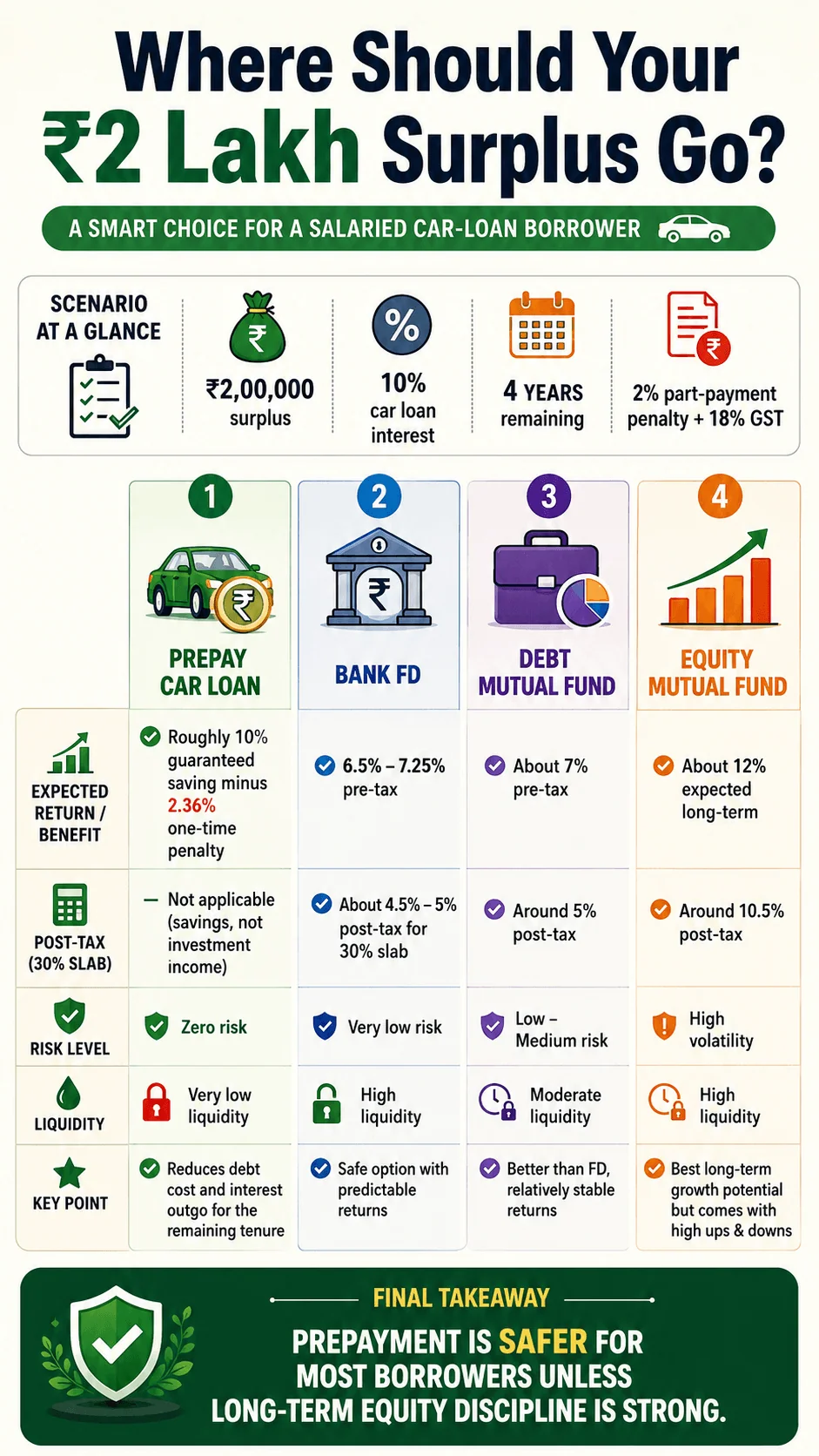
Assume you’re an Indian salaried professional with a ₹2,00,000 surplus. Your car loan is at 10% with 4 years remaining. The bank charges a 2% part-payment penalty plus 18% GST. You’re evaluating three alternatives.
| Option | Expected Return / Saving | Risk | Liquidity | Verdict |
|---|---|---|---|---|
| Prepay car loan | ~10% guaranteed savings (minus 2.36% one-time penalty) | Zero | Very low (locked in a depreciating asset) | Optimal if you prioritise guaranteed wealth preservation |
| Bank Fixed Deposit (FD) | 6.5-7.25% pre-tax. In 30% slab, post-tax ~4.5-5% | Zero | High | Mathematically inferior. Post-tax FD fails to cover the 10% loan cost |
| Debt Mutual Fund | ~7% pre-tax, taxed at marginal slab. Post-tax ~5% | Low-Medium | High | Fails to beat the 10% cost of capital |
| Equity Mutual Fund | ~12% expected long-term. Post-tax (factoring LTCG) ~10.5% | High (market volatility) | High | Viable only for disciplined investors with multi-year horizons who can withstand drawdowns without panic-selling |
The empirical conclusion? Unless you possess specialised equity expertise alongside the emotional discipline required to ride out severe market drawdowns without panic-selling at the worst possible moment, paying down a standard 9-11% auto loan is the mathematically superior and psychologically safer choice for the average Indian salaried borrower. Eliminating a known liability almost always outperforms chasing uncertain yield in lower-risk vehicles.
Part Payment vs Full Foreclosure
When a lump sum lands (annual bonus, FD maturity, asset sale), you have to decide the scale of your move. Big or small? Both options work. They just serve different financial goals.
Part Payment
Partial payment injects targeted capital into the account to suppress the balance, while the contractual relationship with the lender stays active.
Best when: Pros: Cons:
A full payoff wipes out the debt in one stroke, immediately transferring unencumbered legal ownership of the car back to you.
Best when: Pros: Cons:
| Factor | Part Payment | Full Foreclosure |
|---|---|---|
| Loan status | Continues active | Terminated and closed |
| Interest saving | Moderate to high | Highest mathematically possible |
| Liquidity impact | Lower (incremental depletion of savings) | Severe (total lump-sum depletion) |
| Charges | May apply (often 3-5%) | May apply (often 3-6%) |
| Best for | A balanced, risk-managed approach | Aggressive debt-elimination goals |
| Paperwork | Minimal (internal banking adjustments) | Extensive (mandates RTO + Parivahan processes) |
Step-by-Step Process to Prepay or Foreclose Your Car Loan
Winding down a vehicle loan in India isn’t just an internal banking transaction. It’s a rigid legal process involving Regional Transport Office authorities and your motor insurance provider. Skip the final administrative steps? The lender’s lien stays active on your vehicle. That creates serious complications if you ever try to sell or claim total-loss insurance.
For partial payment
- Analyse the agreement. Pull out your original sanction letter and verify lock-in expiry plus any penalty clauses applicable to your profile.
- Request a quotation. Contact customer service or use the bank’s net-banking portal to simulate the exact math (fee + GST + post-payment balance).
- Specify the restructuring. Explicitly instruct the bank, usually via formal written request or digital checkbox, whether the lump-sum payment should trigger tenure reduction (recommended) or EMI reduction.
- Execute the transfer. Move the funds via RTGS, NEFT, or a verified banking portal from a registered account. That ensures a clear audit trail.
- Obtain the new amortization schedule. Download the revised schedule from the bank. It confirms the balance has been correctly reduced and the new tenure or EMI is live in the core banking system.
For full payoff
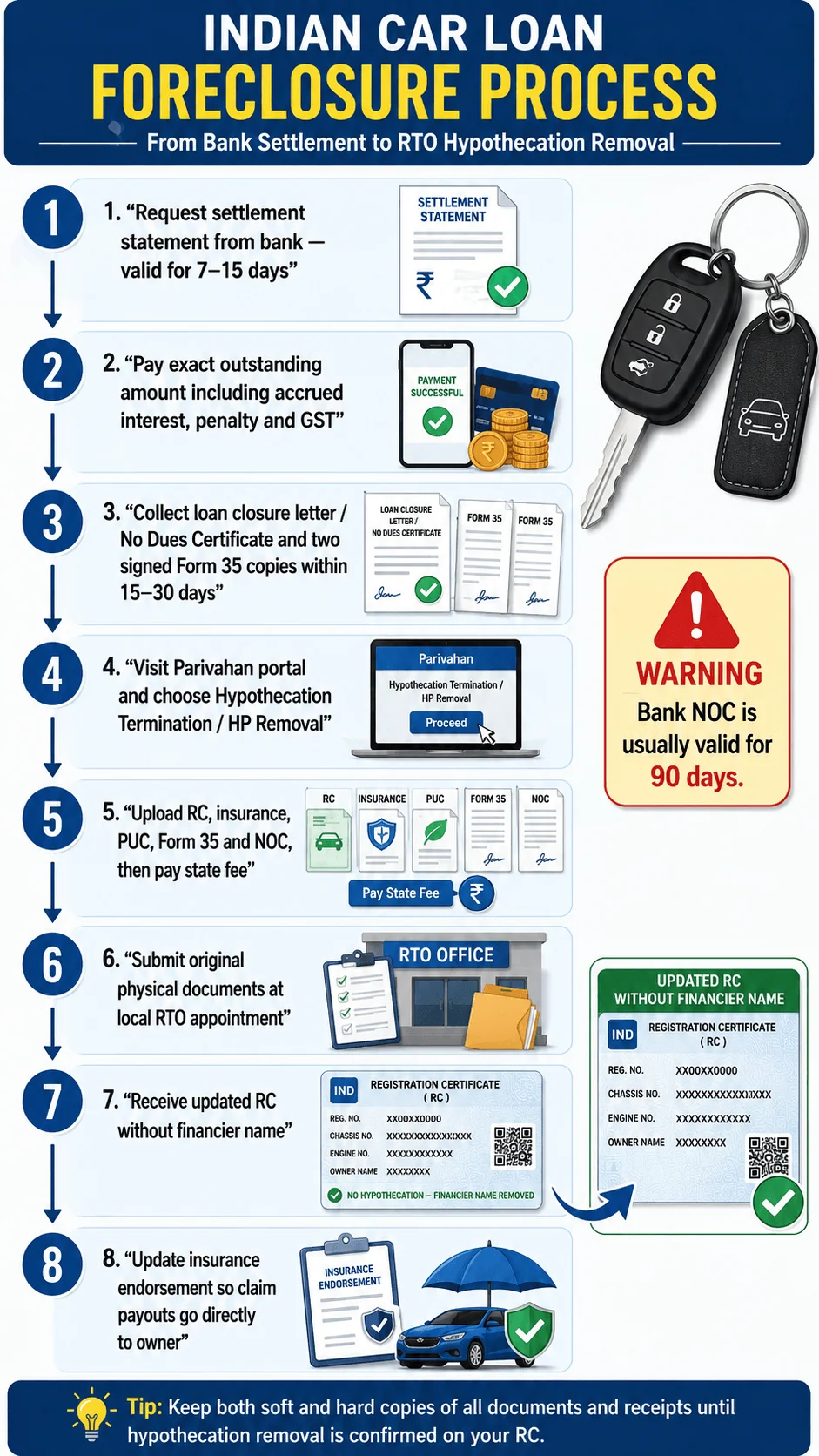
- Request a settlement statement. Apply online via net banking or physically at a branch. This document details exact outstanding balance, accrued daily borrowing cost, the penalty percentage, and the mandatory 18% GST. It’s typically valid only for 7-15 days.
- Settle the account. Remit the precise, down-to-the-rupee amount stipulated before the validity window expires. Partial compliance gets the request rejected.
- Procure closure documents. Within 15-30 days of fund realisation, the bank generates and dispatches a Loan Closure Letter / No Dues Certificate (NDC) and two copies of Form 35 (physically signed and stamped by the financier’s authorised signatory).
- Initiate RTO hypothecation removal (Parivahan). Visit vahan.parivahan.gov.in, navigate to “Vehicle Related Services,” select your state, enter registration and chassis numbers, pick “Hypothecation Termination” (HP Removal), authenticate via Aadhaar-linked OTP, upload scanned copies of RC, comprehensive insurance, PUC, Form 35, and NOC, and pay the online cancellation fee (₹100-500 depending on state).
- Submit physical documents. Book an appointment through the portal and visit the local RTO office to submit the original physical dossier for manual verification by an RTO inspector.
- Receive unencumbered RC. The RTO destroys the old RC and dispatches a freshly printed smart card RC, completely devoid of the financier’s name, to your registered address.
- Update insurance endorsements. Forward a digital copy of the new RC and the bank’s NOC to your motor insurance provider. This removes the hypothecation clause from the comprehensive policy so any future claim payouts go directly to you.
Closure checklist
| Document | Needed For |
|---|---|
| Foreclosure statement | Establishes the legally binding final settlement amount |
| Payment receipt | Evidence of the final fund transfer and bank clearing |
| Loan closure letter (NOC) | Formal declaration that zero dues remain |
| Form 35 | Statutory RTO document terminating the financier’s interest |
| Updated RC | Legal proof that you’re now the sole, unencumbered owner |
| Insurance endorsement | Routes all future insurance claims directly to you |
Important warning: the NOC issued by the bank typically carries a 90-day validity from issuance. Miss submitting Form 35 to the RTO within this window? The NOC expires. Getting a duplicate is a tedious bureaucratic process and invariably triggers additional processing fees.
Credit Score Impact
A common worry. Will aggressive early payment and account shutdown damage your CIBIL score? Short answer: no, unless you make one administrative mistake along the way.
In India’s algorithmic credit ecosystem, your decision to pay down and successfully close an instalment loan signals strong repayment capacity, along with disciplined capital allocation on your part. Both traits fundamentally enhance your credit profile over the long term. Will you see a microscopic, temporary dip due to a shortened “average age of credit history”? Possibly. But that impact stays overwhelmingly negligible and recovers fast.
The real catastrophic risk arises only during the final settlement phase, because of administrative miscoding. You must ensure the bank reports the account status as “Closed” and not “Settled” to CIBIL, Experian, and Equifax. What does “Settled” imply? You defaulted on a portion of the debt and the bank took a negotiated loss. That damages a credit score for 5-7 years. “Closed” confirms all dues (including any penalties and GST) were fully honoured.
Pull your official CIBIL report 45-60 days post-shutdown to verify the status reflects a clean closure. Don’t skip this step. It’s worth ten minutes.
FAQs
Can I prepay my car loan in India?
Yes, Indian banking regulations and the RBI permit prepayment of car loans across all institutions. You can choose to part-pay a lump sum to reduce the principal or fully foreclose the loan. But the action is strictly subject to your lender’s specific terms, lock-in periods, and penalty matrices outlined in the original loan agreement.
What are car loan foreclosure charges?
Foreclosure charges are explicit penalty fees levied by a lender to compensate for the anticipated yield they lose when a loan is settled earlier than scheduled. In India, these fees typically range from 2% to 6% of the outstanding balance, plus an extra 18% GST mandated by the government.
Should I prepay my car loan or invest?
If your active auto loan carries a steep rate (10% or more, typical for used vehicles) and you lack guaranteed investment options yielding a higher post-tax return, paying it down is the mathematically superior choice. If the loan is exceptionally cheap and you’re skilled at navigating equity markets, investing surplus funds may prove more lucrative over a long horizon.
Is part-payment allowed in car loans?
Yes, the vast majority of major Indian lenders permit lump-sum partial payments. But they frequently impose rigid constraints. Examples: a 6-12 month lock-in period, a cap of only two such payments during the entire tenure, and limits restricting each payment to 20-25% of the outstanding balance.
Does car loan prepayment reduce EMI or tenure?
Banks generally offer the borrower a distinct choice. You can either maintain the current EMI and drastically shorten the remaining tenure, or keep the original tenure intact while significantly lowering the monthly EMI.
Is it better to reduce EMI or tenure after part-payment?
Shrinking the tenure is vastly superior for maximising total long-term savings. Why? The balance collapses faster. Pick EMI reduction only when you’re facing persistent cash-flow constraints, job insecurity, or inflation pressures that demand immediate monthly relief.
When is the best time to prepay a car loan?
As early in the tenure as the bank permits, usually right after the lock-in period expires. Because Indian auto loans use reducing-balance amortization, the bulk of the lender’s yield is aggressively charged in the first two years. That’s when paying ahead delivers the biggest savings.
Does prepaying a car loan affect my credit score?
Successfully shutting down a loan generates a strongly positive long-term impact on creditworthiness. It signals financial stability and an intent to clear debt. There may be a microscopic, temporary dip due to a shortened active credit history. But it’s generally highly beneficial for long-term CIBIL profiles. Just make sure the account is reported as “Closed,” not “Settled.”
Can I foreclose my car loan after 6 months?
Depends on your lender’s sanction letter. Some institutions like Kotak Mahindra Bank and Yes Bank explicitly permit an early exit after 6 months have elapsed. Others, such as HDFC Bank, enforce a strict 12-month lock-in period before any early-exit request is even entertained.
Which banks charge foreclosure fees on car loans?
Virtually all private and public sector banks levy exit fees on standard fixed-rate auto loans, including HDFC, ICICI, Axis, and Tata Capital. However, specific public sector banks like Canara Bank and Bank of Baroda promote zero such fees under certain schemes or floating-rate profiles.
Are foreclosure charges negotiable?
While officially structured in rigid tariff schedules, customers with excellent historical repayment records, high CIBIL scores, and premium banking relationships can sometimes successfully negotiate reduced or fully waived fees directly with their branch manager before signing the initial agreement.
Is GST charged on foreclosure fees?
Yes. Exit penalties, lump-sum partial fees, and even simple statement issuance charges are legally classified as financial services and attract a mandatory 18% Goods and Services Tax.
What documents are needed after car loan closure?
After clearing all financial dues, you must collect a formal No Objection Certificate (NOC) and two physical copies of Form 35 (signed and stamped by the financier). These are the legally indispensable papers required to strip the bank’s name from your vehicle’s RC.
How do I remove hypothecation after car loan closure?
Log into the Parivahan Sewa portal, select “Hypothecation Termination,” authenticate via Aadhaar, upload scanned copies of the NOC, Form 35, RC, and insurance, pay the RTO fee, and finally submit the physical documents to your local RTO office to receive a clean RC. Cross-reference your new car delivery checklist to keep all financial documents in order.
Is it worth foreclosing a car loan near the end of tenure?
Rarely. By the final year of the amortization schedule, the outstanding balance is extremely small, and the monthly EMI consists almost entirely of balance repayment rather than borrowing cost. Paying a punitive exit fee plus 18% GST at this late stage often entirely eclipses the negligible savings.