
An NCAP safety rating is an independent crash-test score that tells you how well a car protects its occupants during controlled impact tests. As an Indian buyer, you’ll see ratings from two main programmes today: Global NCAP and Bharat NCAP. Both award stars from 0 to 5. A 5-star rating signals strong crash protection for you, a stable safety cage, plus the right combination of airbags and active safety systems. A 1 or 2-star rating? That’s a serious gap you shouldn’t ignore.
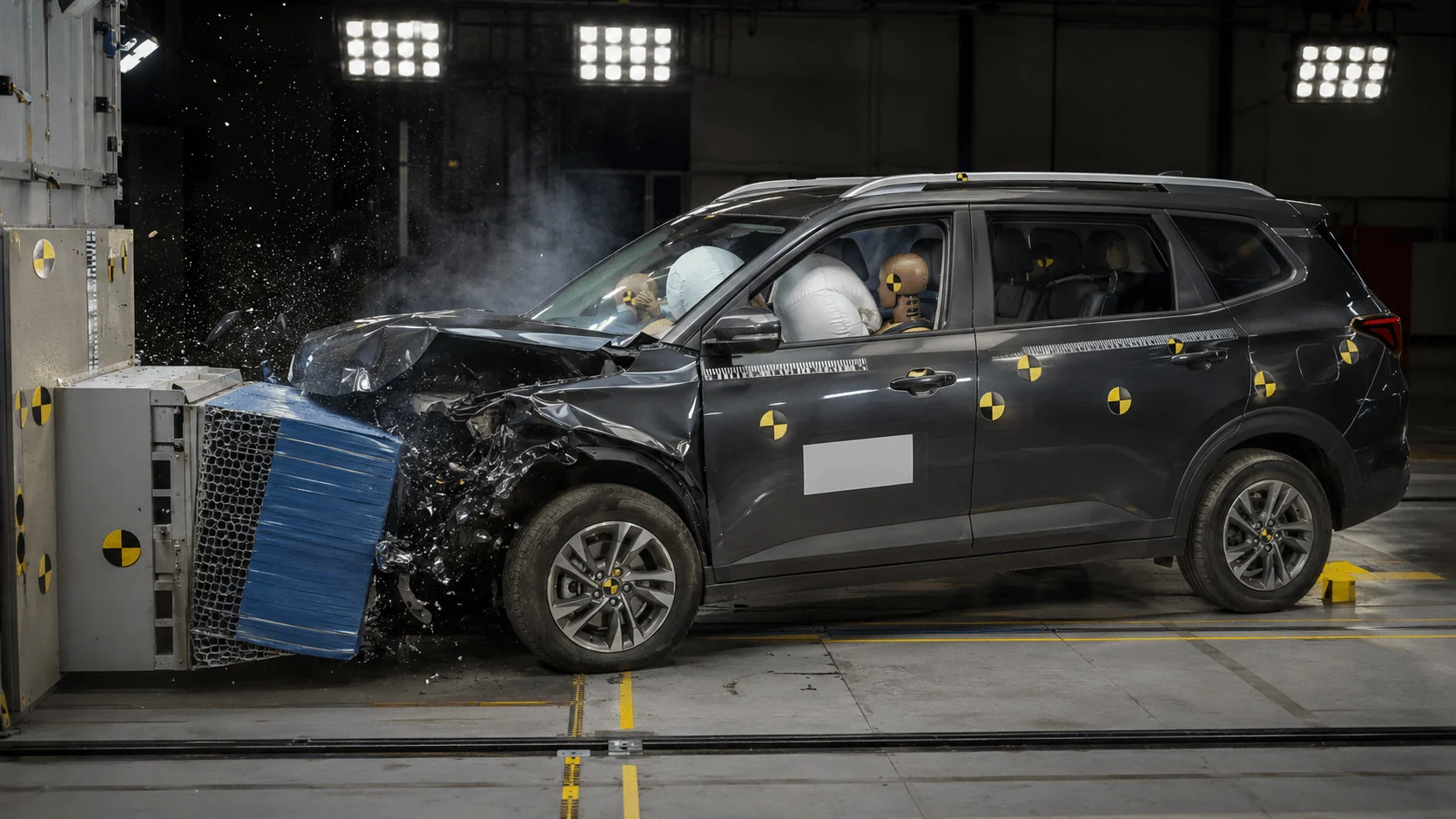
Before we dig in, here’s a quick look at what each rating broadly means for your buying decision.
| NCAP Rating | What It Usually Means |
|---|---|
| 5 stars | Strong crash protection under tested conditions |
| 4 stars | Good protection with some weaknesses |
| 3 stars | Acceptable but basic protection |
| 2 stars | Weak protection in key areas |
| 1 star | Poor crash protection |
| 0 stars | Very poor protection, serious safety gaps |
The car-buying conversation in India has shifted a lot in the last decade. For years, you’d filter by mileage and looks. On-road price came third. Safety? It came up only after a friend’s brother had a bad accident, or when a viral video of a Maruti or Hyundai crumpling like wet cardboard hit YouTube. That’s changed. You probably look up star ratings before stepping into a showroom now. But here’s the catch: most buyers don’t fully understand what those stars cover, what they leave out, or why two cars with the same badge can perform very differently in a real crash. This guide fixes that.
What Is NCAP Safety Rating?
NCAP stands for New Car Assessment Programme. It’s an independent, standardised framework that crash-tests cars and scores how well their structure and safety equipment protect you during impact. Regulatory minimums make a car road-legal. NCAP ratings push manufacturers beyond that minimum by rewarding engineering effort that actually saves your life. Big difference.
Worth clearing up early. A crash-test rating measures passive safety. That’s what happens in the milliseconds after a collision becomes unavoidable. Not the same as active safety or general road-worthiness. Your car can have brilliant brakes and steering, yet still perform terribly in a crash if its structural geometry can’t manage kinetic energy. Both matter. NCAP measures one of them.
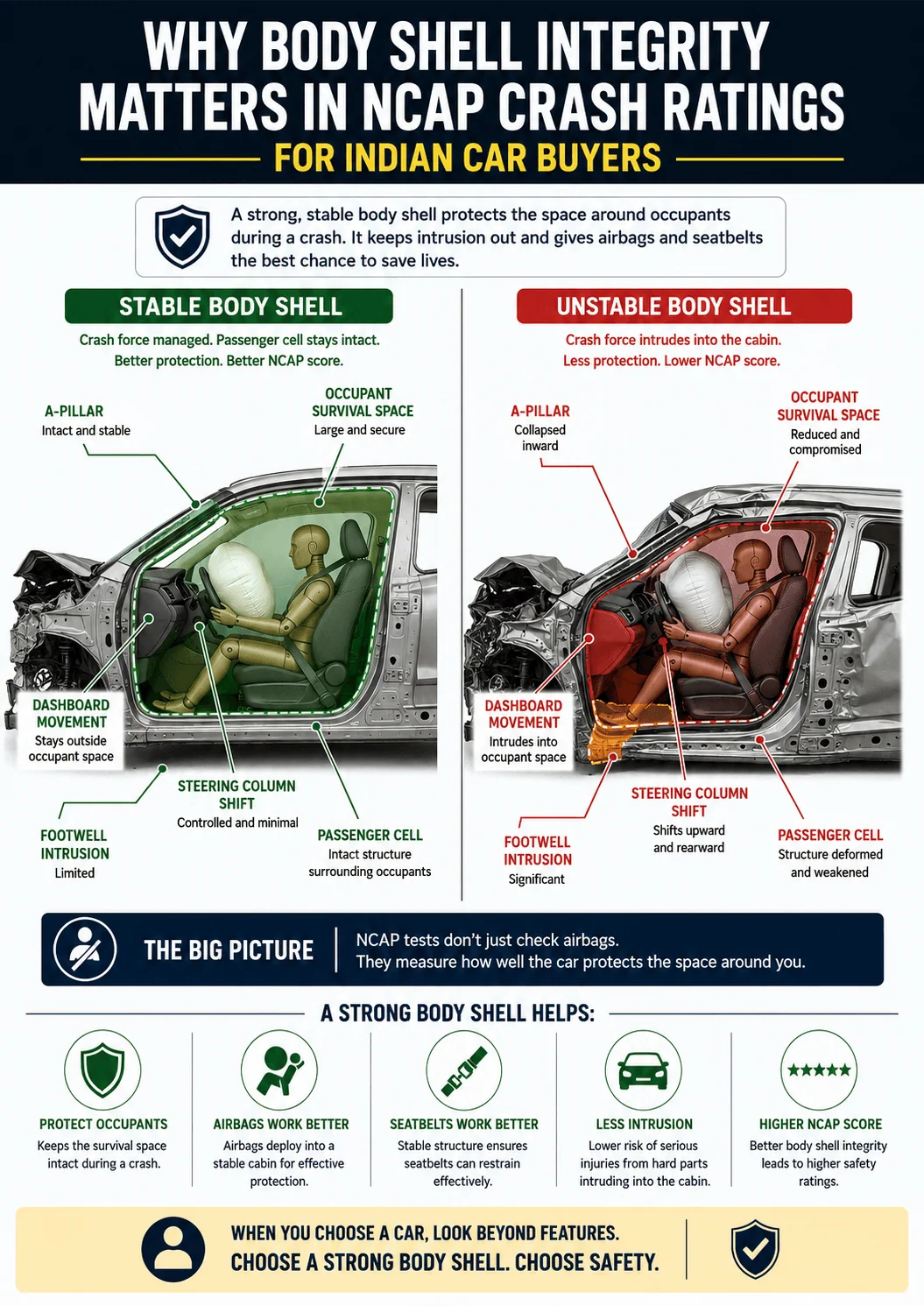
A common myth? That two cars with the same safety equipment will score the same in a crash test. They won’t. Two subcompact SUVs can both ship with six airbags and Electronic Stability Control. But if one sits on a high-strength steel platform with well-engineered load paths and the other doesn’t, their crash performance diverges sharply. Airbags act like cushions. The body shell is the cage. Your car needs both, but the cage matters far more than the cushions when the moment of impact arrives. If the cage collapses, the cushions can’t save you.
NCAP assessments break safety into measurable categories:
- Adult Occupant Protection (AOP): Risk of serious injury to front-seat adults in frontal and side impacts. Sensors measure head, neck, chest, knee and pelvic trauma.
- Child Occupant Protection (COP): How well child dummies stay protected in approved child seats, plus how easily the car accepts standard child restraint systems via ISOFIX.
- Safety Assist Technology (SAT): Active systems that either prevent crashes or prepare the car for impact. Things like ESC, seatbelt reminders, plus an increasing list of ADAS features.
- Pedestrian Protection: Bumper and bonnet design (plus windshield base) that limits injury to anyone the car hits.
NCAP doesn’t stop accidents from happening. It measures what your car does for you when one does. A higher star rating means crumple zones absorbed the impact and the passenger cell stayed intact. The final score combines body shell stability, airbag deployment, restraints and active systems. The badge isn’t just about airbag count.
Global NCAP vs Bharat NCAP
These two programmes shape almost every safety conversation in India today. Related, but not identical. Confusing one for the other leads to bad buying decisions on your part.
Global NCAP
Global NCAP is an independent, UK-registered automotive safety charity. You’ll know it best from its “Safer Cars for India” campaign, launched in 2014. The early results? Shocking. Several high-volume Indian models scored zero stars, with collapsing structures and base variants that didn’t even ship with driver airbags. The campaign forced manufacturers to take structural engineering seriously. Tata moved first. Mahindra followed. Maruti finally joined later.
Global NCAP’s protocols have evolved. The 2014–2021 framework focused mainly on frontal offset crashes, with AOP scored out of 17 points. The updated 2022–2024 protocol scores AOP out of 34, mandates side-impact and pole tests, requires ESC, plus factors in pedestrian protection for top star ratings. So is an older 5-star the same as a newer 5-star? Not even close. An older 5-star isn’t the same as a newer 5-star. A car celebrated as 5-star in 2018 might struggle to get 3 stars under today’s protocol. Worth remembering when you read older reviews.
One bit of context that matters to you: the funded “Safer Cars for India” testing programme ended in April 2024. Global NCAP still publishes results, but manufacturers now have to submit and pay for tests themselves. The torch has effectively passed to Bharat NCAP.
Bharat NCAP
Bharat NCAP (BNCAP) is India’s own official safety rating programme, instituted by the Ministry of Road Transport and Highways (MoRTH) in August 2023, with testing rolling out from 1 October 2023. It runs under the Automotive Industry Standard (AIS) 197 and covers right-hand-drive M1 category vehicles up to 3,500 kg.
Manufacturers voluntarily submit cars to Indian testing agencies. The big win for you as a buyer? The exact variant sold in Indian showrooms gets tested, which removes the ambiguity that sometimes plagued Global NCAP results. Cost of testing is also lower for Indian OEMs, which is partly why BNCAP has already crash-tested over 30 cars in barely two years.
How does the scoring work? Bharat NCAP scores AOP out of 32 and COP out of 49. To earn 5 stars, your car needs at least 27/32 in AOP and 41/49 in COP, plus standard ESC and side head protection (curtain airbags or equivalent).
Side-by-side comparison
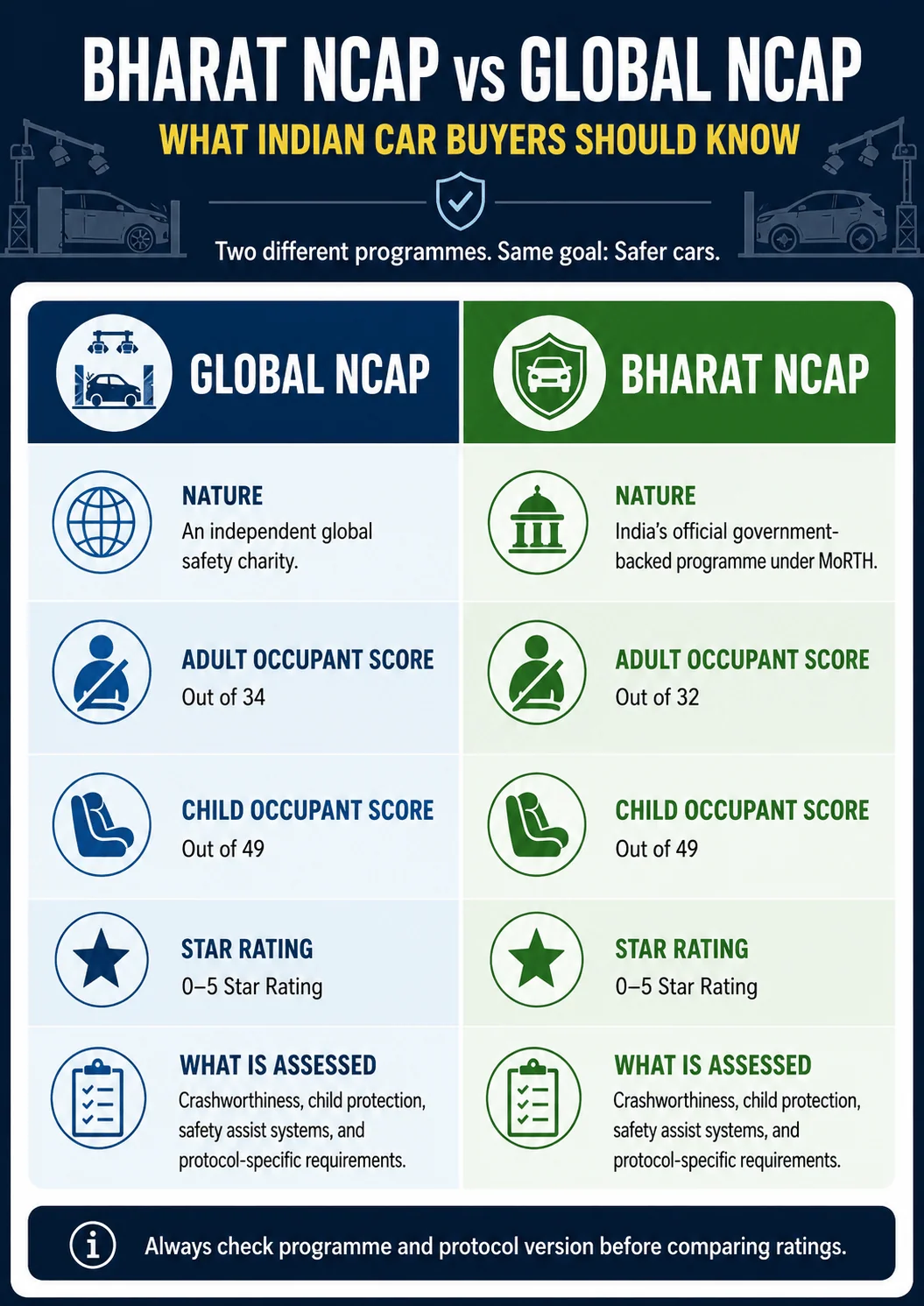
| Factor | Global NCAP | Bharat NCAP |
|---|---|---|
| Programme type | Independent global safety charity | India’s official, government-backed programme |
| Test focus | Indian-spec cars under “Safer Cars for India” (funded testing ended April 2024) | Designed specifically for Indian-market variants |
| Star rating range | 0–5 stars | 0–5 stars |
| Adult Occupant Protection | Out of 34 points (latest protocol) | Out of 32 points |
| Child Occupant Protection | Out of 49 points | Out of 49 points |
| Safety Assist evaluation | Yes, includes ESC, SBR, pedestrian (protocol-dependent) | Yes, ESC, SBR, pedestrian under AIS-197 |
| Direct comparability | Depends on protocol year (2014, 2022, 2024) | Depends on BNCAP 1.0 vs upcoming 2.0 |
The short version? Both programmes have the same purpose but different scoring maximums and protocols that have evolved at different paces. When you compare ratings, always check which programme tested your car and which protocol year applied. A 5-star isn’t a 5-star isn’t a 5-star.
How Stars Are Calculated
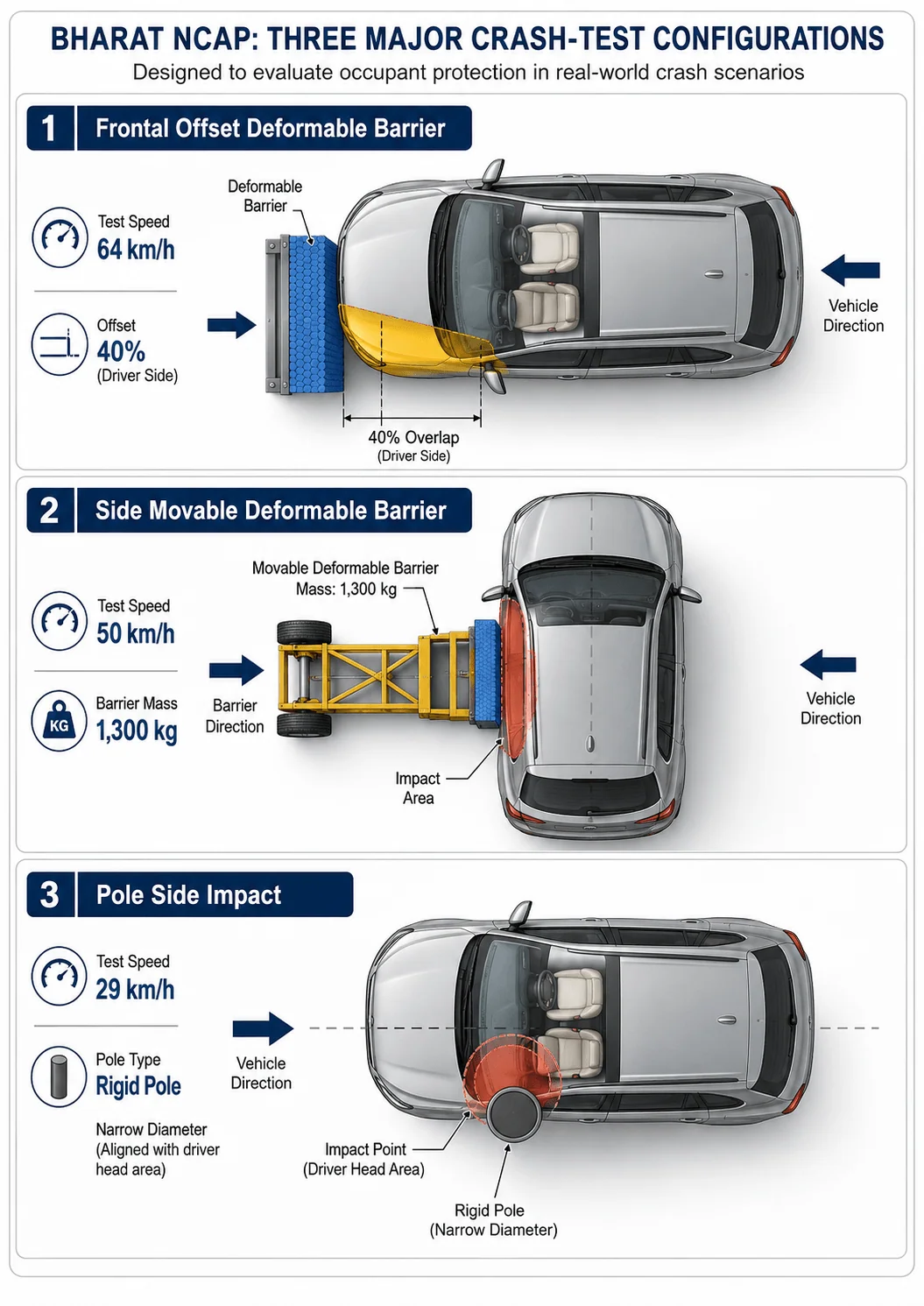
The star rating isn’t a single number you can derive from a brochure. It’s the output of three dynamic crash tests, a set of static inspections, plus several structural and equipment qualifiers. Here’s how it actually works behind the scenes.
The three dynamic crash tests
1. Frontal Offset Deformable Barrier Test (64 km/h)
Your car gets launched at 64 km/h into an aluminium honeycomb barrier with a 40 percent overlap on the driver’s side. The offset matters. Instead of the full front end absorbing energy, only a fraction of the front structure has to manage it. That punishes weak chassis design and exposes A-pillar strength. Why 64 km/h? A significant share of severe real-world frontal collisions happen at this kind of closing speed.
2. Side Movable Deformable Barrier Test (50 km/h)
A 1,300 kg mobile barrier strikes your stationary car on the driver’s side at 50 km/h. This evaluates B-pillar and door rigidity, side sill strength, plus how fast the thorax and curtain airbags deploy.
3. Pole Side Impact Test (29 km/h)
Your car is propelled sideways at 29 km/h into a narrow rigid pole aligned with the driver’s head. Brutal test. There’s almost no crumple zone in a side impact, so your survival depends entirely on side head protection systems and the roof rail’s strength. This test is mandatory for top star ratings.
The dummies and sensors
Your car is fitted with sophisticated test dummies. Hybrid-III dummies represent adults. Q-series dummies represent children of different ages. Both contain dozens of sensors that record acceleration, force and deflection during impact. The data calculates specific trauma probabilities such as Head Injury Criterion (HIC), chest compression and femur load.
When you read a full NCAP report, you’ll see colour-coded body injury maps for the driver and front passenger:
- Green for good protection
- Yellow for adequate
- Orange for marginal
- Brown for weak
- Red for high risk of life-threatening injury
Five colours, not three. These maps tell you exactly where the weakness is. A 5-star car with red on the driver’s chest is a very different proposition from a 5-star car that’s green across the board.
Structural modifiers under AIS-197
The raw sensor score isn’t the final score you see. Bharat NCAP penalises structural compromises under AIS-197 Annexure VII. If the steering column shifts too far upwards or rearwards, points come off. A moving steering wheel can cause the airbag to miss your head entirely. If the footwell ruptures or the A-pillar collapses significantly, the deductions are massive, because they signal that your survival space has compromised.
Why SAT acts as a qualifier
A car cannot reach the higher star tiers without standard ESC, seatbelt pretensioners with load limiters, plus front seatbelt reminders. Pedestrian protection under AIS-100 also gets evaluated. So even if a car has a brilliant body shell and great sensor scores, missing active safety hardware will cap its stars. Worth knowing when you scan a spec sheet.
| Rating Factor | What It Measures | Why It Matters |
|---|---|---|
| Adult Occupant Protection | Driver and front passenger injury risk based on dummy sensor data | Direct indicator of crash survival probability for front occupants |
| Child Occupant Protection | Child dummy dynamics plus ISOFIX compatibility | Critical for families with infants and toddlers |
| Body shell stability | Whether the passenger compartment stays intact post-impact | Decides whether airbags deploy into a stable cabin or a collapsing one |
| Airbags and restraints | Airbag deployment timing, pretensioner action, load limiter behaviour | Decelerates the body safely and reduces secondary injuries |
| ESP/ESC | Electronic Stability Control hardware and tuning | Helps you avoid the crash entirely during evasive maneuvers |
| Side impact protection | Behaviour in mobile barrier and rigid pole side hits | Critical in junction and T-bone crashes where crumple zones are minimal |
The final star rating combines all of this. A high sensor score can be wiped out by an unstable body shell or missing safety hardware. That’s why you can’t reverse-engineer a star rating from a spec sheet alone. The whole report tells the story.
What Each Star Rating Means
Stars are useful, but the nuance behind each tier is what helps you actually buy a safe car for your family. Here’s how to read each band.
5-Star Rating
What does a 5-star rating actually mean? Your car performed strongly under the specific tests that programme runs. It has a rigid structural cage that absorbed and dissipated impact energy without collapsing. Plus it shipped with the standard active safety hardware needed to qualify.
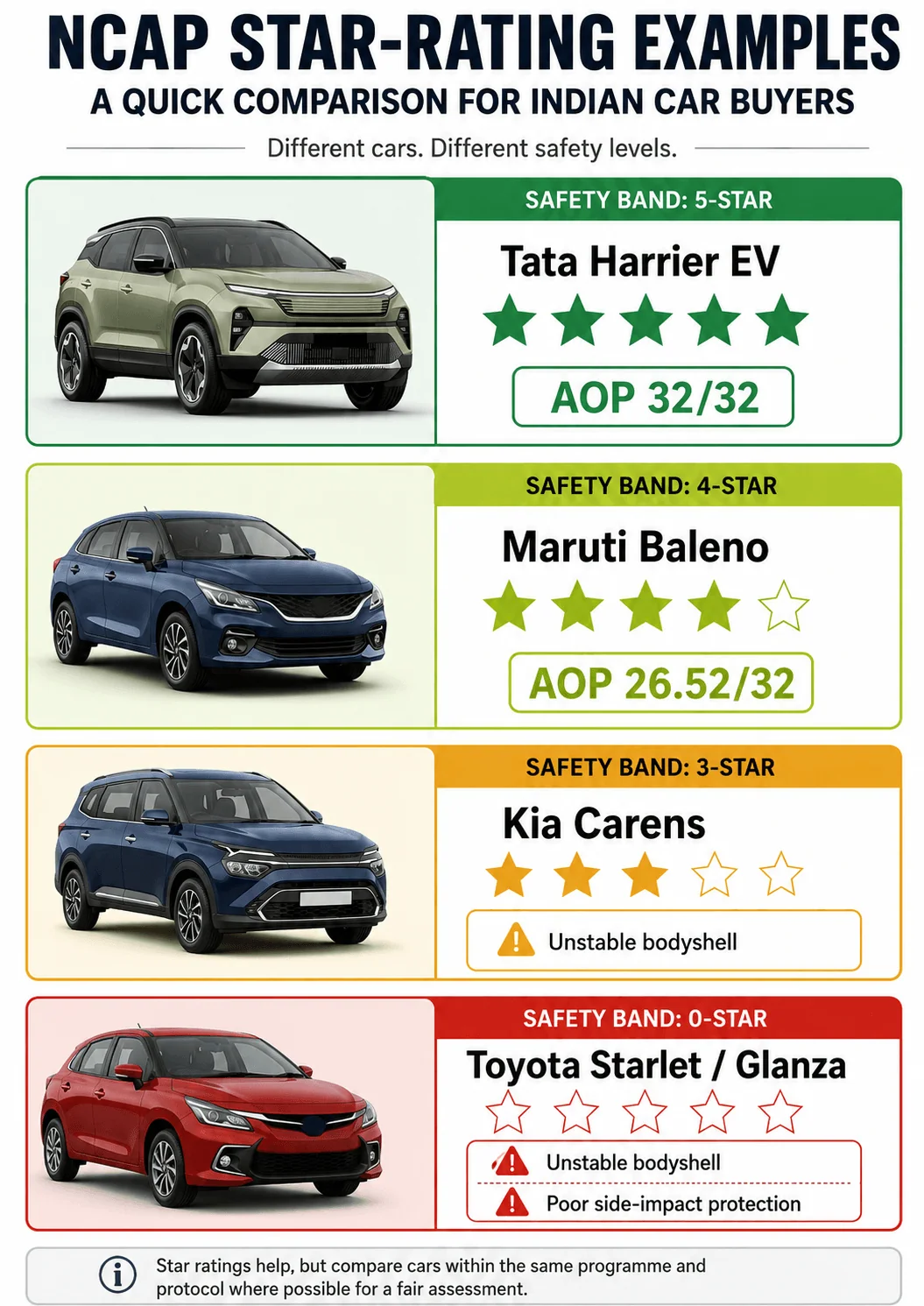
India’s 2026 5-star roster has expanded fast. Electric vehicles have made an outsized contribution. Why? Their skateboard architecture and stiff battery enclosures naturally produce excellent structural rigidity. The Mahindra XEV 9e and Tata Harrier EV both scored a perfect 32.00/32.00 in AOP. The only two cars to hit that ceiling so far. Internal combustion models like the Maruti Suzuki Dzire and Tata Sierra prove that good platform engineering can deliver 5-star results across powertrains.
Does a 5-star badge mean zero injury for you? No. Physics still wins at extreme speeds. But it’s the best statistical indicator you can buy.
4-Star Rating
What does a 4-star car offer you? Good overall protection with minor weaknesses. Sensor data might flag marginal chest protection for the driver. Or your base variant might lack curtain airbags, hurting side pole impact scores. Structure is usually stable. The gaps? They tend to show up in specific body regions or in safety equipment availability.
The Maruti Suzuki Baleno (26.52/32 AOP) and Citroen Basalt (26.19/32) are India’s most prominent 4-star examples. The Baleno is a strong, viable family hatchback for you, just not category-leading on crash protection. Is a 4-star car fine for your needs? For most buyers, yes, especially if budget and segment fit matter more than chasing the absolute top tier.
3-Star Rating
What does 3 stars actually mean for you? Basic, acceptable protection. The crash data often highlights higher injury risk to specific body regions like the chest or lower legs. More worryingly, 3-star cars sometimes show structural compromises. The passenger cell borders on unstable, which means a slightly worse real-world crash could result in cabin intrusion.
Take the Kia Carens. It came with six airbags as standard but scored only 3 stars under Global NCAP, with an unstable bodyshell and excessive pedal movement that threatened the driver’s lower extremities. The cushions worked. The cage didn’t.
Considering a 3-star car? Read the full report and pay close attention to body shell notes and child safety. It might be acceptable for a strict budget or low-speed urban use. Not the right pick if highway driving or kids are part of your equation.
2-Star, 1-Star, and 0-Star Ratings
Anything below 3 stars indicates serious crash protection gaps for you. The structure fails to manage energy. A-pillars and footwells deform. Dummies record severe impacts to the head and chest. These cars often rely on basic dual airbags that may not even deploy correctly. Why? The interior architecture is shifting during the crash.
Global NCAP’s 2025 test of the India-made Toyota Starlet (Glanza) for the African market returned 0 stars for the dual-airbag version, citing an unstable bodyshell and poor side-impact head and chest protection. Older Indian models like the pre-facelift Mahindra Bolero Neo and the Maruti Suzuki S-Presso have historically scored 1 star.
Does a safer alternative exist in your budget? Choose it. Star ratings stay attached to a car until it’s retested or replaced.
| Star Rating | Buyer Interpretation | Should You Buy? |
|---|---|---|
| 5 star | Strong crash protection, excellent structural stability | Yes, especially for family use and frequent highway driving |
| 4 star | Good safety with some limitations or missing assists | Yes if other factors (budget, segment) fit your needs |
| 3 star | Basic protection, possible structural or localised injury risks | Only if budget is tight, and only after reading the full report |
| 2 star | Weak protection, much higher risk of severe injury | Avoid if safer alternatives exist |
| 1 star | Poor protection, evident structural compromise | Not recommended |
| 0 star | Very poor protection, life-threatening gaps | Avoid under all circumstances |
One nuance worth repeating for you: a 5-star under an older protocol isn’t the same as a 5-star under a newer, stricter one. A 4-star result under the 2026 Bharat NCAP guidelines represents far more rigorous engineering than a 4-star result from a 2016 Global NCAP test. Always check the year before you compare.
Limitations of NCAP Ratings
NCAP is the gold standard for independent safety testing, but it has real boundaries. Treating a star rating as bulletproof protection is how false confidence kills you on Indian highways. So what does the rating not tell you?
Test conditions are highly controlled. NCAP assesses a finite matrix of crash types. Mainly frontal offset, side barrier and side pole. What about rear-end hits by trucks, multi-vehicle pileups, complex rollovers or high-speed undercarriage strikes? None of these show up in the headline star you see on a brochure.
Test speeds are fixed. The 64 km/h frontal offset test represents a severe but representative impact. Kinetic energy, however, increases as the square of velocity (E = ½mv²). A 100 km/h crash on an Indian expressway carries more than double the destructive energy of the 64 km/h test. Even your toughest 5-star body shell faces physics limits at extreme highway speeds. Ratings aren’t a substitute for sane driving on your part.
Vehicle mass matters in real collisions. Are a 1,000 kg 5-star hatchback and a 2,000 kg 5-star SUV equal in a head-on collision? No. The heavier vehicle imposes substantially higher forces on the lighter one and will likely come out better, despite the identical star badge. NCAP ratings tell you how a car protects its own occupants relative to its own weight class. Not how it fares against a 4,000 kg truck.
Protocols change. As technology evolves, NCAP bodies tighten their standards. Bharat NCAP 2.0, slated for October 2027, will transition to a 100-point system spread across five pillars. What does that include? A 20 percent weight on Vulnerable Road User (VRU) protection and 20 percent on Safe Driving and Accident Avoidance (read: ADAS). Cars without serious ADAS will be capped at lower ratings under that framework. The Global NCAP family is moving the same direction.
Variant differences are real. NCAP usually tests the base variant to establish a safety floor. Higher trims may add curtain airbags, more sensors and ADAS that would theoretically perform better. Conversely? The variant you’re eyeing might have less equipment than the one rated. Always verify your specific variant.
Real-world variables matter. Driver behaviour. Tyre condition. The size of the other vehicle. Road design. None of these show up in a star rating. Bald tyres severely cut the effectiveness of ABS and ESC. Aftermarket bullbars, oversized alloys and modified steering wheels can interfere with airbag sensors during a crash. NCAP can’t model what you do to your car after you buy it.
Why “More Airbags” Doesn’t Always Mean Safer
This is the most dangerous misconception in the Indian car market right now. Airbag count has become a marketing shortcut, and dealers lean on it heavily when they talk to you. Six airbags sounds twice as safe as two. Is it always? No.
Airbags only help when the body shell, seatbelts, sensors and crash energy management systems are all working together. Your primary line of defence in a crash? The body shell. Crumple zones need to deform predictably and absorb energy. The passenger cell needs to stay rigid. A car with six airbags but a weak structure may not protect you well at all. If the kinetic energy overwhelms the chassis, the A-pillars collapse and the roof buckles. The dashboard intrudes into your cabin. At that point, the airbags can’t stop heavy metal from crushing you. In some cases, airbags deploying from a collapsing dashboard cause secondary injuries. Related: how the restraint system itself works, in our guide to car airbag types.
The Kia Carens is the cleanest technical example. Six airbags as standard. Three stars in Global NCAP testing, because the bodyshell was rated unstable and pedal intrusion threatened the driver’s lower legs. The cushions worked. The cage failed.
Conversely, vehicles with only two front airbags but stiff, well-engineered structures (the older Maruti Brezza and early Tata Nexon tests come to mind) provided strong core protection. And ESC (Electronic Stability Control) is more valuable to you than additional airbags for most real-world incidents, because it actively helps prevent the crash from happening. Airbags only deploy after impact has already begun.
Safety is a systems achievement, not a hardware checklist you tick off. That’s also why MoRTH eventually withdrew the proposed six-airbag mandate. The ministry concluded that Bharat NCAP’s incentives were already pushing manufacturers toward six airbags naturally, without forcing it through legislation that ignored structural quality.
Read the Full Report, Not Just the Badge
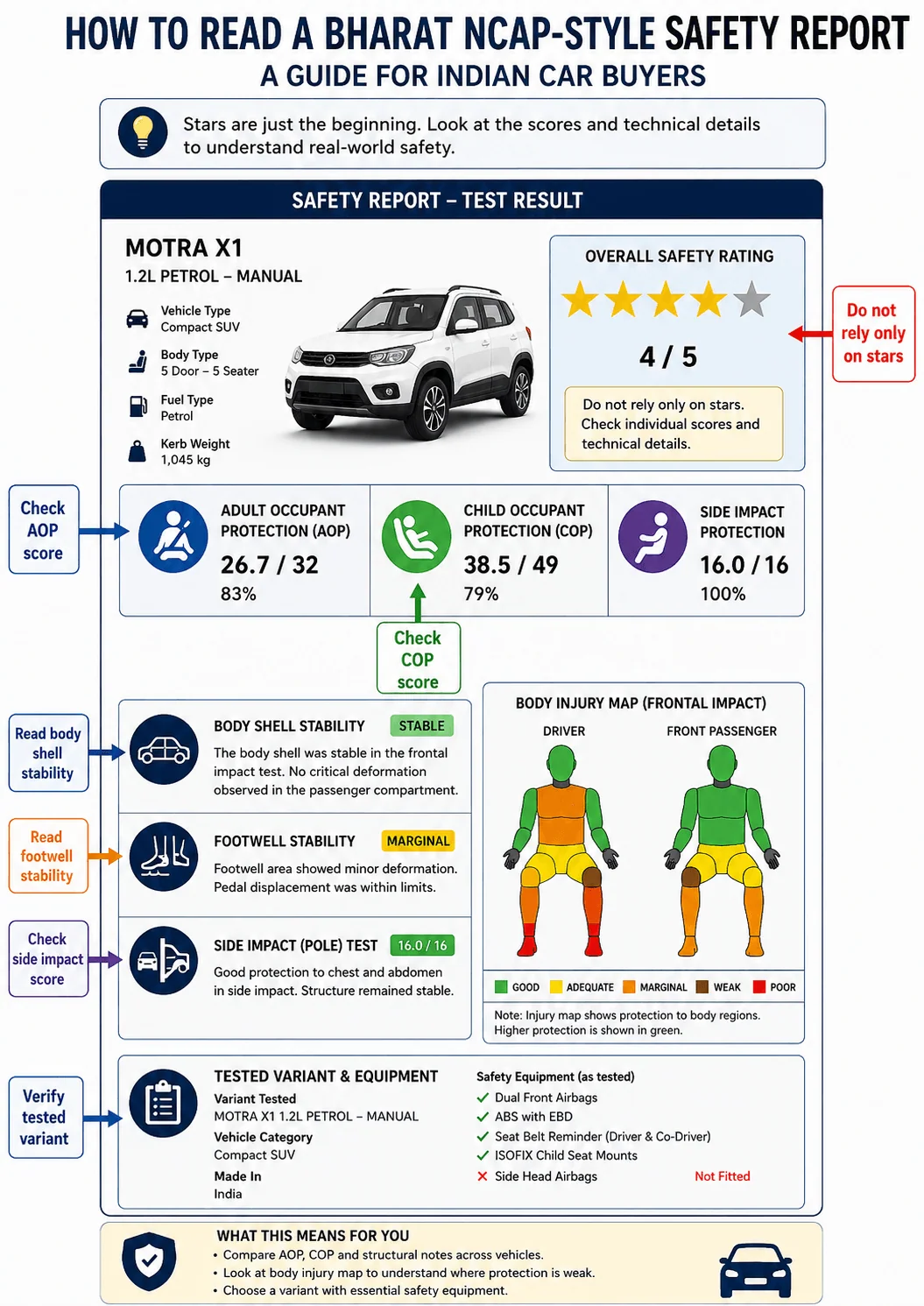
A star is a summary. The report is the evidence. When you’re shortlisting, look up the full NCAP fact sheet for each car on your list. Check the AOP and COP scores, the body shell stability rating (“stable” or “unstable”), the footwell notes, the side impact scores, plus what equipment was fitted to the tested variant. A 4-star car with a “stable” bodyshell and good side impact protection is a better real-world bet for you than a 5-star car with marginal chest protection and a base variant that ditched curtain airbags. Read the safest cars in India 2026 list for full-spec scores across models, including which airbag types each one ships with.
Unrated cars aren’t automatically unsafe. Plenty of capable cars haven’t been independently tested simply because the manufacturer hasn’t submitted them. But without test data, you’re trusting marketing claims rather than verified evidence. If you’re comparing similarly priced options, an NCAP-rated car gives you something concrete. An unrated car gives you a promise.
India-Specific Buyer Guidance
India’s safety regulation is shifting fast. MoRTH is pushing harder on rear seatbelt reminders, ADAS mandates for heavy commercial vehicles by 2026–2027, plus tighter passenger-car norms through Bharat NCAP 2.0. So how do you combine the rating with the rest of your shortlist work? Here’s the practical layer.
| Safety Check | Why It Matters |
|---|---|
| NCAP star rating | Quick, independent benchmark against competitors |
| Adult Occupant Protection score | Front-occupant crash survival probability |
| Child Occupant Protection score | Essential for families. Reflects dummy containment and CRS compatibility |
| Body shell stability | Real indicator of structural energy absorption |
| ESP/ESC availability | Most important tech for accident prevention on Indian highways |
| Number of airbags | Useful, but not enough on its own |
| ISOFIX anchors | Critical for safe, mistake-free child seat installation |
| Variant safety features | Base and top variants can differ drastically in curtain airbags and ADAS |
| Tyre condition | Defines braking distance and the limits of ESC intervention |
| Seatbelt usage | Airbags assume occupants are belted. Unbelted dummies record fatal forces |
Practical buying advice that holds up across segments:
- Prioritise structural stability over feature count. A “stable” bodyshell in the NCAP report is worth more to you than a panoramic sunroof.
- Verify your variant. Base variants often miss the curtain airbags and ADAS that helped the top trim score 5 stars. Get the showroom to confirm in writing.
- Look beyond airbag count. Six airbags in a weak shell is worse than four airbags in a strong one.
- Demand ESC, especially for highway use. It’s the single biggest accident-prevention tech for most drivers.
- For families, read the COP score carefully and verify ISOFIX mounts on both rear outboard seats. Don’t skip this if you’re shopping with a toddler in mind.
- For budget buyers, choose the structurally safest car in your bracket rather than the most feature-loaded one. The Tata Altroz, Maruti Suzuki Dzire and Skoda Kylaq prove that 5-star safety is reachable across price segments today.
Use the rating, but don’t outsource your judgement to it. Run through our things to check before buying a car checklist alongside the NCAP report, and pick a delivery window that works for you once your shortlist is locked.
FAQs
What does NCAP safety rating mean?
An NCAP safety rating tells you how well a car protects its occupants during controlled crash tests. The 0 to 5-star scale combines structural integrity, biomechanical dummy data and active safety equipment evaluation. A higher star count means the vehicle absorbed impact energy better and kept the cabin intact under tested conditions. Think of it as your independent benchmark before you walk into a showroom.
What does 5-star NCAP rating mean?
A 5-star NCAP rating means the car performed strongly under that programme’s specific crash and safety-assessment rules. You’re looking at a rigid body shell that absorbed crash energy without collapsing, dependable adult and child protection, plus the active safety hardware needed to qualify for the top tier. Does it guarantee zero injury in every real-world crash? No, especially at extreme speeds. But it’s the strongest statistical indicator you can buy.
Is Bharat NCAP the same as Global NCAP?
No. Bharat NCAP is India’s official, government-backed safety programme run under MoRTH and operates under AIS-197. Global NCAP is an independent UK-registered charity that ran the “Safer Cars for India” testing campaign from 2014 to 2024. Bharat NCAP scores AOP out of 32. The latest Global NCAP protocol scores AOP out of 34. Their child protection scoring is largely identical. Always check which programme rated your shortlisted car and which protocol year was used.
Does NCAP test all cars?
No. NCAP testing is voluntary. Manufacturers submit models for evaluation, or the testing body may independently buy and test popular cars. Many cars on sale in India remain unrated. An unrated car isn’t automatically unsafe, but without test data, you have no independent proof of how the car would behave in a crash. Worth keeping in mind if safety is a deal-breaker for you.
Is a 5-star car completely safe?
No car is completely immune to crash physics. A 5-star rating gives you significantly higher statistical safety at tested speeds, typically 64 km/h frontal and 50 km/h side. Extreme highway speeds, heavier crash partners or multi-vehicle pileups can still overwhelm any car’s safety systems. Drive sensibly anyway.
Is a 4-star car safe enough?
For most buyers, yes. A 4-star car generally has good structural protection with minor weaknesses, such as marginal chest protection or missing curtain airbags on base variants. It’s a viable option for you, particularly when budget or segment requirements rule out a 5-star alternative.
Are 6 airbags enough for car safety?
Not on their own. Six airbags improve lateral and frontal cushioning, but they’re ineffective if the body shell collapses. Structural integrity, ESC, seatbelt pretensioners and load limiters matter just as much. A six-airbag car with a weak structure can be less safe than a four-airbag car with a stable cage. Don’t let the airbag count alone sell you a car.
What is Adult Occupant Protection?
Adult Occupant Protection (AOP) is a quantitative score that measures the biomechanical injury risk to adult-sized dummies in the front seats during frontal offset and side impact crash tests. Bharat NCAP scores AOP out of 32. The latest Global NCAP protocol uses 34. It’s the headline score you’ll see quoted alongside the star count.
What is Child Occupant Protection?
Child Occupant Protection (COP) measures how 18-month-old and 3-year-old child dummies fare in rear-facing and forward-facing child seats during a crash. It also evaluates how easily the car accommodates standard child restraint systems and the placement of ISOFIX anchors and top tethers. Both Bharat NCAP and Global NCAP score COP out of 49. If you’ve got kids, this score deserves equal attention to AOP.
What is body shell integrity?
Body shell integrity refers to the structural strength of the passenger cabin during impact. A “stable” body shell holds its shape and preserves your survival space. An “unstable” body shell crumples inward, allowing mechanical components, the dashboard or the steering column to intrude into the occupant’s space and cause severe injury, regardless of how many airbags deployed.
Does NCAP rating apply to all variants?
NCAP ratings apply to the specific variant tested. Structural ratings typically extend across the lineup if the chassis is identical, but active safety features and airbag count can vary widely between variants. Always verify the exact equipment list of the variant you’re buying. Read the showroom invoice carefully.
Can an unrated car be safe?
Yes, an unrated car can be engineered with solid safety features and stable structure. However, without independent crash test data, you’re trusting manufacturer claims. For two similarly priced options, a rated car gives you verifiable evidence. An unrated car gives you only promises.
Which is more important, airbags or body shell?
The body shell. Airbags depend on a stable structural cage to deploy correctly and decelerate your body safely. A collapsing cage neutralises airbag effectiveness. Always prioritise vehicles where the NCAP report explicitly notes a “stable” bodyshell.
Does ESP improve safety?
Yes. Electronic Stability Programme (ESP) or Electronic Stability Control (ESC) detects loss of steering control and applies braking to individual wheels to keep your car on its intended path. It actively helps you avoid crashes, especially during evasive maneuvers, sudden lane changes and slippery conditions. Arguably the single most valuable active safety feature on Indian roads.
Should I buy only 5-star rated cars?
A 5-star car is your safest statistical bet, but a 4-star car with a stable body shell, standard ESC and good child protection is also a strong choice. Don’t fixate on the badge alone. A 4-star car with great structural notes can be a better real-world option than a 5-star car with marginal sub-scores or a base variant that strips out safety equipment. Reference the safest cars ranked list to see how segment leaders compare on full-spec scores.