
Most dealerships give you a 10-minute loop around the showroom and call it a test drive. That tells you almost nothing about how a car handles on pothole-ridden city roads, in bumper-to-bumper traffic at 40°C, or with your entire family packed inside.
A proper test drive is your one real chance to evaluate a car before spending ₹8-20 lakh on it. Skip the important checks now, and you’re stuck with buyer’s remorse for the next 7-10 years. Before heading to the showroom, check the on-road price in your city so you walk in knowing the exact numbers.
This checklist covers everything you need to evaluate during your test drive. It’s built specifically for Indian road conditions and driving scenarios that generic international guides completely ignore.

Before the Test Drive — Preparation
You wouldn’t walk into an exam without studying. Same logic applies here. A little preparation makes your test drive 10x more useful.
Shortlist 2-3 Models, Not 10
Narrow your options before visiting dealerships. Pick 2-3 models in your budget and research their variants. Our first car buying guide can help you shortlist. Know exactly which engine type (petrol, diesel, CNG) and transmission you want to test. Trying to evaluate too many cars leads to confusion, not clarity.
Confirm the Exact Variant
Call the dealership a day before and confirm they have the specific variant you want to test. Many showrooms only keep the base or mid variant as the test drive car. If you’re planning to buy the top variant with ADAS features, a sunroof, or a turbo engine, testing the base model won’t tell you much.
Schedule Smartly
Book your test drive for an off-peak weekday morning if possible. Dealerships are less rushed, the salesperson gives you more time, and inventory for test drives is more likely available. Avoid Saturday afternoons when showrooms are packed and test drive slots are squeezed to 5-minute loops.
Block at least one hour. You need 15-20 minutes for the walk-around, 20-30 minutes of actual driving, and 10-15 minutes for questions afterward.
Bring Your Family
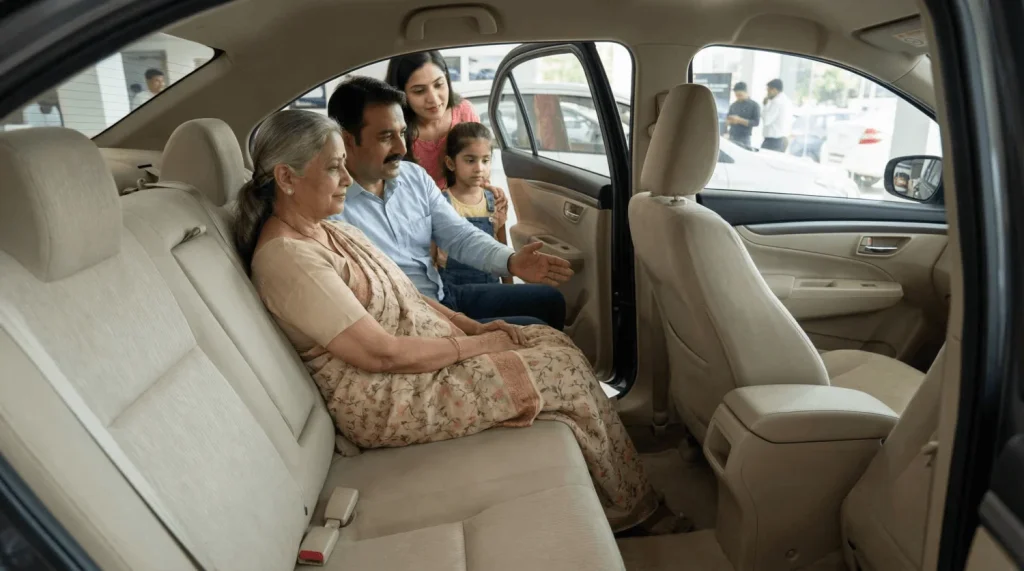
If your spouse, parents, or kids will regularly ride in this car, bring them along. Rear seat comfort, ease of entry for elderly passengers, child seat fitment, boot space for the stroller. These are things only they can evaluate firsthand. Your 6-foot frame might fit perfectly in front while your father struggles to get in and out of the back seat.
What to Carry
- Driving licence (mandatory, dealerships won’t let you drive without it)
- Your own USB drive or phone with music to test the audio system
- A notebook or your phone’s notes app to jot down observations. After 2-3 test drives, details start blurring together.
- Sunglasses if testing during the day. You’ll want to check for dashboard reflections on the windshield.
Know Your Route in Advance
Indian dealerships typically have a fixed test drive route. Familiarize yourself with it, complete it once, then request a longer or different route. Specifically ask to drive through:
- A stretch with speed bumps (to test ground clearance and suspension)
- A rough or broken road section (for ride quality assessment)
- A congested traffic area (for clutch effort and low-speed manners)
- A slightly open road (to test acceleration and highway stability)
If the salesperson resists, politely mention you’re cross-shopping with a competitor. That usually gets you more time.

What to Check While Driving
This is where most buyers go wrong. They focus on how the car looks and forget to actually test how it drives. Here’s your driving checklist, organized by what matters most on Indian roads.
Engine and Acceleration
Start the car yourself. Don’t let the salesperson do it for you. Listen carefully to how the engine sounds at idle. Any excessive vibration through the steering wheel or seats? That’s a red flag. Here’s the thing about city commutes in India: you spend a massive chunk of your drive just idled at signals. So NVH (noise, vibration, harshness) at standstill matters more than most buyers realize.
Accelerate from a stop. Does the car feel responsive, or does it hesitate before picking up speed? Try a quick overtake maneuver. You need to know the car has enough punch for safely merging onto a highway or overtaking a slow truck on a two-lane road.
Rev the engine to about 4,000 RPM and listen to the sound character. Some engines get coarse and noisy past 3,000 RPM while others stay refined.
Clutch and Gearbox (Manual)
If you’re testing a manual, pay close attention to the clutch. Is the pedal too heavy or too light? In Bengaluru or Mumbai traffic, you’ll be working that clutch for hours every day. A heavy clutch leads to leg fatigue fast.
Check gearshift quality. Slots should be precise and easy to find. There shouldn’t be any grinding or resistance when shifting between gears.
Automatic Transmission Feel
For automatics, note how smooth the gear changes are. Does the transmission hunt between gears on inclines? Is there a noticeable lag when you floor the accelerator (kickdown response)? Test the creep function in traffic. A good automatic should crawl forward smoothly when you release the brake, making stop-and-go traffic much less tiring.
Steering Response
Modern cars use Electronic Power Steering (EPS), which is light and easy at parking speeds but can feel numb at higher speeds. Check for:
- Dead zone: Is there excessive play in the center? The car should respond immediately when you turn the wheel, not after a small delay.
- Pulling: On a straight, flat road, briefly ease your grip on the wheel. The car should track straight. Any pulling to one side indicates alignment issues or worse.
- Parking effort: Try a U-turn and parallel parking. Is the turning radius tight enough for your daily needs?
Braking Performance
Test the brakes at different speeds. They should feel progressive, not grabby. The car should stop in a straight line without pulling to either side. If the car has disc brakes on all four wheels versus discs only in front, you’ll feel the difference during hard braking.
Speed Bumps and Ground Clearance
This is where Indian test drives differ completely from international ones. Manufacturers advertise ground clearance measured with an empty car. Load it with four adults and luggage, and a car claiming 175mm clearance can drop to 150mm or less. That’s when the underbody starts scraping on speed breakers.
During the test drive, deliberately go over a couple of speed bumps at a reasonable speed (10-15 km/h). Listen for any scraping sounds. If the test drive car (with probably just you and the salesperson) already sounds close to scraping, imagine what happens with a full family plus luggage.
For context, automotive experts recommend a minimum of 180-190mm ground clearance under full load for comfortable Indian driving. If you’re considering a sedan or low-slung hatchback, this test is non-negotiable.
Ride Quality Over Bad Roads
Don’t avoid the broken patches. Drive over them intentionally. That’s the whole point. You’re testing:
- Suspension absorption: Does the car soak up bumps or transfer every jolt to your spine?
- Body roll: When swerving to avoid a pothole, does the car lean excessively?
- Rattles and squeaks: Listen for dashboard or trim rattles over rough surfaces. They only get worse with age.
- Rear seat bounce: Ask your co-passenger how the ride feels in the back. Many cars ride well in front but are bouncy at the rear.
A car with overly soft suspension feels plush on mild bumps but bottoms out on deep potholes. Conversely, a stiffly sprung car handles well but transfers every road imperfection into the cabin. Neither extreme works well for Indian roads. You want something in between.

Comfort and Ergonomics Assessment
You’ll spend hundreds of hours in this car every year. Comfort isn’t a luxury. It’s a daily requirement.
Driving Position and Visibility
Adjust the seat and steering wheel to your preferred position. Set up the mirrors. Can you get comfortable without compromise? Check:
- Seat height adjustment: Can you see the bonnet edge clearly? This matters for judging gaps in tight traffic.
- Steering reach and rake: Does the wheel come close enough without your elbows being cramped?
- Instrument cluster visibility: Is the speedometer easy to read without looking away from the road for too long?
- Blind spots: Check over your shoulder for lane changes. Some cars with thick C-pillars or small rear windows create dangerous blind spots. Try reversing into a parking spot to evaluate rear visibility.
Rear Seat Reality Check
Don’t skip this. Indian car usage is fundamentally different from the West. Your car will carry the whole family on weekends, elderly parents for hospital runs, and three adults squeezed onto the rear bench during road trips. So actually sit in the back and check:
- Three-abreast test: Can three average-sized adults sit comfortably? Pay attention to shoulder room, not just legroom.
- Transmission tunnel: Is there a large hump in the center of the rear floor? This makes the middle seat uncomfortable for anything longer than a short ride.
- Under-thigh support: If the seat cushion is too short, it won’t support your thighs properly, leading to fatigue on long journeys.
- Headroom: Especially with a sunroof, which eats into vertical space. Have your tallest family member sit in the back and check.
- Rear AC vents: In the Indian summer, front-only AC means the rear passengers are cooking. Check if rear vents exist and whether they blow cold air effectively.
Boot Space
Open the boot. Don’t just look at it. Place your regular items mentally: a couple of suitcases, grocery bags, a stroller if you have a baby. Check the boot opening height and width. Some cars have a high loading lip that makes lifting heavy bags difficult.
Safety Features to Test
Safety features are only useful if they actually work well in real-world Indian conditions. Don’t just confirm they exist on the spec sheet. Test them during the drive.
ADAS: Test It, Don’t Just Tick It
If the car comes with Advanced Driver Assistance Systems (ADAS), you need to test these features specifically in Indian traffic conditions. Here’s why: ADAS was primarily developed for well-marked, predictable Western roads. Indian conditions are a completely different challenge.
- Automatic Emergency Braking (AEB): In dense city traffic, check if the system triggers too aggressively. False positives from pedestrians walking close to the road or two-wheelers cutting in can cause sudden, unexpected braking. That’s dangerous if someone is tailgating you.
- Lane Keep Assist/Lane Departure Warning: These rely on painted lane markings. On Indian highways without clear markings (which is most of them), these features are often inert or erratic. Test if you can easily disable them via a button when they’re not useful.
- Adaptive Cruise Control: On Indian highways, maintaining a safe following distance creates a gap that other drivers immediately fill. This forces the ACC to brake constantly, making for a jerky ride. Test it on an open stretch if possible to understand its limitations.
Basic Safety You Can Test
Even without ADAS, check:
- ABS response: On a safe, empty stretch, do a firm brake application. You should feel the ABS pulsing through the pedal as it prevents wheel lockup.
- Reverse camera and parking sensors: Test their accuracy. Do the guidelines on the camera match the actual distance? Do the sensors beep at the right time, or too late?
- Headlight quality: If you can arrange an evening test drive, evaluate the headlights. Check low beam spread and high beam throw distance. Do cornering lamps (if equipped) actually illuminate blind corners during turns? This matters because India has a disproportionately high number of night-time accidents, and poor illumination is a major factor.
- Auto-dimming mirrors: If available, check that they work against bright headlights.
Seat Belt and Airbag Basics
Check that all seat belts, including rear ones, latch smoothly and retract properly. Confirm the airbag count and positions. This is non-negotiable for any new car in 2026.

AC Performance: The Indian Summer Test
This deserves its own section because AC performance is arguably the most underrated test in Indian conditions. Temperatures regularly cross 40-45°C in most of the country for 4-5 months a year. Here’s what to check:
- Cooling time: Note how long the AC takes to bring the cabin from blazing hot to comfortable. Park the car in the sun for a few minutes with the engine off, then restart and time the cooling.
- Rear cooling: With rear AC vents, check if cold air reaches the back seat passengers effectively.
- Engine power loss with AC on: Turn the AC on while driving at around 80 km/h. You’ll notice a drop in available power, especially in smaller engines (1.0-1.2L). How noticeable is this?
- Blower noise: At higher fan speeds, is the AC blower too loud? You shouldn’t have to shout over it.
- From October 2026, all new cars in India must have their official mileage tested with AC running. This means advertised fuel efficiency figures will finally reflect real Indian driving. Ask the dealer if the model you’re testing has updated AC-on mileage figures.

Infotainment and Connected Features
Modern cars are as much about their screens and software as their engines. Spend a few minutes testing:
- Touchscreen responsiveness: Is there lag when swiping or tapping? Is it usable with one hand while driving?
- Phone connectivity: Connect your phone via Android Auto or Apple CarPlay. Does it connect quickly and run smoothly? Test navigation and music playback. Make a phone call too.
- Voice assistant: If the car has a voice AI system, test it with natural language. Don’t use formal commands. Try something like “AC thoda zyada kar do” or “navigate to the nearest petrol pump.” Many newer systems in India now understand Hinglish. If the system only works with rigid English commands, it’ll be annoying in daily use.
- Offline functionality: Does the voice assistant or navigation work without a mobile data connection? Cloud-dependent systems fail in basement parkings and on rural stretches with no network coverage.
- Wireless charging pad: If present, place your phone on it. Does it charge reliably without overheating?
Questions to Ask the Dealer After
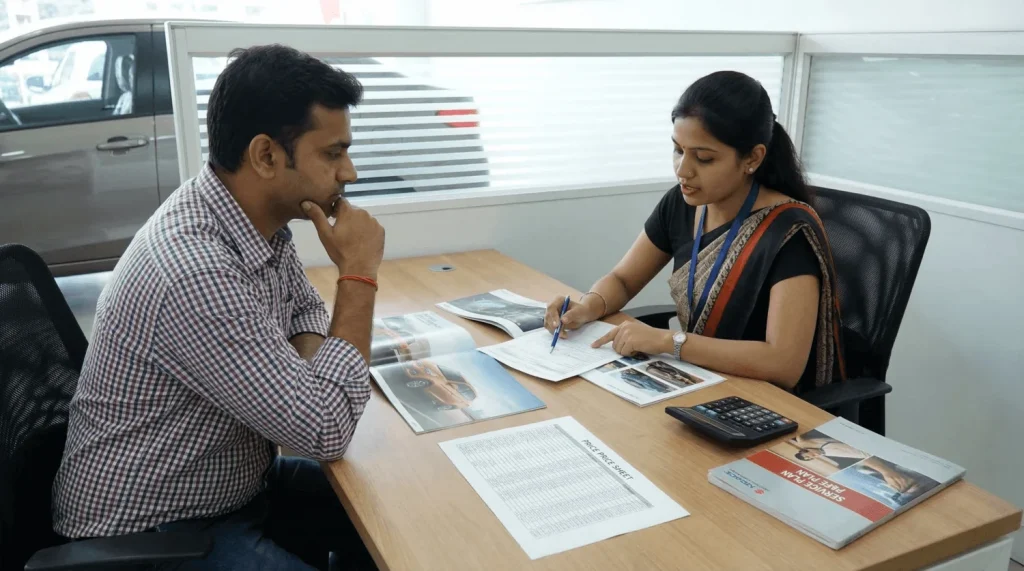
Done driving? Don’t just hand back the keys and leave. Sit down with the salesperson. This part of the visit is just as important as the drive itself.
Service and Ownership
- What’s the service interval? Every 6 months or 10,000 km for most brands. Ask for the cost of the first 3 scheduled services.
- Where’s the nearest authorized service center? If it’s 30 km away, that’s a half-day affair for every service visit.
- What does the warranty cover? Standard is 2-3 years, but ask specifically about what’s excluded. Clutch plates and tyres are commonly excluded, and so is the battery in many cases.
- What’s the current waiting period for my variant? Some popular variants have 2-3 month waits. Others are available immediately. This affects your buying timeline.
Pricing and Deals
- What’s the complete on-road price for my variant? Not just ex-showroom. Get the full breakdown: registration, insurance, accessories, handling charges, everything.
- Any exchange bonus if I’m scrapping or trading in an old car? With India’s Vehicle Scrappage Policy active, scrapping a BS-4 or older vehicle can get you significant concessions. Some states like Maharashtra offer up to 30% motor vehicle tax relief.
- Are there corporate or loyalty discounts? Many brands offer ₹5,000-15,000 off for corporate employees or existing brand owners.
- What accessories come free vs paid? Dealers often bundle accessories into the on-road price. Know what you’re actually getting and what’s optional.
Resale and Future Value
- How does this model hold its value after 3-5 years? Some brands (Maruti Suzuki, Toyota) have significantly better resale value than others. The salesperson may sugarcoat this, so verify independently.
- Is a facelift or new generation expected soon? Buying just before a major update can hurt resale value. Ask directly.
Quick-Reference 15-Point Test Drive Checklist
Print this or save it on your phone before you walk into the dealership:
- ☐ Start the engine yourself. Listen for NVH at idle.
- ☐ Check clutch weight (manual) or creep smoothness (automatic).
- ☐ Test acceleration and overtaking punch from a standing start.
- ☐ Drive over speed bumps. Listen for underbody scraping.
- ☐ Find a rough road. Check suspension comfort and cabin rattles.
- ☐ Test brakes at different speeds. Car should stop straight.
- ☐ Check steering dead zone and straight-line tracking.
- ☐ Turn off the stereo. Listen for wind noise and engine sound.
- ☐ Test AC cooling time from a hot cabin. Check rear AC vents.
- ☐ Try parking. Evaluate turning radius, reverse camera accuracy, and blind spots.
- ☐ Have family test the rear seat for three-abreast comfort and under-thigh support.
- ☐ Test the infotainment. Connect your phone, try voice commands.
- ☐ Check ADAS behavior in real traffic (if equipped).
- ☐ Test headlights if you can get an evening slot.
- ☐ Ask about service cost and complete on-road price. Get warranty exclusion details too.
If you’re in the early stages of your car buying journey, start with our complete buying guide to get your budget and priorities sorted.
FAQ
How long should a test drive be?
Aim for 20-30 minutes of actual driving time, plus 15-20 minutes for the walk-around and post-drive discussion. Indian dealerships often try to limit test drives to 5-10 minutes. Politely insist on more time, especially if you’re a serious buyer. Mention that you’re cross-shopping with a competitor to get the salesperson to accommodate you.
Can I test drive a car on the highway?
Most dealerships have a fixed route that stays within city limits. However, you can request a longer drive that includes a brief highway stretch. Some premium brands and dealerships in smaller cities are more flexible about this. If the dealership refuses, ask if they offer an extended or overnight test drive. A few brands like Hyundai and Tata have started offering these in select cities.
What should I focus on most during a test drive?
For Indian conditions, prioritize these above everything else: suspension comfort over bad roads, AC cooling performance, clutch effort in stop-and-go traffic (for manuals), rear seat comfort with actual passengers sitting in the back, and ground clearance over speed bumps. You simply can’t evaluate any of these from a spec sheet or YouTube review. The test drive is your only shot.
Done with the test drive? Use our pre-purchase checklist to make sure you haven’t missed anything before signing the papers.