
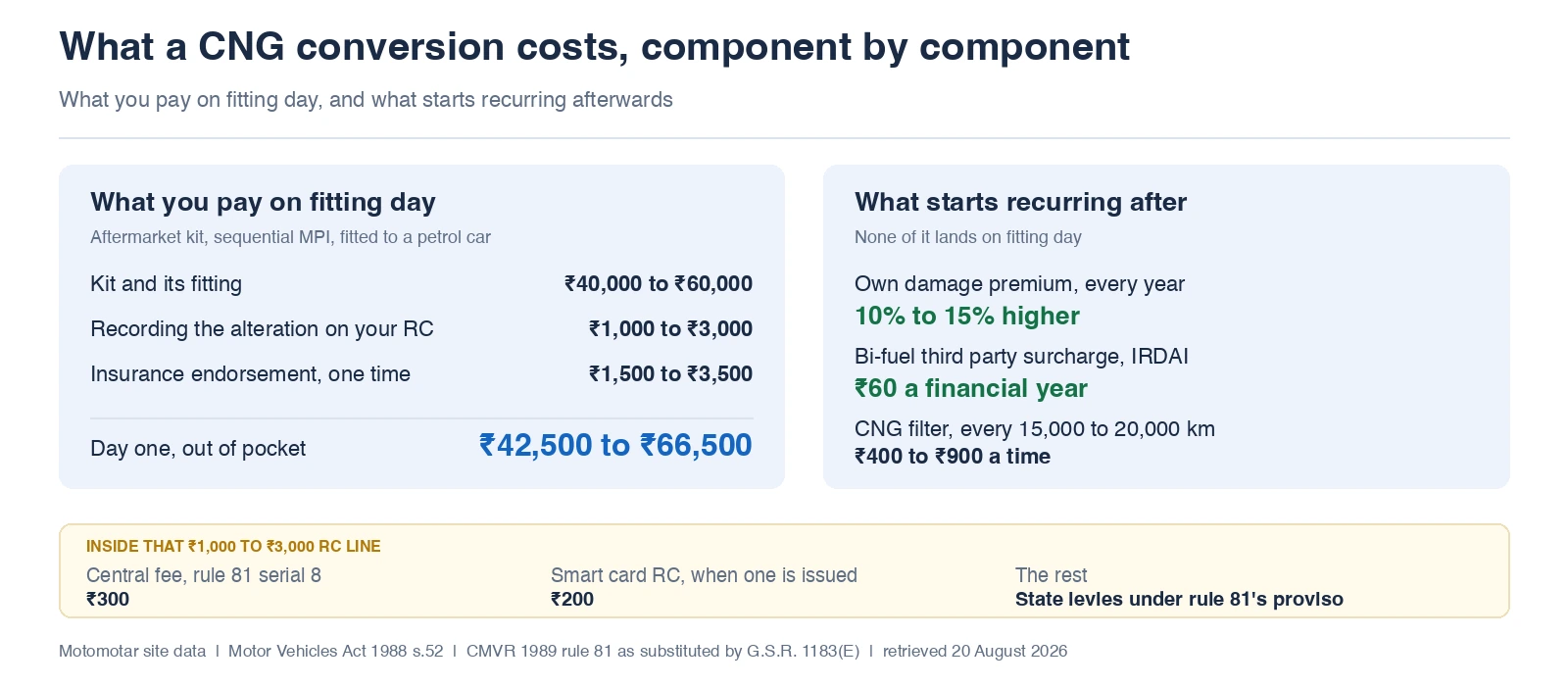
The full petrol to CNG conversion cost in India is ₹42,500 to ₹66,500, and it’s only three line items: the kit and its fitting at ₹40,000 to ₹60,000, the RTO endorsement that records the alteration on your RC at ₹1,000 to ₹3,000, and the ₹1,500 to ₹3,500 your insurer charges to put the kit on your policy. Everything else people fold into that number is an annual line rather than a fitting-day one.
What the petrol to CNG conversion cost covers
| Component | What it costs | Notes |
|---|---|---|
| Aftermarket CNG kit fitted after purchase | ₹40,000 to ₹60,000 | The standard to ask for is an AIS-024 compliant sequential MPI kit |
| Venturi (open loop) kit | ₹15,000 to ₹35,000 | The cheap end of the market, and worth avoiding |
| Recording the alteration on your RC | ₹1,000 to ₹3,000 | ₹300 of that is the central fee; the rest is state levies and the smart card |
| Insurance endorsement | ₹1,500 to ₹3,500, one time | Charged when the kit goes on to the policy |
| Own damage premium, every year after | 10% to 15% higher | Your IDV rises ₹30,000 to ₹50,000 once the kit is declared |
| Third party bi-fuel surcharge | ₹60 a financial year | The IRDAI rate for bi-fuel vehicles |
| Day one, out of pocket | ₹42,500 to ₹66,500 | Kit, fitting, the RC endorsement and the insurance endorsement |
Why do two quotes for the same hatchback land so far apart? Usually because they aren’t quoting the same kit. A venturi kit is an open loop system at the cheap end of the market. Sequential MPI is the standard worth buying, and that gap is not where you want to save money.
What makes a conversion legal
Section 52 of the Motor Vehicles Act, 1988 is the provision that governs alterations to a registered vehicle, and its first proviso deals with fuel conversion head on: where an owner modifies the engine “for facilitating its operation by different type of fuel or source of energy including battery, compressed natural gas, solar power, liquid petroleum gas or any other fuel or source of energy, by fitment of a conversion kit, such modification shall be carried out subject to such conditions as may be prescribed”. So conversion is expressly allowed. The conditions are the catch.
Those conditions sit in the Central Motor Vehicles Rules, 1989, and rule 115-B is the one that covers CNG. It puts the type approval burden on the kit manufacturer or supplier, and it requires that “the retrofitment of CNG kits on in-use vehicles shall be carried out by workshops authorized by the kit manufacturer/supplier or vehicle manufacturers”. It also fixes AIS-024 as the test procedure and safety guideline for CNG kit components “including installation thereof”. Check the AIS-024 line on a quotation before you compare prices at all. A kit without it isn’t a compliant kit.
Then there’s the RC itself. Section 52 requires an alteration made without the registering authority’s prior approval to be reported to the RTO within fourteen days, with the certificate of registration forwarded along with the prescribed fee so the change gets entered on it. That prescribed fee lives in rule 81 of the same rules, as substituted by G.S.R. 1183(E). Serial 8, recording alteration in the certificate of registration, is half the registration fee at serial 4, which works out to ₹300 for a private light motor vehicle. Rule 81’s own proviso then lets states levy additional amounts for automation and value added services, and the schedule adds ₹200 more whenever the RC that comes back is a smart card. That is how a ₹300 line item turns into the ₹1,000 to ₹3,000 that actually leaves your pocket.
Don’t treat that line as optional. Skip the endorsement and your insurer can repudiate a claim on the whole car, even a simple rear-end knock with no fire and no damage to the kit.
A worked example
Say you already own a petrol hatchback and you drive it about 1,500 km a month. A kit supplied and fitted at an authorised workshop runs ₹40,000 to ₹60,000. The RC endorsement, done properly rather than skipped, is ₹1,000 to ₹3,000. Telling your insurer costs you another ₹1,500 to ₹3,500 to get the kit endorsed on your policy. Call it a petrol to CNG conversion cost of ₹42,500 to ₹66,500, before your car has covered a single kilometre on gas.
The rest of it arrives at renewal. Your IDV goes up by ₹30,000 to ₹50,000 to account for the kit, so the own damage component of your premium rises 10% to 15%, and the IRDAI bi-fuel third party surcharge of ₹60 a financial year gets added. None of it is large next to the kit. It’s just the part people leave out when they’re comparing two workshop quotes.
The ownership calendar after you convert
Fitting day isn’t the end of your spending. Your service book changes shape too. Oil changes come round every 7,500 km instead of 10,000. Spark plugs move to a heat resistant specialty grade that costs you more per plug. A CNG filter needs replacing every 15,000 to 20,000 km at ₹400 to ₹900 a time. Work out the CNG car maintenance cost over a full year before you commit rather than after, because it’s the number most conversion quotes leave out entirely.
The cylinder runs on a clock of its own. It goes for a periodic hydrostatic test every three years, so the CNG cylinder testing price is a recurring line rather than a one off. The cylinder also carries a manufacturing date and a finite life beyond which it can’t be recertified, which is worth checking early: know when your CNG cylinder expires before you spend this kind of money on a car you may not keep that long. And it helps to go in already knowing the problems CNG cars develop with age, because a few of them are cheap to sort out and a couple of them really aren’t.
When conversion beats buying factory CNG
So which way should you go? If you’re still shopping rather than converting, the sums run differently. The premium on factory-fitted CNG cars is ₹80,000 to ₹1,00,000 over the same petrol variant, and at 1,500 to 3,000 km a month that comes back in roughly 18 to 36 months. A conversion costs you less up front, but it’s an aftermarket job on a car built for petrol, and it shows at resale: an aftermarket kit typically costs you ₹15,000 to ₹30,000 against what the petrol version would have fetched.
The split is fairly clean: convert a car you already own and mean to run for a good while yet, and buy factory-fitted if you’re at the showroom anyway. The petrol to CNG conversion cost is the easy half of your decision. How long you’ll keep your car is the half that settles it.