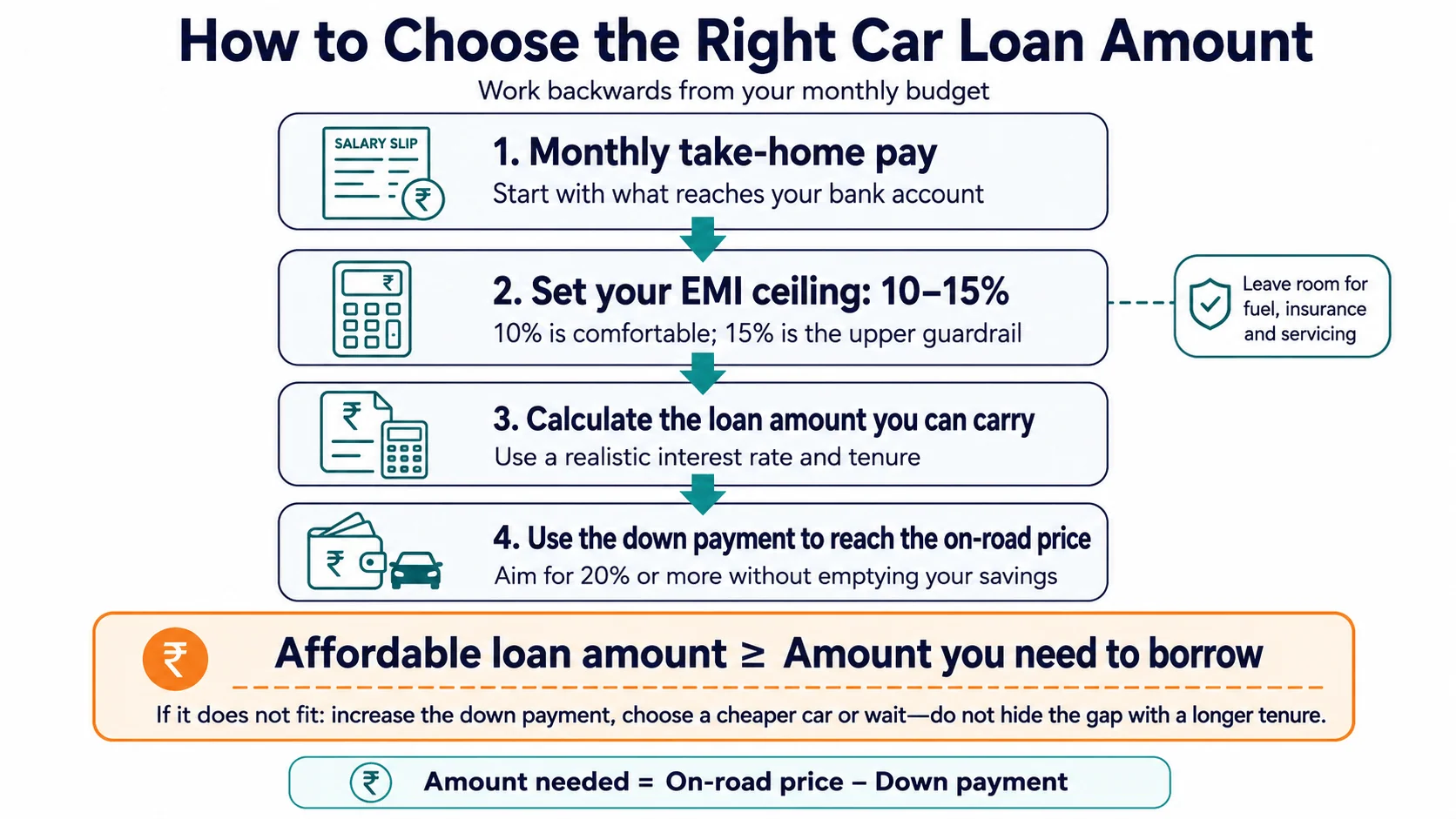
How do you choose the right car loan amount? Work backwards from your monthly budget, not forwards from the car you’ve fallen for. Keep the car loan EMI inside roughly 10 to 15% of your monthly take-home pay, put down at least 20% of the price and borrow against the on-road price rather than the ex showroom price. Get those three right and the loan amount picks itself.
Most buyers do it the other way round. They choose the car, ask the dealer’s finance desk what the EMI would be, and take whatever tenure makes that number look survivable. That’s how a five-year loan quietly becomes a seven-year one.
Start from your salary slip
Your take-home pay sets a monthly ceiling. The ceiling sets the loan.
Say you take home ₹50,000 a month. A car loan EMI of 10 to 15% of that is ₹5,000 to ₹7,500. Run those two figures back through the EMI formula at 9% over 60 months and you get the loan you can actually carry:
| Share of take-home | Monthly EMI | Loan it supports |
|---|---|---|
| 10% (comfortable) | ₹5,000 | about ₹2.41 lakh |
| 15% (stretched) | ₹7,500 | about ₹3.61 lakh |
Both rows assume 9% and a 60-month car loan tenure. Change either input and the loan moves, which is the whole point of doing this before you walk into a showroom. If you want to see where the number comes from, here’s the EMI formula worked out by hand, and here’s the calculator if you’d rather just type your own rate and tenure in.
Notice what this does not do. It doesn’t tell you which car to buy. It tells you how much borrowed money you can service, and then you go shopping inside that.
What percentage of salary should a car EMI be?
There’s a widely quoted rule of thumb, sometimes called 20/4/10: put 20% down, keep the loan to four years or less and hold all your transport costs under 10% of gross monthly income. Look closely at that last number. It covers every rupee the car costs you in a month, EMI plus fuel plus insurance plus servicing, measured against gross pay. It’s a household-budget guideline, not a lender-approval rule.
The 10 to 15% band above is a looser and separate test: the car loan EMI on its own, against take-home rather than gross. So how do the two sit together?
- 10% of take-home is the safer target, 15% is the upper guardrail. Below 10% the EMI barely registers in your month. Past 15%, one bad month starts to hurt.
- Either way, leave room for running costs. Fuel, insurance and servicing don’t pause because you’ve got an EMI, and protecting that is exactly what the classic rule’s 10% is for.
So if the honest answer is that a ₹7,500 EMI leaves nothing for a service bill, your ceiling isn’t ₹7,500. Rules of thumb are for starting the conversation, not ending it.
How much should you put down?
Every rupee of down payment is a rupee that never gets charged interest. Here’s the same car, an on-road price of ₹10,00,000 at 9% over 60 months, at three different down payments:
| Down payment | You pay upfront | Loan amount | EMI | Total repaid | Total interest |
|---|---|---|---|---|---|
| 20% | ₹2,00,000 | ₹8,00,000 | ₹16,607 | ₹9,96,401 | ₹1,96,401 |
| 40% | ₹4,00,000 | ₹6,00,000 | ₹12,455 | ₹7,47,301 | ₹1,47,301 |
| 60% | ₹6,00,000 | ₹4,00,000 | ₹8,303 | ₹4,98,201 | ₹98,201 |
The EMI column is rounded to the rupee, but the totals come from the unrounded formula result. Your lender’s repayment schedule can differ by a few rupees, because instalments get rounded somewhere along the way.
Read the top and bottom rows together. Another ₹4,00,000 upfront cuts the monthly outgo by ₹8,303 and saves ₹98,201 in interest across the loan. That’s the trade, in two numbers.
Treat 20% as a useful starting target rather than a hard floor. Put down much less and the loan tends to run ahead of what the car is worth in the early years, which is how people end up owing more than the car would fetch. Plenty of lenders will fund a far larger share than 80%, so this is a budgeting call you make for yourself, not a limit anyone imposes on you.
Is a bigger down payment always better?
Not automatically. Cash you hand the dealer is cash you no longer have, and a car loan is easier to live with than an empty emergency fund. Put down as much as you can spare after keeping a cushion, then stop.
Put the two numbers together
So far this page has worked out two different things, and the actual decision lives in the gap between them.
- What you need to borrow is the on-road price minus the down payment you can raise.
- What you can afford to borrow is the loan your EMI ceiling supports.
The second number has to be at least as big as the first. When it isn’t, you have three honest moves: raise the down payment, buy a cheaper car or wait a few months. Stretching the car loan tenure until the EMI finally fits is the fourth move, and it’s the one that quietly costs the most.
Try our ₹50,000 take-home buyer against that ₹10,00,000 car and the answer is no. Even at 60% down the EMI comes to ₹8,303 against a ceiling of ₹7,500, and a longer tenure would only turn an unaffordable car into a survivable monthly figure, which is not the same thing. It’s the wrong car, or the right car after a bigger deposit.
Should I finance the on-road price or the ex showroom price?
Budget from the on-road price, then subtract your down payment. Registration, road tax and insurance are real money you have to produce on delivery day, and they’re a meaningful chunk above the ex showroom sticker. Work out your requirement against what the car actually costs on the road, not the number in the brochure, or you’ll be arranging the shortfall in a hurry.
Worth knowing before you sit down at the finance desk: how much a lender will fund, and which parts of the on-road price it counts, varies from product to product. What this page gives you is the amount you can afford to borrow. What any particular lender will advance against it is a separate conversation.
Then, and only then, go looking for a rate
Once the loan amount is settled, the rate and the lender are worth shopping around, and that’s a separate exercise from deciding how much to borrow. Comparing car loan offers is easier when you already know the number you’re asking for, because you’re comparing like with like instead of being sold a longer tenure.
A shorter run through the whole thing:
- Take-home pay, times 10 to 15%. That’s your EMI ceiling.
- Run the ceiling back through the formula at a realistic rate and tenure. That’s what you can afford to borrow.
- On-road price minus your down payment. That’s what you need to borrow.
- If the second number is bigger than the first, change the car or the deposit, not the tenure.
- Aim for 20% down or better, without emptying your savings.
- Now compare lenders.