
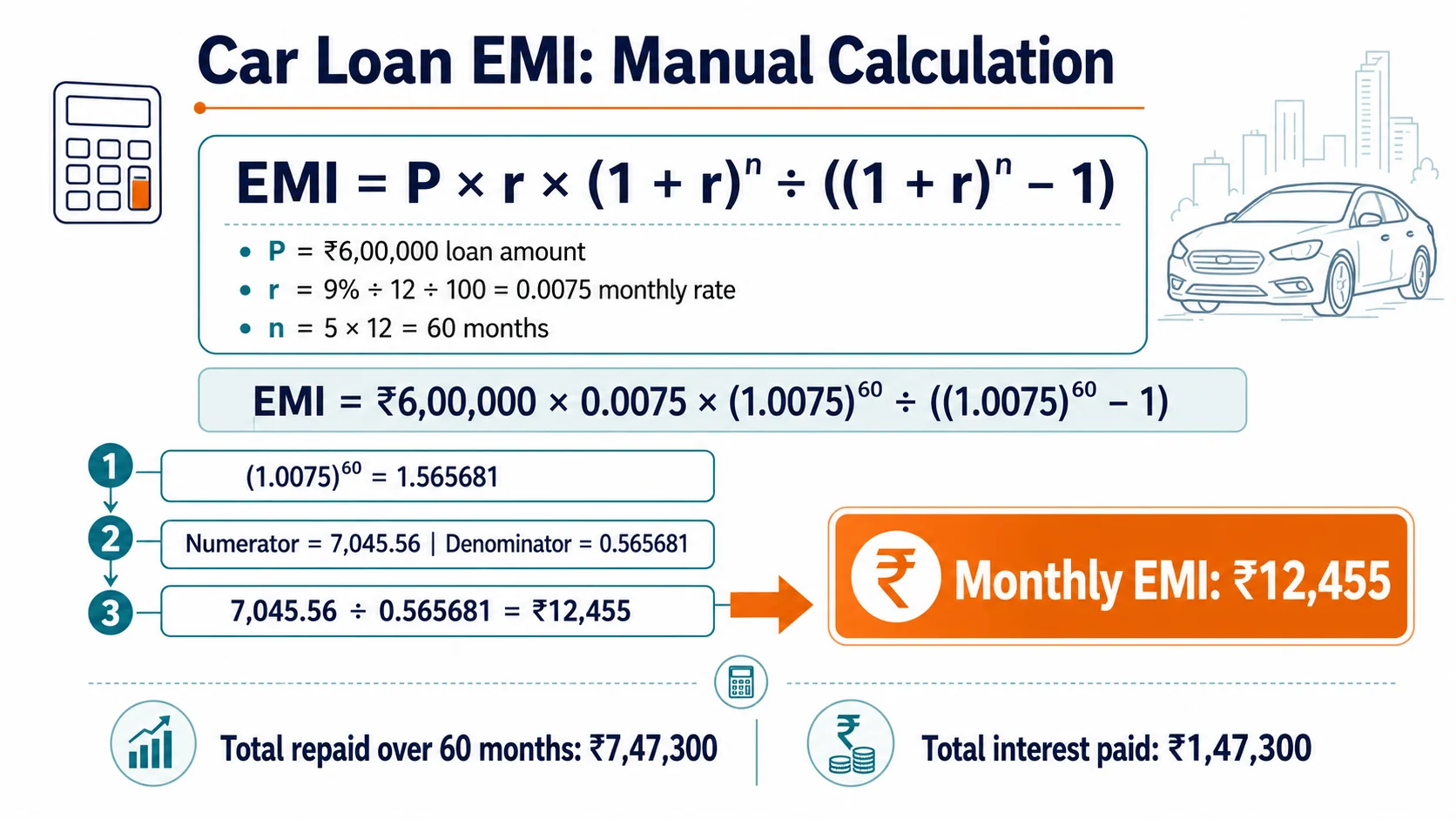
Your car loan EMI comes out of one formula: EMI = P × r × (1+r)^n / ((1+r)^n – 1), where P is the loan amount, r is the monthly interest rate (annual rate divided by 12, then by 100) and n is the loan tenure in months. Borrow ₹6,00,000 at 9% for 60 months and you’re paying ₹12,455 a month. Here’s how to calculate it manually, digit by digit, so you can check the finance sheet at a dealer’s desk instead of nodding at it.
EMI = P × r × (1 + r)^n / ((1 + r)^n – 1)
| Symbol | What it is | In this example |
|---|---|---|
| P | The amount you actually borrow, after your down payment | ₹6,00,000 |
| r | Monthly rate as a decimal: annual rate / 12 / 100 | 9 / 12 / 100 = 0.0075 |
| n | Loan tenure in months | 60 |
The worked example, step by step
- Turn the yearly rate into a monthly one. 9 divided by 12 is 0.75. Divide by 100 to make it a decimal: 0.0075.
- Count months, not years. Five years is 60.
- Raise (1 + r) to the power n. 1.0075 multiplied by itself 60 times gives 1.565681. It’s the one step that needs a power key, or a lot of patience.
- Build the top of the fraction. 6,00,000 × 0.0075 = 4,500. Then 4,500 × 1.565681 = 7,045.56.
- Build the bottom. 1.565681 – 1 = 0.565681.
- Divide. 7,045.56 / 0.565681 = 12,455.
That’s your EMI. By the end of the fifth year you’ll have handed over ₹7,47,301 in all. ₹6,00,000 of that is the money you borrowed. The rest, ₹1,47,301, is interest.
Searched for how to calculate car loan EMI manually instead? Same sum. There’s only one EMI formula, and every lender’s system is running it behind the counter.
Done it once by hand? Now check your own numbers instantly with your real loan amount, rate and tenure.
The Excel shortcut
Not in the mood for long division? Spreadsheets have the formula built in, and one line does it:
=PMT(9%/12, 60, -600000)
That returns 12455.01, the same figure the long division gave. The generic form is =PMT(rate/12, months, -principal). Keep the minus sign in front of the principal, otherwise the answer comes back negative and people assume they’ve typed something wrong.
Doing it by hand once is still worth ten minutes, because it shows you which input really moves the monthly figure and which one barely matters. After that, let the EMI calculator do the grinding and keep the formula for checking what the dealer’s sheet claims.
What loan tenure does to the same loan
Same ₹6,00,000, same 9%, three tenures, and every row below is the formula worked out rather than estimated.
| Loan tenure | (1 + r)^n | EMI | Total repaid | Total interest |
|---|---|---|---|---|
| 36 months | 1.308645 | ₹19,080 | ₹6,86,874 | ₹86,874 |
| 60 months | 1.565681 | ₹12,455 | ₹7,47,301 | ₹1,47,301 |
| 84 months | 1.873202 | ₹9,653 | ₹8,10,890 | ₹2,10,890 |
The EMI column is rounded to the rupee, but the totals are worked out from the unrounded EMI (₹19,079.84, ₹12,455.01 and ₹9,653.45), because that’s the figure a lender actually charges. Multiply the rounded EMI by the number of months and you’ll land a few rupees off, most visibly at 84 months.
Stretching from 36 to 84 months pulls the monthly outgo down by about ₹9,426 and adds about ₹1,24,015 to the total you repay. That’s the whole trade, in two numbers.
Your down payment works the other way. Every rupee you put down is a rupee that never gets multiplied by (1+r)^n, so it cuts the loan amount and the EMI together. Work out what a bigger cheque saves you and compare it against what a lower car loan interest rate saves you before you decide which one to chase. So how big should the loan be in the first place? Settle that before you start comparing offers.
Why the first EMI feels like it does nothing
Interest is charged on what you still owe, not on what you originally borrowed. Month one: 6,00,000 × 0.0075 = ₹4,500 goes to interest, and only what’s left chips away at the principal.
| Month | Opening balance | Interest | Principal repaid | Closing balance |
|---|---|---|---|---|
| 1 | ₹6,00,000 | ₹4,500 | ₹7,955 | ₹5,92,045 |
| 2 | ₹5,92,045 | ₹4,440 | ₹8,015 | ₹5,84,030 |
| 3 | ₹5,84,030 | ₹4,380 | ₹8,075 | ₹5,75,955 |
The interest slice shrinks a little every month and the principal slice grows to fill the gap. How lopsided that first instalment looks depends on your loan tenure: interest is 24% of EMI number one at 36 months, 36% at 60 months and 47% at 84 months. Longer tenure, fatter interest slice at the start, which is why the balance doesn’t seem to budge in year one of a long loan.
Flat rate and reducing balance aren’t the same 9%
Everything above is reducing balance, where interest is calculated on the falling outstanding amount. A flat-rate quote charges interest on the full ₹6,00,000 for all five years: 6,00,000 × 9% × 5 = ₹2,70,000 of interest, and an EMI of ₹14,500. Same headline percentage, so same cost? No. It’s ₹1,22,700 more out of your pocket. Ask which basis a quoted number uses before you put two offers side by side, because the rates themselves vary by lender and by credit profile.
Four things to get right before you trust your own answer
- Don’t start from the ex-showroom price. Use the amount you’re actually borrowing, after the down payment and including anything the lender is folding into the loan.
- Convert the rate properly. 9% a year is 0.0075 a month, not 0.09.
- Confirm whether the quote is reducing balance or flat.
- Run the formula at two tenures before you commit to one, because the monthly figure and the total cost pull in opposite directions.