
Getting the best car loan in India comes down to five moves: check your credit score, get pre-approved by two or three banks before you walk into the showroom, compare the total cost of each loan instead of just the EMI, negotiate the rate using your salary and credit profile, and only take dealer finance if it genuinely beats your bank offer. Do that, and you can save anywhere from ₹20,000 to over ₹1 lakh across the life of the loan.
The catch is that almost nobody does this. Most buyers fall for the car first, then let the showroom finance desk hand them whatever loan keeps the monthly EMI looking small. That is exactly how dealers and lenders make their margin. So here’s the full playbook: current 2026 rates, the new prepayment rule almost no one is talking about, and the negotiation script that flips the table in your favour.
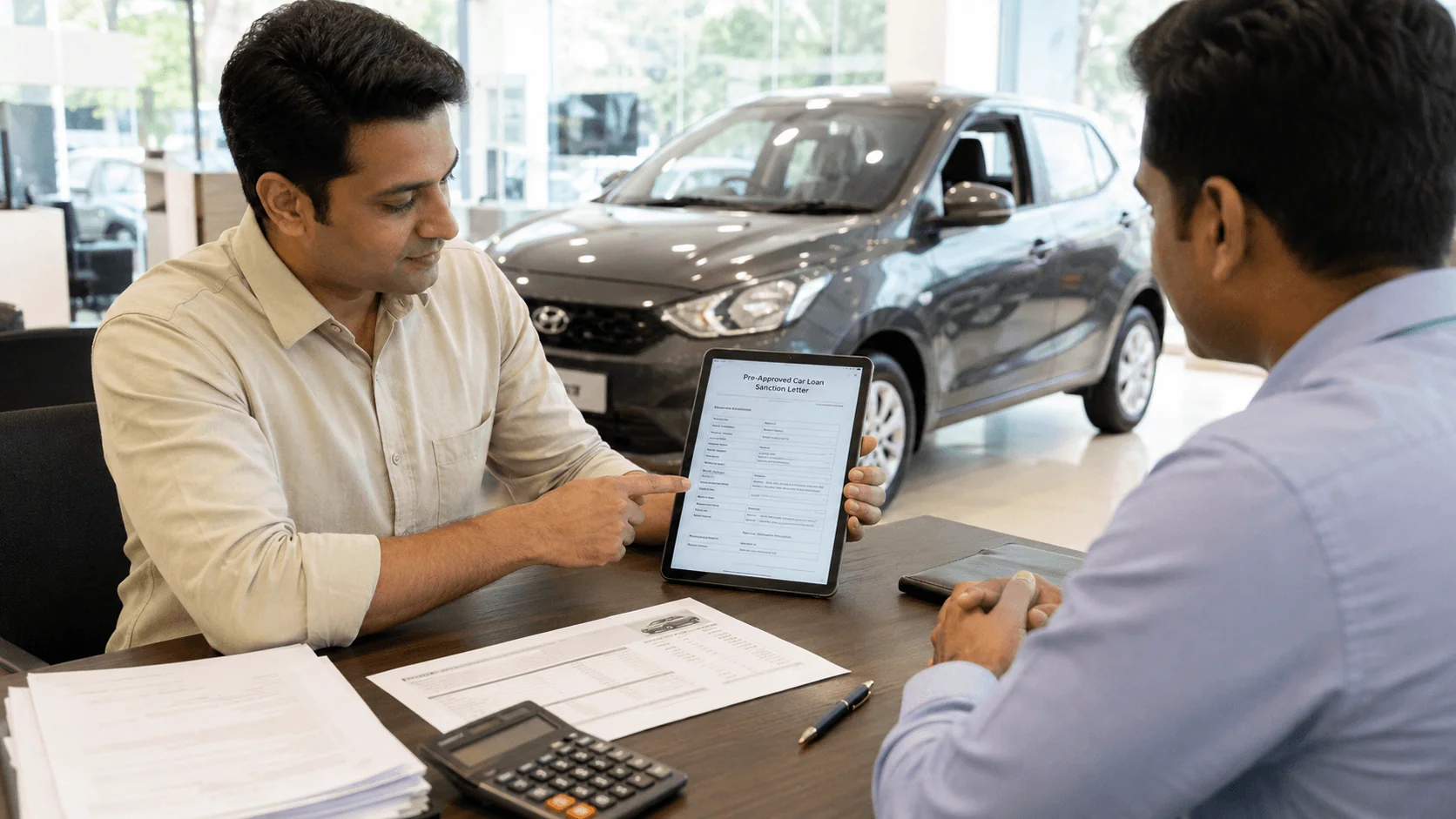
Your 7-Step Plan at a Glance
| Step | What to do | Why it matters |
|---|---|---|
| 1. Check your CIBIL score | Pull your credit report before applying | A score above 750 unlocks the lowest rate band |
| 2. Fix your down payment | Aim for 15–20% of on-road price | Smaller loan, lower risk, better rate |
| 3. Get pre-approved | From 2–3 banks where you have accounts | Gives you a real rate to bargain with |
| 4. Compare total cost | EMI + interest + every fee, over the full tenure | Kills the “low EMI” trap |
| 5. Visit the dealer with quotes | Make their finance partner beat your number | Removes the dealer’s pricing control |
| 6. Refuse forced bundles | Buy insurance and accessories separately | Stops 50–100% markups riding on your loan |
| 7. Read the sanction letter | Check rate, tenure, foreclosure clause in writing | Catches hidden charges before you sign |
How to Compare Car Loan Offers
Comparing loans only on the EMI is the single most expensive mistake an Indian car buyer makes. A salesperson can make almost any loan look affordable just by stretching the tenure from five years to seven. The EMI drops, you feel relieved, and you quietly hand the bank an extra lakh or more in interest. Run your own numbers with our car EMI calculator before you sign.
Indian car loans run on a reducing-balance method, so in the early years most of your EMI is interest, not principal. The real number you should compare is the total cost of the loan, not the monthly figure. Here’s the one formula to keep in mind:
Total loan cost = (EMI × number of months) + processing fee + documentation charges + foreclosure charges (if any)
Strip away the marketing and that single line tells you what your money actually costs.
The tenure trap, in numbers
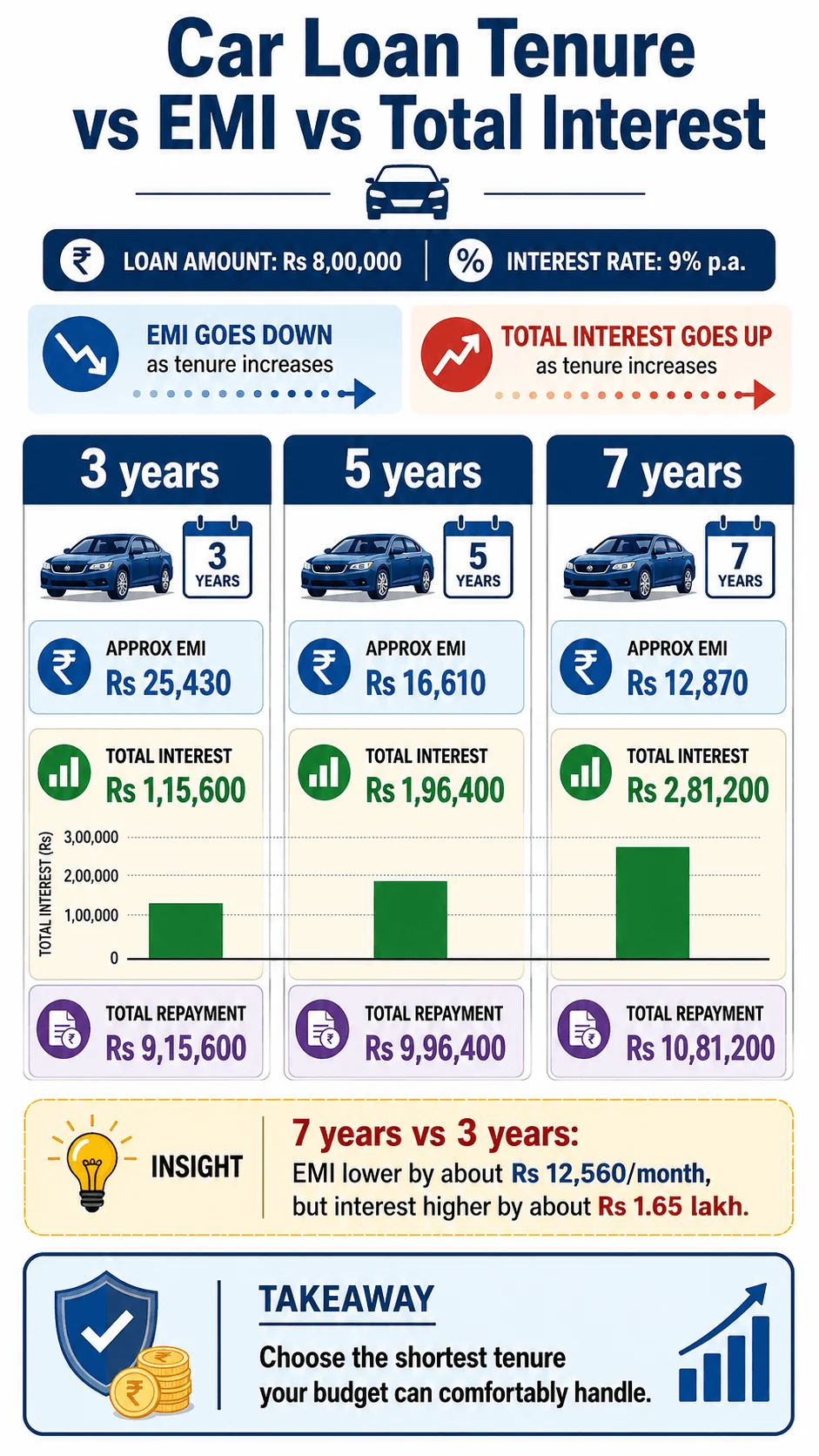
Take an ₹8 lakh loan at 9% per annum. Watch what happens as the tenure stretches:
| Tenure | Approx EMI | Total interest | Total you repay |
|---|---|---|---|
| 3 years | ₹25,430 | ₹1,15,600 | ₹9,15,600 |
| 5 years | ₹16,610 | ₹1,96,400 | ₹9,96,400 |
| 7 years | ₹12,870 | ₹2,81,200 | ₹10,81,200 |
Going from three years to seven cuts your EMI by about ₹12,560 a month, which feels great. But it also adds roughly ₹1.65 lakh in pure interest. So the rule is simple: pick the shortest tenure your monthly budget can comfortably handle, not the longest one the bank will allow.
The lowest rate isn’t always the cheapest loan
A low advertised rate can still be the costlier loan once you add the fees. Say you’re choosing between two offers on a ₹10 lakh, 5-year loan:
| Offer | Interest rate | Processing fee | EMI | Total interest | Total cost (interest + fee) |
|---|---|---|---|---|---|
| Offer A | 8.40% | ₹20,000 (2%) | ₹20,470 | ₹2,28,080 | ₹2,48,080 |
| Offer B | 8.90% | ₹0 (waived) | ₹20,715 | ₹2,42,900 | ₹2,42,900 |
Offer A has the lower rate, yet it costs ₹5,180 more overall, because that 2% processing fee swallows the entire rate advantage. This is why you compare total cost, never the headline number alone. Plug your own figures into any online car loan EMI calculator before you sign anything.
Current car loan interest rates in India (2026)
Rates depend on your CIBIL score, income, employer, the car model, tenure and any existing relationship with the bank. The figures below are “starting from” rates for strong borrowers as of 2026. Always confirm the final sanctioned terms with the lender.
| Lender | Interest rate (p.a.) | Processing fee | Max tenure | Prepayment / foreclosure | Best for |
|---|---|---|---|---|---|
| Canara Bank | 7.70% onwards | 0.25% (₹1,000–₹5,000) | 7 years | Nil | Lowest baseline rate |
| Union Bank of India | 7.80% onwards | ~₹1,000 + GST | 7 years | Nil | Low-EMI seekers |
| Punjab National Bank | 7.85% onwards (floating) | 0.25% / nil | 7 years | Nil on floating | Salaried PSU buyers |
| Bank of Baroda | 8.15% onwards (floating) | ₹500–₹1,500 + GST | 7 years | Nil on floating | Low-rate PSU option |
| HDFC Bank | 8.15% onwards | 1% (₹3,500–₹9,000) | 7 years | 6% / 5% / 3% by year (fixed) | Fast digital approval |
| ICICI Bank | 8.35% onwards | up to ~2% | 7 years | 3% / 2% / nil by year | Existing customers |
| State Bank of India | 8.75% onwards | Nil to ~1% (cap ₹10,000) | 7 years | Nil after 24 months | PSU rate-seekers |
| Axis Bank | 8.75% onwards | ₹3,500–₹12,000 | 7–8 years | ~5% on principal (fixed) | Salary-account holders |
| Tata Capital (NBFC) | 9.49% onwards | up to ~2.95% | 6 years | ~5–6% | Flexible eligibility |
| Bajaj / Mahindra Finance (NBFC) | 10%+ | up to ~3% | 5 years | High; watch flat-rate quotes | Self-employed, quick approval |
The pattern is clear. Public sector banks like Canara, Union Bank, PNB and Bank of Baroda hold the cheapest car loan rates in India, often starting between 7.45% and 7.85% for top-credit salaried buyers, with little or no foreclosure penalty. Private banks like HDFC and ICICI cost a touch more but approve faster and run smoother digital processes. NBFCs sit highest on cost but say yes to profiles banks turn away.
Foreclosure charges and the new 2026 prepayment rule
This is the part most guides miss, and it can save you real money. From 1 January 2026, the RBI banned all foreclosure and prepayment charges on floating-rate loans taken by individuals for personal use. If your car loan is on a floating rate, you can now prepay any amount, anytime, from any source, completely free.
The trap: most car loans in India are still issued on fixed rates, and a fixed-rate loan sanctioned or renewed after 1 January 2026 can still carry a foreclosure penalty, typically 3% to 6% of the outstanding principal at private banks and NBFCs. So if there’s any chance you’ll repay early, ask specifically for a floating-rate loan, or pick a public sector bank that charges nil on floating. It’s worth reading up on the full car loan prepayment rules before you commit, because this one clause decides whether early closure is free or expensive.
Bank vs NBFC vs Dealer Finance
You have three places to get a car loan, and they don’t play by the same rules. Knowing how each one actually makes money is half the battle.
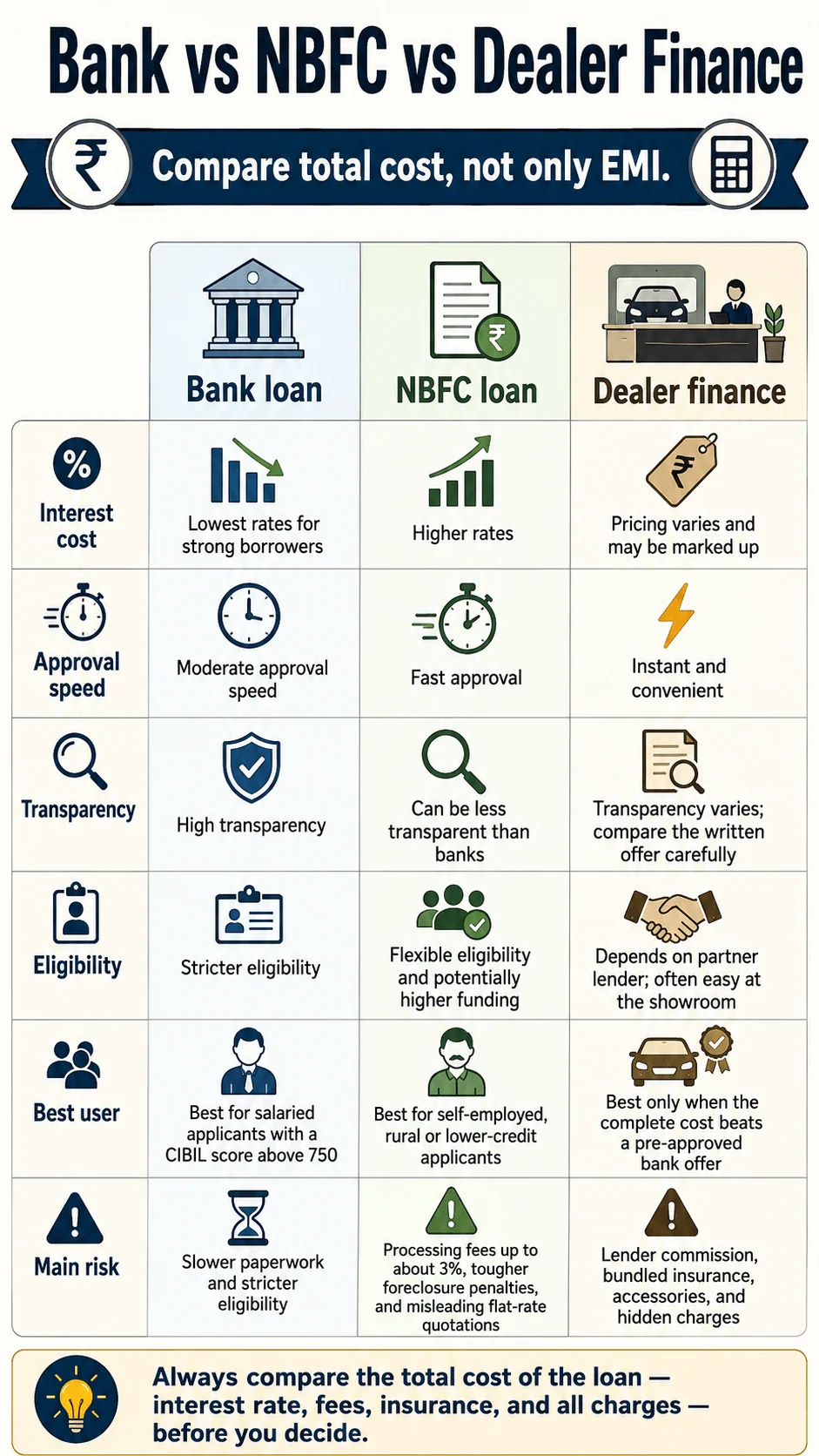
Bank loans are usually the cheapest and most transparent route, especially from a bank where you already hold a salary account. Public sector banks have a lower cost of funds, so they pass on lower rates, and their fees and foreclosure rules are spelled out clearly. The trade-off is slightly slower paperwork and tighter eligibility. This is the best option if you’re salaried with a clean CIBIL score above 750.
NBFC loans (Tata Capital, Bajaj Finance, Mahindra Finance and the like) exist to say yes when banks say no. They approve fast, accept self-employed and rural buyers, and often fund up to 100% of the car. You pay for that flexibility with higher rates (roughly 9.5% to 14%), heftier processing fees (up to 3%), and stricter foreclosure penalties. Watch out for NBFCs that quote a “flat rate”, because a 9% flat rate over five years works out to nearly 16% on a reducing-balance basis.
Dealer finance is the loan arranged right there on the showroom floor, often through captive arms like Maruti Suzuki Smart Finance. It’s the most convenient option and sometimes comes with festival cashbacks or subvention deals. But the dealer earns a commission from the lender, which nudges them toward the loan that pays them most, not the one that’s cheapest for you. This is also where forced insurance and accessory bundling quietly inflate your loan.
| Factor | Bank loan | NBFC loan | Dealer finance |
|---|---|---|---|
| Interest rate | Lowest for strong profiles | Medium to high | Varies, often marked up |
| Approval speed | Moderate | Fast | Instant |
| Transparency | High | Medium | Low, watch bundles |
| Negotiation power | Good | Medium | High, if you’re pre-approved |
| Best for | Good-credit salaried | Flexible or self-employed | Convenience seekers |
| Main risk | Slower disbursal | Higher fees | Hidden bundling |
Should I take loan from bank or dealer?
Take dealer finance only if its total cost beats your pre-approved bank offer after you’ve added everything: interest, processing fee, insurance, accessories and foreclosure charges. A dealer might wave a “₹15,000 finance discount” at you, but if their partner lender’s rate is half a percent higher, that discount can vanish over the tenure. Do the maths on total cost, not the freebie. Before you let a dealer arrange your loan, run through this checklist:
| Ask the dealer | Why |
|---|---|
| Which lender is actually giving this loan? | Your contract is with the bank, not the dealer |
| What’s the exact interest rate? | Avoid EMI-only and flat-rate traps |
| What’s the processing fee? | Adds dead weight to your upfront cost |
| Is insurance compulsory with this loan? | It’s not, and dealer insurance is often 50% costlier |
| Are any accessories mandatory? | Refuse inflated packages rolled into the loan |
| What are the foreclosure charges? | Decides the cost of early closure |
| Is the discount tied to using your finance? | Check the net benefit against an outside bank offer |
Documents Required for Car Loan
A clean, complete file gets you approved faster and quietly strengthens your hand when you negotiate. What you need depends on your profile.
| Applicant type | Documents needed | Notes |
|---|---|---|
| Salaried | PAN, Aadhaar/passport/voter ID, address proof, last 3 months’ salary slips, 3–6 months’ bank statements, latest Form 16 or ITR, employer ID, photos, car proforma invoice | Fastest if you apply through your salary-account bank |
| Self-employed | PAN, Aadhaar/address proof, last 2–3 years’ ITR, 6–12 months’ bank statements, GST or business proof, balance sheet and P&L if asked, photos, car quotation | ITR and bank-statement quality decide approval odds |
| Used-car buyer | All of the above for your profile, plus RC copy, valid insurance, valuation report, seller KYC, hypothecation NOC from the previous financier | Vehicle age and official valuation set your loan-to-value |
| With co-applicant | Income and identity proof of spouse or parent | Adds income, can lower your rate |
Most banks fund 80% to 90% of the car’s value, so plan for the rest as down payment. A quick note on eligibility: lenders typically want salaried applicants earning at least ₹20,000 to ₹25,000 a month with one year in the current job, self-employed buyers with two to three years in business, an age between 21 and 65, and a CIBIL score of 650 or higher (750+ for the best rates).
Pre-Approval: Why It Gives You Leverage
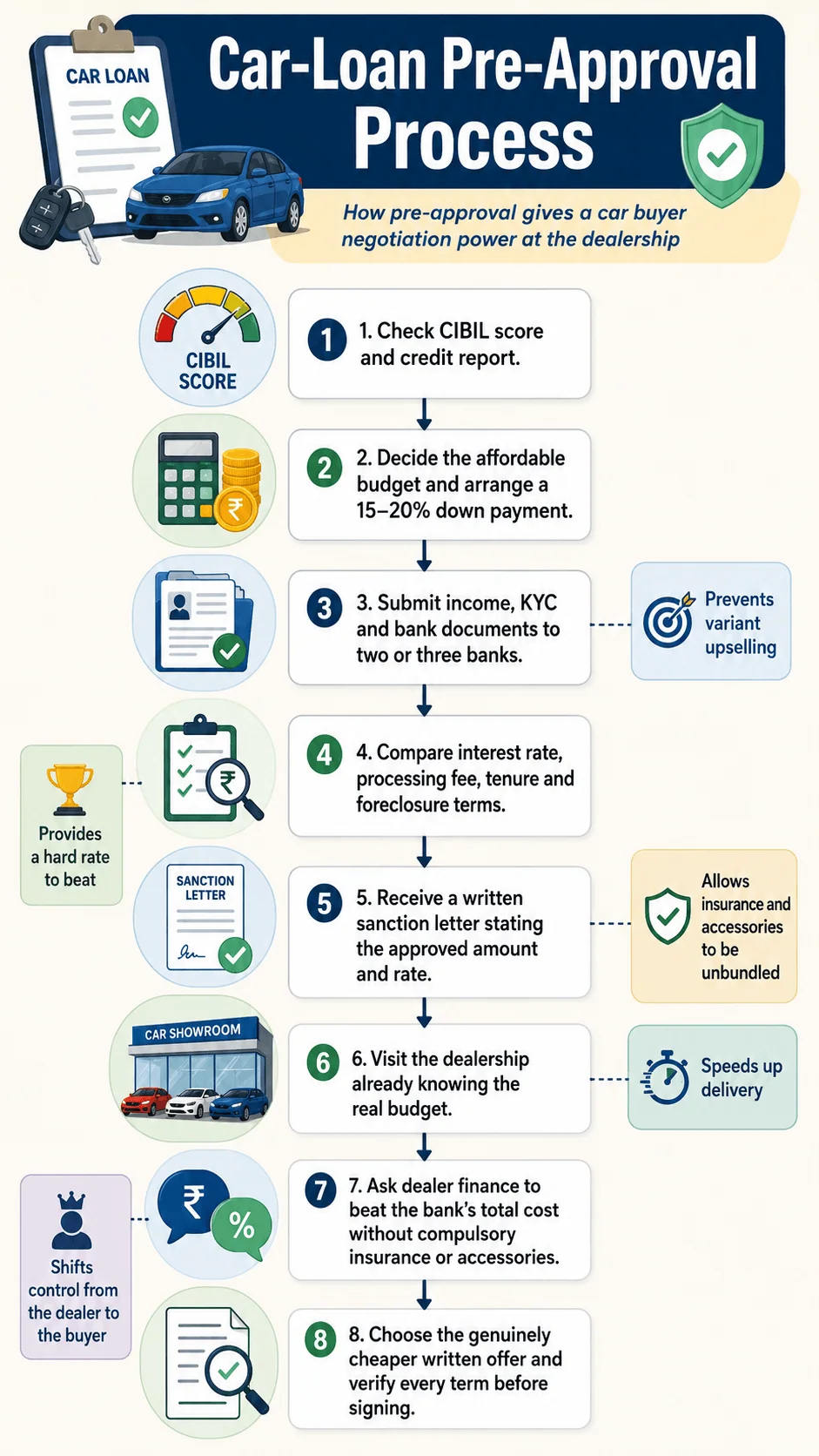
Here’s the difference between an average buyer and one who gets the best car loan in India: pre-approval. Walking into a showroom without it means you’re completely dependent on the dealer’s finance desk, and they know it. Walk in with a sanction letter from your bank, and you’ve turned the whole conversation around.
Pre-approval is when a bank checks your credit score, income and obligations before you pick a car, and tells you the loan amount and rate you qualify for. That figure is a ceiling from the lender, not your target: what matters is the amount you should comfortably borrow. Many banks (SBI, HDFC, ICICI) offer it digitally to existing customers within a day or two, and the sanction letter usually stays valid for 15 to 30 days. So you go car shopping already knowing your real budget and your real rate.
Why does that matter so much?
- You know your true budget, so no salesperson can upsell you into a costlier variant.
- You have a hard number to beat. Any showroom quote now has to compete with a real offer, not a vague “we’ll get you a good rate”.
- You can unbundle costs. With the loan amount fixed externally, you can refuse forced insurance and accessories outright.
- The dealer treats you as a serious buyer and often unlocks deeper cash discounts to close the sale fast.
- Booking and delivery move faster, since you’re not waiting on in-house approval.
How to use pre-approval at the dealership
Don’t reveal your maximum budget early. When the dealer pushes their finance partner, say something close to this:
“I already have a pre-approved car loan at X% with a ₹Y processing fee. If your finance partner can beat my total cost without forcing insurance or accessories, I’m happy to use dealer finance. Otherwise I’ll go with my bank.”
That single sentence shifts control to you. It forces the dealer to compete on total cost, not on a low EMI illusion. Ask for a written quote from their finance desk, never accept verbal promises, and never sign a blank loan or RTO hypothecation form. Pre-approval turns car finance from a dealer-controlled process into a buyer-controlled negotiation.
Negotiating Your Interest Rate
Can you negotiate a car loan interest rate? Yes, and you absolutely should. The “8.75% onwards” you see advertised is a starting point, not a fixed price. Lenders price loans on risk, so the lower the risk you represent, the lower the rate you can push them to. Often you can shave 0.1% to 0.5% off, plus get fees waived. Know the benchmark first: our page on current car loan interest rates shows what is competitive in 2026.
These are the levers that move the rate down:
| Negotiation lever | How it helps |
|---|---|
| CIBIL score above 750 | Signals low default risk, puts you in the best rate band |
| Salary account with the bank | Unlocks relationship pricing, often 0.25–0.50% off |
| Higher down payment | Lowers the bank’s exposure, so it may drop the rate |
| Shorter tenure | Less risk than a 7-year loan, easier to bargain |
| Reputed or government employer | Many banks have lower corporate rate buckets |
| Low existing EMIs | A healthy debt-to-income ratio reassures the lender |
| Co-applicant with strong income | Adds security to the loan profile |
| A competing pre-approved offer | The strongest card of all, makes lenders bid for you |
Getting the right down payment in place before you apply does double duty here: it shrinks your interest outgo and gives you a stronger rate to negotiate from.
What to actually negotiate
When the branch hits its rate floor and won’t budge further, pivot to the fees, because that’s where the rest of your savings hide:
| Item | What to ask for |
|---|---|
| Interest rate | “Can you match or beat my pre-approved 8.40% offer?” |
| Processing fee | “Can this be waived or capped?” |
| Documentation charge | “Can the ₹500–₹4,000 login fee be reduced?” |
| Insurance | “I’ll arrange insurance myself, please don’t bundle it” |
| Accessories | “Finance the car only, I’ll buy accessories separately” |
| Foreclosure terms | “Confirm the prepayment charge and lock-in in writing” |
| EMI date | “Set the debit date just after my salary credit” |
Festival season is your friend here. Retail festivals routinely trigger fee waivers and small rate cuts, and month-end is when sales staff have targets to hit and deal more freely.
Common Car Loan Mistakes to Avoid
The whole system is built to maximise the lender’s and the dealer’s returns. These are the traps that cost buyers the most:
- Comparing only the EMI. The most expensive habit there is. A low EMI on a long tenure hides a mountain of interest.
- Taking the longest tenure on offer. Every extra year inflates total cost. Borrow short.
- Skipping pre-approval. Without a benchmark, you’ve handed the dealer all the bargaining power.
- Accepting dealer finance without comparison. Their first offer is rarely their best, and almost never yours.
- Ignoring foreclosure charges. A 5% to 6% penalty turns an early payoff into a fresh expense. Prefer floating-rate or nil-charge loans.
- Bundling overpriced insurance. Dealer insurance can cost double. Buy your car insurance separately and you stop paying interest on the markup for years.
- Financing accessories. Floor mats and chrome trim depreciate to nothing while you pay interest on them for the full tenure.
- Confusing flat rate with reducing balance. A “9% flat” loan is closer to 16% in reality. Always ask for the reducing-balance rate.
- Not checking your CIBIL first. Applying blindly to many lenders triggers multiple hard enquiries that drag your score down.
- Signing blank forms. Never sign blank RTO or hypothecation papers. Make sure the sanction letter matches every term you agreed on.
FAQs
Which bank is best for car loan in India? It depends on your priority. For the lowest cost, public sector banks like Canara Bank, Union Bank, Bank of Baroda and SBI win, thanks to low rates, small fees and nil foreclosure charges on floating loans. For speed and slick digital service, HDFC and ICICI are better, especially if you already bank with them.
Which bank gives the cheapest car loan? As of 2026, public sector banks offer the cheapest car loan rates in India, often starting between 7.45% and 7.85% per annum for salaried buyers with strong credit. But “cheapest” also means factoring in processing fee waivers and zero foreclosure charges, not just the headline rate.
Should I take a car loan from a bank or dealer? Prefer a bank unless the dealer’s finance is genuinely cheaper on total cost. Add up the dealer’s interest, processing fee, insurance and accessories, subtract any finance-linked discount, and compare that against your pre-approved bank offer. Bank loans are more transparent and easier to compare.
Can I negotiate a car loan interest rate? Yes. A CIBIL score above 750, a strong down payment, an existing bank relationship and a competing pre-approved offer all give you room to push the rate down or get fees waived. The advertised rate is rarely the final rate for a good borrower.
What credit score do I need for a car loan? Most lenders approve loans from a CIBIL score of 650, but the best interest rates are reserved for scores above 750. Below 700, expect a higher rate or a stricter eligibility check.
What documents are required for a car loan? For salaried buyers: PAN, KYC (Aadhaar or passport), the last three months’ salary slips, six months’ bank statements, Form 16 or ITR, and the car’s proforma invoice. Self-employed buyers add two to three years’ ITR and business proof. Used-car loans need the RC, insurance and a valuation report on top.
Is an NBFC car loan better than a bank loan? Only if you need flexible eligibility, very fast approval or higher funding, which suits self-employed and lower-credit buyers. For everyone else, NBFCs cost more, with higher rates, fees up to 3%, and tougher foreclosure penalties than banks.
Is a zero down payment car loan a good idea? Usually not. Financing the full on-road price maximises your interest and puts you in negative equity the moment you drive out. A down payment of 15% to 20% lowers your EMI, cuts total interest and often unlocks a better rate. It helps to understand the on-road price breakdown so you know exactly what you’re financing.
Can I prepay or foreclose my car loan? Yes. Since 1 January 2026, floating-rate loans for individuals carry no prepayment or foreclosure charges at all. Fixed-rate loans, which are still the most common, may charge 3% to 6% of the outstanding principal, so check this clause before you sign if early closure is likely.
Is there a tax benefit on a car loan? For a regular petrol or diesel car, no. The only car-loan tax break is Section 80EEB for electric vehicles, which allows up to ₹1.5 lakh deduction on interest. But here’s the honest catch: that benefit applied only to EV loans sanctioned between April 2019 and March 2023. A new EV loan taken today can’t start a fresh 80EEB claim, though existing loans within that window can keep claiming. Watch the Union Budget for any revival.
Should I choose a shorter or longer loan tenure? Shorter, almost always. A longer tenure feels comfortable because the EMI is low, but it can cost you well over a lakh in extra interest. Pick the shortest tenure your monthly budget can handle without strain.
Rates, fees and charges mentioned are indicative for 2026 and vary by lender, credit profile and car model. Confirm the final sanction terms directly with your lender before signing.