
Zero depreciation car insurance is an add-on that waives IRDAI’s mandatory depreciation cuts on replaced parts during a claim, so the insurer pays the full invoice value of each new part minus only a ₹1,000-₹2,000 deductible. Worth the extra ₹900-₹5,000 a year? For most new and mid-range cars under 5 years old, yes. A single accident involving a plastic bumper or modern sensor array almost always recovers the entire annual premium loading, and then some.
That’s the headline. The detailed answer depends on your car’s age, how often you actually claim, and whether you’ve understood a few sneaky exclusions that catch buyers off guard. This guide breaks it down with real rupee math from two worked claim examples, the 2026 premium tables, and the one trade-off nobody really talks about. Your No Claim Bonus.
What Is Zero Depreciation Insurance?
Zero depreciation insurance, also called nil depreciation cover or bumper-to-bumper insurance, is an optional add-on you stack onto your comprehensive own-damage policy. It contractually overrides the standard depreciation deductions that IRDAI requires insurers to apply when they’re calculating claim payouts. New to the jargon? Start with our overview of car insurance types.
Here’s why it exists. Indian motor insurance is built on the principle of indemnity, which means an insurer can only restore you to the financial position you held just before the accident. Replacing a 2-year-old plastic bumper with a brand-new factory part would technically leave you “better off” than before the crash. The industry calls this “betterment.” IRDAI counteracts it by forcing insurers to subtract depreciation based on the part’s age and material.
The add-on flips that math. You pay a small upfront loading, the insurer absorbs the depreciation risk, and during an approved own-damage settlement the company pays the full cost of the replacement part. Nothing about your underlying base policy changes. Theft cover, third-party liability, fire damage, natural disaster protection: all of those benefits stay exactly the same. Only the payout formula shifts, and only for replaced parts.
One important clarification. The rider isn’t a standalone policy. Indian motor cover has two parts. The mandatory third-party liability section, plus the optional own-damage section. Nil dep sits on top of the own-damage piece. You can’t buy it without a base comprehensive policy underneath.
How It Works — With Claim Example
Before the worked examples, you need to understand the IRDAI depreciation tables, because that’s where the money quietly disappears.
IRDAI Depreciation Rates by Material
| Component / Material | Depreciation Without Zero Dep |
|---|---|
| Glass parts | 0% (no depreciation) |
| Fibreglass components | 30% flat |
| Rubber, nylon, plastic parts | 50% flat |
| Tyres, tubes, batteries, airbags | 50% flat |
| Paint material portion (25% of bill) | 50% on that 25% |
Plastic gets hammered hardest. That matters because modern vehicles rely on plastic and fibre composites for almost every exterior panel that breaks in a city scrape. Front bumpers, grilles, headlamp housings, ORVM caps, interior trims. Every one of these gets a 50% depreciation haircut from day one without the waiver, even on a one-month-old vehicle.
Metal Parts Depreciation Schedule
For metal panels like doors, bonnets, fenders, the depreciation scales with vehicle age:
| Vehicle Age | Depreciation on Metal Parts |
|---|---|
| Up to 6 months | 5% |
| 6 months – 1 year | 15% |
| 1 – 2 years | 20% |
| 2 – 3 years | 30% |
| 3 – 4 years | 40% |
| 4 – 5 years | 50% |
| 5 – 10 years | 40-50% (mutual agreement) |
There’s also a quirky paint rule. When you receive a consolidated painting bill, IRDAI treats 25% of the total as paint material and the remaining 75% as labour. The 50% material haircut applies only to that 25% slice. Labour gets reimbursed in full.
Example 1: Front Bumper + LED Headlamp Replacement
Take a typical city situation. You drive a 2026 compact SUV through Bengaluru’s morning rush. A two-wheeler clips your front-left during a lane change. Plastic bumper cracked, single LED headlamp assembly shattered. The authorised workshop estimate looks like this:
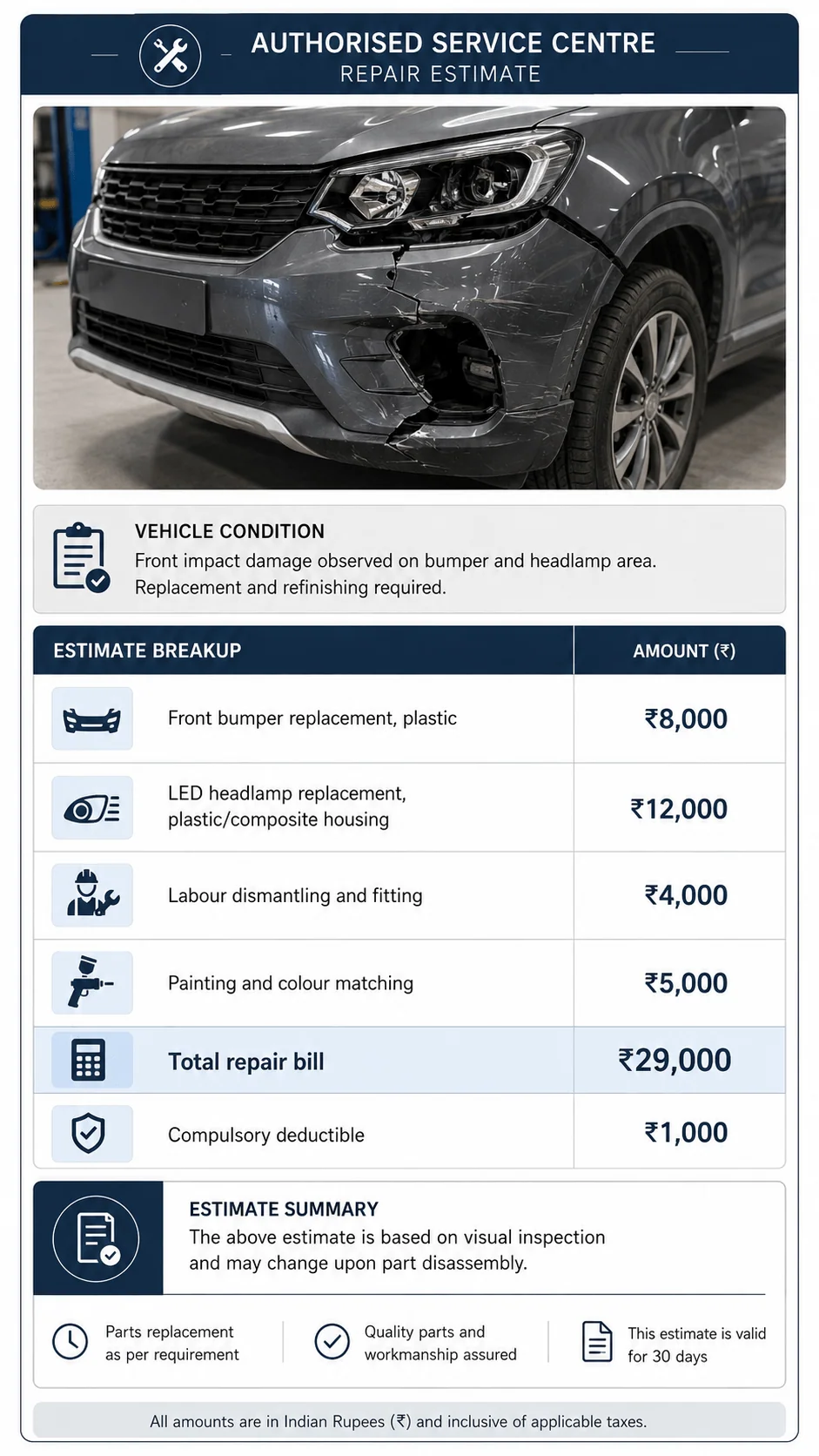
- Front bumper replacement (plastic): ₹8,000
- LED headlamp replacement (plastic/composite housing): ₹12,000
- Labour (dismantling and fitting): ₹4,000
- Painting (bumper colour matching): ₹5,000
- Total bill: ₹29,000
- Compulsory deductible (sub-1500cc engine): ₹1,000
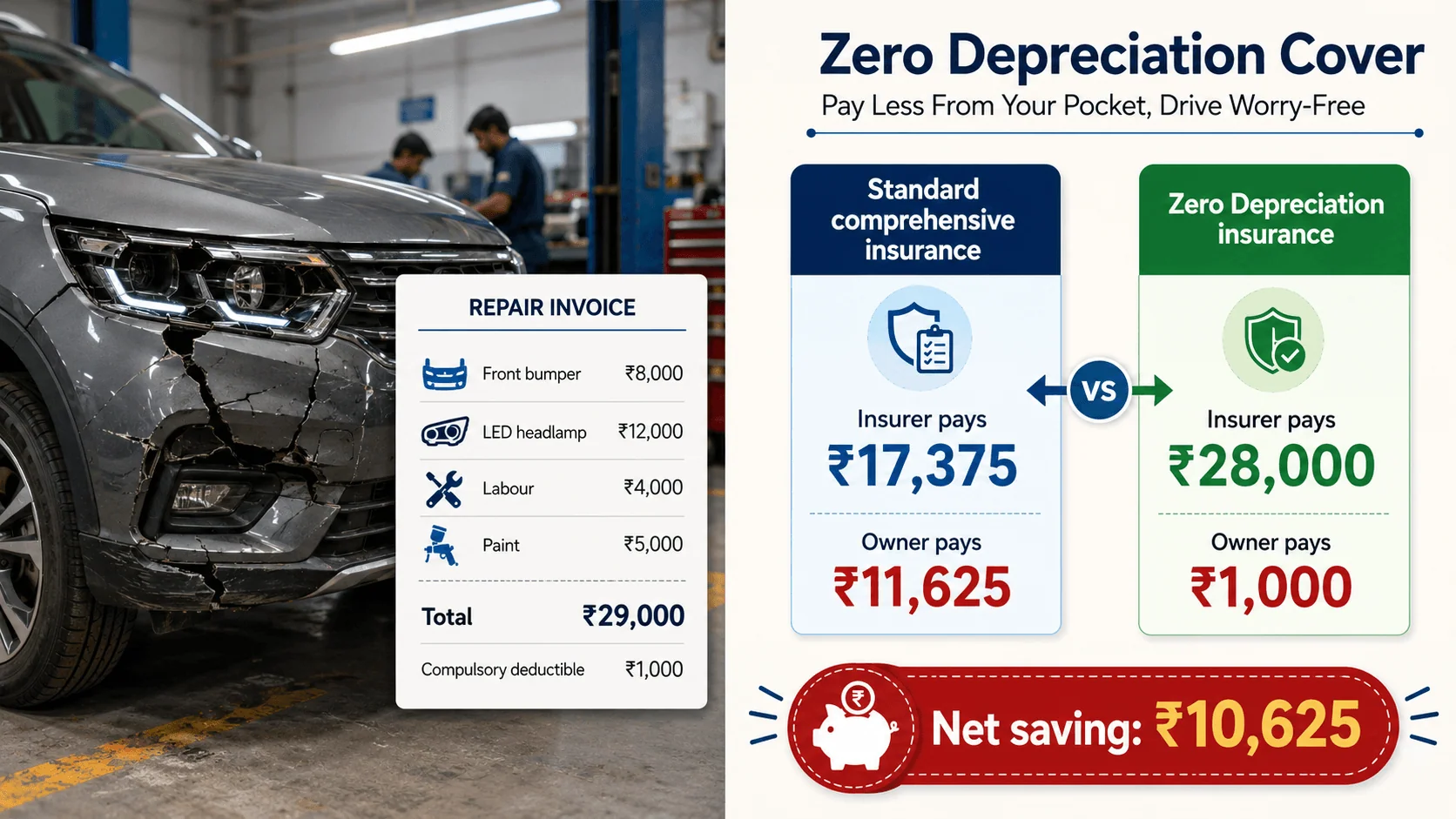
Without the waiver: – Plastic bumper: ₹8,000 minus 50% depreciation = ₹4,000 loss to owner – LED headlamp: ₹12,000 minus 50% depreciation = ₹6,000 loss to owner – Paint: ₹5,000 bill, 25% material = ₹1,250, 50% cut on that = ₹625 loss – Labour: ₹4,000 covered in full – Compulsory deductible: ₹1,000 – Carrier pays ₹17,375. You pay ₹11,625 out of pocket.
With the rider attached: – All depreciation deductions waived on eligible parts – Only compulsory deductible applies – Carrier pays ₹28,000. You pay ₹1,000 out of pocket.
Net saving from the add-on: ₹10,625 on a single ₹29,000 settlement. That’s a sum that would’ve recovered roughly five years’ worth of rider loading on a compact SUV.
Example 2: Door + ORVM on a 3-Year-Old Car
Now consider a side-swipe in a tight Hyderabad parking lot. Your 3-year-old sedan takes a heavy hit on the driver-side door, the electronic outside rear view mirror snaps off, and the door needs paint matching.
- Door replacement (metal): ₹15,000
- ORVM replacement (plastic with electronics): ₹6,000
- Painting (door + mirror cap): ₹7,000
- Labour: ₹5,000
- Total bill: ₹33,000
Without the waiver: – Metal door: 30% depreciation on a 3-year-old vehicle = ₹4,500 loss – Plastic ORVM: 50% cut = ₹3,000 loss – Paint material haircut: ₹875 (50% on the 25% material portion of ₹7,000) – Compulsory deductible: ₹1,000 – You pay roughly ₹9,375 out of pocket.
With the rider active: – All eligible-part depreciation waived – Only deductible applies – You pay ₹1,000.
Saving: about ₹8,375 on this settlement. And here’s the kicker. The vehicle’s IDV doesn’t even matter for the math. What matters is the material and age of every replaced component.
The pattern across both examples becomes clear. The more physical pieces you’ve got to swap, especially plastic and composite ones, the bigger the rider’s cheque. What if your incident is a labour-heavy dent repair where panels are massaged back rather than replaced? Then the savings shrink, because labour was never depreciated to begin with.
Cost of Zero Dep vs Standard Comprehensive
The add-on is priced as a percentage loading on your own-damage premium, not a flat fee. The exact figure depends on actuarial variables: your vehicle’s age, engine cc, IDV, model classification, your city of registration, and the carrier’s loss ratios for that segment.
A sub-1000cc hatchback typically attracts an 8-10% surcharge. A 1500cc+ premium SUV can hit 12-15%. After year 3, the surcharge rises sharply. After year 5? Many carriers refuse the cover entirely or charge a 30%+ markup.
2026 Premium Loading by Vehicle Segment
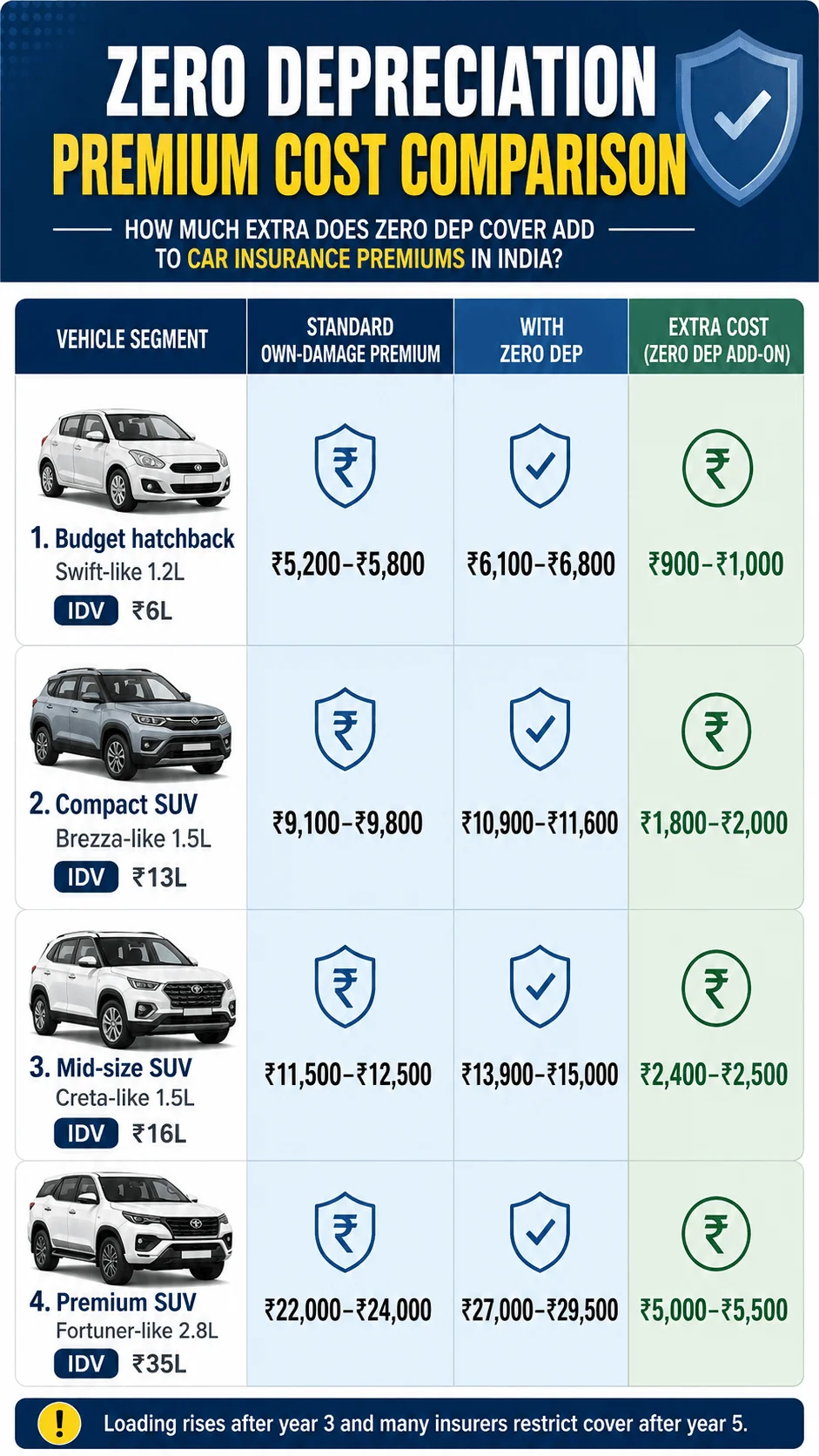
| Car Type | Standard OD Premium | With Zero Dep | Extra Cost |
|---|---|---|---|
| Budget hatchback (Swift, 1.2L, ₹6L IDV) | ₹5,200 – ₹5,800 | ₹6,100 – ₹6,800 | ₹900 – ₹1,000 |
| Compact SUV (Brezza, 1.5L, ₹13L IDV) | ₹9,100 – ₹9,800 | ₹10,900 – ₹11,600 | ₹1,800 – ₹2,000 |
| Mid-size SUV (Creta, 1.5L, ₹16L IDV) | ₹11,500 – ₹12,500 | ₹13,900 – ₹15,000 | ₹2,400 – ₹2,500 |
| Premium car (Fortuner, 2.8L, ₹35L IDV) | ₹22,000 – ₹24,000 | ₹27,000 – ₹29,500 | ₹5,000 – ₹5,500 |
For electric vehicles, the math shifts. A sub-30 kWh EV like a Tiago.ev carries an own-damage base fee near ₹1,780, and stacking the depreciation waiver plus battery protection scales the total outlay closer to ICE compact SUV ranges. Always check whether the battery pack is included by default or needs a separate rider.
Where You Buy Matters
Dealer-bundled insurance, the kind you sign at the showroom along with the vehicle, usually wraps the depreciation waiver into a non-itemised package alongside consumables and engine protect. It’s convenient but rarely the cheapest. Buying online from an aggregator lets you compare line items across carriers, adjust your IDV to the actual market value of your vehicle, and add only the riders you need. For a renewal? Online is almost always cheaper.
Eligibility and Claim Caps
Most Indian carriers offer the cover up to 5 years from registration. A few stretch it to 7 years for petrol vehicles with mandatory pre-inspection. Diesel vehicles often cap at 5-6 years because of higher mechanical fatigue risk. Past 7 years? The waiver is generally unavailable or priced punitively.
Claim caps are the other catch. Mainstream plans limit you to 2 settlements per policy year under the waiver. Any third filing reverts to standard depreciation. Some premium products, including ICICI Lombard, Tata AIG and Royal Sundaram, offer unlimited waiver-protected settlements for a higher upfront fee. New India Assurance and IFFCO Tokio also feature on that unlimited-settlements list.
When Zero Dep Saves You Money
Run through this checklist honestly. If three or more apply to you, the math points strongly toward buying the add-on.
- Your vehicle is under 5 years old. The depreciation curve is steepest in years 1-3, and that’s when the waiver delivers the biggest payout boost.
- Your ride has expensive bumpers, LED or composite headlamps, ADAS sensors, panoramic roofs, or large unibody plastic fascias. A single sensor recalibration after a fender bender can run ₹50,000 on its own.
- You drive in dense urban traffic. Stop-and-go conditions, lane-change scrapes, and parking dings disproportionately damage exterior plastic, exactly the components that attract the full 50% depreciation cut.
- You park in tight apartment basements or mall lots. Static vehicles in crowded environments take constant minor hits from doors and passing scooters.
- You’re a new driver. Inexperience genuinely correlates with more minor incidents in the first 2-3 years of ownership.
- You own a compact SUV or a premium SUV. Aggressive styling combined with prominent plastic cladding makes repairs significantly costlier than on basic hatchbacks.
- You want predictable repair costs. If a sudden ₹50,000-₹1,00,000 bill would strain your finances, paying a known ₹1,500-₹3,000 surcharge upfront is the safer trade.
- You expect at least one own-damage incident during the policy year. Actuarially, a single moderate settlement recovers the entire rider outlay and then some.
High-Benefit Scenarios
| Situation | Zero Dep Benefit | Why |
|---|---|---|
| New car (0-3 years) | Very high | Steep early depreciation hits the payout hardest |
| LED headlamp damage | Very high | Composite housings are expensive and fully depreciated under standard cover |
| City parking scrapes | Medium-high | Bumpers and ORVMs attract 50% material depreciation |
| ADAS-equipped car | Very high | Sensor recalibration costs scale fast on minor front-end damage |
| Old, low-value car | Low | Premium loading rises while IDV falls, math stops working |
When It’s Not Worth It
The add-on isn’t universal good advice. For certain buyer profiles, the surcharge just becomes wasted spend.
- Your vehicle is older than 5 years and the surcharge exceeds 25-30% of the base own-damage outlay. At that point, the upfront cost rarely justifies the diminishing repair savings on a depreciating asset.
- You rarely file settlements. Highly experienced drivers with secure private parking, garaged-only vehicles, and clean records may pay multiple years of waiver loading without ever triggering it.
- You drive very little. A weekend-only second ride has minimal traffic exposure.
- You already have a high voluntary deductible. If you opted for a ₹10,000 voluntary deductible to slash your base outlay, that ₹10,000 must still be paid on every settlement. A ₹12,000 bumper repair would be mostly out of pocket anyway, defeating the waiver entirely.
- Your plan caps depreciation-waiver settlements at one per year. Some budget products do this. Multiple minor incidents in a single year would expose you to full depreciation on the second event.
- The add-on excludes too many components. If the policy fine print strips out batteries, tyres and electronics alongside consumables, you may need three separate riders to achieve true bumper-to-bumper protection. That often costs more than the savings.
- You prefer paying small repairs out of pocket to protect your NCB. This is the big one, and it deserves its own section.
The NCB Trade-Off Nobody Mentions
The No Claim Bonus is a renewal discount that rewards settlement-free years. It’s generous and scales fast:
- After 1 year without a filing: 20% NCB on next year’s own-damage outlay
- After 2 years: 25%
- After 3 years: 35%
- After 4 years: 45%
- After 5+ years: 50% (capped)
Filing any own-damage settlement, even one rupee of waiver-protected payout, resets your NCB to zero at renewal, unless you’ve also bought an NCB Protection rider. Here’s why that matters in practice.
Imagine you’ve held your policy for 4 years, earned a 45% NCB, and your base own-damage outlay for next year would be ₹18,000. That NCB saves you ₹8,100. Now your vehicle picks up a ₹7,000 parking lot scrape. If you file under the depreciation waiver, the carrier covers ₹6,000 of it (after the ₹1,000 deductible). You’ve saved ₹6,000 today. But at renewal, your NCB collapses to 0% and you’re out ₹8,100. You also lose the multi-year compounding, because climbing back to a 45% bonus takes another four settlement-free years.
That’s an ₹8,100 renewal hit plus a multi-year setback, all to save ₹6,000 today. For small cosmetic damage? Paying the mechanic directly almost always beats filing. The rider is built for moderate-to-major accidents, not parking-lot dings. Treat it as a free coupon for every scratch and you’ll regret the spend.
Is Zero Dep Worth It For Old Cars?
Usually no. For a 7-year-old hatchback with an IDV of ₹2 lakhs, a carrier demanding a 30%+ surcharge to extend the cover means the upfront outlay might exceed any realistic single-settlement benefit. There’s an exception, though. High-value ageing vehicles like German sedans or premium SUVs where a single damaged sensor array or composite headlamp can still produce a crippling bill. If you own an ageing luxury ride and a carrier offers the rider at a reasonable rate, take it. Otherwise, switch to plain comprehensive after year 5 and budget for occasional out-of-pocket repairs.
Exclusions to Check Before You Buy
The waiver is narrowly scoped. Don’t assume it covers every expense at the workshop. That’s the surest path to frustration at the settlement counter. Here’s what’s commonly excluded:
- Consumables. Engine oil, brake fluid, coolant, AC gas, nuts, bolts, washers, clips. None covered unless you add a separate Consumables rider.
- Tyres and tubes. Generally face the standard 50% haircut even under the depreciation waiver. A dedicated Tyre Protection cover exists for full reimbursement.
- Engine damage from water ingress. Hydrostatic lock during monsoon flooding gets classified as consequential damage. The cover protects external accidental damage but not a seized engine. You need an Engine Protect rider for that.
- Mechanical or electrical breakdowns. Anything caused by age, wear, or inherent defect rather than a distinct accidental event.
- Consequential loss. No reimbursement for hotel stays or alternative transport. Resale value drop after an accident isn’t covered either.
- Regular wear and tear. Fading paint, rusting panels, torn upholstery.
- Illegal driving. Drunk driving, operating without a valid licence, or driving outside specified geographical limits voids the entire settlement.
- Non-OEM accessories. Aftermarket alloy wheels, stereos, or unapproved CNG kits need separate declaration.
- Settlement caps. Beyond the plan’s allowed waiver-protected filings per year, standard IRDAI depreciation kicks back in.
- Salvage and total loss deductions. In a total loss, if you choose to retain the damaged wreck, the carrier applies a salvage cut representing scrap value.
Before signing, ask your carrier or aggregator these questions:
| Question | Why It Matters |
|---|---|
| How many waiver-protected settlements per year are allowed? | Some plans cap at 2, others are unlimited |
| Which components are excluded? | Batteries and tyres often need separate riders |
| Is consumables cover bundled? | Engine oil, AC gas, nuts and bolts add up on big repairs |
| Is NCB protection included? | Without it, every filing wipes your renewal discount |
| Is there a cashless garage nearby? | Cashless networks avoid large upfront payments |
| Is the surcharge gap reasonable? | If loading exceeds 25-30% of OD outlay, math often fails |
| Does my vehicle still qualify by age? | Most carriers cut off at 5 years |
| Are accessories declared? | Aftermarket fittings need explicit listing |
Companion Add-Ons That Actually Make Sense
The depreciation waiver alone leaves a few obvious gaps. For new vehicles under 3 years, a handful of companion riders fill those holes at minimal extra cost.
- Engine Protect safeguards seized engines from water ingress and oil leak damage. Typical reimbursement sits in the ₹50,000-₹3,00,000 range. It’s essential during monsoon months and for vehicles driven through waterlogged streets.
- Consumables Cover reimburses the ₹3,000-₹5,000 worth of oil and small fittings that the waiver doesn’t pay for. Coolant and AC gas fall into the same bucket.
- NCB Protector lets you file one or two settlements without losing your accumulated discount at renewal. If you’ve built up 35%+ NCB, this rider often pays for itself with a single event.
For most mid-range vehicles, bundling the waiver with Engine Protect plus Consumables and NCB Protector costs roughly ₹3,500-₹6,500 extra per year. That bundle turns your standard plan into something close to actual bumper-to-bumper coverage. Our insurance types overview goes deeper on how these riders fit into the larger policy structure.
When your policy comes up for renewal, comparing across carriers is the single biggest lever for saving money. Our guide to the renewal process walks through ideal timing, document checklists and how to negotiate IDV across aggregators.

FAQs
What does zero depreciation insurance mean? Zero depreciation insurance is an add-on rider that prevents your insurer from applying IRDAI’s mandatory depreciation deductions on most replaced parts during a claim. The insurer pays the full new-part cost minus only the compulsory deductible.
Is zero dep insurance and nil depreciation the same? Yes. Zero dep, nil depreciation and bumper-to-bumper cover all refer to the same motor insurance add-on. It waives standard depreciation on replaced parts during an approved claim.
How does zero dep insurance work? On a standard filing, the carrier deducts depreciation based on each component’s age and material, up to 50% for plastic. The waiver removes this deduction for eligible components, so the payout is calculated on the full replacement cost minus only the ₹1,000-₹2,000 compulsory deductible.
How much extra does zero dep cost? The surcharge typically adds 10-30% to your own-damage outlay, depending on your vehicle’s age, IDV, engine cc and make. In rupee terms that’s roughly ₹900-₹5,500 per year, with hatchbacks at the low end and premium SUVs at the upper end.
Is zero dep worth it for new cars? Yes. New vehicles suffer the steepest depreciation in years 1-3, and modern parts like LED headlamps and ADAS sensors are extremely expensive to replace. The cover usually pays for itself within a single moderate settlement.
Is zero dep worth it for old cars? Usually no. After 5 years, surcharges rise sharply while your IDV drops. The math only continues to work for ageing high-value rides where individual part replacement costs remain steep, such as German sedans or luxury SUVs.
Does zero dep cover plastic parts? Yes. Plastic, nylon and rubber components attract the harshest 50% haircut under standard plans. Waiving that deduction is the primary financial reason to buy the rider.
Does zero dep cover bumper replacement? Yes. Front and rear bumpers are predominantly plastic, so the waiver fully reimburses them at invoice value minus only the standard deductible.
Does zero dep cover labour charges? Labour charges never attract depreciation under IRDAI rules, so they’re reimbursed in full under both plain comprehensive and depreciation-waiver plans, as long as the repair is part of an approved accidental settlement.
Does zero dep cover consumables? No. Engine oil, AC gas, nuts and bolts are excluded by default. You’ll need a separate Consumables rider to recover them.
How many zero dep claims are allowed in a year? Most carriers cap at 2 per policy year. A few premium products, including ICICI Lombard and Tata AIG, offer unlimited filings at a higher upfront fee. Always check your policy wording.
Can I buy zero dep after 5 years? A few carriers extend coverage up to 7 or even 10 years, but this typically requires a physical pre-inspection and a 30%+ surcharge hike. For most owners past 5 years, the math no longer works.
Is zero dep useful if I have NCB? The waiver reduces your immediate repair payout, but filing still resets your No Claim Bonus to zero at renewal unless you also buy an NCB Protection rider. For small cosmetic events, losing a 45% NCB discount often costs more than paying the repair out of pocket.
What is not covered in zero dep insurance? The standard deductibles aren’t waived, nor are mechanical breakdowns or regular wear and tear. Consequential losses sit outside the cover. So do tyres and tubes, consumables, and engine damage from water ingress. Any incident caused while driving under the influence or without a valid licence is also excluded.
Should I buy zero dep from a dealer or online? Online generally offers better price comparison, full customisation of IDV, and broader add-on choices at lower overall outlay. Dealer insurance is convenient at the showroom but typically bundles riders with limited transparency and at higher prices.