
Two people can walk into the same bank, on the same day, ask for a loan on the same car, and walk out with two different interest rates. Your car loan interest rate isn’t a fixed sticker price, it’s a number the bank builds around your profile, so the figure on the billboard is only a starting point, not what you’ll actually pay.
So this isn’t a page that just lists who advertises the lowest figure. We pulled the actual numbers from the official pages of 16 banks in June 2026 (interest rate, processing fee, tenure cap, foreclosure penalty) and lined them up side by side, because the cheapest car loan is rarely the one with the lowest headline rate. A loan at 7.60% with a 2.5% processing fee and a 6% exit penalty can quietly cost you more than a plain 8.70% loan that lets you close early for free.
Here’s the full car loan interest rate comparison, then the parts that actually decide what you pay.
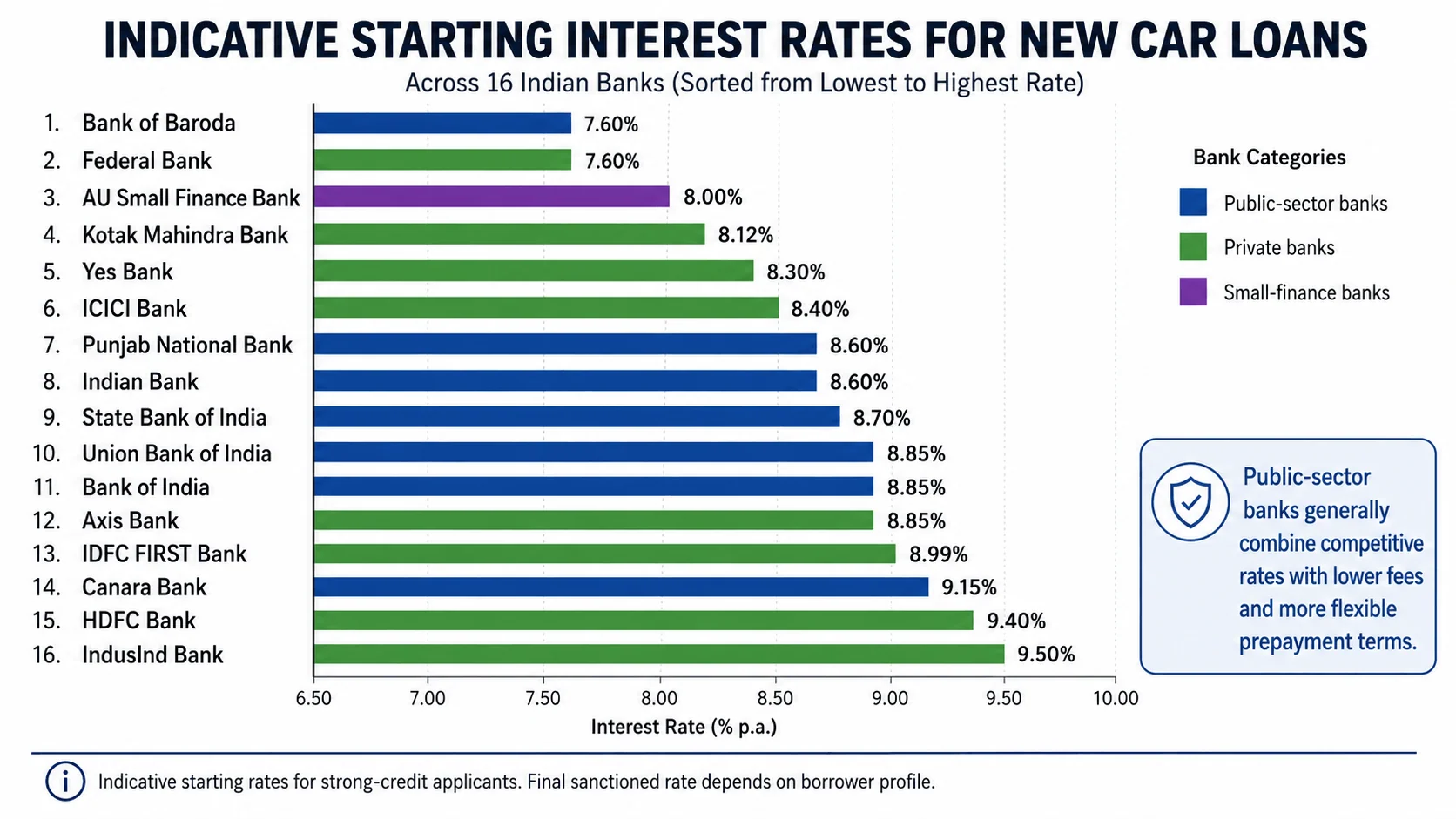
Car Loan Interest Rates by Bank (June 2026)
These are indicative starting rates for a new car and a strong credit profile (CIBIL 750+). Your real rate depends on a stack of things: your credit score, income, employer, loan size, tenure and the car itself. Always confirm the final number in your sanction letter before you sign.
| Bank | Interest Rate (p.a.) | Processing Fee | Max Tenure | Foreclosure / Prepayment | Best For |
|---|---|---|---|---|---|
| State Bank of India | 8.70%–9.85% (fixed) | ₹750–₹1,500 + GST | 7 yr | 3% within 24 months, nil after | Lowest-cost PSU, clean credit |
| Bank of Baroda | 7.60%–11.30% (floating) | ₹1,500–₹2,000 + GST | 7 yr | Nil on floating rate | Lowest total cost |
| Punjab National Bank | 8.60%–9.65% (floating) | 0.25%, max ₹1,500 | 7 yr | Nil on floating rate | Lowest processing fee |
| Canara Bank | 9.15%–11.95% (floating) | 0.25% (₹1,000–₹5,000), waived in festivals | 7 yr | Nil | Women and EV buyers |
| Union Bank of India | 8.85%–13.00% (floating) | 0.50%, max ₹10,000 | 7 yr | Nil on floating rate | EV buyers (fee waiver) |
| Bank of India | 8.85%–10.85% (floating) | Varies by scheme | 7 yr | Nil on floating rate | 100% ex-showroom funding |
| Indian Bank | 8.60%–12.90% (floating) | 0.50% (₹2,000–₹10,000) | 7 yr | Nil on floating rate | Salaried professionals |
| HDFC Bank | 9.40% onwards (fixed) | 0.50% (₹3,500–₹8,000) | 7 yr | 6% / 5% / 3% tiered | Speed, existing customers |
| ICICI Bank | 8.40% onwards (fixed) | Up to ₹9,000 | 7 yr | 3% within 24 months, nil after | Full funding, longer tenure |
| Axis Bank | 8.85%–11.70% (fixed) | ₹3,500–₹12,000 | 8 yr | 5% flat on principal | Axis salary-account holders |
| Kotak Mahindra | 8.12%–23.54% (fixed) | Up to 3% + ₹7,500 docs | 7 yr | 5.21% then 3% | Low headline, heavy fees |
| IDFC FIRST Bank | 8.99%–11.50% (fixed) | Up to ₹10,000 | 10 yr | 5% flat on principal | Long tenure, lower EMI |
| Federal Bank | 7.60%–9.00% (fixed) | 1.50%–2.50% + GST | 7 yr | 3% of outstanding | Low fixed rate (watch the fee) |
| Yes Bank | 8.30%–11.52% (fixed) | 1% of loan | 7 yr | 6% / 5% / 3% tiered | Urban salaried buyers |
| IndusInd Bank | 9.50%–18.00% (fixed) | Varies | 7 yr | 5% then 4% | Specialised / luxury funding |
| AU Small Finance Bank | 8.00%–17.00% (fixed) | Up to 2% | 7 yr | Terms apply | Mixed credit profiles |
One distinction runs through this whole table. Public sector banks mostly price on floating rates tied to the RBI repo rate, and regulation makes them drop foreclosure and part-payment penalties on those floating loans. Private banks mostly sell fixed rates, which lock your EMI but come with stiff exit penalties, often 3% to 6% of what you still owe. That single difference matters more than a 10 or 20 basis point gap in the rate, and we’ll come back to it.
Lowest Interest Rate Car Loans: Which Bank Is Cheapest?
If you sort purely by the lowest car loan rate of interest, the cheapest car loan bank list looks like this in 2026:
| Rank | Bank | Lowest Rate | Processing Fee | The Catch |
|---|---|---|---|---|
| 1 | Bank of Baroda | 7.60% (floating) | ₹1,500–₹2,000 + GST | Moves with the RBI repo rate, but nil foreclosure |
| 2 | Federal Bank | 7.60% (fixed) | 1.50%–2.50% + GST | A 2% fee on ₹8 lakh is ₹16,000 upfront |
| 3 | AU Small Finance | 8.00% (fixed) | Up to 2% | Top of the band runs to 17% for weaker profiles |
| 4 | Yes Bank | 8.30% (fixed) | 1% of loan | 6% foreclosure penalty in the first year |
| 5 | ICICI Bank | 8.40% (fixed) | Up to ₹9,000 | Only if your tenure is above 36 months |
| 6 | State Bank of India | 8.70% (fixed) | Max ₹1,500 + GST | Needs a CIBIL score near 800 for the floor |
Notice how two banks tie at 7.60% but get there very differently. Bank of Baroda’s rate floats with the repo, so it can rise if the RBI hikes, but it charges no penalty if you want to close the loan early. Federal Bank locks 7.60% for the full term, which sounds safer, until you see the 1.5% to 2.5% processing fee and a 3% foreclosure charge eating into that low rate.
This is exactly why the headline number lies. Let’s prove it with real maths.
The total cost test: why the lowest rate can be the costliest loan
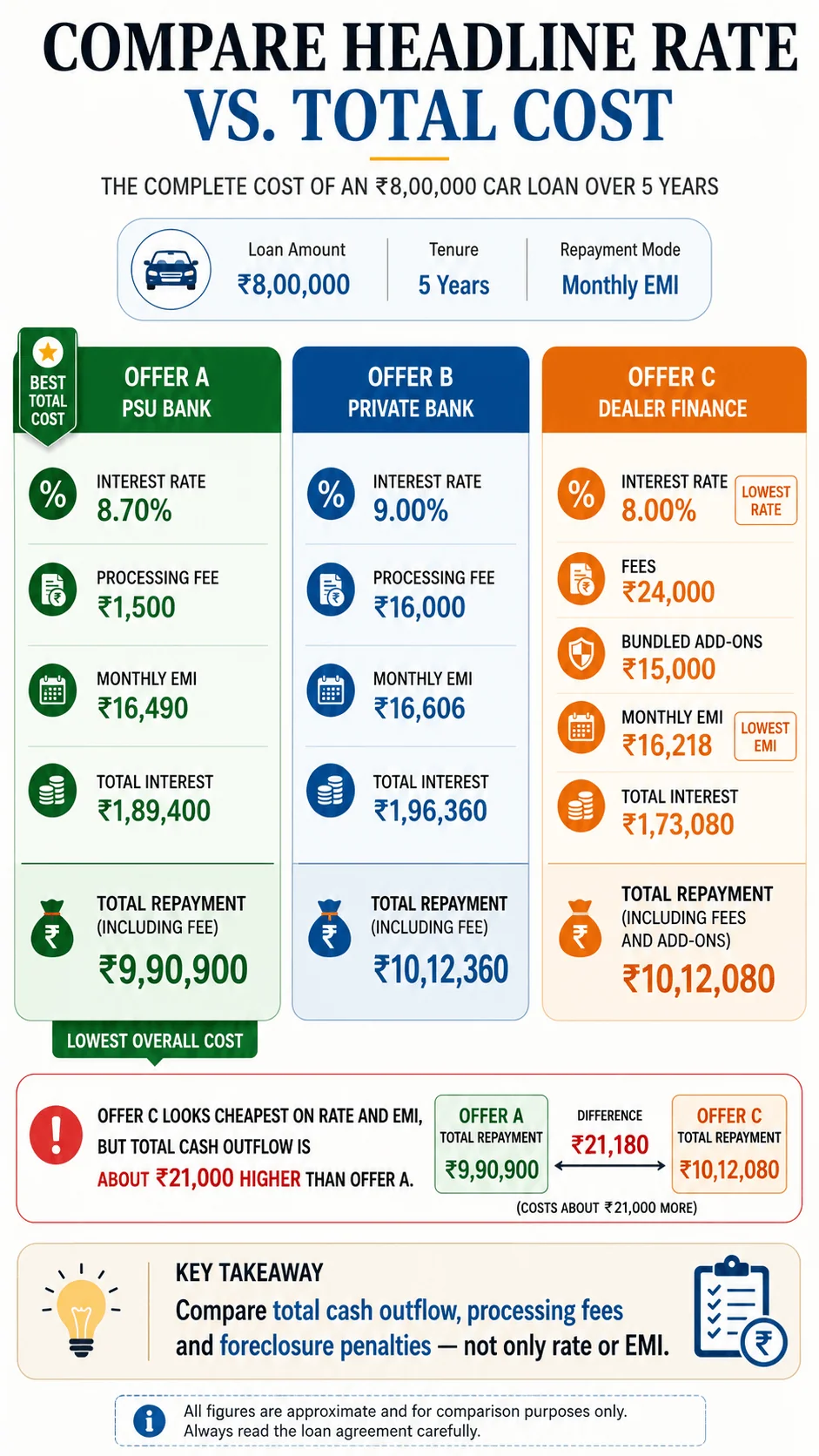
Take an ₹8 lakh loan over 5 years. Three lenders quote you three deals.
| Offer | Interest Rate | Fees | Monthly EMI | Total Interest | Total Cost |
|---|---|---|---|---|---|
| A (PSU bank) | 8.70% | ₹1,500 processing | ₹16,490 | ₹1,89,400 | ₹9,90,900 |
| B (Private bank) | 9.00% | ₹16,000 (2%) | ₹16,606 | ₹1,96,360 | ₹10,12,360 |
| C (Dealer finance) | 8.00% | ₹24,000 fee + ₹15,000 bundled add-ons | ₹16,218 | ₹1,73,080 | ₹10,12,080 |
Offer C has the lowest interest rate and the lowest EMI. At the dealership desk it looks like the obvious winner. But once you add the 3% processing fee and the accessories quietly rolled into the loan, it ends up costing about ₹21,000 more than the plain PSU loan in Offer A. Offer B looks worse on rate, yet its low fee keeps it close.
The lesson is simple: the cheapest loan is the one with the lowest total cash outflow, processing fee and exit penalties included, not the one with the smallest EMI on the dealer’s screen.
Public Sector vs Private Bank Rates
The two camps are built for different buyers. Here’s how they actually compare.
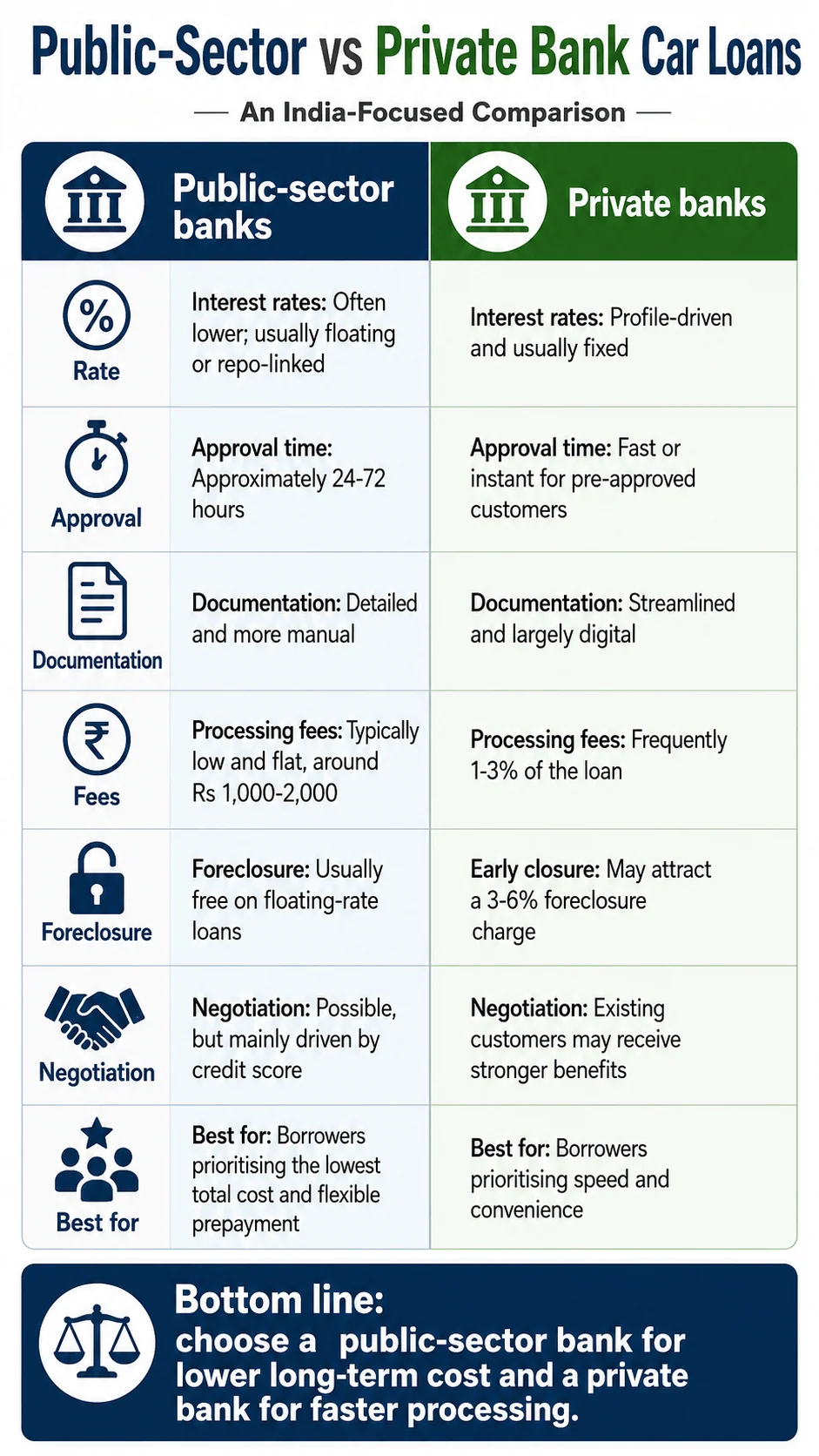
| Factor | Public Sector Banks | Private Banks |
|---|---|---|
| Interest rate | Often lower, usually floating (repo-linked) | Competitive but profile-driven, usually fixed |
| Processing speed | Moderate, 24 to 72 hours | Fast, sometimes instant for existing customers |
| Documentation | Detailed, more manual | Streamlined, largely digital |
| Processing fee | Low, often flat (₹1,000–₹2,000) | Higher, often a percentage (1% to 3%) |
| Foreclosure charges | Usually nil on floating loans | 3% to 6% on early closure |
| Negotiation | Possible, but score-driven | Strong if you’re an existing customer |
Public banks like SBI, Bank of Baroda, and PNB win on total cost for disciplined borrowers, especially anyone who plans to prepay using a bonus or a maturing deposit. They take longer and ask for more paperwork. Private banks like HDFC and ICICI win on speed and convenience, and they’re hard to beat if you bank with them already and just want the keys this weekend. Neither is “better” in the abstract. It depends on whether you value the lowest rupee or the fastest approval.
SBI vs HDFC Car Loan: Which Is Better?
This is the most common head-to-head, so it’s worth settling. SBI is the largest public lender, HDFC the largest private one, and they sit at opposite ends of the philosophy above.
| Factor | SBI Car Loan | HDFC Bank Car Loan |
|---|---|---|
| Interest rate | 8.70%–9.85% (tiered by CIBIL) | 9.40% onwards |
| Processing fee | ₹750–₹1,500 + GST | 0.50% (₹3,500–₹8,000) |
| Approval speed | Moderate, 24 to 48 hours | Instant for pre-approved, else a day |
| Foreclosure | 3% up to 24 months, then nil | 6% / 5% / 3% tiered through the term |
| Best for | Lowest long-term cost | Speed and convenience |
Go with SBI if you want the cheapest total cost and don’t mind the paperwork and the wait. Its lower rate, tiny flat fee, and zero foreclosure charge after two years make it the stronger pick for anyone who might close the loan early. Go with HDFC if you already bank there, need the money fast, or value the slicker digital process, and you’re fine running the loan to term. Just don’t choose HDFC expecting to prepay in year one, because that 6% penalty wipes out any rate you might have saved elsewhere.
Factors That Affect Your Interest Rate
Two borrowers, same bank, different rates. These are the levers that decide which slab you land in.
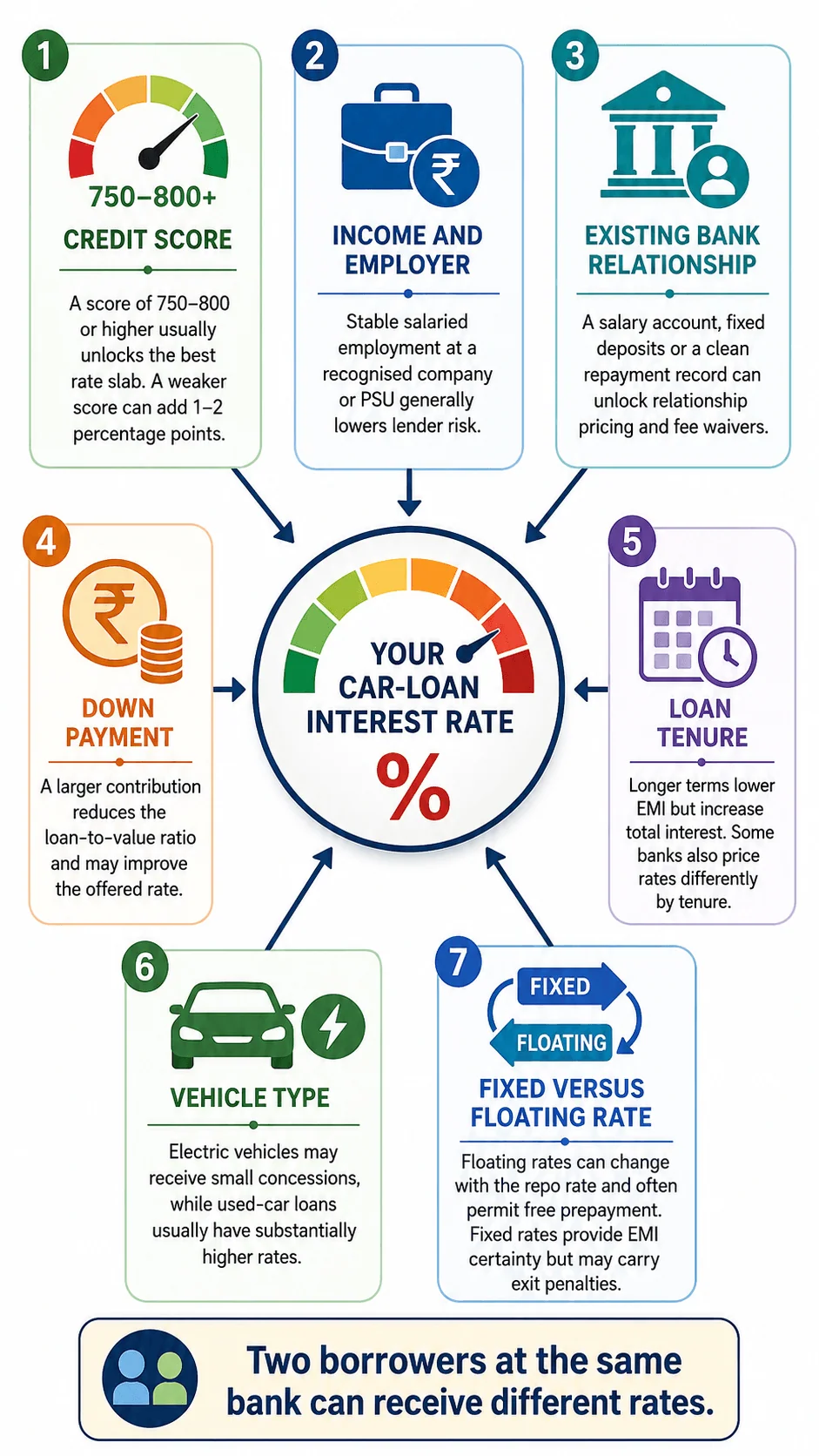
- Credit score. This is the big one. SBI gives its lowest rate to borrowers above 800. Drop to the 700 to 720 band and the same loan can cost close to 1% more, which on an ₹8 lakh loan is roughly ₹40,000 over five years. Check your CIBIL report a few months early and fix any errors before you apply.
- Income and employer. Banks rank employers into tiers. A salaried buyer at a large MNC or PSU usually gets a better rate than a self-employed applicant with the same income, simply because the cash flow looks more predictable.
- Existing relationship. A salary account, fixed deposits, or a clean home loan record with the bank often unlocks a quiet “loyalty” discount, and it’s your strongest card for getting the processing fee waived.
- Down payment. A bigger down payment lowers the loan-to-value ratio and the bank’s risk, which gives you room to push for a lower rate. Working out the right amount is its own decision, and our down payment strategy guide walks through the trade-off.
- Tenure. A longer tenure cuts your EMI but adds a lot of interest. Some banks also price by term. ICICI, for instance, offers 8.40% above 36 months but jumps to 10.25% for shorter loans, because a quick payoff earns it less.
- The car itself. Electric vehicles get a 5 to 25 basis point concession at most banks, and schemes like SBI’s Green Car Loan and Bank of Baroda’s bob Green Wheel add zero processing fees and up to 100% on-road funding. Used cars go the other way, typically 11% to 18%, because they’re harder to value.
- Fixed vs floating. Floating rates follow the repo and usually allow free prepayment. Fixed rates lock your EMI but carry exit penalties. Pick based on whether certainty or flexibility matters more to you.
How to Get the Lowest Rate on Your Car Loan
Treat the loan the way you’d treat the car. Shop it around, ask hard questions, and never take the first quote at face value. Here’s the order that works.
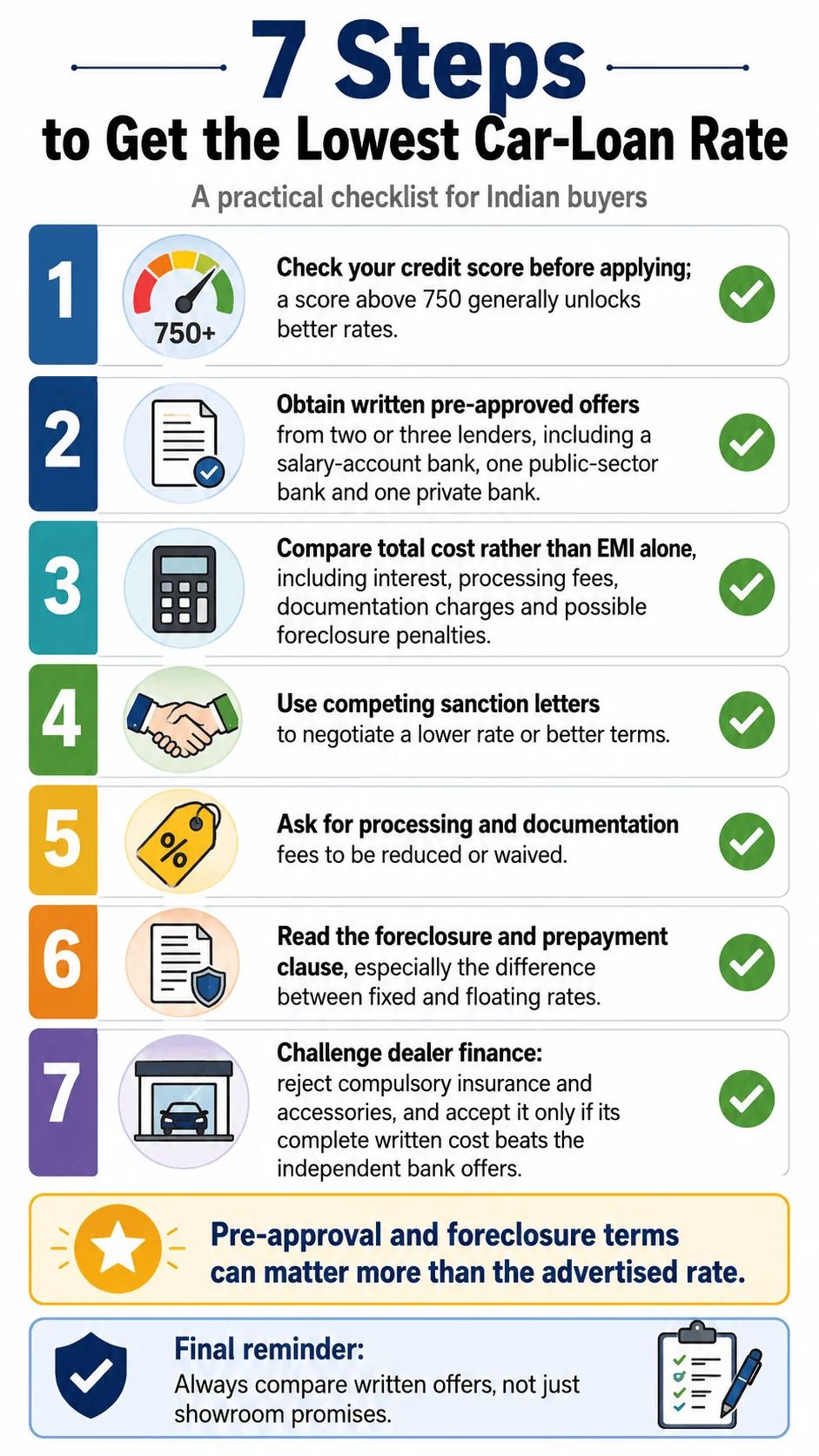
- Check your credit score first. Pull your CIBIL or Experian report before you set foot in a showroom. A 750+ score puts you in the best slab. Avoid firing off multiple applications at once, because each hard inquiry chips away at the score.
- Get two or three pre-approvals. Start with the bank that holds your salary account, then add one PSU and one private bank. Written offers give you a real baseline and something to bargain with.
- Compare total cost, not EMI. Add it up properly: total interest, plus processing fee, plus documentation charges, plus any foreclosure cost you might trigger later. Run the numbers through an EMI calculator so you’re comparing like with like.
- Use the quotes against each other. Show one bank another’s sanction letter. “Bank A has offered me 8.70% with a waived fee, can you match it?” Branch managers chasing monthly targets often will. Our full playbook on how to get the best loan deal goes deeper on this.
- Negotiate the processing fee. If the rate won’t budge, the fee usually will. It’s the most flexible part of any loan, and a waiver during a festive season saves you thousands upfront.
- Read the foreclosure clause. If you expect a bonus or a windfall that could close the loan early, the prepayment and foreclosure rules matter far more than a tiny gap in the headline rate. A floating PSU loan with nil charges beats a fixed loan with a 5% exit fee here every time.
- Watch the dealer finance desk. Dealers earn a commission for steering you to their preferred bank, so their “special” rate may not be special at all. Walk in with a pre-approved loan, behave like a cash buyer, and reject bundled insurance or accessories rolled into the principal. Get every promised number in writing on the sanction letter, never on a verbal assurance.
Car Loan Interest Rate FAQs
Which bank gives the cheapest car loan in India? On rate alone, Bank of Baroda and Federal Bank lead in 2026 at around 7.60%, with SBI close behind from 8.70%. But the genuinely cheapest loan pairs a low rate with a small fee and no foreclosure penalty, which is where repo-linked PSU loans from Bank of Baroda or SBI usually come out ahead once you add everything up.
What is the car loan interest rate in India in 2026? New car loans run from about 7.60% to 11.50% for most buyers, depending on the bank, your credit score, and the tenure. Used car loans sit higher, usually 11% to 18%, because the car is harder to value and depreciates faster.
SBI vs HDFC car loan rate, which is better? SBI is cheaper overall: rates from 8.70%, a flat fee capped at ₹1,500, and no foreclosure charge after two years. HDFC starts higher at 9.40% and uses tiered exit penalties of 3% to 6%, but it approves faster and suits existing customers. If total cost matters most, pick SBI. If speed matters most, pick HDFC.
Can I negotiate the car loan interest rate? Yes. A strong credit score and competing written offers give you real bargaining room. Even when the rate is fixed by the bank’s grid, you can almost always get the processing and documentation fees reduced or waived, especially during festive offers or if you hold a salary account there.
What credit score do I need for the lowest car loan rate? A CIBIL score of 750 to 800 or above gets you the best slab. The 700 to 749 band still qualifies for competitive rates but a little higher, and below 700 you’ll usually pay a 1% to 2% premium, if you’re approved at all.
Which bank has the lowest processing fee? Public sector banks lead here. PNB caps its fee at ₹1,500, SBI at ₹1,500 + GST, and Canara Bank waives it entirely during its retail loan festivals. Several private banks charge 1% to 3% of the loan instead, which adds up fast on a large amount.
Are there foreclosure charges on car loans? It depends on the lender and rate type. Public sector banks waive foreclosure charges on floating-rate loans, and most drop them after 24 months even on fixed loans. Private banks usually charge 3% to 6% of the outstanding principal if you close early, so check this clause before you sign.
Is dealer finance cheaper than a bank loan? Sometimes the headline rate is, especially during a manufacturer subvention scheme. But dealers often recover the gap through bundled insurance, accessories, or a higher effective rate. Always benchmark the dealer’s quote against an independent bank pre-approval before agreeing.
Are used car loan interest rates higher? Yes, by roughly 3% to 6%. Lenders price in the harder valuation and faster depreciation of a used car, so rates that start near 8% for a new car often start around 11% to 14% for a used one.
Does the down payment affect my interest rate? Indirectly, yes. A bigger down payment lowers the loan-to-value ratio and the bank’s risk, which gives you room to push for a lower rate. It also shrinks the principal, so you pay less total interest regardless.
Should I choose a low EMI or low total interest? Aim for low total interest. A low EMI usually just means the loan has been stretched over seven or even ten years, and you end up paying far more interest overall. Pick the shortest tenure your monthly budget can comfortably handle.
Every rate and fee in this comparison was checked against official bank pages in June 2026. Car loan pricing changes often and depends on your individual profile, so confirm the final terms with the lender before you apply.