
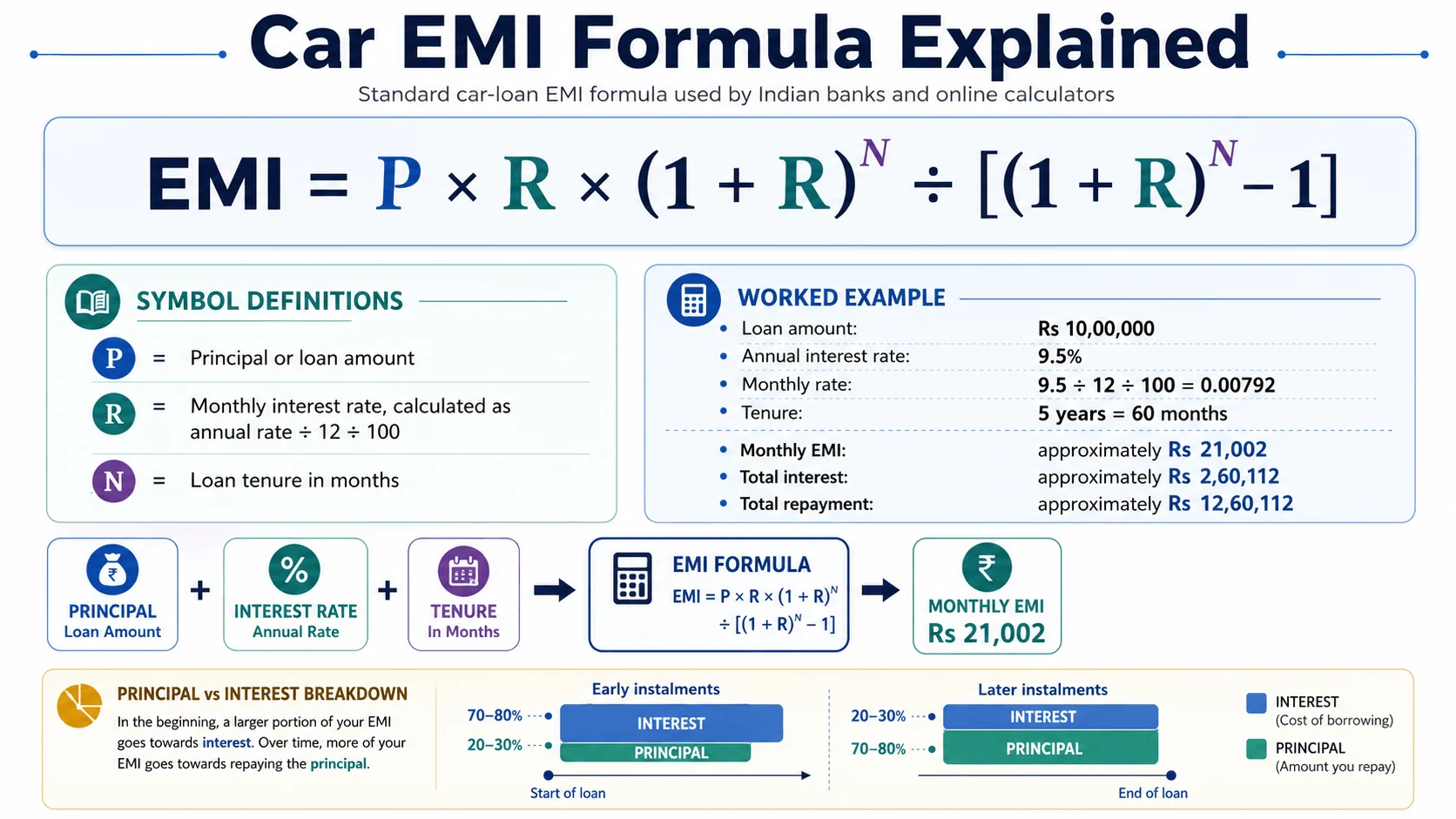
Your car loan EMI is worked out with one standard formula:
EMI = P × R × (1 + R)^N ÷ [(1 + R)^N − 1]
Where P is your loan amount, R is the monthly interest rate (annual rate ÷ 12 ÷ 100), and N is the tenure in months. So for a ₹10 lakh loan at 9.5% for 5 years, the EMI works out to about ₹21,002 a month, with roughly ₹2.6 lakh paid as interest over the full term.
Here’s a quick car loan EMI table you can use right away, at 9.5% interest:
| Loan amount | Tenure | Approx EMI | Total interest |
|---|---|---|---|
| ₹5 lakh | 5 years | ₹10,501 | ₹1,30,056 |
| ₹8 lakh | 5 years | ₹16,801 | ₹2,08,089 |
| ₹10 lakh | 5 years | ₹21,002 | ₹2,60,112 |
| ₹15 lakh | 5 years | ₹31,503 | ₹3,90,168 |
That’s the short answer. The rest of this guide shows you how the car EMI formula actually works, gives you ready-made EMI tables for every common loan size and tenure, and explains the things that quietly change your EMI before you sign, like flat versus reducing rates and processing fees. You’ll be able to estimate your own EMI without touching an online calculator.
A quick note on the rates used here: EMI examples in this guide assume a representative 9.5% per annum. That’s a fair middle-of-the-road number for 2026. Your actual rate could be lower if you have a strong credit score and bank with a public sector lender, or higher if you go through a dealer or an NBFC. Always plug in your own sanctioned rate before you finalise anything.
Car EMI Calculator Formula
Every bank and online EMI calculator in India runs on the same maths. The car EMI formula is:
EMI = P × R × (1 + R)^N ÷ [(1 + R)^N − 1]
| Symbol | Meaning | Example |
|---|---|---|
| P | Principal (your loan amount) | ₹10,00,000 |
| R | Monthly interest rate | Annual rate ÷ 12 ÷ 100 |
| N | Tenure in months | 5 years = 60 months |
EMI stands for Equated Monthly Instalment, the fixed amount you pay your lender every month until the loan is cleared. Each instalment is made up of two parts: a chunk that goes toward repaying the principal, and a chunk that pays the interest. The total stays the same every month on a fixed-rate loan. But the split keeps shifting. In the early months your balance is highest, so most of your EMI goes on interest. As you chip away at the principal, that flips. By the last year, you’re paying mostly principal and barely any interest.
Almost all car loans in India are fixed-rate, so your EMI doesn’t move once the loan is disbursed. Floating-rate car loans exist but are rare. With those, if the RBI repo rate or the bank’s lending rate changes, the bank usually adjusts either your EMI or your tenure to absorb the difference.
Convert the annual rate to a monthly rate first
This is where most manual calculations go wrong. Banks always advertise an annual interest rate, but the formula needs a monthly rate. To get it, divide the annual rate by 12, then by 100.
So at 9.5% per annum:
Monthly rate (R) = 9.5 ÷ 12 ÷ 100 = 0.00792
That decimal is what goes into the formula. Skip this step and your EMI will come out wildly wrong.
Reducing balance vs flat rate: check which one you’re quoted
Here’s something most calculator pages skip, and it can cost you over ₹70,000. There are two ways a lender can charge interest, and they are not the same thing.
A reducing balance rate charges interest only on what you still owe. As you pay down the principal each month, the interest shrinks too. Every bank loan and the formula above use reducing balance.
A flat rate charges interest on the full loan amount for the entire tenure, even though your actual balance keeps falling. Some dealers and NBFCs quote flat rates because the number sounds smaller.
Look at what that does to an ₹8 lakh loan over 5 years:
| Type of rate | Quoted rate | EMI | Total interest |
|---|---|---|---|
| Bank, reducing balance | 9.5% | ₹16,801 | ₹2,08,089 |
| Dealer, flat | 7% | ₹18,000 | ₹2,80,000 |
The 7% flat loan sounds cheaper than the 9.5% bank loan. It isn’t. A 7% flat rate is actually equal to roughly 12.5% on a reducing balance basis, and it costs you about ₹72,000 more in interest on the same loan. So before you compare two offers, make sure both are reducing-balance numbers. If a salesperson quotes you a low “flat” rate, that’s your cue to ask for the reducing-balance equivalent.
How to Calculate Car EMI
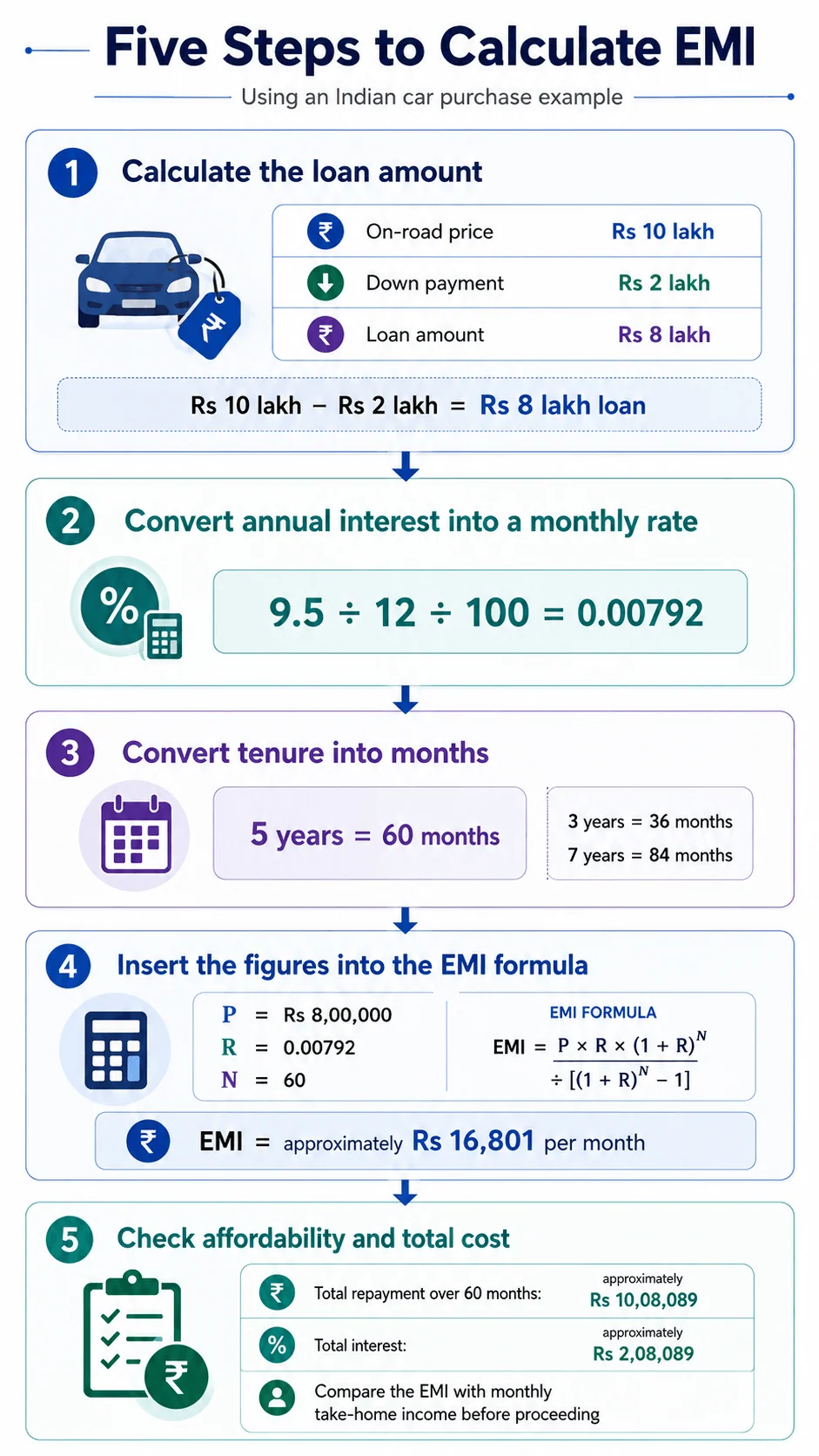
You can work out your EMI in five steps. Let’s go through them with a real example: an ₹8 lakh loan at 9.5% over 5 years.
Step 1: Find your loan amount
Banks don’t lend on the ex-showroom price. They look at the on-road price, which includes road tax, registration, insurance and FASTag, then fund 80% to 90% of it. Your loan is whatever’s left after your down payment.
Loan amount = On-road price − Down payment
If you’re fuzzy on this part, it’s worth understanding the difference between ex-showroom and on-road price first, because working out your EMI on the ex-showroom figure is the single most common mistake people make. Say the on-road price is ₹10 lakh and you put down ₹2 lakh. Your loan is ₹8 lakh.
Step 2: Turn the annual rate into a monthly rate
Divide the annual rate by 12, then by 100. At 9.5%, that’s 9.5 ÷ 12 ÷ 100 = 0.00792.
Step 3: Convert your tenure into months
| Tenure | Months |
|---|---|
| 3 years | 36 |
| 5 years | 60 |
| 7 years | 84 |
Step 4: Put the numbers into the formula
Take our ₹8 lakh loan at 9.5% for 5 years:
- P = ₹8,00,000
- R = 0.00792
- N = 60
First work out (1 + R)^N, which is (1.00792)^60 = about 1.605. Then:
EMI = 8,00,000 × 0.00792 × 1.605 ÷ (1.605 − 1) = about ₹16,801 a month.
Over 60 months you’ll pay roughly ₹10.08 lakh in total, which means about ₹2.08 lakh of that is pure interest on top of the ₹8 lakh you borrowed.
Step 5: Check it against what you can afford
A lower EMI feels good, but it usually means a longer tenure and more interest. Always weigh three numbers together: the monthly EMI, the total interest, and the total repayment. A car loses value every year, so stretching the loan too long can leave you owing more than the car is worth. More on that affordability check further down.
EMI Comparison: Different Loan Amounts
This is the part you can treat as your own calculator. The tables below cover the loan sizes most Indian buyers actually take, across the three common tenures, all at 9.5%. Find your loan amount, pick a tenure, and you have your EMI.
| Loan amount | EMI (3 years) | EMI (5 years) | EMI (7 years) |
|---|---|---|---|
| ₹5 lakh | ₹16,016 | ₹10,501 | ₹8,172 |
| ₹8 lakh | ₹25,626 | ₹16,801 | ₹13,075 |
| ₹10 lakh | ₹32,033 | ₹21,002 | ₹16,344 |
| ₹15 lakh | ₹48,049 | ₹31,503 | ₹24,516 |
The EMI is only half the story though. The longer you take to repay, the more interest you hand over. Here’s the total interest for those exact same loans:
| Loan amount | Interest (3 years) | Interest (5 years) | Interest (7 years) |
|---|---|---|---|
| ₹5 lakh | ₹76,593 | ₹1,30,056 | ₹1,86,447 |
| ₹8 lakh | ₹1,22,549 | ₹2,08,089 | ₹2,98,316 |
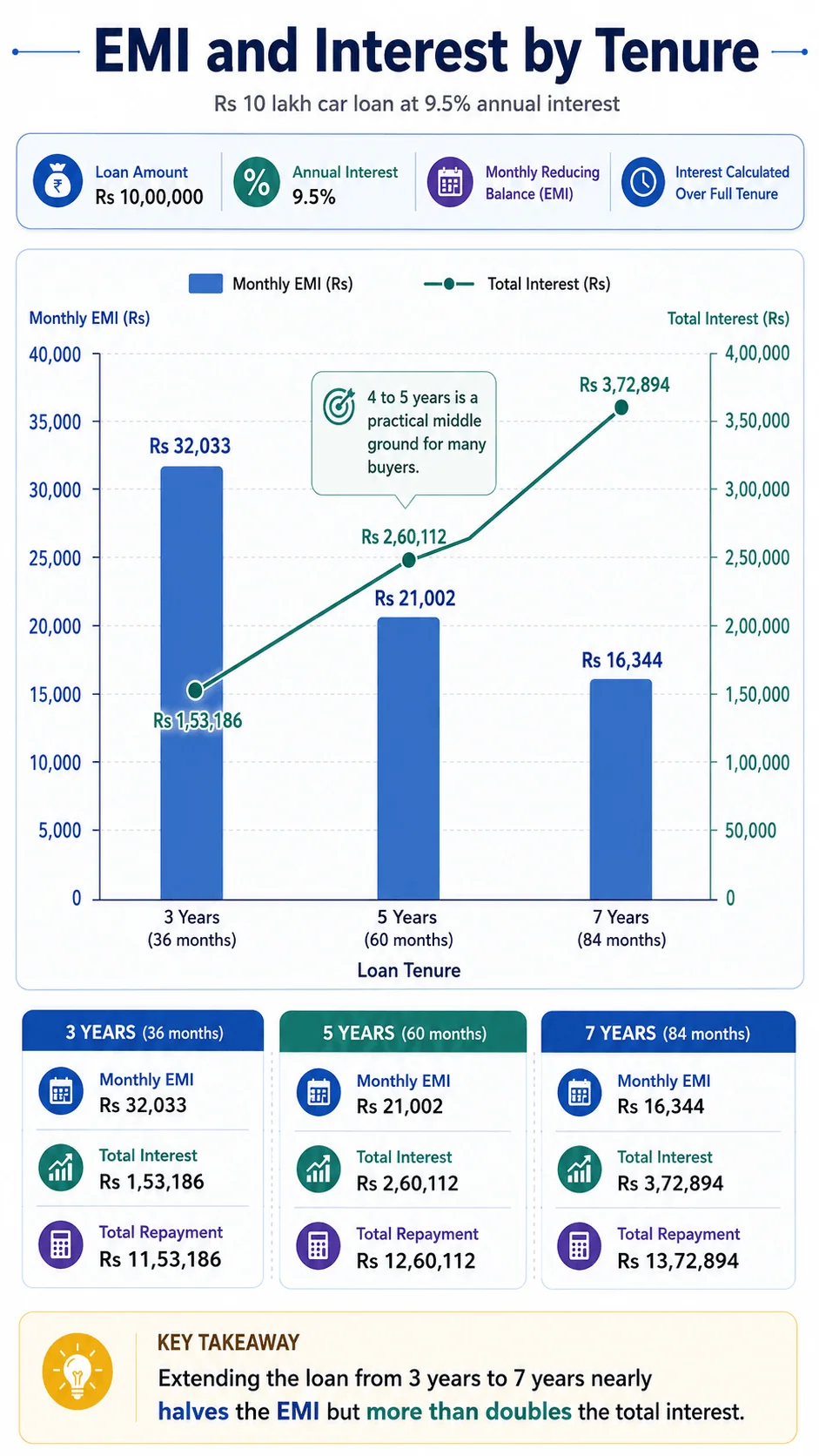
| ₹10 lakh | ₹1,53,186 | ₹2,60,112 | ₹3,72,894 |
| ₹15 lakh | ₹2,29,779 | ₹3,90,168 | ₹5,59,342 |
Look at the ₹10 lakh row. A 3-year loan costs you about ₹1.53 lakh in interest. Stretch it to 7 years and that jumps to ₹3.73 lakh, more than double, just to bring the EMI down from ₹32,000 to ₹16,344. That lower EMI is tempting, but you’re paying a steep price for it.
So what’s the right call? For most buyers, a 4 to 5 year tenure is the sweet spot. It keeps the EMI manageable without bleeding you on interest. A 7-year loan only makes sense if your monthly budget is genuinely tight and you fully understand that you’re paying a lot more overall. Don’t pick a long tenure just because the EMI looks comfortable on a spreadsheet.
Factors That Affect Your EMI
The EMI a calculator spits out isn’t random. A handful of things decide it. Which ones can you actually control? More than you’d think, once you know what each one does.
1. Loan amount. The more you borrow, the higher the EMI. No way around that one. The same car bought with a ₹1 lakh down payment versus a ₹3 lakh down payment gives you very different EMIs, because the loan itself is different. This is why a healthy down payment matters so much.
2. Interest rate. Even half a percent changes your total cost meaningfully over five years. Here’s a ₹10 lakh loan over 5 years at different rates:
| Interest rate | EMI | Total interest |
|---|---|---|
| 8.5% | ₹20,517 | ₹2,30,992 |
| 9.5% | ₹21,002 | ₹2,60,112 |
| 10.0% | ₹21,247 | ₹2,74,823 |
| 11.0% | ₹21,742 | ₹3,04,545 |
Going from 8.5% to 11% adds over ₹73,000 to your interest bill on the same loan. Your rate depends on the lender, your credit profile, and the type of car. New cars from banks typically sit around 8.5% to 11.5%. Electric vehicles often get a small discount through green car loan schemes (SBI’s EV loan, for instance, starts around 8.80%). Used cars cost more, usually 10.5% upwards. It pays to check the current interest rates across a few banks before you commit.
3. Loan tenure. A longer tenure lowers your EMI but raises your total interest, as the tables above showed. There’s no free lunch here: you either pay more each month or more overall.
| Tenure | EMI (₹10 lakh at 9.5%) | Total interest |
|---|---|---|
| 3 years | ₹32,033 | ₹1,53,186 |
| 5 years | ₹21,002 | ₹2,60,112 |
| 7 years | ₹16,344 | ₹3,72,894 |
4. Down payment. Yes, a bigger down payment reduces your EMI, because it directly shrinks the loan. It also cuts your total interest, and a lower loan-to-value ratio sometimes earns you a slightly better rate too. This is worth planning properly, and our guide on down payment strategy walks through how much to put down.
5. Processing fee and other charges. These don’t change the EMI formula, but they add to what the loan actually costs you. Public sector banks like SBI charge around 0.40% of the loan (minimum ₹1,000, capped at ₹7,500) plus 18% GST. Private banks like HDFC and ICICI charge roughly 0.5% to 1%. One thing buyers often miss: that 18% GST applies only to the fee, never to your principal or your interest. On an ₹8 lakh loan, SBI’s processing fee comes to about ₹3,200 plus ₹576 GST, so ₹3,776 in all. Not huge, but worth factoring in. If the lender adds the fee to your loan instead of taking it upfront, your EMI ticks up slightly.
6. Credit score. Your CIBIL score quietly sets your rate. Score above 750 and you’ll be offered the lowest rates, which directly lowers your EMI. Drop below 700 and you’ll pay a premium, or risk rejection.
There’s also a smaller wrinkle worth knowing. Some lenders offer an “advance EMI” option where your first instalment is collected upfront, on day one, before any interest accrues. It shaves the headline EMI a touch but demands more cash at the start. The standard “arrears” structure, where your first EMI falls one month after disbursement, needs less money upfront and is what most buyers go with.
Tips to Reduce Your Car EMI
A few deliberate moves before you sign can shave thousands off your monthly payment and your total interest.
- Put down more upfront. This is the single most effective lever. Every extra rupee of down payment is a rupee you don’t pay interest on. Just don’t drain your emergency fund to do it.
- Be careful with long tenures. A 7-year loan lowers the EMI but balloons the interest. If you do stretch it, pick a lender with cheap or zero prepayment rules so you can pay it off faster when your income grows.
- Negotiate the rate. Quoted rates aren’t final. A good credit score, a salary account relationship, or a rival pre-approved offer all give you room to push the rate down.
- Compare banks and NBFCs, not just the dealer. Dealers earn commissions on the loans they push, so their offer is rarely the cheapest. Checking two or three lenders is the easiest way to land the best car loan deal. Compare the rate, the processing fee, and the foreclosure terms together.
- Don’t finance the accessories. Add extended warranties, seat covers and ceramic coating to the loan and you’ll pay interest on them for years. Better to cover the extras in cash if you can.
- Buy the right car. A lower price means a smaller loan. Don’t stretch to a top variant just because the EMI “fits.” Remember fuel, insurance, servicing and tyres all stack on top of the EMI.
| Tip | Effect on EMI | Watch out for |
|---|---|---|
| Higher down payment | Lower EMI and interest | Keep an emergency buffer |
| Longer tenure | Lower EMI | Much higher total interest |
| Lower interest rate | Lower EMI and interest | Needs negotiation and good credit |
| Smaller loan amount | Lower EMI | Pick a realistic budget |
| No add-ons in the loan | Smaller loan | Pay for extras in cash |
EMI Calculation Examples
Let’s calculate car EMI across the four loan sizes most buyers fall into, each at 9.5% over 3, 5 and 7 years, so you can see how the numbers behave at every level.
Example 1: ₹5 lakh car loan
Typical for a first-time buyer picking up an entry hatchback, or anyone making a large down payment on a mid-range car.
| Tenure | EMI | Total repayment | Total interest |
|---|---|---|---|
| 3 years | ₹16,016 | ₹5,76,593 | ₹76,593 |
| 5 years | ₹10,501 | ₹6,30,056 | ₹1,30,056 |
| 7 years | ₹8,172 | ₹6,86,447 | ₹1,86,447 |
Even on a small loan, the 7-year option more than doubles the interest versus 3 years. If you can manage the higher EMI, the shorter term saves you real money.
Example 2: ₹8 lakh car loan
The most common bracket. It covers premium hatchbacks, compact SUVs and mid sedans priced around ₹10 to ₹12 lakh on-road, after a 20% to 30% down payment.
| Tenure | EMI | Total repayment | Total interest |
|---|---|---|---|
| 3 years | ₹25,626 | ₹9,22,549 | ₹1,22,549 |
| 5 years | ₹16,801 | ₹10,08,089 | ₹2,08,089 |
| 7 years | ₹13,075 | ₹10,98,316 | ₹2,98,316 |
For most salaried buyers here, the 5-year term is the practical pick: an EMI near ₹16,800 while keeping interest around ₹2 lakh.
Example 3: ₹10 lakh car loan
What is the EMI for a ₹10 lakh car loan? At around 9.5%, it’s roughly ₹32,033 for 3 years, ₹21,002 for 5 years, or ₹16,344 for 7 years. Your exact figure depends on your final rate and fees.
| Tenure | EMI | Total repayment | Total interest |
|---|---|---|---|
| 3 years | ₹32,033 | ₹11,53,186 | ₹1,53,186 |
| 5 years | ₹21,002 | ₹12,60,112 | ₹2,60,112 |
| 7 years | ₹16,344 | ₹13,72,894 | ₹3,72,894 |
A ₹21,000 monthly commitment is where many buyers pause and either rethink the variant or save up a bigger down payment first. That’s a healthy instinct.
Example 4: ₹15 lakh car loan
This is premium territory: full-size SUVs, executive sedans and higher-end EVs.
| Tenure | EMI | Total repayment | Total interest |
|---|---|---|---|
| 3 years | ₹48,049 | ₹17,29,779 | ₹2,29,779 |
| 5 years | ₹31,503 | ₹18,90,168 | ₹3,90,168 |
| 7 years | ₹24,516 | ₹20,59,342 | ₹5,59,342 |
Stretch a ₹15 lakh loan to 7 years and you pay over ₹5.5 lakh in interest alone. Worth asking whether you’re buying the car or the badge before you sign up for that.
Down payment scenarios
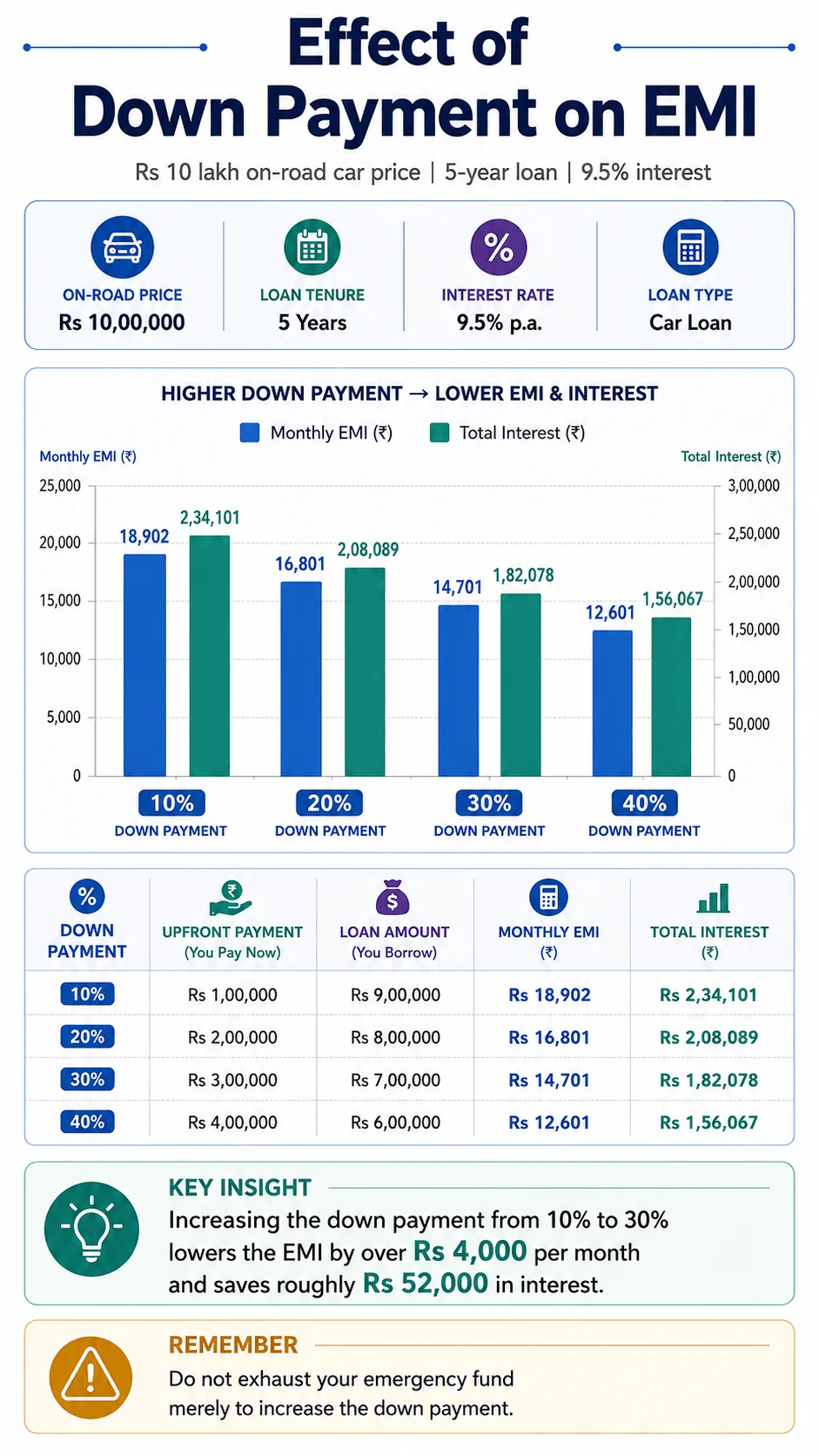
Down payment is the lever you control most directly. Here’s how it plays out on a ₹10 lakh on-road car at 9.5% over 5 years:
| Down payment | Loan amount | EMI (5 years) | Total interest |
|---|---|---|---|
| 10% (₹1 lakh) | ₹9 lakh | ₹18,902 | ₹2,34,101 |
| 20% (₹2 lakh) | ₹8 lakh | ₹16,801 | ₹2,08,089 |
| 30% (₹3 lakh) | ₹7 lakh | ₹14,701 | ₹1,82,078 |
| 40% (₹4 lakh) | ₹6 lakh | ₹12,601 | ₹1,56,067 |
Going from a 10% to a 30% down payment drops your EMI by over ₹4,000 a month and saves you ₹52,000 in interest. And if you want to see the EMI for the same 20% down payment across different car prices:
| On-road price | Loan after 20% down | EMI (5 years) |
|---|---|---|
| ₹5 lakh | ₹4 lakh | ₹8,401 |
| ₹8 lakh | ₹6.4 lakh | ₹13,441 |
| ₹10 lakh | ₹8 lakh | ₹16,801 |
| ₹15 lakh | ₹12 lakh | ₹25,202 |
EMI Affordability Rule
Knowing your EMI is one thing. Knowing whether you can comfortably carry it is another. A simple rule keeps most people out of trouble: keep your car EMI within 10% to 15% of your monthly take-home pay, especially if you already pay rent or other EMIs.
| Monthly take-home | Comfortable EMI range | Keep in mind |
|---|---|---|
| ₹50,000 | ₹5,000 – ₹7,500 | Tight cash flow leaves no room for surprises |
| ₹75,000 | ₹7,500 – ₹11,250 | Keep an emergency buffer intact |
| ₹1,00,000 | ₹10,000 – ₹15,000 | Budget for insurance and fuel on top |
| ₹1,50,000 | ₹15,000 – ₹22,500 | A bigger car is fine, just don’t max out eligibility |
Lenders look at this too, through something called FOIR, your fixed obligations to income ratio. Add up your rent and all your EMIs, and most banks want that total to stay under about 50% of your gross income. Cross it and you risk a higher rate or an outright rejection.
The bigger point is this: your EMI is not the full cost of owning a car. Fuel, insurance renewals, servicing, tyres, parking and tolls all come on top. Just because the bank will lend you the maximum doesn’t mean you should take it.
Common Car EMI Calculator Mistakes
Even with a calculator in hand, people trip over the same few things:
- Using the ex-showroom price instead of the on-road price. The on-road figure is lakhs higher once tax, registration and insurance are added. Calculate on that, or you’ll badly underestimate your loan and EMI.
- Forgetting to subtract the down payment. Enter the full car price without removing your down payment and the EMI comes out inflated.
- Ignoring the processing fee and charges. They don’t change the EMI maths, but they’re real money out of your pocket.
- Chasing the lowest EMI. A long tenure makes the monthly number look friendly while quietly piling on interest.
- Not comparing rates across lenders. Accepting the dealer’s in-house finance without checking a couple of banks can cost you thousands.
- Confusing a flat rate with a reducing rate. A “low” flat rate is usually far more expensive than it sounds. Always compare reducing-balance numbers.
- Treating the advertised rate as guaranteed. Headline rates are for top credit scores. Your sanctioned rate may be higher, so build in a small buffer.
FAQs
How do I calculate car EMI? Use the formula EMI = P × R × (1 + R)^N ÷ [(1 + R)^N − 1], where P is your loan, R is the monthly rate (annual rate ÷ 12 ÷ 100) and N is the tenure in months. Or just use the ready-made tables above: find your loan amount and tenure, and read off the EMI.
What is the EMI formula for a car loan? EMI = P × R × (1 + R)^N ÷ [(1 + R)^N − 1]. P is the principal, R the monthly interest rate as a decimal, and N the number of monthly instalments.
What is the EMI for a ₹10 lakh car loan? At around 9.5% interest, roughly ₹32,033 a month for 3 years, ₹21,002 for 5 years, or ₹16,344 for 7 years. The exact EMI depends on your final sanctioned rate and any fees.
Does a higher down payment reduce EMI? Yes. A bigger down payment lowers the loan amount, which directly reduces both your monthly EMI and the total interest you pay. On a ₹10 lakh car, moving from a 10% to a 30% down payment cuts the EMI by over ₹4,000 a month.
How does loan tenure affect my car EMI? A shorter tenure means a higher EMI but less total interest. A longer tenure means a lower EMI but a lot more interest. On a ₹10 lakh loan, going from 3 to 7 years more than doubles the interest you pay.
Is 5 years a good tenure for a car loan? For most buyers, yes. A 4 to 5 year term balances a manageable EMI against reasonable total interest, without the heavy interest cost of a 7-year loan.
What interest rate should I use to calculate car EMI? Use your lender’s annual rate, converted to monthly. New car loans from banks in 2026 typically run from about 8.5% to 11.5%, with the lowest rates reserved for strong credit scores.
Does the processing fee change my EMI? Not directly. It’s usually paid upfront or deducted from the disbursal. If the lender adds it to your loan instead, your EMI rises slightly. Either way, the 18% GST applies only to the fee, never to your principal or interest.
Is car EMI calculated on the ex-showroom or on-road price? On the loan amount, which is the on-road price minus your down payment. Banks assess your eligibility on the on-road price, then fund 80% to 90% of it.
Which is better, a lower EMI or lower total interest? Lower total interest saves you more money. A low EMI usually just means a longer loan and a bigger interest bill. If you can afford a slightly higher EMI on a shorter term, you’ll come out ahead.