
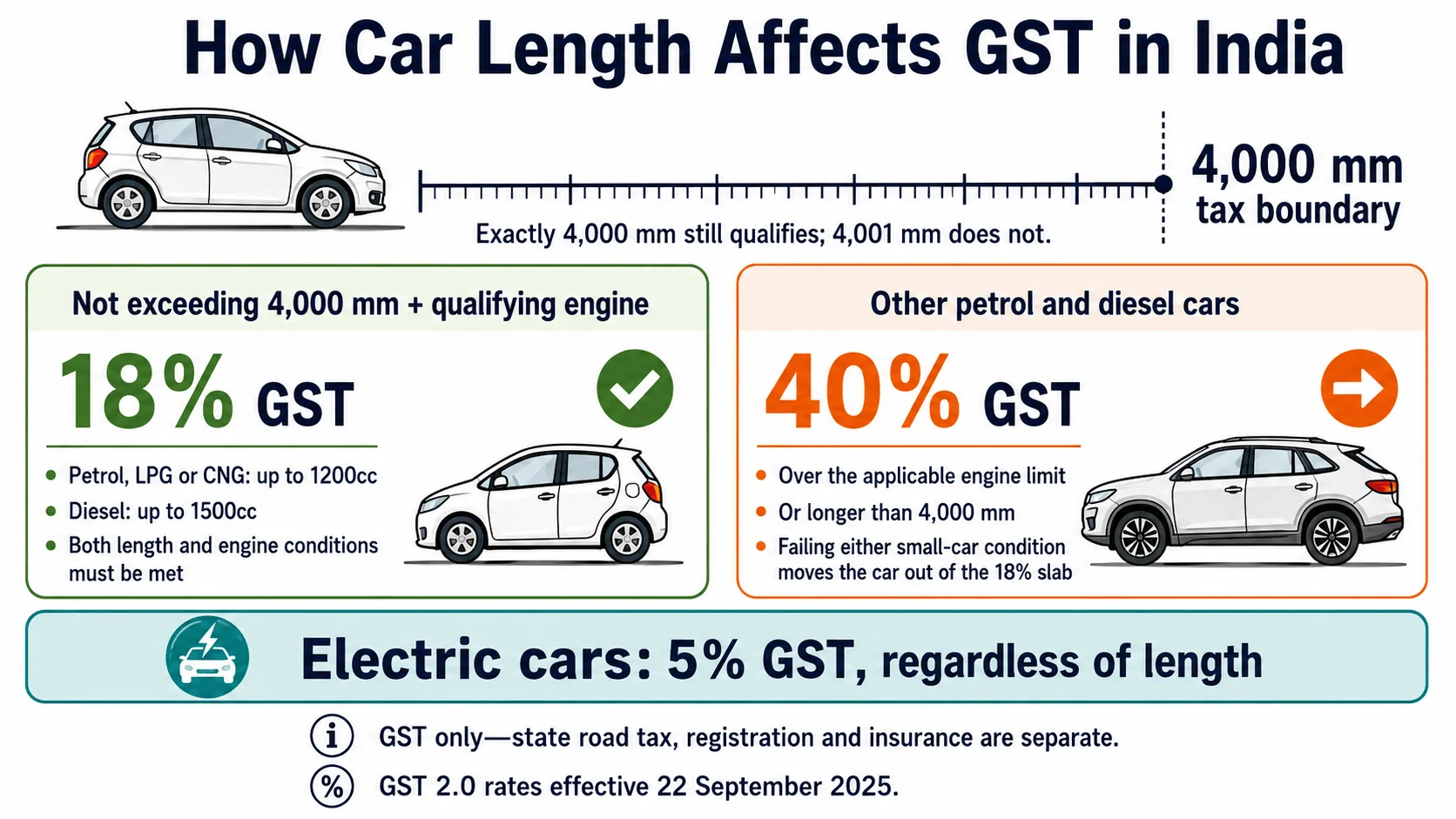
A car’s length changes the tax you pay on it, and the rule turns on one number: 4,000 mm. Under GST 2.0, in force since 22 September 2025, a car that doesn’t exceed 4,000 mm attracts 18% GST provided its engine also qualifies: petrol, LPG or CNG up to 1200cc, or diesel up to 1500cc. Every other petrol or diesel car attracts 40%. Electric cars sit outside the length rule entirely at 5%.
On the same pre-tax value that difference is worth lakhs, and it’s why so many Indian cars measure 3,990 to 3,995 mm.
| Car | GST rate |
|---|---|
| Not exceeding 4,000 mm, petrol, LPG or CNG up to 1200cc | 18% |
| Not exceeding 4,000 mm, diesel up to 1500cc | 18% |
| Not exceeding 4,000 mm, hybrid within those engine limits | 18% |
| Any other petrol or diesel car | 40% |
| Electric car, any length | 5% |
Read that first column closely. The phrase that matters is “not exceeding 4,000 mm”, so a car that sits at exactly 4,000 mm still counts as small. A millimetre over and it doesn’t.
How much tax do sub-4-metre cars attract in India?
18%, provided the engine qualifies too. That’s the small car GST rate, and it’s why the sub-4-metre category matters as much as it does to Indian buyers.
A compensation cess used to sit on top of GST on cars. It was scrapped for cars on 22 September 2025, so what’s in the table is the full GST on the vehicle, with no cess added. That covers GST alone. State road tax, registration and insurance are separate charges that come after it.
Does the engine size also matter, or only length?
Both. Length and engine are two separate conditions, and a car has to meet both to reach 18%.
- A 3,995 mm hatchback with a 1500cc petrol engine: 40%. The body qualifies, the engine doesn’t.
- A 1200cc petrol car measuring 4,100 mm: 40%.
- 3,995 mm with a 1200cc petrol engine: 18%. Both conditions met.
Diesel gets more room at 1500cc, while CNG and LPG follow the same 1200cc limit as petrol. The length condition is identical whatever the fuel.
Check this before you sign: if your model is sold with more than one engine, the slab follows the engine in the variant you’re buying, not the model name. Same badge, same showroom, potentially a different rate.
What the 4,000 mm line is worth in rupees
Here’s an illustration of the tax effect, not a price comparison between two real cars. Take one assumed pre-tax value of ₹8,00,000 and apply each rate to it:
| Small car slab | Other petrol or diesel | |
|---|---|---|
| Assumed pre-tax value | ₹8,00,000 | ₹8,00,000 |
| GST | 18% = ₹1,44,000 | 40% = ₹3,20,000 |
| Ex-showroom price | ₹9,44,000 | ₹11,20,000 |
₹1,76,000 of difference, from the tax rate alone. Real cars on either side of the line also differ in engine, equipment and how the manufacturer prices them, so don’t expect two showroom stickers to line up this cleanly. What the table isolates is the tax.
That effect widens once the car’s on the road, because state road tax is usually charged on the higher ex-showroom figure.
How much of your ex-showroom price is GST?
GST is built into the ex-showroom price rather than added at the payment counter, so you have to work backwards to see it:
GST = ex-showroom price × rate ÷ (100 + rate)
Put the two columns above through that and you get ₹1,44,000 inside ₹9,44,000, and ₹3,20,000 inside ₹11,20,000. Same figures, worked the other way. On a round ₹10,00,000 ex-showroom price, an 18% car carries ₹1,52,542 of GST. A 40% car carries ₹2,85,714. Both rounded to the rupee.
What gets added after that, and the order you pay it in, is covered in the difference between ex-showroom and on road price. If you’d rather see the number for your car in your city, the on road price calculator assembles the stack for you.
Road tax is a separate calculation
State road tax doesn’t follow the 4,000 mm GST cut-off at all. Most states work it out from the value of the vehicle, but the method varies from one state to the next and some use engine capacity or other criteria, which is why the same car carries a different on road price depending on where you register it.
Why are cars in India under 4 metres?
Because the tax line has sat at 4,000 mm across both GST regimes, and manufacturers build to it.
Before 22 September 2025 the arithmetic was different but the cut-offs were the same: 28% GST plus a compensation cess of 1% on small petrol cars, 3% on small diesel cars and 15 to 22% on anything larger, keyed to the same length and engine limits. September 2025 rewrote the rates. The 4,000 mm boundary didn’t move.
So the incentive to stay under it has held for years, and you can read the result straight off the spec sheets. Sub-4-metre cars cluster in the last few millimetres below the limit. Maruti’s Baleno measures 3,990 mm, and the Fronx, a compact SUV on the same side of the line, measures 3,995 mm.
Before you assume a car is in the 18% slab
Three lines on the spec sheet decide it, and the price isn’t one of them:
- Overall length in mm. Not “roughly four metres”. The actual figure.
- Engine displacement in cc, for the exact variant you’re buying rather than the range the brochure quotes across the model.
- Fuel type. Petrol, LPG and CNG share a 1200cc limit, diesel gets 1500cc, and an electric car sits at 5% however long it is.
Check those three yourself and you’ll know which slab a car is in before anyone at a dealership tells you.