
Transferring an RC from one state to another starts at the RTO where the car is registered: apply there in Form 28 for a no objection certificate. Take that NOC to the RTO in the state you’re moving to, file Form 29 and Form 30 for the ownership change, add Form 27 if the car needs a new number, and pay road tax there. Once the new number comes through, claim a refund from the old state for the tax you’d already paid. How long it all takes hinges on your old RTO, which gets 30 days to decide on the NOC.
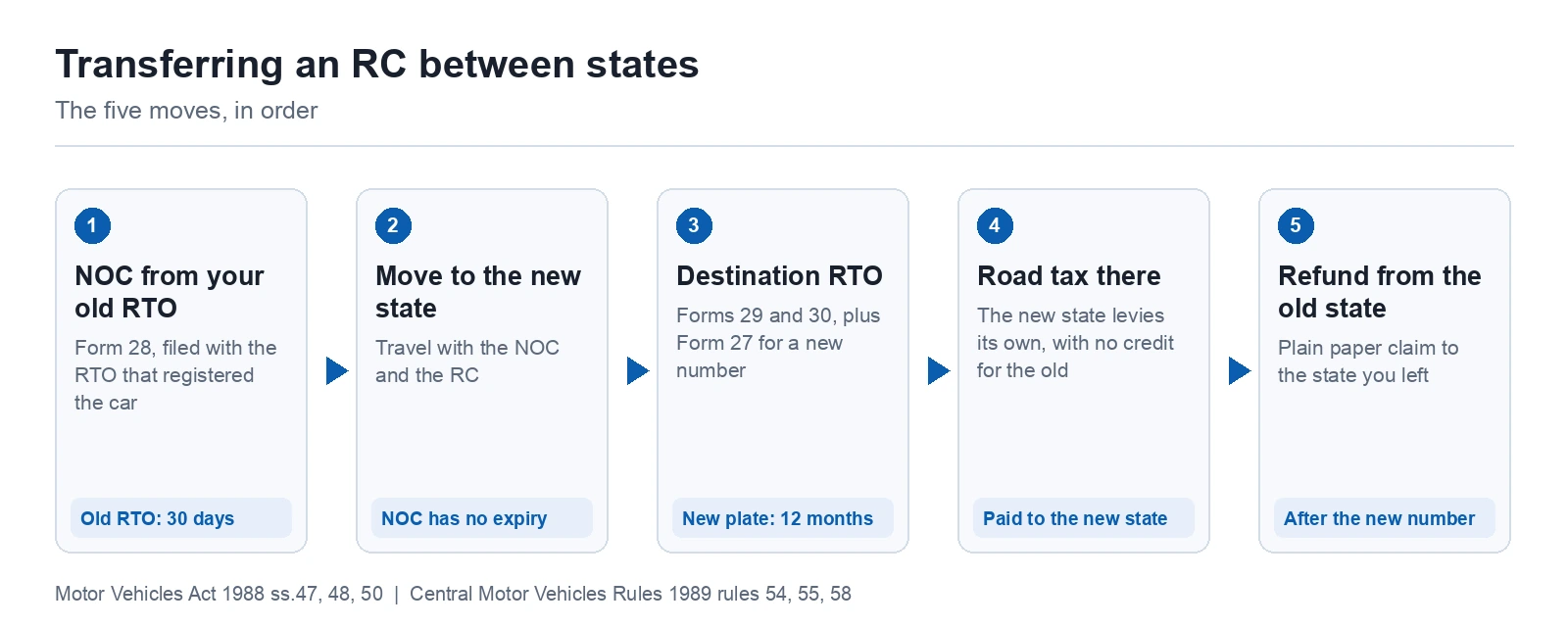
Step 1: the NOC from your current RTO
Your Form 28 goes to the RTO that registered the car, in triplicate. Running a loan? Then it’s four copies, because your financier gets one. Rule 58 of the Central Motor Vehicles Rules fixes what you attach: certified copies of the RC and the insurance certificate, plus proof that motor vehicle tax is paid up to date, or a certificate from the tax authority that nothing is owed for the period. States pile on extras. Telangana wants a pollution certificate and police verification as well.
So what’s the RTO looking for? Under Section 48 of the Motor Vehicles Act it has to obtain a written police report that no theft case on your car has been reported or is pending, and verify that every amount due to government, road tax included, has been paid. From there it has 30 days to grant or refuse in writing, with reasons recorded for any refusal. Miss that window with no refusal delivered to you, and the NOC counts as granted.
How long is the NOC good for? No expiry date is prescribed: neither the Act nor the rules put a clock on one. What the endorsement does say is that it’s valid at the registering authority you named, so pick that destination carefully. Tax arrears are the classic hold-up, and Form 28 makes you declare it: the date tax is paid up to, whether any demand is pending, whether the car is tied up in a theft case. The form also wants a pencil print of the chassis number, so you’ll need the car in front of you, not just its papers. Whether you file at the counter or online depends on the state. Telangana, for one, takes the Form 28 application online.
Step 2: at the destination RTO
Ownership moves on two forms. Form 29 is the seller’s notice, Form 30 is your application as the buyer, and it travels with the RC, the insurance certificate and the fee. Interstate adds one condition. You attach the NOC, or the written refusal, or, if neither has landed, the seller’s declaration plus the receipt or postal acknowledgement from their NOC application.
Address proof carries more weight here than you’d expect. Section 50 routes your report to the authority where you live or normally keep the vehicle, so jurisdiction and address have to agree, and Form 30 says it in brackets next to your address: proof of address to be enclosed. The paperwork is thinner than the full vehicle registration process a showroom-fresh car goes through, because the registration record already exists and only has to move.
Video Explaining How to Transfer RC From One State to Another

Step 3: road tax in the new state, and when a new number is due
The trigger sits in Section 47. Keep a car registered in one state in another state for longer than twelve months and you’ll have to apply locally for a new registration mark. That’s Form 27, filed with the NOC and the fee, and Rule 54 gives you 30 days once those twelve months are up. If you’re sure you’re staying, declare that and you can apply any time inside the twelve months instead of waiting them out. A six month posting sits outside all this. No new plate needed.
Then comes the road tax, which is where the money actually goes. Your new state levies its own and it won’t credit you for what you’ve already paid. West Bengal is blunt about the timing: on a vehicle brought in from outside with an NOC, its tax runs from the date that NOC was issued, so a certificate left in a drawer costs you. And the mechanics of how to transfer RC from one state to another barely change if nobody bought the car. Only the ownership forms drop out of a plain relocation.
Step 4: the refund from the old state
So who owes you that money back? The state you left, under its own motor vehicle taxation law. West Bengal’s transport department FAQ lays out the test: you qualify for a refund covering the remainder period only once your car has been re-assigned a number in the new state. Filing is low-tech. A plain paper application asking for the refund, your tax token, an attested photocopy of the new number, and one blank or cancelled cheque. Note where that goes: to the taxing officer of the state you’ve just left, not the one you’ve moved to.
Step 5: if the car is on a loan
Your lender turns up twice. No consent recorded on Form 28, no NOC, which is why that form runs to four copies. Form 27 repeats the pattern, with a block where the financier records no objection, or objection with reasons, under Section 51(6). They get seven days to answer and silence past that counts as consent, in which case Form 27 wants a declaration under Section 51(8) filed alongside it. The hypothecation itself rides across to your new RC, and changing states doesn’t wipe it. Closing it once you’ve paid the loan off is its own errand: Form 35, signed by you and the financier, filed with the RC and the fee.
Timeline and what it costs
Why does this feel so slow? Every stage runs on its own clock. The RTO takes up to 30 days on the NOC. Where the car is registered outside the state, the seller has 45 days to forward the NOC paperwork to the RTO recording the transfer, while you as the buyer get 30 days to report it and send the RC in with the fee. Twelve months then govern the plate itself. Budget most of a month for the NOC and start before the move, not after.
Fees are the easy part. Centrally, transfer of ownership is priced at ₹300 for a private car, the smart card RC adds ₹200, and a new registration mark costs the same as registering the car did originally. Late paperwork bites: submit the NOC late and the schedule charges ₹500 for every month or part of a month on a car. For the full component list, what RC transfer costs covers financed cars too. Road tax in your new state will still dwarf all of it.
Document checklist
- Form 28 in triplicate, four copies on a financed car, with your financier’s consent recorded
- Certified copies of the RC and insurance certificate, plus proof of tax paid up to date or a no dues certificate
- Forms 29 and 30 signed by both sides, filed at the destination RTO with the RC, insurance, your address proof and the fee
- Form 27 and the NOC where a new registration mark is due, filed with the RTO whose jurisdiction the car is now in
- Pencil print of the chassis number, with tax paid up to date and no demand pending
- For the refund: tax token, attested copy of the new number, and a blank or cancelled cheque