
Moving a car’s registration into your name in Delhi costs ₹500 in government fees: ₹300 for the transfer of ownership and ₹200 for the smart card RC. The transport department’s own citizen charter prices it exactly that way, and unlike a fresh registration, it attaches no postal charge to a transfer. Delhi handles transfers under its faceless policy, and the buyer’s Aadhaar e-KYC carries the identity check.
Where the RC transfer fees in Delhi get interesting is what happens if you’re slow. Delhi publishes two late figures in two different places and they don’t agree, which makes this the one number to read properly before you hand over any money.
What you pay in Delhi, component by component
| Component | When it applies | What you pay |
|---|---|---|
| Transfer of ownership fee | Every car transfer | ₹300 |
| Smart card RC in Form 23A | Every transfer | ₹200 |
| Hypothecation endorsement | Buyer is taking a loan | ₹1,500 |
| Cancelling a hypothecation entry | Loan closed | Nil |
| Postal charge on the new RC | Not listed against a transfer | Nothing published |
| Reporting the transfer late | Either side misses its deadline | ₹50 for the first 30 days, ₹100 a month after |
| NOC submitted late | Only where an NOC is involved | ₹500 per month or part of one |
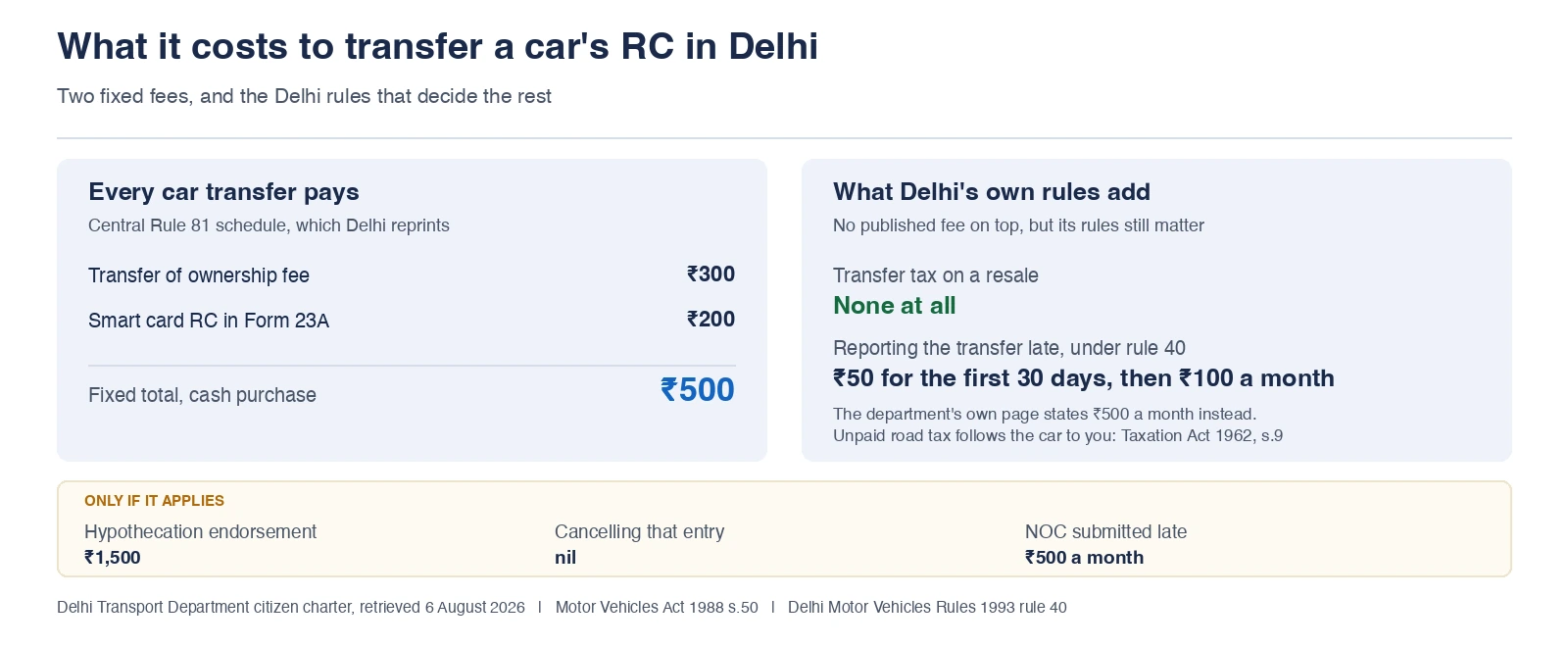
So where does your ₹300 come from? Delhi’s transport department citizen charter prices a transfer at half the registration fee, and registering a private car sits at ₹600. That’s the central Rule 81 schedule the department reprints rather than a Delhi levy, which is why those two fixed numbers read the same wherever you buy. Now look at what the charter doesn’t do. It puts ₹30 of postal charges against a new registration and against a duplicate RC, and attaches nothing of the sort to a transfer. So if you’ve seen ₹530 quoted for Delhi, that’s a postal charge stacked onto a service Delhi doesn’t publish one for.
One more figure to keep in your back pocket. Rule 44B of the Delhi Motor Vehicles Rules 1993 prescribes ₹170 for Part B of the smart card on top of the Rule 81 fees, on exactly the applications a transfer is made under. The charter itemises this branch down to a ₹30 postal charge and never lists it, and the rule’s own memorandum works off a ₹200 registration fee the 2016 schedule replaced. Treat ₹500 as the published figure and carry a little over it.
Working out the total on a used car
Cash purchase and your own paperwork? ₹500 covers you. Borrow for the same car and your lender’s hypothecation becomes a separate entry on the new RC at ₹1,500, taking your government total to ₹2,000. Close that loan later and it costs you nothing at all. The charter puts the fee to delete a hypothecation at nil, and the fresh RC you get afterwards is exempt from the ₹200 smart card charge too. Delhi collects no tax on a resale transfer either, so there’s no percentage of anything waiting for you at the end.
How to apply in Delhi
Do you have to queue at the RTO for this? Delhi’s newer instruction says no. A transport department order from September 2024, issued to make the faceless policy work better for registration certificates, deals with transfer of ownership head on, and Aadhaar based e-KYC is compulsory for the buyer. The order splits the job by where your Aadhaar address sits. Inside Delhi, that e-KYC is the whole identity check. Outside Delhi, you add a present address proof from the department’s approved list, and the new RC then carries that present address. Against that, the department’s older registration FAQ still describes applying at the zonal office where the car is registered, so don’t be startled if a case gets pulled in.
Keep your paperwork ready either way. Form 29 in duplicate with one copy attested, Form 30 in duplicate, the original registration certificate, self attested copies of valid insurance, the buyer’s address proof and a pollution certificate, an attested copy of the PAN card or Form 60 and 61 where applicable, and the fee. The charter gives the department 30 days to deliver your new RC. It’s a far shorter errand than the complete car registration guide describes for a brand new car, because the record already exists and only the name on it changes.
Financed cars, and what being late costs
Has the seller still got a loan on the car? Then nothing moves until their financier signs. Section 51(4) of the Motor Vehicles Act bars any registering authority from entering a transfer on a hypothecated vehicle without the written consent of the financier named on the RC. Your own lender’s hypothecation goes on with Form 34. Taking a closed one off is Form 35, with an NOC from the financier.
Then there are the deadlines, and two clocks run at once. Section 50 gives the seller fourteen days to report a sale inside the state, and gives you as the buyer thirty days to report the transfer and send the RC in with the fee. Where the car was registered outside Delhi, the seller gets forty five days instead, to forward the no objection paperwork. Delhi’s own vehicle registration page then adds an instruction of its own: submit the application within 14 days of purchase, otherwise a penalty of ₹500 a month is charged. Read that as the department’s administrative instruction at its own counter, not as your statutory window, which is thirty days.
And that ₹500 doesn’t match Delhi’s own rules. Rule 40 of the same rules fixes the amount payable under section 50(5) at ₹50 for the first thirty days of delay or part of them, and ₹100 a month or part of one after that, while section 50(3) puts what a registering authority may require at not more than one hundred rupees. Two Delhi government sources, two answers. Budget for the higher one, file on time and the question never arises. One caution about the ₹500 a month in the table above: that one is the charge for a late NOC submission, which is a third thing again.
How Delhi compares nationally
So is Delhi cheap or not? Almost nothing on your bill is Delhi’s own doing. The ₹300, the ₹200 and the ₹1,500 all come from the central schedule the department reprints, and our breakdown of RC transfer fee components nationally sets out how they sit elsewhere. Gujarat’s transfer tax is the real outlier, pegged to a percentage of what the car’s first owner paid. Two things genuinely are Delhi’s: that graded late amount in rule 40, and section 9 of the Delhi Motor Vehicles Taxation Act 1962, which makes whoever ends up in possession of the car liable for tax the previous owner left unpaid. That’s you, once the keys change hands, and it doesn’t let the seller off the hook either. So ask for the tax position before you pay, not after.