
Is Maruti Fronx worth buying? For a city-first buyer who wants SUV seating height and Maruti’s low running costs at roughly hatchback money, yes. For someone expecting genuine SUV room or highway muscle from the base engine, probably not. And here’s the number nobody on the results page actually shows you: that ₹6.85 lakh sticker isn’t what you pay. In Delhi the base Sigma lands at ₹7.84 lakh on road, and in higher-tax Bangalore it’s ₹8.32 lakh. So the real question isn’t the ex-showroom figure. It’s which variant earns its on road price, and whether the car fits your life.
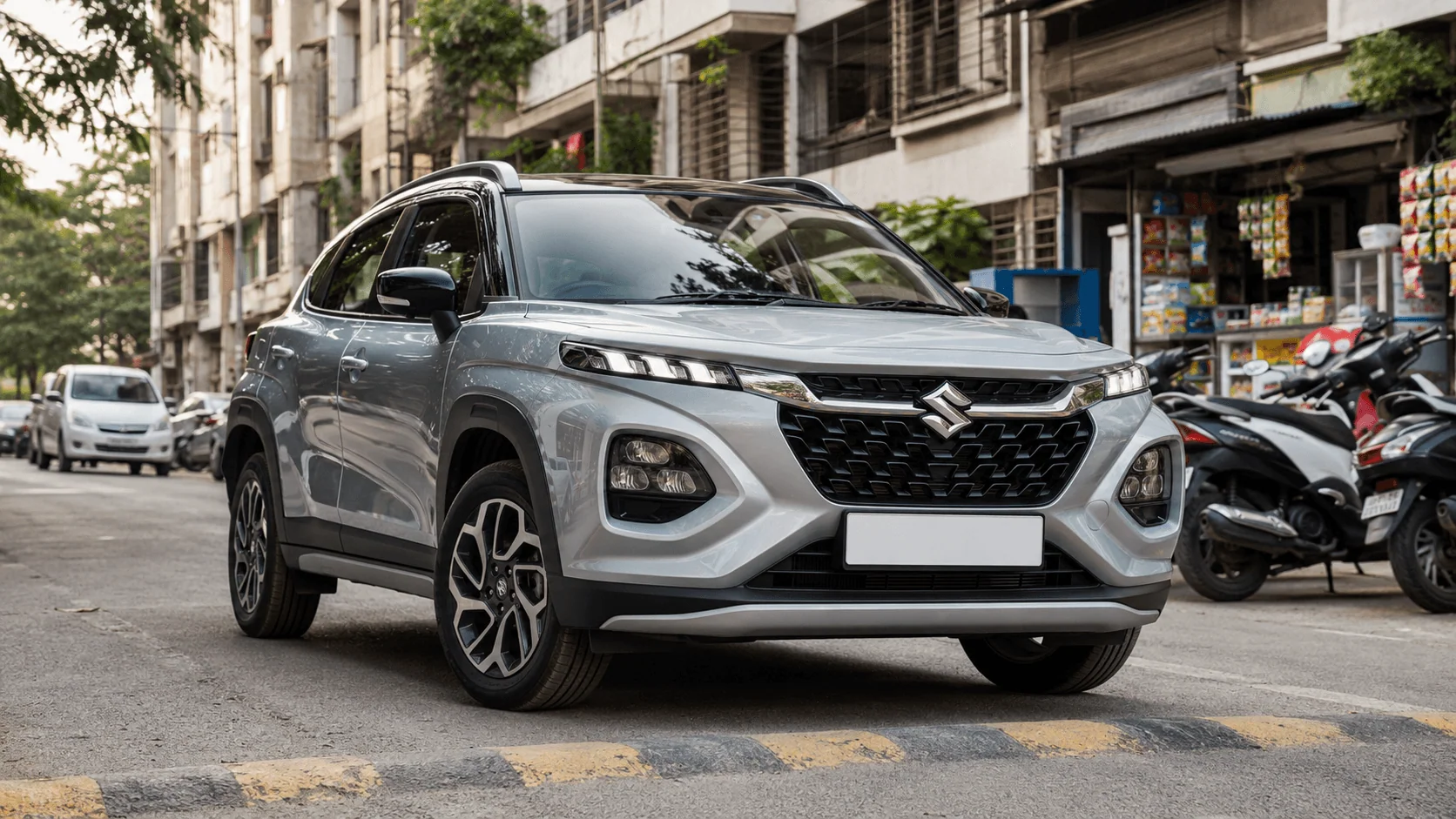
Maruti Fronx worth buying, the short answer: worth it for city-first buyers, not for everyone
Buy it if you spend most of your week in traffic and want a commanding view out, light controls, a cabin that’s easy to place in tight lanes, and fuel bills you barely notice. The CNG option and the frugal petrol engines make it one of the cheapest sub-4-metre crossovers to keep running, and Maruti’s service reach means you’re never far from a workshop.
Skip it if your weekends are highway runs with four adults and luggage, because the base 1.2 works hard when it’s fully loaded. Skip it too if you need three grown-ups sitting comfortably across the back seat, or if a crash-test star rating you can point to is a deal-breaker, because the India car doesn’t have one yet. More on that lower down.
What the Fronx actually costs on road
The gap between the price you’re quoted and the price you pay is the whole game here. In Delhi the base Sigma adds close to ₹1 lakh over ex-showroom. In Bangalore that jumps to about ₹1.5 lakh, because Karnataka’s road tax is steeper and climbs again once the ex-showroom crosses ₹10 lakh. Same car, same variant, roughly ₹50,000 apart just on where you register it.
Here’s what four representative variants really cost, pulled from the same engine that prices our live Fronx city pages.
| Variant (engine, gearbox) | Delhi on road | Bangalore on road | What the step up buys |
|---|---|---|---|
| Sigma 1.2 petrol, manual (base) | ₹7.84 lakh | ₹8.32 lakh | The way in. Six airbags and ESP are standard, but you go without the touchscreen and steering controls. |
| Delta 1.2 petrol, manual | ₹8.73 lakh | ₹9.28 lakh | Where most buyers should stop. About ₹80,000 more adds the touchscreen with CarPlay and Android Auto, auto climate and push-button start. |
| Zeta 1.0 turbo, manual | ₹11.01 lakh | ₹11.68 lakh | The turbo the Baleno never sold, plus wireless charging, rear AC vents and a height-adjustable driver’s seat. |
| Alpha 1.0 turbo, automatic (top) | ₹13.84 lakh | ₹14.74 lakh | The lot: turbo, six-speed automatic, 360-degree camera and a head-up display. Convenience money, not need-to-have money. |
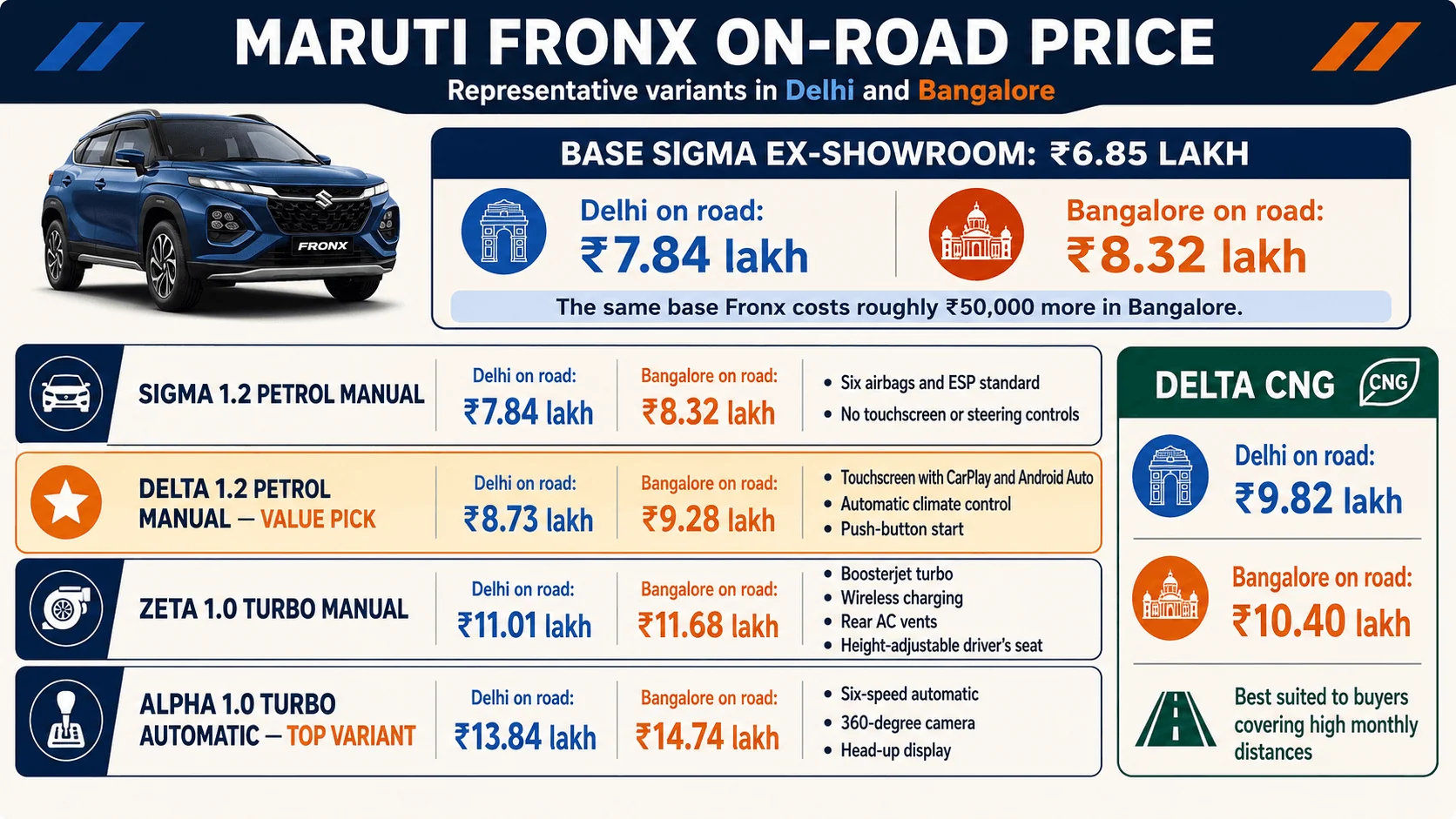
If you want the running-cost play instead, the Delta CNG lands at ₹9.82 lakh on road in Delhi and ₹10.40 lakh in Bangalore, and it’s the variant that pays for itself fastest if you clock big monthly distances. The full variant list with every price sits on the city pages: check the Delhi on road prices or the Bangalore on road prices for your exact trim.
Where the Fronx earns its price
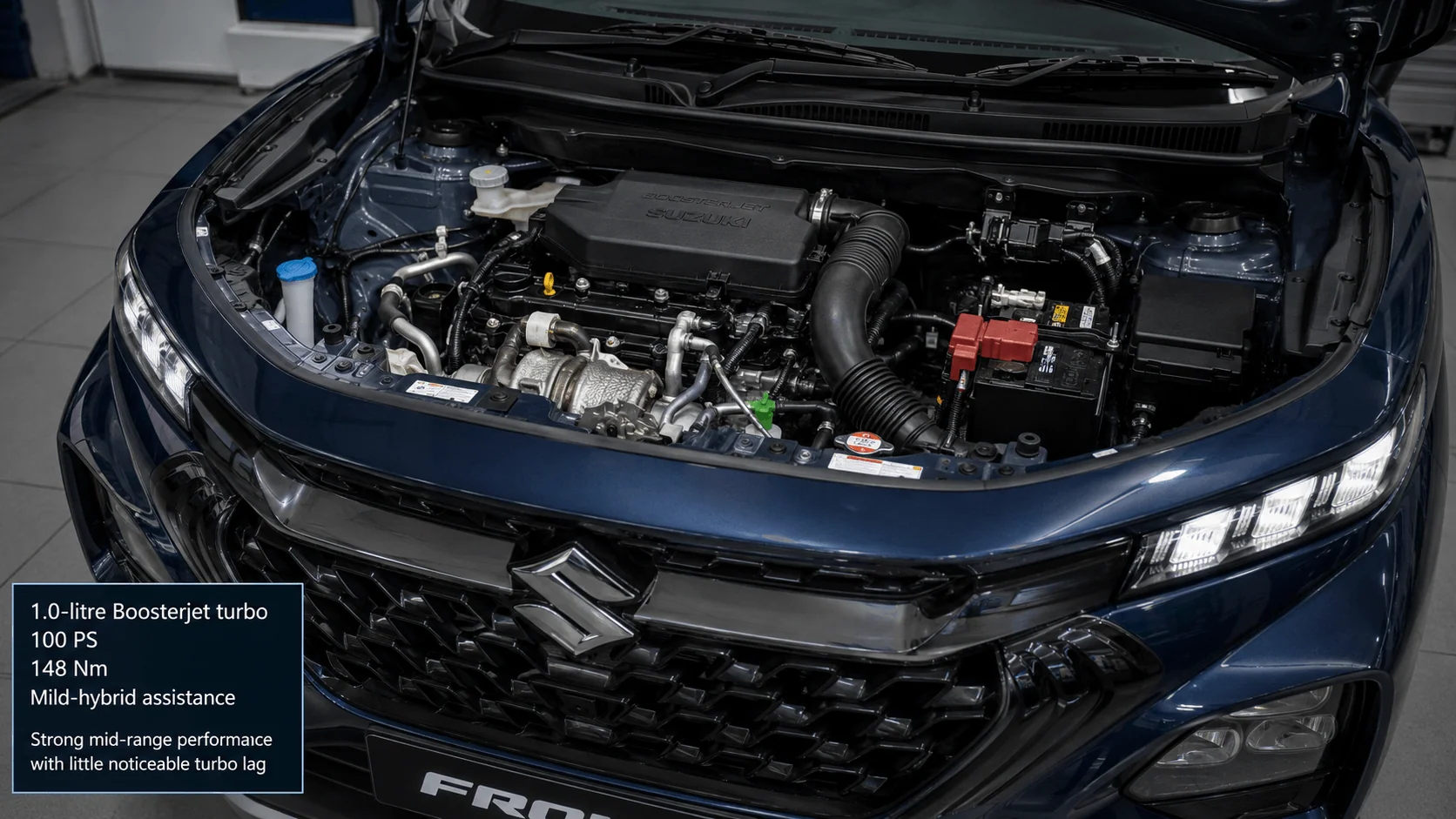
Two things justify the money. First, the 1.0-litre Boosterjet turbo, which makes 100 PS and 148 Nm with a mild-hybrid assist that fills in the low end so there’s barely any lag. The Baleno, the hatchback the Fronx is built on, never offered a turbo at all. That engine is what stops the Fronx from feeling like a Baleno on stilts, and it’s genuinely quick in the mid-range for its class.
Second, running costs. The 1.2 petrol is rated between 20 and nearly 23 kmpl, and owners see a real 20 or so on the highway. The CNG is cheaper still per kilometre if a pump is handy near you. Add Maruti’s cheap, everywhere-you-look servicing, and living with a Fronx over five years is where it quietly beats pricier rivals.
Is Fronx a bad car?
No. But it isn’t flawless, and pretending otherwise helps nobody. The base 1.2 is fine around town and starts to feel stretched on the highway with the car full, which is the single most common owner grumble. The 1.0 turbo is a three-cylinder, so there’s a faint thrum to its note, though most drivers stop noticing it within a week. Road tests and owner reviews also flag the back seat as comfy for two but snug for three adults across, which is normal for a sub-4-metre car but worth knowing.
The one thing that scares people off is a crash-test headline, so let’s be precise about it. There is a one-star ANCAP result, but that test was run on the 1.5-litre Fronx sold in Australia and New Zealand, a different engine from the 1.0 turbo and 1.2 petrol we get here, and it isn’t a Bharat NCAP test. The India-built Fronx hasn’t been assessed by Bharat NCAP at all as of now, so there’s no India-specific star rating to lean on either way. What you can count on is the kit: six airbags and ESP are standard across the whole range, base variant included.
Is Fronx a good family car?
For a city family of four, yes. It’s a five-seater, not a six or seven, so a joint-family run isn’t its brief. But the 308-litre boot swallows a week’s shopping or a pram, the 190 mm of ground clearance shrugs off broken roads and tall speed-breakers, and six airbags come standard even on the cheapest trim. Two adults and a couple of kids travel happily. It’s only three grown-ups abreast at the back that gets tight, and that’s true of nearly everything this size.
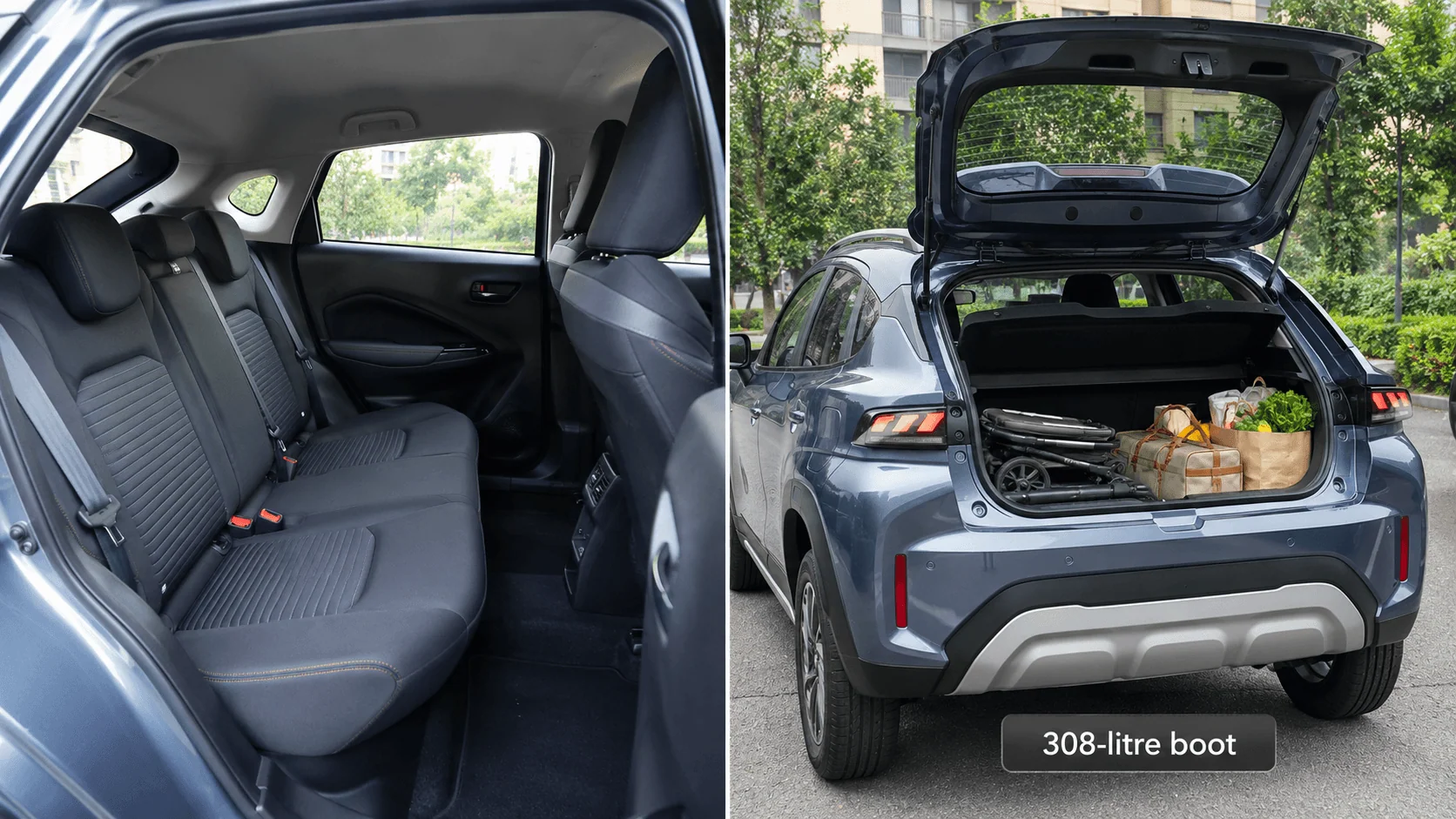
If your priority is the maximum rear-seat and boot space you can get for the money, it’s worth cross-shopping the Baleno, the Fronx’s own hatchback sibling, before you decide. For most young families who mostly drive in the city and value a high seat and low bills, the Fronx does the job without drama.
Verdict and the numbers to run before you book
Worth buying? For the city-first buyer it’s a comfortable yes. The sweet spot is the Delta if you’re counting rupees, or a turbo trim if you want the car at its best. Genuinely reconsider it if you live on the highway with a full car, or you need three adults across the back in comfort.
Before you sign anything, run your exact variant, city and fuel through our on road price calculator so the on road figure is yours and not a rounded showroom guess. Then check the monthly outgo with the car EMI calculator rather than trusting the finance desk’s math. Two minutes there will tell you more about whether the Fronx is worth it for you than any review can.