
Most car maintenance guides online are written for American or European conditions. Smooth highways, mild weather, clean fuel. That’s not your reality. Your car sits in 45°C heat, crawls through monsoon floods, breathes Delhi’s PM2.5 pollution, and rolls over speed breakers that would wreck a European sedan’s suspension in months.
So what does a proper car maintenance checklist for India actually look like? One that accounts for your weather, your roads, your fuel quality?
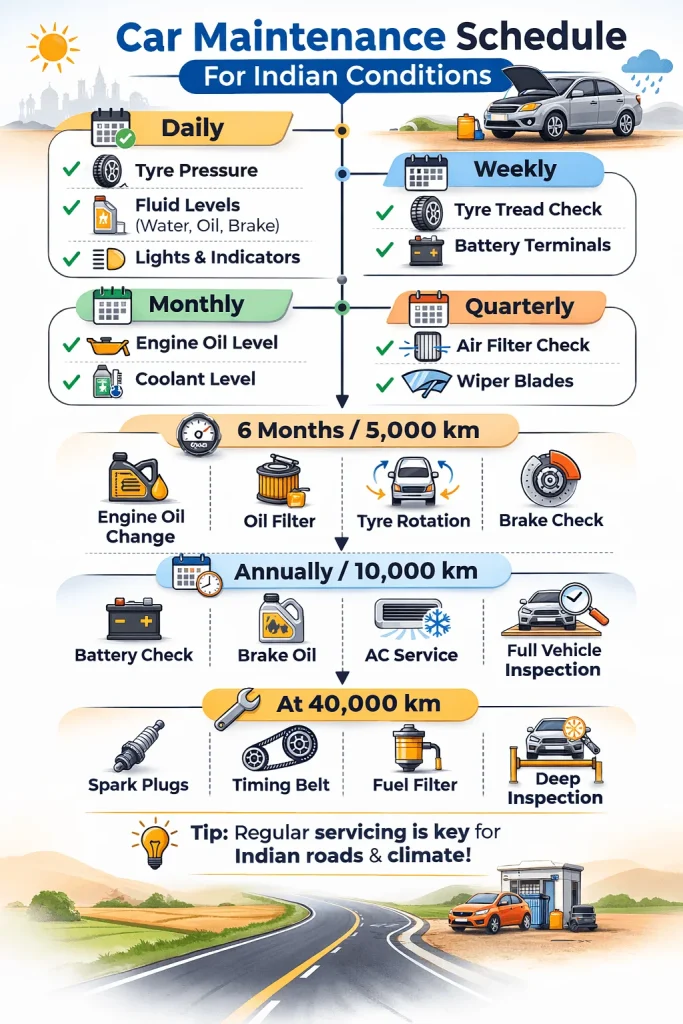
Here’s the quick version before we break it all down:
- Daily: walk-around visual check (fluid leaks, tyre sidewalls, rodent droppings)
- Weekly: tyre pressure on cold tyres, coolant level, ADAS camera wipe
- Monthly: engine oil dipstick, battery terminals, washer fluid, all lights
- Quarterly: cabin air filter, brake pad thickness, wiper blade condition
- Every 6 months / 5,000 km: engine oil change for city cars, wheel alignment
- Annually / 10,000 km: full OEM service, brake fluid test, coolant system check
- At 40,000 km: transmission fluid, coolant flush, suspension bushing check
Now the details.
Monthly Car Maintenance Checklist
Monthly checks are your car’s vital signs. None of them take more than 10 minutes. And they catch problems long before they get expensive.
Engine Oil Level and Condition
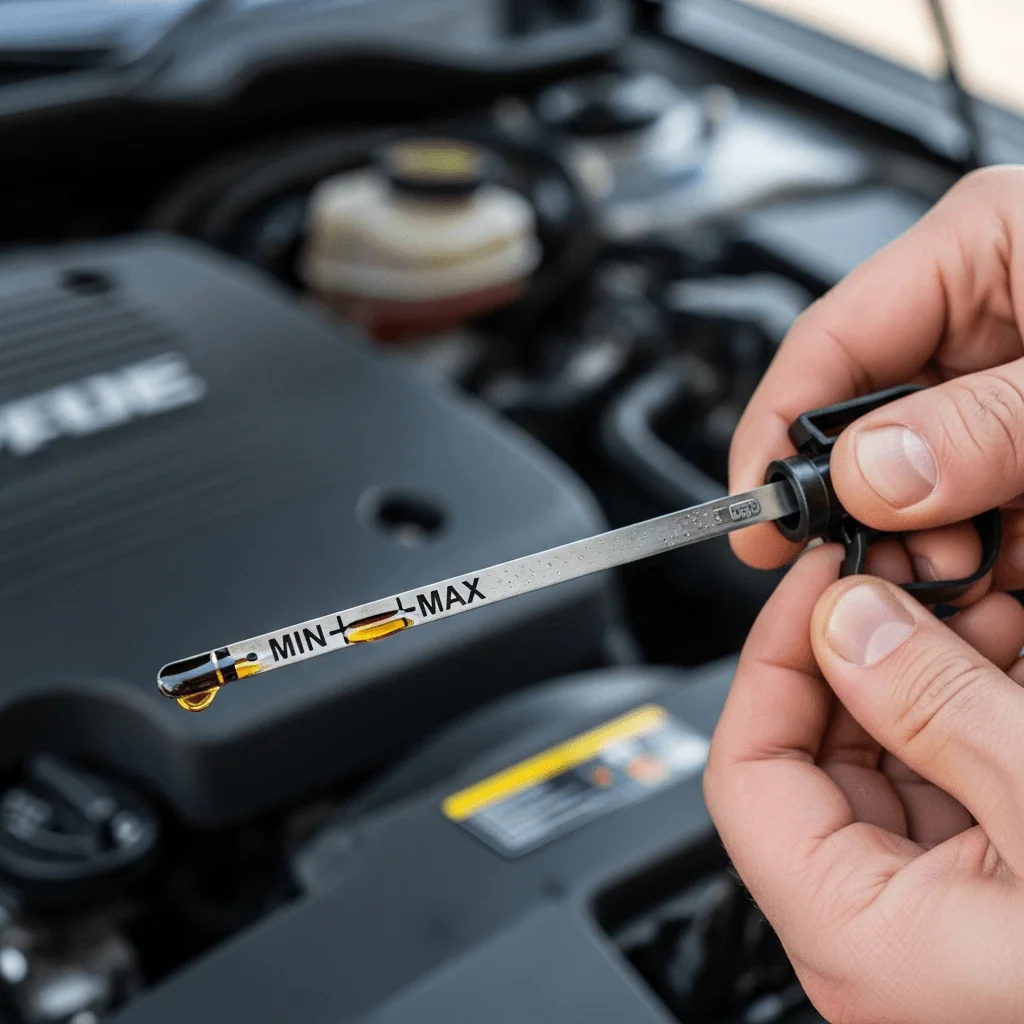
Pull the dipstick on level ground with the engine cool. Oil should sit between MIN and MAX. But don’t stop there. Check the colour too. Healthy oil looks amber and slightly translucent. If it’s turned pitch black within 2,000 km of your last change, the air filter could be clogged, or your engine’s running rich. Milky, frothy oil? That points to coolant contamination. Get the head gasket checked immediately.
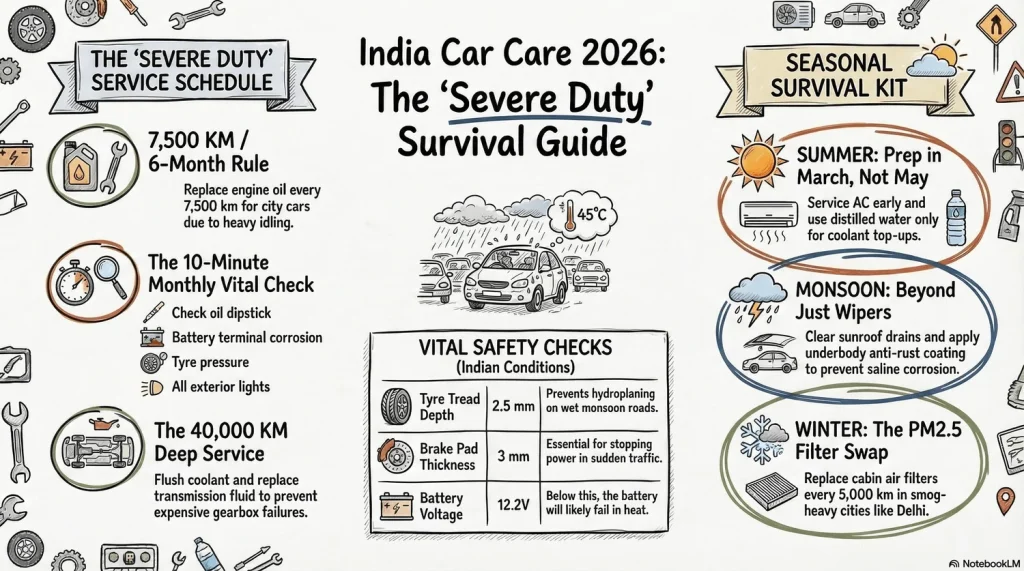
Here’s something most guides won’t tell you. The standard 10,000 km oil change interval doesn’t apply to Indian city driving. A car averaging 15 km/h in Mumbai traffic runs its engine for 666 hours to cover 10,000 km. By any manufacturer’s own definition, that’s “severe duty” use. The realistic interval for city-bound cars is 7,500 km or 6 months, whichever hits first. Stick to fully synthetic oil in the viscosity grade your owner’s manual specifies.
Battery Terminals and Voltage
Open the hood and look at the 12V battery terminals. See blue-white crusty buildup? That’s acidic corrosion. Wipe it off with a dry cloth, then apply petroleum jelly or terminal spray so it doesn’t come back. Today’s cars with start-stop systems and always-on telematics drain batteries faster than older models did.
A healthy battery reads 12.6V or higher. Below 12.2V, it’s struggling. Get any battery older than 3 years load-tested before summer and again before winter.
Tyre Pressure and Visual Inspection
Check tyre pressure every 2 weeks. Always do it in the morning before you drive, when the tyres are cold. Hot tyres give falsely high readings. Your manufacturer’s recommended pressure is usually 32-35 PSI, printed on the sticker inside the driver-side door jamb.
While you’re there, visually inspect all four tyres plus the spare:
- Sidewall bulges or cracks (can’t be repaired, replace the tyre)
- Uneven tread wear (likely an alignment or suspension problem)
- Embedded stones or nails
- Tread depth below 2mm (check against the wear indicators between treads)
Why does this matter so much? An under-inflated tyre folds over the rim edge when you hit a pothole. That pinches and severs the internal sidewall cords. At highway speeds, the result is a sudden blowout.
All Lights
Walk around your car once a month with every light switched on. Headlamps on low and high beam, tail lights, brake lights, indicators, reverse lights, fog lamps. Replace dead bulbs right away. If you spot condensation inside a modern LED headlight cluster, the breather patch is blocked. Get it cleared before moisture short-circuits the diodes.
Washer Fluid and Wipers
Top up windshield washer fluid with a proper surfactant-based solution. Plain water scales the micro-nozzles and can’t cut through oily road film. Run your thumb along each wiper blade edge. If you feel tears, nicks, or hardening, swap the blades out. You don’t want to discover dead wipers in the middle of a monsoon downpour.
Seasonal Maintenance (Summer, Monsoon, Winter)
This is where Indian car care diverges from everything you’ll read in international guides. You face three distinct weather extremes every year. Each one attacks different parts of your car.
Summer Maintenance (March to June)
Indian summers routinely cross 45°C. Your cooling system and AC take the worst hit. Battery and tyres suffer too. Here’s how to prepare.
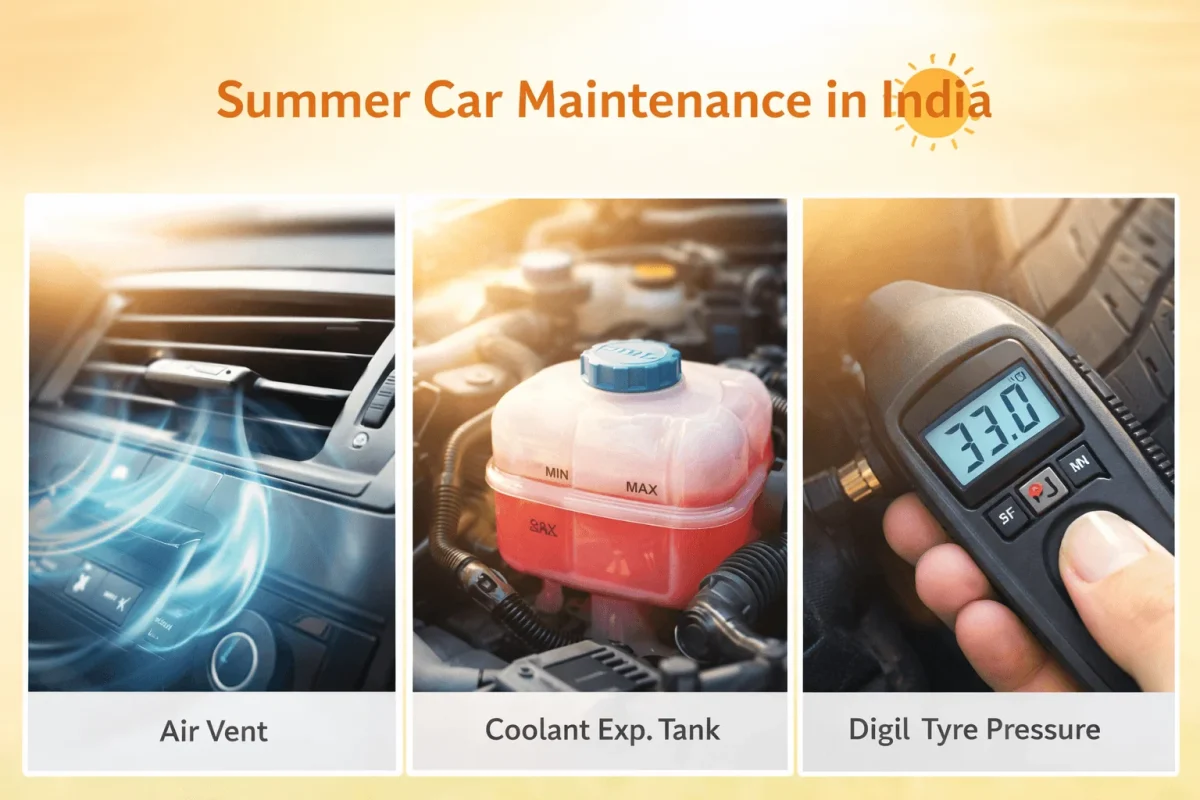
AC System: Service in March, Not May
Don’t wait until your AC stops cooling in peak May heat. Get it serviced in March. A proper service checks refrigerant levels, looks for leaks, and swaps the cabin air filter. Stay away from discount AC gas refills at roadside mechanics. Unverified refrigerant often contains moisture that slowly kills the compressor from inside.
Does your AC blow a musty, vinegar-like smell when you first start the car? That’s fungal growth on the evaporator coil. Indian humidity makes the evaporator a mildew breeding ground. The real fix requires physically removing and chemically washing the evaporator core. Spraying deodorant foam into the vents does nothing.
Engine Oil Grade for Heat
If your owner’s manual allows a range, switch to fully synthetic 5W-40 or 10W-40 when temperatures cross 40°C. These grades hold viscosity under heat better, which matters when you’re idling in traffic for long stretches.
Coolant System
Check coolant levels twice a month in summer. For top-ups, only use distilled water. Municipal tap water introduces calcium deposits that scale up your radiator channels and eat away the water pump impeller. Car is 3+ years old? Get a full coolant flush done. Use only OEM-specified OAT (organic acid technology) coolant. Never mix two types. OAT mixed with IAT creates a gel-like sludge that blocks the radiator core entirely.
Also squeeze your upper and lower radiator hoses. They should feel firm but pliable. Brittle, cracked, or swollen hoses are about to fail. A split coolant hose in peak summer traffic will overheat your engine in minutes.
Tyre Pressure in Summer
Heat expands air inside your tyres, spiking pressure to risky levels by afternoon. Check every 2 weeks, always early morning. Some owners go for nitrogen filling (around Rs 50-80 per tyre vs Rs 20 or free for regular air). Nitrogen expands less with temperature swings and eliminates moisture corrosion inside the rim.
Battery in the Heat
High temperatures evaporate the electrolyte inside lead-acid batteries faster. If your battery has top-up caps, check distilled water levels monthly. Park in shade when possible. And load-test any battery older than 3 years before summer arrives.
Monsoon Maintenance (July to September)
Monsoon is the most damaging season for cars in India. Water finds its way into everything. Rubber seals crack. Underbodies rust. And one flooded road can cause engine damage that costs lakhs.
Pre-Monsoon Prep (Do This in May-June)
- ☐ Replace wiper blades. Summer UV hardens the rubber, and you need streak-free wiping for heavy rain
- ☐ Check tyre tread depth. You need at least 2.5mm for proper wet-road grip. Worn tyres on wet tarmac extend your braking distance dramatically
- ☐ Inspect rubber seals around doors, windows, and the sunroof (if you have one). Cracked seals let rainwater into the cabin, causing rust and mould
- ☐ Clear sunroof drain channels with a flexible trimmer line. Blocked drains overflow into the headliner and can reach the Body Control Module (BCM), triggering phantom electrical glitches
- ☐ Apply underbody anti-rust coating. This is especially critical if you live in a coastal city like Mumbai, Chennai, or Kochi. Saline humidity causes galvanic corrosion on exposed underbody metal. Rubberized products like Dinitrol work well
- ☐ Test all your lights. Headlamps, fog lamps, tail lights, brake lights. You’ll rely on every one of them in heavy downpours
- ☐ Inspect wiring for exposed or frayed sections. Wet conditions and bare wires are a short-circuit waiting to happen
- ☐ Lubricate weather-stripping on doors and windows with silicone protectant
During Monsoon: The Waterlogging Rule
Never drive through standing water deeper than the centre of your wheels. Water sneaking into transmission breather valves and wheel bearings causes silent damage that shows up as an expensive failure months later.
Drove through a waterlogged patch anyway? Brake firmly a few times afterward to evaporate moisture from the rotors.
Car got fully submerged? Disconnect the 12V battery immediately. Do not try to start the engine. Water in the cylinders causes hydrostatic lock, which bends connecting rods and destroys the engine instantly.
Post-Monsoon Recovery (September-October)
After monsoon season, get your brake caliper slide pins lubricated. Water-induced seizure of the slide pins is a common post-rain problem. Also extract moisture from cabin carpets, check fog lamp sealing, and pressure-wash the underbody to clear accumulated mud that speeds up corrosion.
When parking after rain, brake firmly a few times to dry the rotors, then leave the car in gear (or Park for automatics) and disengage the parking brake. In heavy monsoon regions, leaving the handbrake engaged on a wet car allows brake pad material to fuse with the cast-iron rotor. It’s called flash-rusting, and it seizes the brakes.
Winter Maintenance (November to January)
Winter varies hugely by region. North India gets genuinely cold temperatures with dense fog. Add Delhi’s smog to that, and your car’s working overtime. South India barely notices it. But even mild winters affect your car in ways you might not expect.
Engine Oil
Cold weather thickens oil, making starts harder on the engine. If your manual permits, switch to lower-viscosity oil like 0W-20 or 5W-30. And don’t idle the engine for 5 minutes to “warm it up.” That wastes fuel and doesn’t warm the transmission. Instead, drive gently for the first few minutes.
Battery in the Cold
Cold slows the chemical reactions inside your battery. Cranking power drops. Test battery voltage before winter. Below 12.4V? Get it charged or replaced.
If your car sits unused for days, consider a trickle charger. Modern connected cars with embedded eSIMs constantly poll for cellular signal. In underground parking with poor reception, the module cranks up antenna power. This can drain a healthy battery flat within 72 hours.
Fog and Visibility
Apply anti-fog spray to the inside of your windshield. Use the AC with the front defogger to demist the fastest. The AC dehumidifies the air, clearing the glass quicker than the heater alone. Once the glass clears, switch to low-temp heater with medium fan speed.
In dense fog? Use fog lamps, not high beams. High beams reflect off the fog and actually make things worse.
Cabin Air Quality (Delhi NCR Owners, Pay Attention)
In high-smog cities, clean or replace your cabin air filter every 5,000 km during winter. The standard 15,000-20,000 km interval doesn’t cut it when the AQI hits 400+. A clogged filter can’t catch PM2.5 particles. You’re essentially breathing unfiltered Delhi air inside your car.
Don’t Forget the AC in Winter
Run your AC for 10 minutes once a week, even in winter. This circulates refrigerant oil through the compressor seals. Skip this, and microscopic gas leaks develop over the cold months. Come April, you’ll find the AC doesn’t cool anymore.

Service Interval Guide by Mileage
Your owner’s manual probably says “service every 10,000 km or 12 months.” That interval assumes clean fuel, smooth roads, mild weather. Indian conditions qualify as “severe duty” by every manufacturer’s own classification. Stop-go traffic, particulate-heavy air, scorching heat, questionable fuel quality. All of it accelerates wear beyond what those factory intervals account for.
Here’s what realistic service intervals look like for Indian conditions:
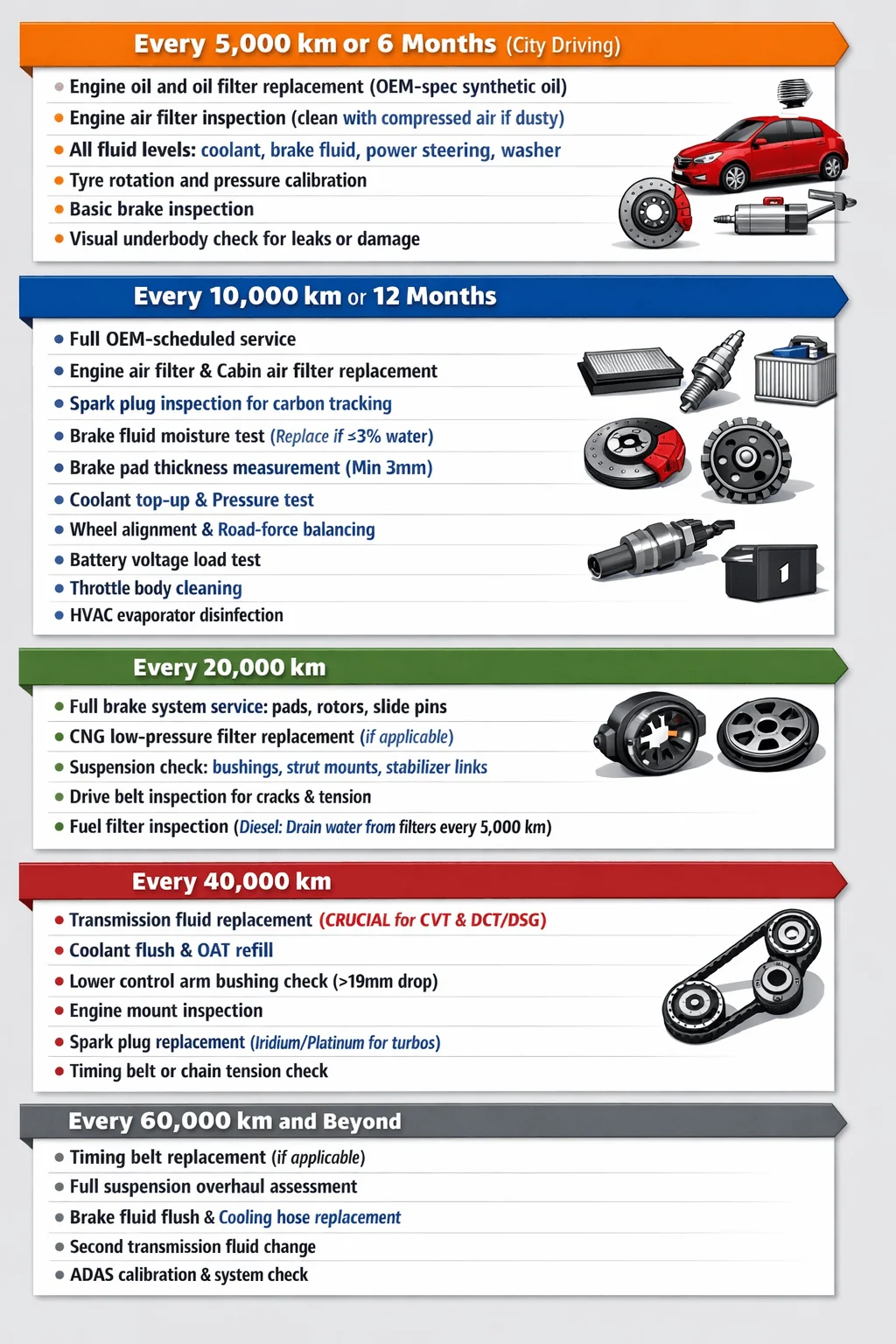
Every 5,000 km or 6 Months (City Driving)
- Engine oil and oil filter replacement (OEM-spec synthetic oil)
- Engine air filter inspection (clean with compressed air if dusty)
- All fluid levels: coolant, brake fluid, power steering, washer
- Tyre rotation and pressure calibration
- Basic brake inspection
- Visual underbody check for leaks or damage
Every 10,000 km or 12 Months
- Full OEM-scheduled service
- Engine air filter replacement
- Cabin air filter replacement
- Spark plug inspection for carbon tracking or widened gaps
- Brake fluid moisture test (replace if water content exceeds 3%)
- Brake pad thickness measurement (you need minimum 3mm remaining)
- Coolant top-up and system pressure test
- Wheel alignment and road-force balancing
- Battery voltage load test
- Throttle body cleaning
- HVAC evaporator disinfection
Every 20,000 km
- Full brake system service: pads, rotors, caliper slide pins
- CNG low-pressure filter cartridge replacement (if applicable)
- Suspension visual check of bushings, strut mounts, stabilizer link rods
- Drive belt inspection for micro-cracks and proper tension
- Fuel filter inspection (diesel owners should drain water from fuel filters every 5,000 km)
Every 40,000 km
- Transmission fluid replacement. This is critical for CVT and DCT/DSG gearboxes. Don’t believe “lifetime fill” claims. CVT fluid loses its frictional properties over time, and degraded fluid permanently scores the steel push-belt against the variable pulleys. That’s a full transmission replacement
- Coolant system flush and refill with OEM-spec OAT coolant
- Suspension lower control arm bushing check (if the drop exceeds 19mm, the bushing has failed structurally)
- Engine mount inspection. Excessive steering wheel vibration at idle? Collapsed hydraulic mount
- Spark plug replacement. Iridium or platinum tips for turbo-petrol engines
- CNG high-pressure filter cartridge replacement (if applicable)
- Timing belt or chain tension verification
Every 60,000 km and Beyond
- Timing belt replacement if your car uses a belt (not a chain). A snapped timing belt causes pistons to slam into valves. The engine is done
- Full suspension overhaul assessment
- Brake fluid flush and system bleeding
- Replace all cooling system hoses if any show hardening or swelling
- Second transmission fluid change
- Full ADAS static calibration check
Diesel owners (BS6 Phase 2): Your DPF (Diesel Particulate Filter) needs regular regeneration. City-only driving never lets exhaust temperatures reach the 600°C needed to burn off soot. Take a highway run for 20 minutes at steady RPM above 2,500 every few weeks. Ignore the DPF warning long enough, and you’re looking at Rs 80,000+ for a replacement.
CNG owners: Higher combustion temperatures wear spark plugs faster. Replace every 10,000-15,000 km using the exact OEM heat rating. Wrong heat range plug? Misfires and destroyed ignition coils. CNG cylinders also need statutory hydro-testing every 3 years.
DIY Checks You Can Do at Home
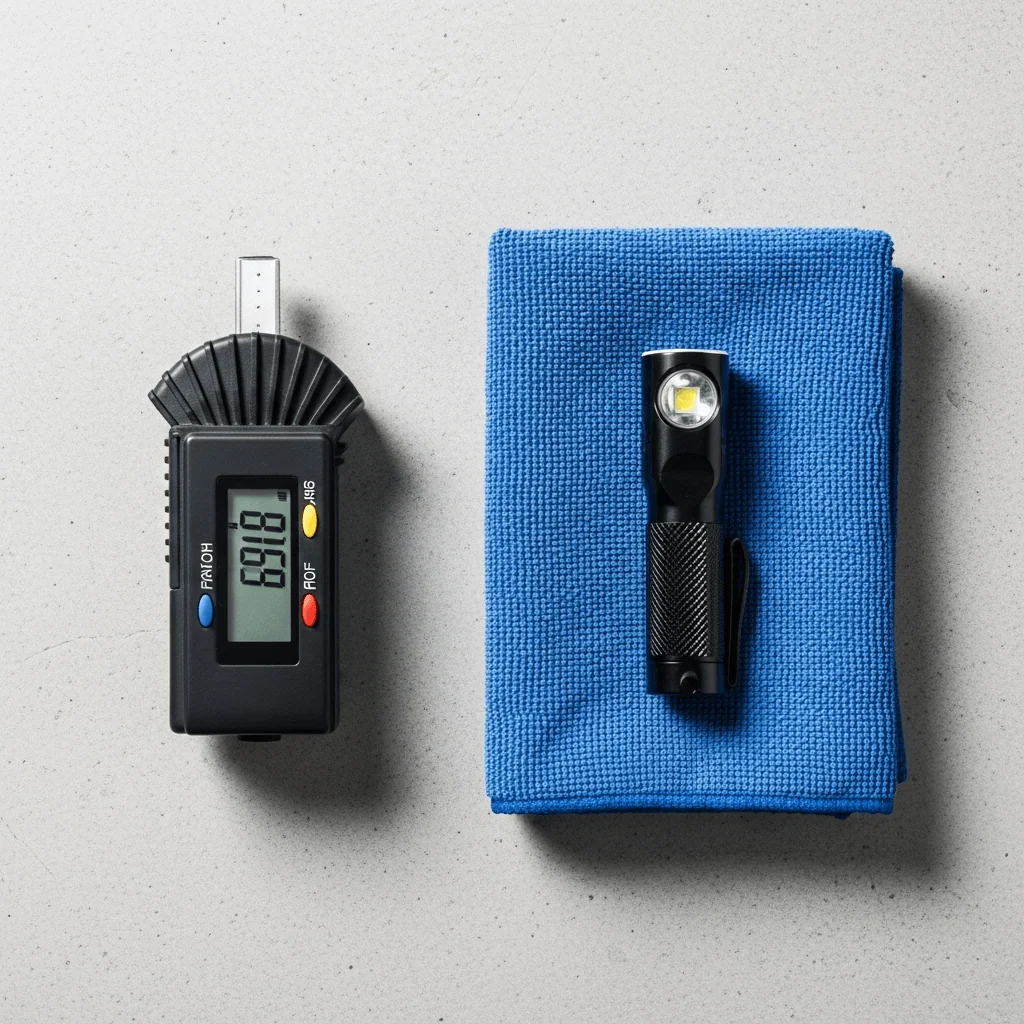
You don’t need a workshop for basic inspections. A 10-minute weekend routine catches 80% of developing problems before they become roadside breakdowns.
The Weekend 10-Minute Inspection
1. Cold Tyre Pressure Check
Use a digital gauge (not the petrol pump’s gauge, which tends to be inaccurate). Measure all four tyres and the spare before you drive anywhere. While at it, visually trace each sidewall looking for cuts, bulges, or cracks.
2. Engine Oil Dipstick
Pull it, wipe clean, reinsert fully, pull again. Check the level. Also look for milky discoloration (water contamination). Oil that smells strongly of petrol is fuel-diluted from too much idling. Schedule an oil change regardless of mileage.
3. Coolant Level
Check the expansion tank. Level should sit between MIN and MAX when the engine’s cold. Never open the radiator cap on a hot engine. If you’re frequently topping up, there’s a leak somewhere. That needs a mechanic.
4. Brake Fluid
Find the brake fluid reservoir (usually near the firewall, driver’s side). Fluid should be semi-transparent and near the MAX line. Dark, murky fluid has absorbed moisture and needs a full flush. Don’t just top it up. Topping up old brake fluid masks pad wear and leaves moisture-laden fluid sitting in your lines.
5. Belt and Hose Squeeze
Pop the hood. Look at the serpentine belt for cracking, fraying, or a glazed surface. Chirping on cold startup usually means a worn tensioner pulley. Squeeze the upper and lower radiator hoses. Firm but pliable is good. Brittle, spongy, or swollen means they’re about to go.
6. Battery Terminals
Check for blue-white crusty corrosion. Clean terminals get a coat of petroleum jelly or terminal protection spray. Corroded terminals cause voltage drops that confuse the ECU and trigger phantom dashboard warnings.
7. Wiper and Windshield
Feel along the wiper blade for tears or hard spots. Check the windshield for micro-chips, particularly in the ADAS camera zone behind the rearview mirror. Small chips spread into full cracks with temperature changes and can throw off ADAS calibration.
What You Should NOT DIY
Some jobs look simple but can go wrong in expensive ways:
- Brake pads on cars with Electronic Parking Brake (EPB): You need an OBD-II scanner to retract the EPB caliper for pad service. Forcing it manually destroys the actuator gear
- Timing belt changes: Get the tension or timing wrong, and the engine is destroyed
- Check Engine Light clearing: Resetting codes without finding the root cause leads to cascading failures
- Coolant mixing: Wrong coolant type creates internal sludge that blocks the entire cooling system
- Suspension spring work: Compressed springs under tension are lethal if they slip during removal
When to Visit the Service Center
DIY checks catch early signs. But some symptoms need professional hands immediately. Ignoring these red flags turns a Rs 2,000 fix into a Rs 50,000 problem.
Red Flags That Need Immediate Attention
Blue exhaust smoke. Oil is bypassing worn piston rings or valve seals and burning inside the combustion chamber. Check your oil level and schedule a compression test.
Sweet-smelling white smoke. Coolant is breaching the head gasket. Stop driving. Continuing risks total engine hydrolock.
Thick black smoke (diesel cars). Incomplete combustion from a choked air filter, faulty injectors, or a ruptured intercooler hose. Get an OBD-II scan for boost leak codes.
Transmission shudder or jerking. In DCT/CVT cars, this means degraded fluid or overheating clutch packs. Shift to Neutral at long traffic stops, let things cool, and book a fluid analysis. Don’t keep driving. The damage accelerates fast.
Car pulls to one side under braking. Asymmetric brake pressure, usually from a seized caliper slide pin. Very common after monsoon. Get both caliper assemblies inspected and lubricated.
Humming noise that changes with speed (not engine RPM). Wheel bearing. The hub races are pitted or dry. Replace the entire hub assembly. Modern bearings aren’t serviceable separately.
Musty or vinegar smell from AC. Fungal growth on the evaporator core. Needs a chemical wash of the evaporator and a new cabin filter.
Slow cranking, dim headlights. Battery sulfation, or the alternator isn’t maintaining 14.4V charge. Get a multimeter load test on the battery terminals.
Spongy brake pedal. Moisture in the brake fluid is boiling into gas bubbles under heat. Air in the hydraulic lines. Get a full brake fluid flush and system bleed done immediately. Don’t drive until this is sorted.
Sudden mileage drop. Could be low tyre pressure (increases rolling resistance), a clogged air filter, a sticky brake caliper dragging, or a faulty O2 sensor forcing a rich fuel mixture. Check pressures first, then scan OBD-II fuel trims.
How to Handle Service Center Upsells
Service advisors push high-margin add-ons at every visit. Some are genuine. Most aren’t. Here’s what you can safely decline unless your mechanic shows you a specific diagnostic reason:
- AC disinfectant balm / vent cleaning (Rs 1,000+). They spray cheap foam into the vents. Actual AC cleaning requires removing and washing the evaporator coil
- Engine dressing / lacquer coating (Rs 800+). Cosmetic silicone spray on plastic engine covers. Zero mechanical protection. Traps heat. Attracts more dust
- Silencer coating. Modern exhausts are aluminized or stainless steel. The spray-on paint offers marginal rust protection at best
- Chemical engine decarbonization (under 50,000 km). Unnecessary for modern engines. And for GDI engines, chemical flushes don’t even reach the intake valves where carbon actually builds up
What you should ask at every service visit:
- “Can I see an OBD-II scan printout before any work starts?”
- “Are you using OEM, OES, or aftermarket parts for this?”
- “Keep all replaced parts in the trunk so I can verify”
- “What viscosity and brand of engine oil are you putting in?”
- “Is that oil low-SAPS compatible?” (diesel owners with DPF)
Always ask to see your old parts. Workshops charging for new parts but reinstalling cleaned old ones is a known scam, common enough to warrant the ask every single time.
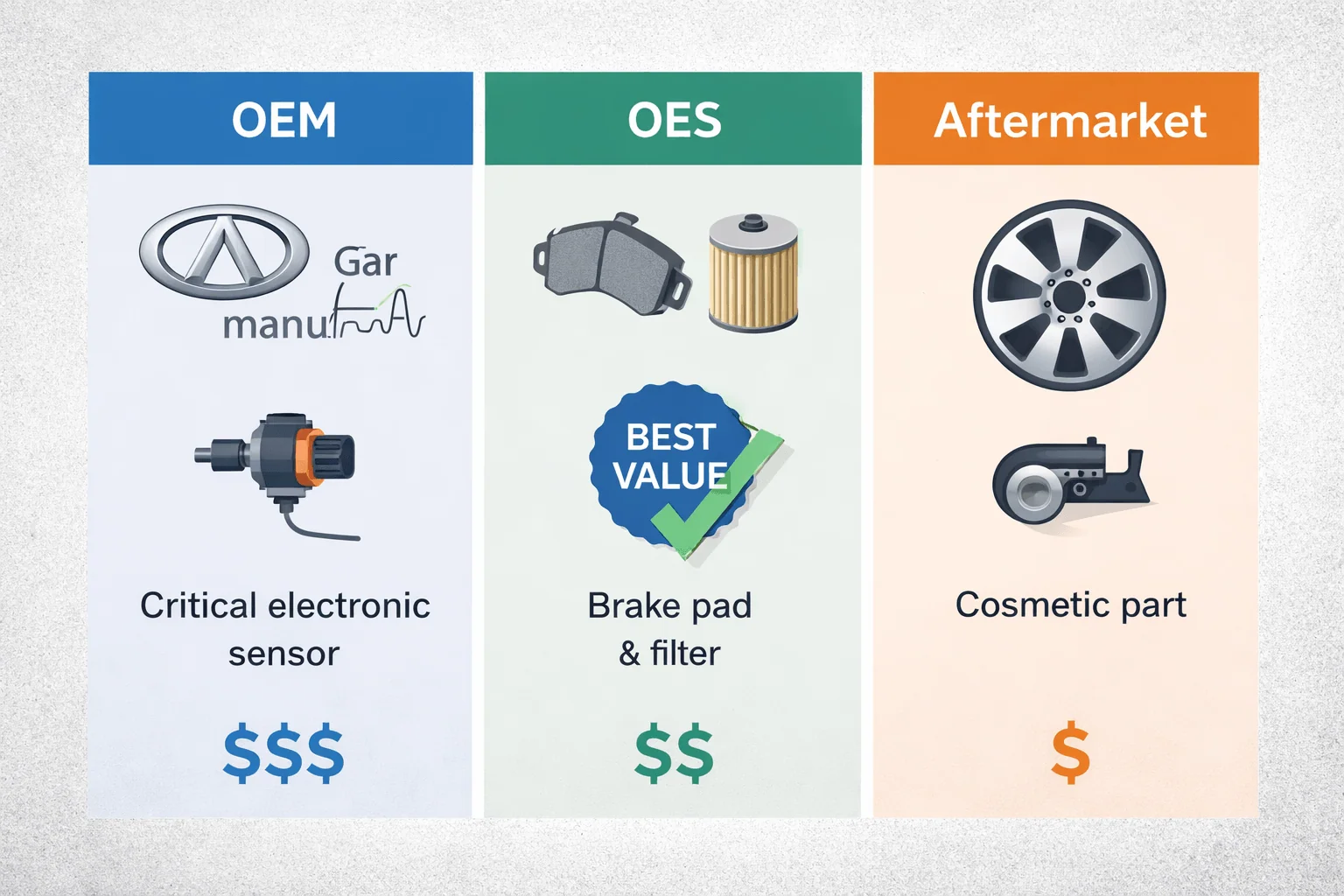
Quick note on parts. OEM parts carry the car brand’s logo and are the most expensive. OES (Original Equipment Supplier) parts come from the same factory (Bosch, Valeo, NGK) but without the brand packaging, often 30-50% cheaper. Use OEM exclusively for sensors and ADAS components. OES works perfectly for brake pads, spark plugs, filters, and other wear items. Aftermarket is fine for non-critical cosmetic parts and fluids meeting exact API/ACEA specifications.
Maintenance Tips by Fuel Type
Your car’s powertrain changes what actually needs attention. Running the same maintenance checklist on a diesel and an EV? That’s how things get missed. Here’s what differs.
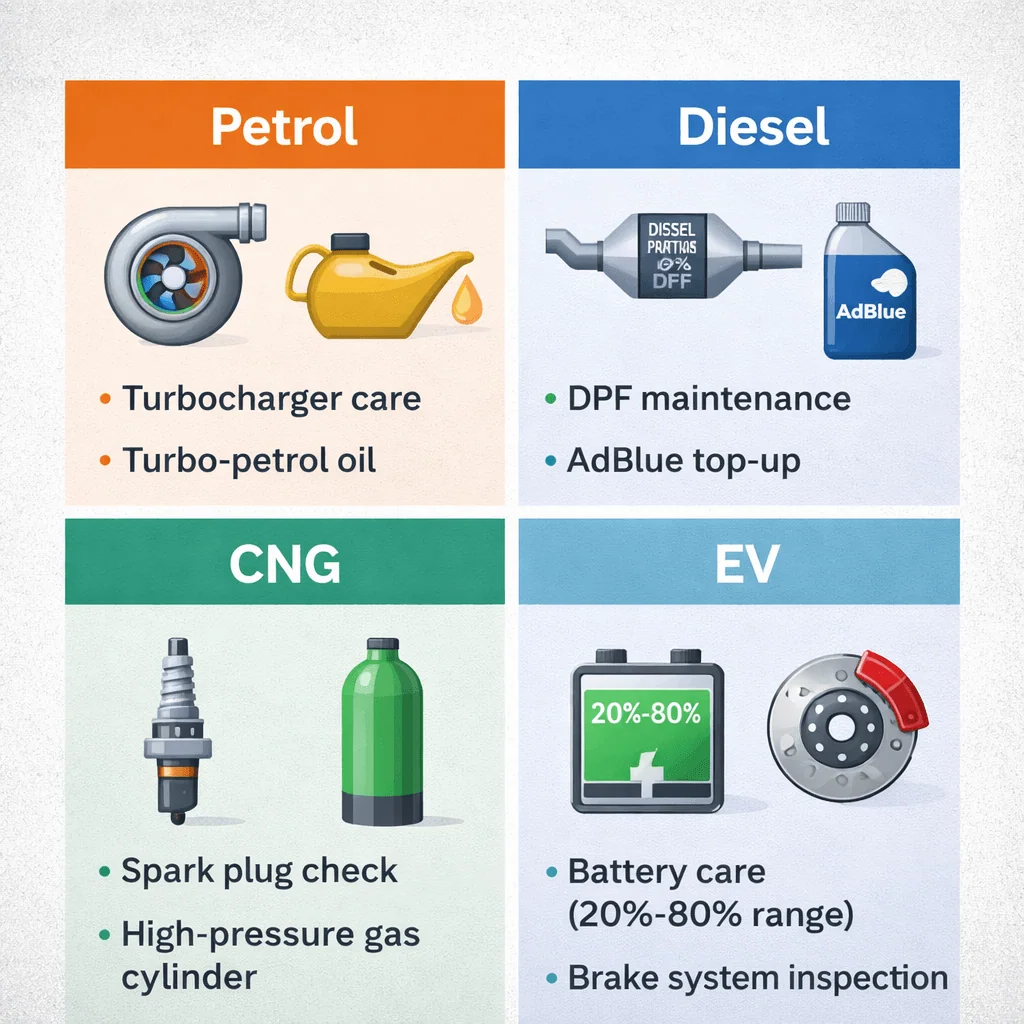
Petrol (Turbo-GDI). Modern turbo-petrols need quality synthetic oil changed at 7,500 km in city use. Extended idling dilutes engine oil with unburnt fuel, stripping its viscosity. One more thing: after a highway run, idle the engine for 60 seconds before switching off. This lets the turbocharger’s oil films cool properly instead of coking into abrasive carbon deposits inside the turbo core.
Diesel (BS6 Phase 2). Only use low-SAPS engine oils (Sulphated Ash, Phosphorus, Sulphur). Standard oil deposits mineral ash inside the DPF that can’t be burned off. Eventually you’re paying Rs 20,000+ for physical removal. Also keep AdBlue (Diesel Exhaust Fluid) topped up. Ignoring the low-fluid warning triggers an ECU lockout that prevents the engine from starting.
CNG. Higher combustion temperatures wear spark plug electrodes and accelerate valve seat recession. Replace plugs every 10,000-15,000 km, strictly using the OEM heat rating. Wrong heat range causes misfires and kills ignition coils. CNG filter cartridges (low-pressure at 20,000 km, high-pressure at 40,000 km) must be replaced on schedule. CNG cylinders need statutory hydro-testing every 3 years under 2026 scrappage compliance rules.
EV and Hybrid. Keep your battery State of Charge (SoC) between 20% and 80% for daily driving. Save 100% charges for long trips. Prefer AC slow-charging (3.3 kW) over DC fast-charging. Slow charging limits battery degradation to roughly 15% over 75,000 km, versus significantly more with frequent fast-charging. Keep the battery cooling vents (often under the rear seats) free of luggage and seat covers. And here’s something most EV owners don’t know: your brake pads can rust from disuse because regenerative braking handles most deceleration. Do a few firm mechanical stops every week to clean the rotor surface.
FAQs
How often should I service my car in India?
Every 6 months or 7,500 km for city driving, whichever comes first. This is shorter than the manufacturer’s standard 10,000 km recommendation because Indian urban driving falls under “severe duty” conditions. Stop-go traffic and extreme temperatures accelerate engine oil degradation. Variable fuel quality doesn’t help either. Highway-heavy drivers can comfortably stretch to 10,000 km.
What maintenance does a car need every month?
At minimum, check these: engine oil level via dipstick, tyre pressure on all five tyres (including the spare), battery terminals for corrosion, coolant level in the expansion tank, washer fluid level, and all exterior lights. Run your fingers along wiper blades to check for hardening or tears. The whole routine takes about 10 minutes.
Can I do basic car maintenance myself?
Absolutely. Fluid level checks, tyre pressure monitoring, wiper blade replacement, battery terminal cleaning, air filter visual inspections, and washer fluid top-ups are all safe DIY tasks. Where you should stop: brake pads (especially on EPB-equipped cars), timing belt changes, coolant system work, and anything involving the Check Engine Light. These need professional tools and knowledge. Getting them wrong costs more than just paying for the service.
What’s the most important maintenance for Indian conditions?
Three areas get punished hardest by Indian roads and weather. First, engine oil at severe-duty intervals (7,500 km, not 10,000 km for city cars). Second, seasonal prep, especially pre-monsoon waterproofing and pre-summer AC and coolant service. Third, tyre maintenance: pressure, tread depth, alignment. Get these right, and you’ve covered most of what goes wrong.
How do I protect my car from rodents?
Rodents love engine bay warmth and the soy-based wiring insulation used in modern cars. Chewed harnesses cause electrical shorts and fire risk. Your warranty? Voided instantly. Use rodent repellent spray (automotive-grade, not household) every 6 months. Remove food wrappers and crumbs from the cabin. If you park in a dark basement, fit stainless steel wire mesh over fresh air intakes. Some owners also place naphthalene balls near the engine bay, though dedicated automotive repellent sprays work better.
Is underbody coating worth it?
If you’re in a coastal city (Mumbai, Chennai, Kochi, Goa) or drive through waterlogged roads regularly, yes. Saline humidity causes corrosion on exposed underbody metal. Apply rubberized anti-rust coating before every monsoon. For inland cities with decent roads, factory underbody protection typically holds up for the first 4-5 years without additional coating.
My car’s AC smells bad on startup. What do I do?
That musty smell is fungal growth on the AC evaporator coil. It happens because moisture gets trapped in the HVAC system. Don’t waste money on vent deodorant sprays. The actual fix requires a mechanic to access and chemically wash the evaporator core, plus a new cabin filter. To prevent it from coming back, switch the AC to fresh air mode for 2 minutes before turning the car off. This helps dry the evaporator surface.
When should I replace my car battery?
Most car batteries in India last 3-4 years. After the 3-year mark, get a load test at every service. Replace proactively if voltage drops below 12.2V or you notice sluggish cranking on cold mornings. Cars with start-stop systems use AGM (Absorbent Glass Mat) batteries. Never swap an AGM for a standard lead-acid unit. It’ll fail within months.
One last thing. Keep your service records documented properly. In the 2026 used car market, platforms like Spinny and Cars24 heavily penalize vehicles without documented service history. A well-maintained record with authorized service stamps can add 10-20% to your car’s resale value.
Your car doesn’t need pampering. It needs the right checks, at the right intervals, for Indian conditions. Follow this checklist, and you’ll spend less on surprise repairs, stay safer on the road, and comfortably push your car past the 1,00,000 km mark.