
If you only check the ex-showroom price before signing a car loan, you’re seeing maybe 60% of what your car will actually cost you. The other 40% shows up later, in service bills, insurance renewals, tyre replacements, and the slow burn of capital depreciation. That’s the part nobody warns first-time buyers about.
This guide breaks down the real annual car maintenance cost in India, model by model, for 2026. The numbers below come from owner invoices, dealer service menus, and current spare part prices, not theoretical OEM brochures.
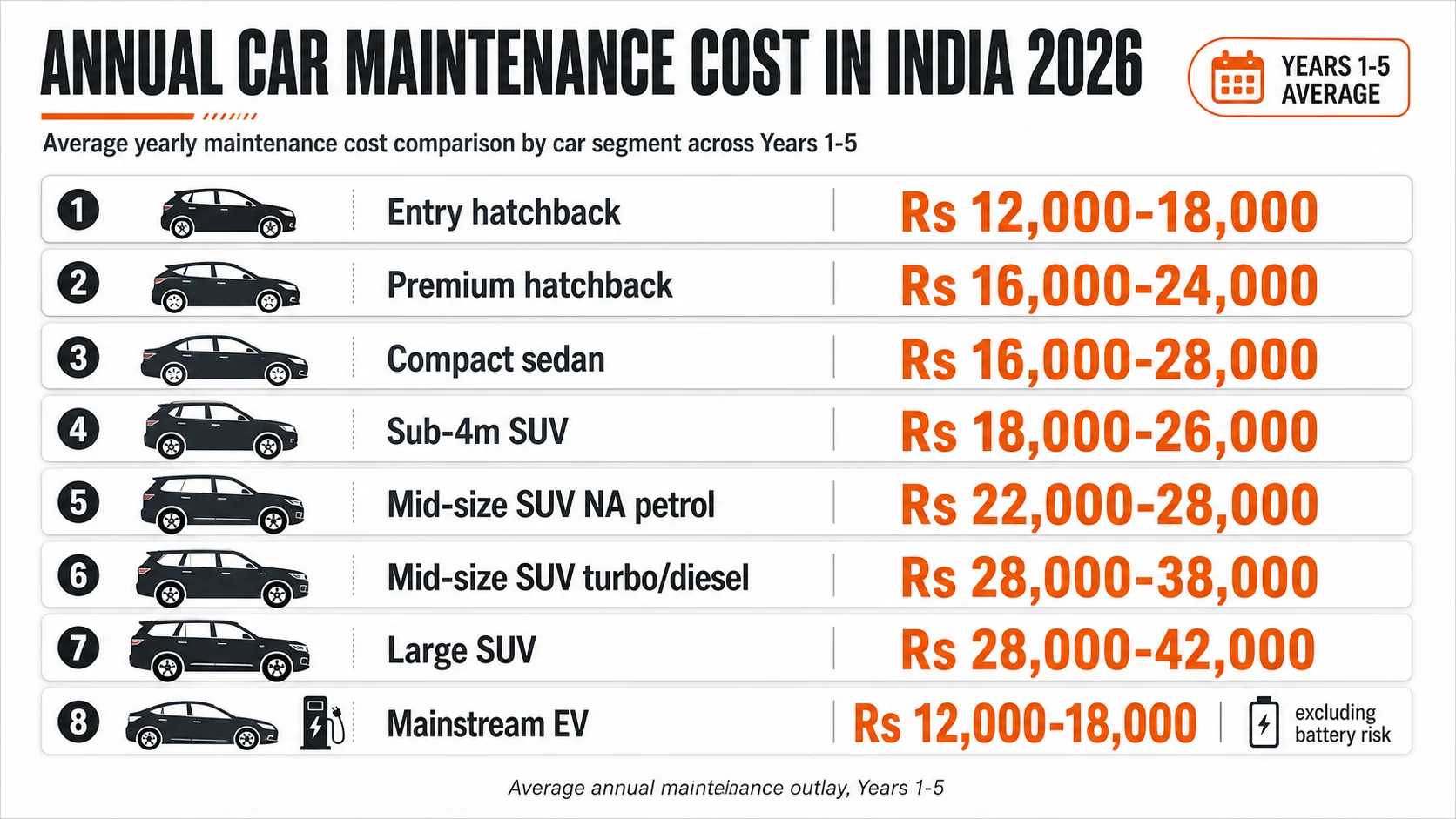
Quick answer (for the impatient):
| Segment | Annual Maintenance (Yrs 1-5 average) |
|---|---|
| Entry hatchback (Alto K10, WagonR) | ₹12,000 – ₹18,000 |
| Premium hatchback (Swift, Baleno, Grand i10 Nios) | ₹16,000 – ₹24,000 |
| Compact sedan (Dzire, Amaze) | ₹16,000 – ₹28,000 |
| Sub-4m SUV (Brezza, Punch, Nexon petrol) | ₹18,000 – ₹26,000 |
| Mid-size SUV NA petrol (Creta, Seltos) | ₹22,000 – ₹28,000 |
| Mid-size SUV turbo/diesel (Creta DCT, Seltos Turbo) | ₹28,000 – ₹38,000 |
| Mid-size sedan European (Slavia, Virtus TSI) | ₹24,000 – ₹32,000 |
| Large SUV (XUV700 diesel) | ₹28,000 – ₹42,000 |
| Mainstream EV (Nexon EV, MG ZS EV) | ₹12,000 – ₹18,000 (excl. battery risk) |
These are amortised numbers. They include scheduled service plus a yearly reserve for wear-and-tear items like brake pads, the 12V battery, and tyres. If you prefer those rupees per kilometre driven, the per-kilometre maintenance breakdown runs the same components at 10,000 km a year. They exclude fuel, insurance, and depreciation, which we cover separately below.
Annual Maintenance Cost by Popular Model
Here’s the core data table. The “Annual Maintenance” column averages scheduled service plus a yearly sinking fund for wear-and-tear consumables (brake pads, battery, tyres prorated, suspension bushes). It does not include fuel or insurance, which we’ll add later for total ownership cost.
| Vehicle Model & Segment | Powertrain | Annual Maintenance (Yrs 1-5) | Powertrain Risk | Spare Parts Ecosystem |
|---|---|---|---|---|
| Maruti Alto K10 (Entry) | 1.0L NA Petrol | ₹12,000 – ₹16,000 | Very Low | Excellent (MGP, FNG access) |
| Maruti WagonR (Tallboy) | 1.0L / 1.2L NA Petrol | ₹14,000 – ₹18,000 | Very Low | Excellent (MGP, FNG access) |
| Maruti Celerio | 1.0L NA Petrol | ₹14,000 – ₹18,000 | Very Low | Excellent |
| Maruti Swift (Premium Hatch) | 1.2L Z-Series Petrol | ₹16,000 – ₹22,000 | Very Low | Excellent |
| Maruti Dzire (Compact Sedan) | 1.2L NA Petrol | ₹16,000 – ₹22,000 | Very Low | Excellent |
| Maruti Baleno | 1.2L NA Petrol | ₹17,000 – ₹23,000 | Very Low | Excellent |
| Maruti Brezza (Compact SUV) | 1.5L NA Mild-Hybrid | ₹18,000 – ₹24,000 | Very Low | Excellent |
| Maruti Fronx | 1.2L NA / 1.0L Turbo | ₹17,000 – ₹24,000 | Low | Excellent |
| Hyundai Grand i10 Nios | 1.2L NA Petrol | ₹18,000 – ₹24,000 | Low | Excellent |
| Tata Tiago | 1.2L NA Petrol | ₹18,000 – ₹22,000 | Low (minor electrical gremlins) | Good |
| Tata Punch | 1.2L NA Petrol | ₹19,000 – ₹24,000 | Low | Good |
| Renault Kwid | 0.8L / 1.0L Petrol | ₹16,000 – ₹22,000 | Low | Moderate (longer downtime in non-metros) |
| Honda Amaze (Compact Sedan) | 1.2L i-VTEC Petrol | ₹22,000 – ₹28,000 | Low | Good |
| Tata Nexon (Petrol) | 1.2L Turbo Petrol | ₹22,000 – ₹26,000 | Moderate (turbo, 6-yr major service spike) | Good |
| Tata Nexon (Diesel) | 1.5L Turbo Diesel | ₹28,000 – ₹34,000 | High (DPF risk, ₹22-26K major service) | Good |
| Kia Sonet / Hyundai Venue | 1.2L NA Petrol | ₹20,000 – ₹26,000 | Low | Excellent |
| Mahindra XUV3XO | 1.2L Turbo Petrol | ₹22,000 – ₹28,000 | Moderate (turbo) | Good |
| Hyundai Creta / Kia Seltos | 1.5L NA Petrol | ₹22,000 – ₹28,000 | Low | Excellent |
| Hyundai Creta / Kia Seltos | 1.5L Turbo DCT | ₹28,000 – ₹38,000 | High (DCT clutch wear, mechatronics) | Excellent |
| Hyundai Creta / Kia Seltos | 1.5L Diesel | ₹30,000 – ₹38,000 | High (DPF clogging) | Excellent |
| Honda City / Hyundai Verna | 1.5L NA / Turbo Petrol | ₹20,000 – ₹26,000 | Low | Good |
| Skoda Slavia / VW Virtus | 1.0L / 1.5L TSI Petrol | ₹24,000 – ₹32,000 | Moderate-High (turbo plumbing, DSG mechatronics) | Good (95% MQB A0-IN localised, but ASC-dependent) |
| Mahindra XUV700 | 2.0L Turbo / 2.2L Diesel | ₹28,000 – ₹42,000 | Moderate (heavy brake wear, complex ADAS) | Good |
| Tata Harrier / Safari (Diesel) | 2.0L Turbo Diesel | ₹32,000 – ₹45,000 | High (DPF, larger oil volume, 18-inch tyres) | Moderate |
| Mahindra Scorpio-N (Diesel) | 2.2L Turbo Diesel | ₹30,000 – ₹42,000 | High (DPF, larger consumables) | Good |
| Tata Nexon EV / MG ZS EV | 30-50 kWh battery | ₹12,000 – ₹18,000 (excl. battery risk) | High post-warranty (battery degradation) | OEM ASC-dependent |
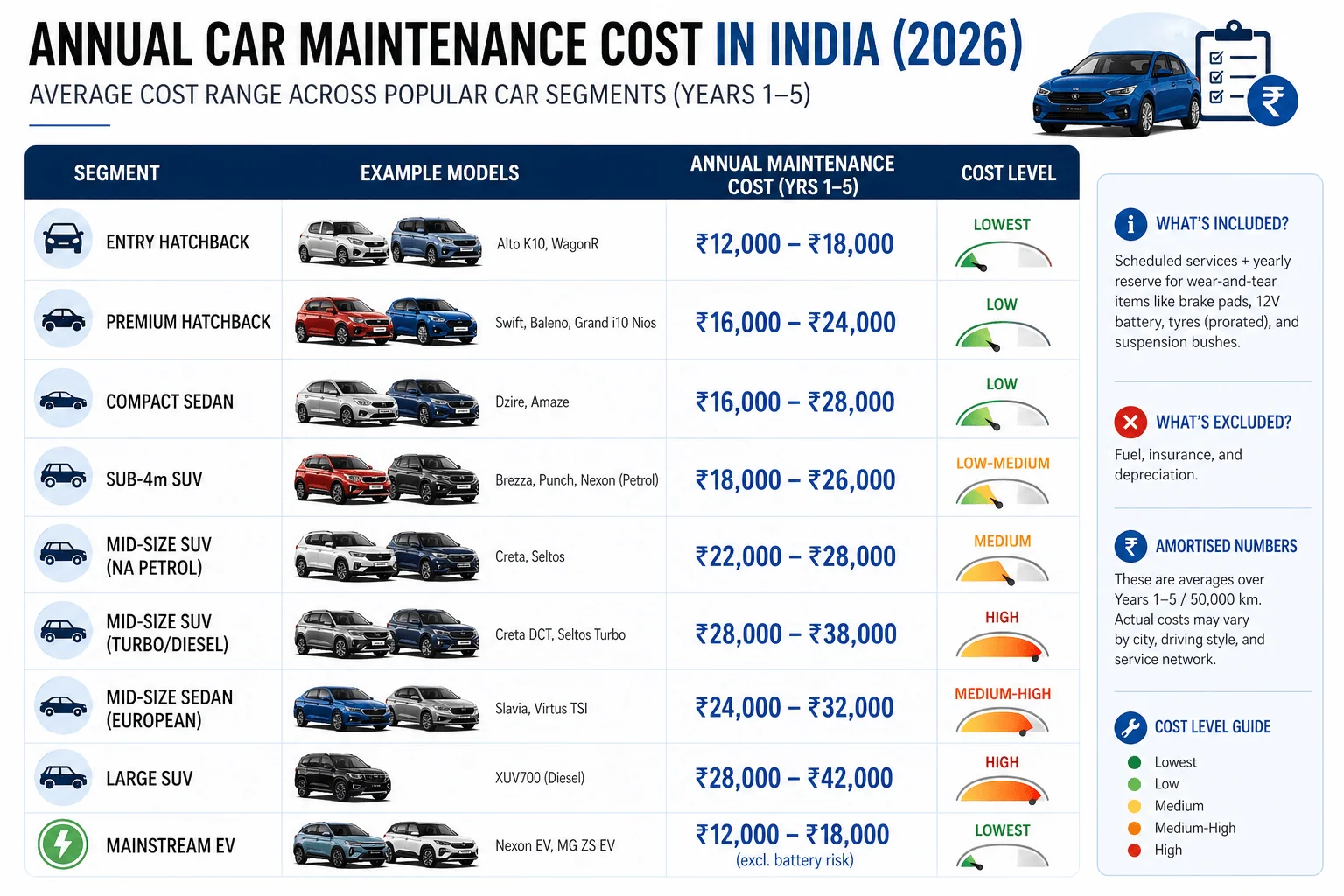
A few things worth flagging about this table.
The Brezza wins quietly. The Maruti Brezza’s 1.5L mild-hybrid NA engine pulls in roughly ₹17,092 in scheduled service over five years, which is the lowest in its segment. Compare that to the Kia Seltos NA (~₹19,481 over five years) and the Hyundai Creta NA (~₹22,601 over five years). Same body class, ~30% cost gap, mostly because the Brezza skips turbocharger thermal management entirely.
Diesel is no longer cheap. The Tata Nexon diesel runs ₹9,500-11,000 a year in scheduled service alone, but the financial event nobody talks about is the 6-year / 90,000 km major service. Timing belt kit, tensioner, water pump, the works. That single visit can run ₹22,000-26,000. Plus DPF risk, which we’ll get to.
EVs look cheap on the service menu, but read the asterisk. A mainstream EV’s annual scheduled service is genuinely tiny, ₹3,500-7,000. But once you factor in faster tyre wear, eventual battery anxiety, and brutal secondary-market depreciation, the picture changes. More on this below.
Cheapest Cars to Maintain in India
If you want the shortest possible annual maintenance bill over a 5-year window, the answer is boring and consistent. It’s a Maruti.
The Maruti Alto K10 and WagonR sit at the absolute floor: ₹12,000-18,000 a year all-in. Three structural reasons explain why no other brand matches this:
1. Aggressive component sharing. Suspension bushes, alternators, filtration parts, and electrical relays in the WagonR are the same components used in the Swift, Baleno, Dzire, and Fronx. Maruti orders these in volumes that no rival can match, so the per-piece cost stays artificially suppressed.
2. The Maruti Genuine Parts (MGP) ecosystem. Maruti openly distributes its genuine parts to friendly neighbourhood garages (FNGs), not just authorised service centres. Once your warranty ends, you can have a small workshop fit MGP parts at half the labour rate of a Maruti ASC. No other brand allows this kind of leakage from its parts channel.
3. Service network density. Over 1,500 distributor touchpoints and thousands of service centres, deep into Tier-3 cities. Competition between centres keeps labour rates down. A scheduled service that costs ₹5,500-8,000 in Mumbai or Bangalore drops to ₹4,200-6,500 in Jaipur, Kolkata, or Lucknow.
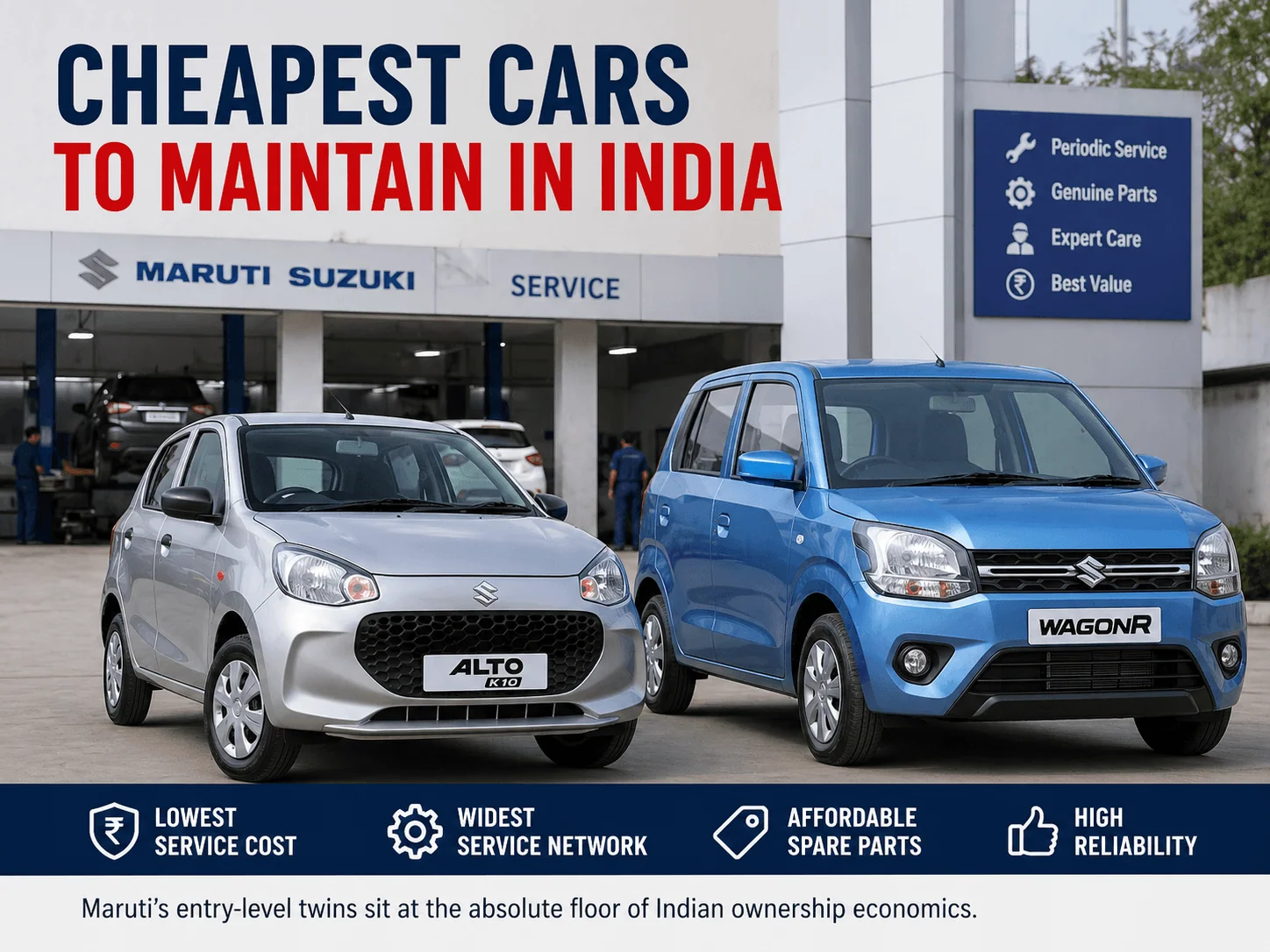
The Cheapest-to-Maintain Shortlist (5-Year Lifecycle)
| Model | Annual Maintenance (Yrs 1-5) | Why It’s Cheap |
|---|---|---|
| Maruti Alto K10 | ₹12,000 – ₹16,000 | Mechanical simplicity, lowest parts pricing |
| Maruti WagonR | ₹14,000 – ₹18,000 | MGP network, parts shared across portfolio |
| Maruti Celerio | ₹14,000 – ₹18,000 | NA petrol or CNG, low labour |
| Maruti Dzire | ₹16,000 – ₹22,000 | High fuel efficiency, high resale |
| Tata Tiago | ₹18,000 – ₹22,000 | Extended service intervals, structurally safe |
| Hyundai Grand i10 Nios | ₹18,000 – ₹24,000 | Transparent service billing, refined NA engine |
| Maruti Brezza | ₹18,000 – ₹24,000 | Lowest scheduled cost in compact SUV class |
The Tata Tiago deserves a special mention. It’s structurally one of the safest entry hatchbacks (4-star Global NCAP) and its scheduled costs are competitive, but it does occasionally throw minor electrical sensor faults that bump the long-term bill slightly above the WagonR. If safety matters more to you than rupee-perfect optimisation, the Tiago is a smart pick.
The Renault Kwid is another value play, but its parts logistics outside metros are slower than Maruti’s. So even though the bill is similar, the car can sit at the workshop for an extra 2-3 days waiting for, say, a specific bumper clip. That’s an indirect cost (cab fares, lost productivity) most owners forget to count.
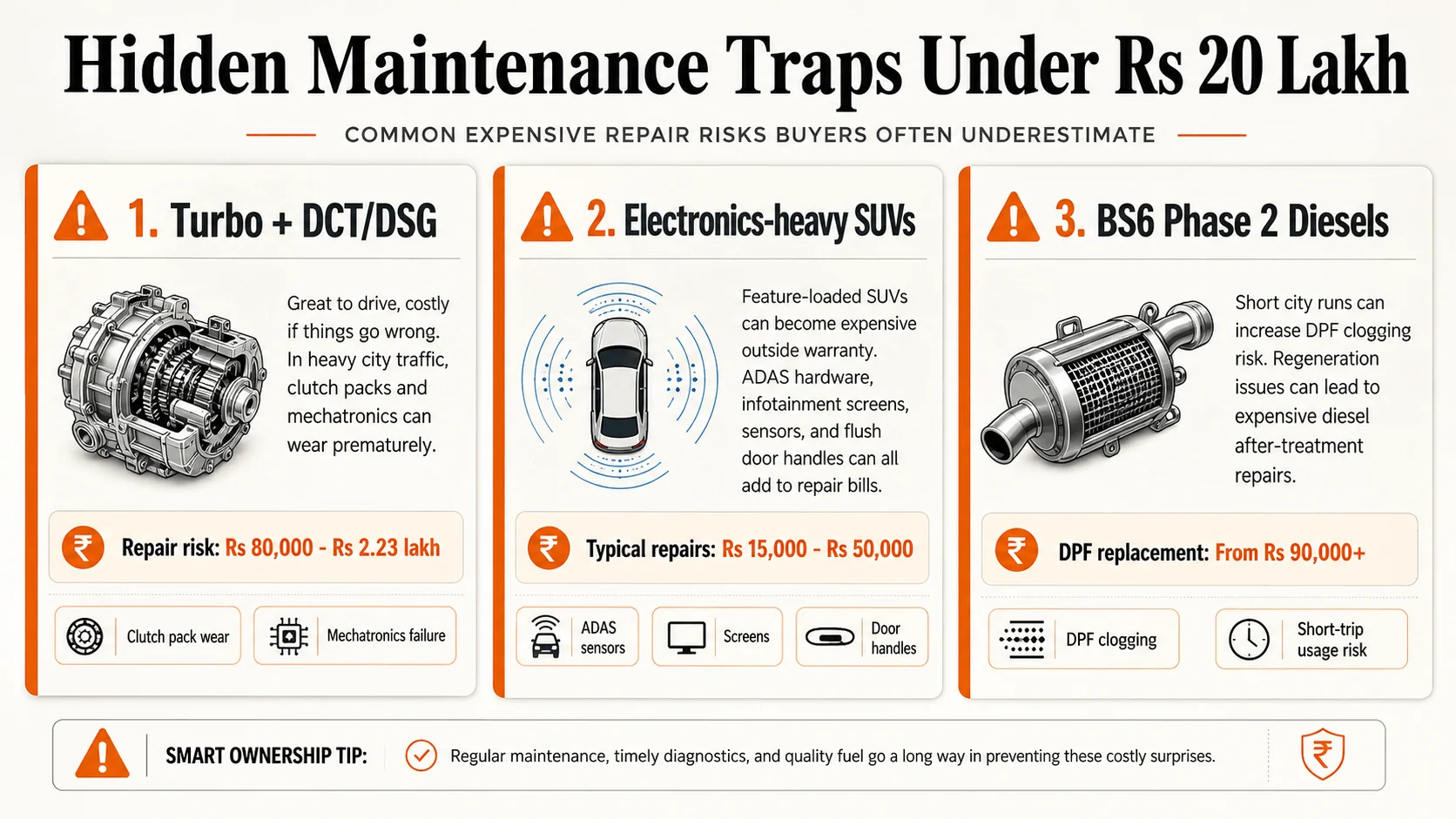
Most Expensive Cars to Maintain (Under ₹20 Lakh)
The ₹15-20 lakh segment is where automotive marketing has done its best work and your wallet has done its worst. Buyers walk in expecting Maruti-grade running costs because, well, the car costs less than ₹20L. But the engineering inside these cars is borrowed from luxury platforms, and so is the bill that comes with them.
Three categories quietly cost a fortune to keep on the road.
1. Turbo-Petrols Mated to Dual-Clutch Transmissions
Models like the Kia Seltos 1.5 Turbo DCT, Hyundai Creta N-Line, Skoda Kushaq 1.5 TSI DSG, and VW Taigun 1.5 TSI DSG drive beautifully. They also operate at the absolute edge of internal combustion stress.
A dry-clutch DCT/DSG hates Indian urban traffic. In bumper-to-bumper crawl, the transmission’s computer constantly slips the dry clutches at sub-10 km/h speeds to prevent stalling, which generates heat the gearbox can’t dissipate. The clutch packs wear out prematurely, and the delicate mechatronics unit (the brain of the gearbox) frequently suffers thermal failure post-warranty.
Real invoices for a post-warranty DSG/DCT clutch + flywheel + mechatronics replacement: ₹80,000 to ₹2,23,000.
If your daily commute is heavy urban traffic and you’re cross-shopping a Seltos, take the manual or the IVT (CVT) over the DCT. Save the gearbox, save the bill.
2. Feature-Dense, Electronics-Heavy SUVs
The Mahindra XUV700 packs in motorised pop-out door handles, dual-screen digital displays, electronic parking brakes, and Level 2 ADAS radars at a price most rivals can’t match. That’s value at purchase.
The trouble is, every one of those features is a future failure point. Year 4-6 onwards, electronic sensors degrade, software-hardware desyncs creep in, and individual repairs can run ₹15,000-50,000. ADAS recalibration after a simple windshield replacement (a stone chip on the highway) adds ₹2,500-4,500 to your insurance claim.
The XUV700’s annual maintenance over years 1-5 is manageable at ₹28,000-42,000. The shock comes in years 6-8, when the electronics start retiring one by one.
3. Heavyweight BS6 Phase 2 Diesels
The diesel variants of the Tata Safari, Tata Harrier, and Mahindra Scorpio-N drink fully synthetic oil at ₹1,100-1,300 per litre, and they need a lot of it. Their kerb weight (often above 1,800 kg) chews through brake pads and large 18-inch tyres faster than a hatchback.
But the real ambush is the Diesel Particulate Filter (DPF). More on that next.
The BS6 Phase 2 Diesel Particulate Filter Crisis
This deserves its own warning section because it’s the single biggest hidden cost in modern Indian car ownership.
Every BS6 Phase 2 diesel sold today (Hyundai Creta, Kia Seltos, Mahindra Scorpio-N, Tata Harrier, Tata Safari, the lot) carries a DPF in its exhaust line. The filter traps soot. To clean itself, the engine has to hit and sustain very high exhaust temperatures, which only happens when you drive above 60 km/h with engine speeds above 2,000 RPM for more than 20-30 minutes on the highway.
If you bought the diesel because you “drive a lot in the city” and your daily routine is short stop-and-go office commutes, the DPF will never regenerate properly. It will clog. Eventually, the soot turns into hardened ash that no amount of forced regeneration can remove. At that point, OEM DPF replacement quotes start at ₹90,000 and go up.
There is an aftermarket workaround: dedicated DPF cleaning machines that flush the filter using chemical solvents and high-pressure water. Cost: ₹4,000-6,000 per cleaning. It buys time but it’s not a permanent fix, and most owners discover it only after they’ve already paid ₹90,000 for a replacement.
Bottom line: if your driving is predominantly urban and under 12,000 km a year, the diesel maintenance math no longer works. A petrol or strong hybrid will be cheaper across a 7-10 year window even with worse fuel economy.
What’s Actually Included in Annual Maintenance Cost
Most “car maintenance cost” calculators online give you a service-only number and call it done. That’s wrong. Here’s what a realistic annual maintenance budget actually contains.
1. Scheduled Service (Predictable)
Every 10,000 km or 12 months, whichever comes first. Non-negotiable in Indian driving conditions. The 15,000-20,000 km intervals quoted in European service manuals do not apply here, our heat, dust, and traffic load tribologically punishes engine oil far faster.
A typical scheduled service includes:
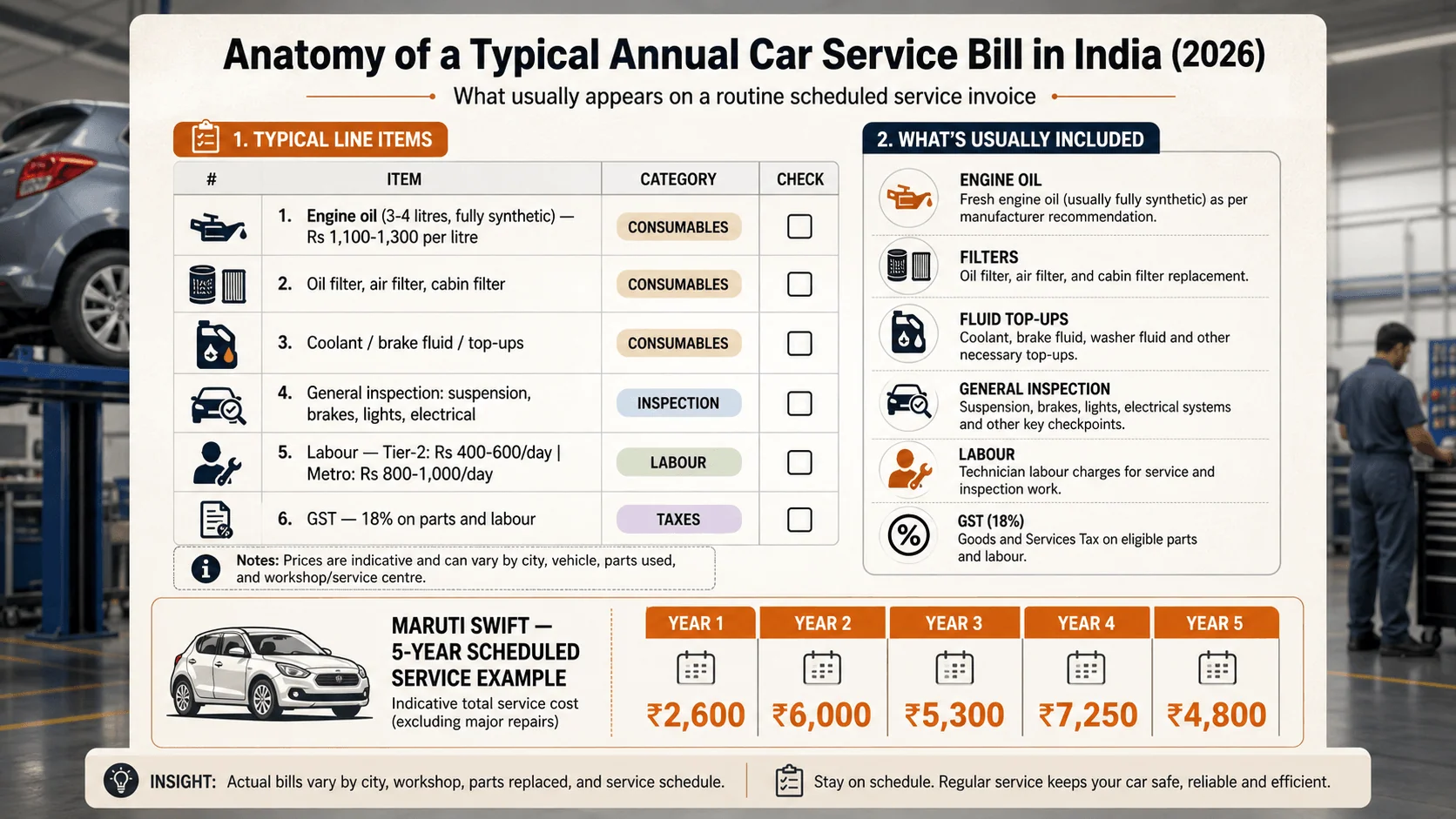
- Engine oil change (3-4 litres of fully synthetic 0W-20 or 5W-30 at ₹1,100-1,300 per litre)
- Oil filter, air filter, cabin pollen filter
- Top-up of coolant, brake fluid, power steering fluid (if applicable)
- General inspection (suspension, brakes, lights, electrical)
- Labour charges (₹400-600/day in Tier-2, ₹800-1,000/day in Mumbai/Bangalore/Delhi)
- 18% GST on parts and labour combined
For a 2026 Maruti Swift, this works out to ₹2,600 (Year 1) → ₹6,000 (Year 2) → ₹5,300 (Year 3) → ₹7,250 (Year 4 major) → ₹4,800 (Year 5). Roughly 60 paise per kilometre averaged across five years.
2. Wear-and-Tear Items (Unscheduled but Inevitable)
These are explicitly excluded from your manufacturer warranty and from most basic AMCs. They will hit you, just at unpredictable intervals.
| Item | Replacement Frequency | Cost (2026) |
|---|---|---|
| Front brake pads | 30,000-50,000 km | ₹1,500 – ₹4,500 |
| Rear brake shoes | 60,000-80,000 km | ₹1,200 – ₹3,500 |
| Clutch plate set | 60,000-1,00,000 km (urban abuse cuts this by half) | ₹6,500 – ₹18,000 |
| 12V auxiliary battery | 3-4 years | ₹4,500 – ₹12,000 |
| Shock absorbers (pair) | 60,000-1,00,000 km | ₹4,500 – ₹12,000 |
| Tyres, set of 4 (15-inch) | 40,000-50,000 km | ₹16,000 |
| Tyres, set of 4 (17/18-inch) | 35,000-45,000 km | ₹40,000 + |
| Wiper blades | Yearly | ₹600 – ₹1,500 |
Smart yearly budgeting means setting aside ₹6,000-12,000 every year as a sinking fund for these. They will arrive.
3. Insurance (Recurring, Heavily Variable)
Insurance is the second largest annual ownership cost after fuel for most buyers, and it’s the easiest to under-estimate. A typical comprehensive premium runs 2.5-3.5% of your car’s IDV (Insured Declared Value) in year one and declines as the IDV depreciates.
Real 2026 numbers, sub-4m petrol SUV (Tata Nexon Petrol), brand new:
- Own-damage component: ₹24,966
- Third-party (3-year statutory): ₹10,640
- Total Year 1: ₹35,606 (before NCB and dealer discounts)
For a Honda City class sedan, expect ₹15,000-20,000. For a mid-range SUV like the Creta, expect ₹18,000-25,000. Luxury vehicles routinely cross ₹50,000.
If your car is less than 5 years old, always keep the Zero Depreciation (Bumper-to-Bumper) add-on. Modern cars are loaded with LED headlight clusters, radar sensors, and intricate plastic body panels that get hit with a 50% depreciation deduction in standard claim settlements without it.
4. Tyre Replacement (Hidden Capital Outlay)
Tyres are silent ownership costs. A budget hatchback on 15-inch rubber will cost you ~₹16,000 every 4-5 years. A modern compact or mid-size SUV on 17 or 18-inch tyres will cost ₹40,000+ every 3-4 years. EV tyres (specialised low-rolling-resistance, silica-rich compounds) wear 15-30% faster and replacement sets run ₹30,000-40,000 every 25,000-30,000 km under enthusiastic driving.
Amortise tyres into your annual budget at ₹3,000-10,000 a year depending on size.
5. Fuel (The Daily Drip)
Per-kilometre energy cost in 2026:
| Powertrain | Real-World Efficiency | Running Cost |
|---|---|---|
| Petrol (Naturally Aspirated) | 15 km/l @ ₹100/L | ₹6.66/km |
| Diesel (Turbocharged) | 20 km/l @ ₹90/L | ₹4.50/km |
| CNG (Factory) | 25 km/kg @ ₹87/kg | ₹3.48/km |
| Electric (Home charging) | 7 km/kWh @ ₹8/kWh | ₹1.14/km |
At 12,000 km/year, that’s ₹80,000 (petrol) or ₹14,000 (EV) just in fuel. Fuel is the single biggest ownership cost for ICE cars and dwarfs maintenance in absolute rupees.
6. Capital Depreciation (The Invisible Killer)
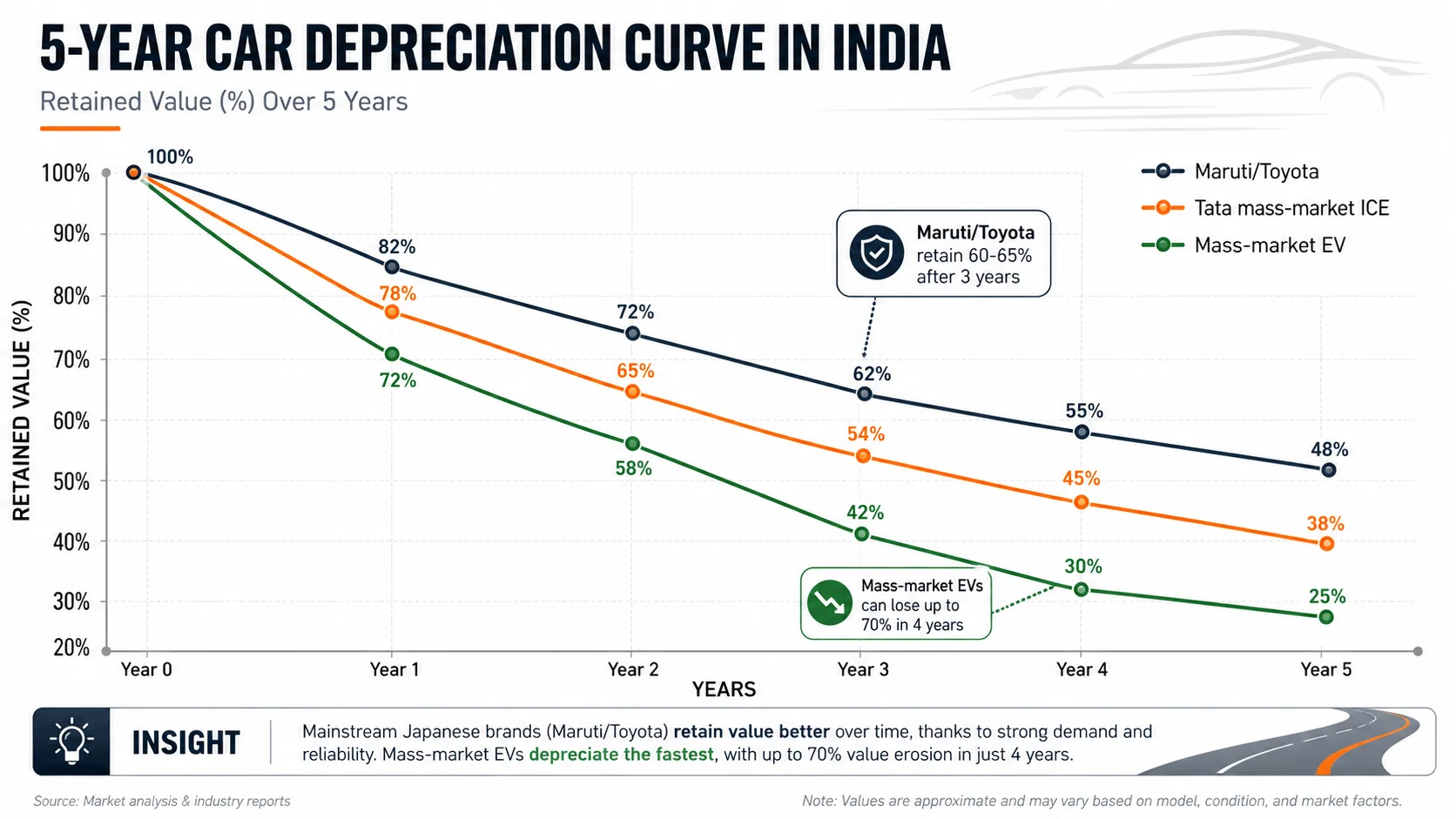
Indian cars typically lose 15-20% of their ex-showroom value in Year 1 alone, then 8-12% annually after. A ₹12 lakh car sold after 3 years for ₹8 lakh has just cost you ₹1.33 lakh per year in invisible depreciation. That’s more than your fuel bill.
Holding the same car for 10 years and selling it at ₹3 lakh reduces the annualised depreciation hit to ₹90,000 a year. The single most powerful way to reduce annualised car cost is to simply hold your car longer.
Brand matters here too. Maruti Suzuki and Toyota retain 60-65% of original value after three years. Mass-market EVs (Tata Nexon EV, MG Comet) routinely lose 50-70% in three to four years. A 2020 Tata Nexon EV bought for ₹16 lakh was trading in at barely ₹4 lakh by 2024.
A Realistic Annual Ownership Budget
Putting all six components together, here’s what a compact petrol SUV (Maruti Brezza or Kia Sonet) actually costs to own per year, driven 10,000 km annually:
| Cost Component | Annual Outlay |
|---|---|
| Insurance renewal | ~₹15,000 |
| Scheduled service at ASC | ~₹8,000 |
| Sinking fund for wear-and-tear (brakes, battery, tyres prorated) | ~₹10,000 |
| Fuel (10,000 km @ ₹6.66/km) | ~₹66,000 |
| Total recurring upkeep (excl. EMI & depreciation) | ~₹99,000 / year |
Roughly ₹8,250 a month, before you account for capital depreciation or loan EMIs.
The honest, accurate answer to “how much does a car cost per year in India” is closer to ₹1.5-2 lakh per year for a mid-segment compact SUV when you factor everything in. Not the ₹40-50K that ASC service quotes alone might suggest.
A Real 6-Year Owner Case Study
A meticulously documented 6-year ownership log of a Hyundai Venue 1.0 SX+ DCT (Petrol), purchased in 2019 for ₹13,35,767 and driven 46,800 km, looked like this:
- Scheduled service over 6 visits: ₹40,147
- Fuel: ₹4,47,119
- Insurance over 6 years: ₹1,06,067
- Extended warranty: ₹27,000
- Battery, bulbs, incidentals: ₹27,600
- Total cash outflow: ₹20,41,975
- Estimated resale at end of Year 6: ₹7,50,000
- Effective ownership cost: ₹27.61 per km
Compare this to the ₹6/km fuel cost most calculators advertise. The truth is 4-5x higher.
Are EVs Really Cheaper to Maintain in India?
This is the most-asked question of 2026, and the honest answer has nuance the brochure doesn’t show.
On scheduled service alone, yes, decisively. A mainstream EV’s annual scheduled bill is ₹3,500-7,000 (vs ₹8,000-15,000 for an equivalent petrol SUV). No oil changes, no spark plugs, no clutch, no DPF, no timing belt. Five-year scheduled service for an EV SUV totals ₹22,000-40,000, against ₹55,000-90,000 for a petrol SUV. Genuine 40-60% saving.
On total cost of ownership, the picture flips for most buyers. Three reasons:
- Tyres wear 15-30% faster. Heavy battery pack (300-400 kg heavier than ICE) plus instantaneous torque means a ₹30,000-40,000 tyre set lasts 25,000-30,000 km instead of 40,000-50,000 km.
- Battery degradation is real. Indian summer temperatures regularly cross 40°C, which accelerates lithium-ion electrolyte breakdown. Real-world data shows 2-4% capacity loss in Year 1, climbing to 15-20% by Year 5. Out-of-warranty battery replacement: ₹3.5 lakh (Tata Tigor EV) to ₹5.2 lakh (Tata Nexon EV).
- Vicious secondary-market depreciation. Used-car dealers don’t trust EV batteries. The Tata Nexon EV example above (₹16L → ₹4L in four years, 75% wealth destruction) is the rule, not the exception.
EVs become economically rational if you drive over 20,000 km a year (cab/ride-share/long-distance commute) and you intend to keep the car at least 7-8 years. For a typical 10,000 km/year private owner who upgrades every 4-5 years, a petrol Maruti will work out cheaper across the full lifecycle, even at ₹7/km fuel.
Is Tata or Maruti Cheaper to Maintain?
Maruti, every time. Three structural reasons:
- Lower baseline labour rates across the network
- Cheaper spare parts due to component sharing across the entire portfolio
- Mechanically simpler engines (predominantly NA petrols, no DPF, no DCT)
Tata builds genuinely safer cars (5-star Global NCAP for the Punch, Nexon, Altroz) with better build quality. But its parts logistics are tighter, its labour rates slightly higher, and its 6-year/90,000-km major service for diesels can hit ₹22,000-26,000 in a single visit, a spike rarely seen in the equivalent Maruti portfolio.
If your decision is purely about minimising lifetime maintenance bills: Maruti. If you weigh structural safety equally: Tata Punch or Nexon, with the petrol variant, not the diesel.
For brand-level service economics, see our deeper data resource on brand-level service costs covering Maruti, Hyundai, Tata, Mahindra, Honda, and Kia in detail.
How to Reduce Your Annual Car Maintenance Cost
Five strategies that actually move the needle. They’re ranked by how much money each saves a typical owner over a 5-year window.
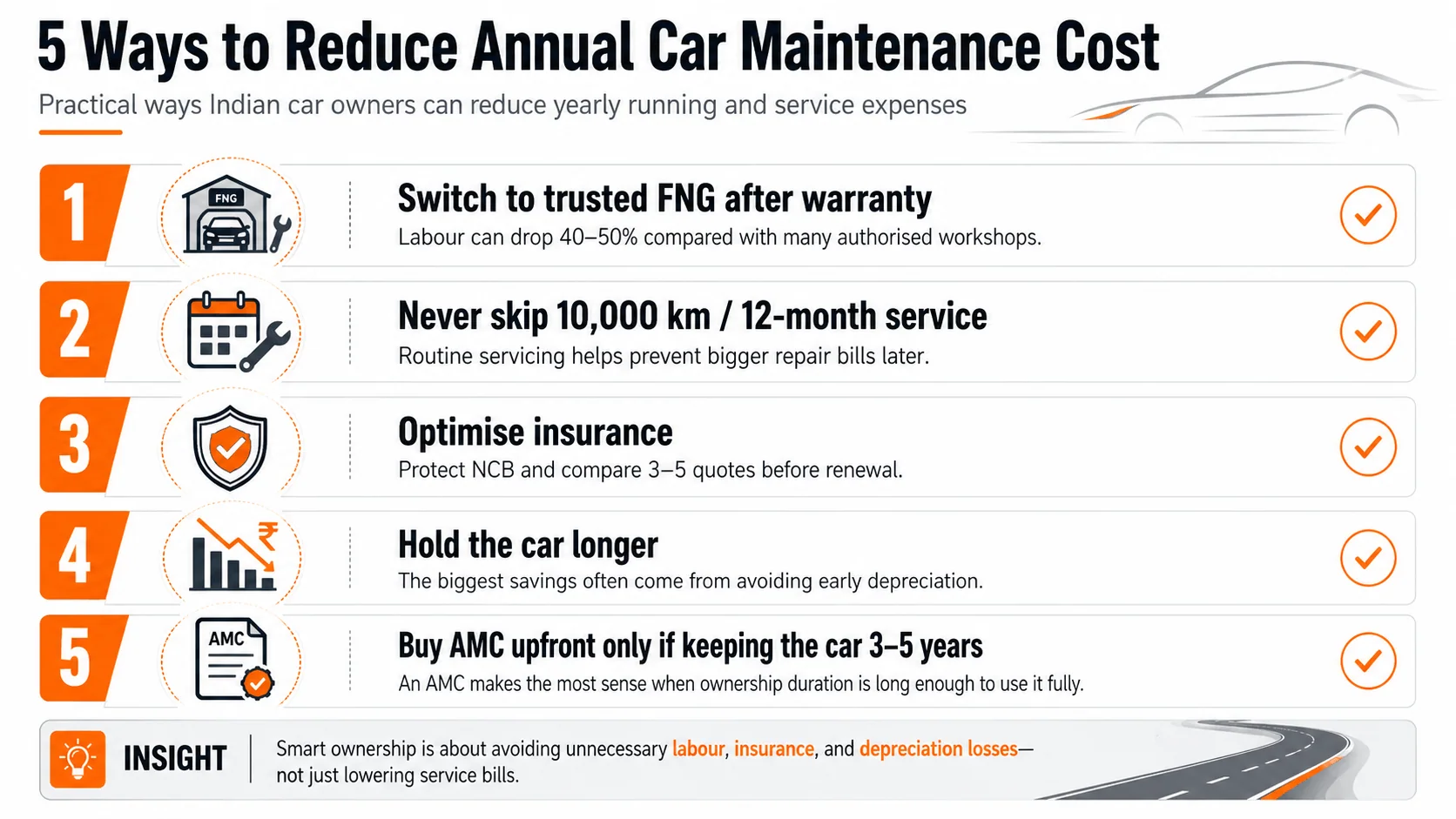
1. Switch to a Friendly Neighbourhood Garage After Warranty (Biggest Win)
ASCs operate on huge corporate overheads. They’re also incentivised to swap entire assemblies rather than repair sub-components. A leaking AC cooling coil that a competent local mechanic can replace for ₹5,000 turns into a ₹33,000 AC compressor unit replacement quote at the ASC.
Once your statutory warranty ends, transitioning to a trusted FNG:
- Cuts labour rates by 40-50% (FNG: ₹400-600/day vs ASC ₹800-1,000/day)
- Lets you buy parts directly from OES suppliers (Bosch, TRW, Valeo, Schaeffler) at 30-40% cheaper than the OEM box. The exact same component, just different packaging.
- A set of front brake pads in an OEM box: ₹3,200. Same component in OES branding: ₹2,100.
The catch: do this only after warranty, and only with an FNG that has documented ratings, treats your service book seriously, and uses verifiable OES parts.
2. Don’t Skip the 10,000 km / 12-Month Service Interval
Counter-intuitive, but skimping on scheduled service is the most expensive false economy in Indian car ownership. The 15,000-20,000 km intervals advertised by some European luxury manufacturers do not apply to Indian conditions. Our heat and dust shorten the molecular life of synthetic engine oil dramatically.
Skip a service to save ₹5,000 today, you risk premature engine wear costing ₹50,000-2,00,000 in six months. Don’t.
3. Optimise Insurance Aggressively
- Years 1-5: Always keep Zero Depreciation add-on. Modern cars carry too much expensive plastic and electronics for standard policies.
- Year 5+: Drop Zero Depreciation (it gets prohibitively expensive or denied), switch to a standard comprehensive policy.
- Always protect your No Claim Bonus. A 50% NCB after 5 claim-free years is a permanent 50% discount on your own-damage premium. Don’t claim for ₹3,000 cosmetic dents, pay out of pocket and keep the NCB intact.
- Get 3-5 quotes per renewal. Premiums for the same IDV swing 15-30% across insurers.
4. Hold the Car Longer
Already covered above, but it bears repeating because it’s the single most powerful lever. The annualised cost of a ₹12L car held for 10 years is roughly half the annualised cost of the same car held for 3 years. Most of the destruction happens in Years 1-3.
5. Consider an Annual Maintenance Contract (AMC) Upfront
Tata Motors’ Gold AMC, Maruti’s Service Plan, and Hyundai’s Shield of Trust packages let you lock in the cost of labour, scheduled fluids, filters, and high-wear items like brake pads at today’s prices for 3-5 years. Given that India’s vehicle parts imports rose 18.92% YoY in late 2025, locking in today’s prices is mathematically strong, provided you’ll actually keep the car for the full AMC duration.
Don’t buy a 5-year AMC if you plan to sell at year 3.
A factor in your overall buying decision: a car that’s ₹50,000 cheaper at ex-showroom but costs ₹15,000 more to maintain every year wipes out its price advantage in 3 years. Always factor into buying decision the long-term running cost, not just the sticker.
City vs Highway: How Your Driving Pattern Changes the Bill
Same car, two cities, different bills.
A scheduled service for a mid-segment car at an ASC in Mumbai, Bangalore, or Delhi NCR costs ₹5,500-8,000. The exact same service in Jaipur, Kolkata, or Lucknow drops to ₹4,200-6,500. Real-estate-driven facility overheads and metro labour rates are the difference.
City driving is brutal on certain components: brakes, the clutch (especially DCTs), and the engine cooling system. The engine never reaches optimal operating temperature, leading to premature carbon deposits and intake valve fouling. In diesel cars, this is what kills DPFs.
Highway driving is gentler on those components but harder on tyres (sustained high-speed friction) and on the windshield/radar sensors (stone chips at 100+ km/h, which now trigger expensive ADAS recalibration).
Match your car to your dominant driving pattern. If you do 80% city, you want NA petrol or strong hybrid, never a turbo-diesel or DCT. If you do 80% highway, diesel becomes economically viable again, and the DPF gets to regenerate properly.
FAQs
Which car is cheapest to maintain in India?
The Maruti Suzuki Alto K10 and WagonR are the cheapest cars to maintain in India, with annual maintenance costs averaging ₹12,000-18,000 over a 5-year window. They benefit from massive component sharing across Maruti’s portfolio, the cheapest spare parts in the market via the MGP network, and the densest service network in the country. The Tata Tiago and Hyundai Grand i10 Nios follow closely at ₹18,000-24,000 per year.
How much does car maintenance cost per year in India?
Annual car maintenance cost in India ranges from ₹4,000-12,000 in Years 1-3 (the warranty honeymoon phase) to ₹15,000-22,000 for hatchbacks and ₹20,000-35,000 for SUVs and sedans once wear-and-tear items start hitting in Years 4-6. A realistic full-budget number that includes scheduled service plus a sinking fund for brake pads, tyres prorated, and the auxiliary battery is closer to ₹18,000-30,000 a year for most mass-market cars.
Is Tata or Maruti cheaper to maintain?
Maruti is unequivocally cheaper to maintain. Maruti offers lower baseline labour rates, fundamentally cheaper spare parts thanks to economies of scale, and mechanically simpler naturally aspirated petrol engines. Tata builds structurally safer cars, but the diesel variants (Nexon, Harrier, Safari) carry expensive timing belt replacements, DPF risks, and a 6-year/90,000 km major service that can run ₹22,000-26,000 in a single visit. For lowest lifetime cost, choose Maruti. For best build safety + reasonable cost, choose a Tata petrol (Punch or Nexon).
What is a realistic yearly budget for car upkeep?
For a mid-range compact petrol SUV (Maruti Brezza, Kia Sonet) driven 10,000 km a year, budget approximately ₹15,000 for insurance renewal, ₹8,000 for scheduled ASC service, ₹10,000 into a sinking fund for future tyre and battery replacements, and ₹66,000 for petrol. Total recurring upkeep: roughly ₹99,000 per year, or ₹8,250 a month. This excludes loan EMIs and capital depreciation.
Which cars have the lowest maintenance after 5 years?
Cars with naturally aspirated petrol engines mated to manual transmissions or traditional torque-converter automatics have the lowest post-warranty maintenance bills. Models like the Honda City, Maruti Brezza, Toyota Glanza, and Maruti Dzire are known for staying cheap long after the warranty ends. They structurally avoid the catastrophic failure risks of turbochargers, dry dual-clutch transmissions (DSG/DCT), and Diesel Particulate Filters (DPF), which routinely shock owners of European cars and modern diesels after Year 5.
Are EVs really cheaper to maintain in India?
On scheduled service alone, yes, EVs are 40-60% cheaper, with annual service bills of just ₹3,500-7,000 versus ₹8,000-15,000 for a petrol SUV. However, when you account for the full cost of ownership, EVs lose this advantage for most private buyers. EVs consume specialised tyres 15-30% faster, face higher comprehensive insurance premiums, and suffer brutal secondary-market depreciation (often losing 50-70% of value in 3-4 years). Unless you drive more than 20,000 km a year and keep the car for 7-8 years, a comparable petrol vehicle works out cheaper over a standard 5-year ownership cycle.
Does service cost increase with car age in India?
Yes, significantly. Maintenance costs follow a U-shaped curve. Years 1-3 are the warranty honeymoon, with low scheduled service bills and zero wear-and-tear surprises. Years 4-5 see the bill flatten or dip slightly as you exit free services. From Year 6 onwards, costs climb exponentially as major wear items kick in: clutches (₹6,500-18,000), shock absorbers (₹4,500-12,000 per pair), tyres (₹16,000-40,000 per set), the 12V battery (every 3-4 years at ₹4,500-12,000), and any major engine services like the Tata Nexon diesel’s 90,000 km timing belt overhaul.
Should I buy an extended warranty?
For modern cars loaded with electronics, ADAS sensors, and turbocharged engines, an extended warranty (Year 4-5 cover) is mathematically strong if priced reasonably. Single sensor failures or a turbocharger replacement can run ₹40,000-1,50,000 out of warranty. Extended warranty prices vary from ₹15,000-40,000 for 2 additional years depending on segment. For simple naturally aspirated petrol cars (Maruti Alto, WagonR, Swift), the math is closer to a wash, you’re often better off self-insuring with a sinking fund.
The Bottom Line
The cheapest car to maintain in India is, without exception, an entry-level Maruti. The most expensive trap, hidden behind sticker prices that look harmless, is a diesel SUV with a DPF, or a turbo-petrol with a dual-clutch gearbox, driven primarily in city traffic.
Match your car to your annual mileage and driving pattern, and the maintenance bill takes care of itself. Mismatch them, and no service plan in the country will save you.
Run the numbers before you sign the loan, not after.