Most people buy whatever car insurance their dealer recommends, then wonder why their next claim got rejected. Here’s what nobody tells you up front: third party and comprehensive aren’t two flavours of the same product. They protect very different things, and the price gap between them isn’t really about “savings”. It’s about who pays when your bumper breaks, your car gets stolen, or Mumbai floods your engine.
This is the practical breakdown. Real 2026 premium numbers across five car price bands, five claim scenarios with rupee math, and a straight answer on which one you actually need.
Third Party vs Comprehensive: Quick Comparison
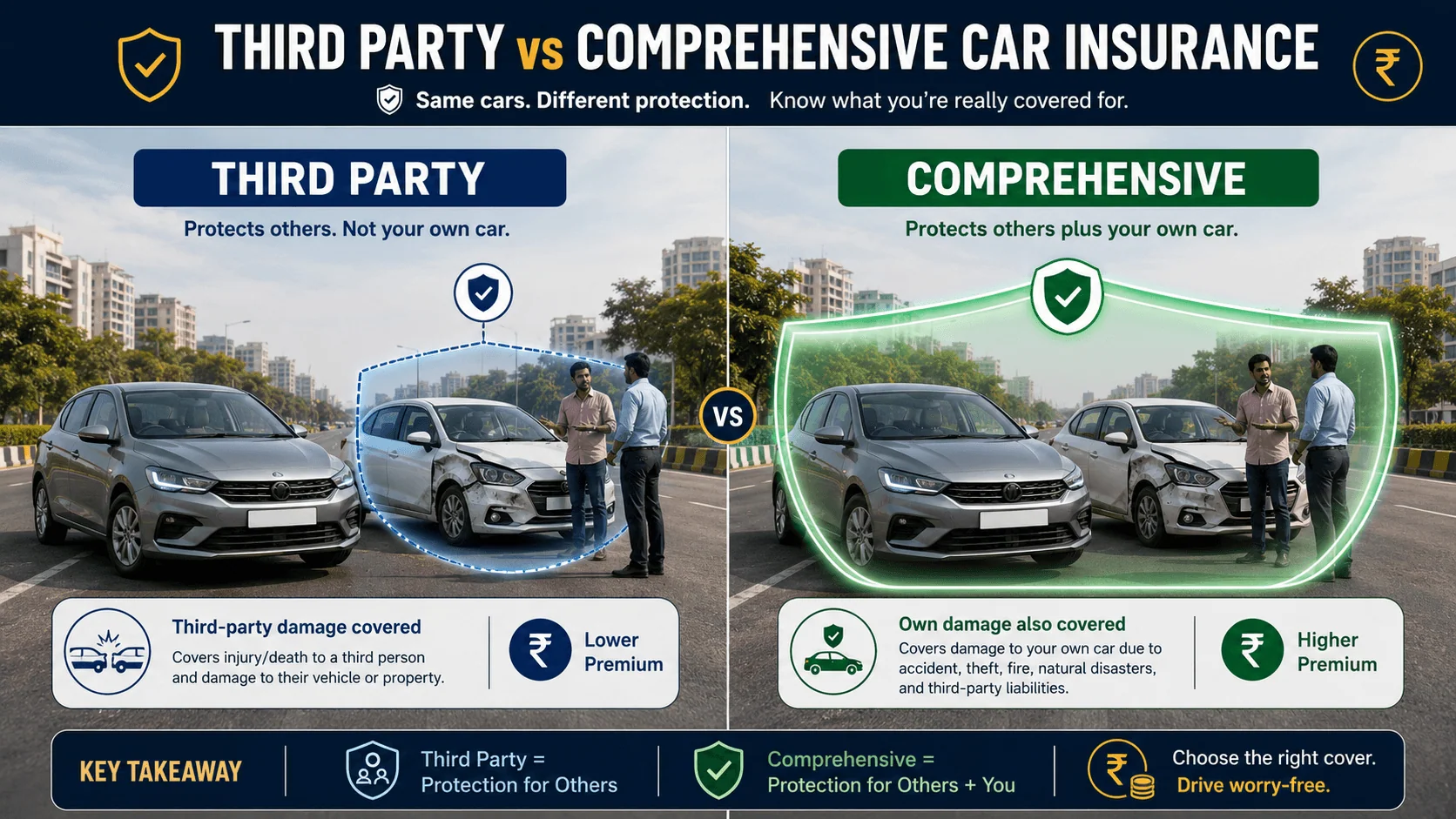
Before we go deep, here’s the table you’ll want to screenshot. It captures every meaningful difference.
| Comparison Point | Third Party Insurance | Comprehensive Insurance |
|---|---|---|
| Legal status | Mandatory under Section 146, Motor Vehicles Act 1988 | Optional, but includes the mandatory third party cover |
| Premium set by | IRDAI (fixed by engine cc) | Insurer (variable, based on IDV) |
| Premium cost | Lowest | 3x to 15x higher |
| Covers damage to others | Yes (injury, death, property up to ₹7.5 lakh) | Yes |
| Covers your own car (accident) | No | Yes |
| Theft | No | Yes |
| Fire / explosion | No | Yes |
| Floods, cyclones, natural calamity | No | Yes |
| Vandalism, riots, malicious damage | No | Yes |
| IDV (Insured Declared Value) | Doesn’t apply | Applies (sets payout ceiling) |
| No Claim Bonus | None | Up to 50% discount |
| Add-ons | Usually not available | Zero Dep, Engine Protection, RTI, RSA, etc. |
| Best for | Old, low-value cars | New cars, financed cars, daily-use cars |
Quick verdict: Third party is enough only if you’re willing to pay for your own repairs out of pocket. For most owners, comprehensive is the rational pick because it protects both your legal liability and the car itself.
What Third Party Insurance Covers
Third party insurance exists for one purpose: to make sure that if you cause an accident, the victim doesn’t get financially destroyed waiting for you to pay. It’s social protection, not asset protection. In insurance jargon, you’re the “first party”, the insurer is the “second party”, and anyone else who suffers harm because of your vehicle is the “third party”.
Here’s what the policy actually pays for:
1. Injury or death to a third party
If your car causes permanent disability, serious injury, or death to a pedestrian, a passenger, or someone in another vehicle, the policy pays the compensation. There’s no upper limit on bodily injury claims under Indian law. The exact payout is decided by the Motor Accident Claims Tribunal (MACT), which uses a multiplier formula factoring in the victim’s age, income, dependants, and future earning potential. Your insurer is legally bound to honour the MACT award, which is what shields you from lifelong debt or losing your house.
2. Damage to third party property
If your car hits another vehicle, smashes a shop front, takes out a boundary wall, or wrecks a traffic signal, the policy covers it. But there’s a cap. The maximum statutory limit for third party property damage is ₹7.5 lakh per accident. If you total a luxury car and the tribunal assesses the damage at ₹12 lakh, you personally owe the ₹4.5 lakh difference.
3. Legal defence costs
A serious accident usually means a long civil case. The insurer pays your lawyer’s fees, court costs, and procedural expenses, as long as they’ve given written consent. This part matters more than people realise.
What third party does NOT cover
This is the part that catches first-time buyers off guard. A standalone third party policy gives you zero protection for your own car. Specifically:
- Damage to your own car from collisions, rollovers, or any accident
- Theft (partial accessory theft or the whole car)
- Fire from short circuits, self-ignition, or external sources
- Flood damage, water ingress, hydrostatic engine lock
- Vandalism, riots, malicious damage
- Broken windshields, headlamps, dents, scratches, paint
- Anything inside the car (laptop, phone, personal belongings)
- Access to any add-on like Zero Depreciation or Engine Protection
A quick scenario check:
| What happened | Does third party pay? | Why |
|---|---|---|
| You hit another car | Yes, for the other car only | Your own car repair is on you |
| Your bumper breaks in the impact | No | Own damage is excluded entirely |
| Your car gets stolen | No | Theft needs comprehensive |
| Your car gets flooded | No | Natural calamity isn’t covered |
| You damage someone’s wall | Yes | Counted as third party property (up to ₹7.5 lakh) |
If your car loses traction on a wet road, hits another car, then smashes into a divider, the math is brutal. Third party pays for the other car and the damaged divider. The other car’s repair, the divider, fine. Your own bumper, radiator, and headlamp? Entirely from your savings.
What Comprehensive Insurance Covers
Comprehensive insurance bundles the mandatory third party cover with a layer called “Own Damage” (OD). The OD part is what makes comprehensive worth buying. Here’s everything it includes:
1. Third party liability
Same legal protection as standalone third party. Up to ₹7.5 lakh for property damage, unlimited for bodily injury.
2. Own damage from accidents
Whether you’re at fault or not, the insurer pays to restore your car to its pre-accident condition. Bumper repairs, body panel work, denting and painting, windshield replacement, structural repairs after a serious crash.
3. Theft
If your car is stolen and the police can’t recover it (eventually issuing a non-traceable report), the insurer pays out the current Insured Declared Value (IDV) as a lump sum.
4. Fire and explosion
Covers accidental fire, lightning strikes, self-ignition, and explosions. With modern cars stuffed with electronics and lithium-ion accessories, this isn’t a theoretical risk.
5. Natural calamities
Floods, cyclones, storms, earthquakes, landslides, hailstorms. In flood-prone cities like Mumbai, Chennai, Bengaluru, and the Kerala coast, this is the single most important thing comprehensive covers.
6. Man-made damage
Riots, strikes, vandalism, malicious mischief, terrorism. Also covers damage during transit by road, rail, lift, or elevator.
7. Add-on covers (optional, paid extra)
| Add-on | What it does | Best for |
|---|---|---|
| Zero Depreciation | Removes the 30-50% depreciation cut on plastic, rubber, glass parts during claims | New cars, expensive bumpers |
| Engine Protection | Covers hydrostatic lock, oil leakage, internal engine damage | Mumbai, Chennai, flood-prone cities |
| Return to Invoice (RTI) | In total loss/theft, pays the ex-showroom price instead of depreciated IDV | Cars under 3 years old |
| Roadside Assistance | Towing, jump-starts, flat tyre help, emergency fuel | Highway commuters, long-distance drivers |
| Consumables Cover | Pays for engine oil, coolant, nuts, bolts after a claim | Anyone who hates ₹3K-5K “extras” |
| NCB Protection | Lets you file one claim without losing your accumulated No Claim Bonus | Owners with 35%+ NCB |
| Key Replacement | Covers cost of modern smart keys and lockset | Premium hatchbacks and above |
| Tyre Protection | Covers tyre bursts and cuts where the car itself isn’t damaged | Cars with low-profile tyres |
Important clarification: “Comprehensive” doesn’t mean “everything is free”. Mandatory deductibles, age-based depreciation on parts, specific exclusions, and consumable charges still apply on every claim. The term “full insurance” is a misnomer the industry uses too loosely. Read on for the math.
Cost Difference by Car Value
This is where the comparison gets concrete. Third party premiums are flat (IRDAI-fixed by engine cc). Comprehensive premiums scale with your car’s IDV. Here’s how that plays out across five real price points in 2026.
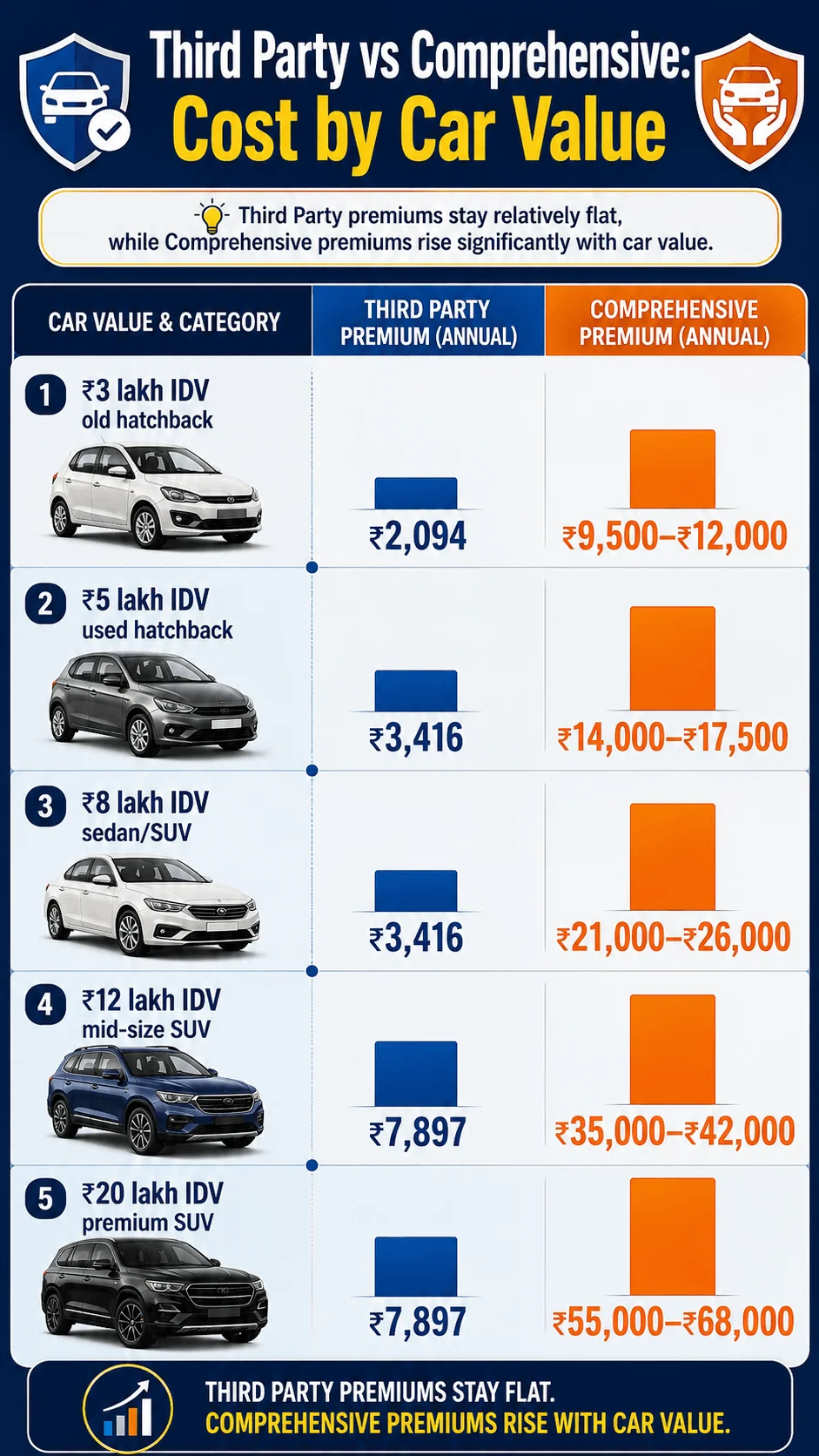
| Car IDV | Engine cc | Third Party Premium | Comprehensive Premium | Difference | What it means |
|---|---|---|---|---|---|
| ₹3 lakh (very old hatchback) | <1000cc | ₹2,094 | ₹9,500 – ₹12,000 | ~₹7,500 | An extra ₹7,500 protects a ₹3 lakh asset. Generally worth it unless the car is on its last legs |
| ₹5 lakh (used hatchback, 4-5 yrs old) | 1000-1500cc | ₹3,416 | ₹14,000 – ₹17,500 | ~₹12,500 | Moderate jump for medium-value hatchback protection |
| ₹8 lakh (mid-segment sedan/SUV) | 1000-1500cc | ₹3,416 | ₹21,000 – ₹26,000 | ~₹20,000 | Repair costs at this tier easily justify the OD premium |
| ₹12 lakh (mid-size SUV like Creta, Seltos) | >1500cc | ₹7,897 | ₹35,000 – ₹42,000 | ~₹30,000 | High-value SUVs carry massive repair risk. Comprehensive is essential |
| ₹20 lakh (premium SUV like XUV 7XO, Harrier) | >1500cc | ₹7,897 | ₹55,000 – ₹68,000 | ~₹53,000 | Laser headlamps and sensor-laden bumpers can run ₹1.5+ lakh. The big premium is actuarial necessity |
Why the gap widens with car value: Third party premium is locked because the harm you can do to others doesn’t change based on what you drive. But replacing a sensor-fused bumper on a ₹20 lakh SUV can easily cross ₹1.5 lakh. The insurer has to charge ₹60K+ to pool enough capital for those payouts.
One pricing tip that saves real money: Dealer-quoted insurance is almost always inflated because of bundled add-ons and embedded commissions. Buying directly from an insurer’s website or an online aggregator like Policybazaar or Acko strips out those layers. Identical coverage, often 20-30% cheaper.
Claim Scenarios: When Each Type Actually Pays
Abstract definitions don’t drive decisions. Rupees do. Here are five real scenarios with the exact financial outcome under each policy type. (Assume a 1200cc car with a ₹3,416 third party premium and a ₹14,000 comprehensive premium.)
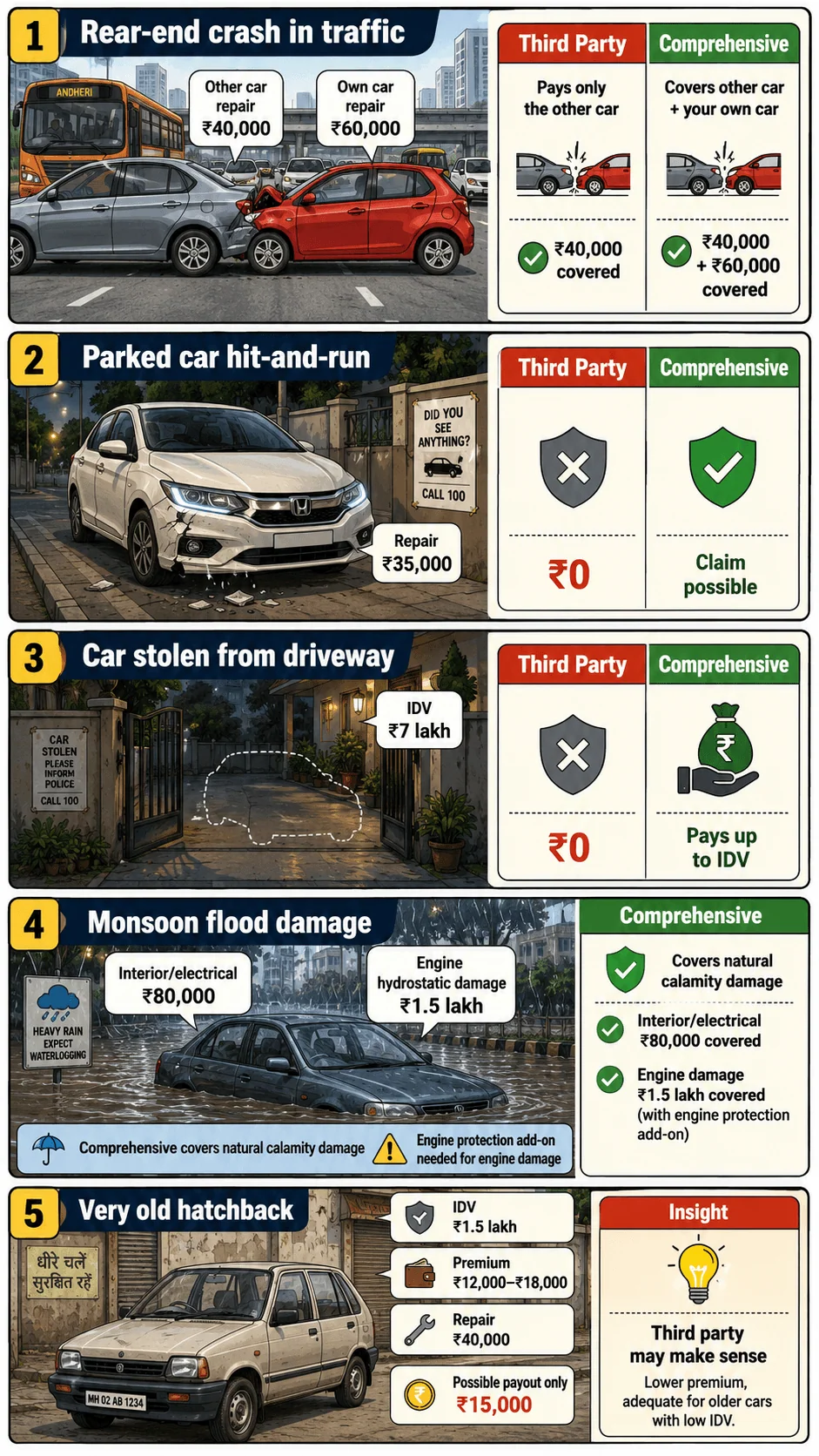
Scenario 1: You hit another car and damage yours too
You lose control in heavy traffic and rear-end a sedan. Both cars suffer significant damage.
- Other car repair: ₹40,000
- Your car repair: ₹60,000
| Policy | Pays for other car | Pays for your car | Your out-of-pocket |
|---|---|---|---|
| Third Party | Yes | No | ₹60,000 |
| Comprehensive | Yes | Yes | Compulsory deductible (₹1,000 or ₹2,000) + parts depreciation |
The third party owner liquidates ₹60,000 from personal savings to restore mobility. The comprehensive owner pays maybe ₹3,000-5,000 after deductibles and depreciation. If they had Zero Depreciation, even less.
Scenario 2: Hit-and-run while your car is parked
You come back to your parked car overnight to find a cracked bumper and a shattered LED headlamp assembly. Whoever did it has long gone.
- Bumper + headlamp repair: ₹35,000
| Policy | Claim possible? | Owner pays |
|---|---|---|
| Third Party | No | ₹35,000 (full) |
| Comprehensive | Yes | Deductible + parts depreciation |
Third party gives you zero protection here. There’s no third party to pursue, the at-fault driver fled. The comprehensive policyholder is back on the road for under ₹4,000 out of pocket.
Scenario 3: Your car is stolen
The car is taken from your driveway. The police register an FIR but never recover it, issuing a non-traceable report after six months.
- Assumed IDV: ₹7 lakh
| Policy | Payout |
|---|---|
| Third Party | ₹0 |
| Comprehensive | Up to ₹7 lakh (current IDV) |
Theft is the single most devastating financial event. Third party leaves you with a 100% loss of your asset. The comprehensive owner gets the IDV minus standard processing deductibles, enough to fund a replacement vehicle.
Scenario 4: Flood damage during monsoon
Severe rains submerge your parked car up to the dashboard. Water destroys interior electronics. You try to start it (don’t ever do this), and water enters the engine, causing hydrostatic lock with bent connecting rods.
- Interior/electrical: ₹80,000
- Engine hydrostatic damage: ₹1.5 lakh
| Policy | Pays for interior | Pays for engine |
|---|---|---|
| Third Party | No | No |
| Comprehensive (standard) | Yes (₹80K covered as natural calamity) | Likely rejected (counted as consequential damage from cranking) |
| Comprehensive + Engine Protection add-on | Yes | Yes |
This scenario shows why the Engine Protection add-on isn’t optional in flood-prone cities. A standard comprehensive policy covers the ₹80,000 interior repair but rejects the ₹1.5 lakh engine bill because trying to restart a submerged engine counts as policyholder negligence. The Engine Protection rider overrides that exclusion.
Scenario 5: Old hatchback with low market value
A 14-year-old hatchback gets sideswiped in a parking lot.
- IDV: ₹1.5 lakh
- Comprehensive premium: ₹12,000 – ₹18,000
- Repair estimate: ₹40,000
After IRDAI-mandated depreciation deductions (up to 50% on plastic and rubber parts) and the compulsory deductible, the insurer’s actual payout might be only ₹15,000. Paying ₹18,000 in annual premium to recover a possible ₹15,000 settlement is mathematically irrational. This is the rare case where third party makes sense if the owner is willing to scrap the car after a serious accident.
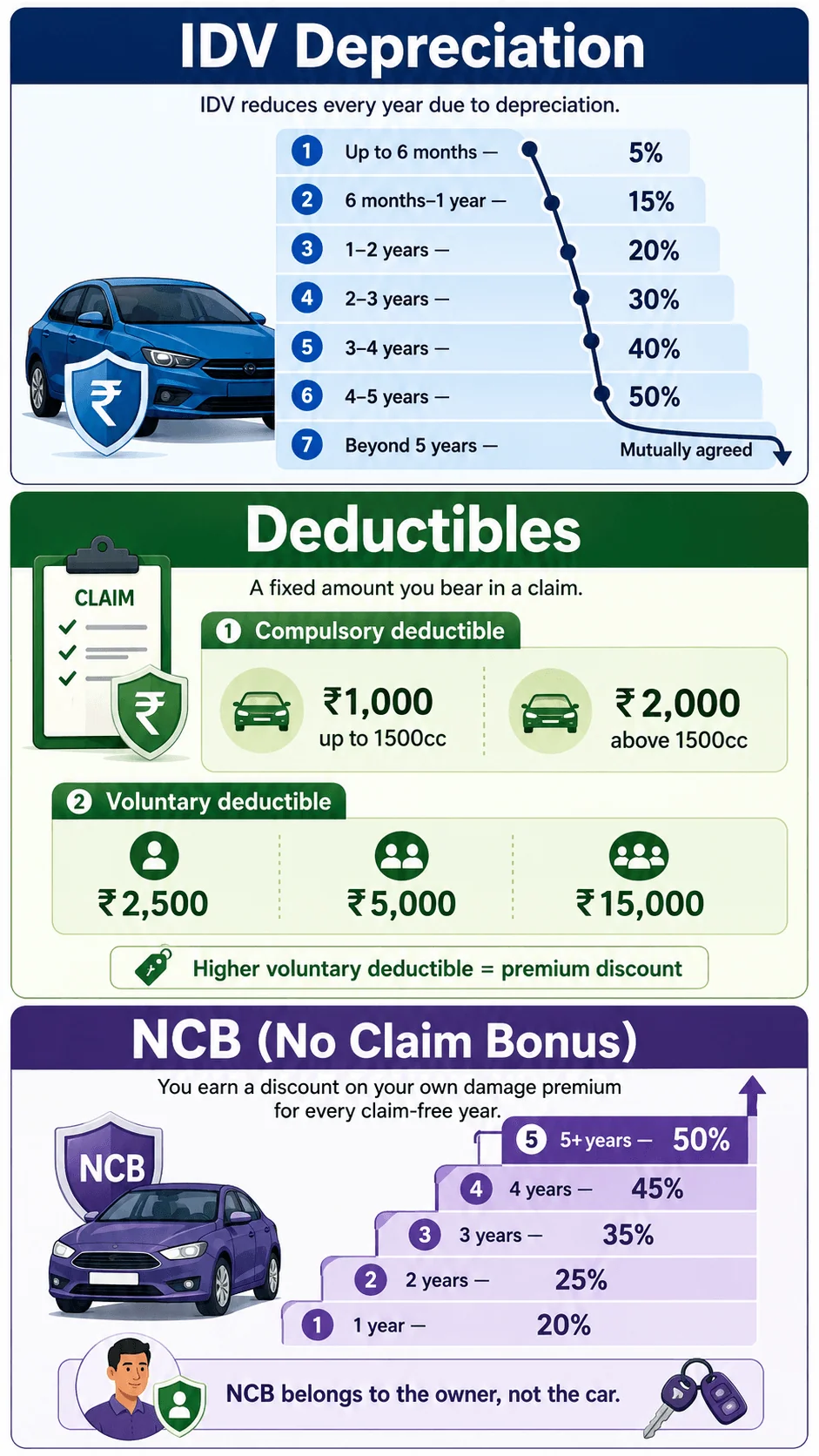
How IDV, Deductibles, and NCB Actually Work
To make sense of why comprehensive premiums vary so much (and why two quotes for the same car can differ by ₹10,000), you need to understand three levers.
Insured Declared Value (IDV)
IDV is the maximum amount your insurer will pay in case of theft or total loss. It’s not your car’s resale value or what OLX would offer. It’s calculated using a depreciation schedule fixed by IRDAI, applied to the manufacturer’s listed price at the time of insurance:
- Up to 6 months: 5% depreciation
- 6 months to 1 year: 15%
- 1 to 2 years: 20%
- 2 to 3 years: 30%
- 3 to 4 years: 40%
- 4 to 5 years: 50%
- Beyond 5 years: mutually agreed between insurer and you, usually after a surveyor’s report
A car is declared a Constructive Total Loss only when repair costs cross 75% of the IDV.
Dual deductible system
A deductible is what you pay before the insurer’s contribution kicks in. India uses two layers:
- Compulsory deductible: Fixed by IRDAI. ₹1,000 for cars up to 1500cc, ₹2,000 above 1500cc. Applies to every claim, can’t be waived, doesn’t reduce your premium.
- Voluntary deductible: Optional. You agree to absorb a chunk (₹2,500 / ₹5,000 / ₹15,000) of any future claim in exchange for a premium discount. A ₹2,500 voluntary deductible cuts ~20% off your OD premium. ₹15,000 cuts ~35%. Useful for confident drivers who plan to ride out small dents themselves.
No Claim Bonus (NCB) ladder
NCB is a discount on your next OD premium for every claim-free year. The progression:
- 1 claim-free year: 20% discount
- 2 years: 25%
- 3 years: 35%
- 4 years: 45%
- 5+ years: 50% (maximum)
NCB stays with you, not the car. If you sell a car after building 50% NCB, you can get an NCB retention certificate and apply that discount to your next car’s premium. This is why filing a tiny ₹4,000 bumper claim on a high-value car is often disastrous. Losing a 50% NCB can add ₹12,000-15,000 to next year’s premium.
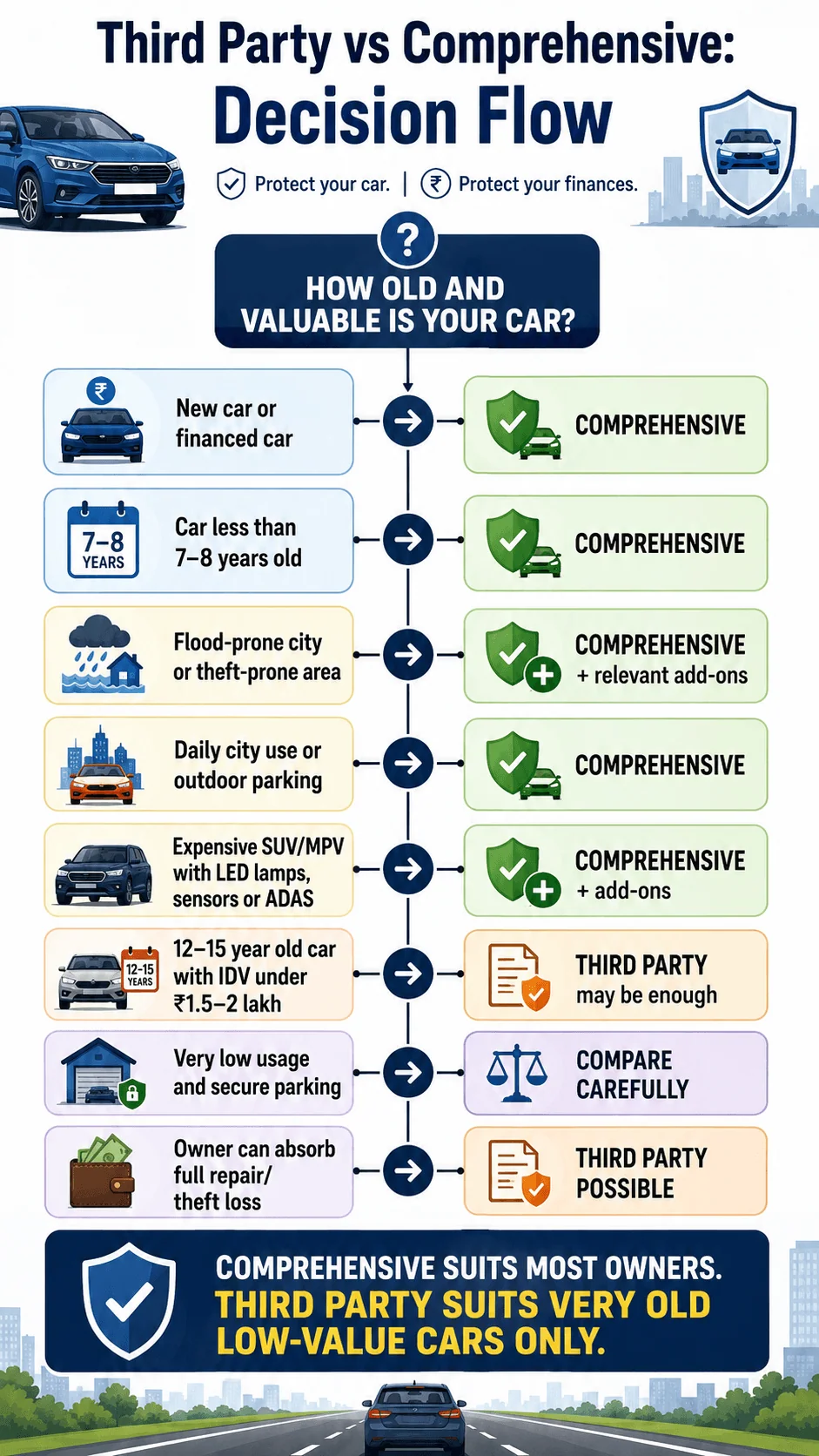
Which Should You Choose?
Time for the actual decision. Here’s the dispassionate version.
Choose third party if:
- Your car is more than 12-15 years old with an IDV under ₹1.5-2 lakh
- You’re genuinely fine paying for your own repairs out of pocket
- You barely drive the car, and it’s parked in a secure private space
- The comprehensive quote you got is way out of proportion to your car’s actual value
- You have enough emergency savings to absorb a total loss
- You just need to meet the bare minimum legal requirement to avoid traffic fines
Choose comprehensive if:
- Your car is less than 7-8 years old and still has serious residual value
- Your car is financed or leased (your bank likely insists on this anyway)
- Your car has ADAS sensors, LED headlamps, airbag modules, or turbo components. A single bumper replacement can exceed five years of premiums
- You live in a flood-prone or theft-prone area (Mumbai, Chennai, parts of Kerala, Delhi-NCR for theft)
- You drive frequently in dense city traffic
- You park outdoors on public streets at night
- You can’t absorb a ₹50,000+ repair bill without disrupting your finances
- You want peace of mind, not just legal compliance
Quick decision matrix
| Your situation | Better choice | Why |
|---|---|---|
| New car | Comprehensive | Protects high-value asset against early-stage depreciation and severe collision costs |
| Financed car | Comprehensive | Banks usually require it to secure the hypothecation |
| 10+ year old, low-value car | Third party may be enough | Premium outlay doesn’t justify the depreciated payout |
| Flood-prone city | Comprehensive + Engine Protection | Hydrostatic engine lock is a real, expensive risk |
| Daily city use | Comprehensive | Parking damage and minor collisions are statistically constant |
| Very low usage | Compare carefully | Pay-As-You-Drive comprehensive may offer the best balance |
| Expensive SUV / MPV | Comprehensive + add-ons | LED assemblies and sensor bumpers cost a fortune to replace |
Final verdict: For the vast majority of Indian car owners, comprehensive is the rational choice because it absorbs financial shocks that would otherwise hit household savings hard. Third party only makes sense for very old, low-value cars where you’re completely willing to bear the total repair or theft loss yourself.
Can you switch from third party to comprehensive?
Yes. You can do this at renewal or even mid-term, but the insurer will put your car through a pretty rigorous check first.
What to expect:
- Vehicle inspection: Either physical or via a 360-degree video walkthrough using the insurer’s app. Photos cover the exterior, engine bay, undercarriage, interior.
- Exclusion of pre-existing damage: Any scrapes, dents, cracked glass, or compromised bumpers found during inspection get documented and permanently excluded from cover. You can’t claim those later.
- Lapsed policies: If your third party has fully lapsed, the inspection is mandatory before a new comprehensive policy is issued.
- Premium dependency: The comprehensive premium depends on the IDV the surveyor assigns and the car’s overall condition.
- Underwriting rejection: Some insurers reserve the right to refuse OD cover for very old or structurally compromised cars.
For most buyers, the cleaner route is to switch at renewal. The inspection is still required, but pricing tends to be friendlier.
If your existing comprehensive policy is up for renewal soon, our car insurance renewal guide covers the documents, timing, and common gotchas.
A Few 2026 Updates Worth Knowing
The motor insurance market shifted in late 2025 and early 2026. Three changes that affect this decision:
- 3-year third party mandatory at new car purchase. Since IRDAI tightened enforcement, every new private car sold in India now ships with a 3-year third party policy as a single premium. You’re still free to buy OD as an annual add-on and switch insurers each year.
- Pay-As-You-Drive (PAYD) is mainstream. Following the 2025 IRDAI master circular on usage-based insurance, most major insurers now offer telematics-linked comprehensive policies. Drivers who clock under 5,000 km a year get significant OD premium reductions. Worth checking if you’re a weekend driver subsidising the high-mileage pool.
- TP premium hike of ~10% proposed. The Ministry of Road Transport and IRDAI are discussing a 10% increase in third party premiums, likely effective from April 2026. The first hike since FY20.
FAQs
What is the difference between third party and comprehensive car insurance?
Third party covers only the financial and legal liability for injury, death, or property damage you cause to others. Comprehensive includes that mandatory third party cover and adds extensive own damage protection for your vehicle against collisions, theft, fire, and natural disasters.
Is third party insurance enough?
Third party insurance is legally enough to drive on Indian roads, but rarely financially sufficient. It’s only adequate for very old, low-value cars where you’re fully prepared to pay out-of-pocket for any repair or the total loss of the vehicle.
Is comprehensive insurance mandatory in India?
No. Comprehensive insurance is entirely optional. The Motor Vehicles Act 1988 only mandates third party liability insurance for vehicles operating on public roads. The penalty for driving without it is ₹2,000 (first offence), ₹4,000 (subsequent), and up to three months’ imprisonment.
How much more is comprehensive vs third party?
For a 1200cc car, third party costs around ₹3,416 a year. A comprehensive policy on an ₹8 lakh car typically costs ₹21,000-26,000, so you’re paying roughly ₹18,000-23,000 more annually for own damage protection.
Does third party insurance cover my car damage?
No. Third party explicitly excludes any damage to your own car, regardless of accident severity or fault. If the other driver is clearly at fault, you can claim your repair from their third party policy (you become the third party in their case), but your own policy won’t pay.
Does comprehensive insurance cover theft?
Yes. If your car is stolen and law enforcement issues a non-traceable report, the insurer pays out a lump sum equal to your current Insured Declared Value.
Does comprehensive insurance cover flood damage?
Standard comprehensive policies cover flood-related interior and electrical damage. But hydrostatic engine lock (caused by water entering the engine, typically after cranking a submerged car) usually requires a separate Engine Protection add-on for the claim to be approved.
Can I switch from third party to comprehensive mid-term?
Yes. You can switch at renewal or mid-term, but the insurer will mandate a physical or video inspection of the vehicle and exclude any pre-existing damage before activating the comprehensive cover.
Is comprehensive insurance worth it for old cars?
For cars older than 10-15 years with severely diminished IDV, comprehensive often doesn’t pay off mathematically. High depreciation deductions (up to 50% on replaced parts) cap the useful claim amount.
What add-ons should I buy with comprehensive insurance?
New car owners should prioritise Zero Depreciation and Return to Invoice. Owners in flood-prone cities need Engine Protection. Frequent highway drivers benefit from Roadside Assistance and Consumables Cover. Anyone with 35%+ NCB should consider NCB Protection.
Is dealer insurance better than online insurance?
Dealer-provided insurance is convenient at the point of sale but often includes inflated premiums due to bundled add-ons and embedded commissions. Online aggregators offer identical coverage and access to the same cashless garage networks, usually at significantly lower cost.
Can I drive with only third party insurance?
Yes. A valid third party policy satisfies all statutory requirements under the Motor Vehicles Act and prevents traffic fines or legal penalties. Whether it’s enough financially is a separate question.