
Here’s the thing about a 7-seater under 15 lakhs: seven seatbelts don’t mean seven happy adults. The number on the brochure is the easy part. What actually decides whether the third row gets used or stays folded for life comes down to legroom and headroom, plus whether cool air ever reaches the back. So this list does what most don’t. It tells you honestly who can sit in row three, for how long, and what happens to your boot when they do.
If you want the quick answer: the Maruti Ertiga is still the smartest all-round buy for most families, the Kia Carens (now sold as the Carens Clavis) has the best rear bench in the segment, and the Renault Triber is the cheapest way to legally seat seven. Everything else fits a more specific need. Here’s how they stack up.
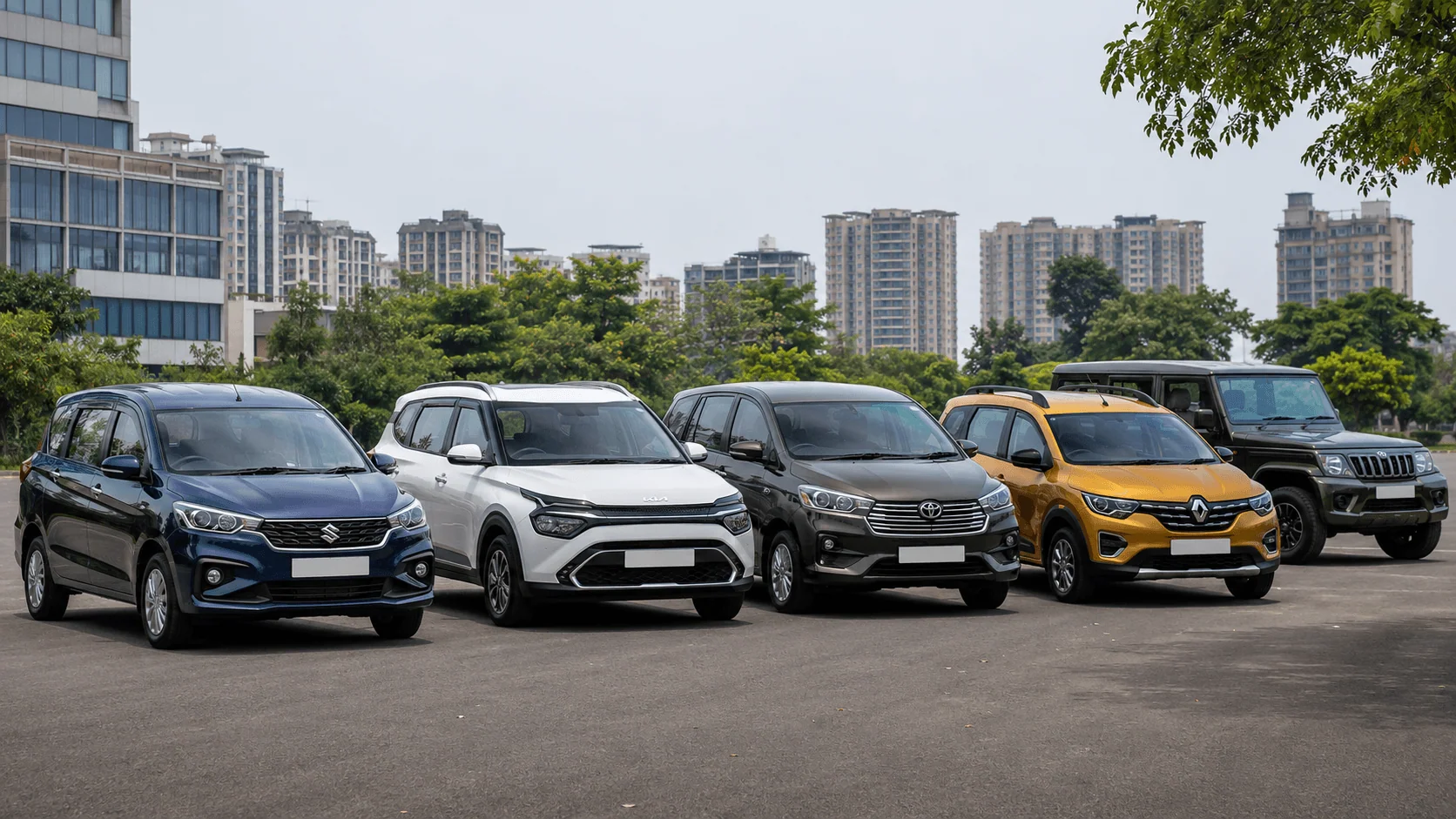
Best 7-Seater Cars Under 15 Lakhs
Before the mini-reviews, here’s the segment at a glance. Note that “third-row reality” is our honest call, not the spec sheet’s optimism.
| Model | Ex-showroom (2026) | Type | Third-row reality | Best for |
|---|---|---|---|---|
| Maruti Ertiga | ₹8.80L – ₹12.94L | MPV | Adults OK on short hops | Best all-rounder, CNG value |
| Kia Carens Clavis | ₹11.21L – ₹14.66L* | MPV/crossover | Genuine adult third row | Best comfort + features |
| Toyota Rumion | ₹9.56L – ₹13.86L | MPV | Same as Ertiga | Toyota badge + service |
| Renault Triber | ₹5.81L – ₹8.70L | Sub-4m MPV | Kids / short trips only | Cheapest true 7-seater |
| Mahindra Bolero Neo | ₹8.84L – ₹10.50L | Ladder SUV | Side-facing jump seats | Rugged, semi-rural use |
Carens Clavis runs past ₹21 lakh in top variants. The figure shown is the highest variant that stays under ₹15 lakh.
So which 7-seater car is best under 15 lakhs? For the largest number of buyers, it’s the Ertiga. But “best” genuinely depends on whether you value running cost, third-row comfort, or sheer toughness. Let’s break down the five that matter, then settle the third-row, highway and boot questions properly.
1. Maruti Ertiga: The Default Smart Buy
The Ertiga is the benchmark every other MPV is measured against, and 2026 only strengthened its case. After the GST revision late in 2025, prices dropped by roughly ₹31,000–₹46,000 across the range, so the whole lineup now sits comfortably under budget, automatic included. That runs from the base LXi at ₹8.80 lakh right up to the ZXi+ AT at ₹12.94 lakh.
It runs a 1.5-litre petrol (around 102 bhp) with a 5-speed manual or 6-speed torque converter auto, plus the factory CNG option that’s the real headline. The CNG manual claims 26.1 km/kg and owners report roughly 20–22 km/kg in the real world, which is why nothing here is cheaper to run. Petrol returns a sensible 20 kmpl-ish on the highway. Run yours on CNG and your monthly fuel bill roughly halves.
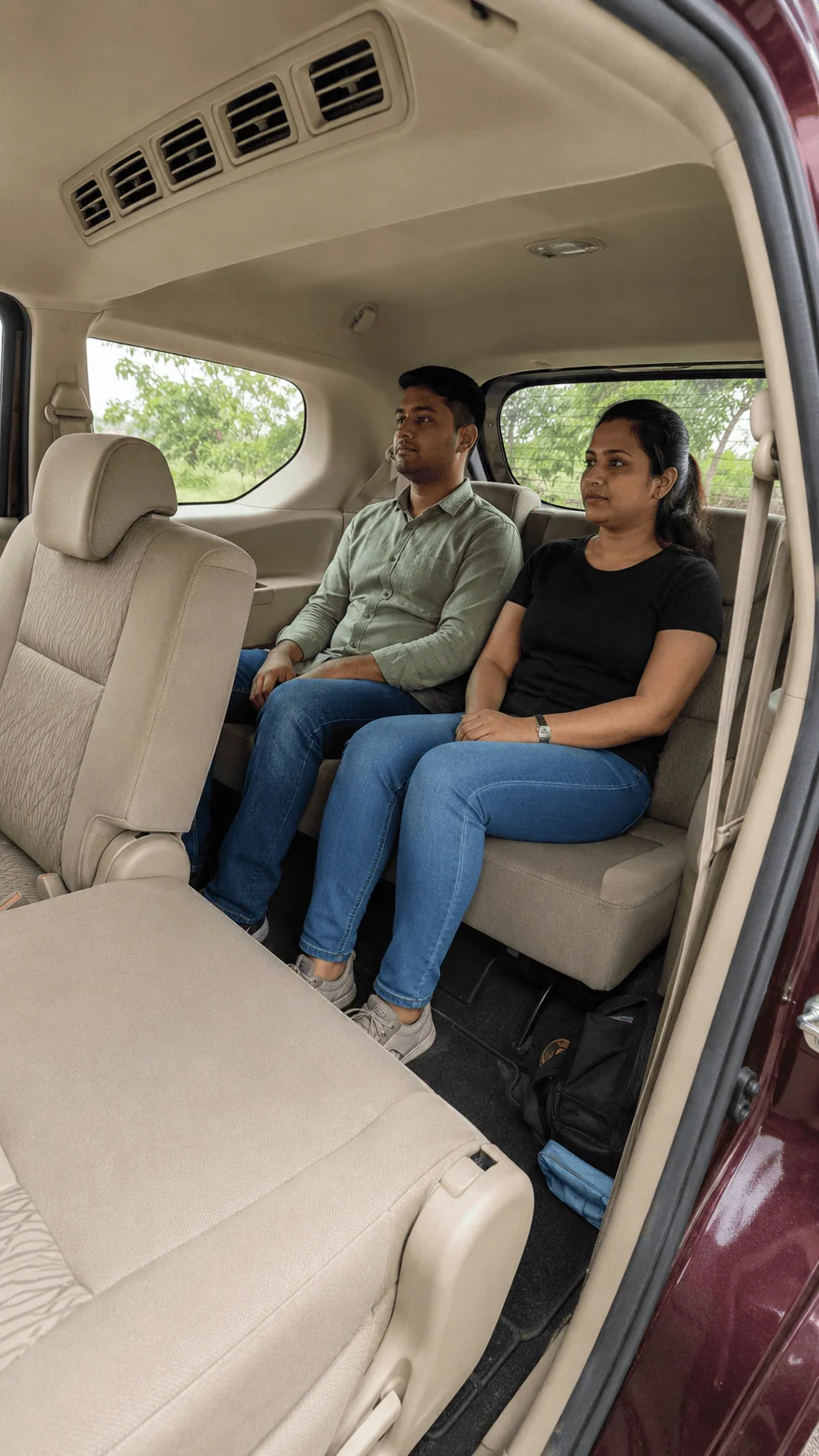
On the third row: it’s genuinely usable for two adults on short trips. With the middle bench slid forward a touch, even a six-footer fits, though under-thigh support gets marginal past 90 minutes and a reclined head will brush the roof. Boot with all seven up is 209 litres. That’s a couple of soft bags, no more. The big 2026 win is safety: six airbags are now standard, finally answering its old one-star Global NCAP score.
Best for: families who want low running costs, a real CNG option, and Maruti’s service reach. Skip if: you want strong acceleration or a true long-distance adult back row.
2. Kia Carens Clavis: The Best Third Row, Period
If your seventh seat actually carries adults, this is the one. The Carens, refreshed for 2026 as the Carens Clavis, starts at ₹11.21 lakh, and the variants that stay under fifteen run up to the HTE (EX) diesel manual at about ₹14.66 lakh. The well-loaded turbo and top variants push past ₹21 lakh, so this is a case where variant choice matters more than the badge.
Why it tops the comfort charts: the third row has an adjustable backrest, its own AC vents and Type-C charging, and there’s enough knee and headroom for two adults to sit for a few hours rather than a few minutes. Two 5’11” passengers genuinely fit. Will your in-laws complain on a four-hour drive? Probably not. You can have it as a 7-seat bench or a 6-seat captain-chair layout. Boot space with all rows up is 216 litres, fractionally ahead of the Ertiga.
Engine choice is the other ace. You get a 1.5 petrol, a turbo-petrol, and a torquey 1.5 diesel (250 Nm) that makes it the better highway hauler. Safety kit is generous (six airbags, ESC, all-disc brakes), though the older Carens carried a middling 3-star Global NCAP score, so it leans on its active-safety net.
Best for: buyers who’ll regularly use all three rows and want a premium cabin. Skip if: you need the cheapest possible running cost, since diesel and Kia servicing cost more than Maruti’s.
3. Toyota Rumion: The Ertiga in a Suit
The Rumion is a badge-engineered Ertiga, built on the same platform with the same 1.5 petrol and CNG options. Pricing runs from roughly ₹9.56 lakh to ₹13.86 lakh, a premium of ₹50,000-odd over the equivalent Ertiga. What you’re paying for is the Toyota badge, the warranty, the service experience, and a slightly more SUV-flavoured grille.
Mechanically it’s identical, so the rearmost row, the 209-litre boot and the 26 km/kg CNG figure all carry over, right down to the six airbags it gained as standard in late 2025. So is the badge worth it? Only if Toyota’s after-sales reputation and warranty genuinely matter to you, because in every measurable way the cabin, the space and the way it drives are pure Ertiga underneath.
Best for: buyers who trust Toyota after-sales and don’t mind paying for it. Skip if: you want maximum value, because the Ertiga does the same job for less.
4. Renault Triber: Most Affordable, With Honest Limits
Nothing else legally seats seven for this little money. Seven seats for hatchback cash. The Triber starts at ₹5.81 lakh, and even a loaded variant stays under ₹9 lakh. Its party trick is the EasyFix removable third row: pull those seats out and you get a 625-litre estate-like load bay that’s genuinely huge for a sub-4-metre car.
But be honest with yourself about that row three. It’s fine for children or average-sized adults on short hops, with a knees-up posture and limited under-thigh support. Large adults will be cramped quickly. The 1.0-litre, 72 bhp three-cylinder petrol also runs out of breath when fully loaded or climbing hills, so this is a city-and-short-trip tool, not a highway cruiser. The upside: it’s the cheapest 7-seater to buy and run in India by a wide margin.
Best for: budget families who need seven seats occasionally and a big boot the rest of the time. Skip if: you regularly carry seven people on the highway.
5. Mahindra Bolero Neo: The Rugged Outlier
If your roads are broken or unpaved, a monocoque MPV’s soft suspension becomes a liability, and that’s where the ladder-frame Bolero Neo earns its place. Priced from ₹8.84 lakh to ₹10.50 lakh, it’s built on proven Scorpio underpinnings with a 1.5 mHawk diesel (about 100 bhp, 260 Nm) and rear-wheel drive.
Now the honest part most listicles skip: its “third row” is a pair of side-facing jump seats, not a forward-facing bench. They’re fine for quick local runs and maximise capacity, but they’re not where you’d put adults for a long drive, and there are no rear AC vents. Safety also trails the MPVs here. It still ships with just dual front airbags, well short of the new six-airbag norm.
Best for: semi-rural buyers who prioritise durability and ground clearance over cabin refinement. Skip if: safety kit and third-row comfort are non-negotiable.
Honorable mentions worth a look
Not sold on the top five? A few others deserve your glance, depending on what you actually need from the car.
- Nissan Gravite (₹5.65L–₹8.94L): brand-new for 2026, this is a rebadged Triber with smarter styling, the same strengths and the same kids-only third-row bench.
- Maruti XL6 (₹11.52L–₹14.61L): a 6-seater, not a 7, but its captain-chair second row is far roomier than the Ertiga’s, which is ideal if you rarely need the seventh seat.
- Citroen Aircross (₹8.89L–₹14.57L): a 5-star Bharat NCAP performer with a 5+2 layout. The third row suits children only, but the safety and ride quality are outstanding.
- Hyundai Alcazar (from ~₹14.49L): only the base turbo-petrol manual sneaks under ₹15 lakh, but its 160 bhp engine makes it the segment’s best highway machine if you can stretch.
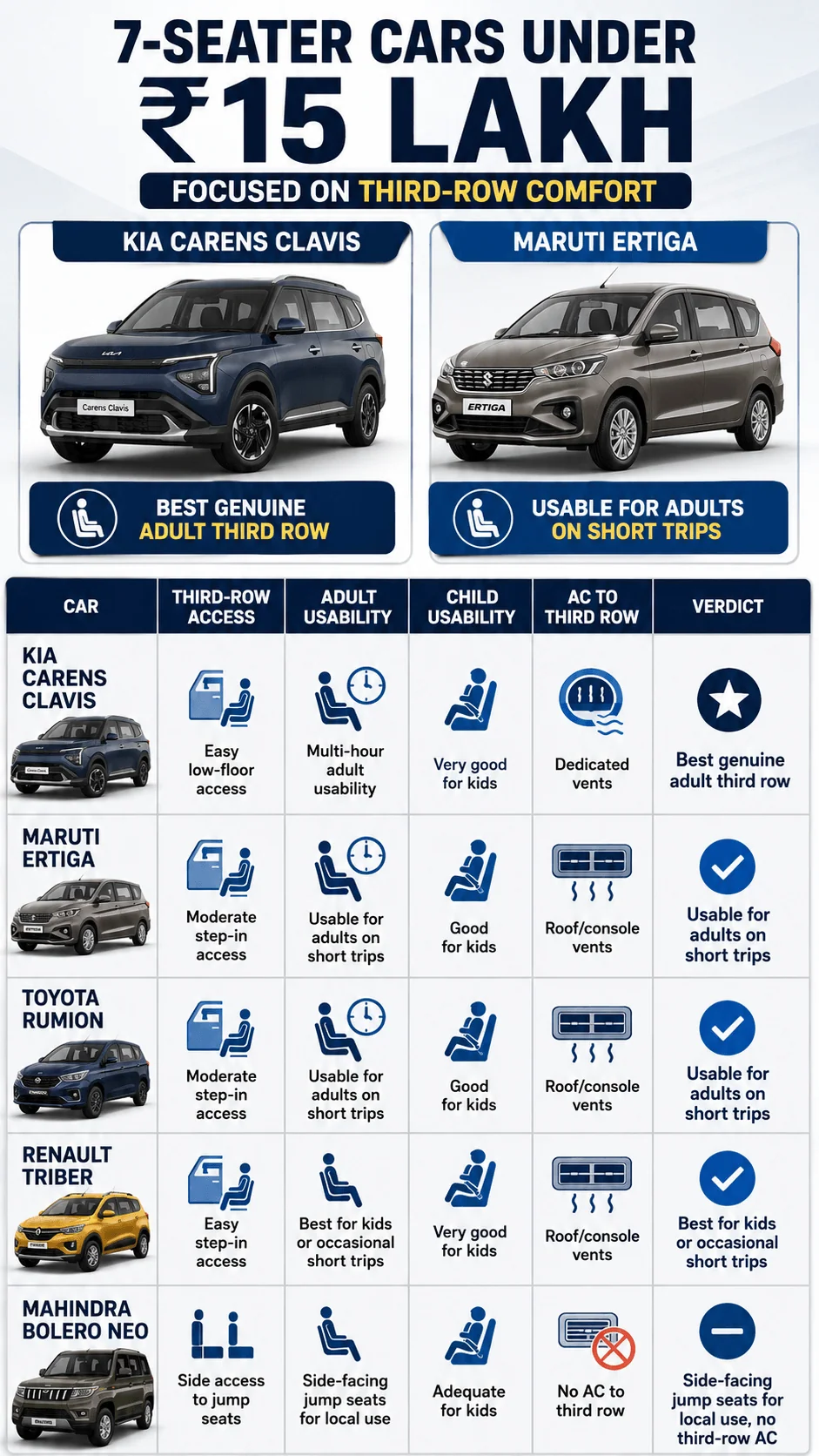
Third Row Comfort Comparison
This is where the honest assessment matters most. A “7-seater” is only a 7-seater if real people can sit in the back. Here’s our verdict, not the spec sheet’s.
| Car | 3rd-row access | Adult usability | Child usability | AC to 3rd row | Verdict |
|---|---|---|---|---|---|
| Kia Carens Clavis | Easy (low floor) | Yes, multi-hour | Excellent | Dedicated vents | Proper adult third row |
| Maruti Ertiga | Moderate step-up | Yes, short trips | Very good | Roof/console vents | Adults OK briefly |
| Toyota Rumion | Easy | Short trips only | Good | Roof vents | Same as Ertiga |
| Renault Triber | Very easy (low) | No, cramped | Yes | Roof vents | Kids / occasional |
| Mahindra Bolero Neo | Easy step-up | No (jump seats) | Small kids | None | Side-facing, local use |
Is the rear bench usable in the Ertiga? Yes, for short trips, with the caveats above. But the clear winner for genuine adult comfort over distance is the Carens Clavis, thanks to its flat floor, adjustable backrest and proper rear vents. Everything below the top two is realistically a kids-and-short-hops third row, and the Bolero Neo’s side-facing seats are a different proposition altogether. Be honest with yourself about who you’ll actually seat back there before you pay for seven seats you’ll mostly use as five.
Best for Highway Travel
Fully loaded with seven, two things decide a good highway car: enough engine to overtake without a prayer, and a ride that stays composed. Power matters here in a way it doesn’t around town. So which of these can you trust with a full cabin at 100 km/h?
| Rank | Car | Engine | Full-load pace | Ride | Verdict |
|---|---|---|---|---|---|
| 1 | Hyundai Alcazar | 1.5T, 160 bhp | Effortless overtakes | Plush, SUV-grade | Top highway pick (if in budget) |
| 2 | Kia Carens Clavis (diesel) | 1.5D, 250 Nm | Strong, torquey | Composed, quiet | Best in-budget cruiser |
| 3 | Maruti Ertiga | 1.5 NA, 102 bhp | Adequate, plan overtakes | Stable with 7 aboard | Balanced all-rounder |
| 4 | Toyota Rumion | 1.5 NA, 102 bhp | Same as Ertiga | Composed | Refined enough |
| 5 | Renault Triber | 1.0 NA, 72 bhp | Slow when full | Soft, noisy at speed | Light loads only |
If highway touring with a full cabin is your main use, the Carens Clavis diesel is the sweet spot inside the budget. It’s the only proper torque-rich diesel here. The Ertiga and Rumion are perfectly composed cruisers, they just ask you to plan your overtakes. Avoid loading the Triber’s little 1.0 with seven people on a long run. It’ll do it, but slowly.
Boot Space With All Seats Up
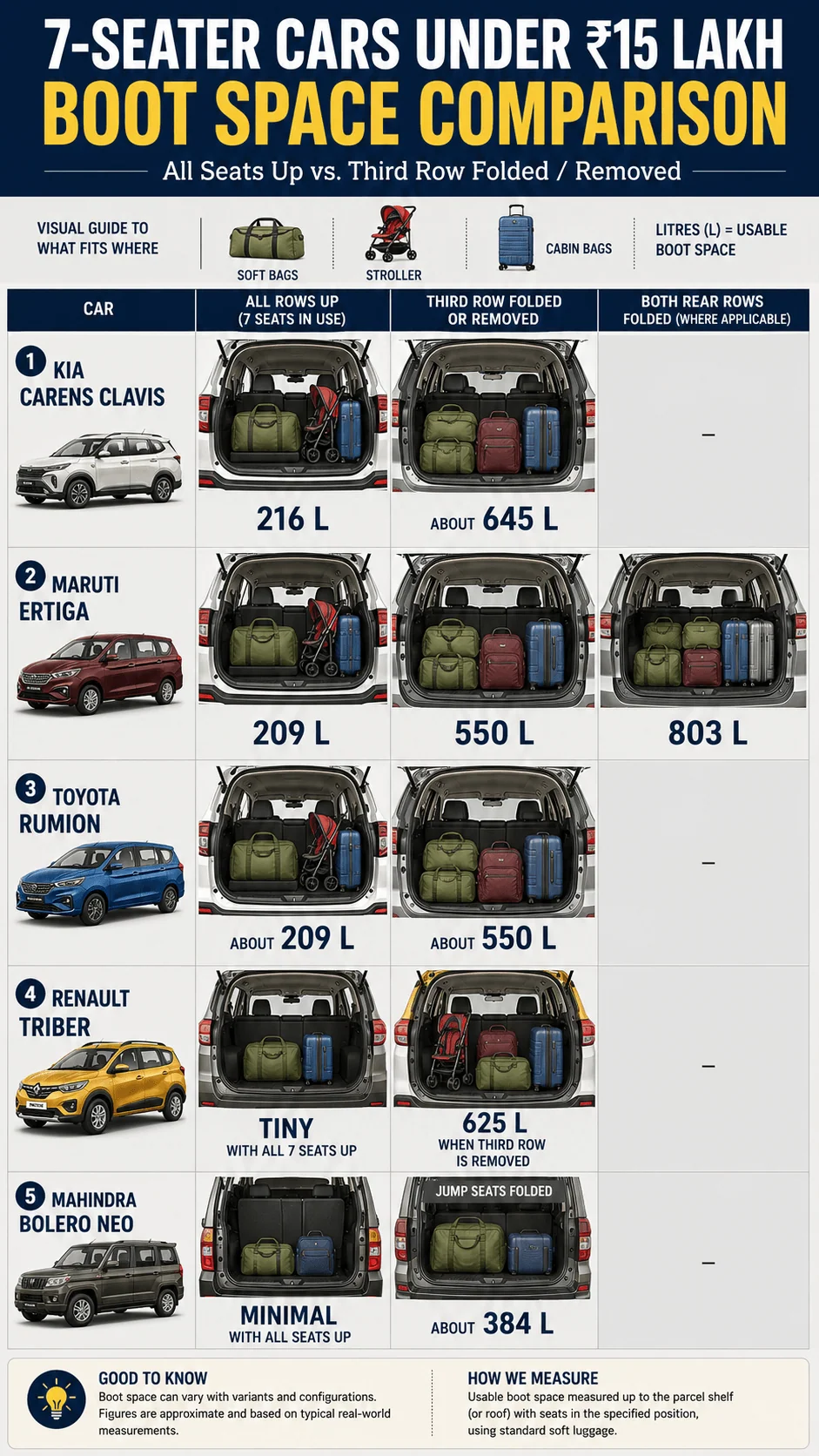
Here’s the compromise nobody mentions in the showroom. With all three rows occupied, every car here has a small boot. The real question is how small, and how much it recovers when you fold row three.
| Car | Boot (all 7 up) | Boot (3rd row folded) | Practical verdict |
|---|---|---|---|
| Kia Carens Clavis | 216 L | ~645 L | A couple of bags with 7, generous folded |
| Maruti Ertiga | 209 L | 550 L (803 L both folded) | Stroller or 3–4 soft bags with 7 |
| Toyota Rumion | ~209 L | ~550 L | Identical to Ertiga |
| Renault Triber | Tiny with 7 up | 625 L (3rd row removed) | Huge, but only as a 5-seater |
| Mahindra Bolero Neo | Minimal | ~384 L | Plan for a roof carrier |
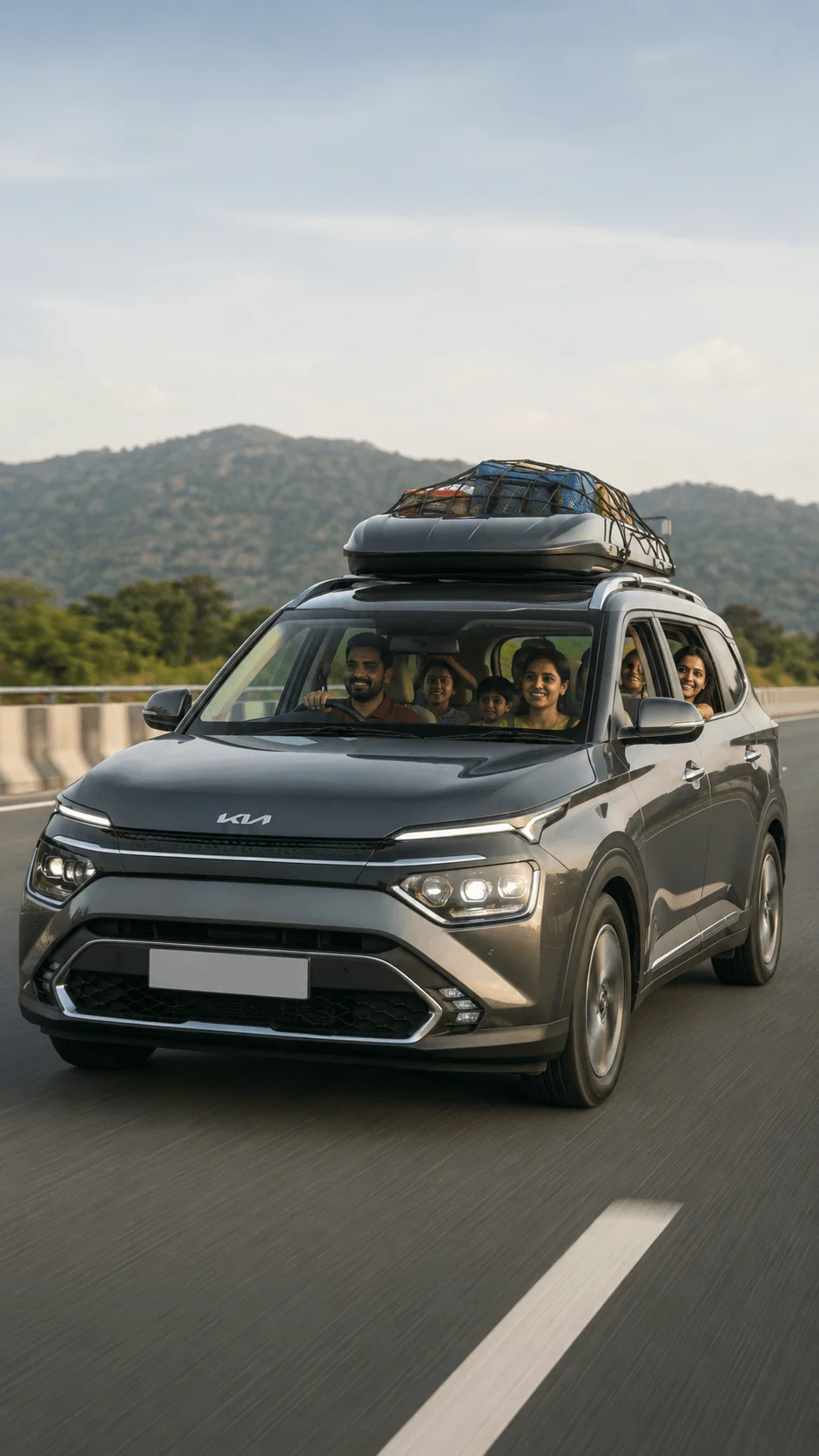
So what does this mean for your weekend plans? The honest takeaway: no sub-₹15 lakh 7-seater gives you both seven seats and a holiday’s worth of luggage at the same time. For an airport run with six adults, you’ll fold a seat or strap on a roof box. The Carens and Ertiga are the least compromised. The Triber is brilliant only when you treat it as a five-seater with a cavernous boot.
Maruti Ertiga vs Kia Carens for Families
This is the question most buyers actually land on, so let’s settle it.
| Factor | Maruti Ertiga | Kia Carens Clavis | Edge |
|---|---|---|---|
| Third-row comfort | Adults, short trips | Adults, multi-hour | Carens |
| Boot (all 7 up) | 209 L | 216 L | Carens |
| Engine (full load) | 1.5 petrol, adequate | Petrol/turbo/diesel | Carens |
| Automatic under ₹15L | Yes (ZXi+ AT) | Petrol AT only in higher variants | Ertiga |
| Mileage | 20 kmpl / 26 km/kg CNG | ~16 kmpl petrol | Ertiga |
| Running & service cost | Lowest in class | Higher | Ertiga |
| Features | Simpler kit | 360° cam, sunroof, more | Carens |
Verdict: choose the Ertiga for rock-bottom running costs (especially CNG) and Maruti’s unmatched service network. Choose the Carens Clavis for a plusher cabin, more engine choice, and the only genuinely adult-friendly third row in the segment. For a family that lives in the city and values economy, Ertiga. For one that road-trips with all seven seats full, Carens. Neither gives you a big boot with everyone aboard, but that’s simply the trade-off every three-row car in this price bracket asks you to accept. If your needs are smaller, there are also roomier smaller family car options that cost less to run.
A quick word on on-road reality: these are ex-showroom prices. In a high-tax state, registration and insurance can add ₹2.5–3 lakh, which pushes a top Ertiga or Carens past ₹15 lakh on the road. If you’re working to a strict on-road number, understand how ex-showroom and on-road prices differ before you sign anything, and stick to a manual or mid-spec variant.
FAQs
Which 7-seater car is best under 15 lakhs? For most families, the Maruti Ertiga. It balances space, mileage, low running cost and Maruti’s service reach. If your back row carries adults regularly, the Kia Carens Clavis is the better pick. Pick by your real need, not the price tag alone.
Is the third row usable in the Ertiga? Yes, for short trips. With the middle row slid forward, even a six-footer fits, and headroom is decent. But under-thigh support fades past about 90 minutes, so it’s a city-and-short-hop third row, not a long-distance one.
Ertiga or Carens for family use? Ertiga if you want the lowest running costs (especially in CNG) and the widest service network. Carens Clavis if you want a more premium cabin, more engine options including diesel, and the best adult third row in the class. Both are excellent. The choice is economy versus comfort.
Which 7-seater under 15 lakhs has the best third row? The Kia Carens Clavis, comfortably. It has a flat floor, an adjustable backrest, dedicated rear AC vents and enough room for two adults to sit for hours. The Ertiga is second, and the rest are best kept for children or short trips.
Which 7-seater has the best boot with all seats up? They’re all small. The Carens Clavis (216 L) and Ertiga (209 L) lead. The Renault Triber’s boot is tiny with seven aboard but expands to a massive 625 litres once the third row is removed.
Is an automatic 7-seater available under 15 lakhs? Yes, in petrol. The Maruti Ertiga ZXi+ AT comes in at ₹12.94 lakh ex-showroom. Carens Clavis automatics tend to sit in higher, pricier variants.
Should I buy an MPV or an SUV 7-seater under 15 lakhs? For usable third-row space, luggage flexibility and fuel economy, MPVs (Ertiga, Carens, Triber) win at this budget. Ladder-frame SUVs like the Bolero Neo give you ground clearance and toughness for bad roads but compromise on third-row comfort and safety kit. Match the body style to where you actually drive, and if crash protection tops your list, cross-check our pick of the safest cars in India before you decide.
Always test the third row and boot with your own family before booking, and verify the exact variant price with your dealer, since 2026 has seen several rounds of price changes.