
A decade ago, a turbo badge meant a German sedan or a hot hatch most of us couldn’t afford. Today, almost every compact SUV and sporty hatchback on an Indian showroom floor runs a small turbo petrol engine. If you’re shopping in 2026, the question isn’t really “should I look at turbo petrol cars in India” anymore. It’s “which one actually suits how I drive, and is the turbo worth it for me?”
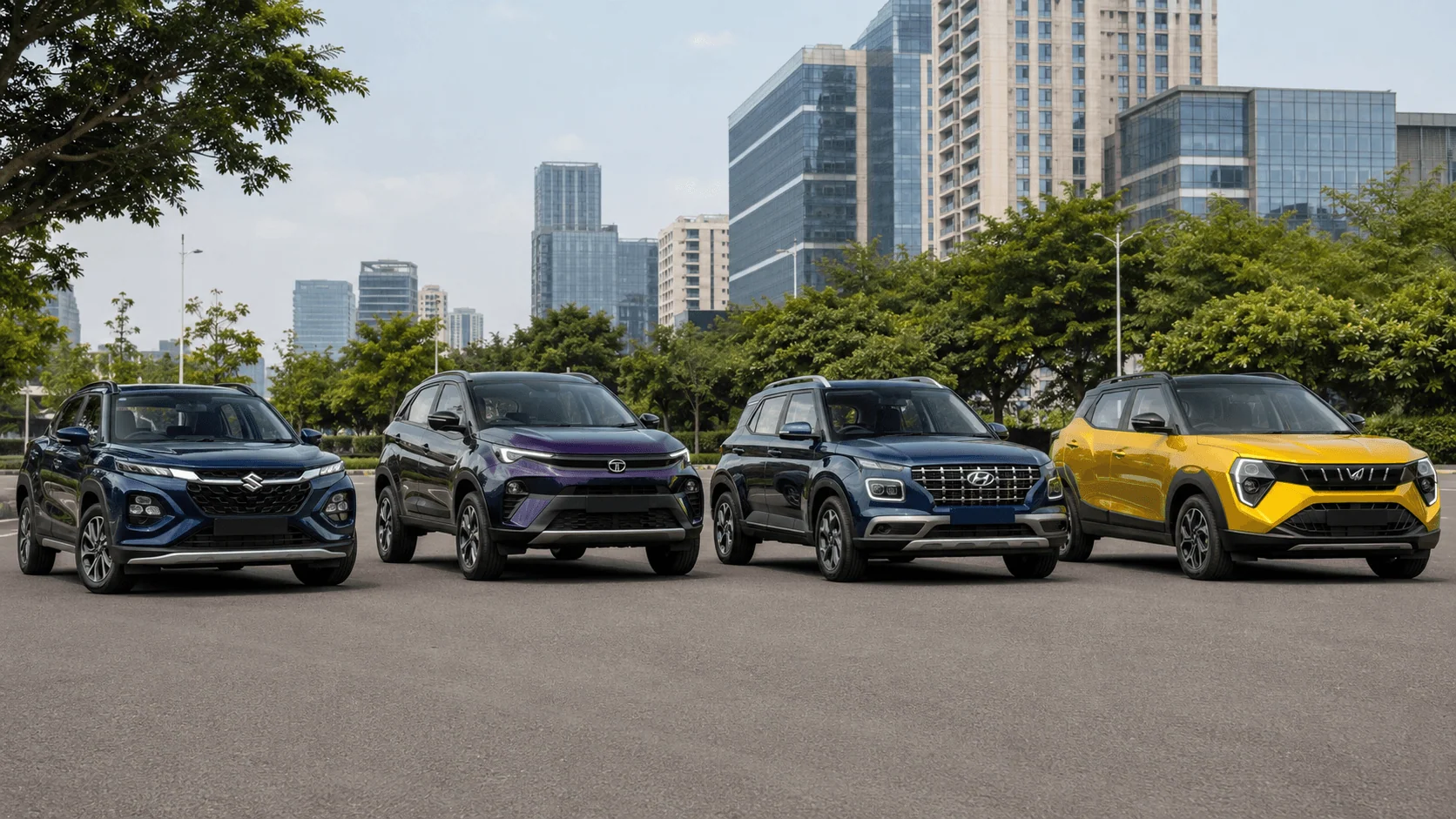
Here’s the honest short answer. The best turbo petrol cars in India right now are the Maruti Fronx, Tata Nexon, Kia Sonet, Hyundai Venue, Skoda Kylaq, Tata Punch, Mahindra XUV 3XO, Hyundai i20 N Line, Skoda Kushaq, Volkswagen Taigun and the punchy Hyundai Verna 1.5. But the “best” one for you depends almost entirely on one thing most listicles skip: how a turbo behaves in real Indian traffic versus on the brochure. A turbo petrol feels brilliant on the highway and on hills. In bumper-to-bumper city crawl, a good normal petrol can still be the easier car to live with.
So this guide does two things differently. We give you real-world mileage from road tests and owner reports, not the optimistic ARAI sticker number. And we give every car an honest turbo lag verdict, because that low-speed hesitation is the single biggest surprise for first-time turbo buyers. All prices below are ex-showroom and current for 2026, so reconfirm the exact variant price in your city before you book.
Best Turbo Petrol Cars at a Glance
Short on time? This table is your shortlist. The mileage figures are real-world bands from tests and owner reports, not the ARAI claims you’ll see on the brochure.
| Car | Turbo engine | Power / Torque | Real city / highway (kmpl) | Turbo lag | Safety |
|---|---|---|---|---|---|
| Maruti Fronx | 1.0 Boosterjet | 100 PS / 148 Nm | 11–14 / 17–19 | Minimal | 4★ Japan NCAP* |
| Tata Nexon | 1.2 Turbo | 120 PS / 170 Nm | 9–13 / 15–17 | Medium | 5★ Bharat NCAP |
| Kia Sonet | 1.0 T-GDi | 120 PS / 172 Nm | 10–13 / 16–18 | Mild | Not rated* |
| Hyundai Venue | 1.0 T-GDi | 120 PS / 172 Nm | 11–13 / 16–18 | Mild | 5★ Bharat NCAP |
| Skoda Kylaq | 1.0 TSI | 115 PS / 178 Nm | 9–11 / 15–17 | Medium | 5★ Bharat NCAP |
| Tata Punch | 1.2 i-Turbo | 108 PS / 140 Nm | 10–12 / 15–17 | Medium | 5★ Bharat NCAP |
| Mahindra XUV 3XO | 1.2 TGDi | 130 PS / 230 Nm | 11–13 / 15–18 | Low | 5★ Bharat NCAP |
| Hyundai Verna | 1.5 T-GDi | 160 PS / 253 Nm | 9–11 / 16–21 | Very low | 5★ Global NCAP |
*Maruti Fronx isn’t Bharat NCAP rated. It scored 4 stars in Japan NCAP. Kia Sonet’s India-spec car ships with 6 airbags standard but hasn’t been rated by Bharat NCAP. The widely shared 1-star result was a different South Africa export model, so don’t read it as the Indian car.
What Is a Turbo Petrol Engine?
A turbocharger is basically an air pump driven by the engine’s own exhaust gases. A normal, naturally aspirated petrol engine breathes air at atmospheric pressure. A turbo forces extra compressed air into the cylinders, so the engine can burn more fuel and make a bigger bang. That’s why a tiny 1.0-litre turbo can pull harder than a much larger non-turbo engine. It’s also why almost every modern turbo engine car in India is a compact SUV: these cars have grown heavy to meet crash norms, and a small turbo gives them the muscle to move without a thirsty big engine.
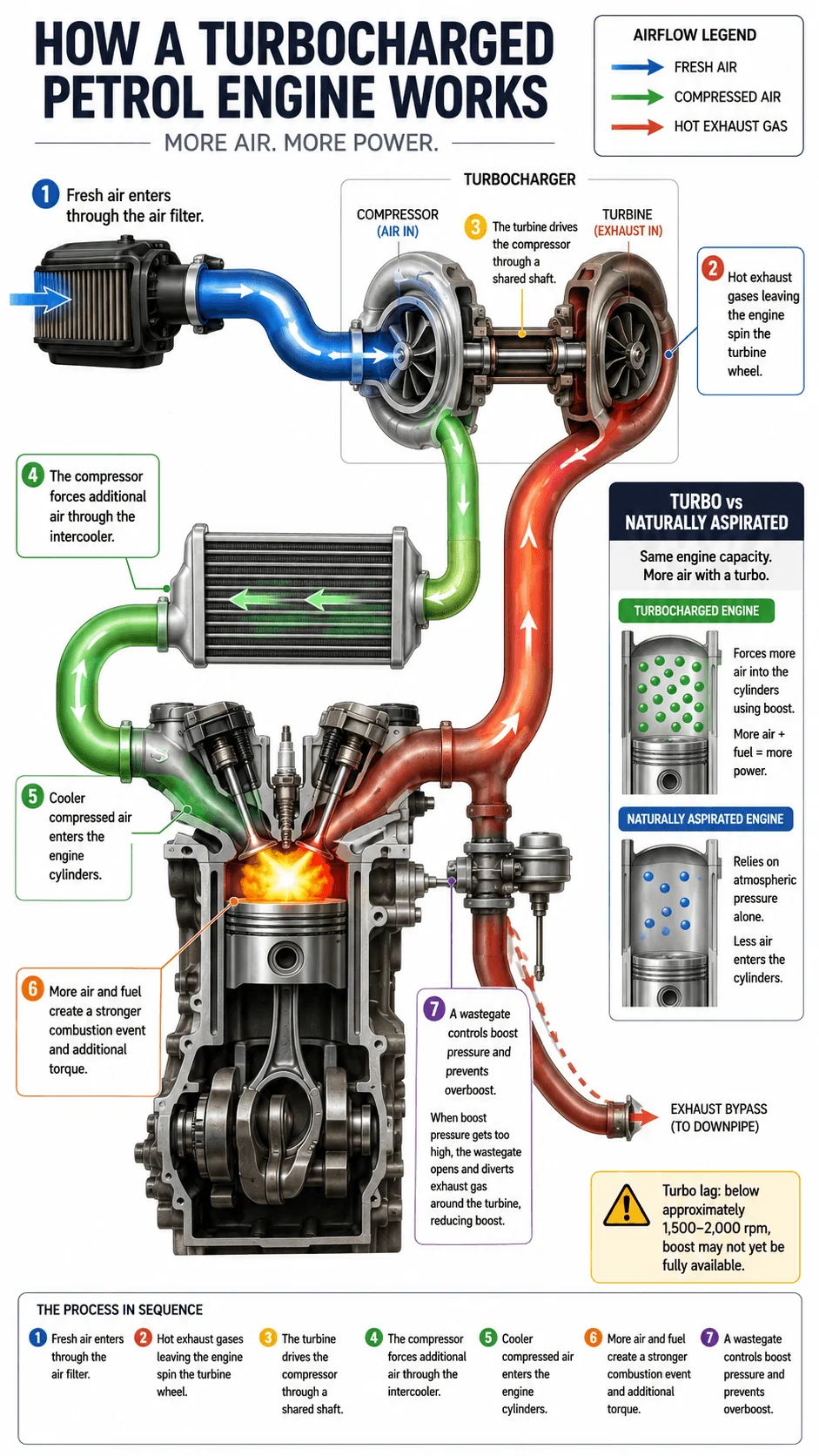
The two phrases worth understanding before you test drive anything are low-end torque and top-end power. Torque is the shove that pushes you back in your seat and helps you climb a flyover or overtake without dropping two gears. A turbo delivers a big slug of torque early, but only once the turbo “spools up.” Below that, the engine can feel flat. A normal petrol builds power smoothly and predictably from low revs, but needs more revving to feel quick.
That flat patch before the shove arrives is turbo lag. On most affordable Indian turbos, the lag zone sits below roughly 1,500 to 2,000 rpm, depending on the engine and gearbox. Press the throttle while crawling and there’s a beat of nothing, then a surge. Modern tech has shrunk this a lot (twin-scroll turbos, electric wastegates, mild-hybrid assist), but it hasn’t gone away.
Turbo lag is also why real mileage swings so much with your right foot. Want proof? Drive gently, stay off boost, and a 1.0 turbo sips fuel like a small city car. Push it hard and the engine has to pour in fuel to match all that compressed air, so economy falls off a cliff. That’s the gap between the ARAI figure and what you’ll actually see on your fuel bills.
Three engine sizes cover almost everything on sale:
- 1.0 turbo petrol: Around 100 to 120 PS. Great efficiency and strong mid-range, but the most noticeable lag at crawl. Found in the Fronx, Venue, Sonet, Kylaq, Kushaq and Taigun.
- 1.2 turbo petrol: The Indian sweet spot. Roughly 108 to 130 PS, with more low-speed muscle and less lag. Found in the Nexon, Punch and XUV 3XO.
- 1.5 turbo petrol: Performance territory. Around 160 PS with almost no off-boost lag thanks to the bigger block. Found in the Verna, Seltos, Carens and Creta.
The Wider Turbo Engine Cars List
The turbo engine cars list in India runs deeper than our top picks. The Maruti Fronx has a near-identical twin in the Toyota Urban Cruiser Taisor, and Tata sells a warm-hatch Altroz Racer on the same 1.2 turbo as the Nexon. Want a smooth budget automatic? The Nissan Magnite and Renault Kiger pair 1.0 turbos with easy CVTs, and Citroen’s 1.2 PureTech turbo, the torquiest small unit here, powers the C3, the Aircross and the Basalt. Among the bigger 1.5-litre turbocharged petrol cars India offers, the Kia Seltos, Hyundai Creta and seven-seat Kia Carens all share a 160 PS engine, while the Kia Syros runs the same 1.0 T-GDi as the Venue and Sonet. We’ve kept the reviews below to the cars that make the most sense for mainstream buyers.
Best Turbo Petrol Cars Under 10 Lakhs
This is where most people enter turbo ownership, usually upgrading from a normal petrol hatchback. We’ve ranked these on how useful the turbo feels in real Indian driving, not just on power output. City smoothness, real mileage, service reach and ownership cost all count.
One honest flag before the list: under ₹10 lakh, automatics are scarce. The Hyundai Venue’s turbo automatic, for example, starts above ₹10.8 lakh, so under this budget the Venue turbo is manual only. The genuine sub-₹10 lakh turbo automatics are the Kia Sonet’s DCT, the Skoda Kylaq’s torque converter, the Maruti Fronx’s torque converter and the CVT-equipped Magnite and Kiger.
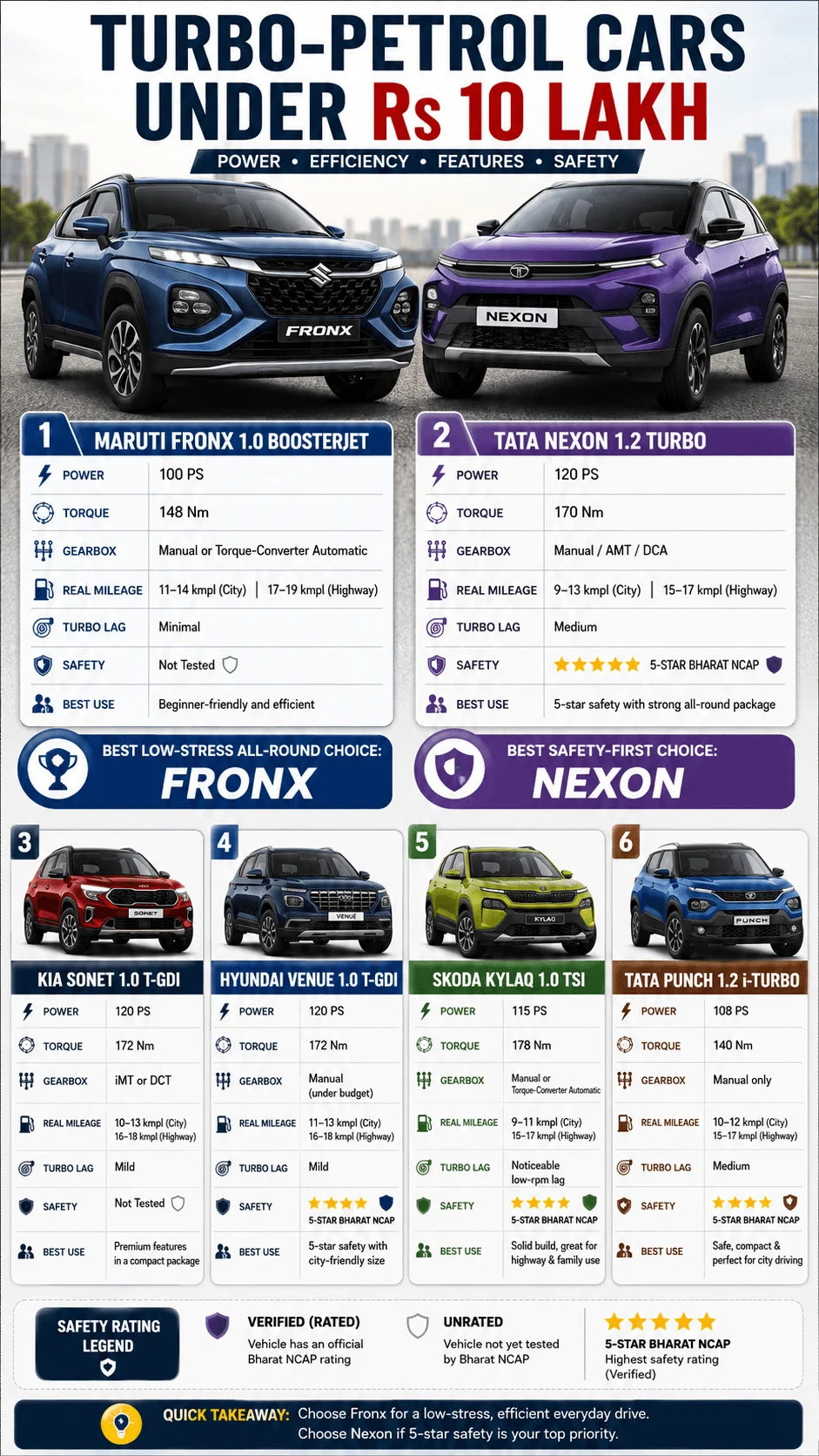
1. Maruti Fronx 1.0 Boosterjet
- Price: turbo variants roughly ₹8.9–11.98 lakh
- Power and torque: 100 PS / 148 Nm
- Gearboxes: 5-speed manual, 6-speed torque converter automatic
- Real-world mileage: about 11–14 kmpl city, 17–19 kmpl highway (ARAI up to ~20 kmpl)
- Turbo lag: minimal and beginner-friendly
- Best variant: Zeta MT or Alpha AT
- Safety: not Bharat NCAP rated, but 4 stars in Japan NCAP
This is the easiest turbo car to recommend to someone stepping up from a regular petrol. Maruti pairs the Boosterjet with a mild-hybrid ISG motor that fills in torque right off the line, so the usual turbo hesitation barely registers. The torque converter automatic is a proper, smooth unit rather than a traffic-sensitive dual-clutch, and real mileage stays far less punishing than rivals. Add Maruti’s enormous service network and strong resale, and it’s the low-stress pick. It isn’t the most powerful or the most planted car here, and cabin insulation is average above 90 kmph, but for your daily commute it’s hard to beat. Verdict: if you want one safe answer under ₹10 lakh, start here.
2. Tata Nexon 1.2 Turbo
- Price: turbo from about ₹9.6 lakh (manual) under ₹10 lakh, rising to roughly ₹14.2 lakh up the range
- Power and torque: 120 PS / 170 Nm
- Gearboxes: 5/6-speed manual, 6-speed AMT, 7-speed DCA (dual clutch)
- Real-world mileage: about 9–13 kmpl city, 15–17 kmpl highway (ARAI ~17 kmpl)
- Turbo lag: noticeable below 2,000 rpm, worst in the manual and AMT
- Best variant: a turbo manual under ₹10 lakh, or stretch to the DCA automatic
- Safety: 5 stars, Global and Bharat NCAP
The Nexon is the safety-first all-rounder. Tank-like build, a 5-star crash record and one of the widest variant spreads in the segment. The 1.2 turbo has genuine punch once it’s on boost, and the wet-clutch DCA was tuned for hot Indian traffic. The flip side: it’s a three-cylinder engine that can feel boomy, the kerb weight hurts city mileage, and the lag is real in stop-go traffic with the manual or AMT. Verdict: buy it if structural safety and presence matter more than fuel bills, and pick the DCA over the AMT if your budget can climb a little.
3. Kia Sonet 1.0 Turbo
- Price: turbo from about ₹9.1 lakh (iMT/manual), DCT from roughly ₹9.89 lakh, topping out near ₹14.2 lakh
- Power and torque: 120 PS / 172 Nm
- Gearboxes: 6-speed iMT (clutchless manual), 7-speed DCT
- Real-world mileage: about 10–13 kmpl city, 16–18 kmpl highway (ARAI ~18.3 kmpl)
- Turbo lag: mild
- Best variant: HTK+ turbo iMT for value, or the DCT if traffic isn’t relentless
- Safety: India-spec ships with 6 airbags standard, not Bharat NCAP rated
The Sonet still nails the “small SUV that feels premium” brief, with a big feature list, a clutchless iMT that suits manual lovers tired of city clutch work, and a peppy engine. It’s notable for being one of the very few cars to put a real dual-clutch automatic under ₹10 lakh. The catch is the same as its Venue cousin: the rear seat is tight, and the DCT can feel hesitant at crawling speeds, so city economy drops fast if you drive it hard. Verdict: great if you want features and punch, less ideal if your daily life is a smooth, cheap-to-run traffic automatic.
4. Hyundai Venue 1.0 Turbo
- Price: turbo manual roughly ₹8.9–9.9 lakh, turbo DCT from about ₹10.8 lakh (above this budget)
- Power and torque: 120 PS / 172 Nm
- Gearboxes: 6-speed manual, 7-speed DCT
- Real-world mileage: about 11–13 kmpl city, 16–18 kmpl highway (ARAI 18.74 kmpl MT)
- Turbo lag: mild, mostly below 2,000 rpm
- Best variant: the turbo manual for value under ₹10 lakh
- Safety: 5 stars, Bharat NCAP (Venue and Venue N Line)
Hyundai’s 1.0 turbo is one of the most polished small turbos you can buy. The refinement, the noise insulation and the well-judged power delivery make it an easy car to recommend, and the all-new model’s 5-star Bharat NCAP result (it scored 31.15 of 32 for adult protection) seals the case. Under ₹10 lakh you’re buying the manual, and it’s a sweet one. The main compromises are a tight rear seat for taller adults and a slightly firm low-speed ride. Verdict: the refined, safe, easy-to-drive choice, as long as you can live with the rear space.
5. Skoda Kylaq 1.0 TSI
- Price: about ₹7.6–12.99 lakh
- Power and torque: 115 PS / 178 Nm
- Gearboxes: 6-speed manual, 6-speed torque converter automatic
- Real-world mileage: about 9–11 kmpl city, 15–17 kmpl highway (ARAI ~19.6 kmpl)
- Turbo lag: more obvious, feels asleep below roughly 1,800 rpm
- Best variant: Signature Plus AT
- Safety: 5 stars, Bharat NCAP (30.88 of 32 adult, 6 airbags standard)
Skoda’s first sub-4m SUV brings European driving manners to this price. The chassis is excellent, high-speed stability is a class above, and the boot is huge. The 5-star Bharat NCAP result is one of the strongest in the segment. The trade-offs are honest: the 1.0 TSI is laggier at low revs than the Korean and Maruti units, the rear bench is strictly for two, and city mileage is poor if you’re heavy-footed. The torque converter masks the lag well, so the automatic is the smart city buy. Verdict: buy it for driving feel and safety, not for Maruti-like running costs.
6. Tata Punch 1.2 i-Turbo
- Price: i-Turbo on the Adventure variant at ₹8.29 lakh, Accomplished+ S at ₹9.79 lakh
- Power and torque: 108 PS / 140 Nm
- Gearboxes: 6-speed manual only
- Real-world mileage: about 10–12 kmpl city, 15–17 kmpl highway
- Turbo lag: present below 2,000 rpm, and you manage it with the manual
- Best variant: Adventure i-Turbo for the best value entry
- Safety: 5 stars, Bharat NCAP
The 2026 Punch facelift finally gives this popular micro-SUV a turbo option, and it’s a milder 108 PS tune rather than the Nexon’s stronger unit, so don’t expect hot-hatch pace. What you get instead is a tall, easy-to-park SUV with genuine extra urgency over the standard petrol, a strong safety record and Tata’s high seating position that buyers love. There’s no automatic on the turbo yet, which limits it for traffic-heavy commuters. Verdict: a sensible step up if you want a rugged sub-4m turbo and don’t need an automatic.
Also worth a look: the Nissan Magnite and Renault Kiger turbo CVTs are the smoothest cheap automatics here if you mostly crawl in traffic, and the Citroen C3 Turbo has the best ride comfort and a torquey engine, though its service network is thin outside big cities. If your shortlist is wider than turbos alone, our roundup of budget car options covers every fuel type under ₹10 lakh.
Best Turbo Petrol Cars Under 15 Lakhs
Push the budget to ₹15 lakh and the segment changes character. This is where you find the slick automatics, advanced driver aids, and the bigger 1.5-litre engines that all but erase turbo lag. It’s also where the cars from the previous list move up: the Nexon DCA, the Venue and Sonet DCT autos, the Fronx Alpha AT and the higher XUV 3XO trims all sit in this band. So if an automatic is what you’re after, this is the budget that finally unlocks the good ones. The best turbo cars under 15 lakhs that earn a fresh mention here are the step-up models below.
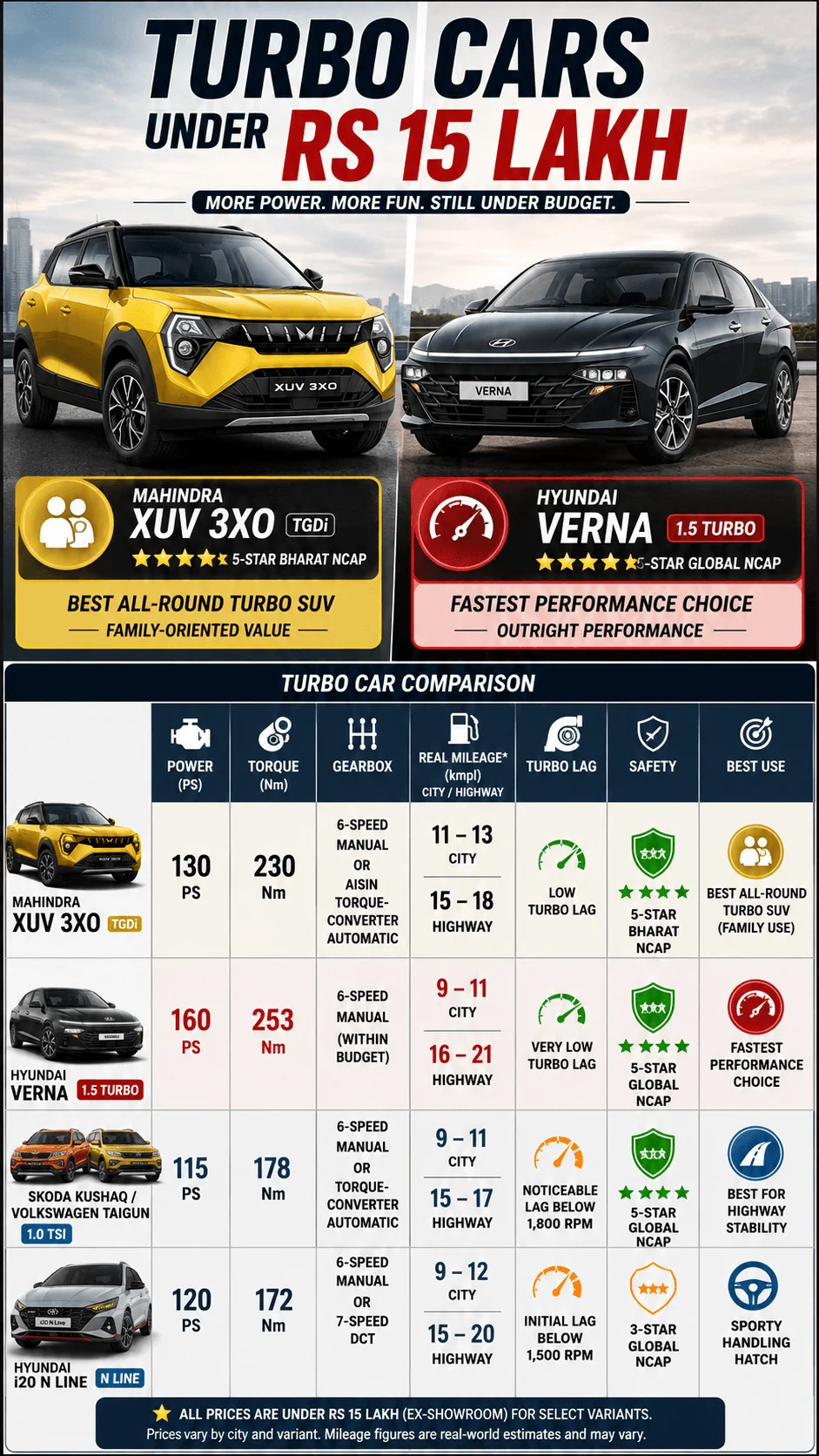
1. Mahindra XUV 3XO TGDi
- Price: about ₹7.5–14.88 lakh (TGDi turbo in the upper trims)
- Power and torque: 130 PS / 230 Nm
- Gearboxes: 6-speed manual, 6-speed AISIN torque converter automatic
- Real-world mileage: about 11–13 kmpl city, 15–18 kmpl highway (ARAI ~18–20 kmpl)
- Turbo lag: low, thanks to direct injection and 230 Nm from ~1,500 rpm
- Best variant: AX5 L turbo automatic
- Safety: 5 stars, Bharat NCAP (6 airbags standard, all variants)
This is the clearest example of a turbo whose extra torque genuinely improves everyday usability. The direct-injection TGDi engine is the strongest in the sub-4m class, the AISIN torque converter is smoother in traffic than the dual-clutch boxes in some rivals, and Mahindra packs in Level 2 driver aids, a panoramic sunroof and dual-zone climate at a sharp price. The big 5-star Bharat NCAP result makes it an easy family recommendation. The weak spots? A small 364-litre boot and styling that divides opinion. Verdict: the most complete turbo petrol SUV under ₹15 lakh, let down only by how much you can fit in the boot.
2. Hyundai Verna 1.5 Turbo
- Price: SX Turbo manual fits just under ₹15 lakh, the DCT crosses it
- Power and torque: 160 PS / 253 Nm
- Gearboxes: 6-speed manual (DCT above budget)
- Real-world mileage: about 9–11 kmpl city, 16–21 kmpl highway (ARAI ~20 kmpl)
- Turbo lag: very low, the big engine pulls cleanly from low revs
- Best variant: SX Turbo MT
- Safety: 5 stars, Global NCAP
If outright performance is your thing, the Verna 1.5 turbo is the fastest car near this price, with 0 to 100 kmph in around 8 seconds. It’s also genuinely refined, has a spacious rear seat and slices through the air efficiently, so highway runs can touch 20-plus kmpl. In dense city traffic the powerful engine still drinks fuel, and the low ground clearance means you’ll baby it over tall speed-breakers. Verdict: the performance halo of this list, and the rare turbo sedan that still makes sense for a family.
3. Skoda Kushaq and Volkswagen Taigun 1.0 TSI
- Price: 1.0 TSI variants from roughly ₹10.6–14.5 lakh
- Power and torque: 115 PS / 178 Nm
- Gearboxes: 6-speed manual, 6-speed torque converter automatic
- Real-world mileage: about 9–11 kmpl city, 15–17 kmpl highway (ARAI ~19.6–20 kmpl)
- Turbo lag: pronounced below 1,800 rpm in the manual, though the automatic hides it
- Best variant: the 1.0 TSI automatic in either badge
- Safety: 5 stars, Global NCAP
These twins are the highway specialists. Few cars near ₹15 lakh feel as planted and confident at speed, the build quality is solid, and both carry 5-star Global NCAP records. The 1.0 TSI is the sensible buy under this theme. The larger 1.5 versions push past the budget. The downside is city manners: the manual stalls easily if you lug it at low revs, and economy in traffic is nothing special. Verdict: brilliant for buyers who rack up highway miles, more demanding for pure city use, so pick the automatic.
4. Hyundai i20 N Line
- Price: about ₹9.2–11.7 lakh
- Power and torque: 120 PS / 172 Nm
- Gearboxes: 6-speed manual, 7-speed DCT
- Real-world mileage: about 9–12 kmpl city, 15–20 kmpl highway (ARAI ~20 kmpl)
- Turbo lag: patient below 1,500 rpm, then eager
- Best variant: N8 DCT
- Safety: 3 stars, Global NCAP (base i20 shell)
For buyers who want a turbo because they actually enjoy driving and don’t want an SUV, the i20 N Line is the answer. It gets real mechanical changes over the standard i20: stiffer suspension, weightier steering, disc brakes all round and a sportier exhaust note. The manual is the one that hides the engine’s initial lag best. What do you give up? A firm ride over sharp bumps, and a 3-star crash record that trails the SUVs here. Verdict: the keen driver’s hatchback, if you value handling over plushness.
Need seven seats with the same 1.5 turbo? The Kia Carens turbo is the family option, though its older crash record was a modest 3 stars, so check the latest rating for your variant before you commit.
Turbo vs Naturally Aspirated: The Real Performance Difference
The practical difference is simpler than the marketing makes it sound. A turbo petrol gives you stronger mid-range shove, easier overtakes and better full-load and hill performance. A naturally aspirated petrol gives you cleaner low-speed response, more predictable city behaviour, less sensitivity to your right foot, and usually simpler long-term ownership. Plenty of buyers fall for a turbo on the test drive, then quietly admit a good normal petrol would have matched their actual daily use.
| Factor | Turbo petrol | Naturally aspirated petrol |
|---|---|---|
| City drivability | Can feel flat below boost, gearbox choice matters a lot | Smoother and more linear at low speed |
| Highway overtaking | Usually much stronger | Needs more revs and planning |
| Hill and full-load driving | Easier thanks to extra torque | Strains sooner, needs downshifts |
| Mileage sensitivity | High, economy swings sharply with driving style | Low, mileage stays predictable |
| Maintenance cost | Around 10–20% higher, oil and service-sensitive | Simpler and more forgiving |
| Long-term reliability | Strong if serviced on time, less forgiving of neglect | Easier to keep happy for a decade |
| Best for | Mixed use, highways, hills, keen drivers | Slow city use, low running, fuss-free owners |
So who should pick which? If your routine is office traffic, short hops, low yearly running and a gentle right foot, a normal petrol may still be the smarter buy. If you regularly overtake on two-lane highways, drive in the hills, travel with a full load, or simply dislike wringing an engine out, the turbo’s extra torque is worth paying for.
Turbo Engine Maintenance Tips
A turbo petrol is not fragile, but it’s less tolerant of neglect than an old-school normal petrol. A turbocharger spins at over 1,50,000 rpm and runs extremely hot, so it relies on clean, fresh oil far more than a simple engine does. A replacement turbo can cost upwards of ₹40,000, which is exactly why a little discipline pays off. These are the rules that matter most, and they pair well with the basics in our guide to maintaining your turbo engine.
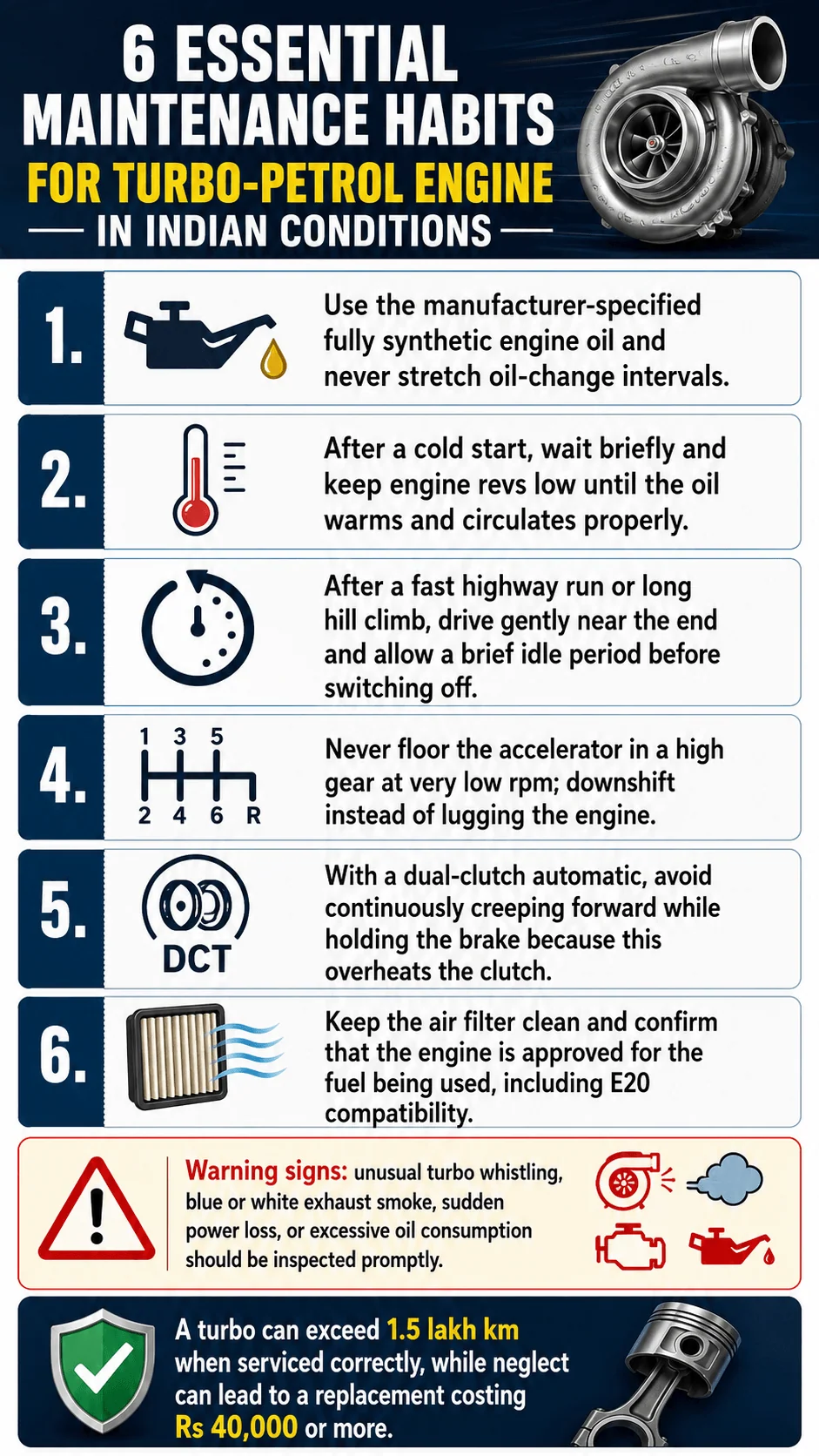
- Never stretch oil changes. Use the fully synthetic grade your owner’s manual specifies and stick to the service interval. Old oil loses its heat resistance and bakes carbon into the turbo bearings.
- Go easy on cold starts. When the engine is cold the oil is thick and slow to circulate. Let it settle for a few seconds and keep revs low until it warms up, rather than flooring it from the driveway.
- Don’t shut off straight after a hard run. After a fast highway stint or a long climb, the turbo is red hot. Drive the last bit gently and let it idle for a few seconds before you switch off, so oil can cool the turbo rather than bake inside it.
- Don’t lug the engine. Sit in a high gear at very low revs, then floor it, and you get knocking and strain. Downshift instead.
- Mind your gearbox. If you drive a turbo DCT, don’t creep forward on the brake in traffic. Let the car ahead move, then release fully. Riding the brake cooks the dual-clutch.
- Keep the air filter clean and check E20 compatibility. A clogged filter starves the turbo and makes it run hotter. Confirm your model is rated for E20 fuel and follow the manual, not generic advice.
A quick note on cost. Maintenance runs higher on the European cars (Skoda and VW) and Tata than on Hyundai and Maruti, where five-year scheduled servicing is among the cheapest. Watch for whistling sounds, blue or white exhaust smoke, or sudden power loss, since those usually point to a turbo hose leak that’s cheap to fix early and expensive to ignore.
Common Turbo Buyer Mistakes
- Buying a turbo mainly for bumper-to-bumper traffic, then complaining it isn’t relaxed.
- Expecting ARAI mileage in dense city driving.
- Assuming a DCT is the best automatic for every turbo, when in heavy traffic a torque converter is calmer.
- Treating every turbo as a performance car, when many are just torque-rich everyday engines.
- Skipping the recommended synthetic oil to save money, which is the fastest way to shorten a turbo’s life.
FAQs: Turbo Petrol Cars in India
Are turbo petrol cars reliable in India? Broadly, yes. The catch is that you have to service them on time and never skip an oil change. Modern turbo engines from every major brand are mainstream now, with standard warranties and wide service support behind them. They’re less forgiving of neglect than a simple petrol, but look after one and it’ll outlast your car loan.
Does a turbo engine increase maintenance cost? A little, usually around 10 to 20% more than an equivalent normal petrol, mostly because of pricier synthetic oil and slightly faster wear on parts like spark plugs. The bigger cost is the cost of neglect: skip servicing and a turbo will punish you far sooner than a non-turbo engine.
Which is the best turbo petrol car under 10 lakh? For most buyers, the Maruti Fronx, for its easy nature, mild-hybrid-assisted low-end and low running costs. If you want driving feel and top safety instead, the Skoda Kylaq is the enthusiast’s pick, and the Tata Nexon is the choice if a 5-star crash record is your first filter.
Which is the best turbo petrol car under 15 lakh? The Mahindra XUV 3XO TGDi is the most complete, with strong performance, a smooth torque-converter automatic, Level 2 driver aids and a 5-star rating. For sheer performance, the Hyundai Verna 1.5 turbo is the one to beat.
Is turbo petrol better than normal petrol? Not automatically. It’s better for overtaking, hills and full-load driving. It’s not always better if you mostly crawl in city traffic and want the simplest, most predictable running costs. The right answer depends on your roads, not the brochure. Our petrol, diesel or CNG guide can help if you’re still weighing fuel types.
What is turbo lag? It’s the brief delay between pressing the accelerator at low revs and the engine delivering its full boosted shove. The turbo needs enough exhaust flow to spin up first. On most affordable Indian turbos it’s most noticeable below 1,500 to 2,000 rpm.
Which turbo petrol car has the least turbo lag? Among affordable options, the Maruti Fronx feels the most lag-free, because its mild-hybrid motor adds torque before the turbo spools. The Mahindra XUV 3XO TGDi is also very low-lag thanks to direct injection, and the 1.5-litre Verna barely has any.
Which turbo petrol car gives the best real-world mileage? In the city, the Maruti Fronx is the most consistently efficient turbo. On the highway, the aerodynamic Hyundai Verna 1.5 can stretch beyond 20 kmpl when driven steadily.
Is the Tata Nexon turbo petrol good for city driving? It’s good enough, but not the last word in low-rpm smoothness or economy. The manual and AMT feel laggy in traffic, so the DCA automatic is the one to pick for city use.
Is the Hyundai Venue turbo petrol reliable? Yes. The 1.0 T-GDi has a strong track record, maintenance costs are among the lowest in the segment, and the current model’s 5-star Bharat NCAP result strengthens the overall case.
Is the Kia Sonet turbo petrol worth buying? Yes, if you want a premium-feeling cabin, plenty of features and a quick DCT. Be aware the rear seat is tight and the dual-clutch can feel jerky at crawling speeds.
Are 1.0 turbo petrol engines powerful enough? Yes. For everyday family use, highway overtakes and the odd hill climb, a good 1.0 turbo makes more torque than a typical 1.2 normal petrol, so you’re rarely short of pull. The only real weakness is how it behaves at crawl, and how it feels once you’ve loaded five people and their luggage.
Should I buy turbo petrol or diesel? If your running is high and highway-heavy, diesel still usually wins on fuel cost. For moderate running and more refinement without diesel’s complexity, a turbo petrol is the easier compromise.
Are turbo petrol cars good for highways and hills? Yes, this is exactly where they shine. The strong mid-range torque makes overtaking and climbing gradients far easier than a similarly priced normal petrol.
Prices, variants, mileage and waiting periods change often and vary by city. Reconfirm the exact on-road price, E20 compatibility and warranty terms at the dealership before you book.