
Here’s the uncomfortable bit most lists of 7 seater cars in india skip. A car isn’t a good seven-seater just because the brochure prints seven seatbelts. Seven belts and seven content adults are two very different promises. So before you touch prices or variants, ask yourself the one question that really settles this purchase. Will that back row actually get used, or will it stay folded for life because nobody past the age of twelve can sit there?
We went through current showroom prices, manufacturer spec sheets, and a stack of owner road tests to answer that honestly. The short version: across today’s seven-seaters, a proper MPV still beats almost every seven-seat SUV for genuine last-row use. Want one pick for most families and the budget allows it? The Toyota Innova Hycross sets the bar. Shopping under ₹15 lakh? The Maruti Ertiga. After the roomiest cabin below the Innova bracket without Innova money? The Kia Carens Clavis is your answer. The SUVs, your Tata Safari and Mahindra XUV 7XO and Scorpio N and Hyundai Alcazar, still earn a place, but mostly as five-plus-two cars rather than true people movers. Let’s prove every word of that.
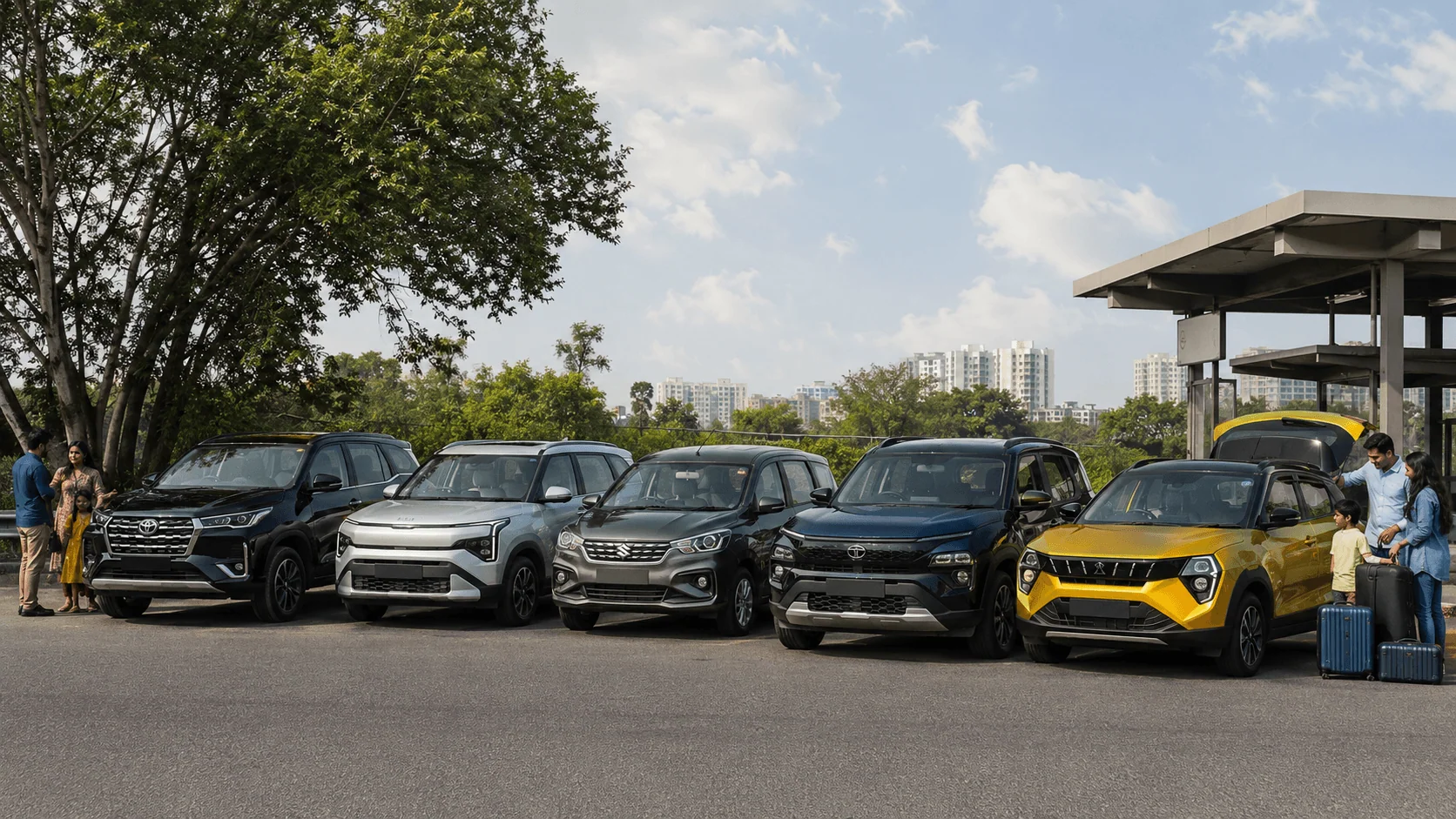
All 7-Seater Cars in India 2026
Two naming updates before your shortlist takes shape. Searching for the Mahindra XUV700? The car on sale now is the Mahindra XUV 7XO, same platform, refreshed in January 2026. And Kia keeps both the older Carens and the plusher new Carens Clavis on its books, with a Clavis EV alongside. With that sorted, here’s the full 7 seater car list, cheapest first.
- Renault Triber and the near-identical Nissan Gravite, from about ₹5.7 lakh
- Maruti Ertiga, ₹8.80 lakh onwards
- Mahindra Bolero Neo, the rugged budget pick, from ₹8.85 lakh
- Toyota Rumion, ₹9.55 lakh onwards
- Kia Carens and the plusher Carens Clavis, ₹11.02 lakh onwards
- Citroën Aircross 5+2, from about ₹12 lakh
- Mahindra Scorpio N and the monocoque XUV 7XO, ₹13.49 lakh onwards
- Tata Safari, ₹13.29 lakh onwards
- Hyundai Alcazar, ₹14.49 lakh onwards
- MG Hector Plus, ₹17.29 lakh onwards
- Toyota Innova Crysta and the hybrid Hycross, ₹19.53 lakh onwards
- Maruti Invicto, the priciest of the lot at ₹24.97 lakh onwards
Bookmark the table below. It pairs every mainstream model with price and body type, plus the one column nobody else prints straight: an honest read on who actually fits in the back once you load up.
| Model | Ex-showroom price | Body type | Third-row reality | Safety |
|---|---|---|---|---|
| Renault Triber | ₹5.81–8.69 lakh | Sub-4m MPV | Kids and short hops | 4★ adult (Global NCAP) |
| Nissan Gravite | ₹5.73–9.08 lakh | Sub-4m MPV | Kids and short hops | Not separately tested |
| Maruti Ertiga | ₹8.80–12.94 lakh | MPV | Adults OK on shorter trips | 3★ (Global NCAP) |
| Mahindra Bolero Neo | ₹8.85–10.49 lakh | Ladder SUV | Side-facing jump seats | Not rated |
| Toyota Rumion | ₹9.55–13.86 lakh | MPV | Same as Ertiga | 3★ (Global NCAP) |
| Kia Carens / Clavis | ₹11.02–21.59 lakh | MPV | Genuinely adult-usable | 3★ (Global NCAP) |
| Citroën Aircross 5+2 | ₹11.99–14.37 lakh | Crossover SUV | Children only | Awaited for 5+2 |
| Mahindra Scorpio N | ₹13.49–24.95 lakh | Ladder SUV | Emergency use | 5★ adult (Global NCAP) |
| Mahindra XUV 7XO | ₹13.66–24.92 lakh | Monocoque SUV | Tight, kids best | 5★ (as XUV700, Global NCAP) |
| Tata Safari | ₹13.29–26.40 lakh | Monocoque SUV | Best SUV third row here | 5★ (Bharat NCAP) |
| Hyundai Alcazar | ₹14.49–21.25 lakh | Monocoque SUV | Short trips only | Not separately rated |
| MG Hector Plus | ₹17.29–19.69 lakh | Monocoque SUV | Children, short use | Not rated |
| Toyota Innova Crysta | ₹19.72–26.77 lakh | MPV (diesel) | Truly adult-friendly | 5★ (ASEAN NCAP) |
| Toyota Innova Hycross | ₹19.53–32.95 lakh | MPV | Best in class | 5★ (Bharat NCAP) |
| Maruti Invicto | ₹24.97–28.61 lakh | MPV | Hycross-class | 5★ (Bharat NCAP) |
A word on that last column, because it trips up plenty of buyers. We list crash-test stars only, never airbag counts. A bigger airbag number tells you nothing about how the shell holds up in a crash, and the Kia Carens proves it. Six airbags on board, three stars on the test. Where a model hasn’t been independently crash-tested, you’ll see “Not rated” or “Awaited” rather than a blank that quietly reads as unsafe. Prices shift with offers and GST tweaks. Treat these as your 2026 starting point, then pin down the exact variant at the dealership before you sign.
Budget 7-Seaters Under 15 Lakhs
Under ₹15 lakh, your real choice is between an honest value MPV and an SUV-shaped compromise. If the seventh seat sees even semi-regular use, an Ertiga or Carens is the safer bet than any budget SUV. Need that seat only now and then, with city parking your bigger headache? The Triber stays clever.
| Model | Price band | Best for | Biggest compromise |
|---|---|---|---|
| Renault Triber | ₹5.81–8.69 lakh | Tight parking, low budget | Strained 1.0L engine when fully loaded |
| Nissan Gravite | ₹5.73–9.08 lakh | Lowest running cost via CNG | Built-to-cost cabin, thin service network |
| Maruti Ertiga | ₹8.80–12.94 lakh | Reliable city and highway family use | 3-star rating, single CNG cylinder eats the boot |
| Toyota Rumion | ₹9.55–13.86 lakh | Ertiga buyers who want Toyota service | A price premium for the badge |
| Citroën Aircross 5+2 | ₹11.99–14.37 lakh | Ride comfort, removable seats | 44L boot with all seats up, no rear AC vents |
| Mahindra Bolero Neo | ₹8.85–10.49 lakh | Rough rural roads | Side-facing jump seats, basic ride |
The Ertiga is still the smart default down here, and it isn’t close. After the GST revision late in 2025, its whole range slipped comfortably under budget. The automatic slips in too. And the factory CNG version is the cheapest seven-seater in the country to feed, around 22 to 24 km/kg once you account for real traffic. Its back bench is one of the few below the Innova class that genuinely works for grown-ups, happiest with shorter adults or teenagers on the kind of two-to-three-hour run your family actually does. The Rumion is the very same car wearing a Toyota badge and warranty. Worth the small premium only if that peace of mind speaks to you. As for the Triber and its twin the Gravite, both are brilliant packaging tricks rather than full-time people movers. Their last rows suit your kids, and their 84-litre boots vanish the moment all seven seats go up.
There’s a lot more variant-level detail on this price band, including which Ertiga and Carens trims to pick and how the on-road numbers shake out. If you’re shopping strictly under this budget, read our deep-dive on the best 7-seater cars under ₹15 lakh before you commit.
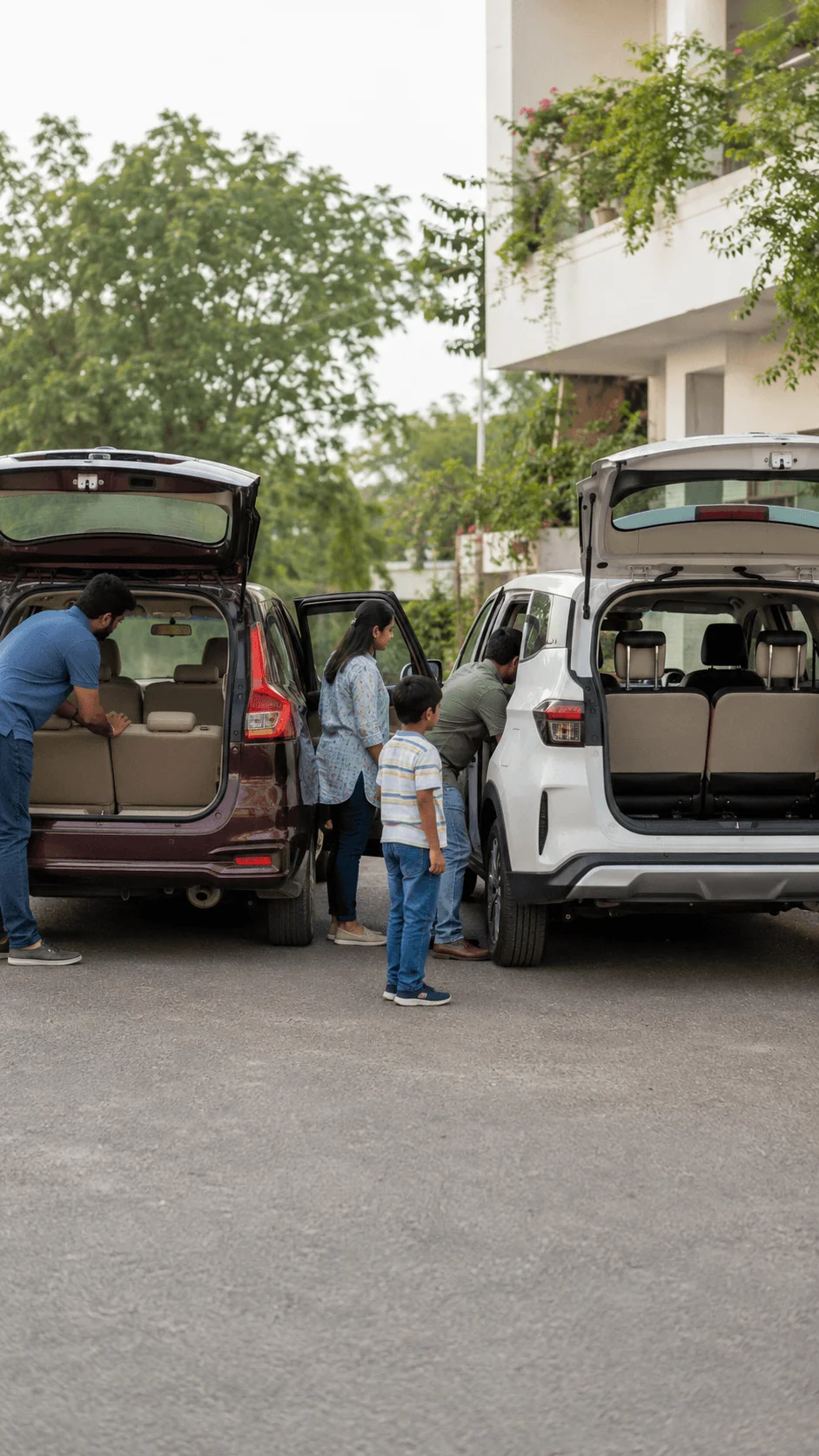
Video Comparing the Best 7-Seater MPV Cars in India

Premium 7-Seaters Under 25 Lakhs
This is where most shortlist mistakes get made. You see the SUV stance, the big wheels riding high, and you assume the bigger-looking car must be the better family seven-seater. Then you actually sit in the back and measure knee room, floor height, AC reach and the boot with everyone aboard, and the order flips. The MPVs keep behaving like family cars. The SUVs start behaving like five-seaters that take two more in a pinch. Here are the nine that matter, with honest mini-reviews.
Kia Carens Clavis
Price: ₹11.23–21.59 lakh · Body: premium MPV · Best variant: Clavis HTX(O) for ADAS
The Clavis answers the questions families actually ask. Is the last row usable? Yes, more than in nearly any SUV near this money. Is getting back there a fight? Less so, thanks to a one-touch tumbling middle row. Does it still suit your city life? It does, because it never feels as big or intimidating as an Innova. A long 2780mm wheelbase frees up real space, the 2026 update brought Level 2 ADAS and a panoramic sunroof, and 216 litres survive behind the third row, enough for two cabin bags. The catches? An unconfirmed crash rating for the Clavis itself (the related Carens sits at three stars), plus a soft suspension that sags under a full load. For most families chasing real seven-seat comfort without the bulk, this is the easiest call under ₹20 lakh.
Hyundai Alcazar
Price: ₹14.49–21.25 lakh · Body: monocoque SUV · Best variant: Signature diesel AT
The Alcazar is arguably the most feature-dense car in this group. Ventilated seats, a panoramic sunroof, a proper audio setup, and a refined diesel automatic that genuinely shines on the highway. It parks far more easily than a Safari or XUV 7XO too. But it feels like a stretched Creta, and the rearmost bench pays for those proportions. In the captain-seat versions, getting in is notoriously fiddly, and once you’re down there, your knees press into the seat ahead. So buy it as your luxurious four or five seater with a big boot and rare back-row duty. Don’t buy it to haul six or seven adults week in, week out.
Mahindra XUV 7XO
Price: ₹13.66–24.92 lakh · Body: monocoque SUV · Best variant: AX7L diesel AT
As a self-driven family SUV, the XUV 7XO has a genuine case. The engines are properly quick, it stays planted at speed, and the twin screens with Level 2 ADAS feel a cut above what rivals offer. It’s a five-star car too, tested as the XUV700 under Global NCAP. The snag is the family brief. Row three runs tight, knee room maxes out near 670mm, and you’ll feel the effort every time you load kids in. The petrol automatic drinks hard in town, roughly 7 to 8 kmpl, so think twice if your annual mileage is high. Its 240-litre all-seats-up boot is actually the best of the seven-seat SUVs here, yet it still trails any proper MPV. Pick it for pace and tech, and treat the rear seats as occasional duty.
Tata Safari
Price: ₹13.29–26.40 lakh · Body: monocoque SUV · Best variant: Accomplished diesel AT
Want SUV presence without fully surrendering family usability? The Safari is the one to test with all three rows occupied. Built on a Land Rover-derived platform, it feels planted on long runs, the second row is among the most opulent at this money, and a five-star Bharat NCAP score hands it a safety story the MPVs can’t quite match. The fresh 1.5 turbo-petrol for 2026 broadens the choice. Now the honest catches. The diesel’s hydraulic steering is heavy in traffic, service bills run higher than MPV rivals, and the genuinely usable luggage room behind an upright back row is tiny. Tata quotes up to 420 litres, but that’s measured to the roof. Even so, its third row is the best of the SUVs here, and your adults will manage a one-to-two-hour hop without much complaint.
Mahindra Scorpio N
Price: ₹13.49–24.95 lakh · Body: ladder-frame SUV · Best variant: Z8 diesel
The Scorpio N clicks instantly if your roads are broken, your routes rural, or you just want a tough body-on-frame SUV that won’t bottom out under a full load. It commands respect, the engines pull hard, and resale stays famously sticky. But it isn’t kind to whoever ends up at the back. The high floor forces a knees-up posture, the cabin pinches in at the rear, and that big step will trouble your parents every time they climb aboard. Luggage room with every seat up is close to nothing. Buy it for bad roads and stance, not for a daily adult seventh seat.
MG Hector Plus
Price: ₹17.29–19.69 lakh · Body: monocoque SUV · Best variant: Sharp Pro 7-seater
The Hector Plus still feels big and plush, with a comfy second row and plenty of theatre on its giant screen. If you travel four or five up most days and only occasionally unfold the back, it can feel like a lot of car for your money. The trouble is that 155-litre boot with all rows up, one of the clearest warnings in this whole segment, and a last row that simply can’t argue with a Carens or an Innova. Think of it as a comfortable six-plus-one rather than a true seven-seater.
Toyota Innova Crysta
Price: ₹19.72–26.77 lakh · Body: ladder-frame MPV (diesel) · Best variant: VX 7-seater
The Crysta is the diesel road-trip specialist that refuses to retire, and for good reason. The ladder-frame build shrugs off heavy loads and broken tarmac, the 2.4 diesel has effortless low-end shove, and around 300 litres stay free with every seat in use. Your adults sit happily in the back. The downsides? It’s diesel and manual only now, since Toyota nudges automatic buyers toward the Hycross. The steering goes heavy in traffic, and the cabin feels its age. But if you mostly do long highway miles with the family and luggage aboard, it’s still one of the safest buys you can make.
Toyota Innova Hycross
Price: ₹19.53–32.95 lakh · Body: premium MPV · Best variant: VX Hybrid
This is the closest thing India has to a default answer when you genuinely need seven seats. The switch to a car-like monocoque platform turned the ride plush and quiet, and the strong-hybrid version returns a claimed 23.24 kmpl, with a real-world 16 to 17 kmpl even in stop-start city crawl, where hybrids do their best work. The rearmost bench is the finest on sale for mainstream buyers, airy and adult-usable for hours, and roughly 300 litres of luggage still fit with all rows up. A five-star Bharat NCAP rating seals it. The only real catch is the climb in price once you reach for the hybrid trims. Stretch to it and nothing else here solves as many of your real family problems.
Maruti Invicto
Price: ₹24.97–28.61 lakh · Body: premium MPV · Best variant: Zeta Plus
The Invicto is the Hycross’s mechanical cousin, sold through Maruti’s Nexa network with a strong-hybrid heart and a five-star Bharat NCAP score. Back-row comfort is effectively Hycross-grade, which puts it among the best you can buy. It drops a few of the Toyota’s flourishes, the ottoman seats and some ADAS kit, and badge pull still leans Toyota in this bracket. But if you’re watching fuel bills, you’d rather deal with Nexa, and you want a crash-tested hybrid people mover, it’s a genuine alternative for you, not a watered-down one.
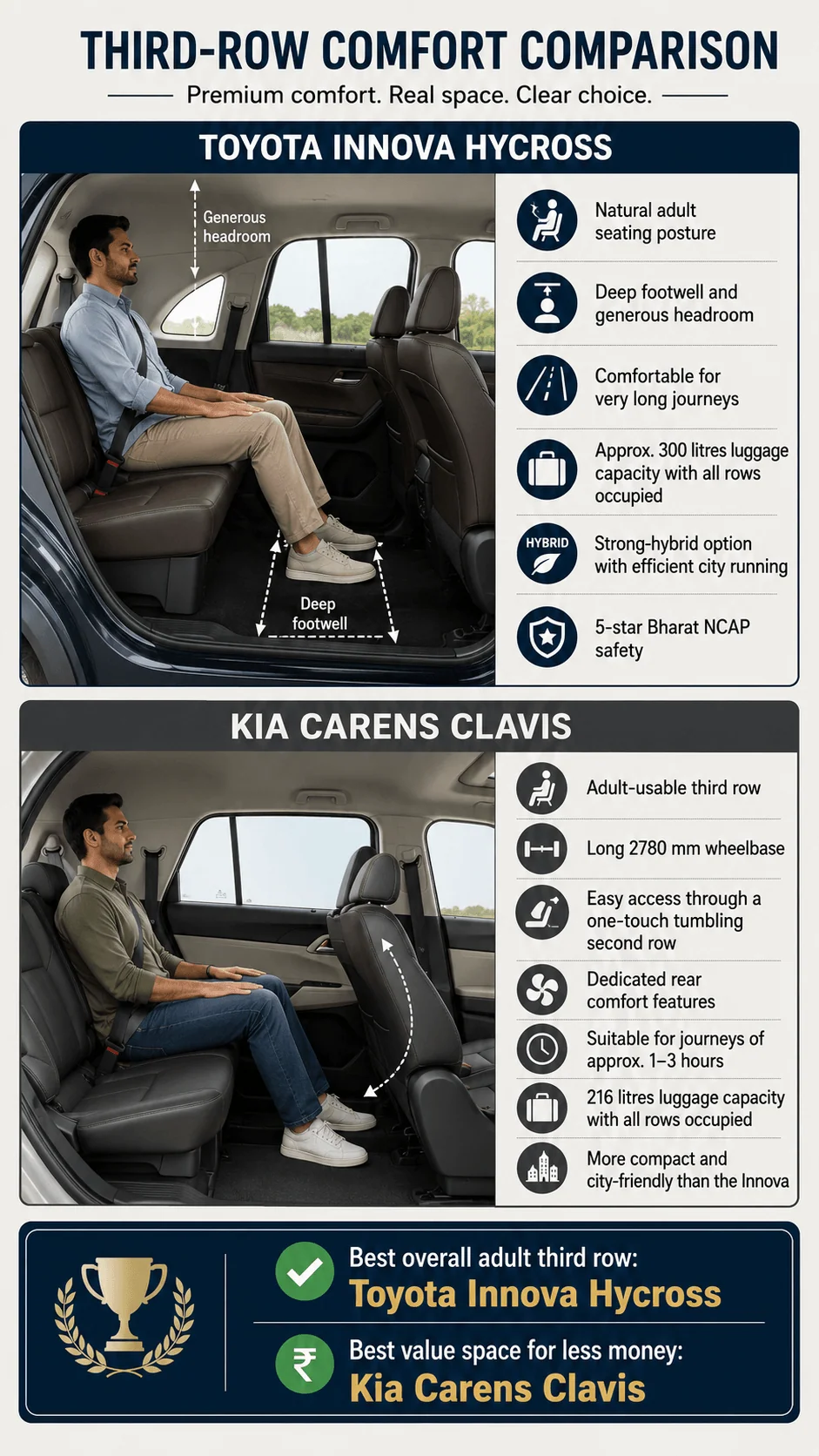
Third Row Comfort Ranking
Here’s the part reviews usually skate over, so it’s the part we leaned into hardest. No carmaker publishes back-row legroom in one comparable way, so this ranking blends the packaging numbers that do exist with hours of road-test ergonomics. Treat it as an ownership-first read on how long a real adult can actually last back there.
| Rank | Model | Verdict | Knee room and posture | Comfortable for |
|---|---|---|---|---|
| 1 | Toyota Innova Hycross / Invicto | Adult-friendly | Natural angle, deep footwell | Very long drives |
| 2 | Toyota Innova Crysta | Adult-friendly | Supportive, slightly higher floor | Long drives |
| 3 | Kia Carens / Clavis | Adult-usable | Very good, long wheelbase helps | One to three hours |
| 4 | Maruti Ertiga / Rumion | Short trips | Honest for the price | About an hour |
| 5 | Tata Safari | Short trips | Best SUV here, around 600–780mm | One to two hours |
| 6 | Hyundai Alcazar | Compromise | Fine for shorter occupants | 30 to 60 minutes |
| 7 | Mahindra XUV 7XO | Compromise | Tight, around 670mm max | 30 to 60 minutes |
| 8 | Renault Triber / Gravite | Kids best | Small but clever for the size | Short hops |
| 9 | Mahindra Scorpio N | Emergency | Severe knees-up, high floor | Short hops |
| 10 | MG Hector Plus | Emergency | Weakest premium-SUV case | Very short trips |
| 11 | Citroën Aircross 5+2 | Emergency | Negligible, no rear AC vents | Children only |
So is the back row comfortable for adults? In a true MPV like the Hycross, the Crysta or a Carens, yes, genuinely. In a five-plus-two SUV like the XUV 7XO or Alcazar or Scorpio N, not really, not for long, and not without grumbling from whoever drew the short straw.
Why MPVs win the third row
There’s a simple engineering reason behind that ranking. An SUV needs ground clearance, so its floor rides high. To look sporty, its roof slopes down toward the tail. Now your back-row passengers get pinched between a tall floor that pushes their knees up and a low roof that crowds their head. An MPV sits them on a lower floor under a boxy, upright roofline, so you get a natural, chair-like posture instead. That’s the whole story in one paragraph.
The boot space nobody mentions
Here’s the trade-off that wrecks more airport runs than any other. Fill an SUV with seven people and there’s almost nowhere left for your bags.
| Model | Boot with all rows up | Real meaning |
|---|---|---|
| Toyota Innova Hycross / Crysta / Invicto | ~300 litres | Two medium suitcases plus soft bags |
| Kia Carens / Clavis | 216 litres | Two cabin trolleys and backpacks |
| Maruti Ertiga / Rumion | 209 litres | Soft duffels, tight for hard cases |
| Mahindra XUV 7XO | 240 litres | Decent for an SUV, still below MPVs |
| Hyundai Alcazar | 180 litres | A couple of soft bags |
| MG Hector Plus | 155 litres | One duffel and a laptop bag |
| Renault Triber / Gravite | 84 litres | Two laptop bags, barely usable |
| Tata Safari | ~73 litres usable | Roof carrier needed for a holiday |
| Mahindra Scorpio N | ~60 litres | Practically none, roof carrier mandatory |
| Citroën Aircross 5+2 | 44 litres | Zero usable luggage room |
Carmaker boot figures for SUVs often get measured all the way to the roofline. That’s exactly why a Safari can be quoted at 420 litres yet still leave you strapping a bag to the roof in practice. The MPV numbers above are honest behind-the-seat space.
The detail most blogs miss: child seats and access
Fix an ISOFIX child seat in the second-row bench of an Ertiga or Safari, and you usually can’t tumble that seat forward to let anyone into the back. So you either uninstall the child seat every single time or send rear passengers in through the tailgate. Cars with captain-chair middle rows, like the Hycross or the six-seat Carens and Alcazar, let people walk straight down the central aisle, child seat untouched. Got a toddler and grandparents in the same trip? That one design choice will matter more to you than any feature list.
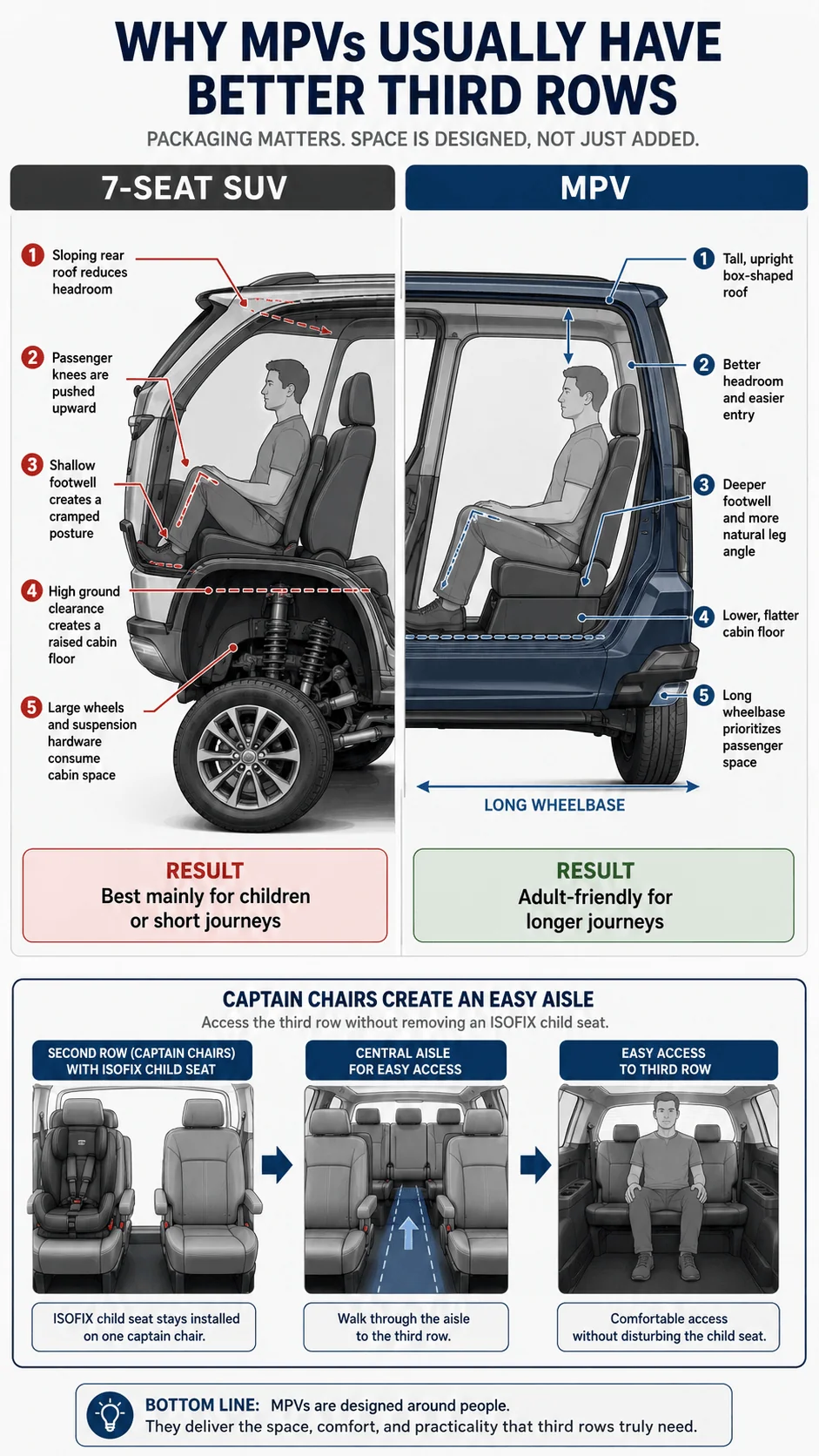
Which 7-Seater for Your Family?
Match the car to your life, not to the showroom mood lighting. Here’s a quick-reference grid. Below it sits a short, blunt note on what each of these actually costs you to keep running on Indian roads.
| If your priority is | Best pick | Runner-up |
|---|---|---|
| Best overall family 7-seater | Toyota Innova Hycross | Kia Carens Clavis |
| Best MPV for city families | Kia Carens Clavis | Maruti Ertiga |
| Best under ₹15 lakh | Maruti Ertiga | Toyota Rumion |
| Best premium under ₹25 lakh | Kia Carens Clavis | Tata Safari |
| Best third row for adults | Innova Hycross / Crysta | Kia Carens |
| Best for elderly parents | Kia Carens (low step-in) | Innova Hycross |
| Best for CNG running cost | Maruti Ertiga CNG | Nissan Gravite CNG |
| Best for rough roads | Mahindra Scorpio N | Mahindra Bolero Neo |
| Best for highway road trips | Tata Safari | Toyota Innova Crysta |
| Best for resale value | Toyota Innova | Maruti Ertiga |
| Safest 7-seater | Toyota Innova Hycross | Tata Safari / XUV 7XO |
On running costs, the pecking order barely budges whatever the fuel price does. Factory CNG (Ertiga, Rumion) is cheapest to feed. Strong hybrids (Hycross, Invicto) come next, then the efficient diesels, then small turbo-petrols, and a distant last, the big petrol SUVs. A rough real-world picture:
| Vehicle and fuel | Real-world economy | Running-cost read |
|---|---|---|
| Ertiga / Rumion CNG | 22–24 km/kg | Lowest fuel cost, full stop |
| Innova Hycross hybrid | 16–17 kmpl in city | Best big-family efficiency without CNG limits |
| Kia Carens diesel AT | 14–16 kmpl | Strong all-rounder |
| Tata Safari diesel | 11–14 kmpl | Honest diesel SUV economy |
| XUV 7XO / Scorpio N petrol | 7–9 kmpl | Expensive if you drive a lot |
Don’t ignore the hidden costs either. Move from an Ertiga’s 15-inch tyres to an XUV 7XO’s 18-inch rubber and a fresh set can cost you roughly four times as much, while insurance climbs with the sticker. The cheapest car to buy is rarely the cheapest to live with. On this list, the Ertiga somehow manages to be both.
One more honest nudge. If you mostly carry five or fewer and only rarely need extra seats, a three-row car is the wrong buy. You’ll pay for bulk you never use. Look instead at roomier 5-seater family options, which cost less to buy and less to run.
A quick reality check on price, too. Everything above is ex-showroom. In a high-tax state, registration and insurance can pile on ₹2.5 to 3 lakh, which shoves a top Carens or a mid Safari well past its sticker. Working to a strict on-road number? Read up on the gap between ex-showroom and on-road price before you sign anything.
FAQs
Which is the best 7-seater car in India? For most families with the budget for it, the Toyota Innova Hycross is the best overall 7-seater. It pairs the most adult-friendly back row with strong hybrid economy and a five-star Bharat NCAP rating. Under ₹15 lakh, the Maruti Ertiga is the smartest pick, and the Kia Carens Clavis offers the best value below the Innova bracket.
Is the third row comfortable for adults? That depends entirely on the car. In true MPVs like the Innova Hycross, the Innova Crysta and the Kia Carens, yes, adults can sit back there for hours. In most seven-seat SUVs (XUV 7XO, Alcazar, Scorpio N, Hector Plus), the last row forces a knees-up posture and really suits children or very short trips.
Which 7-seater is best under ₹15 lakh? The Maruti Ertiga. It blends a usable back row with very low running costs, especially in the factory CNG version, plus Maruti’s huge service network. Prices now sit fully under budget after the 2025 GST cut.
Which 7-seater is best under ₹25 lakh? For sheer space and family comfort, the Kia Carens Clavis. For SUV presence and a five-star safety story, the Tata Safari. After performance and tech instead? The Mahindra XUV 7XO.
Is the Ertiga better than the Carens? For running cost, CNG savings and a wider service reach, the Ertiga wins. For cabin richness, features and a more premium family feel, the Carens (especially the Clavis) is clearly ahead. Pick by whether your priority sits with the wallet or the cabin.
Is a 7-seater SUV better than an MPV? For carrying people and their luggage, no. MPVs give you easier access, a more usable back row and far better boot space with everyone aboard. Choose an SUV only when you genuinely need ground clearance for bad roads, or you mostly travel four or five up and want the stance.
Which 7-seater is safest in India? Among models with current crash-test results, the Toyota Innova Hycross and Maruti Invicto lead with five-star Bharat NCAP scores. The Tata Safari, Mahindra XUV 7XO and Scorpio N also hold five-star ratings. Remember that a high airbag count alone, as with the three-star Kia Carens, doesn’t guarantee a strong body shell.
Which 7-seater has the best mileage? For the lowest running cost, the Maruti Ertiga CNG is hard to beat at a real-world 22 to 24 km/kg. For petrol-hybrid economy without CNG’s luggage penalty, the Innova Hycross and Invicto hybrids lead at a claimed 23.24 kmpl.
Which 7-seater is best for elderly parents? The Kia Carens. Its low step-in height, wide rear doors and effortless one-touch tumbling middle row make climbing into the back far easier than it ever is in a tall ladder-frame SUV.