
Walk into a Maruti showroom today and you’d have to pick between a Swift, a Dzire, and a Brezza that all cost roughly the same on-road. Same brand, same budget, three completely different cars. So which one should you actually buy? The honest answer isn’t about which body type is “best” in the abstract. It’s about which one fits your roads, your family, your parking and your monthly EMI ceiling.
Here’s the quick answer most buyers need:
| Body type | Best for | Main advantage | Main compromise |
|---|---|---|---|
| Hatchback | City drivers, first-time buyers | Easy parking, low cost, best mileage | Smaller boot, less road presence |
| Sedan | Highway drivers, comfort-focused families | Big boot, stable ride, plush rear seat | Low ground clearance scrapes on bad roads |
| SUV / Crossover | Bad-road commuters, family buyers, elderly parents | High seating, ground clearance, cabin space | Highest purchase price, fuel and tyre costs |
That table gives you the answer in one glance. The rest of this guide is for the buyer who wants to know why, and exactly how the math plays out on Indian roads, at Indian fuel prices, against Indian potholes.
Quick context on where the market is heading. SUVs and crossovers now command more than 53% of all passenger vehicle sales in FY26, while hatchbacks have slipped to roughly 22.8% and sedans hold around 8.6% of the mix. But here’s the twist most blogs miss. The single highest-selling car in India this year is the Maruti Dzire, a sedan, at 2.28 lakh units, up 38.6% year-on-year. So is the SUV really what every Indian buyer wants? The “SUV is what India wants, the sedan is what India still pays to be driven in” pattern is very real. Body type isn’t a referendum on what’s cool. It’s a personal fit question.
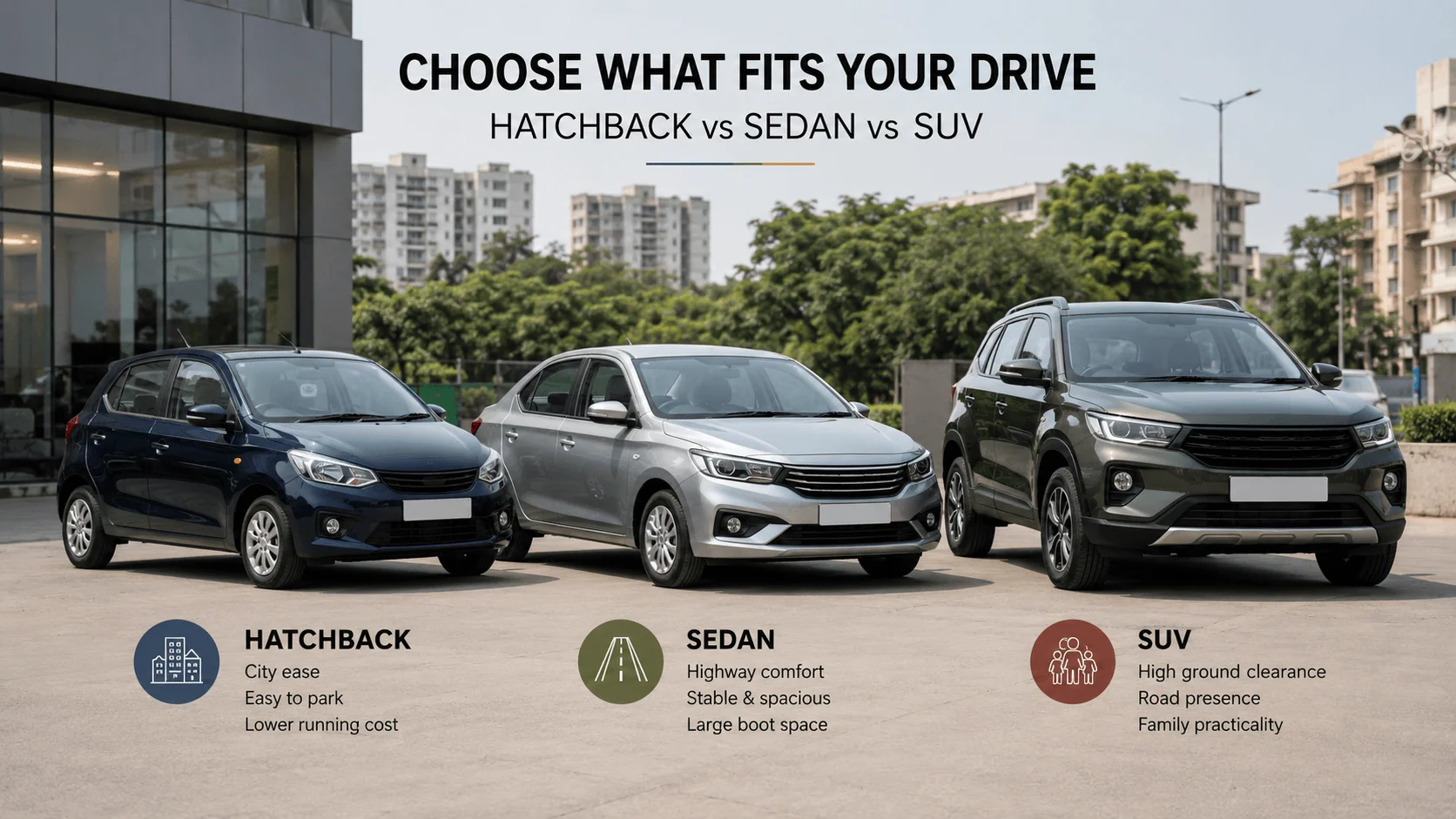
Hatchback: Pros, Cons, Best For
A hatchback is a compact two-box car where the cabin and the cargo area share one continuous space, accessed by a rear hatch door that opens upward. Almost every hatchback sold in India is engineered to stay under 4 metres long, which unlocks the lower GST slab. Think Maruti Swift, WagonR, Baleno, Hyundai i20, Tata Tiago, Renault Kwid. If you’ve never owned a car before, this is probably the body type you’re being nudged towards by every dealer for good reason.
Pros of hatchbacks
1. Easy to drive in cities. Short overhangs, a tight turning radius and compact dimensions make hatchbacks the easiest body type to thread through Bengaluru’s Koramangala lanes or Mumbai’s Lalbaug bylanes. You can see exactly where your bumpers end, which makes parallel parking on a crowded curbside or sliding into a basement slot far less stressful than it would be in a sedan or wide-track SUV. Anyone who’s tried to reverse a 4.4m car into a 4.7m slot will appreciate this.
2. Lowest purchase price. Mass production and the sub-4m tax benefit let manufacturers price hatchbacks aggressively. You can find a loaded premium hatchback with touchscreen, auto climate control, six airbags and 360-degree camera for less than the bare-bones base variant of a comparable SUV. That price gap usually buys you two or three feature tiers of upgrade if you stay in the hatchback segment.
3. Best real-world mileage. With kerb weights typically around 900–950 kg and small displacement engines, hatchbacks deliver fuel economy nothing else matches. ARAI-certified figures cross 25 kmpl for the Swift and 26.68 kmpl for the Celerio, and CNG variants routinely exceed 26–30 km/kg. In real-world city traffic, hatchbacks consistently return 15–20 kmpl on petrol.
4. Lowest running cost. Your annual scheduled maintenance averages between ₹6,000 and ₹10,000 thanks to smaller fluid capacities and simpler mechanicals. Replacement tyres in standard 14- or 15-inch sizes (175/65 R15, 185/65 R15) cost ₹3,900–6,900 per unit, and comprehensive insurance premiums sit in the ₹10,000–15,000 range annually. Add it up over five years and the cumulative saving versus an SUV crosses two lakh rupees.
5. Practical enough for small families. Modern packaging has pushed the wheels to the corners of the chassis, so cabins are roomier than they look. Standard 60:40 split-folding rear seats give you flexibility for the occasional Ikea run or airport drop.
Cons of hatchbacks
1. Limited boot space. Most hatchbacks offer 250–300 litres. The Wagon R stretches that to 341 litres, but the volume is vertical rather than deep. Two large hard-shell suitcases plus a stroller is your practical ceiling. Try fitting four 28-inch suitcases for an airport drop and you’ll be folding down the rear bench every single trip.
2. Less rear-seat comfort than sedans or SUVs. Rear legroom is tight for adults above average height, the rear bench rarely seats three adults comfortably for long journeys, and the seatback recline angle is more upright than what sedans offer.
3. Lower road presence. If chaotic NH traffic intimidates you and you want a bigger vehicle around you, hatchbacks won’t deliver that psychological cushion. They look like what they are: small cars.
4. Highway stability varies. Premium hatchbacks with stiffer suspension feel planted at 100 kmph plus. Lightweight entry-level hatchbacks can feel floaty above 100 kmph and get unsettled by crosswinds or the wake of passing trucks.
5. Ground clearance can run out. Standard hatchback ground clearance is 165–170 mm. That’s enough for normal roads, but if you load four adults and luggage, the suspension compresses and you risk scraping the underbody on tall, unscientifically-built rural speed breakers.
Hatchback best for
| Buyer profile | Hatchback suitability |
|---|---|
| First-time buyer | Excellent |
| City commuter | Excellent |
| Budget buyer | Excellent |
| Small family (2–3 people) | Good |
| Highway-heavy user | Average to good (model-dependent) |
| Large family | Limited |
| Daily rough-road user | Average |
Verdict: Buy a hatchback if you want the lowest possible cost of ownership, daily city ease, and class-leading mileage. Avoid one if you regularly carry four adults plus heavy luggage on long highway trips or drive on heavily broken rural roads.
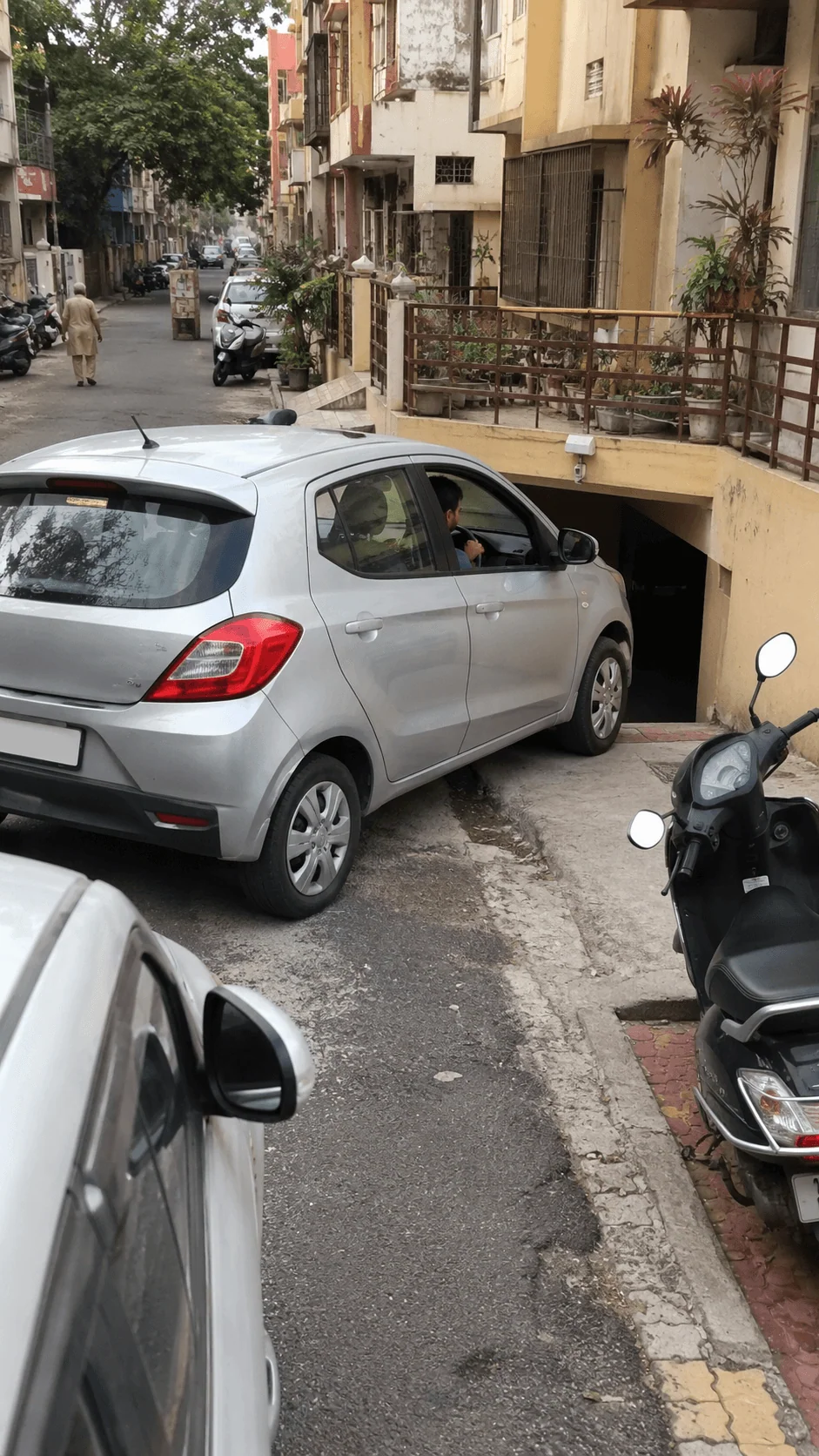
Sedan: Pros, Cons, Best For
A sedan is a three-box car: engine bay, passenger cabin, and a separate enclosed boot. It has the lowest, most aerodynamic profile of the three body types and traditionally the longest wheelbase relative to its segment. Think Maruti Dzire, Honda Amaze, Hyundai Aura, Skoda Slavia, Volkswagen Virtus, Honda City. Sedans aren’t dying in India. They’re just being bought by a more specific kind of buyer.
Pros of sedans
1. Best highway stability. Physics is on the sedan’s side here. A low centre of gravity plus a long wheelbase plus a sleek aerodynamic profile equals less body roll, less wind noise, less drag. At 110–120 kmph on the Mumbai-Pune Expressway or the Yamuna Expressway, a sedan feels planted in a way that a tall SUV simply can’t match.
2. Largest usable boot. Compact sub-4m sedans like the Dzire offer 382 litres. Mid-size sedans like the Slavia and Virtus offer a cavernous 521 litres. Because the boot is structurally isolated from the cabin, your luggage doesn’t intrude on rear-passenger space or bring noise and dust into the cabin. If you do weekly airport runs, you’ll appreciate this every single time.
3. Best rear-seat comfort. The extended wheelbase lets engineers optimise the rear bench with a deeper seat squab, more under-thigh support and a more relaxed recline angle than hatchbacks. The suspension is usually tuned softer too. If you’re chauffeur-driven or regularly take elderly parents on long trips, the rear seat of a Slavia, Virtus or City is hard to beat at the price.
4. Better driving dynamics. The lower seating position puts the driver closer to the chassis roll centre, so you get more steering feel and less body roll on twisty ghats and curvy highways. Drivers who care about how a car feels through corners almost always pick a sedan.
5. Premium, mature aesthetic. A sedan signals understated elegance rather than aggressive dominance. For corporate executives, professionals and mature buyers who don’t want to look like they’re going off-road on a Tuesday, the silhouette matters.
Cons of sedans
1. Lower ground clearance and the “breakover angle” problem. This is the biggest day-to-day Indian-road issue with sedans. The Slavia and Virtus show 179 mm unladen and the Dzire shows 163 mm, but the metric that actually matters is the breakover angle, which is the angle between front wheel, lowest belly point and rear wheel. Because sedans have a long wheelbase (2,450 mm Dzire, 2,651 mm Slavia/Virtus), that angle is shallow. So what happens when you crest a tall, sharp speed breaker with a fully loaded car? The suspension compresses and the underbody scrapes. Most sedan owners learn to take big breakers diagonally and slowly.
2. Harder to park than hatchbacks. Longer front and rear overhangs mean a bigger parking footprint. Novice drivers regularly misjudge where the boot ends.
3. Lower seating position. Forward visibility in traffic is restricted compared to SUVs. Older passengers also have to bend deeper to get in and climb out, which is a real ergonomic issue if you regularly transport elderly parents.
4. Shrinking choice. As SUVs have taken over, manufacturers have rationalised sedan portfolios. There are fewer new launches and that has accelerated depreciation curves for sedans in the used market.
5. Less bad-road confidence. Even with a competent ride, sedans feel sharp impacts harder on potholes, and the persistent worry about scraping the front lip on broken stretches is fatiguing on long journeys.
Sedan best for
| Buyer profile | Sedan suitability |
|---|---|
| Highway traveller | Excellent |
| Family needing big boot | Good to excellent |
| Driving enthusiast | Good |
| Chauffeur-driven buyer | Good |
| City-only user | Average |
| Daily bad-road user | Limited |
| Elderly passenger primary | Depends on seat height |
Verdict: Choose a sedan if your weekly mileage skews towards highways, you value rear-seat comfort over road presence, and your daily commute is on relatively well-paved tarmac. Skip it if your route involves daily aggressive speed breakers or broken tarmac.
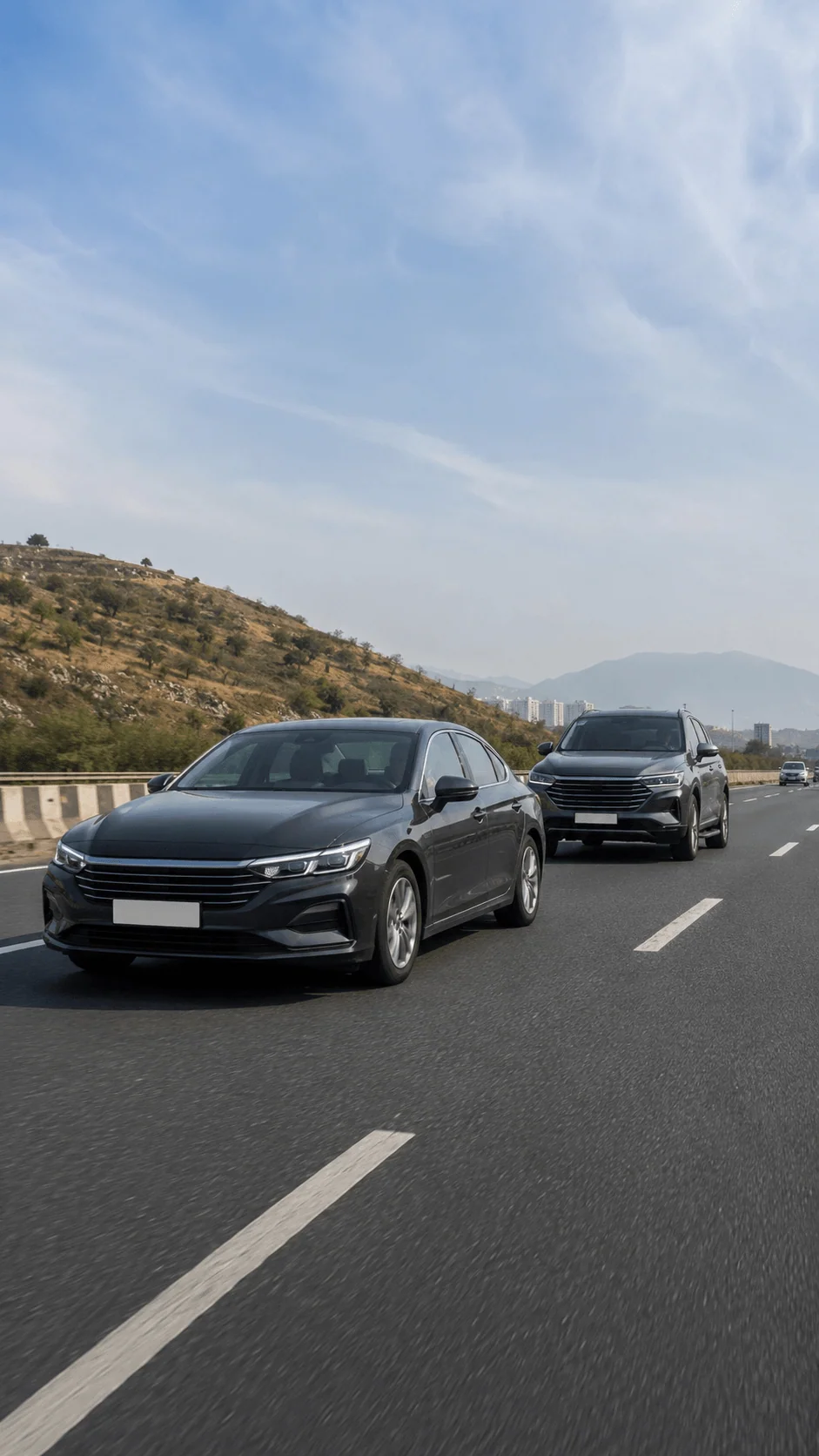
SUV and Crossover: Pros, Cons, Best For
Here’s where buyer education matters. The word “SUV” in India is a marketing umbrella that covers two very different vehicles, and you should know which one you’re actually buying before you write the cheque.
A true SUV sits on a body-on-frame (ladder-frame) chassis, often has rear-wheel drive or proper 4×4 hardware, and is engineered for off-road work and towing. Mahindra Scorpio N, Mahindra Thar, Toyota Fortuner, Force Gurkha, Toyota Land Cruiser.
A crossover is built on a monocoque passenger-car platform, usually front-wheel drive, and is engineered for on-road comfort with SUV-style stance. Hyundai Creta, Kia Seltos, Tata Nexon, Maruti Brezza, Maruti Grand Vitara, Honda Elevate, Tata Punch.
About 90% of “SUVs” sold in India are technically crossovers. They give you the high seating, ground clearance and road presence of an SUV with the ride quality, mileage and dynamics closer to a sedan. So is your Creta really an SUV? Mechanically, no. It’s a crossover, and that’s actually good news if your driving is mostly on-road. Knowing which one you’re buying matters because it changes how the vehicle behaves on a Leh ride or under heavy load.
Pros of SUVs and crossovers
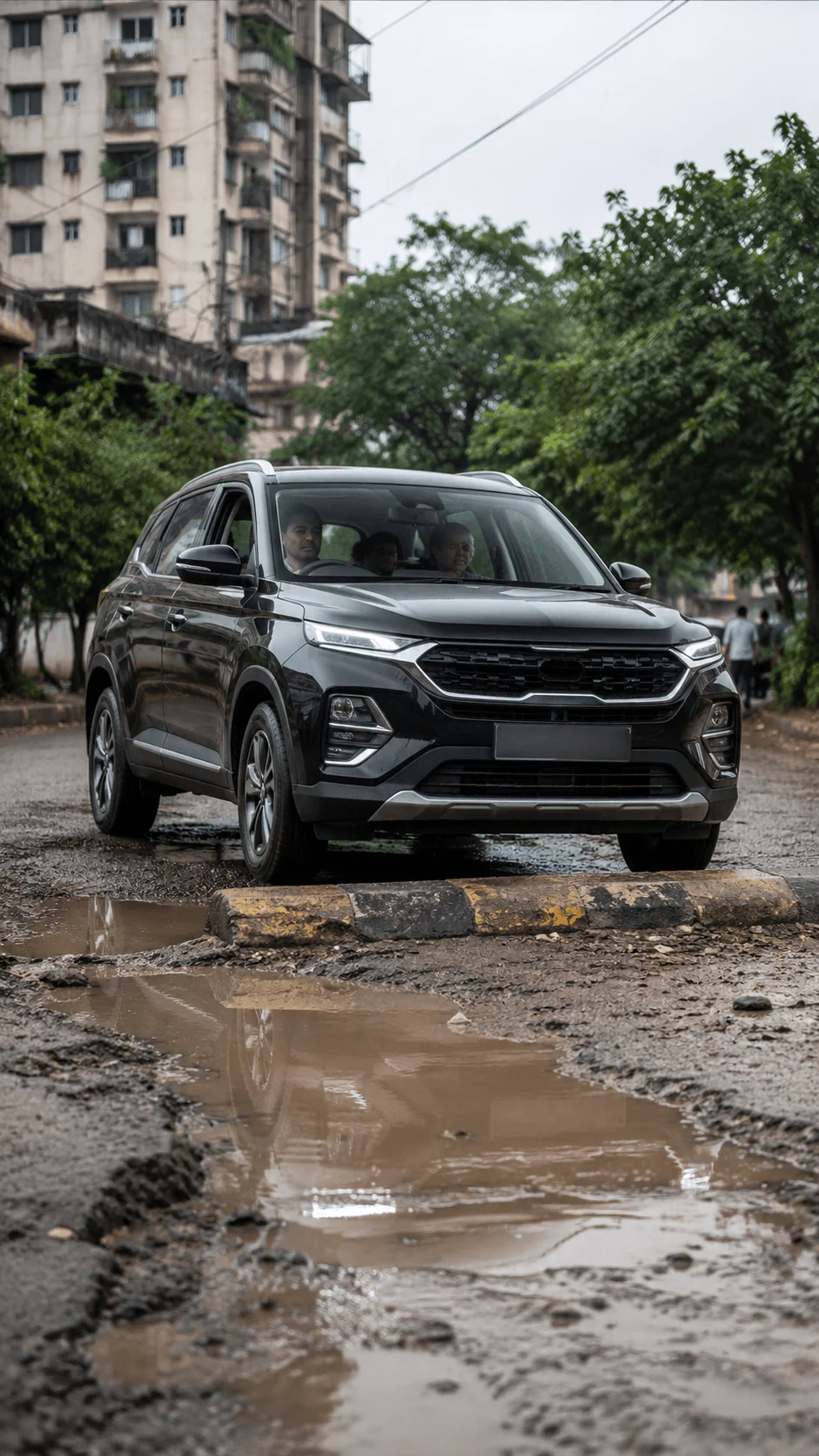
1. Higher ground clearance. This is the defining functional benefit on Indian roads. Compact SUVs typically offer 190–220 mm (Hyundai Creta 190 mm, Tata Nexon 209 mm, Honda Elevate 220 mm) and full off-road SUVs go to 225–235 mm (Toyota Fortuner 225, Mahindra Thar 226, Force Gurkha 233). Tall speed breakers, monsoon-flooded streets, unpaved village trails and deep potholes stop being a daily anxiety.
2. High seating position. SUVs put your hip-point closer to standing hip height, which means you slide into the seat instead of dropping down into it. Forward visibility improves because you can see over the roofs of smaller cars in traffic, and ingress and egress is dramatically easier for elderly passengers. Got knee or back issues? You’ll feel the difference on day one.
3. Strong road presence. The tall stance, flared arches and muscular styling give an SUV visual mass that buyers genuinely want for psychological comfort on chaotic highways and for social signalling. Worth saying clearly: this is perceived safety, not actual safety. Crashworthiness is determined by Bharat NCAP or Global NCAP structural ratings, six-airbag count and active safety like ESC, not by how tall the car is.
4. Practical family cabin. The upright two-box silhouette maximises headroom and gives a sense of airy spaciousness. Flat-folding rear seats let you carry awkward, bulky items that no sedan boot would swallow.
5. Best bad-road confidence. Larger wheel diameters with thicker tyre sidewalls (195/60 R16 on compact SUVs, 215/60 R17 on mid-size) act as an extra layer of pneumatic suspension, absorbing sharp pothole impacts before they reach the cabin. Longer suspension travel helps too. For mixed urban, highway and rural use, crossovers are the most versatile choice.
Cons of SUVs and crossovers
1. Highest purchase price. A compact SUV typically costs ₹2–3 lakh more than a mechanically comparable premium hatchback or compact sedan. Much of that premium pays for stance, cladding and ground clearance, not for proportionally more cabin space or engine performance.
2. Lower real-world mileage. Heavier kerb weight and a tall, flat-faced design that creates aerodynamic drag at highway speeds means a petrol crossover typically returns 15–25% lower real-world mileage than a hatchback with the same engine.
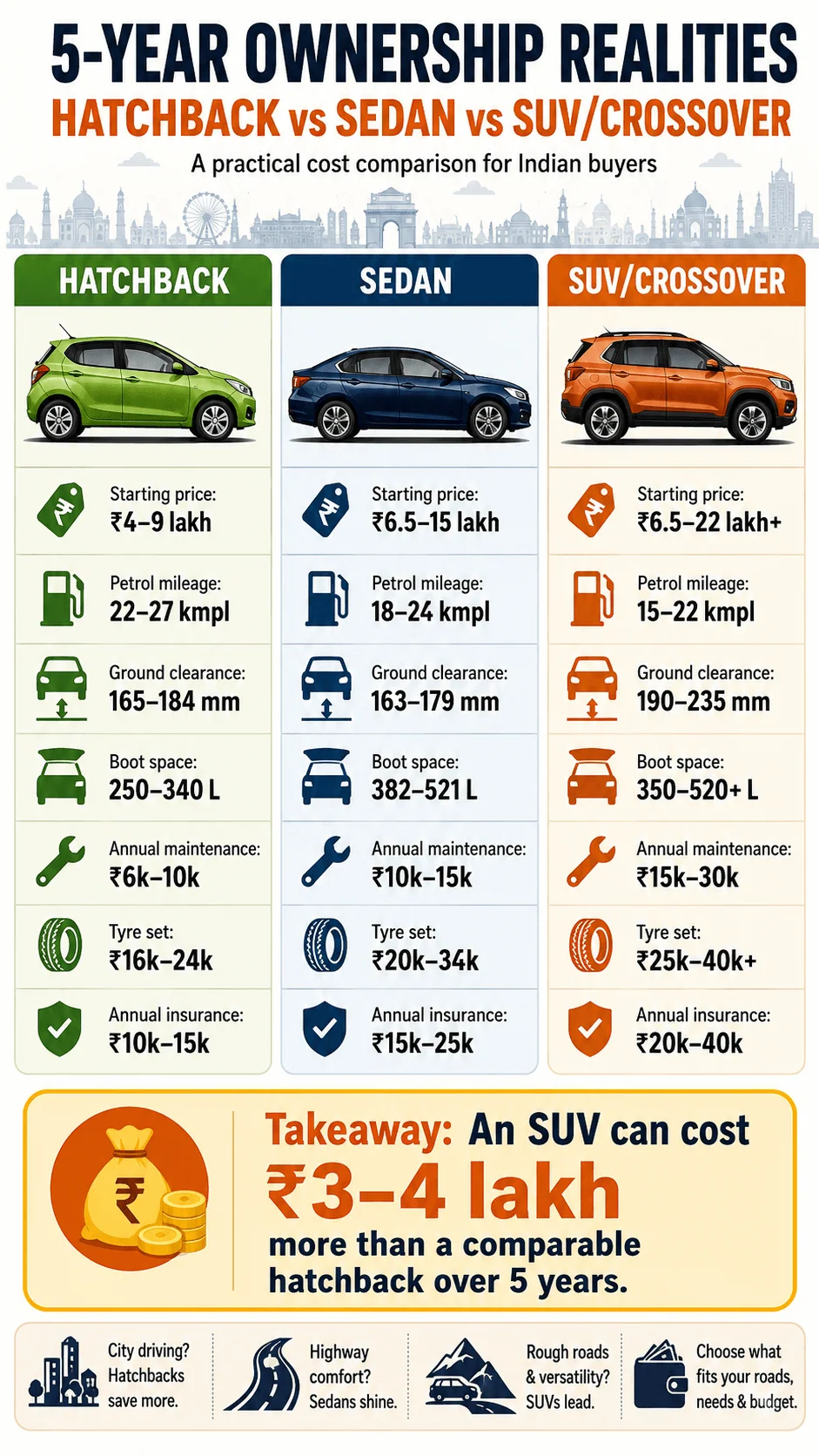
3. Higher running and maintenance costs. Annual scheduled servicing runs ₹15,000–30,000. A fresh set of four 16- to 18-inch tyres can cost ₹25,000–40,000+. Comprehensive insurance premiums sit in the ₹20,000–40,000 bracket because the IDV is higher and replacement body panels are more expensive. The cumulative impact: an SUV typically costs ₹3–4 lakh more than a comparable hatchback to own over five years.
4. Bulky exterior doesn’t always mean spacious interior. Several sub-4m compact SUVs offer less rear-seat shoulder width and tighter legroom than mid-size sedans because thick cladding and stylised pillars eat into cabin volume. Always sit in the rear seat before you sign anything. Place the family who’ll actually use it back there for ten minutes, not just yourself.
5. More body roll, more rollover risk. Raising the centre of gravity compromises handling. SUVs body-roll more through corners and ghats, and they carry a higher statistical rollover risk in severe lateral collisions than lower vehicles. Modern crossovers handle this better than ladder-frame SUVs but still can’t match a sedan’s planted feel.
6. Parking gets harder as size grows. Wider track, taller bonnet line and longer overall length make mid-size and full-size SUVs awkward in older basement ramps and tight city alleys. The 4.5m+ length cars frequently can’t park in older society slots designed in the hatchback era.
SUV / crossover best for
| Buyer profile | SUV / crossover suitability |
|---|---|
| Bad-road user | Excellent |
| Family buyer | Good to excellent |
| Elderly passenger primary | Excellent (high H-point) |
| Highway user | Good (crossovers preferred) |
| City parking-heavy user | Depends on vehicle size |
| Mileage-focused buyer | Average to poor |
| Budget buyer | Limited |
Verdict: Choose an SUV or crossover if your routes routinely include broken tarmac, deep potholes or tall speed breakers, if you regularly carry elderly parents, or if you need a versatile family vehicle for mixed conditions. Skip it if your driving is mostly on well-paved city roads and your priority is fuel economy or minimum running costs.
Comparison Table: Mileage, Space and Cost
Quick reference for the most common decision factors.
| Factor | Hatchback | Sedan | SUV / Crossover |
|---|---|---|---|
| Starting price (2026) | Lowest (₹4–9 L) | Medium (₹6.5–15 L) | Highest (₹6.5–22 L+) |
| ARAI mileage (petrol) | Best (22–27 kmpl) | Good (18–24 kmpl) | Usually lowest (15–22 kmpl) |
| Ground clearance | 165–184 mm | 163–179 mm | 190–235 mm |
| Boot space | 250–340 L | 382–521 L | 350–520+ L (flexible) |
| City parking | Easiest | Medium | Medium to hard |
| Highway stability | Medium | Best | Good (model dependent) |
| Bad-road confidence | Medium | Lowest | Best |
| Rear-seat comfort | Medium | Best | Good (model dependent) |
| Elderly ingress / egress | Medium | Low to medium | Best |
| Annual maintenance | ₹6k–10k | ₹10k–15k | ₹15k–30k |
| Tyre set (4 units) | ₹16k–24k | ₹20k–34k | ₹25k–40k+ |
| Annual insurance | ₹10k–15k | ₹15k–25k | ₹20k–40k |
| 5-year depreciation | Stable (~50% loss) | Steepest (45–55% loss) | Strong retention (40–50% loss) |
| Road presence | Low | Medium | Highest |
The headline that explains everything: over a 5-year ownership cycle, an SUV typically costs you ₹3–4 lakh more than a comparable hatchback in cumulative fuel, tyres, servicing and insurance. Sedans currently depreciate fastest because the segment is shrinking. But if you buy used, that same depreciation curve makes a 3-year-old sedan a steal.
Which Body Type for Your Indian Lifestyle?
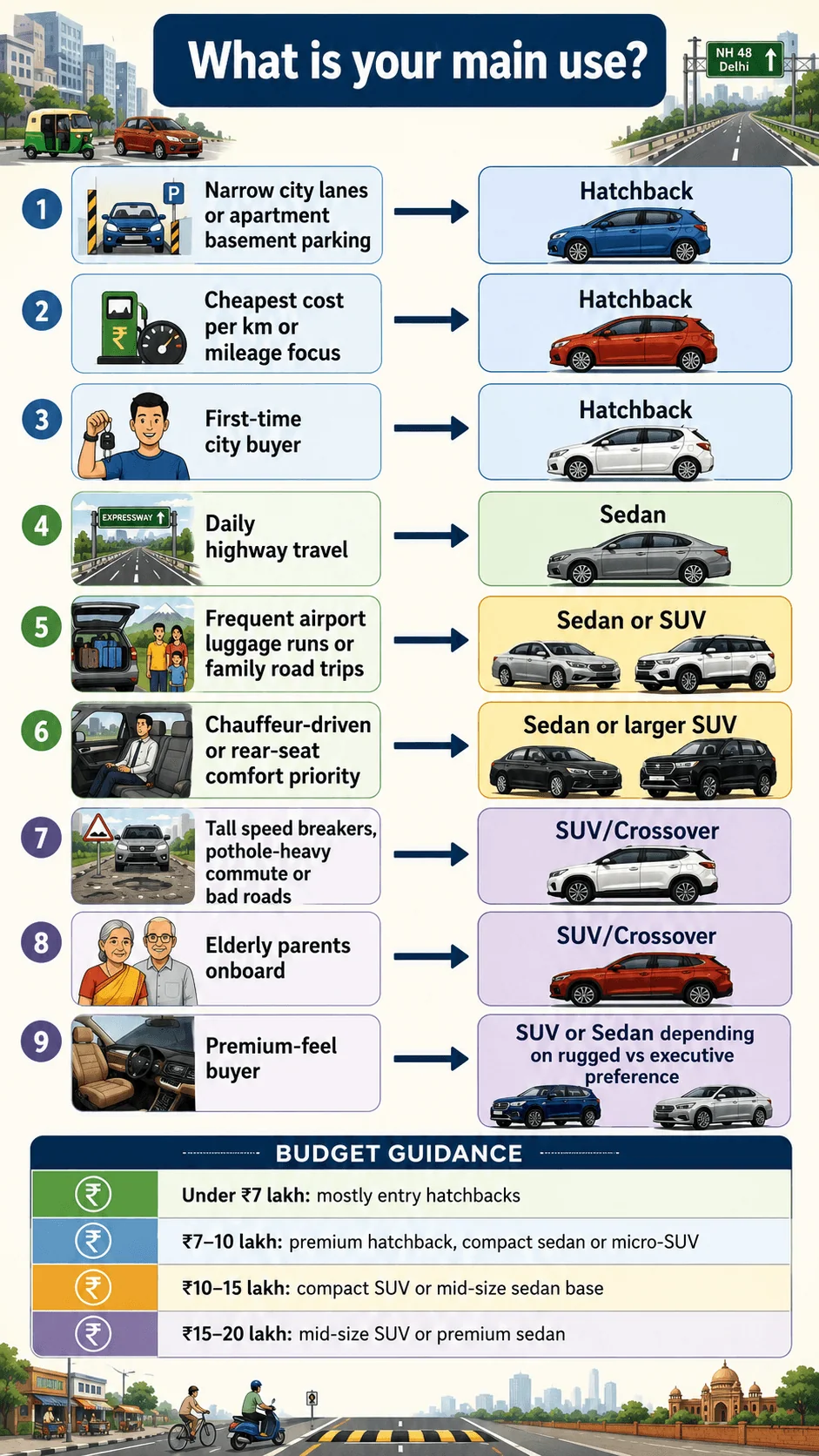
Forget what’s selling. Match the car to your actual daily reality. Here’s the India-specific factor table, and every row is a real problem Indian buyers solve.
| Indian road / use-case factor | Best body type | Why |
|---|---|---|
| Narrow city lanes, daily traffic | Hatchback | Tightest turning radius, shortest overhangs |
| Apartment basement parking | Hatchback | Predictable dimensions, no overhang surprises |
| Tall speed breakers daily | SUV / Crossover | Best breakover angle, highest clearance |
| Pothole-heavy commute | SUV / Crossover | Thick tyre sidewalls absorb sharp impacts |
| Highway-heavy weekly miles | Sedan | Lowest centre of gravity, least body roll |
| Frequent airport luggage runs | Sedan or SUV | Isolated, large boot |
| Family road trips with 5 adults | Sedan or SUV | Better recline, more legroom |
| Cheapest cost per km | Hatchback | Lowest weight, smallest tyres |
| Elderly parents in rear seat | SUV / Crossover | High H-point allows walk-in entry |
Recommendation matrix by buyer profile
| Buyer profile | Best choice | Why |
|---|---|---|
| First-time city buyer | Hatchback | Easiest to drive, park, insure and repair |
| Small family on tight budget | Hatchback or compact SUV | Best balance of acquisition vs daily practicality |
| Daily highway traveller | Sedan | Aerodynamic stability and rear-seat comfort |
| Bad-road commuter | SUV / Crossover | Ground clearance and tyre sidewall protection |
| Elderly parents onboard | SUV / Crossover | Easy walk-in cabin entry |
| Mileage-focused owner | Hatchback | Lowest kerb weight, lowest cost per km |
| Family road trips | Sedan or SUV | Big boot, comfortable rear seat |
| Premium-feel buyer | SUV or Sedan | Depends on whether you want rugged or executive |
| Chauffeur-driven buyer | Sedan or larger SUV | Best rear-seat comfort and legroom |
Budget-based shortlist (2026 on-road prices)
| Budget | Realistic options |
|---|---|
| Under ₹7 lakh | Entry-level hatchback (Alto K10, Wagon R, Tiago, Punch base) |
| ₹7–10 lakh | Premium hatchback (Swift, Baleno, i20), entry compact sedan (Dzire, Amaze), micro-SUV (Exter, Punch) |
| ₹10–15 lakh | Well-equipped compact SUV (Brezza, Nexon, Venue, Sonet), top hatchback (Baleno top), mid-size sedan base (Slavia, Virtus, City) |
| ₹15–20 lakh | Mid-size SUV (Creta, Seltos, Grand Vitara, Hyryder, Elevate, Taigun), premium sedan (Slavia top, Virtus top, City top), entry 7-seater (Ertiga top) |
| ₹20 lakh+ | Body-on-frame SUVs (Scorpio N, Thar Roxx), 7-seat SUVs (XUV700, Safari, Hexa), premium sedans, strong hybrids, EVs |
If you’re a first-time buyer, our first car buying guide for India walks you through what to do after you’ve picked the body type. The actual rupee cost difference between ex-showroom and on-road is covered in our ex-showroom vs on-road price explainer, and state-wise RTO road tax is in the RTO road tax by state guide.
10 mistakes to avoid before you sign the booking form
- Buying an SUV purely for the image when your monthly budget can’t absorb 12 kmpl city economy and ₹35,000 tyre replacements.
- Buying a sedan despite scraping daily on the unscientific speed breaker outside your gate.
- Buying a hatchback when airport runs are weekly and folding the rear seat every time is no fix.
- Assuming an SUV is automatically safer. Higher centre of gravity raises rollover risk; safety comes from Bharat NCAP rating, six airbags and ESC. Read more in our safest cars in India guide.
- Equating big exterior with spacious interior. Many sub-4m SUVs have less rear shoulder room than a mid-size sedan.
- Ignoring tyre and maintenance step-up. Moving from 15-inch hatchback rubber to 17-inch SUV rubber doubles the replacement bill.
- Not measuring your home parking. A wide-track SUV in an old society stilt parking slot is a daily anxiety machine.
- Not testing rear-seat comfort with the actual family who will sit there for long trips.
- Test-driving only on the smooth road outside the showroom. Take it home on your real commute first. Our test drive tips checklist covers what to test for.
- Choosing the body type before defining usage. A theoretical Leh trip once a year is a poor reason to suffer SUV fuel bills 365 days.
Before you commit, run through our things to check before buying a car checklist. It covers paperwork, dealer tricks and the inspection items most first-time buyers miss.
FAQs
Which is better: hatchback, sedan or SUV? No single body type wins all metrics. Hatchbacks win on cost and city ease. Sedans win on highway comfort and boot space. SUVs and crossovers win on ground clearance and rough-road usability. The right answer depends on your daily roads, family size and budget.
Is an SUV worth the extra cost? Only if you routinely drive on broken roads, carry elderly passengers who struggle with low cars, or genuinely need vertical cabin space. For pure city commuting on well-paved roads, the extra purchase price, lower fuel economy and higher maintenance make an SUV an inefficient choice. You’ll spend roughly ₹3–4 lakh more over five years versus an equivalent hatchback.
Which is the best body type for Indian roads? For mixed conditions with unscientific speed breakers, deep potholes and monsoon flooding, an SUV or crossover is the most mechanically resilient choice. For buyers operating strictly in well-maintained urban areas, a premium hatchback works just as well at half the running cost.
Is a sedan better than an SUV for highways? Yes. Lower centre of gravity, longer wheelbase and aerodynamic profile give sedans the calmest, most planted high-speed cruise. SUVs feel taller, draggier and roll more in lane changes. If 60% of your weekly driving is on expressways, a sedan is structurally the better tool.
Is a hatchback better for city driving? Yes. Short wheelbase, tight turning radius and minimal overhangs make hatchbacks the easiest body type for narrow lanes, U-turns and constrained parking. First-time drivers especially benefit from how forgiving they are.
Which body type gives the best mileage? Hatchbacks. Lower kerb weight, smaller frontal area and smaller-displacement engines all help. A Swift or Celerio on petrol returns real-world figures consistently higher than any same-engine sedan or SUV. CNG hatchbacks push the ceiling even higher.
Which is cheapest to maintain: hatchback, sedan or SUV? Hatchbacks, by a significant margin. Lower service bills, cheaper 14- or 15-inch tyres and lower insurance premiums combine into the lowest cost per kilometre across body types.
Which is safest: hatchback, sedan or SUV? Body type isn’t the deciding factor. Real-world occupant safety comes from chassis engineering, structural crash test ratings (check Bharat NCAP or Global NCAP), six-airbag count and active safety like ESC. A 5-star NCAP hatchback is safer than a 3-star SUV. Read our NCAP safety ratings explained guide for the full picture.
Is an SUV better for bad roads? Yes. The 190–235 mm ground clearance, thicker tyre sidewalls and longer suspension travel of an SUV or crossover absorb broken-road impacts that would damage a sedan’s underbody.
Is a sedan difficult to drive in India? Not difficult, but it requires calculated caution. Drivers learn to take tall speed breakers slowly and diagonally to avoid scraping the underbody, and parking demands more spatial awareness than a hatchback because the boot extends further out.
Which body type is best for families? For long highway trips with luggage, a mid-size sedan is excellent. For families needing flexible seating, easy child-seat access and confidence on mixed terrain, a crossover or SUV is the more versatile choice.
Which is better for elderly passengers? SUVs and crossovers. The hip-point sits closer to a standing adult’s hip height, so passengers slide into the seat instead of bending and dropping down into it. This makes a real difference for parents with joint issues.
Are compact SUVs really SUVs? Most sub-4m compact SUVs sold in India are technically crossovers. They use a monocoque passenger-car chassis and front-wheel drive rather than the ladder-frame construction of true SUVs like the Thar or Fortuner. You get SUV stance and ground clearance with the dynamics and mileage of a heightened hatchback.
Which body type has the best resale value in 2026? Compact SUVs and crossovers hold the strongest resale value in the first 3–5 years thanks to strong demand. Hatchbacks depreciate slowly and predictably. Sedans currently face the steepest curves because the new-buyer pool is shrinking. That’s also why used sedans are excellent value if you’re a second-hand buyer.
Should I buy a hatchback or a compact SUV as my first car? A hatchback is usually the better first car. Lower purchase price, lower insurance, far better mileage and a more forgiving footprint for new drivers building confidence. Move up to a compact SUV with your second car if your needs change.
About this guide: Pricing, mileage and clearance figures reflect 2026 model-year data verified against ARAI, OEM spec sheets and SIAM sales figures. Cost-of-ownership ranges are typical mainstream brand bands (Maruti, Hyundai, Tata, Kia, Honda) and exclude premium European brands. Always confirm current ex-showroom and on-road pricing with your local dealer before booking.