
So what’s a connected car, really? It’s a vehicle that talks to the internet through a built-in SIM card. You control it from your phone, the car pings you with alerts, and the manufacturer pushes software updates without a workshop visit. By 2026, almost every car above ₹10 lakh sold in India ships with some flavour of it. BlueLink, Kia Connect, iRA, AdrenoX, Suzuki Connect, i-SMART, Honda Connect, i-Connect. Same idea, eight different badges.
The honest question isn’t whether your next car will be connected. It’s whether the features are worth the variant premium and the annual subscription you’ll pay after the freebie expires. Here’s what these systems actually do, what they cost across a 7-year ownership, and which cars under ₹15 lakh give you the best deal in 2026.
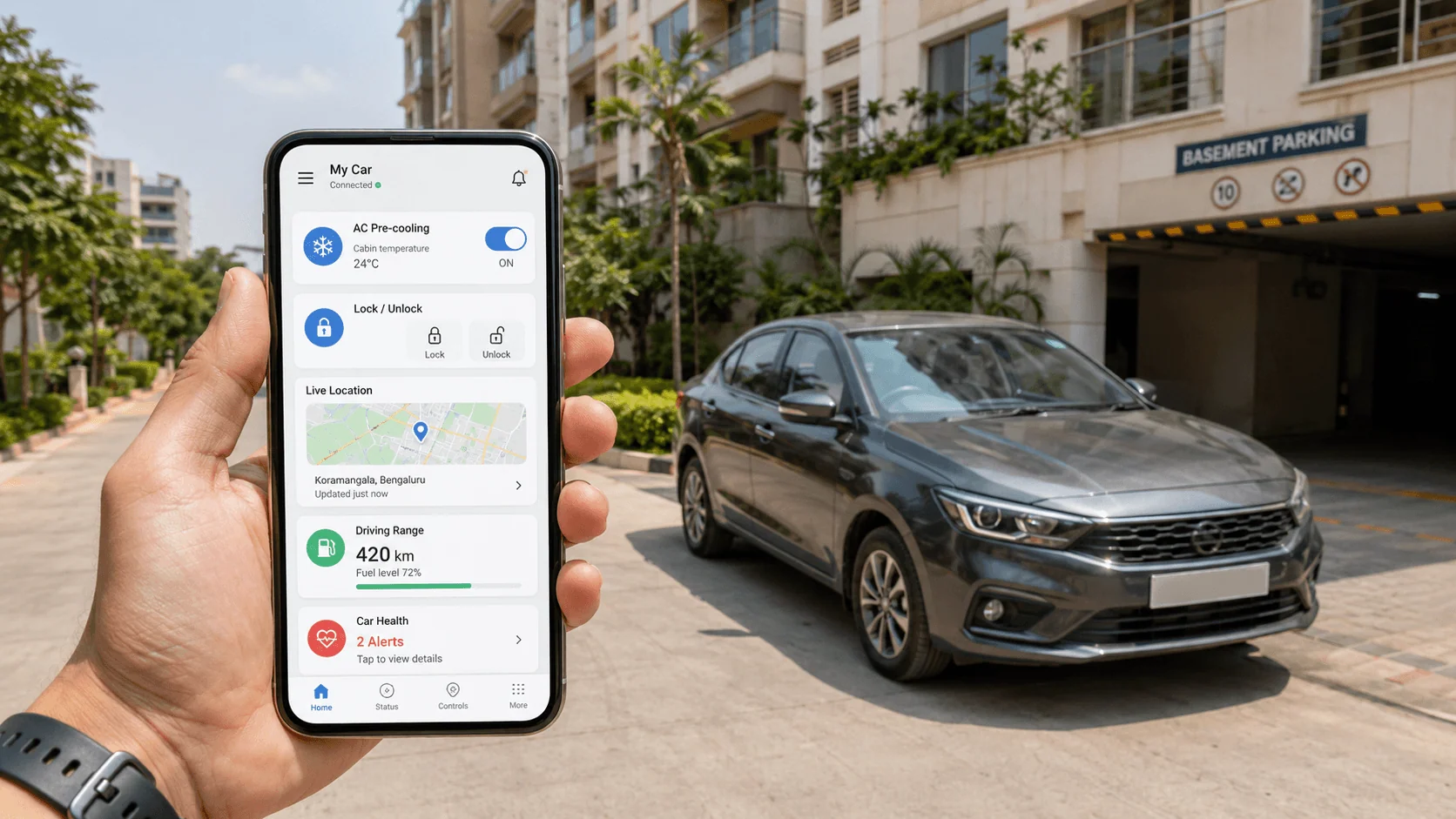
What Are Connected Car Features?
Connected car features are smartphone-controlled, cloud-linked functions in a vehicle. They’re made possible by an embedded SIM card (eSIM) sitting inside the car’s Telematics Control Unit (TCU). The car uses a cellular network (Jio, Airtel, or Vi) to send and receive data. That’s how you can start the engine remotely, track location, get crash alerts, and pull down over-the-air software updates.
Think of it this way. Your car has just become another device on your phone.
The Indian connected car market is expected to cross USD 30 billion in 2026, with over 60% of new-car buyers in metros listing connectivity as a top-three priority. The industry has even invented a new label for it: the Software-Defined Vehicle, or SDV. It’s the term you’ll start hearing dealers use when a sale needs more polish than horsepower.
Common Connected Car Features in India
Brand names change. The feature set doesn’t. Here’s what you’ll find across every major OEM platform.
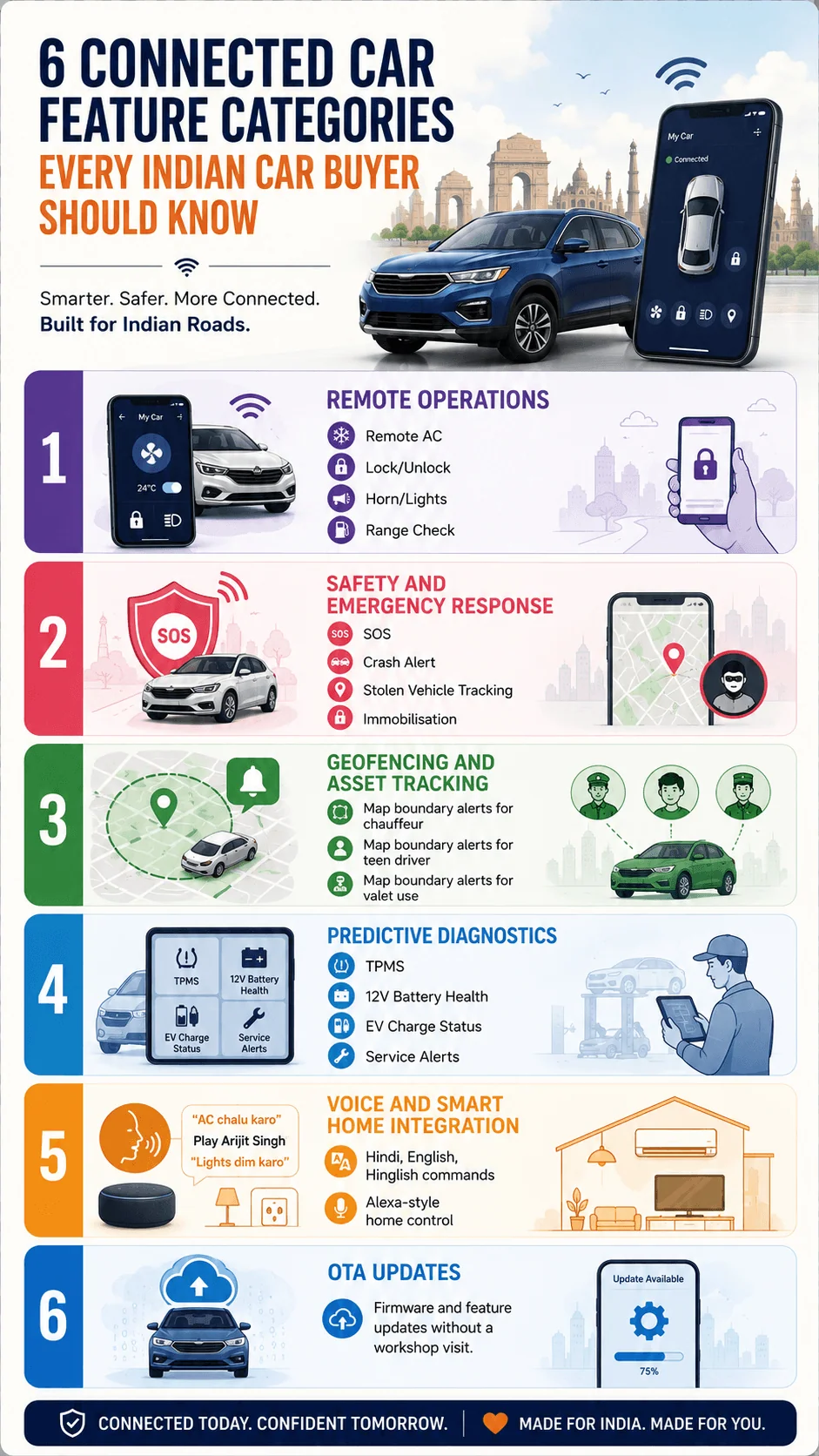
1. Remote operations (the daily-use stuff)
- Remote engine start and stop
- Cabin pre-cooling or pre-heating (the biggest win in 45°C Indian summers)
- Door lock and unlock from anywhere
- Headlamp and horn activation to find your car in a crowded parking lot
- Fuel range and odometer check from the app
Are these features actually used? Yes. Pre-cooling alone justifies the tech for anyone driving through a Delhi, Chennai, Hyderabad or Pune summer. Walk to your car at 2 PM in May and you’ll see why.
2. Safety and emergency response
- Automatic Crash Notification (ACN): when airbags deploy, the car sends GPS coordinates and a voice call to an emergency response centre
- Manual SOS button on the rearview mirror or roof console
- Stolen vehicle tracking with police coordination
- Remote engine immobilization once the car is brought to a halt
3. Geofencing and asset tracking
Draw a boundary on the map. Anywhere. If the car crosses it, your phone buzzes. It’s the feature parents lean on when they hand keys to teens, the one fleet owners use to keep tabs on chauffeurs, and the one you’ll thank yourself for the day you give the keys to a valet. There’s a linked “time-fence” version too, which pings you if the car moves between hours you’ve set, say 10 PM and 6 AM.
4. Predictive diagnostics
Beyond the dashboard warning lights, the system quietly monitors tyre pressure (TPMS), 12V battery health, EV state-of-charge, and powertrain temperature. You’ll get a monthly health report on the app. The dealership gets the same heads-up, which means they can call you before something breaks. Handy when service slots are booked out three weeks ahead.
5. Voice and smart home integration
Hindi, English, and Hinglish voice commands (best executed on Tata and Mahindra), plus an Amazon Alexa link so you can switch on the geyser from inside the car. Sound impressive? Sure. Used often? Not really. It’s the least-touched category in Indian connected cars. Most buyers still reach for the physical climate knob and the Android Auto button.
6. Over-the-air (OTA) updates
Your car downloads firmware and feature updates the same way your phone does. Tata, Hyundai, Kia, and MG actively push OTA updates. Maruti and Toyota? Slower. Most updates on those brands still need a workshop visit, which feels archaic in 2026.
How Connected Car Apps Work
It sounds complicated. It really isn’t.
- An embedded SIM (eSIM) is soldered into the car’s Telematics Control Unit during manufacturing. You can’t swap it.
- The eSIM connects to a mobile network chosen by the manufacturer. Hyundai and Kia use Airtel, MG uses Jio, others vary.
- Sensors across the car (CAN bus, GPS, TPMS, battery) feed live data into the TCU.
- The TCU sends that data via the cellular network to the OEM’s cloud server.
- Your mobile app reads from that cloud and lets you push commands back the same way.
Two big consumer pain points come out of this architecture, and you should know about them before you fall in love with the marketing.
Latency. A remote engine-start command travels from your phone to a cell tower, up to the cloud, back down to another tower, and finally to the car. In low-signal areas, that round trip can take 30 seconds. Sometimes 5 minutes. Sometimes it just times out. Owners on Team-BHP routinely report that walking to the car and starting it manually is faster. It’s not a flattering reality.
No network portability. Unlike your phone, an automotive eSIM cannot be ported. If your car was provisioned with Vi and your basement parking only gets Jio, the system goes dead until you move the car. You can’t swap the SIM. You can’t request a port. There’s no consumer recourse here. Only the telecom regulator can fix this, and there’s no sign that they will.
Privacy and Data Concerns
Should you worry about all this data flying around? A bit, yes. A connected car generates a steady stream of personal information. Where you go. When you go. How fast you drive. What you say in the cabin if voice features are on. What music you play. Under India’s Digital Personal Data Protection (DPDP) Act, 2023, all of it now counts as personal data and needs your explicit consent.
What changed in 2026:
- OEMs must give you granular consent. You can agree to mechanical diagnostics but refuse GPS marketing
- Data must be stored on Indian servers unless the buyer agrees to cross-border transfer
- ARAI’s AIS 189 standard mandates anonymization techniques for telematics data
- Withdrawal of consent must be processed immediately, not buried in policy pages
What still worries security researchers:
- Law enforcement can compel disclosure of vehicle location history without owner notification
- Dealerships and third-party service apps often have weaker cybersecurity than the OEM itself
- Insurance integration (usage-based premiums) is coming, and your driving score could affect your premium
What can you actually do about it? Open the app on day one. Toggle off marketing and third-party sharing. Ask the dealer where your data is stored, in writing, and keep that paper. It’s not paranoia. It’s just sensible. While you’re at it, here’s what else to verify before buying a car.
Are Connected Car Features Free or Paid?
Free at first, paid later. That’s the model every OEM follows. Here’s what the renewal cheque actually looks like in 2026.
| OEM platform | Free trial | Annual renewal | Notes |
|---|---|---|---|
| Tata iRA 2.0 / iRA.ev | 1 year | ₹1,999 (₹6,999 for 3 years) | Aggressively price-corrected from ₹3,500 |
| Kia Connect | 3 years | ₹1,890 Standalone / ₹3,590 Basic / ₹4,690 Premium | Top tier bundles roadside assistance |
| Hyundai BlueLink | 3 years | ₹2,000 to ₹2,499 | Mirrors Kia pricing |
| Honda Connect | 5 years (longest in India) | ₹1,749 / ₹3,249 for 2 years | Habituation strategy |
| Mahindra AdrenoX | 1 to 3 years | ₹5,000 to ₹5,999 (₹2,499 on promo) | Highest renewal, documented reliability issues |
| Maruti Suzuki Connect | Bundled (3 years, ₹11,900 in invoice) | ₹999/yr or ₹2,299 for 3 years | No post-sale subscription friction |
| MG i-SMART | 1 to 3 years | ₹1,500 + separate data pack | App and network billed separately |
| Toyota i-Connect | 3 years | ₹2,299 | Feature set is the most restricted |
Notice the playbooks here. Tata slashed its renewal price to keep more subscribers active. Honda hands out a five-year freebie so you’re hooked before the paywall shows up. Mahindra charges the most and collects the most complaints. Maruti buries the cost in the on-road price, which is why most Fronx owners don’t even realise they’ve paid for three years of telematics.
Do I Really Need Connected Car Features?
Short answer? It depends. Long answer? It depends on what you actually use day to day.
Buy the variant with connected features if:
- You live in a city with extreme summers and will use remote AC pre-cooling daily
- You hand the car to a chauffeur or family member regularly (geofencing pays for itself)
- You park in covered/basement spots where car theft is a risk
- You buy an EV, where connected charging status and range planning matter much more
Skip the upgrade if:
- You park at home or office only and rarely need remote access
- Your phone supports wireless Android Auto or Apple CarPlay, so most navigation needs are covered without a subscription
- The variant jump costs ₹1.5 lakh or more for connected features alone
Here’s one real-world cautionary tale. AdrenoX owners on the Mahindra XUV700 documented a parasitic 12V battery drain caused by remote-start commands during the free trial itself. Cars dead in 24 hours. Renewals taking up to six months to activate after the cheque had cleared. Mahindra refused pro-rated refunds. The platform has improved since then, but the lesson? Connected reliability varies wildly between brands. Read forum threads before you buy.
Cars With the Best Connected Features Under ₹15 Lakhs (2026)
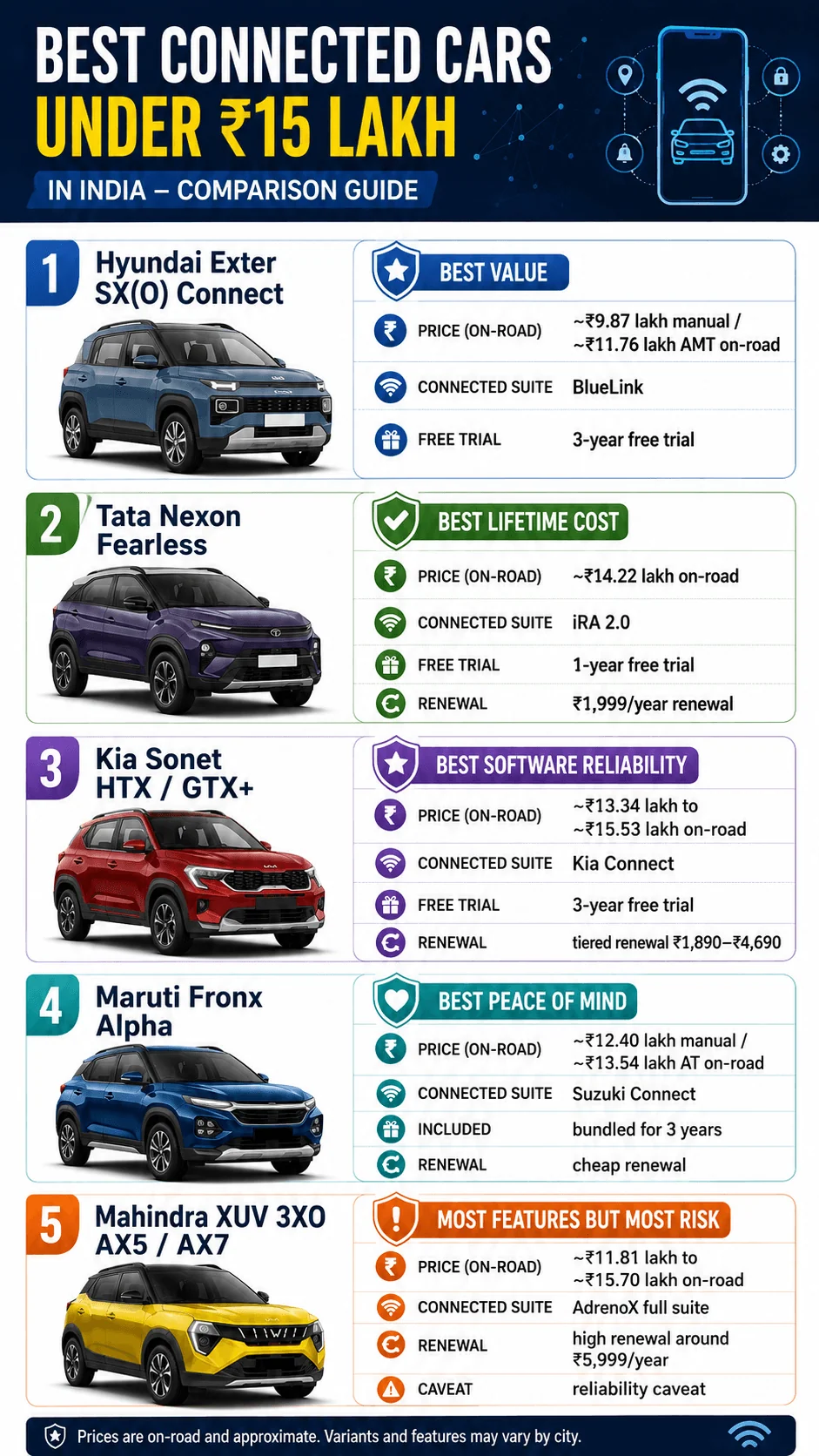
Which connected cars are actually worth the money under ₹15 lakh in 2026? These five. On-road prices and trim-level connected status are verified.
Hyundai Exter SX (O) Connect: best value
- 1.2L Petrol Manual: ~₹9.87 lakh on-road
- 1.2L AMT: ~₹11.76 lakh on-road
- BlueLink suite included with 3-year free trial. It’s the most aggressively-priced full-feature connected car under ₹11 lakh. Frankly, the Exter has commoditised the tech.
Tata Nexon Fearless: best lifetime cost
- 1.2L Petrol Manual: ~₹14.22 lakh on-road
- iRA 2.0 full suite included with 1-year free trial. After the trial, ₹1,999/year is by far the lowest renewal you’ll find. Run the math across seven years and you’ve spent less than ₹15,000 on connected subscriptions. The Mahindra equivalent? Closer to ₹35,000.
Kia Sonet HTX / GTX+: best software reliability
- HTX 1.0L Turbo DCT: ~₹13.34 lakh on-road
- GTX+ 1.0L Turbo DCT: ~₹15.53 lakh on-road
- Kia Connect full suite with 3-year free trial. It’s the lowest-latency app in the segment. Higher entry price than the Exter, sure, but tiered renewal packages (₹1,890 to ₹4,690) let you pick what you’ll actually use.
Maruti Fronx Alpha: best peace of mind
- 1.0L Turbo Manual: ~₹12.40 lakh on-road
- 1.0L Turbo AT: ~₹13.54 lakh on-road
- Suzuki Connect bundled in invoice (3-year pre-paid). It’s a lighter feature set than the Korean rivals can match, but ₹2,299 for the next three years after the trial is the cheapest long-term ownership you’ll find.
Mahindra XUV 3XO AX5 / AX7: most features, most risk
- AX5 1.2L Turbo Petrol: ~₹11.81 lakh on-road
- AX7 1.5L Turbo Diesel: ~₹15.70 lakh on-road
- AdrenoX full suite + Level 2 ADAS + Harman Kardon. The hardware is class-leading. The software? Still rough, with documented reliability issues and a ₹5,999/year renewal burden once the trial runs out. Buy this one with your eyes open.
Want to go deeper? Read our guides on ADAS features explained and NCAP safety ratings explained.
FAQs
What is a connected car?
A car with a built-in SIM card that lets you control it from a phone app, sends you alerts, and gets software updates over the internet. No workshop visit needed.
Is connected car free or subscription-based?
Free for the first 1 to 5 years depending on brand (Honda offers 5 years, most others 3, Tata 1). After that, expect ₹1,899 to ₹5,999 per year.
Do I need connected car features?
Yes if you live in a high-temperature city, share the car with family, or own an EV. No if you mostly park at home and use CarPlay/Android Auto for navigation.
Which car has the best connected features under ₹10 lakh?
Hyundai Exter SX(O) Connect at ~₹9.87 lakh on-road delivers the full BlueLink suite. By far the most generous package below ₹10 lakh.
Can I change the eSIM network in my car?
No. Automotive eSIMs are permanently locked to the operator chosen by the manufacturer. There is no Mobile Number Portability for cars in India yet.
Is my connected car data safe?
Under the DPDP Act 2023, OEMs must store data on Indian servers and get explicit consent for sharing. Granular consent and immediate withdrawal are mandatory. Risks remain at dealership and third-party app level.
The Bottom Line
Connected car features aren’t a luxury anymore. They’re a default. The real decisions in front of you? Which platform you trust (Kia and Tata lead on reliability), which variant tier you’re willing to pay for, and whether the ₹2,000 to ₹6,000 annual renewal is worth the cabin pre-cool, geofencing, and crash alerts you’ll actually use.
For most Indian buyers under ₹15 lakh in 2026, three names stand out. The Hyundai Exter SX(O). The Tata Nexon Fearless. The Kia Sonet HTX. They mix the best hardware density, the most stable software, and the friendliest long-term subscription economics. Pick the one that matches your network coverage and how often you’ll really pull out the phone to talk to the car.