
If you’re shortlisting a new car in 2026, the airbag count on the brochure has probably grabbed your attention. Most modern cars in India now come with a mix of these airbag types:
- Driver airbag, in the steering wheel, protects head and chest
- Front passenger airbag, in the dashboard, protects head and chest
- Side torso airbags, in the front seat bolsters or door panel, protect ribs and pelvis
- Side curtain airbags, in the roof headliner, protect heads in side impacts and rollovers
- Knee airbags, under the lower dashboard, prevent femur and pelvic injuries
- Centre airbag, between the front seats, stops front occupants from crashing into each other
That covers the six positions you’ll see on most spec sheets. But which configuration is right for your car, what’s the deal with the 6-airbag mandate that came and went, and does a higher count actually translate to a safer ride? Here’s the full picture for 2026.
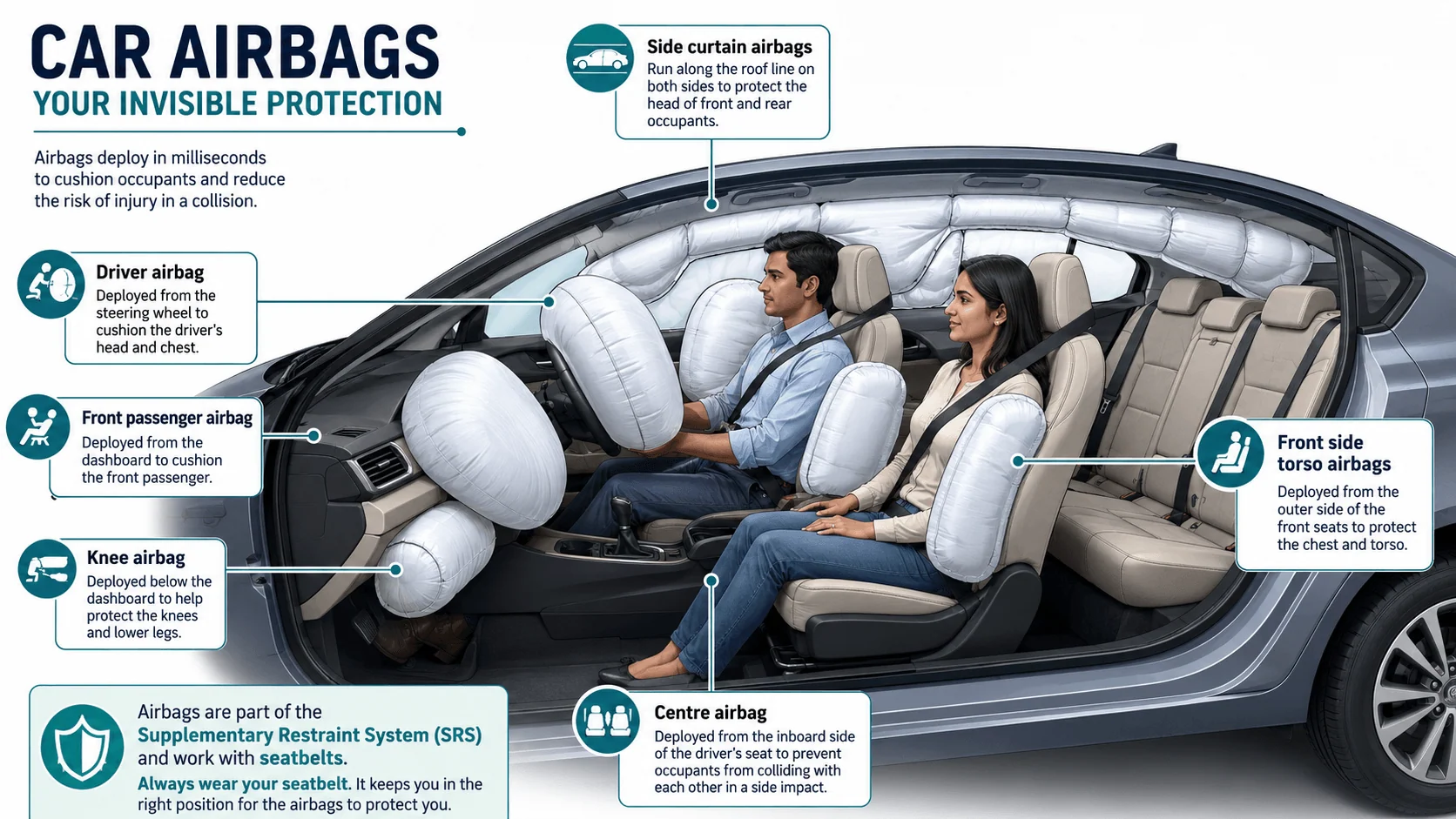
Types of Airbags in Cars
Every airbag in your car is part of a Supplementary Restraint System (SRS). That word “supplementary” matters. Airbags don’t replace your seatbelt. They work with it. Without a fastened belt, a deploying airbag can cause more harm than good.
| Airbag Type | Where It’s Placed | What It Protects |
|---|---|---|
| Driver airbag | Steering wheel hub | Driver’s head and chest |
| Passenger airbag | Upper dashboard | Front passenger’s head and chest |
| Side torso airbag | Outer seat bolster or door panel | Torso, ribs, pelvis (front occupants) |
| Side curtain airbag | Roof lining above windows | Heads of front and rear occupants in side impacts and rollovers |
| Knee airbag | Lower dashboard | Knees, femurs and pelvis; prevents “submarining” under the seatbelt |
| Centre airbag | Inside edge of driver’s seat | Stops front occupants from striking each other in a side hit |
The driver and front passenger airbags handle frontal crashes for you. The driver airbag has been mandatory in India since July 2019. The front passenger airbag joined it from 1 April 2021. So every new car you can buy today has at least these two. That’s the floor.
Side torso and curtain airbags are where things get interesting. In a T-bone crash, there’s barely any crumple zone between the door and your body. Side airbags fill that gap. Curtain airbags drop down from the roof and stay inflated for up to 10 seconds during a rollover, which is how they keep you from being thrown partially out through the window.
Knee airbags are still rare on budget cars. You’ll mostly see them in premium SUVs and luxury sedans. The centre airbag is even rarer in India and barely shows up outside premium European models.
How Airbags Actually Deploy
Airbags aren’t soft cushions that gently pop out. They’re calibrated ballistic devices.
A network of crash sensors in the front bumper, door panels and floor pan tracks deceleration constantly. When your car hits something hard enough, the sensors detect what engineers call a Delta-V: a sudden, severe change in velocity. The airbag control module decides whether to fire within 15-20 milliseconds. If yes, an electrical pulse triggers a chemical reaction (typically sodium azide combustion) that produces nitrogen gas to inflate the bag.
| Specification | Value |
|---|---|
| Sensor response time | 15-20 milliseconds |
| Full inflation time | 20-50 milliseconds |
| Inflation speed | 240-320 km/h |
| Trigger threshold (frontal) | Crash equivalent to hitting a solid wall at 13-23 km/h |
| Internal gas temperature | 260-530°C |
The bag inflates faster than you can blink. Then it immediately starts deflating through vents at the rear. That controlled deflation is what cushions you. If the bag stayed rigid, your head would bounce off it and snap your neck.
This is also why airbags don’t fire in every minor knock. The sensors are deliberately tuned to deploy only when impact forces exceed what your seatbelt alone can manage. A fender-bender at parking-lot speeds? It usually won’t trigger them.
How Many Airbags Does Your Car Need?
The honest answer depends on who you drive with, where you drive, and how often you hit the highway.
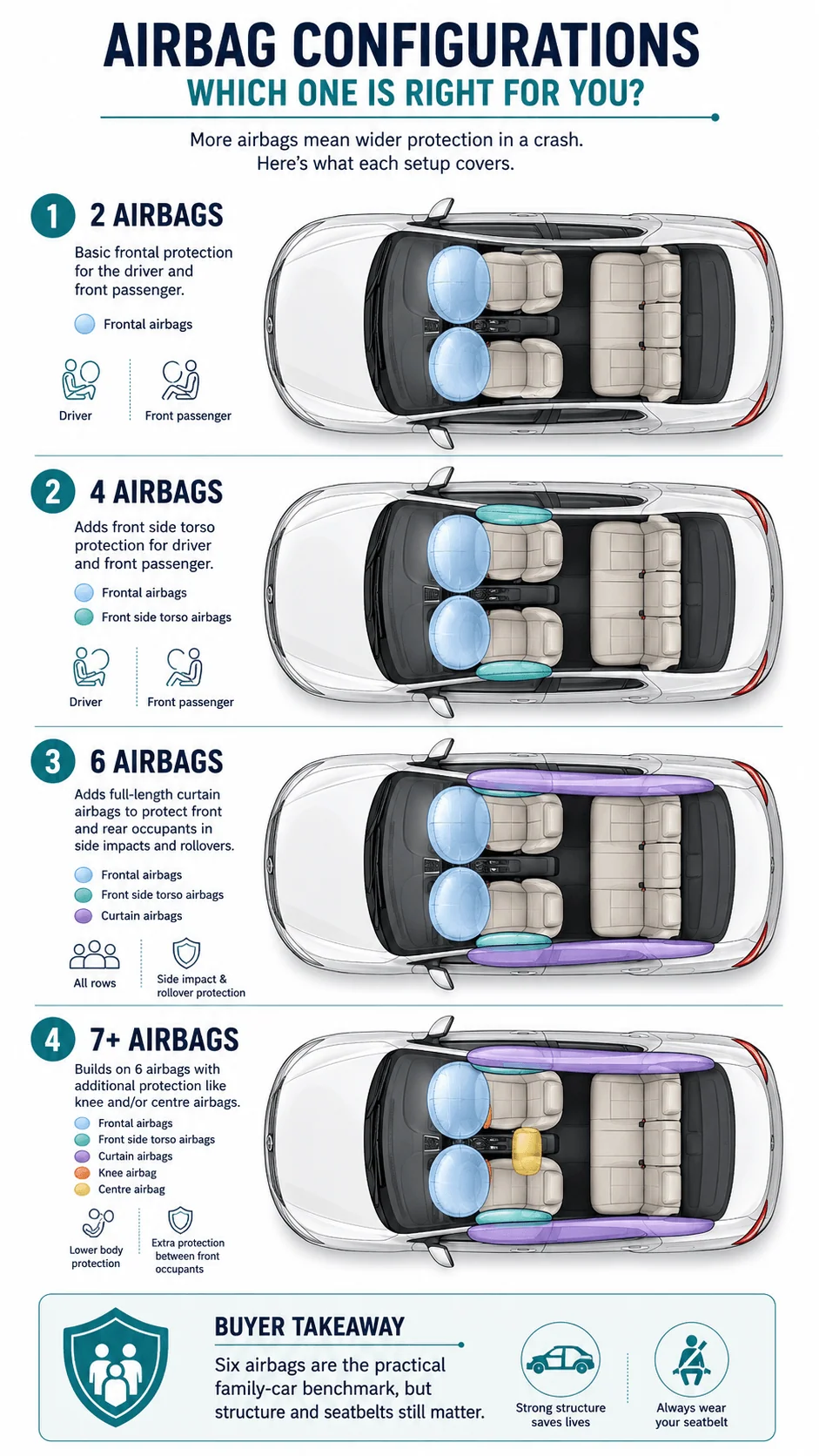
2 Airbags
This is the legal minimum. One driver, one front passenger. It covers a head-on collision and not much else. Rear-seat passengers rely entirely on their belts. Side impacts? Your head and torso have only the door panel between them and the other vehicle. Not great odds.
Are 2 airbags enough? For city-only driving with adults in the front and no kids in the back, you can get by. For highway travel, family trips, or any car that carries children regularly, two is genuinely not enough.
4 Airbags
Adds two side torso airbags for the front occupants. Big improvement for T-bone protection. But the problem is what’s still missing: curtain airbags. Your head stays exposed to side glass and any intruding object, and your rear passengers still get nothing.
6 Airbags
Dual front + side torso + full-length side curtains. This is the new gold standard. The curtain airbags run the entire length of the cabin, so your kids in the back get head protection too. Every car chasing a 4-star or 5-star Bharat NCAP rating now ships with this configuration. If you’re shopping in 2026, this should be your minimum for any family car.
7 or More
Usually adds a knee airbag for the driver, sometimes a passenger knee airbag or a centre airbag. The incremental gain is real but small. Body shell strength matters more than going from six to eight bags. For most buyers, these are nice-to-haves.
For most Indian buyers, six airbags is the right answer. Two protect you from frontal hits. Two more cover your sides. The last two protect every head in the cabin during side impacts and rollovers. That’s the full perimeter, front to back.
The 6-Airbag Mandate in India: What Actually Happened
Here’s the story behind the headlines you’ve been seeing for the past three years.
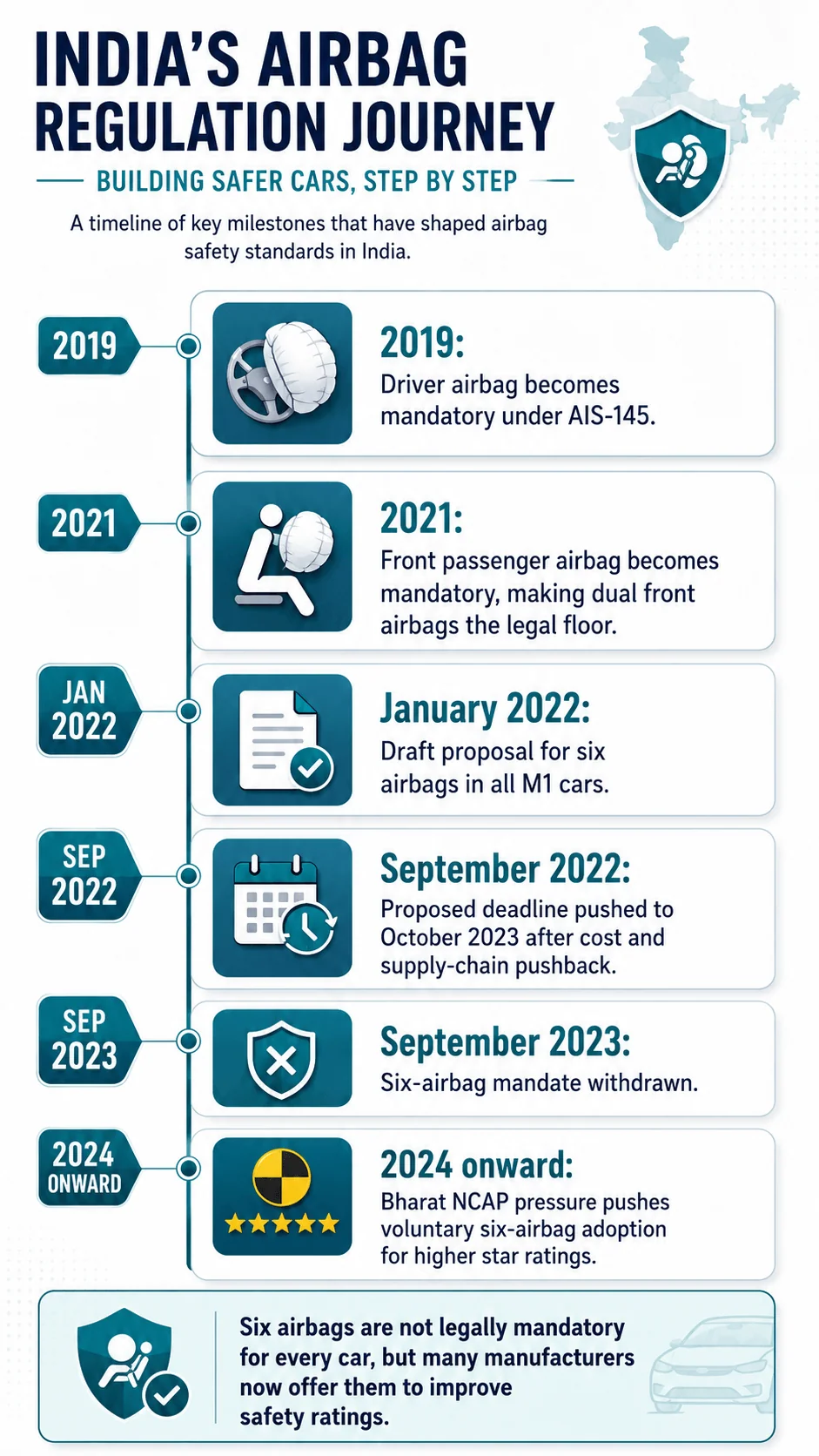
2019: Driver airbag becomes mandatory under AIS-145.
2021: Front passenger airbag joins it. Dual front airbags become the legal floor for every new car sold in India.
January 2022: Union Transport Minister Nitin Gadkari issues a draft notification proposing six airbags as mandatory for all M1 category vehicles. Target date: 1 October 2022.
September 2022: The deadline gets pushed to October 2023. Carmakers, led by Maruti Suzuki and backed by SIAM, push back hard. Their argument: retrofitting curtain airbags into entry-level hatchbacks needs structural redesigns, and supply chains for airbag modules are still recovering from the semiconductor crunch.
The cost dispute became the flashpoint. The government quoted ₹6,221 (about $75) per car to add the four extra airbags. JATO Dynamics, an independent automotive data firm, put the real-world cost closer to ₹19,161 once you accounted for integration, sensor calibration and structural changes. For cars in the sub-₹5 lakh bracket, that’s a 4-5% price hike, enough to spook OEMs.
September 2023: Gadkari publicly retracts the mandate. His reasoning, in his own words: “We have introduced the BNCAP protocols, which demand six airbags for a 4- or 5-star rating. So there is no need to mandate six airbags in cars now. It will automatically push OEMs to offer them.”
2026 status: Six airbags are not legally required. But Bharat NCAP, launched in late 2023, has effectively done the regulator’s job. To get the marketing-friendly 4-star or 5-star rating, a car needs six airbags, Electronic Stability Control, pedestrian protection and seatbelt reminders. Most mainstream manufacturers have voluntarily standardised six airbags across their lineup to chase those stars.
That’s why Maruti Suzuki, the very company that fought the mandate hardest, announced in May 2025 that its entire Arena range, including the Alto K10, WagonR, Celerio, Swift, Dzire, Brezza and Eeco, would ship with six airbags as standard.
The buyer takeaway: Don’t assume every variant has six airbags just because the top trim does. Some OEMs still advertise a low starting price by keeping the base variant on dual airbags. Always check the variant-specific feature list before you sign anything.
Cars With 6 Airbags Under ₹10 Lakhs (2026)
The good news for you as a budget buyer is that six airbags are no longer a luxury feature. Here are the most prominent sub-₹10 lakh options as of mid-2026.
| Car | Brand | 6-Airbag Availability | Starting Price (6-airbag variant) | Body Type |
|---|---|---|---|---|
| Alto K10 | Maruti Suzuki | Standard across range | ~₹4.00 lakh | Hatchback |
| WagonR | Maruti Suzuki | Standard across range | ~₹5.50 lakh | Hatchback |
| Grand i10 Nios | Hyundai | Standard across range | ~₹5.90 lakh | Hatchback |
| Punch | Tata | Standard across range (2026 facelift) | ~₹5.65 lakh | Micro-SUV |
| Magnite | Nissan | Standard across range | ~₹6.50 lakh | Compact SUV |
| Kiger | Renault | Standard across range | ~₹5.76 lakh | Compact SUV |
| Exter | Hyundai | Standard across range | ~₹6.13 lakh | Micro-SUV |
| Baleno | Maruti Suzuki | Mid/top variants | ~₹6.00 lakh | Premium hatchback |
| Fronx | Maruti Suzuki | Delta and Zeta upwards | ~₹6.85 lakh | Subcompact SUV |
| Amaze | Honda | Standard across range | ~₹7.50 lakh | Compact sedan |
| Kylaq | Skoda | Standard across range | ~₹7.59 lakh | Subcompact SUV |
| XUV 3XO | Mahindra | Top variants | ~₹7.28 lakh | Compact SUV |
The Tata Punch is worth singling out. Its 2026 facelift made six airbags standard across every variant, and it walks away with a 5-star Bharat NCAP rating (30.58/32 in adult occupant protection). That’s a meaningful combination at this price point.
The Hyundai twins (Grand i10 Nios, Exter, Aura) have been ahead of the curve. Hyundai standardised six airbags across these entry-level cars before the regulatory pressure peaked.
For a complete comparison of crash-test performance at every price point, see our list of safest cars ranked by NCAP score.
Do More Airbags Mean a Safer Car?
This is where most buyers get it wrong. A higher airbag count helps. It does not guarantee safety.
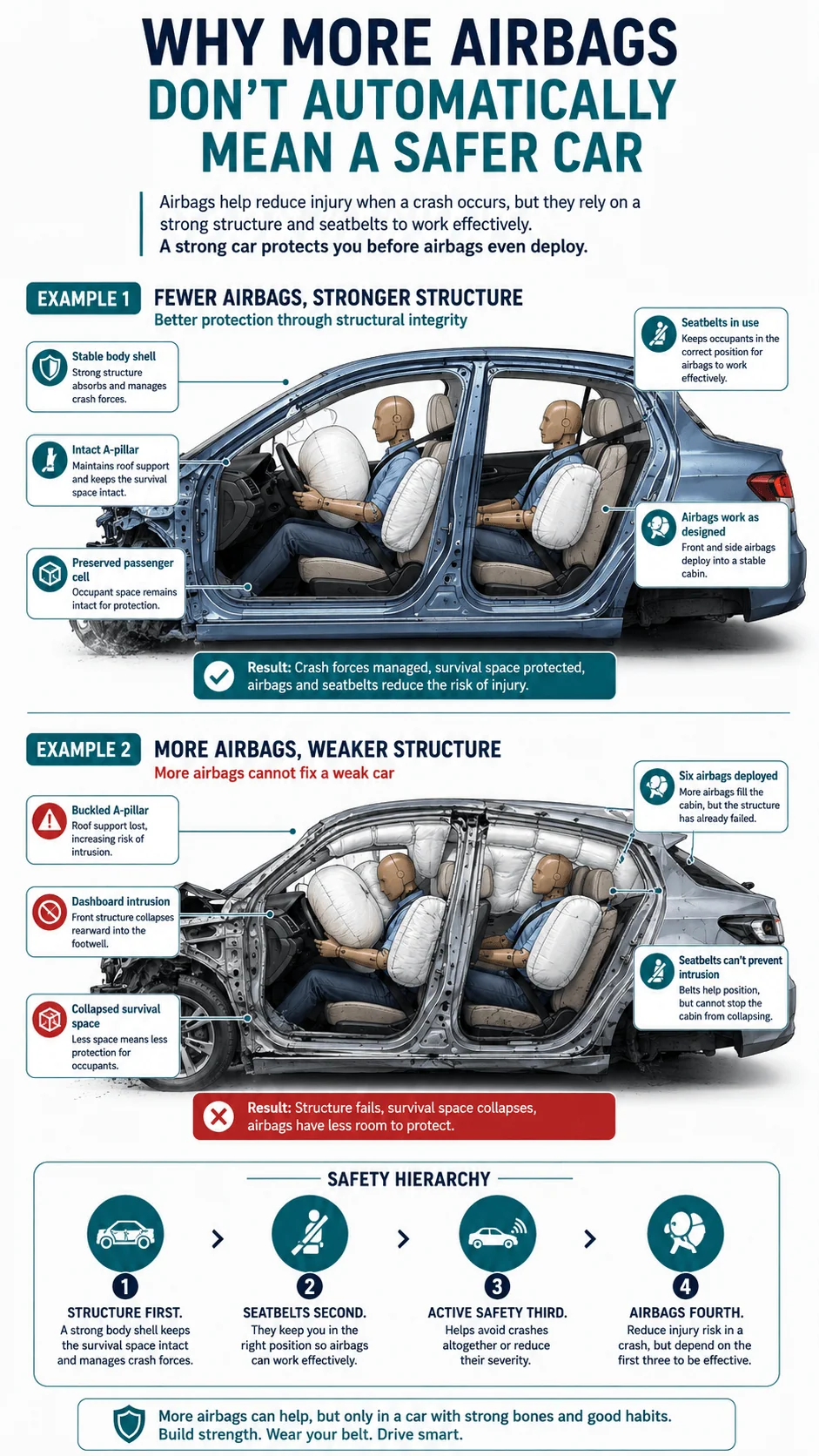
Airbags are passive safety features. They activate after a crash has begun. They can only do their job if three things are also in place:
A stable body shell. Crash labs grade body shells as either “stable” or “unstable” after offset deformable barrier tests at 64 km/h. An unstable shell means the A-pillar buckles, the roof collapses, and the dashboard gets shoved into the cabin. If that happens, your airbag deploys into a steering column that’s already pinned against your chest. The Kia Carens is a real example. It launched with six airbags as standard but originally scored only 3 stars in Global NCAP because its structure failed under the test load. Structure dictates the ceiling.
Your seatbelt fastened. Airbags inflate at 240-320 km/h. If you’re unbelted, you’re already moving forward at the car’s pre-crash speed when the bag is still expanding outward. You meet it mid-deployment, and the impact alone can fracture your skull or snap your neck. Your seatbelt is the primary defence here. The airbag only works as the supplemental cushion it was designed to be.
Active safety systems. ABS prevents wheel lockup during emergency braking, so you can steer around an obstacle instead of sliding into it. Electronic Stability Control corrects skids before they turn into rollovers. These features prevent the crash in the first place. No airbag can match that.
The honest hierarchy: structure first, seatbelts second, active safety third, airbags fourth. All four matter. Counting only airbags is how buyers end up with a brochure-safe car that performs poorly in the real world.
FAQs
How many airbags are mandatory in India?
Two. The driver airbag has been mandatory since July 2019 and the front passenger airbag since 1 April 2021. There is no legal requirement for six airbags. The 2022 proposal was officially retracted by the Transport Ministry in late 2023.
Are 2 airbags enough?
For legal compliance, yes. For real-world safety, no. Two airbags only cover head-on impacts and do nothing for side crashes, rollovers, or rear-seat passengers. If you regularly drive on highways or carry family, six airbags are the practical minimum.
Which cars have 6 airbags under ₹10 lakh?
The most affordable options in 2026 include the Maruti Alto K10, WagonR and Celerio, the Hyundai Grand i10 Nios and Exter, the Tata Punch (2026 facelift), the Renault Kiger, Nissan Magnite, Honda Amaze and Skoda Kylaq. Several have six airbags across every variant, while a few reserve them for higher trims.
Do airbags work without seatbelts?
No. They’re designed to function as a Supplementary Restraint System. Without a seatbelt pinning you to the seat, you accelerate into a deploying airbag at the car’s pre-crash speed. That collision alone is often fatal.
Do more airbags mean a safer car?
Only up to a point. After six, the gains are marginal and dependent on the rest of the car. A 5-star NCAP rating with a stable body shell, six airbags and ESC is what real safety looks like. Counting only airbags ignores the structure that has to hold up around them.
How much does airbag replacement cost in India?
A single airbag module retails for around ₹8,000, but a full repair after deployment requires replacing the dashboard, steering hub, seatbelt pretensioners, crash sensors and the airbag ECU. Total bills routinely run into tens of thousands of rupees.
Are rear-seat passengers protected by airbags?
Only if the car has full-length curtain airbags that extend over the rear windows. With a 2-airbag or 4-airbag setup, rear passengers rely entirely on their seatbelts.
Bottom line: Buy six airbags if you can afford them, but never stop at the airbag count. Check the Bharat NCAP or Global NCAP score, confirm the body shell was rated “stable”, and verify the exact variant you’re buying has the airbags you expect. A 5-star structure with six airbags is what you want on your driveway.